TEST / NOT A TEST

Capturewrong

Capture

1

Melancholia — Jacek Malczewski

“Too Blue” — Langston Hughes

tooblue

Tour of the Louvre — Glen Baxter

Capture

A Mountain Climber — J.F. Willumsen

RIP Mavis Gallant

mg

RIP Mavis Gallant, 1922-2014

The Globe and Mail has reported the death of Mavis Gallant, the Canadian writer who lived much of her life in Paris, writing sharp, observant short stories.

I had never read Gallant until last year, when The New Yorker fiction podcast introduced me to her work via Margaret Atwood, who read Gallant’s story “Voices in the Snow” for the series. Years earlier, Antonya Nelson read Gallant’s story “When We Were Nearly Young” for the same series.

Gallant published many, many stories for The New Yorker (which may consider unlocking some of them, yes?), including “Florida,” which you can read here.

Gallant will be remembered for her short stories, of course. her Paris Review interview:

With few exceptions, books of short stories seldom sell well. Short-story readers are a special kind of reader, like readers of poetry. Many novel readers don’t like collections of stories—I think that they dislike the frequent change of time, place and people. Of course, stories should not be read one after the other. A book of stories is not a novel. Someone once said to me, “Katherine Mansfield died before she was ready to write a novel. Perhaps she would never have been ready.” I thought that was just stupid.

The Portrait of Jan Six — Rembrandt

Parson Weem’s Fable — Grant Wood

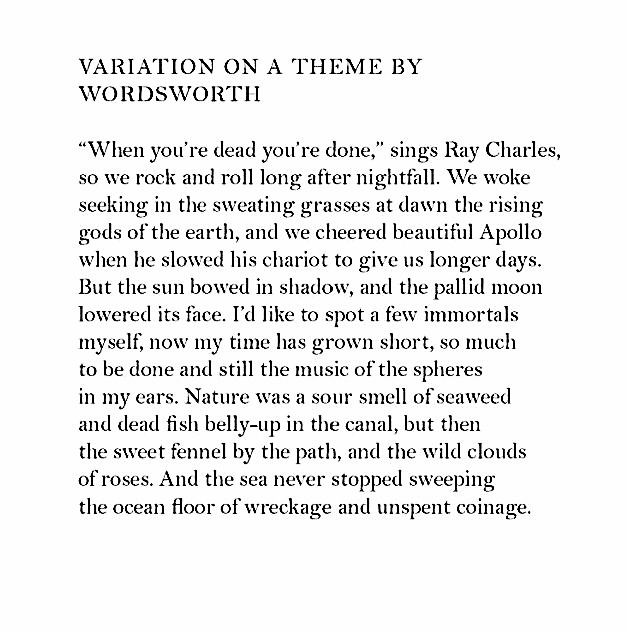
“Variation on a Theme by Wordsworth” — Marvin Bell

mb

George Washington’s Rules of Civility

(Non-manuscript, more legible version).

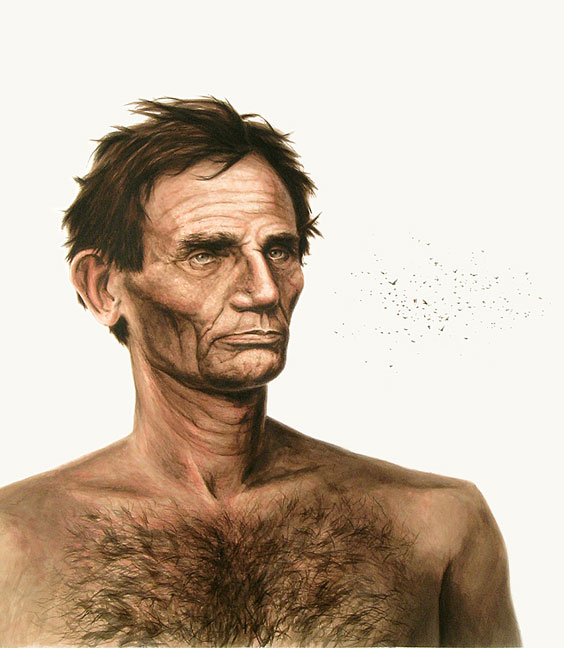
Lincoln — George Boorujy

Carvings in Natural Concrete — Siri Derkert

“Jimmy Goggles the God” — H.G. Wells

“Jimmy Goggles the God”

by

H.G. Wells

“It isn’t every one who’s been a god,” said the sunburnt man. “But it’s happened to me. Among other things.”

I intimated my sense of his condescension.

“It don’t leave much for ambition, does it?” said the sunburnt man.

“I was one of those men who were saved from the Ocean Pioneer. Gummy! how time flies! It’s twenty years ago. I doubt if you’ll remember anything of the Ocean Pioneer?”

The name was familiar, and I tried to recall when and where I had read it. The Ocean Pioneer? “Something about gold dust,” I said vaguely, “but the precise—”

“That’s it,” he said. “In a beastly little channel she hadn’t no business in—dodging pirates. It was before they’d put the kybosh on that business. And there’d been volcanoes or something and all the rocks was wrong. There’s places about by Soona where you fair have to follow the rocks about to see where they’re going next. Down she went in twenty fathoms before you could have dealt for whist, with fifty thousand pounds worth of gold aboard, it was said, in one form or another.”

“Survivors?”

“Three.”

“I remember the case now,” I said. “There was something about salvage—”

But at the word salvage the sunburnt man exploded into language so extraordinarily horrible that I stopped aghast. He came down to more ordinary swearing, and pulled himself up abruptly. “Excuse me,” he said, “but—salvage!”

He leant over towards me. “I was in that job,” he said. “Tried to make myself a rich man, and got made a god instead. I’ve got my feelings—

“It ain’t all jam being a god,” said the sunburnt man, and for some time conversed by means of such pithy but unprogressive axioms. At last he took up his tale again.

“There was me,” said the sunburnt man, “and a seaman named Jacobs, and Always, the mate of the Ocean Pioneer. And him it was that set the whole thing going. I remember him now, when we was in the jolly-boat, suggesting it all to our minds just by one sentence. He was a wonderful hand at suggesting things. ‘There was forty thousand pounds,’ he said, ‘on that ship, and it’s for me to say just where she went down.’ It didn’t need much brains to tumble to that. And he was the leader from the first to the last. He got hold of the Sanderses and their brig; they were brothers, and the brig was the Pride of Banya, and he it was bought the diving-dress—a second-hand one with a compressed air apparatus instead of pumping. He’d have done the diving too, if it hadn’t made him sick going down. And the salvage people were mucking about with a chart he’d cooked up, as solemn as could be, at Starr Race, a hundred and twenty miles away. Continue reading ““Jimmy Goggles the God” — H.G. Wells”

Portrait of Laura Battiferri — Bronzino

Grasshopper — Peter Doig

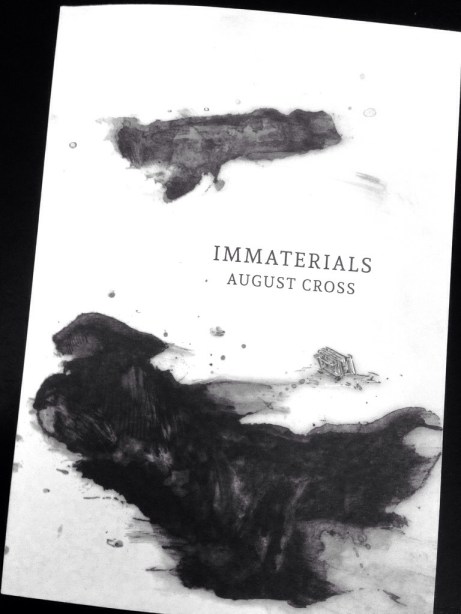
Immaterials, August Cross’s Contemporary Take on Goya’s Caprichos

20140216-114744.jpg

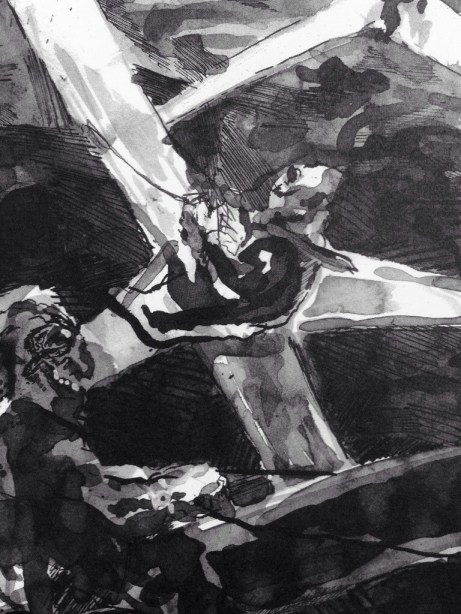
August Cross’s Immaterials—new from indie Inpatient Press—is a dark, strange hybrid of art and poetry. Cross offers 32 chapters here, each combining a stark, rough black and white and gray watercolor with a spare (not-quite) haiku. Cross takes his lead from Francisco Goya here—specifically Goya’s black and white aquatint series, Los Caprichos, and the later etching series The Disasters of War. Cross’s contemporary riff on Goya is apparent in the opener “unmanned,” where Goya’s witches turn into drones:
20140216-114755.jpg

The text accompanying the image introduces the biting, cruel irony that courses throughout Immaterials:
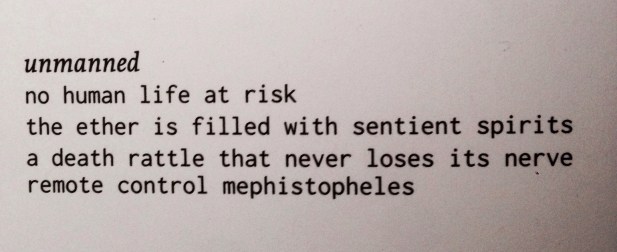
20140216-115320.jpg

While the phrase “unmanned” refers overtly to the drones themselves, it also reflects back on the attempt to completely depersonalize modern warfare—to unman, unperson both the remote pilot and the target, who becomes “no human life.” That spirit of irony and criticism, often oblique, informs all of Immaterials.

In “monolith,” Cross updates Goya’s The Third of May, 1808, ending the accompanying poem with the line: “a warning to whistleblowers”:
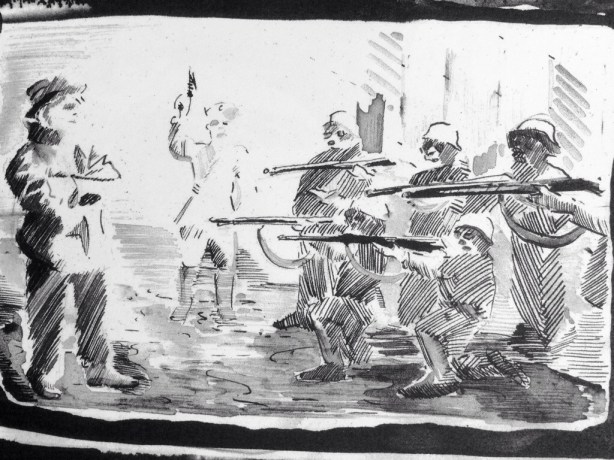
20140216-114810.jpg

In “dat capitol,” Cross transmutes Goya’s Colossus into a bizarre, dark-eyed lover, a politician gripping the capitol sensually, violently, sucking from its teat. The tone is simultaneously playful and ominous (just like Goya’s work):
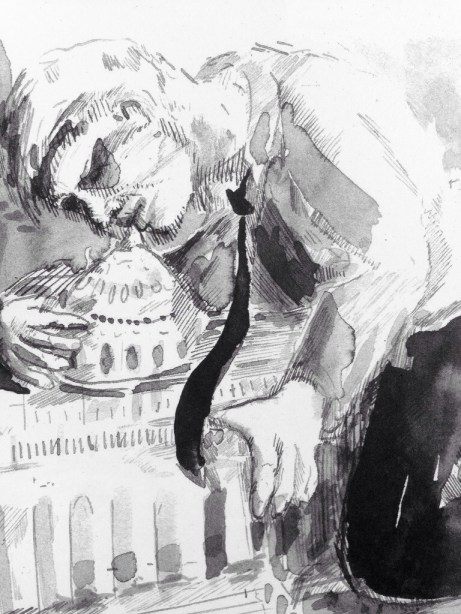
20140216-114827.jpg

That same dark, violent humor is readily apparent in many of the pieces, like “selfie,” where a grinning cop  takes a selfie with his miserable captive, or “big game,” where “the tie is a leash / the boot is a lack / uniforms trick young men into shocked shells”:
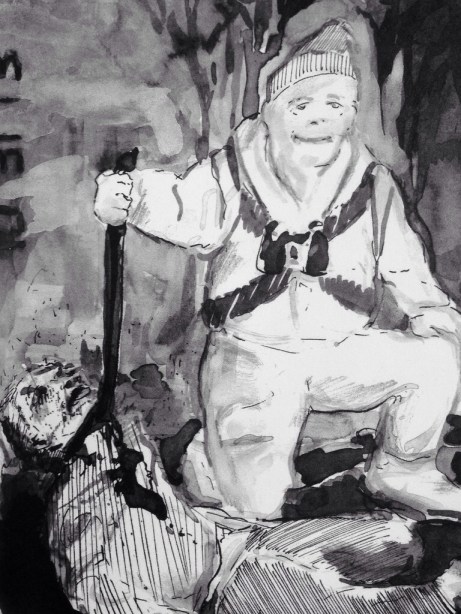
20140216-114847.jpg

There’s a roughness, a rudeness to Cross’s work—a splattering of ink, a muddiness to the grays, a blurriness of line that causes the viewer to have to intensify his gaze in an attempt to resolve the picture (or perhaps look away). The poems too at first appear simple, rude, rough—Cross opts for the monosyllable, the German root. But again, an intensified gaze—a review, a reread—reveals the second and third meanings of each phrase, where the inelegant alliteration of “shocked shells” hides the vacant human subject—the shell, its immaterial essence choked out.

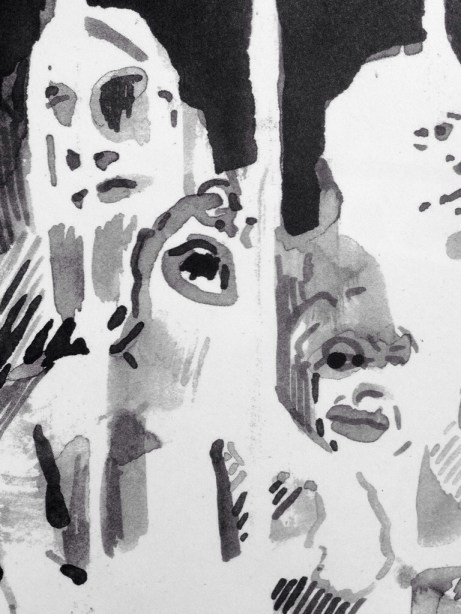
Immaterials presents a sharp if oblique critique of contemporary American society, perhaps summed up best in the two faces in the center of this detail from “gaol over-crowded:
20140216-114837.jpg

Might the howl of the center left figure turn into a laugh? A bark? Either way, it’s tempered by the grimace of the man center right, who focuses intently away from the gaze of the viewer, aiming sights on something the viewer cannot see, can never see.
Truffaut on the Auteur Theory