“A Christmas Number” — A.A. Milne

“A Christmas Number” — A.A. Milne

The common joke against the Christmas number is that it is planned in July and made up in September. This enables it to be published in the middle of November and circulated in New Zealand by Christmas. If it were published in England at Christmas, New Zealand wouldn’t get it till February. Apparently it is more important that the colonies should have it punctually than that we should.

Anyway, whenever it is made up, all journalists hate the Christmas number. But they only hate it for one reason—this being that the ordinary weekly number has to be made up at the same time. As a journalist I should like to devote the autumn exclusively to the Christmas number, and as a member of the public I should adore it when it came out. Not having been asked to produce such a number on my own I can amuse myself here by sketching out a plan for it. I follow the fine old tradition. First let us get the stories settled. Story No. 1 deals with the escaped convict. The heroine is driving back from the country- house ball, where she has had two or three proposals, when suddenly, in the most lonely part of the snow-swept moor, a figure springs out of the ditch and covers the coachman with a pistol. Alarms and confusions. “Oh, sir,” says the heroine, “spare my aunt and I will give you all my jewels.” The convict, for such it is, staggers back. “Lucy!” he cries. “Harold!” she gasps. The aunt says nothing, for she has swooned. At this point the story stops to explain how Harold came to be in knickerbockers. He had either been falsely accused or else he had been a solicitor. Anyhow, he had by this time more than paid for his folly, and Lucy still loved him. “Get in,” she says, and drives him home. Next day he leaves for New Zealand in an ordinary lounge suit. Need I say that Lucy joins him later? No; that shall be left for your imagination. The End.

So much for the first story. The second is an “i’-faith-and-stap- me” story of the good old days. It is not seasonable, for most of the action takes place in my lord’s garden amid the scent of roses; but it brings back to us the old romantic days when fighting and swearing were more picturesque than they are now, and when women loved and worked samplers. This sort of story can be read best in front of the Christmas log; it is of the past, and comes naturally into a Christmas number. I shall not describe its plot, for that is unimportant; it is the “stap me’s” and the “la, sirs,” which matter. But I may say that she marries him all right in the end, and he goes off happily to the wars.

We want another story. What shall this one be about? It might be about the amateur burglar, or the little child who reconciled old Sir John to his daughter’s marriage, or the ghost at Enderby Grange, or the millionaire’s Christmas dinner, or the accident to the Scotch express. Personally, I do not care for any of these; my vote goes for the desert-island story. Proud Lady Julia has fallen off the deck of the liner, and Ronald, refused by her that morning, dives off the hurricane deck—or the bowsprit or wherever he happens to be—and seizes her as she is sinking for the third time. It is a foggy night and their absence is unnoticed. Dawn finds them together on a little coral reef. They are in no danger, for several liners are due to pass in a day or two and Ronald’s pockets are full of biscuits and chocolate, but it is awkward for Lady Julia, who had hoped that they would never meet again. So they sit on the beach back to back (drawn by Dana Gibson) and throw sarcastic remarks over their shoulders at each other. In the end he tames her proud spirit—I think by hiding the turtles’ eggs from her—and the next liner but one takes the happy couple back to civilization.

But it is time we had some poetry. I propose to give you one serious poem about robins, and one double-page humorous piece, well illustrated in colours. I think the humorous verses must deal with hunting. Hunting does not lend itself to humour, for there are only two hunting jokes —the joke of the horse which came down at the brook and the joke of the Cockney who overrode hounds; but there are traditions to keep up, and the artist always loves it. So far we have not considered the artist sufficiently. Let us give him four full pages. One of pretty girls hanging up mistletoe, one of the squire and his family going to church in the snow, one of a brokendown coach with highwaymen coming over the hill, and one of the postman bringing loads and loads of parcels. You have all Christmas in those four pictures. But there is room for another page—let it be a coloured page, of half a dozen sketches, the period and the lettering very early English. “Ye Baron de Marchebankes calleth for hys varlet.” “Ye varlet cometh righte hastilie—-” You know the delightful kind of thing.

I confess that this is the sort of Christmas number which I love. You may say that you have seen it all before; I say that that is why I love it. The best of Christmas is that it reminds us of other Christmases; it should be the boast of Christmas numbers that they remind us of other Christmas numbers.

But though I doubt if I shall get quite what I want from any one number this year, yet there will surely be enough in all the numbers to bring Christmas very pleasantly before the eyes. In a dull November one likes to be reminded that Christmas is coming. It is perhaps as well that the demands of the colonies give us our Christmas numbers so early. At the same time it is difficult to see why New Zealand wants a Christmas number at all. As I glance above at the plan of my model paper I feel more than ever how adorable it would be—but not, oh not with the thermometer at a hundred in the shade.

A Reader — Toyen

Night Startled by the Lark — William Blake

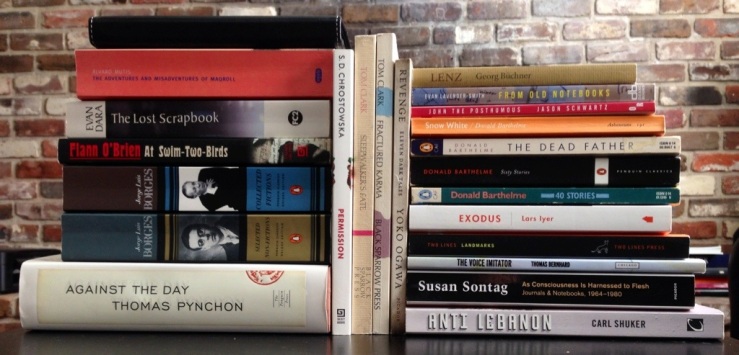
The books I liked the most in 2013

20131217-144555.jpg


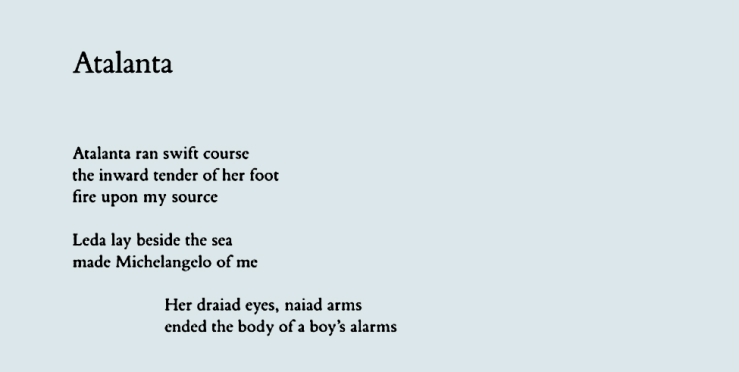
“Atalanta” — Charles Olson

atalanta

Alchemical Lyon Tortured With Abstraction — William T. Wiley

“I do not like books” (Samuel Butler)

I do not like books.  I believe I have the smallest library of any literary man in London, and I have no wish to increase it.  I keep my books at the British Museum and at Mudie’s, and it makes me very angry if anyone gives me one for my private library.  I once heard two ladies disputing in a railway carriage as to whether one of them had or had not been wasting money.  “I spent it in books,” said the accused, “and it’s not wasting money to buy books.”  “Indeed, my dear, I think it is,” was the rejoinder, and in practice I agree with it.  Webster’s Dictionary, Whitaker’s Almanack, and Bradshaw’s Railway Guide should be sufficient for any ordinary library; it will be time enough to go beyond these when the mass of useful and entertaining matter which they provide has been mastered.  Nevertheless, I admit that sometimes, if not particularly busy, I stop at a second-hand bookstall and turn over a book or two from mere force of habit.

I know not what made me pick up a copy of Æschylus—of course in an English version—or rather I know not what made Æschylus take up with me, for he took me rather than I him; but no sooner had he got me than he began puzzling me, as he has done any time this forty years, to know wherein his transcendent merit can be supposed to lie.  To me he is, like the greater number of classics in all ages and countries, a literary Struldbrug, rather than a true ambrosia-fed immortal.  There are true immortals, but they are few and far between; most classics are as great impostors dead as they were when living, and while posing as gods are, five-sevenths of them, only Struldbrugs.  It comforts me to remember that Aristophanes liked Æschylus no better than I do.  True, he praises him by comparison with Sophocles and Euripides, but he only does so that he may run down these last more effectively.  Aristophanes is a safe man to follow, nor do I see why it should not be as correct to laugh with him as to pull a long face with the Greek Professors; but this is neither here nor there, for no one really cares about Æschylus; the more interesting question is how he contrived to make so many people for so many years pretend to care about him.

Perhaps he married somebody’s daughter.  If a man would get hold of the public ear, he must pay, marry, or fight.  I have never understood that Æschylus was a man of means, and the fighters do not write poetry, so I suppose he must have married a theatrical manager’s daughter, and got his plays brought out that way.  The ear of any age or country is like its land, air, and water; it seems limitless but is really limited, and is already in the keeping of those who naturally enough will have no squatting on such valuable property.  It is written and talked up to as closely as the means of subsistence are bred up to by a teeming population.  There is not a square inch of it but is in private hands, and he who would freehold any part of it must do so by purchase, marriage, or fighting, in the usual way—and fighting gives the longest, safest tenure.  The public itself has hardly more voice in the question who shall have its ear, than the land has in choosing its owners.  It is farmed as those who own it think most profitable to themselves, and small blame to them; nevertheless, it has a residuum of mulishness which the land has not, and does sometimes dispossess its tenants.  It is in this residuum that those who fight place their hope and trust.

Or perhaps Æschylus squared the leading critics of his time.  When one comes to think of it, he must have done so, for how is it conceivable that such plays should have had such runs if he had not?  I met a lady one year in Switzerland who had some parrots that always travelled with her and were the idols of her life.  These parrots would not let anyone read aloud in their presence, unless they heard their own names introduced from time to time.  If these were freely interpolated into the text they would remain as still as stones, for they thought the reading was about themselves.  If it was not about them it could not be allowed.  The leaders of literature are like these parrots; they do not look at what a man writes, nor if they did would they understand it much better than the parrots do; but they like the sound of their own names, and if these are freely interpolated in a tone they take as friendly, they may even give ear to an outsider.  Otherwise they will scream him off if they can.

From Samuel Butler’s “Ramblings in Cheapside.”

Lady Reading — Vlaho Bukovac

ladyreading-bukovac

“A Birthday”– Christina Rossetti

birthday

Fairy and Griffon — Gustave Moreau

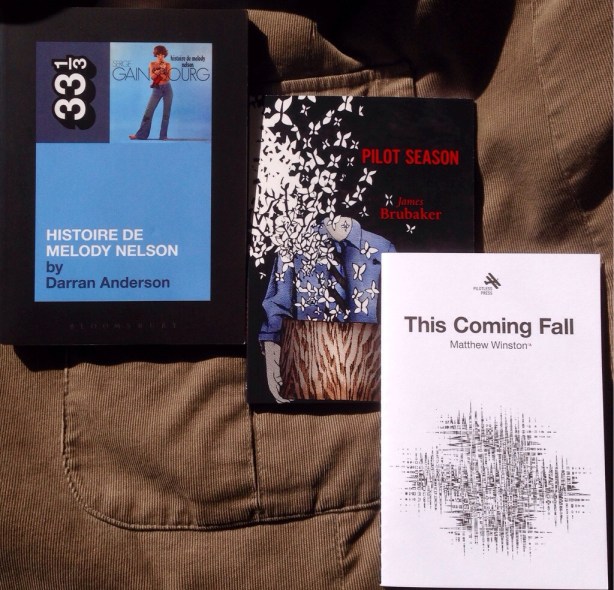
Three Books That Fit in My Jacket Pocket

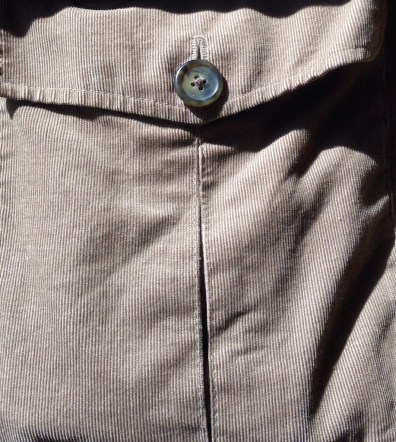
This is the front right pocket of the casual corduroy blazer I usually wear.

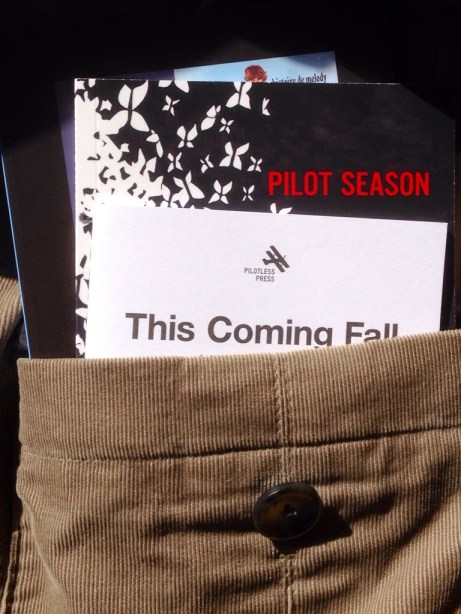
In this picture, it is loaded with three books.

20131216-120737.jpg

Those books:

Darran Anderson’s Histoire de Melody Nelson

James Brubaker’s Pilot Season

Matthew Winston’s This Coming Fall

20131216-120744.jpg

Perfect for parties you don’t want to be at, family get togethers, end of year faculty meetings, and any other event that you might need to secretly ameliorate with a furtive read.

20131216-120750.jpg

Shadow and Reflection — Nicolae Maniu

Read My Interview with S.D. Chrostowska at 3:AM Magazine

I interviewed S.D. Chrostowska for 3:AM Magazine. I reviewed Chrostowska’s novel Permission here.

3:AM also features a new piece of short fiction from Chrostowska, “How to Avoid the Cardinal Sins /A Nominalistic Pamphlet/“.

From the interview:


3:AM: How did Permission begin? Did it begin as a novel? As something else?

S D Chrostowska: It began with the first message, and ended with the last. It was principally a literary effort subordinated to communication. To me this remains a crucial difference, itsdifferentia specifica. The origin of the now-book Permission was in an illegitimate literary dimension outside the frame of book authorship. You have to understand that, though I had chosen my reader, this reader could not know what if anything would become of the writing that came their way. Naturally I wonder whether and how it changes things for readers today, who approach them as a bound book, to know that the letters, just as they are, were once for real.

3:AM: Why write the letters under a pseudonym? How did you arrive at “Fearn Wren”?

SDC: For the sake of ambiguity. Knowing too much, or for that matter anything, about the artist-producer prejudices us about their work. The prejudice is not just personal or social but also simply contextual. It is all but unavoidable in visual and performing artworks requiring direct human contact, where other people are involved from the start rather than just on the receiving end. Sitting for a portrait or mounting a play depends on direct interaction. But we have already chosen the photographer based on their reputation. And we know something about the director before we get involved in their production or, if we happen to be directors, select actors based on their training or past work.

But writing, usually done at some distance from readers, can minimize our reader’s prejudices—at least until the finished work is judged, and the reviews and exposés come out. One way it can do this is by appearing anonymously or pseudonymously. Such publishing has a long history. As, one should add, does letter-writing under a pseudonym. Permission’s first reader would have had no context to go on.

Being read as an unknown author, not part of the literary scene, mimics that condition somewhat. But almost everyone nowadays can be googled, which is to say traced. I imagine that many people who would pick up a book like mine would be curious in this way.

I’m not sure how I settled on this particular pen-name. I do like ferns and wrens, their behaviors and the myths around them.

Bonus:

So, my signature interview question — “Have you ever stolen a book?” — had to be cut because it was just kind of confusing on 3:AM, but I couldn’t not ask it, so:

3:AM: Have you ever stolen a book?

SDC: Of course. 


Morning, Going to Work — Vincent van Gogh

“A Visit to Walt Whitman”

“A Visit to Walt Whitman”

From James Huneker’s Ivory Apes and Peacocks

My edition of Walt Whitman’s Leaves of Grass is dated 1867, the third, if I am not mistaken, the first appearing in 1855. Inside is pasted a card upon which is written in large, clumsy letters: “Walt Whitman, Camden, New Jersey, July, 1877.” I value this autograph, because Walt gave it to me; rather I paid him for it, the proceeds, two dollars (I think that was the amount), going to some asylum in Camden. In addition, the “good grey poet” was kind enough to add a woodcut of himself as he appeared in the 1855 volume, “hankering, gross, mystical, nude,” and another of his old mother, with her shrewd, kindly face. Walt is in his shirt-sleeves, a hand on his hip, the other in his pocket, his neck bare, the pose that of a nonchalant workman—though in actual practice he was always opposed to work of any sort; on his head is a slouch-hat, and you recall his line: “I wear my hat as I please, indoors or out.” The picture is characteristic, even to the sensual mouth and Bowery-boy pose. You almost hear him say: “I find no sweeter fat than sticks to my own bones.” Altogether a different man from the later bard, the heroic apparition of Broadway, Pennsylvania Avenue, and Chestnut Street. I had convalesced from a severe attack of Edgar Allan Poe only to fall desperately ill with Whitmania. Youth is ever in revolt, age alone brings resignation. My favourite reading was Shelley, my composer among composers, Wagner. Chopin came later. This was in 1876, when the Bayreuth apotheosis made Wagner’s name familiar to us, especially in Philadelphia, where his empty, sonorous Centennial March was first played by Theodore Thomas at the Exposition. The reading of a magazine article by Moncure D. Conway caused me to buy a copy, at an extravagant price for my purse, of The Leaves of Grass, and so uncritical was I that I wrote a parallel between Wagner and Whitman; between the most consciously artistic of men and the wildest among improvisators. But then it seemed to me that both had thrown off the “shackles of convention.” (What prison-like similes we are given to in the heady, generous impulses of green adolescence.) I was a boy, and seeing Walt on Market Street, as he came from the Camden Ferry, I resolved to visit him. It was some time after the Fourth of July, 1877, and I soon found his little house on Mickle Street. A policeman at the ferry-house directed me. I confess I was scared after I had given the bell one of those pulls that we tremblingly essay at a dentist’s door. To my amazement the old man soon stood before me, and cordially bade me enter. Continue reading ““A Visit to Walt Whitman””

The Temptation of St. Anthony — January Wellens de Cock

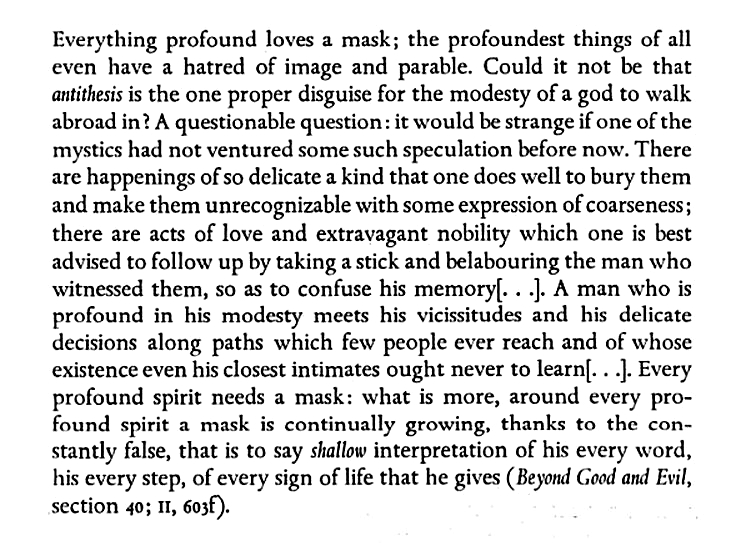
“Everything profound loves a mask” (Nietzsche)

profound