Two Comedians — Edward Hopper

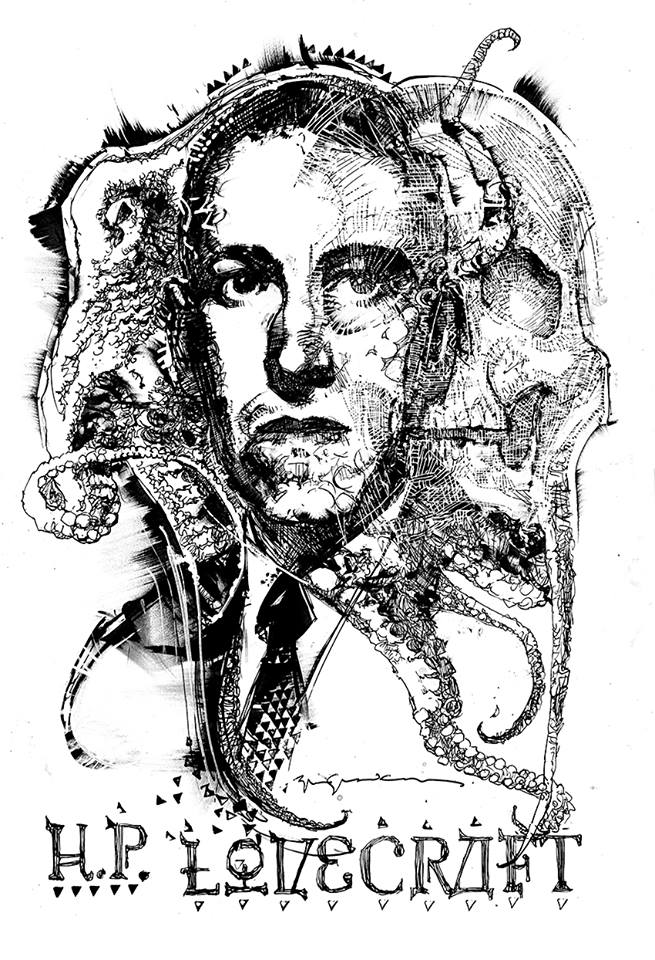
H.P. Lovecraft — Bill Sienkiewicz

lovecraft

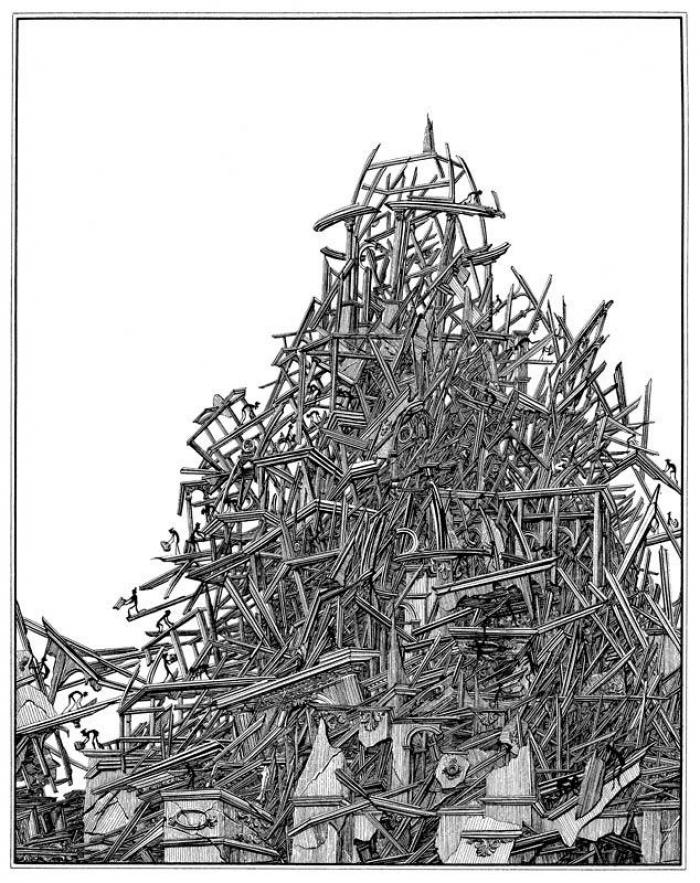
Chaos as Order — Hans-Georg Rauch

49

Ennio Morricone Disucsses Scoring Petri’s Investigation of a Citizen Above Suspicion

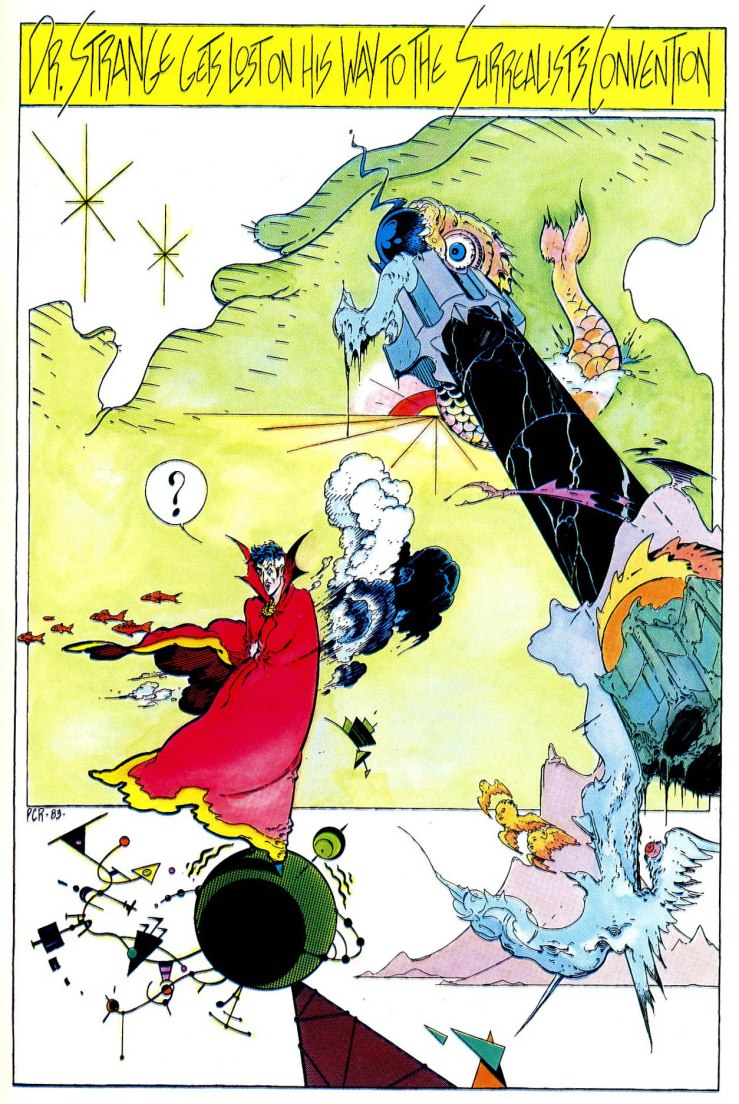
Dr. Strange Gets Lost on His Way to the Surrealist’s Convention — P. Craig Russell

russell strange

“Egotism; Or, The Bosom Serpent” — Nathaniel Hawthorne

 “Egotism; Or, The Bosom Serpent” — Nathaniel Hawthorne

“Here he comes!” shouted the boys along the street. “Here comes the man with a snake in his bosom!”

This outcry, saluting Herkimer’s ears as he was about to enter the iron gate of the Elliston mansion, made him pause. It was not without a shudder that he found himself on the point of meeting his former acquaintance, whom he had known in the glory of youth, and whom now after an interval of five years, he was to find the victim either of a diseased fancy or a horrible physical misfortune.

“A snake in his bosom!” repeated the young sculptor to himself. “It must be he. No second man on earth has such a bosom friend. And now, my poor Rosina, Heaven grant me wisdom to discharge my errand aright! Woman’s faith must be strong indeed since thine has not yet failed.”

Thus musing, he took his stand at the entrance of the gate and waited until the personage so singularly announced should make his appearance. After an instant or two he beheld the figure of a lean man, of unwholesome look, with glittering eyes and long black hair, who seemed to imitate the motion of a snake; for, instead of walking straight forward with open front, he undulated along the pavement in a curved line. It may be too fanciful to say that something, either in his moral or material aspect, suggested the idea that a miracle had been wrought by transforming a serpent into a man, but so imperfectly that the snaky nature was yet hidden, and scarcely hidden, under the mere outward guise of humanity. Herkimer remarked that his complexion had a greenish tinge over its sickly white, reminding him of a species of marble out of which he had once wrought a head of Envy, with her snaky locks.

The wretched being approached the gate, but, instead of entering, stopped short and fixed the glitter of his eye full upon the compassionate yet steady countenance of the sculptor.

“It gnaws me! It gnaws me!” he exclaimed.

And then there was an audible hiss, but whether it came from the apparent lunatic’s own lips, or was the real hiss of a serpent, might admit of a discussion. At all events, it made Herkimer shudder to his heart’s core.

“Do you know me, George Herkimer?” asked the snake-possessed.

Herkimer did know him; but it demanded all the intimate and practical acquaintance with the human face, acquired by modelling actual likenesses in clay, to recognize the features of Roderick Elliston in the visage that now met the sculptor’s gaze. Yet it was he. It added nothing to the wonder to reflect that the once brilliant young man had undergone this odious and fearful change during the no more than five brief years of Herkimer’s abode at Florence. The possibility of such a transformation being granted, it was as easy to conceive it effected in a moment as in an age. Inexpressibly shocked and startled, it was still the keenest pang when Herkimer remembered that the fate of his cousin Rosina, the ideal of gentle womanhood, was indissolubly interwoven with that of a being whom Providence seemed to have unhumanized. Continue reading ““Egotism; Or, The Bosom Serpent” — Nathaniel Hawthorne”

The Tome — Kama and Seele

cowboy-henk-513082013_0000

Watch Salesman, a 1969 Documentary About Traveling Bible Salesmen by the Maysles Brothers and Charlotte Zwerin

The Distributor of Crowns — Odilon Redon

“First he slew a snowshoe rabbit cleaving it in twain with a single blow and then he slew a spiny anteater” (Donald Barthelme)

They found the Dead Father standing in a wood, slaying. First he slew a snowshoe rabbit cleaving it in twain with a single blow and then he slew a spiny anteater and then he slew two rusty numbats and then whirling the great blade round and round his head he slew a wallaby and a lemur and a trio of ouakaris and a spider monkey and a common squid. Then moving up and down the green path in his rage he dispatched a macaque and a gibbon and fourscore innocent chinchillas who had been standing idly by watching the great slaughter. Then he rested standing with the point of his sword stuck in the earth and his two hands folded upon the hilt. Then he again as if taken by a fit set about the bloody work slaying a prairie dog and a beaver and a gopher and a dingo and a honey badger and an otter and a house cat and a tapir and a piglet. Then his anger grew and he called for a brand of even greater weight and length which was brought him by a metaphorically present gillie and seizing it with his two fine-formed and noble hands he raised it above his head, and every living thing within his reach trembled and every dead thing within his reach remembered how it got that way, and the very trees of the wood did seem to shrink and step away. Then the Dead Father slew a warthog and a spotted fawn and a trusting sheep and a young goat and a marmoset and two greyhounds and a draghound. Then, kicking viciously with his noble and shapely foot at the piles of the slain, raw and sticky corpses drenching the earth in blood on every side, he cleared a path to a group of staring pelicans slicing the soft white thin necks of them from the bodies in the wink of an eye. Then he slew a cassowary and a flamingo and a grebe and a heron and a bittern and a pair of ducks and a shouting peacock and a dancing crane and a bustard and a lily-trotter and, wiping the sacred sweat from his brow with one ermine-trimmed sleeve, slew a wood pigeon and a cockatoo and a tawny owl and a snowy owl and a magpie and three jackdaws and a crow and a jay and a dove. Then he called for wine. A silver flagon was brought him and he downed the whole of it in one draught looking the while out of the corner of his ruby eye at a small iguana melted in terror against the limb of a tree. Then he tossed the silver flagon into the arms of a supposititious cupbearer sousing the cupbearer’s hypothetical white tunic with the red of the (possible) wine and split the iguana into two halves with the point of his sword as easily as one skilled in the mystery fillets a fish. Then the Dead Father resumed his sword work in earnest slaying diverse small animals of every kind, so that the heaps mounted steaming to the right and to the left of him with each passionate step. A toad escaped.

From Donald Barthelme’s novel The Dead Father.

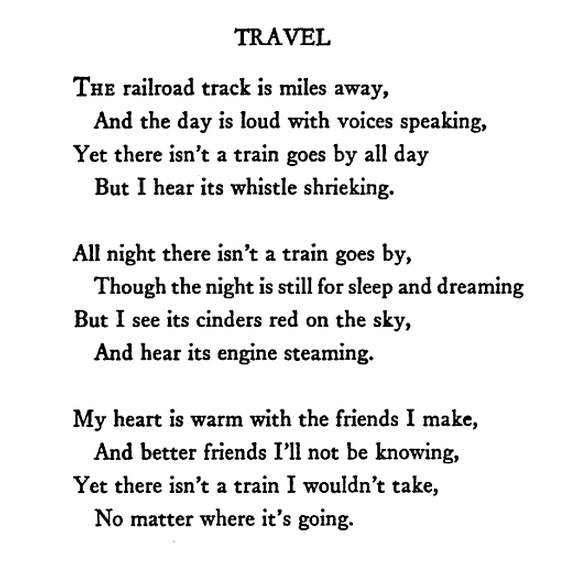
“Travel” — Edna St. Vincent Millay

travel

The Barber Shop — Edward Hopper

Although Of Course You End Up Riffing Obliquely on How a David Foster Wallace Road Trip Movie Is a Terrible Idea

  1. In 1992 I asked my grandmother to rent Steven Soderbergh’s film Kafka from Blockbuster so I could watch it. We watched it together. I was intrigued; she found it dull. I saw it again in college and then again a few years ago. It’s nothing special.
  2. In my freshman year of college I lived right next to a big video rental place that rented most old films for a dollar. This is where I discovered Where the Buffalo Roam, a 1980 semi-biopic starring Bill Murray as Hunter S. Thompson with music from Neil Young. My metaphorical lid flipped. I returned to my apartment to screen this strange find. Disappointment.
  3. Seeing and immediately being disappointed by Where the Buffalo Roam fits neatly into another memory: In 1991 a record store clerk dissuaded me from buying an expensive bootleg recording of Jimi Hendrix featuring Jim Morrison. The clerk went to great lengths to do this (short of opening the CD, of course), insisting that the record was awful, that it should never have been released. A few weeks later a friend loaned me a tape of the recording he’d somehow acquired. Total garbage. I didn’t even bother to dub it.
  4. (Sometimes when I see that some new scrap and tittle of a dead author’s work is going to be posthumously published, I think of that Hendrix/Morrison recording).
  5. In 1998 I saw Terry Gilliam’s adaptation of Fear and Loathing in Las Vegas. Sloppy, cartoonish, vivid, and occasionally incoherent, Fear and Loathing is successful mostly because it isn’t a film about Hunter S. Thompson. It’s a film about the end of the illusion of the 1960s.
  6. I don’t remember when I first saw Barfly. Sometime in college. Undoubtedly I tried to keep pace with old Hank on-screen. Hence the poor memory.
  7. Factotum: I fell asleep at the end. But it wasn’t bad, I guess. A good attempt at interpreting Bukowski’s autobiographical novel.
  8. (But obviously the documentaries that feature Bukowski himself are so much more alive than any interpretation).
  9. Some interpretations of writers’ lives benefit from the distance—the distortion—of time: QuillsThe LibertineMarat/Sade, any riff on Shakespeare (although I can’t think of one that isn’t crap, actually, right this minute), etc.
  10. In particular, Jane Campion’s film Bright Star is excellent, but it’s not really about John Keats: The film is really about Fanny Brawne. Again though, I think time’s distortion helps.
  11. (And oh lord I would love to see Val Kilmer’s one-man Mark Twain show, but that’s a whole other thing, not a film thing, not even a writer thing, more of a Kilmer thing).
  12. The Faulkner/Hemingway amalgamation in Barton Fink is something else.
  13. I turned off Capote.
  14. I turned off The Motorcycle Diaries.
  15. A few weeks ago I turned off Walter Salles’s adaptation of On the Road.
  16. The Guardian and other sources report that Jason Segel will play David Foster Wallace in a film adaptation of David Lipsky’s Rolling Stone interview-turned-full-length-book, Although Of Course You End Up Becoming Yourself: A Road Trip With David Foster Wallace. Jesse Eisenberg will reportedly take awkwardly stammer through Lipsky’s role.
  17. Jason Segel, of the hit CBS comedy How I Met Your Mother, will play the late David Foster Wallace, who wrote “Good Old Neon.”
  18. Jason Segel, a Judd Apatow stable staple, will play the late David Foster Wallace, who wrote an essay about misanthropy and a cruise ship.
  19. Jason Segel, whose goofy charm and lovable good-nature belie a sensitive temperament, will play the late David Foster Wallace, who often wore a bandanna on his head.
  20. Although Of Course You End Up Becoming Yourself covers Wallace touring on his Infinite Jest book tour; his fame explodes and he’s not entirely sure what any of it means yet—whether to enjoy it, how to enjoy it, is it even possible to enjoy it, etc. Lipsky inserts a heavy editorial hand—lots of bracketed thoughts in this one, as our interlocutor repeatedly registers, or attempts to register, his own verbal dexterity, his own writerliness. And who can blame him? What writer-critic can resist showing a little plumage to the writer under discussion (to steal James Wood’s phrase)?
  21. Lipsky’s book features one of the most intriguing characters in late twentieth-century literature: David Foster Wallace performing David Foster Wallace attempting to not-perform David Foster Wallace by acknowledging that David Foster Wallace is self-consciously aware of performing himself.
  22. I can easily envision the shape, the tone, the contours, the set-pieces of this proposed film adaptation. A road trip film, a buddy film, but a film about antagonists, bullshitters, waxing hard, some high laughs, some intense moments (gaining so much easy shallow depth from Wallace’s suicide), maybe a few reading scenes. Etc.
  23. And that’s what most bothers me about this film adaptation: How easily I can imagine what it will likely look and sound and feel like. How comfortable it all is.
  24. There’s just not enough of that magical temporal distortion I referenced in point nine. The film is likely to piss off real fans of Wallace’s work and give anyone else interested a facile notion of who the writer was and what he thought and how he thought and how he represented and shared what he thought. How is such a film not a crass cash grab? Even if the film were artistically successful (leave aside what that nebulous term could mean for a moment, please)—again, how is such a film not a crass cash grab?
  25. I could be wrong though. I’m fine with being wrong.

Reclining Woman with Green Stockings — Egon Schiele

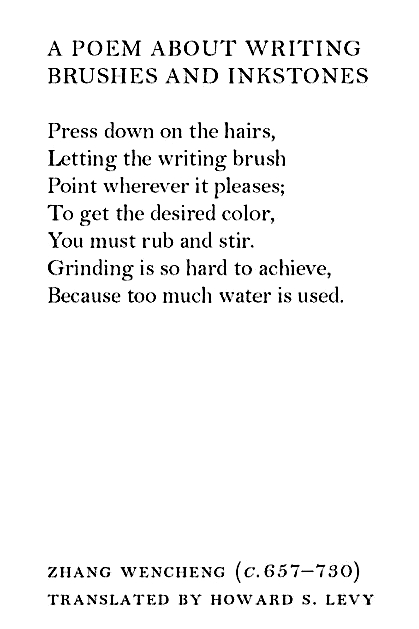
“A Poem About Writing Brushes and Inkstones” — Zhang Wencheng

brushes

Dwelling in the Pure and Infinite — William T. Wiley