“A sublime murkiness and original pent fury” | Walt Whitman on Millet’s Paintings

The Diggers, Jean-Francois Millet

April 18.—Went out three or four miles to the house of Quincy Shaw, to see a collection of J. F. Millet’s pictures. Two rapt hours. Never before have I been so penetrated by this kind of expression. I stood long and long before “the Sower.” I believe what the picture-men designate “the first Sower,” as the artist executed a second copy, and a third, and, some think, improved in each. But I doubt it. There is something in this that could hardly be caught again—a sublime murkiness and original pent fury. Besides this masterpiece, there were many others, (I shall never forget the simple evening scene, “Watering the Cow,”) all inimitable, all perfect as pictures, works of mere art; and then it seem’d to me, with that last impalpable ethic purpose from the artist (most likely unconscious to himself) which I am always looking for. To me all of them told the full story of what went before and necessitated the great French revolution—the long precedent crushing of the masses of a heroic people into the earth, in abject poverty, hunger—every right denied, humanity attempted to be put back for generations—yet Nature’s force, titanic here, the stronger and hardier for that repression—waiting terribly to break forth, revengeful—the pressure on the dykes, and the bursting at last—the storming of the Bastile—the execution of the king and queen—the tempest of massacres and blood. Yet who can wonder?

Could we wish humanity different? Could we wish the people made of wood or stone? Or that there be no justice in destiny or time?

The true France, base of all the rest, is certainly in these pictures. I comprehend “Field-People Reposing,” “the Diggers,” and “the Angelus” in this opinion. Some folks always think of the French as a small race, five or five and a half feet high, and ever frivolous and smirking. Nothing of the sort. The bulk of the personnel of France, before the revolution, was large-sized, serious, industrious as now, and simple. The revolution and Napoleon’s wars dwarf’d the standard of human size, but it will come up again. If for nothing else, I should dwell on my brief Boston visit for opening to me the new world of Millet’s pictures. Will America ever have such an artist out of her own gestation, body, soul?

—From Walt Whitman’s journal of 1881


In the Barber Shop — Ilya Bolotowsky

“The same blue rocks and spectral grottos could be seen in Leonardo’s Virgin of the Rocks” | J.G. Ballard

From J.G. Ballard’s short story “The Gioconda of the Twilight Noon”:

‘There’s a postcard from your mother. They’re near Malta, somewhere called Gozo.’

‘Give it to me.’ Maitland felt the card in his hands.

‘Gozo – that was Calypso’s island. She kept Ulysses there for seven years, promised him eternal youth if he’d stay with her forever.’

‘I’m not surprised.’ Judith inclined the card towards her. ‘If we could spare the time, you and I should go there for a holiday. Wine–dark seas, a sky like heaven, blue rocks. Bliss.’

‘Blue?’

‘Yes. I suppose it’s the bad printing. They can’t really be like that.’

‘They are, actually.’

Still holding the card, Maitland went out into the garden, feeling his way along the string guiderail. As he settled himself in the wheelchair he reflected that there were other correspondences in the graphic arts. The same blue rocks and spectral grottos could be seen in Leonardo’s Virgin of the Rocks, one of the most forbidding and most enigmatic of his paintings. The madonna sitting on a bare ledge by the water beneath the dark overhang of the cavern’s mouth was like the presiding spirit of some enchanted marine realm, waiting for those cast on to the rocky shores of this world’s end. As in so many of Leonardo’s paintings, all its unique longings and terrors were to be found in the landscape in the background. Here, through an archway among the rocks, could be seen the crystal blue cliffs that Maitland had glimpsed in his reverie.


“Here is the riddle, and it is a son-of-a-bitch” (Donald Barthelme)

Here is the riddle said the Great Father Serpent with a great flourishing of his two-tipped tongue, and it is a son-of-a-bitch I will tell you that, the most arcane item in the arcana, you will never guess it in a hundred thousand human years some of which I point out have already been used up by you in useless living and breathing but have a go, have a go, do: What do you really feel? Like murderinging, I answered, because that is what I had read on the underside of the tin, the wording murderinging inscribed in a fine thin cursive. Why bless my soul, said the Great Father Serpent, he’s got it, and the two ruffians blinked at me in stunned wonder and I myself wondered, and marveled, but what I was wondering and marveling at was the closeness with which what I had answered accorded with my feelings, my lost feelings that I had never found before. I suppose, the Father Serpent said, that the boon you wish granted is the ability to carry out this foulness? Of course, I said, what else? Granted then, he said, but may I remind you that having the power is often enough. You don’t have to actually do it. For the soul’s ease. I thanked the Great Father Serpent; he bowed most cordially; my companions returned me to the city. I was abroad in the city with murderinging in mind — the dream of a stutterer.

That is a tall tale, said the Dead Father. I don’t believe it ever happened.

No tale ever happened in the way we tell it, said Thomas, but the moral is always correct.

What is the moral?

Murderinging, Thomas said.

From Donald Barthelme’s novel The Dead Father.


Original Sin — Salvador Dali

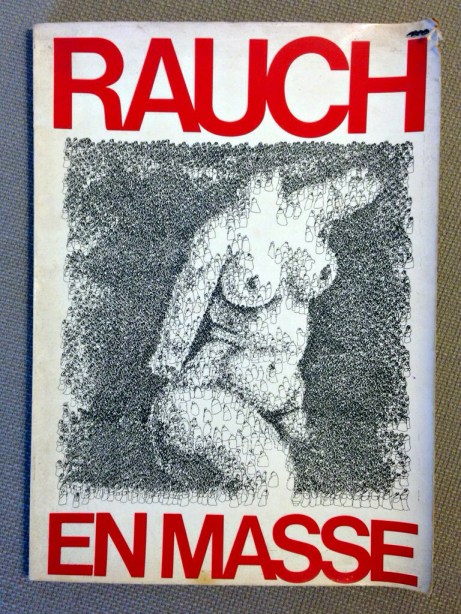
Rauch’s En Masse (Book Acquired, 12.09.2013)

r

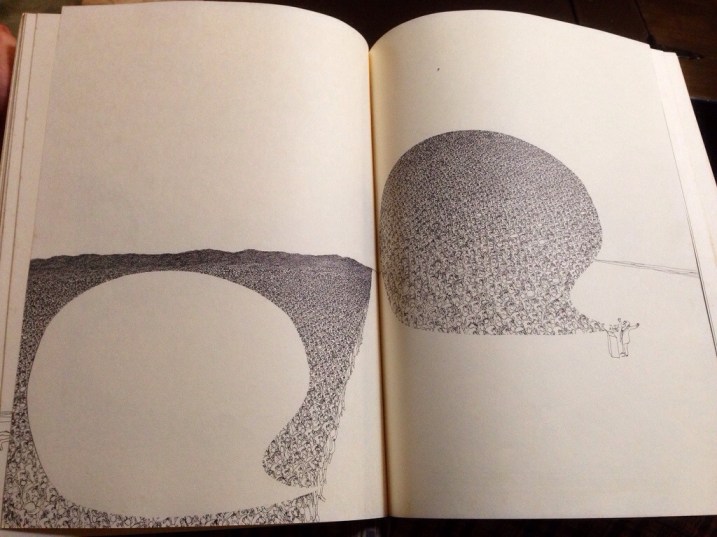
Meandering through the bookstore on a Monday morn, I spied this beat up copy of Hans-Georg Rauch’s En Masse and had to have it.

I’d never heard of Rauch before, but his spidery ink drawings immediately intrigued me.

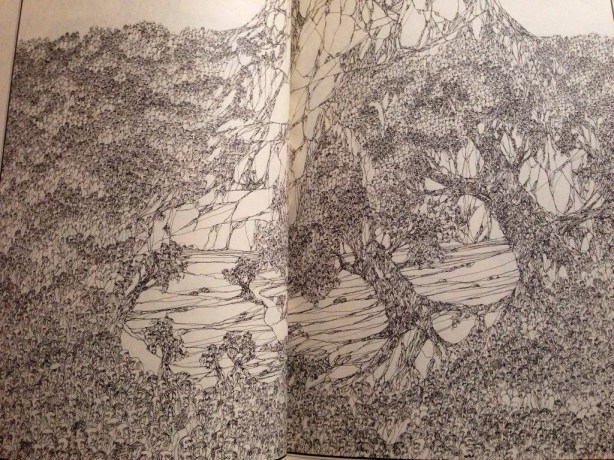
None of the images in En Masse is labeled—indeed, there are no words in the book.

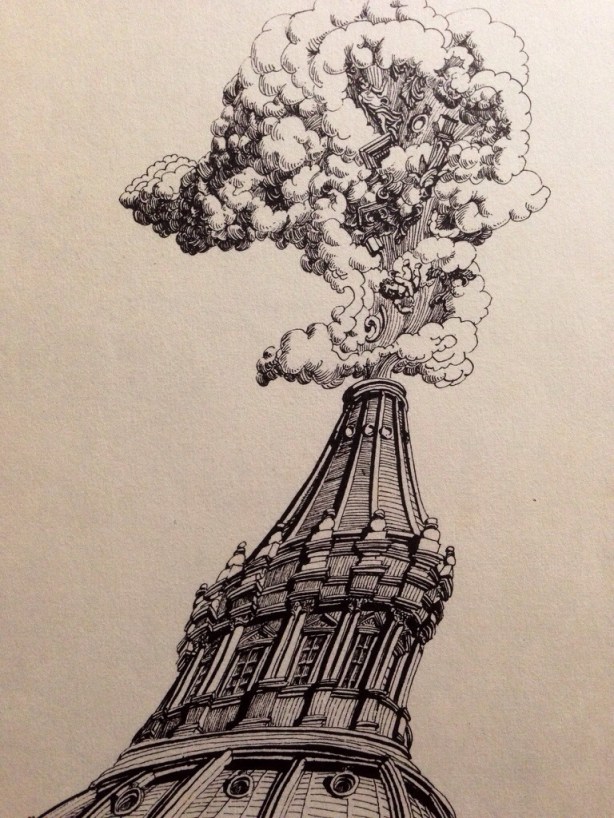
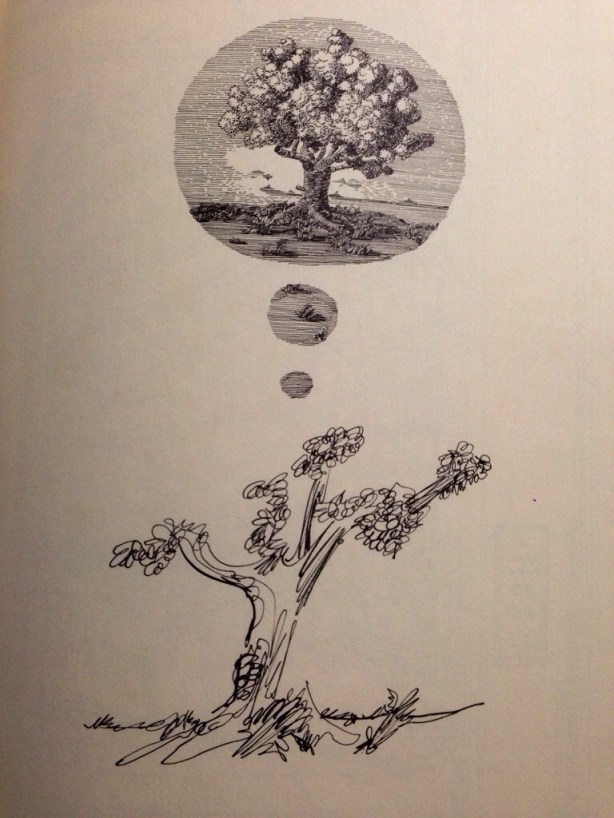
Instead, Rauch plays with themes of creation and nihilism, sex and politics, architecture and nature.

20131211-143452.jpg

This two page spread came out blurry via my iPhone pic—sorry—but in the book’s oversize 13″ x 9″ format  the effect is overwhelming.

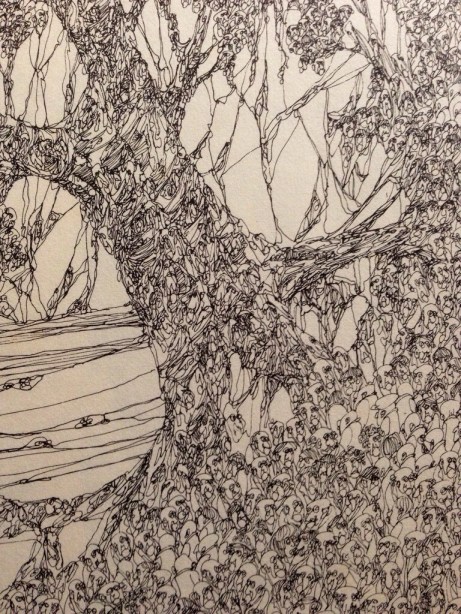
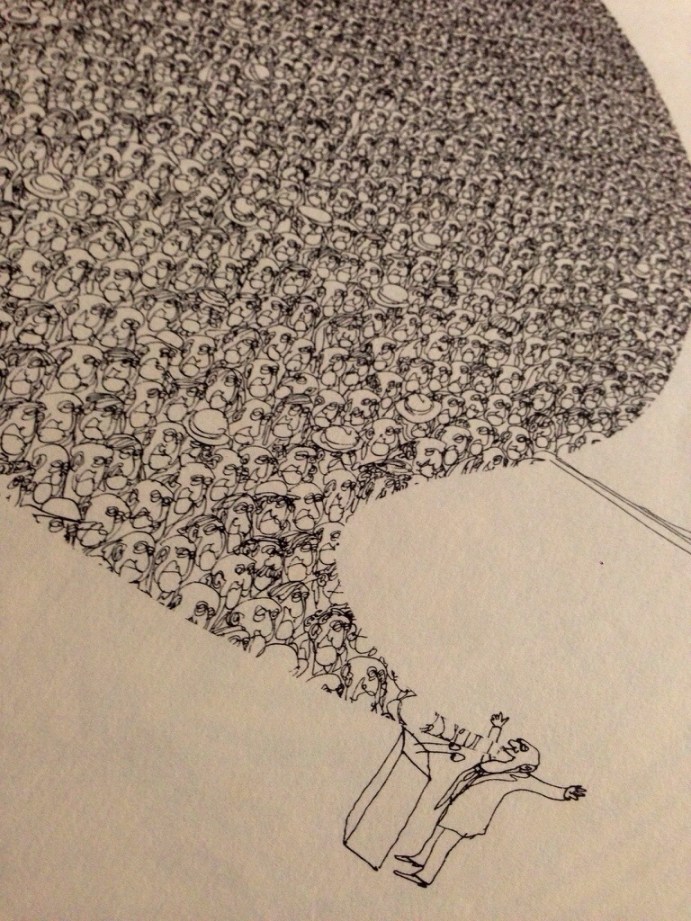
You can see some of the masses perhaps better in this close-up:

20131211-143459.jpg

Rauch’s cartoony style is balanced with an Escher-like acumen; the guy can draft. But there’s a sense of humor here that I think puts him closer to Tomi Ungerer.

20131211-143505.jpg

20131211-143518.jpg

20131211-143525.jpg

Lovely stuff.

20131211-143532.jpg

“The Darling” — Anton Chekhov

“The Darling” by Anton Chekhov

Olenka, the daughter of the retired collegiate assessor Plemyanikov, was sitting on the back-door steps of her house doing nothing. It was hot, the flies were nagging and teasing, and it was pleasant to think that it would soon be evening. Dark rain clouds were gathering from the east, wafting a breath of moisture every now and then.

Kukin, who roomed in the wing of the same house, was standing in the yard looking up at the sky. He was the manager of the Tivoli, an open-air theatre.

“Again,” he said despairingly. “Rain again. Rain, rain, rain! Every day rain! As though to spite me. I might as well stick my head into a noose and be done with it. It’s ruining me. Heavy losses every day!” He wrung his hands, and continued, addressing Olenka: “What a life, Olga Semyonovna! It’s enough to make a man weep. He works, he does his best, his very best, he tortures himself, he passes sleepless nights, he thinks and thinks and thinks how to do everything just right. And what’s the result? He gives the public the best operetta, the very best pantomime, excellent artists. But do they want it? Have they the least appreciation of it? The public is rude. The public is a great boor. The public wants a circus, a lot of nonsense, a lot of stuff. And there’s the weather. Look! Rain almost every evening. It began to rain on the tenth of May, and it’s kept it up through the whole of June. It’s simply awful. I can’t get any audiences, and don’t I have to pay rent? Don’t I have to pay the actors?”

The next day towards evening the clouds gathered again, and Kukin said with an hysterical laugh:

“Oh, I don’t care. Let it do its worst. Let it drown the whole theatre, and me, too. All right, no luck for me in this world or the next. Let the actors bring suit against me and drag me to court. What’s the court? Why not Siberia at hard labour, or even the scaffold? Ha, ha, ha!”

It was the same on the third day.

Olenka listened to Kukin seriously, in silence. Sometimes tears would rise to her eyes. At last Kukin’s misfortune touched her. She fell in love with him. He was short, gaunt, with a yellow face, and curly hair combed back from his forehead, and a thin tenor voice. His features puckered all up when he spoke. Despair was ever inscribed on his face. And yet he awakened in Olenka a sincere, deep feeling. Continue reading ““The Darling” — Anton Chekhov”

The Council Chamber — Edward Burne-Jones

Love — Martiros Saryan

“Life does not agree with philosophy: there is no happiness which is not idleness and only the useless is pleasurable” (Chekhov)

* * * * *

The hen sparrow believes that her cock sparrow is not chirping but singing beautifully.

* * * * *

When one is peacefully at home, life seems ordinary, but as soon as one walks into the street and begins to observe, to question women, for instance, then life becomes terrible. The neighborhood of Patriarshi Prudy (a park and street in Moscow) looks quiet and peaceful, but in reality life there is hell.

* * * * *

These red-faced young and old women are so healthy that steam seems to exhale from them.

* * * * *

The estate will soon be brought under the hammer; there is poverty all round; and the footmen are still dressed like jesters.

* * * * *

There has been an increase not in the number of nervous diseases and nervous patients, but in the number of doctors able to study those diseases.

* * * * *

The more refined the more unhappy.

* * * * *

Life does not agree with philosophy: there is no happiness which is not idleness and only the useless is pleasurable.

* * * * *

The grandfather is given fish to eat, and if it does not poison him and he remains alive, then all the family eat it.

* * * * *

—From Anton Chekhov’s Note-Books.

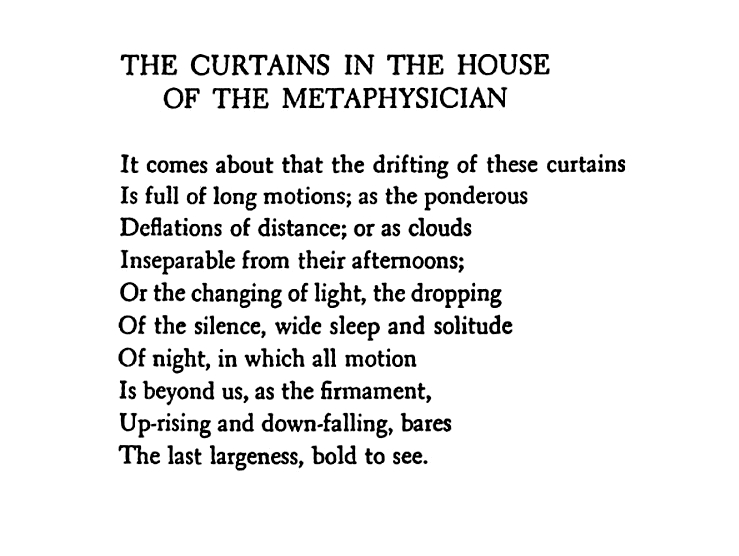
“The Curtains in the House of the Metaphysician” — Wallace Stevens

Capture

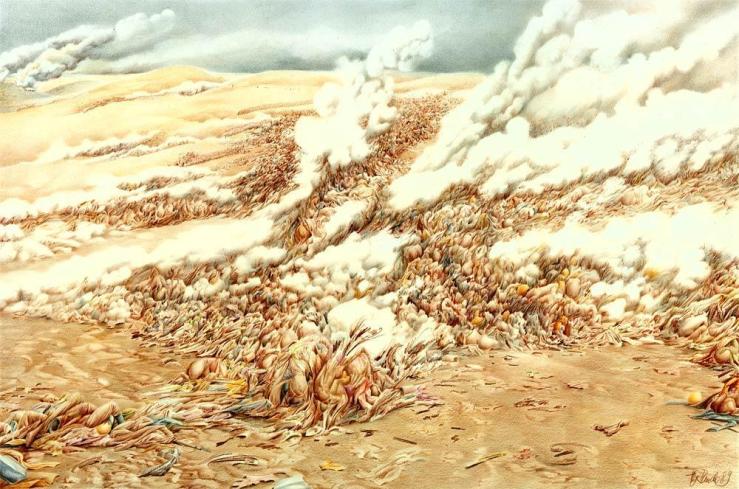
Battle Paintings II — Hans-Georg Rauch

battle

The Complete Short Stories of J.G. Ballard (Sixth Riff: 1963-1964)

jgb_complete_ss40031

PREVIOUSLY:

Introductions + stories 1956-1959

Stories of 1960

Stories of 1961

Stories of 1962

“The Subliminal Man,” Black Friday, and Consumerism

IN THIS RIFF:

“The Reptile Enclosure” (1963)

“A Question of Re-Entry” (1963)

“The Time Tombs” (1963)

“Now Wakes the Sea” (1963)

“The Venus Hunters” (1963)

“End-Game” (1963)

“Minus One” (1963)

“The Sudden Afternoon” (1963)

“The Screen Game” (1963)

“Time of Passage” (1964)

“Prisoner of the Coral Deep” (1964)

“The Lost Leonardo” (1964)

“The Terminal Beach” (1964)

“The Illuminated Man” (1964)

“The Delta at Sunset” (1964)

“The Drowned Giant” (1964)

“The Gioconda of the Twilight Noon” (1964)

“The Volcano Dances” (1964)

1.”The Reptile Enclosure” (1963) / “A Question of Re-Entry” (1963) / “The Time Tombs” (1963) / “Now Wakes the Sea” (1963) / “The Venus Hunters” (1963) / “Minus One” (1963) / “Prisoner of the Coral Deep” (1964) / “The Illuminated Man” (1964) / “The Delta at Sunset” (1964) / “The Gioconda of the Twilight Noon” /”The Volcano Dances” (1964)

There are 98 stories in The Complete Short Stories of J.G. Ballard. That’s a lot of stories. Maybe too many. Too many for me to write about in full, anyway. I’ve lumped these stories together because they are somewhat unremarkable: Ballard does his Ballardian thing way better elsewhere. Several of these stories feel like sketches (or leftovers) from Ballard’s early novels like The Drowned WorldThe Burning World, and The Crystal World. Themes of time, memory, art, and nature abound here, usually glommed on to simple adventure narratives or sci-fi pulp treadthroughs. Jungles, watches, crystals, structures, beaches. Misanthropy, paranoia, nagging wives, misunderstood heroes. Man apart from nature, but beholden to nature. Etc. The worst moments of these stories—and we can find these moments all through early Ballard, to be fair—suffer from a bad case of White Man’s Burden doubled up with a shot of misogyny. I’ve written it before in these posts, but the most disappointing aspect of early Ballard is our would-be futurist’s inability to transcend the patriarchal ideology of the post-war era. So now let’s move to the good stuff.

2. “End-Game” (1963)

I first read “End-Game” when I was sixteen or seventeen, and it’s always stuck with me. It’s the story of a former “party member” who’s been imprisoned under nebulous circumstances—only his prison isn’t that bad—a nice little villa, comfortable, with books and a chess set. He even has a housekeeper. Unfortunately, the housekeeper is also his executioner, and the date and method of the execution is forever withheld from him:

This ironic inversion of the classical Kafkaesque situation, by which, instead of admitting his guilt to a non–existent crime, he was forced to connive in a farce maintaining his innocence of offences he knew full well he had committed, was preserved in his present situation at the execution villa.

The psychological basis was more obscure but in some way far more threatening, the executioner beckoning his victim towards him with a beguiling smile, reassuring him that all was forgiven. Here he played upon, not those unconscious feelings of anxiety and guilt, but that innate conviction of individual survival, that obsessive preoccupation with personal immortality which is merely a disguised form of the universal fear of the image of one’s own death. It was this assurance that all was well, and the absence of any charges of guilt or responsibility, which had made so orderly the queues into the gas chambers.

Ballard directly invokes Kafka, whose tale “Before the Law” comes to mind here (not to mention The Trial and The Castle); “End-Game” also feels like Ballard’s take on 1984. It’s a great little tale, and I think it helps to prove that Ballard is at his best when he sticks to a confined, limited cast and setting. Much of the force of “End-Game” comes from Ballard pitting his prisoner/protagonist against the protagonist’s mental conception of his guard/executioner. Part of my ideal collection, The Essential Short Stories of J.G. Ballard.

3. “The Sudden Afternoon” (1963) / “Time of Passage” (1964)

In “The Sudden Afternoon” and “Time of Passage,” Ballard explores how time and place—context, I suppose—constitute identity. The former story is a tale of metempsychosis with a troubling take on Indian spirituality, wherein a doctor—an Indian, of course—transplants his psyche and his wife’s psyche into the bodies of another couple (his wife is dying of a terminal disease). Ballard’s own wife died a year after the story was first published (I’m reminded of Poe here, whose wife Virginia died after the publication of “The Raven”). “The Sudden Afternoon” isn’t very good, but structurally we see Ballard beginning to employ something approaching the cut-ups/fragments he’ll move to in the next decade.

“Time of Passage” is essentially a rewrite of F. Scott Fitzgerald’s “The Curious Case of Benjamin Button.” It’s also basically a rewrite of Ballard’s own 1961 tale “Mr. F Is Mr. F” — only this time, Ballard dispenses with abject-horror-for-maternal-body in lieu of a fable-like exploration of what a life in reverse might actually look like. A lovely story. Stick it in The Essentials.

4. “The Screen Game” (1963)

Another Vermilion Sands story. More insanity. Another femme fatale. An attempt at the story of Orpheus, perhaps. I would have lumped it in with the stories in point 1, but I wanted to clarify: The Vermilion Sands stories are the worst.
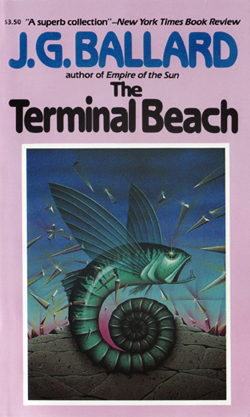
15. “The Lost Leonardo” (1964)

This is an excellent little detective tale with mystical-magic undertones. I’m a sucker for any story of art theft, too. We all know Dan Brown ripped off Umberto Eco, but maybe Eco ripped off Ballard? Who cares. Lovely stuff. Ballard is excellent at the detective story; Poe is one of his clearest predecessors, but like Poe, he’s more famous for other stuff. Too bad. Let’s call it Essential.

6. “The Terminal Beach” (1964)

1964’s “The Terminal Beach” is such a big break through for Ballard in terms of formal elements and structuring that it probably deserves its own post, but I’ll jab at it here anyway. Up until now, Ballard’s stories have been notable almost entirely for their ideas—his prose has improved some, but ultimately, the pulp fiction he’s writing for magazine publication constrains him to a pedestrian rhetoric that simply can’t match how far out his concepts are. With “The Terminal Beach,” Ballard finally approaches a narrative structure—fractured, polyglossic, shifting through interiors to exteriors, breaking through different forms—that can match the themes of his tale. The story–clearly an Essential—points to the finest of Ballard’s future work. You can read it here in two parts, but here’s a taste that I think stands alone as a microfiction:

The Fly

(A small fly, which Traven presumes has followed him into the fissure, now buzzes about the corpse’s face. Guiltily, Traven leans forward to kill it, then reflects that perhaps this minuscule sentry has been the corpse’s faithful companion, in return fed on the rich liqueurs and distillations of its pores. Carefully, to avoid injuring the fly, he encourages it to alight on his wrist.)

DR YASUDA: Thank you, Traven. In my position, you understand

TRAVEN: Of course, Doctor. I’m sorry I tried to kill it – these ingrained habits, you know, they’re not easy to shrug off. Your sister’s children in Osaka in ’44, the exigencies of war, I hate to plead them. Most known motives are so despicable, one searches the unknown in the hope that YASUDA: Please, Traven, do not be embarrassed. The fly is lucky to retain its identity for so long. ‘That son you mourn, not to mention my own two nieces and nephew, did they not die each day? Every parent in the world grieves for the lost sons and daughters of their earlier childhoods.

TRAVEN: You’re very tolerant, Doctor. I wouldn’t dare – YASUDA: Not at all, Traven. I make no apologies for you. Each of us is little more than the meagre residue of the infinite unrealized possibilities of our lives. But your son, and my nephew, are fixed in our minds forever, their identities as certain as the stars.

TRAVEN: (not entirely convinced) That may be so, Doctor, but it leads to a dangerous conclusion in the case of this island. For instance, the blocks – YASUDA: They are precisely what I refer to, Traven. Here among the blocks you at last find an image of yourself free of the hazards of time and space. This islandis an ontological Garden of Eden, why seek to expel yourself into a world of quantal flux?

TRAVEN: Excuse me (The fly has flown back to the corpse’s face and sits in one of the dried-up orbits, giving the good doctor an expression of quizzical beadiness. Reaching forward, Traven entices it on to his palm. He examines it carefully) Well, yes, these bunkers may be ontological objects, but whether this is the ontological fly is doubtful. It’s true that on this island it’s the only fly, which is the next best thing

YASUDA: You can’t accept the plurality of the universe – ask yourself why, Traven. Why should this obsess you? It seems to me that you are hunting for the white leviathan, zero. The beach is a dangerous zone. Avoid it. Have a proper humility, pursue a philosophy of acceptance.

TRAVEN: Then may I ask why you came here, Doctor?

YASUDA: To feed this fly. ‘What greater love – ?’

TRAVEN: (Still puzzling) It doesn’t really solve my problem. The blocks, you see

YASUDA: Very well, if you must have it that way

TRAVEN: But, Doctor

YASUDA: (Peremptorily) Kill that fly!

TRAVEN: That’s not an end, or a beginning.

(Hopelessly, he kills the fly. Exhausted, he falls asleep beside the corpse.)

7. “The Drowned Giant” (1964)

Another Essential, this puzzling fable readily recalls Gabriel García Márquez’s story “A Very Old Man with Enormous Wings.” Ballard rarely handles archetypes so directly as he does here. Even if the story’s theme seems almost too-plain—we lose the miracle, we cast down the old gods, we deny the sublime, etc.—its construction and telling are wonderfully achieved.

The lower jaw, typically, found its way to the museum of natural history. The remainder of the skull has disappeared, but is probably still lurking in the waste grounds or private gardens of the city – quite recently, while sailing down the river, I noticed two ribs of the giant forming a decorative arch in a waterside garden, possibly confused with the jaw–bones of a whale. A large square of tanned and tattooed skin, the size of an indian blanket, forms a backcloth to the dolls and masks in a novelty shop near the amusement park, and I have no doubt that elsewhere in the city, in the hotels or golf clubs, the mummified nose or ears of the giant hang from the wall above a fireplace. As for the immense pizzle, this ends its days in the freak museum of a circus which travels up and down the north–west. This monumental apparatus, stunning in its proportions and sometime potency, occupies a complete booth to itself. The irony is that it is wrongly identified as that of a whale, and indeed most people, even those who first saw him cast up on the shore after the storm, now remember the giant, if at all, as a large sea beast.

8. On the horizon:

Ballard plays with fragmentation again in “The Beach Murders” and “The Assassination of John Fitzgerald Kennedy Considered as a Downhill Motor Race” — and we finally get to his stories of the late sixties.

Hero and Leander (To Christopher Marlowe) — Cy Twombly

“On Mr. Rudyard Kipling and Making the World Small” — G.K. Chesterton

“On Mr. Rudyard Kipling and Making the World Small” by G.K. Chesterton

There is no such thing on earth as an uninteresting subject; the only thing that can exist is an uninterested person. Nothing is more keenly required than a defence of bores. When Byron divided humanity into the bores and bored, he omitted to notice that the higher qualities exist entirely in the bores, the lower qualities in the bored, among whom he counted himself. The bore, by his starry enthusiasm, his solemn happiness, may, in some sense, have proved himself poetical. The bored has certainly proved himself prosaic.

We might, no doubt, find it a nuisance to count all the blades of grass or all the leaves of the trees; but this would not be because of our boldness or gaiety, but because of our lack of boldness and gaiety. The bore would go onward, bold and gay, and find the blades of grass as splendid as the swords of an army. The bore is stronger and more joyous than we are; he is a demigod—nay, he is a god. For it is the gods who do not tire of the iteration of things; to them the nightfall is always new, and the last rose as red as the first.

The sense that everything is poetical is a thing solid and absolute; it is not a mere matter of phraseology or persuasion. It is not merely true, it is ascertainable. Men may be challenged to deny it; men may be challenged to mention anything that is not a matter of poetry. I remember a long time ago a sensible sub-editor coming up to me with a book in his hand, called “Mr. Smith,” or “The Smith Family,” or some such thing. He said, “Well, you won’t get any of your damned mysticism out of this,” or words to that effect. I am happy to say that I undeceived him; but the victory was too obvious and easy. In most cases the name is unpoetical, although the fact is poetical. In the case of Smith, the name is so poetical that it must be an arduous and heroic matter for the man to live up to it. The name of Smith is the name of the one trade that even kings respected, it could claim half the glory of that arma virumque which all epics acclaimed. The spirit of the smithy is so close to the spirit of song that it has mixed in a million poems, and every blacksmith is a harmonious blacksmith. Continue reading ““On Mr. Rudyard Kipling and Making the World Small” — G.K. Chesterton”

Still Life with Hourglass, Pencase and Print — Gerrit Dou

François Truffaut: The Man Who Loved Cinema (Documentary)