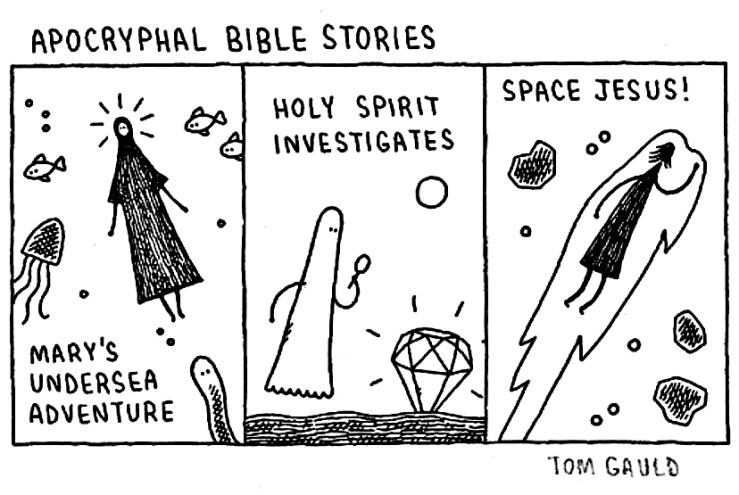
Apocryphal Bible Stories — Tom Gauld

tg

“The Hobo and the Fairy” — Jack London

“The Hobo and the Fairy” by Jack London

He lay on his back. So heavy was his sleep that the stamp of hoofs and cries of the drivers from the bridge that crossed the creek did not rouse him. Wagon after wagon, loaded high with grapes, passed the bridge on the way up the valley to the winery, and the coming of each wagon was like the explosion of sound and commotion in the lazy quiet of the afternoon.

But the man was undisturbed. His head had slipped from the folded newspaper, and the straggling, unkempt hair was matted with the foxtails and burrs of the dry grass on which it lay. He was not a pretty sight. His mouth was open, disclosing a gap in the upper row where several teeth at some time had been knocked out. He breathed stertorously, at times grunting and moaning with the pain of his sleep. Also, he was very restless, tossing his arms about, making jerky, half-convulsive movements, and at times rolling his head from side to side in the burrs. This restlessness seemed occasioned partly by some internal discomfort, and partly by the sun that streamed down on his face and by the flies that buzzed and lighted and crawled upon the nose and cheeks and eyelids. There was no other place for them to crawl, for the rest of the face was covered with matted beard, slightly grizzled, but greatly dirt-stained and weather-discolored.

The cheek-bones were blotched with the blood congested by the debauch that was evidently being slept off. This, too, accounted for the persistence with which the flies clustered around the mouth, lured by the alcohol-laden exhalations. He was a powerfully built man, thick-necked, broad-shouldered, with sinewy wrists and toil-distorted hands. Yet the distortion was not due to recent toil, nor were the callouses other than ancient that showed under the dirt of the one palm upturned. From time to time this hand clenched tightly and spasmodically into a fist, large, heavy-boned and wicked-looking.

The man lay in the dry grass of a tiny glade that ran down to the tree-fringed bank of the stream. On either side of the glade was a fence, of the old stake-and-rider type, though little of it was to be seen, so thickly was it overgrown by wild blackberry bushes, scrubby oaks and young madrono trees. In the rear, a gate through a low paling fence led to a snug, squat bungalow, built in the California Spanish style and seeming to have been compounded directly from the landscape of which it was so justly a part. Neat and trim and modestly sweet was the bungalow, redolent of comfort and repose, telling with quiet certitude of some one that knew, and that had sought and found. Continue reading ““The Hobo and the Fairy” — Jack London”

Interior with a Young Man Reading — Vilhelm Hammershøi

The Rules of the Game — Jean Renoir (Full Film)

Lovers Man and Woman — Egon Schiele

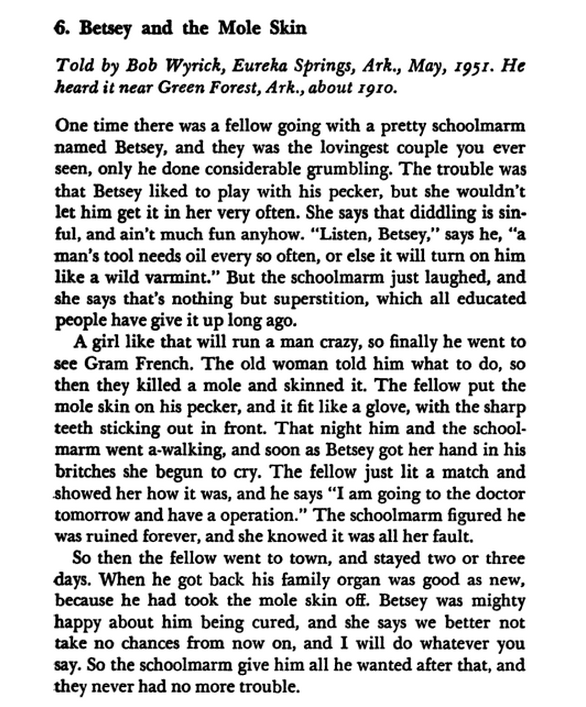
Betsey and The Mole Skin (A Dirty Ozark Folktale)

bms

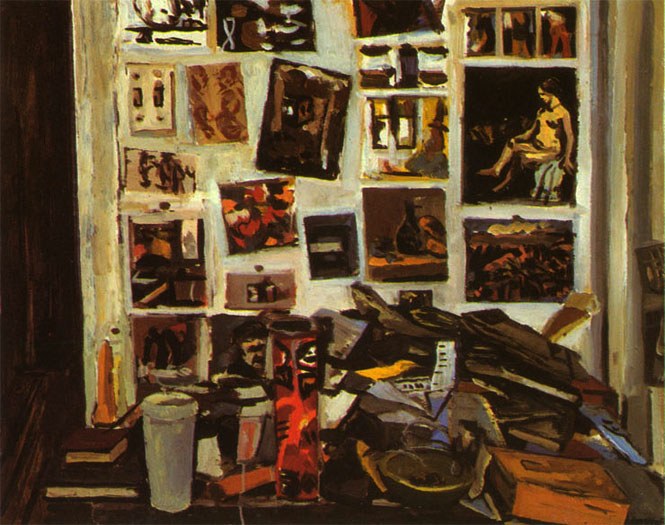
Wall of Fame — Dmitry Samarov

walloffame

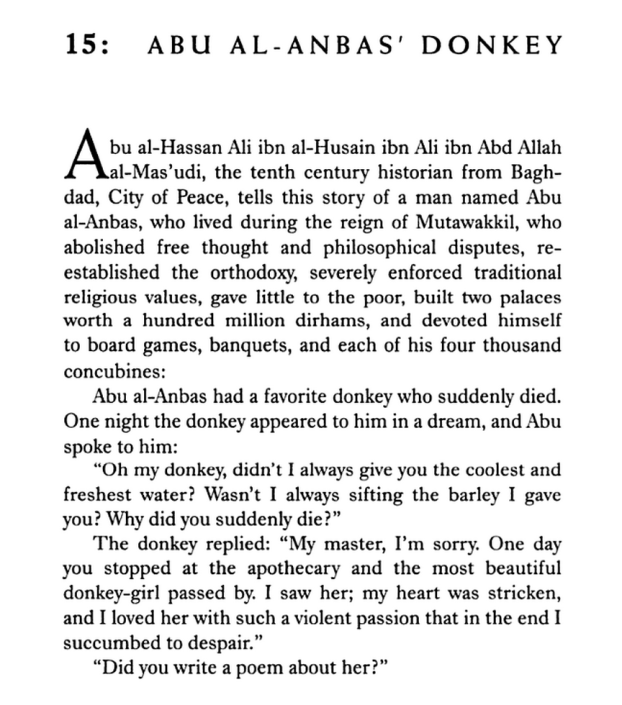
“Abu Al-Anbas’ Donkey” – Eliot Weinberger

Screen Shot 2013-09-07 at 11.51.10 AM Screen Shot 2013-09-07 at 11.51.48 AM

“The World’s Greatest” — Bonnie ‘Prince’ Billy

“—you see you were always lost” (Thomas Bernhard)

“You just arrive in a place,” said the painter,“ and then you leave it again, and yet everything, every single object you take in, is the sum of its prehistory. The older you become, the less you think about the connections you’ve already established. Table, cow, sky, stream, stone, tree, they’ve all been studied. Now they just get handled. Objects, the harmonic range of invention, completely unappreciated, no more truck with variation, deepening, gradation. You just try to work out the big connections. Suddenly you look into the macro-structure of the world, and you discover it: a vast ornament of space, nothing else. Humble backgrounds, vast replications—you see you were always lost. As you get older, thinking becomes a tormenting reference mechanism. No merit to it. I say ‘tree,’ and I see huge forests. I say ‘river,’ and I see every river. I say ‘house,’ and I see cities with their seas of roofs. I say ‘snow,’ and I see oceans of it. A thought sets off the whole thing. Where it takes art is to think small as well as big, to be present on every scale …”

From Thomas Bernhard’s novel Frost.

Lesender Knabe — Frans Hals

“Game” – Octavio Paz

I’ll plunder seasons.
I’ll play with months and years.
Winter days with the red faces of summer.

And down the gray road,
in the silent parade
of hard, unmoving days,
I’ll organize the blues and gymnastics.

A rippling morning
of painted lips,
cool, as though just bathed,
with an autumn dawn.

And I’ll catch the clouds–
red, blue, purple–
and throw them against the inexpressive paper
of the black and blue sky,
so that they’ll write a letter
in the universal language
to their good friend the wind.

To help the shopkeepers,
I’ll make luminous billboards,
with spotlights of stars.

Maybe I’ll assassinate a dawn
so that, bleeding,
it will stain a white cloud purple.

In the shop of the seasons,
I’ll sell ripe autumn apples
wrapped in the paper of winter mists.

I’ll kidnap Spring,
to have her in my house,
like a ballerina.

The wind will change its schedule.
Unpredictable crossings of the clouds.

And down the highway of the Future, I’ll rush toward Winter,
for the surprise of meeting it later,
mixed with Summer.

On the green felt of space,
I’ll bet on days
that will roll like dice.

I’ll play with months and years.


Octavio Paz’s first unpublished poem, 1931. Translated by Eliot Weinberger.

Watch Rembrandt’s J’Accuse, Peter Greenaway’s Film-Essay on Visual Illiteracy


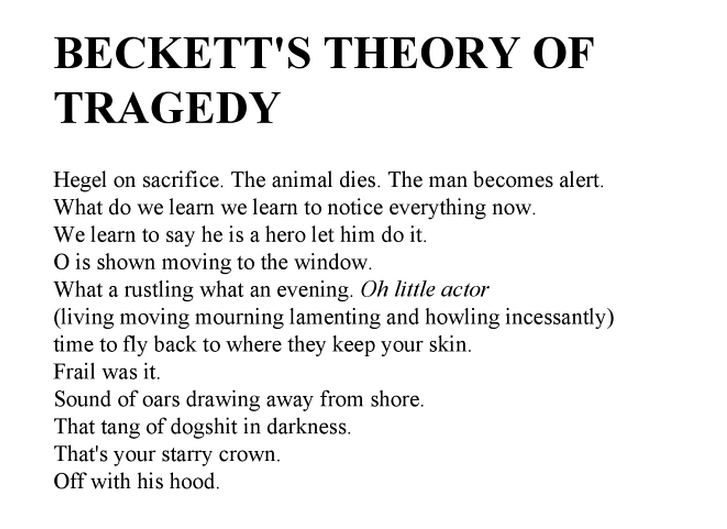
“Beckett’s Theory of Tragedy” — Anne Carson

Capture

Scheveningen Women and Other People Under Umbrellas — Vincent van Gogh

List with No Name #38

  1. John Barth’s beret
  2. Zora Neale Hurston’s fedora
  3. Mark Twain’s bowtie
  4. David Foster Wallace’s bandanna
  5. Tom Wolfe’s white suit
  6. Carson McCuller’s cigarettes
  7. Wiillaim Faulkner’s pipe
  8. Jonathan Franzen’s spectacles
  9. Flannery O’Connor’s crutches
  10. Walt Whitman’s hat (cocked, natch)
  11. Oscar Wilde’s fur coat
  12. Thomas Pynchon’s paper bag

Waterproof Mascara — Marlene Dumas