Illegitimate (David Markson)

Capture

Brian Wilson All Cuddled Up with His Manipulative Psychologist

The Dream (Paolo and Francesca) — Umberto Boccioni

“On Noise” — Arthur Schopenhauer

Kant has written a treatise on The Vital Powers; but I should like to write a dirge on them, since their lavish use in the form of knocking, hammering, and tumbling things about has made the whole of my life a daily torment. Certainly there are people, nay, very many, who will smile at this, because they are not sensitive to noise; it is precisely these people, however, who are not sensitive to argument, thought, poetry or art, in short, to any kind of intellectual impression: a fact to be assigned to the coarse quality and strong texture of their brain tissues. On the other hand, in the biographies or in other records of the personal utterances of almost all great writers, I find complaints of the pain that noise has occasioned to intellectual men. For example, in the case of Kant, Goethe, Lichtenberg, Jean Paul; and indeed when no mention is made of the matter it is merely because the context did not lead up to it. I should explain the subject we are treating in this way: If a big diamond is cut up into pieces, it immediately loses its value as a whole; or if an army is scattered or divided into small bodies, it loses all its power; and in the same way a great intellect has no more power than an ordinary one as soon as it is interrupted, disturbed, distracted, or diverted; for its superiority entails that it concentrates all its strength on one point and object, just as a concave mirror concentrates all the rays of light thrown upon it. Noisy interruption prevents this concentration. This is why the most eminent intellects have always been strongly averse to any kind of disturbance, interruption and distraction, and above everything to that violent interruption which is caused by noise; other people do not take any particular notice of this sort of thing. The most intelligent of all the European nations has called “Never interrupt” the eleventh commandment. But noise is the most impertinent of all interruptions, for it not only interrupts our own thoughts but disperses them. Where, however, there is nothing to interrupt, noise naturally will not be felt particularly. Sometimes a trifling but incessant noise torments and disturbs me for a time, and before I become distinctly conscious of it I feel it merely as the effort of thinking becomes more difficult, just as I should feel a weight on my foot; then I realise what it is. Continue reading ““On Noise” — Arthur Schopenhauer”

Nude from the Rear, Reading — Edgar Degas

Kurosawa: The Last Emperor (Documentary by Alex Cox)

“…the amazing, world-reversing night of Fourth of July Eve 1899” (Pynchon’s Against the Day)

For years after, there were tales told in Colorado of the amazing, world-reversing night of Fourth of July Eve 1899. Next day’d be full of rodeos, marching bands, and dynamite explosions—but that night there was man-made lightning, horses gone crazy for miles out into the prairie, electricity flooding up through the iron of their shoes, shoes that when they finally came off and got saved to use for cowboy quoits, including important picnic tourneys from Fruita to Cheyenne Wells, why they would fly directly and stick on to the spike in the ground, or to anything else nearby made of iron or steel, that’s when they weren’t collecting souvenirs on their way through the air—gunmen’s guns came right up out of their holsters and buck knives out from under pants legs, keys to traveling ladies’ hotel rooms and office safes, miners’ tags, fencenails, hairpins, all seeking the magnetic memory of that long-ago visit. Veterans of the Rebellion fixing to march in parades were unable to get to sleep, metallic elements had so got to humming through their bloodmaps. Children who drank the milk from the dairy cows who grazed nearby were found leaning against telegraph poles listening to the traffic speeding by through the wires above their heads, or going off to work in stockbrokers’ offices where, unsymmetrically intimate with the daily flow of prices, they were able to amass fortunes before anyone noticed. .

A passage from Thomas Pynchon’s novel Against the Day.


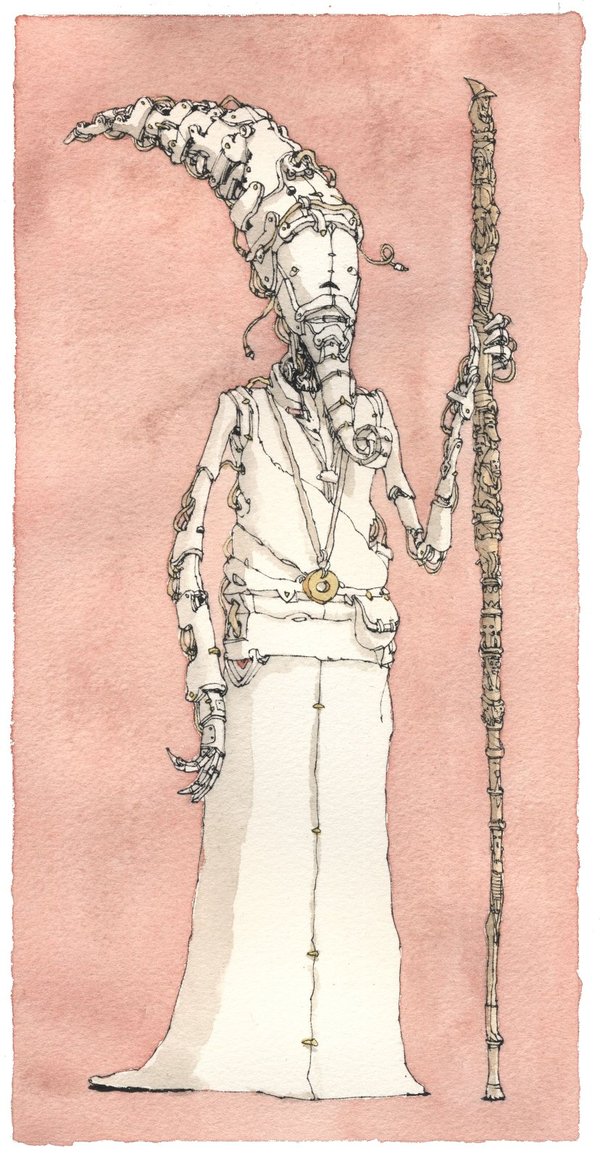
Gandalf Bot — Mattias Adolfsson

gandalf

(More/via).

List with No Name #28

  1. Carlos Castaneda
  2. Tom Robbins
  3. Paulo Coelho
  4. John Irving
  5. Tom Wolfe
  6. Bret Easton Ellis
  7. James McInerney
  8. Mark Leyner
  9. Miranda July
  10. Tao Lin

Mike Leigh Offers an Alphabetized List of Themes in His Film Life Is Sweet


Wednesday (Charles Addams)

wed

“The Singing Lesson” — Katherine Mansfield

“The Singing Lesson” — Katherine Mansfield

With despair—cold, sharp despair—buried deep in her heart like a wicked knife, Miss Meadows, in cap and gown and carrying a little baton, trod the cold corridors that led to the music hall. Girls of all ages, rosy from the air, and bubbling over with that gleeful excitement that comes from running to school on a fine autumn morning, hurried, skipped, fluttered by; from the hollow class-rooms came a quick drumming of voices; a bell rang; a voice like a bird cried, “Muriel.” And then there came from the staircase a tremendous knock-knock-knocking. Some one had dropped her dumbbells.

The Science Mistress stopped Miss Meadows.

“Good mor-ning,” she cried, in her sweet, affected drawl. “Isn’t it cold? It might be win-ter.”

Miss Meadows, hugging the knife, stared in hatred at the Science Mistress. Everything about her was sweet, pale, like honey. You wold not have been surprised to see a bee caught in the tangles of that yellow hair.

“It is rather sharp,” said Miss Meadows, grimly.

The other smiled her sugary smile.

“You look fro-zen,” said she. Her blue eyes opened wide; there came a mocking light in them. (Had she noticed anything?)

“Oh, not quite as bad as that,” said Miss Meadows, and she gave the Science Mistress, in exchange for her smile, a quick grimace and passed on…

Forms Four, Five, and Six were assembled in the music hall. The noise was deafening. On the platform, by the piano, stood Mary Beazley, Miss Meadows’ favourite, who played accompaniments. She was turning the music stool. When she saw Miss Meadows she gave a loud, warning “Sh-sh! girls!” and Miss Meadows, her hands thrust in her sleeves, the baton under her arm, strode down the centre aisle, mounted the steps, turned sharply, seized the brass music stand, planted it in front of her, and gave two sharp taps with her baton for silence. Continue reading ““The Singing Lesson” — Katherine Mansfield”

Leontine Reading — Pierre-Auguste Renoir

Fitzcardboardaldo / The Corrugation of Dreams

(By Robin Forhardt; via)

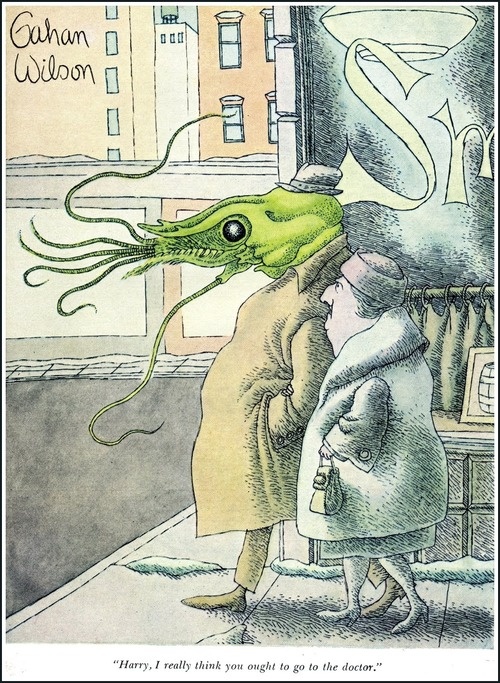
Advice (Gahan Wilson Comic)

wilson

(Via).

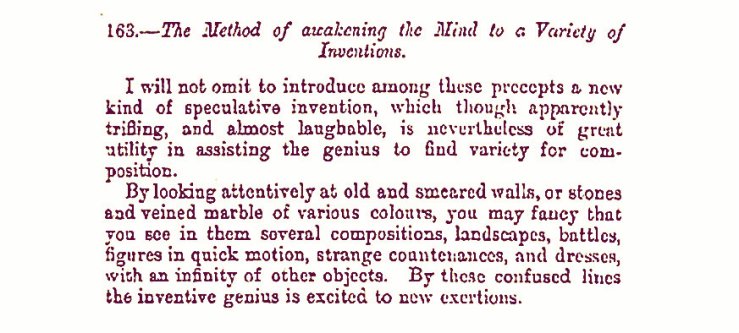
“The Method of Awakening the Mind to a Variety of Inventions” — Leonardo da Vinci

Capture

“Liar” — Royal Trux