The Reading Girl — Theodore Roussel

The Reading Girl 1886-7 by Théodore Roussel 1847-1926

Field with Two Rabbits — Vincent van Gogh

A Riff on Lars Iyer’s Novel Exodus

l

I. Trilogy

Exodus is the third entry in a trilogy that Lars Iyer began with Spurious and Dogma.

What happens in Exodus?

Not much (but also maybe everything—like all sorts of philosophical investigations and intellectual adventure and despair and potential revolution and symbolic death, etc.).

If you’ve read Spurious and Dogma you’d expect this.

There is a quest though in Exodus, a quest that feels more visceral, more real, cuts closer to the bone than in the first two entries.

What is this quest?

Do our heroes W. and Lars vanquish despair? Figure out Kafka?

Do they save humanity (or at least the humanities department)?

Do they finally cast the One Ring into Mount Doom?

(They go on a lecture tour).

II. Quest

What is the connection between Kierkegaard and capitalism?: that’s our question, W. says. What does Kierkegaard tell us about the despair of capitalism?

And

‘The true and only virtue is to hate ourselves’, W. says, reading from his notebook.

And, perhaps more specifically

Of course, they’re going to close all humanities courses in British universities, W. says . . . They’re simply going to marketise education, W. says. They’re simply going to turn the university over to the free market. They’re going to submit philosophy to the forces of capitalism . . .

And

Imagine it! Two plastic cups of Plymouth Gin might usher in the reign of peace, W. says.

And

There are no jobs in philosophy — everyone knows that. No jobs in academia!

And etc.

III. The Call to Adventure

This is our last tour, W. says. He feels that strongly. Something’s going to happen. Something’s about to happen. . . Why does he feel such a sense of dread?

IV. The Road of Trials

Gin, Deleuze, Kafka, Kierkegaard, gin, Blade Runner, Guy Debord, postgraduate students, linguistic stupidity, anxiety over what Alan Badiou is doing right this very minute, gin, Gandhi, Marx, the blogosphere (so-called), Bartleby, Moses, God, logical-mathematical stupidity, the Talmud, gin, bodily-kinesthetic stupidity, cheap food, the Thames, Oxford, Rosenzweig, interpersonal stupidity, gin, Bela Tarr, Manchester, Wikipedia, gin, intrapersonal stupidity, Beckett, Gombrowicz, Middlesex, Weil, naturalistic stupidity, Abraham and Isaac, Old Europe, sports science students, moral stupidity, Solomon Maimon, gin, Plato (turning in his grave), public houses, existential stupidity, Kant, a friend from Taiwan, a plenary speaker, sartorial stupidity, gin, Krasznahorkai, blowing a great horn to have the horde come running (like that guy in Anchorman), a Dostoevskian innocence or a Grossmanian selflessness, religious stupidity, Master/Blaster as a metaphor for the mind-brain problem, Canadian laughter in the glittering light (etc.), Essex Postgraduates, gin, gin, gin, job security, painting-and-decorating stupidity, hangovers, posh people eating lunch in the sun, settling for cans of Stella from the trolley, philosophy of walking, gin, romantic stupidity, gin, culinary stupidity, gin, stupidity stupidity.

Revolution!

V. The Magic Flight

Alcohol makes people speak, that’s its greatness, W. says. It makes them religious, political, even as it shows them the impossibility of religion and the impossibility of politics. Drinking carries you through despair, W. says. Through it, and out beyond it, if you are prepared to keep drinking right all through the night.

VI. Apotheosis

W. dreams of the profound slumber from which we would rise reborn, ready for the morning, ready for work. He dreams of the great day that would follow our night of rest, and of the great ideas that would flash above us like diurnal stars.

How is it still alive in him, the belief that he might wake into genius?, W says. How is it that he still believes, despite everything, that he is a man of thought?

VII. Freedom to Live

Thought is the hangman, our hangman, W. says. Thought has its nooses ready just for us.

VIII. Cult Fiction

Judgment, evaluation, criticism: Exodus—the Spurious Trilogy, if that’s what we’ll call it—has reserved its own special place in the world of cult fiction. These novels (if they are in fact novels) perform their own deconstruction. They delineate metacognition. They frustrate. They are simultaneously sad and funny, and even a little bit scary, at least if you earn your bread by academicizin’.

They frustrate. Wait, do I repeat myself? Very well then, I repeat myself.

These novels dissect the problems of philosophy against the backdrop of late capitalism, but part of this dissection is also the covering up of the dissection: the fear, the failure, the despair, the doom. (Hence the anesthesia, the gin). So that the novels seem to be a series of references, contours, quirks, loops of dialog, declamations, insults . . . That the novels take their own central subject as the failure to mean, to communicate—and then perform these failures: deferral, delay, intellectual suspense. And that these suspensions replace the furniture and sets of the traditional novel, etc. Maybe I’m failing to mean. I’ve anesthetized myself a bit, I do admit.

I get it. I mean, that’s maybe what I mean, or hope to mean to say about these novels: That meaning is hard, that saying meaning doing thinking is hard; that thinking afteragainstbeyond other thinkers is hard, painful, produces despair, dread, etc. Maybe that’s why I like these novels. Because I think that maybe I get them even as I doubt that I do get them.

IX. An Idea

Publisher Melville House might consider putting all three of these books into one epic volume.

X. A Question

Do the eagles ever show up to fly W. and Lars out of Mordor?
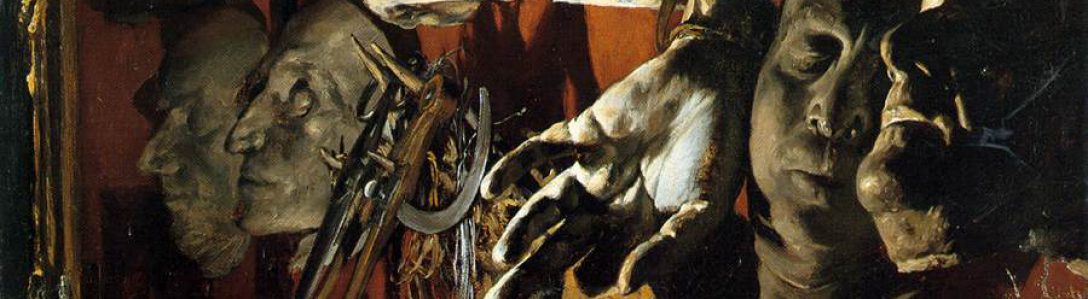
Cage III — Free Show (Infinite Jest)

Cage III — Free Show. B.S. Latrodectus Mactans Productions/Infernatron Animation Concepts, Canada. Cosgrove Watt, P. A. Heaven, Everard Maynell, Pam Heath; partial animation; 35 mm.; 65 minutes; black and white; sound.

The figure of Death (Heath) presides over the front entrance of a carnival sideshow whose spectators watch performers undergo unspeakable degradations so grotesquely compelling that the spectators’ eyes become larger and larger until the spectators themselves are transformed into gigantic eyeballs in chairs, while on the other side of the sideshow tent the figure of Life (Heaven) uses a megaphone to invite fairgoers to an exhibition in which, if the fairgoers consent to undergo unspeakable degradations, they can witness ordinary persons gradually turn into gigantic eyeballs.

INTERLACE TELENT FEATURE CARTRIDGE #357-65-65

From David Foster Wallace’s novel Infinite Jest.

Palm Sunday — Ferdinand Georg Waldmüller

“Porcelain and Pink” — F. Scott Fitzgerald

“Porcelain and Pink” by F. Scott Fitzgerald

A room in the down-stairs of a summer cottage. High around the wall runs an art frieze of a fisherman with a pile of nets at his feet and a ship on a crimson ocean, a fisherman with a pile of nets at his feet and a ship on a crimson ocean, a fisherman with a pile of nets at his feet and so on. In one place on the frieze there is an overlapping—here we have half a fisherman with half a pile of nets at his foot, crowded damply against half a ship on half a crimson ocean. The frieze is not in the plot, but frankly it fascinates me. I could continue indefinitely, but I am distracted by one of the two objects in the room—a blue porcelain bath-tub. It has character, this bath-tub. It is not one of the new racing bodies, but is small with a high tonneau and looks as if it were going to jump; discouraged, however, by the shortness of its legs, it has submitted to its environment and to its coat of sky-blue paint. But it grumpily refuses to allow any patron completely to stretch his legs—which brings us neatly to the second object in the room:

It is a girl—clearly an appendage to the bath-tub, only her head and throat—beautiful girls have throats instead of necks—and a suggestion of shoulder appearing above the side. For the first ten minutes of the play the audience is engrossed in wondering if she really is playing the game fairly and hasn’t any clothes on or whether it is being cheated and she is dressed.

The girl’s name is JULIE MARVIS. From the proud way she sits up in the bath-tub we deduce that she is not very tall and that she carries herself well. When she smiles, her upper tip rolls a little and reminds you of an Easter Bunny, She is within whispering distance of twenty years old.

One thing more—above and to the right of the bath-tub is a window. It is narrow and has a wide sill; it lets in much sunshine, but effectually prevents any one who looks in from seeing the bath-tub. You begin to suspect the plot?

We open, conventionally enough, with a song, but, as the startled gasp of the audience quite drowns out the first half, we will give only the last of it:

JULIE: (In an airy sophrano—enthusiastico)

   When Caesar did the Chicago
He was a graceful child,
Those sacred chickens
Just raised the dickens
The Vestal Virgins went wild.
Whenever the Nervii got nervy
He gave them an awful razz
They shook is their shoes
With the Consular blues
The Imperial Roman Jazz

(During the wild applause that follows JULIE modestly moves her arms and makes waves on the surface of the water—at least we suppose she does. Then the door on the left opens and LOIS MARVIS enters, dressed but carrying garments and towels. LOIS is a year older than JULIE and is nearly her double in face and voice, but in her clothes and expression are the marks of the conservative. Yes, you’ve guessed it. Mistaken identity is the old rusty pivot upon which the plot turns.)

LOIS: (Starting) Oh, ‘scuse me. I didn’t know you were here.

JULIE: Oh, hello. I’m giving a little concert—

LOIS: (Interrupting) Why didn’t you lock the door?

JULIE: Didn’t I?

LOIS: Of course you didn’t. Do you think I just walked through it?

JULIE: I thought you picked the lock, dearest. Continue reading ““Porcelain and Pink” — F. Scott Fitzgerald”

A Pupil of Green Girl’s School, Reading — Annie Margaret Bradley

Copyright Reading Museum Service / Supplied by The Public Catalogue Foundation

Microcosmos (Full Film)


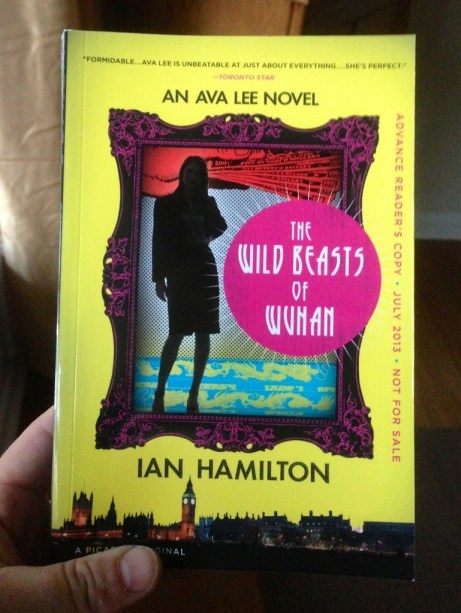
The Wild Beasts of Wuhan (Book Acquired, 3.21.2013)

20130322-135238.jpg

It took me a few minutes to figure out the title of Ian Hamilton’s latest Ava Lee novel, The Wild Beasts of Wuhan—something about the font I guess. The book is out this June from Picador. Blurb from Hamilton’s site:

In The Wild Beasts of Wuhan, Uncle and Ava are summoned by Wong Changxing, “The Emperor of Hubei” and one of the most powerful men in China, when he discovers that the Fauvist paintings he recently acquired are in fact forgeries.

Ava uncovers a ring of fraudulent art dealers and follows their twisted trail to Denmark, the Faroe Islands, Dublin, London, and New York. But the job is further complicated by Wong’s second wife, the cunning and seductive May Ling, who threatens to interfere in Ava’s investigation.

Will Ava find the perpetrators and get the Wongs’ money back? Or will May Ling get to them first…


Jorge Luis Borges Uses Zeno’s Paradox to Describe Kafka’s Literature

I once premeditated making a study of Kafka’s precursors. At first I had considered him to be as singular as the phoenix of rhetorical praise; after frequenting his pages a bit, I came to think I could recognize his voice, or his practices, in texts from diverse literatures and periods. I shall record a few of these here, in chronological order.

The first is Zeno’s paradox against movement. A moving object at A (declares Aristotle) cannot reach point B, because it must first cover half the distance between two points, and before that, half of the half, and before that, half of the half of the half, and so on to infinity; the form of this illustrious problem is, exactly, that of “The Castle”, and the moving object and the arrow and Achilles are the first Kafkian characters in literature.

Read the rest of “Kafka and His Precursors” by Jorge Luis Borges here.

Misshelved

20130323-123116.jpg

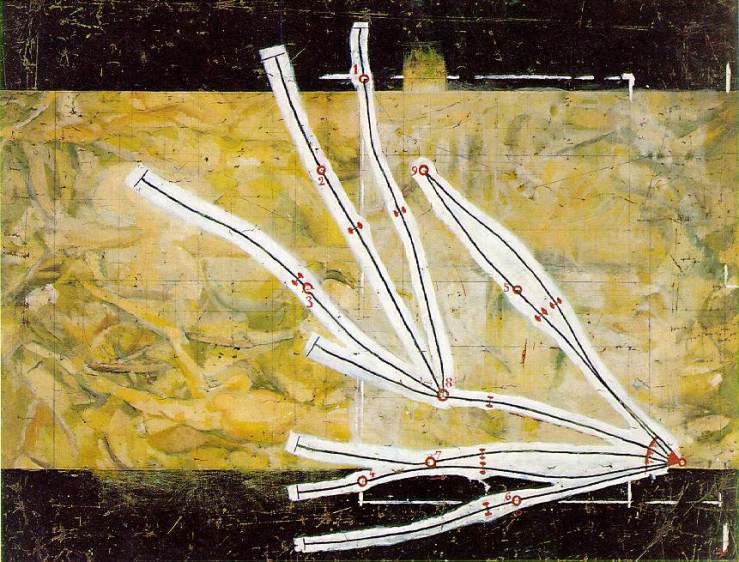
Network of Stoppages — Marcel Duchamp

network-of-stoppages-1914

List with No Name #20

1. Reboot of True Blood as a half-hour sitcom focused on Merlotte’s; Lafayette is the star, that red headed chick is his sidekick, and Sookie is nowhere in sight.

2. Reboot/sequel of Battlestar Galactica that picks up right where the second reboot ended, in modern-day New York City. No sci-fi elements. The series is simply a dull soap opera.

3. Girls/Game of Thrones mashup; the Khaleesi sends her dragons to eat privileged white people in Brooklyn. The series is over in about 4 minutes.

4. Sequel to The Wire that takes place entirely in your imagination; you occasionally muddle key details.

5. Reboot of Mad Men as insufferable single-camera faux documentary 30 minute sitcom featuring direct-to-camera interviews, etc.

6. A fourth season of Bored to Death; each episode is 8 minutes long and embedded as a series of “commercial breaks” into random late-night infomercials.

7. Reboot of Family Ties as a serious one hour drama / secret mash-up with Batttlestar Galactica (Dad Keaton begins to suspect that Alex is a cylcon—or is he a cylon himself?!).

8. American version of Downton Abbey that lasts nine seasons longer than the British version.

9. Nine hour miniseries sequel to Xena: Warrior Princess.

10. Reboot of The Sopranos in the style of Real Housewives of New Jersey.

11. Reboot of Freaks and Geeks that gets canceled after one season but no one from the show moves on to any measure of fame or success.

12. Reboot of Seinfeld as a series of dramatic monologues performed by subterranean survivors of some unnameable apocalypse.

13. Reboot of Breaking Bad without cancer, meth, crime plots. Series is about a high school teacher and his family.

14. Reboot of Entourage as a first-person shooter video game where players can repeatedly execute the characters.

15. A fourth season of Deadwood.

“Samples of My Common-Place Book” — Walt Whitman

“Samples of My Common-place Book” — Walt Whitman (from Specimen Days)

I ought not to offer a record of these days, interests, recuperations, without including a certain old, well-thumb’d common-place book,[18] filled with favorite excerpts, I carried in my pocket for three summers, and absorb’d over and over again, when the mood invited. I find so much in having a poem or fine suggestion sink into me (a little then goes a great ways) prepar’d by these vacant-sane and natural influences.

 Samples of my common-place book down at the creek:

I have—says old Pindar—many swift arrows in my quiver which speak to the wise, though they need an interpreter to the thoughtless. Such a man as it takes ages to make, and ages to understand. H. D. Thoreau.

If you hate a man, don’t kill him, but let him live.—Buddhistic.
Famous swords are made of refuse scraps, thought worthless.

Poetry is the only verity—the expression of a sound mind speaking after the ideal—and not after the apparent.—Emerson.

The form of oath among the Shoshone Indians is, “The earth hears me.
The sun hears me. Shall I lie?”

The true test of civilization is not the census, nor the size of cities, nor the crops—no, but the kind of a man the country turns out.—Emerson.

    The whole wide ether is the eagle’s sway:
The whole earth is a brave man’s fatherland.—Euripides.

    Spices crush’d, their pungence yield,
Trodden scents their sweets respire;
Would you have its strength reveal’d?
Cast the incense in the fire.

Matthew Arnold speaks of “the huge Mississippi of falsehood called
History.”

    The wind blows north, the wind blows south,
The wind blows east and west;
No matter how the free wind blows,
Some ship will find it best.

Preach not to others what they should eat, but eat as becomes you, and be silent.—Epictetus.

Victor Hugo makes a donkey meditate and apostrophize thus:

    My brother, man, if you would know the truth,
We both are by the same dull walls shut in;
The gate is massive and the dungeon strong.
But you look through the key-hole out beyond,
And call this knowledge; yet have not at hand
The key wherein to turn the fatal lock.

“William Cullen Bryant surprised me once,” relates a writer in a New York paper, “by saying that prose was the natural language of composition, and he wonder’d how anybody came to write poetry.”

    Farewell! I did not know thy worth;
But thou art gone, and now ’tis prized:
So angels walk’d unknown on earth,
But when they flew were recognized.—Hood.

John Burroughs, writing of Thoreau, says: “He improves with age—in fact requires age to take off a little of his asperity, and fully ripen him. The world likes a good hater and refuser almost as well as it likes a good lover and accepter—only it likes him farther off.”

Louise Michel at the burial of Blanqui, (1881.)

Blanqui drill’d his body to subjection to his grand conscience and his noble passions, and commencing as a young man, broke with all that is sybaritish in modern civilization. Without the power to sacrifice self, great ideas will never bear fruit.

    Out of the leaping furnace flame
A mass of molten silver came;
Then, beaten into pieces three,
Went forth to meet its destiny.
The first a crucifix was made,
Within a soldier’s knapsack laid;
The second was a locket fair,
Where a mother kept her dead child’s hair;
The third—a bangle, bright and warm,
Around a faithless woman’s arm.

    A mighty pain to love it is,
And’tis a pain that pain to miss;
But of all pain the greatest pain,
It is to love, but love in vain.

Maurice F. Egan on De Guerin.

    A pagan heart, a Christian soul had he,
He followed Christ, yet for dead Pan he sigh’d,
Till earth and heaven met within his breast:
As if Theocritus in Sicily
Had come upon the Figure crucified,
And lost his gods in deep, Christ-given rest.

    And if I pray, the only prayer
That moves my lips for me,
Is, leave the mind that now I bear,
And give me Liberty.—Emily Bronte.

    I travel on not knowing,
I would not if I might;
I would rather walk with God in the dark,
Than go alone in the light;
I would rather walk with Him by faith
Than pick my way by sight


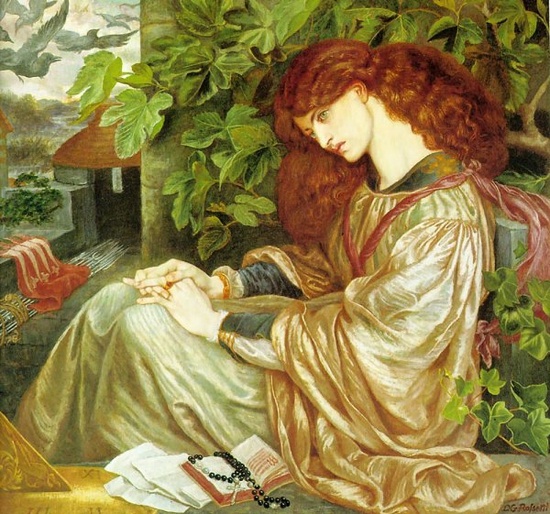
La Pia de’ Tolomei — Dante Gabriel Rossetti

1e562a1d6163fcb813dd68de136888a5

Family Nest — Béla Tarr (Full Film with English Subtitles)

“Your first nightmare away from home” (Infinite Jest)

Your first nightmare away from home and folks, your first night at the Academy, it was there all along: The dream is that you awaken from a deep sleep, wake up suddenly damp and panicked and are overwhelmed with the sudden feeling that there is a distillation of total evil in this dark strange subdorm room with you, that evil’s essence and center is right here, in this room, right now. And is for you alone. None of the other little boys in the room are awake; the bunk above yours sags dead, motionless; no one moves; no one else in the room feels the presence of something radically evil; none thrash or sit damply up; no one else cries out: whatever it is is not evil for them. The flashlight your mother name-tagged with masking tape and packed for you special pans around the institutional room: the drop-ceiling, the gray striped mattress and bulged grid of bunksprings above you, the two other bunkbeds another matte gray that won’t return light, the piles of books and compact disks and tapes and tennis gear; your disk of white light trembling like the moon on water as it plays over the identical bureaus, the recessions of closet and room’s front door, door’s frame’s bolections; the cone of light pans over fixtures, the lumpy jumbles of sleeping boys’ shadows on the snuff-white walls, the two rag throw-rugs’ ovals on the hardwood floor, black lines of baseboards’ reglets, the cracks in the Venetian blinds that ooze the violet nonlight of a night with snow and just a hook of moon; the flashlight with your name in maternal cursive plays over every cm. of the walls, the rheostats, CD, Inter-Lace poster of Tawni Kondo, phone console, desks’ TPs, the face in the floor, posters of pros, the onionskin yellow of the desklamps’ shades, the ceiling-panels’ patterns of pinholes, the grid of upper bunk’s springs, recession of closet and door, boys wrapped in blankets, slight crack like a creek’s course in the eastward ceiling discernible now, maple reglet border at seam of ceiling and walls north and south no floor has a face your flashlight showed but didn’t no never did see its eyes’ pupils set sideways and tapered like a cat’s its eyebrows’ \ / and horrid toothy smile leering right at your light all the time you’ve been scanning oh mother a face in the floor mother oh and your flashlight’s beam stabs jaggedly back for the overlooked face misses it overcorrects then centers on what you’d felt but had seen without seeing, just now, as you’d so carefully panned the light and looked, a face in the floor there all the time but unfelt by all others and unseen by you until you knew just as you felt it didn’t belong and was evil: Evil.

And then its mouth opens at your light.

And then you wake like that, quivering like a struck drum, lying there awake and quivering, summoning courage and spit, roll to the right just as in the dream for the nametagged flashlight on the floor by the bed just in case, lie there on your shank and side, shining the light all over, just as in the dream. Lie there panning, looking, all ribs and elbows and dilated eyes. The awake floor is littered with gear and dirty clothes, blond hardwood with sealed seams, two throw-rugs, the bare waxed wood shiny in the windows’ snowlight, the floor neutral, faceless, you cannot see any face in the floor, awake, lying there, faceless, blank, dilated, playing beam over floor again and again, not sure all night forever unsure you’re not missing something that’s right there: you lie there, awake and almost twelve, believing with all your might.

From David Foster Wallace’s Infinite Jest.