Girl Reading by the Water — Camille Corot

girl-reading-by-the-water

Aguirre, The Wrath of God — Werner Herzog (Full Film)

“…over any ignominious blemish in him all his fellows should run to throw their costliest robes” (Moby-Dick)

Men may seem detestable as joint stock-companies and nations; knaves, fools, and murderers there may be; men may have mean and meagre faces; but man, in the ideal, is so noble and so sparkling, such a grand and glowing creature, that over any ignominious blemish in him all his fellows should run to throw their costliest robes. That immaculate manliness we feel within ourselves, so far within us, that it remains intact though all the outer character seem gone; bleeds with keenest anguish at the undraped spectacle of a valor-ruined man. Nor can piety itself, at such a shameful sight, completely stifle her upbraidings against the permitting stars. But this august dignity I treat of, is not the dignity of kings and robes, but that abounding dignity which has no robed investiture. Thou shalt see it shining in the arm that wields a pick or drives a spike; that democratic dignity which, on all hands, radiates without end from God; Himself! The great God absolute! The centre and circumference of all democracy! His omnipresence, our divine equality!

From Chapter 26 of Herman Melville’s Moby-Dick.


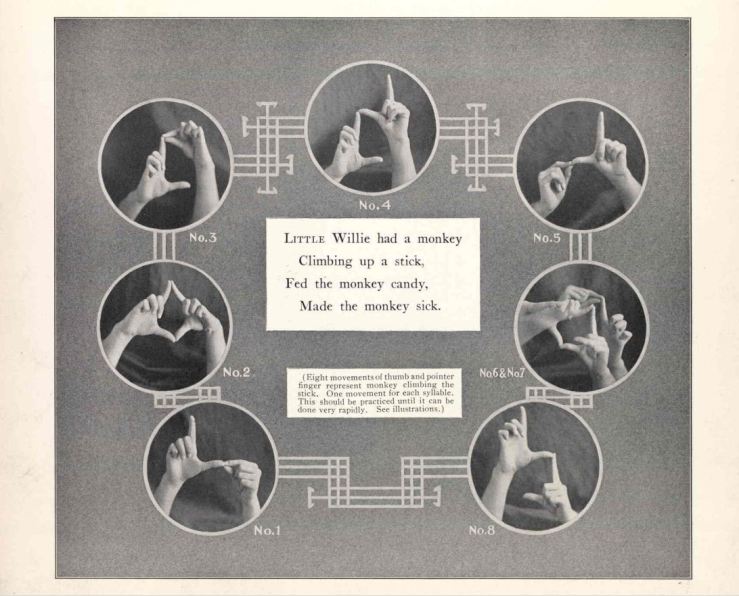
“Little Willie had a monkey / Climbing up a stick”

little willie

(More/via).

Hüsker Dü Plays Some Songs, Chats with Joan Rivers

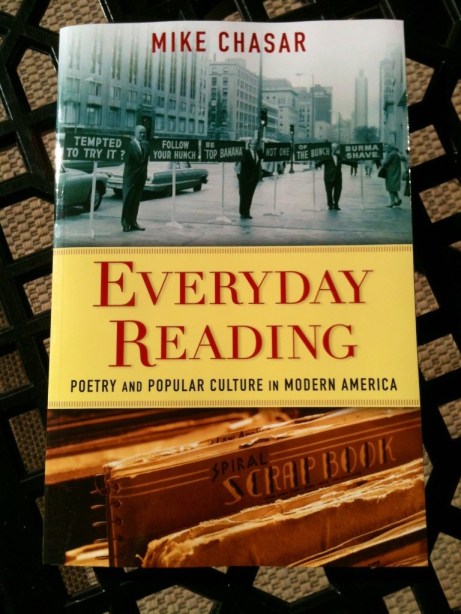
Everyday Reading: Poetry and Popular Culture in America (Book Acquired, Sometime in December of 2012)

20130105-110115.jpg

I got a little lax with these “books acquired” posts at the end of last year—chalk it up to end of semester deadlines and meetings, family-oriented holiday stuff, and an awful illness. Anyway–

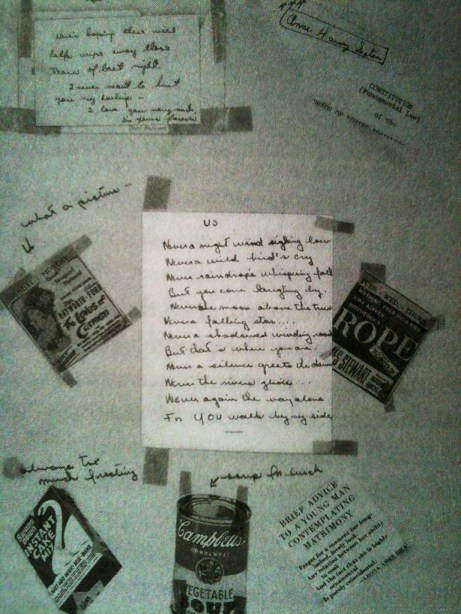
Mike Chasar’s Everyday Reading: Poetry and Popular Culture in Modern America, new from Columbia University Press is pretty cool: it’s kind of a dialogic study of how poetry evinces (or infiltrates or collides or emerges from or is bound by) a variety of popular media. Some of the most fascinating chapters dwell on scrapbooking. Here’s Columbia U of P’s blurb:

Exploring poetry scrapbooks, old-time radio show recordings, advertising verse, corporate archives, and Hallmark greeting cards, among other unconventional sources, Mike Chasar casts American poetry as an everyday phenomenon consumed and created by a vast range of readers. He shows how American poetry in the first half of the twentieth century and its reception helped set the stage for the dynamics of popular culture and mass media today.

Poetry was then part and parcel of American popular culture, spreading rapidly as the consumer economy expanded and companies exploited its profit-making potential. Poetry also offered ordinary Americans creative, emotional, political, and intellectual modes of expression, whether through scrapbooking, participation in radio programs, or poetry contests. Reenvisioning the uses of twentieth-century poetry, Chasar provides a richer understanding of the innovations of modernist and avant-garde poets and the American reading public’s sophisticated powers of feeling and perception.

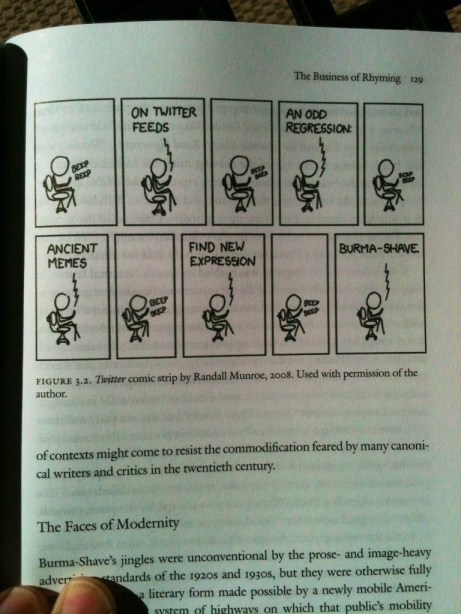
A couple of snaps from the book—pics of pages from one of those scrapbooks—

20130105-110232.jpg

20130105-110245.jpg

And—

20130105-110159.jpg

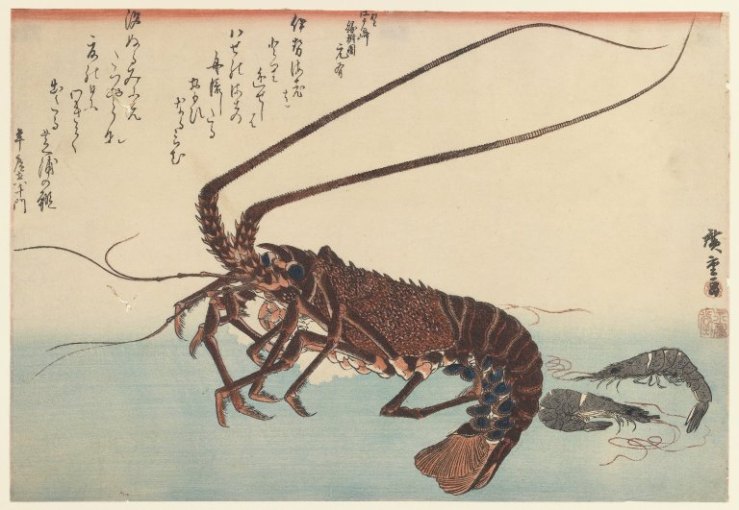
Crayfish — Hiroshige

crayfish-and-two-shrimps-1845

“How the Whale Got His Throat” — Rudyard Kipling

“How the Whale Got His Throat” — Rudyard Kipling

IN the sea, once upon a time, O my Best Beloved, there was a Whale, and he ate fishes. He ate the starfish and the garfish, and the crab and the dab, and the plaice and the dace, and the skate and his mate, and the mackereel and the pickereel, and the really truly twirly-whirly eel. All the fishes he could find in all the sea he ate with his mouth—so! Till at last there was only one small fish left in all the sea, and he was a small ‘Stute Fish, and he swam a little behind the Whale’s right ear, so as to be out of harm’s way. Then the Whale stood up on his tail and said, ‘I’m hungry.’ And the small ‘Stute Fish said in a small ‘stute voice, ‘Noble and generous Cetacean, have you ever tasted Man?’

‘No,’ said the Whale. ‘What is it like?’

‘Nice,’ said the small ‘Stute Fish. ‘Nice but nubbly.’

‘Then fetch me some,’ said the Whale, and he made the sea froth up with his tail.

‘One at a time is enough,’ said the ‘Stute Fish. ‘If you swim to latitude Fifty North, longitude Forty West (that is magic), you will find, sitting on a raft, in the middle of the sea, with nothing on but a pair of blue canvas breeches, a pair of suspenders (you must not forget the suspenders, Best Beloved), and a jack-knife, one ship-wrecked Mariner, who, it is only fair to tell you, is a man of infinite-resource-and-sagacity.’

So the Whale swam and swam to latitude Fifty North, longitude Forty West, as fast as he could swim, and on a raft, in the middle of the sea, with nothing to wear except a pair of blue canvas breeches, a pair of suspenders (you must particularly remember the suspenders, Best Beloved), and a jack-knife, he found one single, solitary shipwrecked Mariner, trailing his toes in the water. (He had his mummy’s leave to paddle, or else he would never have done it, because he was a man of infinite-resource-and-sagacity.)

Then the Whale opened his mouth back and back and back till it nearly touched his tail, and he swallowed the shipwrecked Mariner, and the raft he was sitting on, and his blue canvas breeches, and the suspenders (which you must not forget), and the jack-knife—He swallowed them all down into his warm, dark, inside cup-boards, and then he smacked his lips—so, and turned round three times on his tail.

But as soon as the Mariner, who was a man of infinite-resource-and-sagacity, found himself truly inside the Whale’s warm, dark, inside cup-boards, he stumped and he jumped and he thumped and he bumped, and he pranced and he danced, and he banged and he clanged, and he hit and he bit, and he leaped and he creeped, and he prowled and he howled, and he hopped and he dropped, and he cried and he sighed, and he crawled and he bawled, and he stepped and he lepped, and he danced hornpipes where he shouldn’t, and the Whale felt most unhappy indeed. (Have you forgotten the suspenders?)

So he said to the ‘Stute Fish, ‘This man is very nubbly, and besides he is making me hiccough. What shall I do?’

‘Tell him to come out,’ said the ‘Stute Fish.

So the Whale called down his own throat to the shipwrecked Mariner, ‘Come out and behave yourself. I’ve got the hiccoughs.’

‘Nay, nay!’ said the Mariner. ‘Not so, but far otherwise. Take me to my natal-shore and the white-cliffs-of-Albion, and I’ll think about it.’ And he began to dance more than ever.

‘You had better take him home,’ said the ‘Stute Fish to the Whale.

‘I ought to have warned you that he is a man of infinite-resource-and-sagacity.’

So the Whale swam and swam and swam, with both flippers and his tail, as hard as he could for the hiccoughs; and at last he saw the Mariner’s natal-shore and the white-cliffs-of-Albion, and he rushed half-way up the beach, and opened his mouth wide and wide and wide, and said, ‘Change here for Winchester, Ashuelot, Nashua, Keene, and stations on the Fitchburg Road;’ and just as he said ‘Fitch’ the Mariner walked out of his mouth. But while the Whale had been swimming, the Mariner, who was indeed a person of infinite-resource-and-sagacity, had taken his jack-knife and cut up the raft into a little square grating all running criss-cross, and he had tied it firm with his suspenders (now, you know why you were not to forget the suspenders!), and he dragged that grating good and tight into the Whale’s throat, and there it stuck! Then he recited the following Sloka, which, as you have not heard it, I will now proceed to relate—

By means of a grating

I have stopped your ating.

For the Mariner he was also an Hi-ber-ni-an. And he stepped out on the shingle, and went home to his mother, who had given him leave to trail his toes in the water; and he married and lived happily ever afterward. So did the Whale. But from that day on, the grating in his throat, which he could neither cough up nor swallow down, prevented him eating anything except very, very small fish; and that is the reason why whales nowadays never eat men or boys or little girls.

The small ‘Stute Fish went and hid himself in the mud under the Door-sills of the Equator. He was afraid that the Whale might be angry with him.

The Sailor took the jack-knife home. He was wearing the blue canvas breeches when he walked out on the shingle. The suspenders were left behind, you see, to tie the grating with; and that is the end of that tale.

WHEN the cabin port-holes are dark and green

Because of the seas outside;

When the ship goes wop (with a wiggle between)

And the steward falls into the soup-tureen,

And the trunks begin to slide;

When Nursey lies on the floor in a heap,

And Mummy tells you to let her sleep,

And you aren’t waked or washed or dressed,

Why, then you will know (if you haven’t guessed)

You’re ‘Fifty North and Forty West!’

 

The Letter — Julian Alden Weir

the-letter

The Temptation of St. Anthony — Ivan Albright

the-temptation-of-st-anthony-1945

Faust — F.W. Murnau (Full Film, 1926)

“Emily Dickinson” — Wendy Cope

“Emily Dickinson” by Wendy Cope:

Higgledy-piggledy
Emily Dickinson
Liked to use dashes
Instead of full stops.

Nowadays, faced with such
Idiosyncrasy,
Critics and editors
Send for the cops.

“Edgar Poe’s Significance” — Walt Whitman

“Edgar Poe’s Significance” by Walt Whitman. From Specimen Days.

Jan. 1, ’80.—In diagnosing this disease called humanity—to assume for the nonce what seems a chief mood of the personality and writings of my subject—I have thought that poets, somewhere or other on the list, present the most mark’d indications. Comprehending artists in a mass, musicians, painters, actors, and so on, and considering each and all of them as radiations or flanges of that furious whirling wheel, poetry, the centre and axis of the whole, where else indeed may we so well investigate the causes, growths, tally-marks of the time—the age’s matter and malady?

By common consent there is nothing better for man or woman than a perfect and noble life, morally without flaw, happily balanced in activity, physically sound and pure, giving its due proportion, and no more, to the sympathetic, the human emotional element—a life, in all these, unhasting, unresting, untiring to the end. And yet there is another shape of personality dearer far to the artist-sense, (which likes the play of strongest lights and shades,) where the perfect character, the good, the heroic, although never attain’d, is never lost sight of, but through failures, sorrows, temporary downfalls, is return’d to again and again, and while often violated, is passionately adhered to as long as mind, muscles, voice, obey the power we call volition. This sort of personality we see more or less in Burns, Byron, Schiller, and George Sand. But we do not see it in Edgar Poe. (All this is the result of reading at intervals the last three days a new volume of his poems—I took it on my rambles down by the pond, and by degrees read it all through there.) While to the character first outlined the service Poe renders is certainly that entire contrast and contradiction which is next best to fully exemplifying it.

Almost without the first sign of moral principle, or of the concrete or its heroisms, or the simpler affections of the heart, Poe’s verses illustrate an intense faculty for technical and abstract beauty, with the rhyming art to excess, an incorrigible propensity toward nocturnal themes, a demoniac undertone behind every page—and, by final judgment, probably belong among the electric lights of imaginative literature, brilliant and dazzling, but with no heat. There is an indescribable magnetism about the poet’s life and reminiscences, as well as the poems. To one who could work out their subtle retracing and retrospect, the latter would make a close tally no doubt between the author’s birth and antecedents, his childhood and youth, his physique, his so-call’d education, his studies and associates, the literary and social Baltimore, Richmond, Philadelphia and New York, of those times—not only the places and circumstances in themselves, but often, very often, in a strange spurning of, and reaction from them all.

The following from a report in the Washington “Star” of November 16, 1875, may afford those who care for it something further of my point of view toward this interesting figure and influence of our era. There occurr’d about that date in Baltimore a public reburial of Poe’s remains, and dedication of a monument over the grave:

“Being in Washington on a visit at the time, ‘the old gray’ went over to Baltimore, and though ill from paralysis, consented to hobble up and silently take a seat on the platform, but refused to make any speech, saying, ‘I have felt a strong impulse to come over and be here to-day myself in memory of Poe, which I have obey’d, but not the slightest impulse to make a speech, which, my dear friends, must also be obeyed.’ In an informal circle, however, in conversation after the ceremonies, Whitman said: ‘For a long while, and until lately, I had a distaste for Poe’s writings. I wanted, and still want for poetry, the clear sun shining, and fresh air blowing—the strength and power of health, not of delirium, even amid the stormiest passions—with always the background of the eternal moralities. Non-complying with these requirements, Poe’s genius has yet conquer’d a special recognition for itself, and I too have come to fully admit it, and appreciate it and him.

“‘In a dream I once had, I saw a vessel on the sea, at midnight, in a storm. It was no great full-rigg’d ship, nor majestic steamer, steering firmly through the gale, but seem’d one of those superb little schooner yachts I had often seen lying anchor’d, rocking so jauntily, in the waters around New York, or up Long Island sound—now flying uncontroll’d with torn sails and broken spars through the wild sleet and winds and waves of the night. On the deck was a slender, slight, beautiful figure, a dim man, apparently enjoying all the terror, the murk, and the dislocation of which he was the centre and the victim. That figure of my lurid dream might stand for Edgar Poe, his spirit, his fortunes, and his poems—themselves all lurid dreams.'”

Much more may be said, but I most desired to exploit the idea put at the beginning. By its popular poets the calibres of an age, the weak spots of its embankments, its sub-currents, (often more significant than the biggest surface ones,) are unerringly indicated. The lush and the weird that have taken such extraordinary possession of Nineteenth century verse-lovers—what mean they? The inevitable tendency of poetic culture to morbidity, abnormal beauty—the sickliness of all technical thought or refinement in itself—the abnegation of the perennial and democratic concretes at first hand, the body, the earth and sea, sex and the like—and the substitution of something for them at second or third hand—what bearings have they on current pathological study?

Badger — Kit Williams

badger-1979

New Mutants Cover — Bill Sienkiewicz

tumblr_ma7xgf4fWF1r93mfqo1_1280

(Via).

“The Four Fists” — F. Scott Fitzgerald

“The Four Fists” — F. Scott Fitzgerald

At the present time no one I know has the slightest desire to hit Samuel Meredith; possibly this is because a man over fifty is liable to be rather severely cracked at the impact of a hostile fist, but, for my part, I am inclined to think that all his hitable qualities have quite vanished. But it is certain that at various times in his life hitable qualities were in his face, as surely as kissable qualities have ever lurked in a girl’s lips.

I’m sure every one has met a man like that, been casually introduced, even made a friend of him, yet felt he was the sort who aroused passionate dislike—expressed by some in the involuntary clinching of fists, and in others by mutterings about “takin’ a poke” and “landin’ a swift smash in ee eye.” In the juxtaposition of Samuel Meredith’s features this quality was so strong that it influenced his entire life.

What was it? Not the shape, certainly, for he was a pleasant-looking man from earliest youth: broad-bowed with gray eyes that were frank and friendly. Yet I’ve heard him tell a room full of reporters angling for a “success” story that he’d be ashamed to tell them the truth that they wouldn’t believe it, that it wasn’t one story but four, that the public would not want to read about a man who had been walloped into prominence.

It all started at Phillips Andover Academy when he was fourteen. He had been brought up on a diet of caviar and bell-boys’ legs in half the capitals of Europe, and it was pure luck that his mother had nervous prostration and had to delegate his education to less tender, less biassed hands.

At Andover he was given a roommate named Gilly Hood. Gilly was thirteen, undersized, and rather the school pet. From the September day when Mr. Meredith’s valet stowed Samuel’s clothing in the best bureau and asked, on departing, “hif there was hanything helse, Master Samuel?” Gilly cried out that the faculty had played him false. He felt like an irate frog in whose bowl has been put goldfish. Continue reading ““The Four Fists” — F. Scott Fitzgerald”

A Lady Reading — Gwen John

A Lady Reading 1909-11 by Gwen John 1876-1939