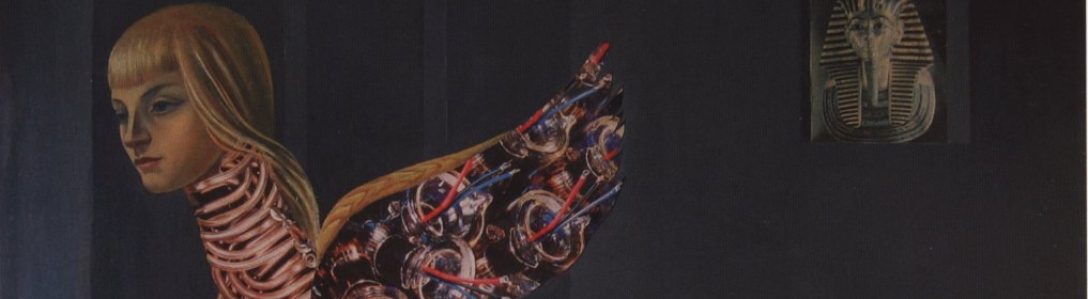
Snakes — M.C. Escher

Charles Bukowski’s Worst Hangover

“The Right Eye of the Commander” — Bret Harte

“The Right Eye of the Commander” — Bret Harte

The year of grace 1797 passed away on the coast of California in a southwesterly gale. The little bay of San Carlos, albeit sheltered by the headlands of the blessed Trinity, was rough and turbulent; its foam clung quivering to the seaward wall of the Mission garden; the air was filled with flying sand and spume, and as the Senor Commandante, Hermenegildo Salvatierra, looked from the deep embrasured window of the Presidio guardroom, he felt the salt breath of the distant sea buffet a color into his smoke-dried cheeks.

The Commander, I have said, was gazing thoughtfully from the window of the guardroom. He may have been reviewing the events of the year now about to pass away. But, like the garrison at the Presidio, there was little to review; the year, like its predecessors, had been uneventful—the days had slipped by in a delicious monotony of simple duties, unbroken by incident or interruption. The regularly recurring feasts and saints’ days, the half-yearly courier from San Diego, the rare transport ship and rarer foreign vessel, were the mere details of his patriarchal life. If there was no achievement, there was certainly no failure. Abundant harvests and patient industry amply supplied the wants of Presidio and Mission. Isolated from the family of nations, the wars which shook the world concerned them not so much as the last earthquake; the struggle that emancipated their sister colonies on the other side of the continent to them had no suggestiveness. In short, it was that glorious Indian summer of California history around which so much poetical haze still lingers—that bland, indolent autumn of Spanish rule, so soon to be followed by the wintry storms of Mexican independence and the reviving spring of American conquest.

The Commander turned from the window and walked toward the fire that burned brightly on the deep ovenlike hearth. A pile of copybooks, the work of the Presidio school, lay on the table. As he turned over the leaves with a paternal interest, and surveyed the fair round Scripture text—the first pious pothooks of the pupils of San Carlos—an audible commentary fell from his lips: “‘Abimelech took her from Abraham’—ah, little one, excellent!—’Jacob sent to see his brother’—body of Christ! that upstroke of thine, Paquita, is marvelous; the Governor shall see it!” A film of honest pride dimmed the Commander’s left eye—the right, alas! twenty years before had been sealed by an Indian arrow. He rubbed it softly with the sleeve of his leather jacket, and continued: “‘The Ishmaelites having arrived—'”

He stopped, for there was a step in the courtyard, a foot upon the threshold, and a stranger entered. With the instinct of an old soldier, the Commander, after one glance at the intruder, turned quickly toward the wall, where his trusty Toledo hung, or should have been hanging. But it was not there, and as he recalled that the last time he had seen that weapon it was being ridden up and down the gallery by Pepito, the infant son of Bautista, the tortilla-maker, he blushed and then contented himself with frowning upon the intruder. Continue reading ““The Right Eye of the Commander” — Bret Harte”

The Reading — Federico Zandomeneghi

Stańczyk During a Ball at the Court of Queen — Jan Matejko

“Old and New Year Ditties” — Christina Rossetti

“Old and New Year Ditties” by Christina Rossetti

I

New Year met me somewhat sad:
Old Year leaves me tired,
Stripped of favourite things I had
Baulked of much desired:
Yet farther on my road to-day
God willing, farther on my way.

New Year coming on apace
What have you to give me?
Bring you scathe, or bring you grace,
Face me with an honest face;
You shall not deceive me:
Be it good or ill, be it what you will,
It needs shall help me on my road,
My rugged way to heaven, please God.

II

Watch with me, men, women, and children dear,
You whom I love, for whom I hope and fear,
Watch with me this last vigil of the year.
Some hug their business, some their pleasure-scheme;
Some seize the vacant hour to sleep or dream;
Heart locked in heart some kneel and watch apart.

Watch with me blessèd spirits, who delight
All through the holy night to walk in white,
Or take your ease after the long-drawn fight.
I know not if they watch with me: I know
They count this eve of resurrection slow,
And cry, “How long?” with urgent utterance strong.

Watch with me Jesus, in my loneliness:
Though others say me nay, yet say Thou yes;
Though others pass me by, stop Thou to bless.
Yea, Thou dost stop with me this vigil night;
To-night of pain, to-morrow of delight:
I, Love, am Thine; Thou, Lord my God, art mine.

III

Passing away, saith the World, passing away:
Chances, beauty and youth sapped day by day:
Thy life never continueth in one stay.
Is the eye waxen dim, is the dark hair changing to grey
That hath won neither laurel nor bay?
I shall clothe myself in Spring and bud in May:
Thou, root-stricken, shalt not rebuild thy decay
On my bosom for aye.
Then I answered: Yea.

Passing away, saith my Soul, passing away:
With its burden of fear and hope, of labour and play;
Hearken what the past doth witness and say:
Rust in thy gold, a moth is in thine array,
A canker is in thy bud, thy leaf must decay.
At midnight, at cockcrow, at morning, one certain day
Lo, the Bridegroom shall come and shall not delay:
Watch thou and pray.
Then I answered: Yea.

Passing away, saith my God, passing away:
Winter passeth after the long delay:
New grapes on the vine, new figs on the tender spray,
Turtle calleth turtle in Heaven’s May.
Though I tarry wait for Me, trust Me, watch and pray:
Arise, come away, night is past and lo it is day,
My love, My sister, My spouse, thou shalt hear Me say.
Then I answered: Yea.


R.I.P. 2012

RIP Charles Durning

RIP Pandit Ravi Shankar

RIP Comix Legend Spain Rodriguez

RIP Roy Bates, Prince of Sealand

RIP Tony Scott

RIP Joe Kubert

RIP Robert Hughes

RIP Gore Vidal

RIP Chris Marker

RIP Mystery Writer Donald J. Sobol, Creator of Encyclopedia Brown

RIP Andrew Sarris

RIP Ray Bradbury

RIP Doc Watson

RIP Carlos Fuentes

RIP Maurice Sendak

RIP Adam Yauch

RIP Levon Helm

RIP Neil Armstrong

RIP Cynthia Dall

RIP Harry Crews, an Underappreciated Southern Great

RIP Jean Giraud aka Moebius

RIP Mike Kelley

RIP Etta James

RIP Davy Jones

RIP Earl Scuggs

The Lion of St. Mark — Vittore Carpaccio

if . . . . — Lindsay Anderson (Full Film)

(Read my review).

Pond Pass — Neil Welliver

Slow Century (2002 Pavement Documentary)

“New Year’s Eve” / “New Year’s Night” — D.H.Lawrence

Two poems by D.H. Lawrence:

“New Year’s Eve”—

There are only two things now,
The great black night scooped out
And this fire-glow.

This fire-glow, the core,
And we the two ripe pips
That are held in store.

Listen, the darkness rings
As it circulates round our fire.
Take off your things.

Your shoulders, your bruised throat!
Your breasts, your nakedness!
This fiery coat!

As the darkness flickers and dips,
As the firelight falls and leaps
From your feet to your lips!

“New Year’s Night”—

Now you are mine, to-night at last I say it;
You’re a dove I have bought for sacrifice,
And to-night I slay it.

Here in my arms my naked sacrifice!
Death, do you hear, in my arms I am bringing
My offering, bought at great price.

She’s a silvery dove worth more than all I’ve got.
Now I offer her up to the ancient, inexorable God,
Who knows me not.

Look, she’s a wonderful dove, without blemish or spot!
I sacrifice all in her, my last of the world,
Pride, strength, all the lot.

All, all on the altar! And death swooping down
Like a falcon. ’Tis God has taken the victim;
I have won my renown.


Book Shelves #53, 12.30.2012 (Final Entry)

Book shelves series #53, fifty-third—and final!—Sunday of 2012: In which I take a few photos at random.

I somehow managed to squeeze 52 weeks of shots out of all the book-bearing surfaces of my home (—oh—I did one week from my office).

For the last in this series (yay!) I simply walked through the rooms of the house, took a few shots, and then put them in digital frames.

For the most part, my method was thoughtless, although I did grab a pic of a bookcase new to our house (second pic, top left) that dominates my son’s room.

I also took a pic of Perec’s essay collection because one of his essays inspired this (awful, awful) project.

From that essay, “The Art and Manner of Arranging One’s Books”:

We should first of all distinguish stable classifications from provisional ones. Stable classifications are those which, in principle, you continue to respect; provisional classifications are those supposed to last only a few days, the time it takes for a book to discover, or rediscover, its definitive place. This may be a book recently acquired and not read yet, or else a book recently read that you don’t quite know where to place and which you have promised to yourself you will put away on the occasion of a forthcoming ‘great arranging’, or else a book whose reading has been interrupted and that you don’t to classify before taking it up again and finishing it, or else a book you have used constantly over a given period, or else a book you have taken down to look up a piece of information or a reference and which you haven’t yet put back in its place, or else a book that you can’t put back in its place, or else a book that you can’t put back in its rightful place because it doesn’t belong to you and you’ve several times promised to give it back, etc.

20121230-103829.jpg

20121230-103740.jpg

20121230-103752.jpg

20121230-103804.jpg

So, what did I get out of doing this project?

1. Photographing books is difficult—I mean physically. They all reflect light differently.

2. Doing a regularly-scheduled project is difficult.

3. I have too many books.

Okay. That’s it. Finis.

Garden Hose — Edith Vonnegut

“The Whale Tooth” — Jack London

“The Whale Tooth” by Jack London

It was in the early days in Fiji, when John Starhurst arose in the mission house at Rewa Village and announced his intention of carrying the gospel throughout all Viti Levu. Now Viti Levu means the “Great Land,” it being the largest island in a group composed of many large islands, to say nothing of hundreds of small ones. Here and there on the coasts, living by most precarious tenure, was a sprinkling of missionaries, traders, bêche-de-mer fishers, and whaleship deserters. The smoke of the hot ovens arose under their windows, and the bodies of the slain were dragged by their doors on the way to the feasting.

The Lotu, or the Worship, was progressing slowly, and, often, in crablike fashion. Chiefs, who announced themselves Christians and were welcomed into the body of the chapel, had a distressing habit of backsliding in order to partake of the flesh of some favorite enemy. Eat or be eaten had been the law of the land; and eat or be eaten promised to remain the law of the land for a long time to come. There were chiefs, such as Tanoa, Tuiveikoso, and Tuikilakila, who had literally eaten hundreds of their fellow men. But among these gluttons Ra Undreundre ranked highest. Ra Undreundre lived at Takiraki. He kept a register of his gustatory exploits. A row of stones outside his house marked the bodies he had eaten. This row was two hundred and thirty paces long, and the stones in it numbered eight hundred and seventy-two. Each stone represented a body. The row of stones might have been longer, had not Ra Undreundre unfortunately received a spear in the small of his back in a bush skirmish on Somo Somo and been served up on the table of Naungavuli, whose mediocre string of stones numbered only forty-eight.

The hard-worked, fever-stricken missionaries stuck doggedly to their task, at times despairing, and looking forward for some special manifestation, some outburst of Pentecostal fire that would bring a glorious harvest of souls. But cannibal Fiji had remained obdurate. The frizzle-headed man-eaters were loath to leave their fleshpots so long as the harvest of human carcases was plentiful. Sometimes, when the harvest was too plentiful, they imposed on the missionaries by letting the word slip out that on such a day there would be a killing and a barbecue. Promptly the missionaries would buy the lives of the victims with stick tobacco, fathoms of calico, and quarts of trade beads. Natheless the chiefs drove a handsome trade in thus disposing of their surplus live meat. Also, they could always go out and catch more. Continue reading ““The Whale Tooth” — Jack London”

Duke of Alba — Francisco Goya