Grammar — Gentile da Fabriano

Walt Kelly’s Pogo Does “Twas the Night Before Christmas”

Read the rest of Walt Kelly’s Pogo take on “Twas the Night Before Christmas” here.

Christmas Eve — John Everett Millais

https://i0.wp.com/uploads4.wikipaintings.org/images/john-everett-millais/christmas-eve.jpg

“Twas the Night Before Christmas” — The Simpsons

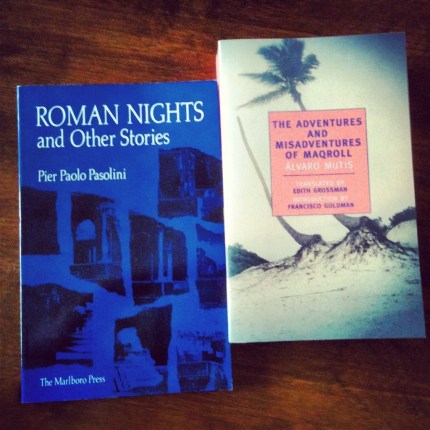
Pier Paolo Pasolini / Alvaro Mutis (Books Acquired, 12.21.20212)

20121223-132457.jpg

The edition I had of Mutis’s Maqroll only holds the first three novellas, so I ordered the NYRB seven-story volume. It’s like 700 pages and very attractive.

I also found this collection of Pier Paolo Pasolini short stories.

Read “The Honored Dead,” a Story by Breece D’J. Pancake

“The Honored Dead” by Breece D’J. Pancake

Watching little Lundy go back to sleep, I wish I hadn’t told her about the Mound Builders to stop her crying, but I didn’t know she would see their eyes watching her in the dark. She was crying about a cat run down by a car—her cat, run down a year ago, only today poor Lundy figured it out. Lundy is turned too much like her momma. Ellen never worries because it takes her too long to catch the point of a thing, and Ellen doesn’t have any problem sleeping. I think my folks were a little too keen, but Lundy is her momma’s girl, not jumpy like my folks.

My grandfather always laid keenness on his Shawnee blood, his half-breed mother, but then he was hep on blood. He even had an oath to stop bleeding, but I don’t remember the words. He was a fair to sharp woodsman, and we all tried to slip up on him at one time or another. It was Ray at the sugar mill finally caught him, but he was an old man by then, and his mind wasn’t exactly right. Ray just came creeping up behind and laid a hand on his shoulder, and the old bird didn’t even turn around; he just wagged his head and said, “That’s Ray’s hand. He’s the first fellow ever slipped on me.” Ray could’ve done without that because the old man never played with a full deck again, and we couldn’t keep clothes on him before he died.

I turn out the lamp, see no eyes in Lundy’s room, then it comes to me why she was so scared. Yesterday I told her patches of stories about scalpings and murders, mixed up the Mound Builders with the Shawnee raids, and Lundy chained that with the burial mound in the back pasture. Tomorrow I’ll set her straight. The only surefire thing I know about Mound Builders is they must have believed in a god and hereafter or they never would have made such big graves.

Continue reading “Read “The Honored Dead,” a Story by Breece D’J. Pancake”

Silent Prayer — Stanley Spencer

An Animated Christmas Card from Maurice Sendak

Maurice Sendak’s animated intro for the 1977 film Simple Gifts was based on an earlier design for a Christmas card  by the artist:

(Image and info via the very cool Michael Sporn Animation blog, with a hat tip to Jescie for sending me the link).

Given: 1. The Waterfall, 2. The Illuminating Gas — Marcel Duchamp

Read “Farewell Tour,” New Short Fiction from Teju Cole

Here’s the first paragraph of Teju Cole’s new short story “Farewell Tour” —

Frank Low told me this one Friday night in Times Square. He said he’d been transfixed by “Lavoisier and His Wife” at the Metropolitan Museum that past Wednesday afternoon, and in telling me about it, he had the hesitant manner of someone trying to remember the precise wording of a poem. When his words came, they came complete. He had read the wall label next to the painting and noted that 222 years had passed since it was made. The text read: “Antoine-Laurent Lavoisier (1743-1794) and His Wife (Marie-Anne-Pierrette Paulze, 1758-1836)”. The picture was, historically speaking, an intake of breath, a preparation for what was to come. Within a year after David painted it the Bastille was stormed. When it came to revolutions Low himself would rather there were none. He preferred order, lived as he liked, in a world of well-kept invoices and precise appointments, a world in which he never spent beyond his means. The Jean-Georges dinner on Tuesday night had been an unusual extravagance that he hadn’t mentioned to his wife. She might have thought it odd, rightly so, given that he hadn’t worked in three months.

Read the rest of “Farewell Tour.”

Read our review of Cole’s brilliant novel Open City.

Waiting for Christmas — Grandma Moses

https://i0.wp.com/uploads5.wikipaintings.org/images/grandma-moses/christmas%282%29.jpg

Book Shelves #52, 12.23.2012

Book shelves series #52, fifty-second Sunday of 2012: In which, in this penultimate chapter, we return to the site of entry #1.

The first entry in this project was my bedside nightstand. This is what it looked like back in January:

This is it this morning:

20121223-113957.jpg

This is the major difference:

20121223-114053.jpg

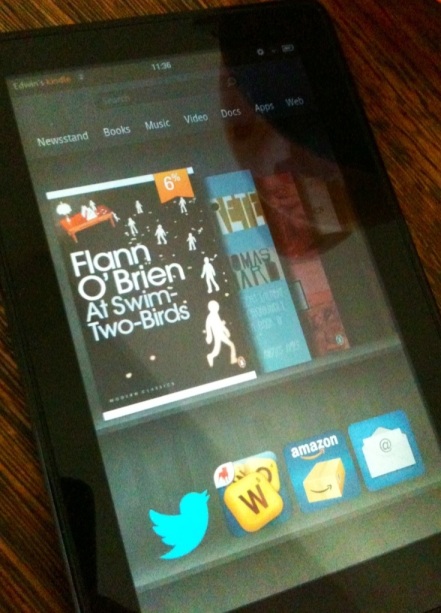
The Kindle Fire has changed my late night shuffling habits.

Here are the books that are in the nightstand:

20121223-114006.jpg

I read the Aira novel but completely forgot about it, which I’m sure says more about me than it.

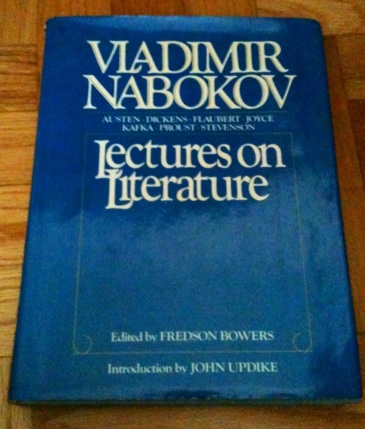
Have no idea why this is in there:

20121223-114014.jpg

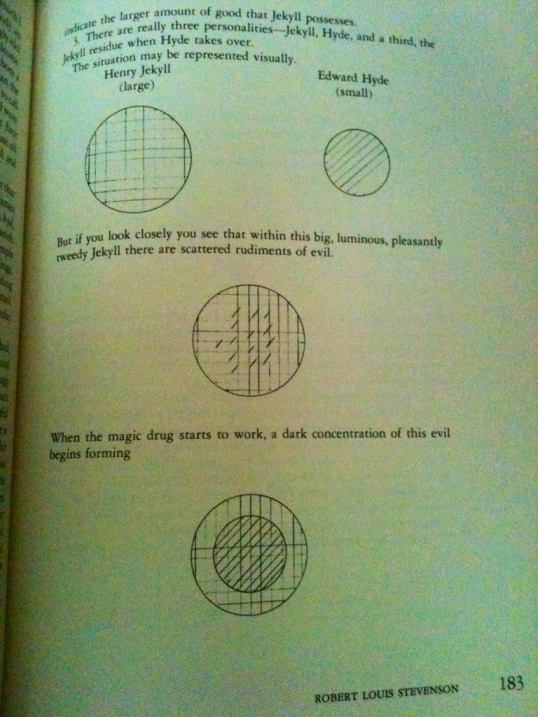
But it’s a fun book. With pictures! Sample:

20121223-114024.jpg

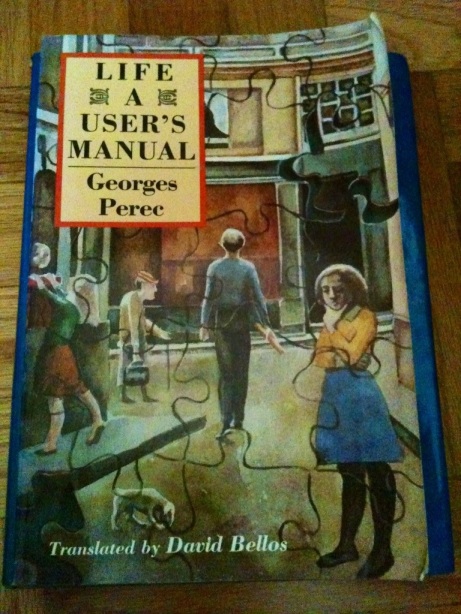
Finally, Perec’s Life A User’s Manual—this is one of my reading goals for 2013. It seems like a good way to close out this penultimate post, as one of Perec’s essays inspired this project

“Every library answers a twofold need, which is often also a twofold obsession: that of conserving certain objects (books) and that of organizing them in certain ways”

—Georges Perec, from ”Brief Notes on the Art and Manner of Arranging One’s Books” (1978)

20121223-114044.jpg

The House Opposite — Leonora Carrington

untitled1336461157077

Read Nathaniel Hawthorne’s Short Story “The Christmas Banquet”

“The Christmas Banquet,” a tale from Nathaniel Hawthorne (from Mosses from an Old Manse):

“I HAVE HERE attempted,” said Roderick, unfolding a few sheets of manuscript, as he sat with Rosina and the sculptor in the summer-house–“I have attempted to seize hold of a personage who glides past me, occasionally, in my walk through life. My former sad experience, as you know, has gifted me with some degree of insight into the gloomy mysteries of the human heart, through which I have wandered like one astray in a dark cavern, with his torch fast flickering to extinction. But this man–this class of men–is a hopeless puzzle.”

“Well, but propound him,” said the sculptor. “Let us have an idea of him, to begin with.”

“Why, indeed,” replied Roderick, “he is such a being as I could conceive you to carve out of marble, and some yet unrealized perfection of human science to endow with an exquisite mockery of intellect; but still there lacks the last inestimable touch of a divine Creator. He looks like a man, and, perchance, like a better specimen of man than you ordinarily meet. You might esteem him wise–he is capable of cultivation and refinement, and has at least an external conscience–but the demands that spirit makes upon spirit, are precisely those to which he cannot respond. When, at last, you come close to him, you find him chill and unsubstantial–a mere vapor.”

Continue reading “Read Nathaniel Hawthorne’s Short Story “The Christmas Banquet””

Reading the Letter — Nikolay Bogdanov-Belsky

Christmas in Shakespeare (From Thomas Firminger Thiselton-Dyer’s Folk-lore of Shakespeare)

From Thomas Firminger Thiselton-Dyer’s Folk-lore of Shakespeare:

Christmas. Among the observances associated with this season, to which Shakespeare alludes, we may mention the Christmas Carol, a reference to which is probably made in “A Midsummer-Night’s Dream” (ii. 1), by Titania: “No night is now with hymn or carol blest.”

Hamlet (ii. 2) quotes two lines from a popular ballad, entitled the “Song of Jephthah’s Daughter,” and adds: “The first row of the pious chanson will show you more.”

In days gone by, the custom of carol-singing was most popular, and Warton, in his “History of English Poetry,” notices a license granted in 1562 to John Tysdale for printing “Certayne goodly carowles to be songe to the glory of God;” and again “Crestenmas Carowles auctorisshed by my lord of London.”

In the “Taming of the Shrew” (Ind., sc. 2) Sly asks whether “a comonty is not a Christmas gambold.” Formerly the sports and merry-makings at this season were on a most extensive scale, being presided over by the Lord of Misrule. Again, in “Love’s Labour’s Lost” (v. 2), Biron speaks of “a Christmas comedy.”

As we have noticed, too, in our chapter on Plants, a gilt nutmeg was formerly a common gift at Christmas, and on other festive occasions, to which an allusion is probably made in the same scene. Formerly, at this season, the head of the house assembled his family around a bowl of spiced ale, from which he drank their healths, then passed it to the rest, that they might drink too. The word that passed among them was the ancient Saxon phrase wass hael , i. e., to your health. Hence this came to be recognized as the wassail or wassel bowl; and was the accompaniment to festivity of every kind throughout the year. Thus Hamlet (i. 4) says: “The king doth wake to-night, and takes his rouse, Keeps wassail.” And in “Love’s Labour’s Lost” (v. 2), Biron speaks of: “wakes and wassails, meetings, markets, fairs.” In “Macbeth” (i. 7), it is used by Lady Macbeth in the sense of intemperance, who, speaking of Duncan’s two chamberlains, says: “Will I with wine and wassail so convince, That memory, the warder of the brain, Shall be a fume, and the receipt of reason A limbeck only.” In “Antony and Cleopatra” (i. 4), Cæsar advises Antony to live more temperately, and to leave his “lascivious wassails.” In the same way, a “wassail candle” denoted a large candle lighted up at a festival, a reference to which occurs in “2 Henry IV.” (i. 2): “Chief-Justice. You are as a candle, the better part burnt out. Falstaff. A wassail candle, my lord; all tallow.”

A custom which formerly prevailed at Christmas, and has not yet died out, was for mummers to go from house to house, attired in grotesque attire, performing all kinds of odd antics. Their performances, however, were not confined to this season. Thus, in “Coriolanus” (ii. 1) Menenius speaks of making “faces like mummers.”


What the Water Gave Me — Frida Kahlo