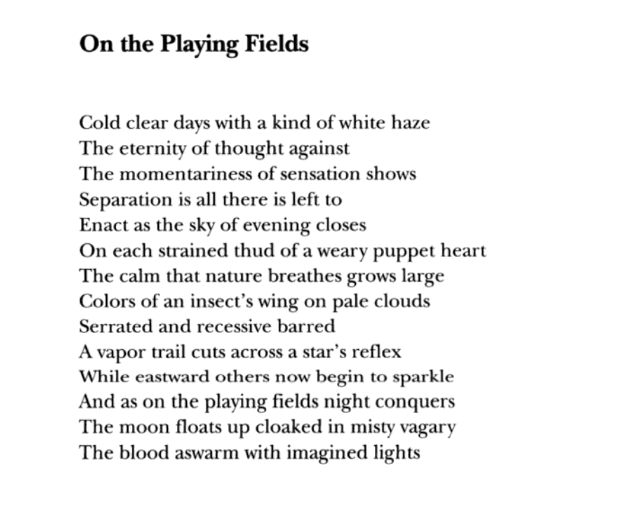
“On the Playing Fields” — Tom Clark

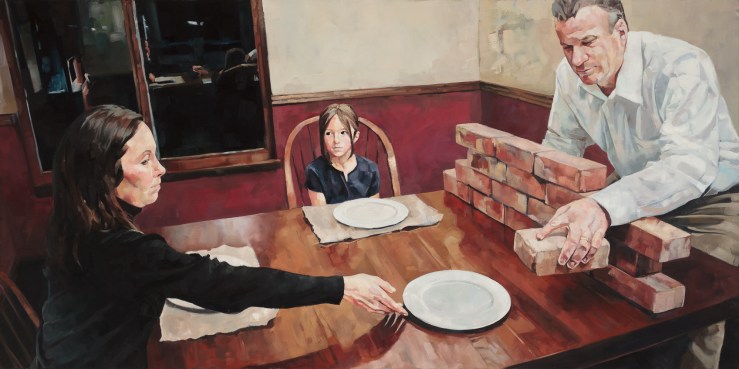
Set in Place — Wes Magyar

Set in Place by Wes Magyar

Sea of September — Julio Larraz

Sea of September, 1983 by Julio Larraz (b. 1944)

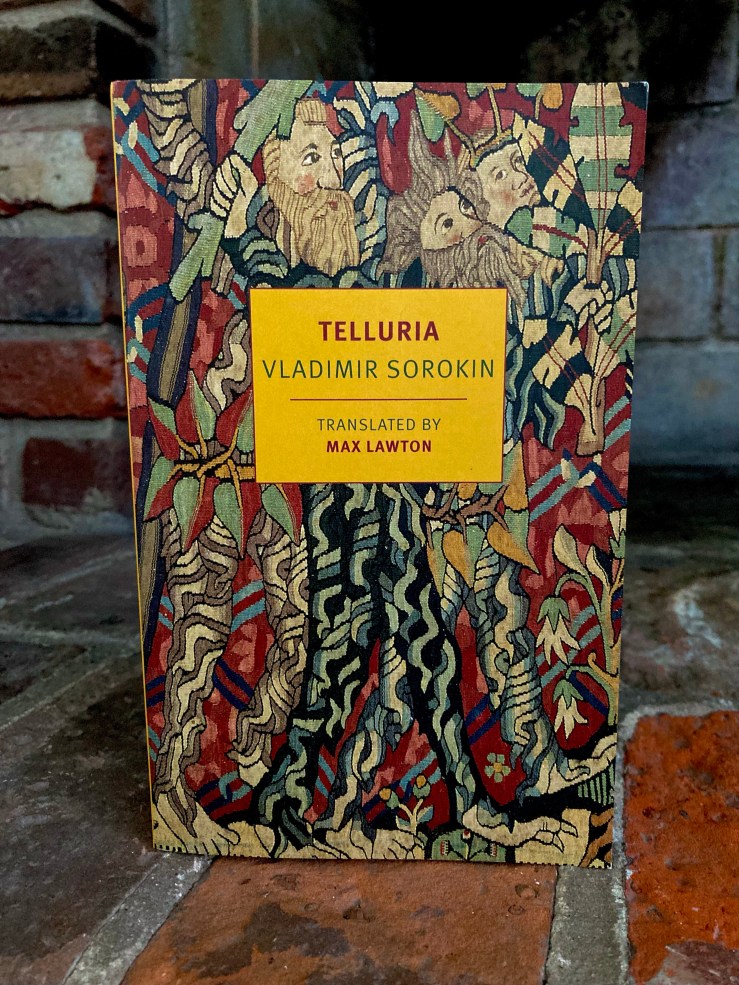
Vladimir Sorokin’s novel Telluria is a polyglossic satirical epic pieced together in vital miniatures


Vladimir Sorokin’s 2013 novel Telluria, in its first English translation thanks to the estimable talents of Max Lawton, is one of the best contemporary novels I’ve read in a long time. Telluria is a polyglossic satirical epic pieced together in vital miniatures. Its fifty sections are simultaneously discrete and porous, richly dense but also loose and funny. It teems with life and language, exploding notions of stable storytelling into a carnival of wild voices.

The world Sorokin conjures in Telluria is best experienced without map or gloss. My joy in reading the novel came from wandering through its fifty chapters and slowly building my own sense of this post-collapse world. You explore Telluria, finding footing after stumbling initially over the disorienting newness of a particular section. And just as you’ve tuned into the particular section’s frequency, you find yourself in a new chapter, a new idiom, a new voice. It’s a goddamn linguistic picaresque best enjoyed on its own terms, terms it refuses to spell out in simple exposition.

Telluria does not have a plot in the traditional sense, although its sum is greater than its parts. The fifty sections are not mere exercises in style, but rather a reflection of post-twentieth century consciousness: fractured, paranoid, hallucinatory, kaleidoscopic, chaotic, joyous, dystopian, utopian, ironic, earnest, strange…The reader who wanders through the fifty chapters will piece together a brave weird world where our contemporary nation states and political alliances have splintered into a cacophony of fiefdoms, city states, monarchies, republics, and so on. (There’s even a system of “enlightened theocratocommunofeudalism.”)

The needle that threads through it all is tellurium, a real (if earth-rare) element (as you’ll undoubtedly recall from your high-school chemistry class). In our world, tellurium is mostly employed in creating alloys for machines. In the world of Telluria, it is a drug that can take its user on a transcendental journeys, Those lucky enough to get their hands on a tellurium spike might find themselves transported into metaphysical spaces. Expert “carpenters” hammer tellurium nails into the heads of seekers, and these seekers go on to communicate with the dead, rampage fearlessly in battle, meet Christ in heaven, fly above mountaintops, or, in some cases, simply perish.

I should have by now offered a taste of the language in Telluria. A nice chunk of text set within the gum of context, no? But I don’t know how to do that effectively–Telluria is a dazzle of tongues. Offering a taste of just two or three of the sections would insufficient. It would amount to something like the parable of the blind men and the elephant.

Instead, I’ll offer Max Lawton’s thoughts on translating Telluria, from an interview he granted me earlier this year

Sorokin’s conceit in writing the thing was not to symbolically represent a particular historical period or something like that, but to give voice to difference itself. 50 voices and 50 differences. Because of that, my task was monomaniacal in its complexity: to follow Sorokin out into deep waters of difference and, like him, give birth to 50 absolutely unique voices…I had to be impenetrable where he was impenetrable, ungainly where he was ungainly, and senseless where he was senseless; anything less would have been a betrayal of what makes the book worth reading. As such, I appealed to Chaucer (for the centaur), Céline (for the bagmen), Turgenev translations (for the hunting), Faulkner and McCarthy (for the oral narratives about highly rural situations…), Ginsberg (for the “Howl” rip-off), Mervyn Peake (for the overripe fantasy-novel fun), and a great many others.

Telluria’s verbal carnival matches (and, really, engenders) seemingly endless imaginative invention on Sorokin’s part. We get dog-headed mutants engaged in philosophical discourse, “litluns” planning a revolution over the normies, the Carpenters of Western Europe hammering tellurium spikes into an army of Knights Templar who are about to set off on their thirteenth flying crusade against Islamic invaders. There are late-night, drug-fueled, multilingual bullshitting sessions, orgies, a princess who gets her kicks slumming it in disguise and fucking the serfs. There are lovers separated by thousands of miles, mutated horses larger than three-story houses, tourists in the USSR — the Ultra-Stalinist Soviet Socialist Republic. A centaur falls in love. Etc.

I copped out of citing any passages from Telluria above, protesting that it might offer an incomplete picture—and that’s true. But reviewing my notes, I think it’s worth sharing one passage at some length, a passage that I think both describes the milieu of the novel as well as approaches a kind of moral vision for the novel (with the strong caveat that any one distinct moral vision is necessarily exploded and ironized by the other voices that thread through the novel—as Lawton stated in our interview, Telluria is “an ode to difference….For Sorokin, the world is a million different textures, a million different languages, and no ONE can be said to triumph.”)

“We must not take anyone else’s karma upon ourselves, not even in small matters,” the brigadier continued. “Especially now in our renewed, post-war world. Take a look at the Eurasian continent: after the collapse of ideological, geopolitical, and technological utopias, it was finally plunged back into the blessèd and enlightened Middle Ages. The world returned to human scale. Nations found themselves. Man ceased to be the sum of the technology around him. Mass production is living out its final years. There aren’t two identical nails beaten into humanity’s head. Man regained a sense of the thing, started to eat healthy grub and ride horses again. Genetic engineering helps man to feel his true size. Man has regained faith in the transcendental. Regained his sense of time. We’re not rushing anywhere anymore. Most importantly–we understand that there can be no technological heaven on earth. And, and in broader terms, no heaven at all. Earth has been given to us as an island of overcoming. Everyone chooses what to overcome and how to overcome it. And they make that choice themselves!”

Sorokin’s post-collapse world doesn’t seem all that bad to me. 

Telluria was my first encounter with Sorokin, and I think it makes a grand introduction. I’ve since read Day of the Oprichnik (translated by Jamey Gambrell) and Blue Lard (forthcoming next year from NYRB and also translated by Max Lawton). I’m currently reading Lawton’s translation of Their Four Hearts. While I think Blue Lard is the strongest of these titles (and I look forward to/dread reviewing it in the future), Telluria is an excellent introduction to Sorokin’s work, offering an engaging taste of his methods (all through Lawton’s lively translation). The book’s energy and imagination offer a nice counter to the dour dystopian narratives that abound these days.

Telluria is Not For Everyone. Readers interested in clear “worldbuilding” or plots that tie up all the loose ends will find themselves exasperated, as will readers who actively resist the linguistic playfulness of Lawton’s translation. Similarly, readers searching for a moral analogy for contemporary Russian politics and culture will find themselves straining to apply whatever mold they’ve already forged in their minds. Neither is this book particularly interested in the Americas or Western Europe. Sorokin’s province is the vast vacillating mass of Eurasia. In his 2012 book Russia: A Very Short History, Geoffrey Hosking notes “the arduous and challenging task of building a coherent polity on the flat open plains of northern Eurasia,” arguing that although Russia “has been a remarkable success story,” it is nevertheless a country “which had its own weaknesses programmed into it.” Hoskings continues: “[Russia] rested on a tacit compact between ruler, elites, and communities of ordinary people, renewed after periods of upheaval and crisis, yet never wholly harmonious, always subject to internal strains.” Telluria is an ecstatic and jarring exploration of those upheavals, those crises, those wonderful strains, a satire on the very notion of a coherent polity.

I loved it. Very highly recommended.

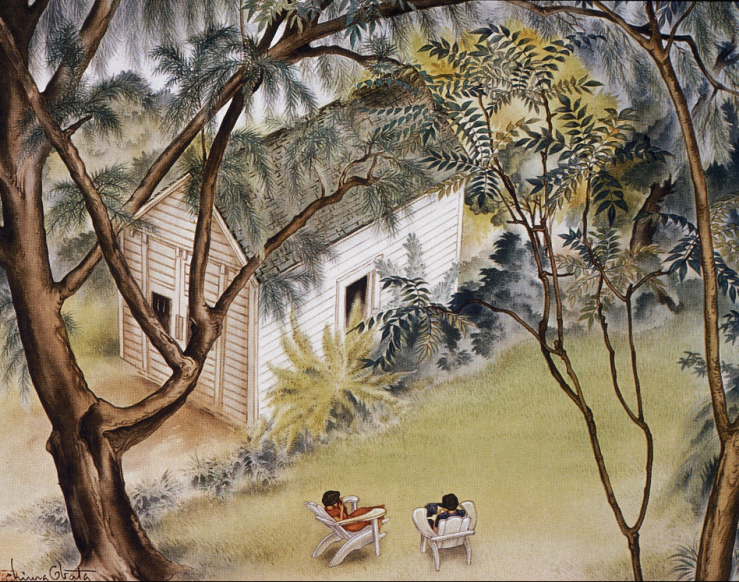
Webster Groves — Chiura Obata

Webster Groves, 1943 by Chiura Obata (1885-1975)

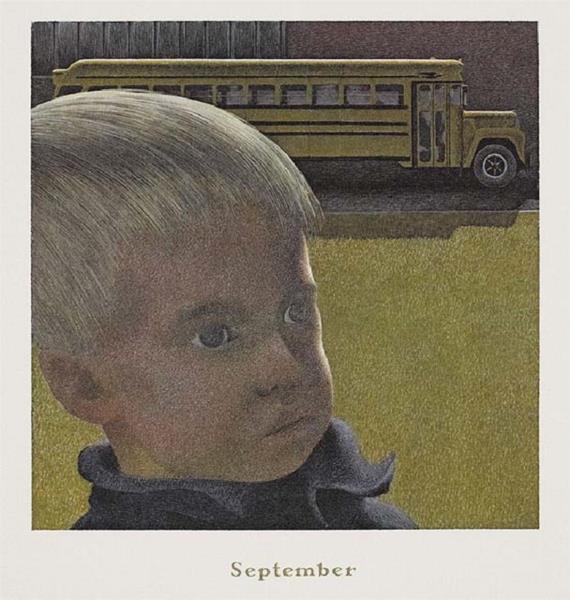
September — Alex Colville

september-1979large

September, 1979 by Alex Colville (1920-2013)

Jim O’Rourke live, 8 Aug. 2021

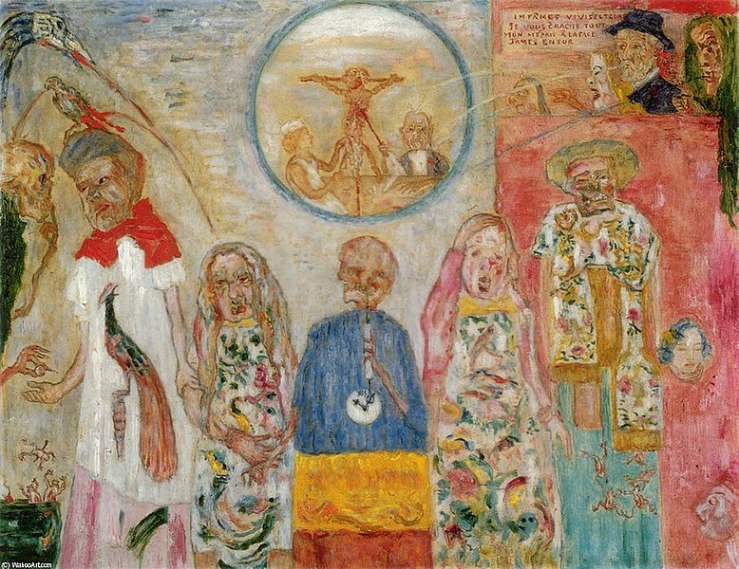
Vile Vivisectors — James Ensor

Vile Vivisectors, 1925 by James Ensor (1860-1949)

Vasily Grossman’s The People Immortal (Book acquired, 30 Aug. 2022)

A copy of by Vasily Grossman’s 1943 novel The People Immortal arrived at Biblioklept World Headquarters. It’s a new translation by Robert Chandler and Elizabeth Chandler, available next month from NYRB.

(It’s also a reminder to pick up the copy of Grossman’s massive novel Life and Fate that’s been staring me down for years).

NYRB’s blurb:

Vasily Grossman wrote three novels about the Second World War, each offering a distinct take on what a war novel can be, and each extraordinary. A common set of characters links Stalingrad and Life and Fate, but Stalingrad is not only a moving and exciting story of desperate defense and the turning tide of war, but also a monumental memorial for the countless war dead. Life and Fate, by contrast, is a work of moral and political philosophy as well as a novel, and the deep question it explores is whether or not it is possible to behave ethically in the face of overwhelming violence. The People Immortal is something else entirely. Set during the catastrophic first months of the German invasion of the Soviet Union, this is the tale of an army battalion dispatched to slow the advancing enemy at any cost, with encirclement and annihilation its promised end. A rousing story of resistance, The People Immortal is the novel as weapon in hand.

Prego — Eduardo Berliner

Prego, 2020 by Eduardo Berliner (b. 1978)

Nieces — Zoey Frank 

Nieces, 2020 by Zoey Frank (b. 1987)

I never found my audience | Stanley Elkin

Bodies rose to the surface of the seas and began swimming. They were released from faded, colorless flags, stove ships, hidden pilings where they had snagged for years. They came up out of shoals and split sandbars. The drowned and murdered floated up from the bottoms of lakes, their faces and bodies in the same dishabille in which they had died. They seeped out of riverbanks, they surfaced in wells. A rising tide of the dead.

In woods and rain forests they quickened, corpses lost years. They came to in deserts, they waked up on mountains, a treasury of jigsaw death. One could not have suspected their numbers, that so many random had fallen. These were merely the discards, the old boot dead, stochastic as beer can, deposit bottle.

They woke up in battlefields. They gathered themselves where they had exploded. They got up in hospitals, their deaths not yet discovered. They still wore identification bracelets, IVs dangled from their wrists like slack banderillas. They woke up in archeology, cities done in by earthquake, fire, and time.

They climbed out of eaves, out of canyons, geology.

Up out of mine shafts they came, comrades in cave-ins.

They worked their way through holes they had melted in glaciers.

All earth gave up its dead.

They strained against coffin lids, against sealers. Stymied as escape artists they banged encumbrance.

They swarmed, they popped through, the hatched, frantic chicks of death.

A man named Ladlehaus climbed out of his grave like someone backing out a window.

Like elopers they left their burials. They touched their tombs and niches as if they were the old rooms of childhood, brushing them lightly, as if they were dusting. They scrutinized their plots and read their markers like people hunting addresses. They loitered in their graveyards as if they were keeping appointments. Already they missed their deaths. There were complaints. They were cold in just sunlight after the heat of Hell. Those who had donated organs had lost them forever. They could feel the cavities and hollows, the terrible gouged and amputate absentness A woman who had given her eyes away stirred her fingers in her weeping holes.

“So grotesque,” she moaned, “death grotesque as life. All, all grotesque.”

They came down from churchyards on hillsides and in from cemeteries on the outskirts of town. They bestirred themselves in the celebrated tombs and sepulchers of the big-shot dead.

Their bodies shone with gore like wet paint, They sooted the world as if it were carpet. The living and dead were thrown together, and the dead looked away first.

Tribes covered the earth now, families did, clans, races. Mary, squeamish in the press of population, could not bear the stench. It’s morning sickness, she told herself. Joseph couldn’t get over how much things had changed, and Christ flinched when he saw soldiers. Quiz, looking for sanctuary, pulled Flanoy into a Y.M.C.A.

Into the Valley of jehoshaphat they came and along all the coasts of Palestine. They covered the ranges of Samaria and Judea, of Abilene and Gilead, and stood in the Plains of jezreel and Sharon and spread out by Kinnereth’s Sea and the salted waters between Idumea and Moab. And were a million deep all about the tough shores of the ruined Mediterranean circle.

They seemed a kind of vegetation, their burnt skin a smear of sullen growth. Pressed together, Coney Island’d, Woodstock’d, Tivoli Garden’d, jonestownd, they seemed spectators at some game less stadium, vast as the world.

They waited. They did not know what was going to happen. They consulted the religious among them but they didn’t know either.

Then God was there and, strangely, all could see Him. There was not a bad seat in the house. It was short and sweet.

“Because I never found My audience,” God said.

“Because I never found My audience.” He looked at the assembled dead, at the living billions anxious at ground zero.

“You gave me, some of you, your ooh’s and aah’s, the Jew’s hooray and Catholic’s Latin deference-all theology’s pious wow. But I never found My audience.” He looked at Mary, who had feared Him, victim to His blue ribbon force, distrustful still, savoring the ordinary who had been taken out of all that.

“I never found My audience. What had you,” He asked His audience, “to complain of? You had the respect of peers. You had peers.” He looked at Jesus.

“You were no audience. You had all the advantages. You were only God’s clone.” And at Joseph.

“You were a carpenter,” He said.

“You did things with your hands. Why didn’t you admire Me more?” At the damned.

“I gave you pain. Do you appreciate the miracle? To make it up out of thin air, deep, free-fall space, the gifted, driven atoms of remonstrance? Trickier than orange juice or the taste of Brie. Because I never found My audience,” said God and annihilated, Mother Mary and Christ and Lesefario and Flanoy and Quiz in their Y.M.C.A. sea front room in Piraeus and all Hell’s troubled sighed, everything.

From Stanley Elkin’s novel The Living End.

A Girl Reading — Frank Huddlestone Potter

A Girl Reading by Frank Huddlestone Potter (1845-1887)

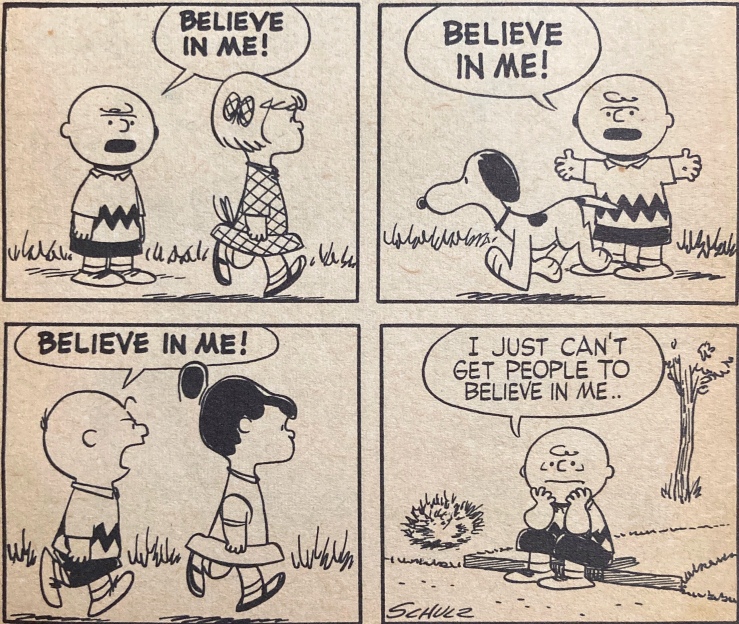
Believe in me (Peanuts)

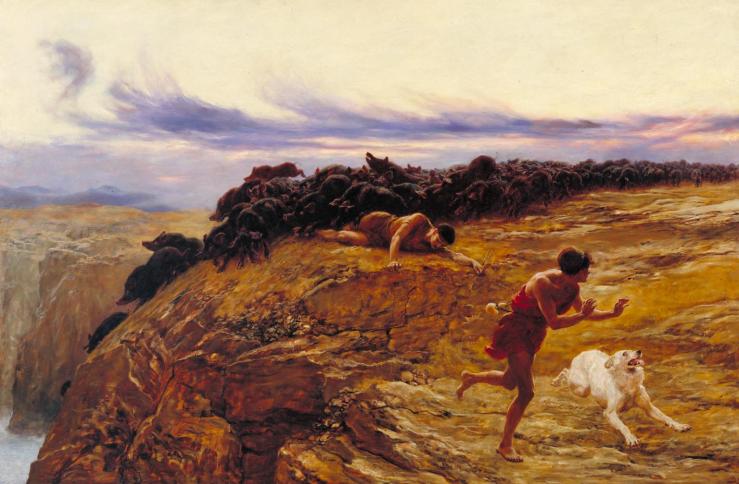
The Miracle of the Gaderene Swine — Briton Riviere

The Miracle of the Gaderene Swine, 1883 by Briton Riviere (1840-1920)


26 And they arrived at the country of the Gadarenes, which is over against Galilee.

27 And when he went forth to land, there met him out of the city a certain man, which had devils long time, and ware no clothes, neither abode in any house, but in the tombs.

28 When he saw Jesus, he cried out, and fell down before him, and with a loud voice said, What have I to do with thee, Jesus, thou Son of God most high? I beseech thee, torment me not.

29 (For he had commanded the unclean spirit to come out of the man. For oftentimes it had caught him: and he was kept bound with chains and in fetters; and he brake the bands, and was driven of the devil into the wilderness.)

30 And Jesus asked him, saying, What is thy name? And he said, Legion: because many devils were entered into him.

31 And they besought him that he would not command them to go out into the deep.

32 And there was there an herd of many swine feeding on the mountain: and they besought him that he would suffer them to enter into them. And he suffered them.

33 Then went the devils out of the man, and entered into the swine: and the herd ran violently down a steep place into the lake, and were choked.

Luke 8:26-32, KJV

God gave a gala | Stanley Elkin

God gave a gala, a levee at the Lord’s.

All Heaven turned out.

“Gimme,” He said, that old time religion.” His audience beamed. They cheered, they ate it up. They nudged each other in Paradise.

“What did I tell you?” He demanded over their enthusiasm.

“It’s terrific, isn’t it? I told you it would be terrific. All you ever had to do was play nice. Are you disappointed? Is this Heaven? Is this God’s country? In your wildest dreams-let Me hear it. Good-in your wildest dreams, did you dream such a Treasury, this museum Paradise? Did you dream My thrones and dominions, My angels in fly-over? My seraphim disporting like dolphins, tumbling God’s sky in high Heaven’s high acrobacy? Did you imagine the miracles casual as card tricks, or ever suspect free lunch could taste so good? They should see you now, eh? They should see you now, trembling in rapture like neurological rut. Delicious, correct? Piety a la mode! That’s it, that’s right. Sing hallelujah! Sing Hizzoner’s hosannas, Jehovah’s gee whiz! Well,” God said, .1 that’s enough, that will do.” He looked toward the Holy Family, studying them for a moment.

“Not like the creche, eh?” He said.

“Well is it? Is it?” He demanded of Jesus.

“No,” Christ said softly.

“No,” God said, “not like the creche. just look
at this place- the dancing waters and indirect lighting. I could put gambling in here, off-track betting. Oh, oh, My costume jewelry ways, My game show vision.

Well, it’s the public. You’ve got to give it what it wants. Yes, Jesus?”

“Yes,” Jesus said.

“It just doesn’t look lived in, is that what you think

“Call on someone else,” Christ said.

“Sure,” God said.

“I’m Hero of Heaven. I call on Myself.”

That was when He began His explanations. He revealed the secrets of books, of pictures and music, telling them all manner of things-why marches were more selfish than anthems, lieder less stirring than scat, why landscapes were to be preferred over portraits, how statues of women were superior to statues of men but less impressive than engravings on postage. He explained why dentistry was a purer science than astronomy, biography a higher form than dance. He told them how to choose wines and why solos were more acceptable to Him than duets. He told them the secret causes of inflation-“It’s the markup,” He said-and which was the best color and how many angels could dance on the head of a pin. He explained why English was the first language at Miss Universe pageants and recited highlights from the eighteen-minute gap.

Mary, wondering if she showed yet, was glad Joseph was seated next to her. Determined to look proud, she deliberately took her husband’s hand. So rough, she thought, such stubby fingers. He explained why children suffered and showed them how to do the latest disco steps. He showed them how to square the circle, cautioning afterwards that it would be wrong.

He revealed the name of Kennedy’s assassin and told how to shop for used cars.

From Stanley Elkin’s novel The Living End.

Midnight Monster — Takaya Katsuragawa

Midnight Monster by Takaya Katsuragawa