The Gobolink and How to Make Him

(More)

Intervals, A Short Film by Peter Greenaway

Five Rules of Wisdom (From Flann O’Brien’s The Third Policeman)

‘Tell me this much,’ I ventured. ‘What sort of readings were those in the policeman’s black book?’

The Sergeant gave me a keen look which felt almost hot from being on the fire previously.

‘The first beginnings of wisdom,’ he said, ‘is to ask questions but never to answer any. You get wisdom from asking and I from not answering. Would you believe that there is a great increase in crime in this locality? Last year we had sixty-nine cases of no lights and four stolen. This year we have eighty-two cases of no lights, thirteen cases of riding on the footpath and four stolen. There was one case of wanton damage to a three-speed gear, there is sure to be a claim at the next Court and the area of charge will be the parish. Before the year is out there is certain to be a pump stolen, a very depraved and despicable manifestation of criminality and a blot on the county.’

‘Indeed,’ I said.

‘Five years ago we had a case of loose handlebars. Now there is a rarity for you. It took the three of us a week to frame the charge.’

‘Loose handlebars,’ I muttered. I could not clearly see the reason for such talk about bicycles.

‘And then there is the question of bad brakes. The country is honeycombed with bad brakes, half of the accidents are due to it, runs in families.’

I thought it would be better to try to change the conversation from bicycles.

‘You told me what the first rule of wisdom is,’ I said. ‘What is the second rule?’

‘That can be answered,’ he said.

‘There are five in all. Always ask any questions that are to be asked and never answer any. Turn everything you hear to your own advantage. Always carry a repair outfit. Take left turns as much as possible. Never apply your front brake first.’

‘These are interesting rules,’ I said dryly.

‘If you follow them,’ said the Sergeant, ‘you will save your soul and you will never get a fall on a slippy road.’

‘I would be obliged to you,’ I said, ‘if you would explain to me which of these rules covers the difficulty I have come here today to put before you.’

‘This is not today, this is yesterday,’ he said, ‘but which of the difficulties is it? What is the crux rei?’

‘Yesterday? I decided without any hesitation that it was a waste of time trying to understand the half of what he said. I persevered with my inquiry.

‘I came here to inform you officially about the theft of my American gold watch.’

He looked at me through an atmosphere of great surprise and incredulity and raised his eyebrows almost to his hair.

‘That is an astonishing statement,’ he said at last.

‘Why?’

‘Why should anybody steal a watch when they can steal a bicycle?’

From Flann O’Brien’s surreal comic masterpiece, The Third Policeman.

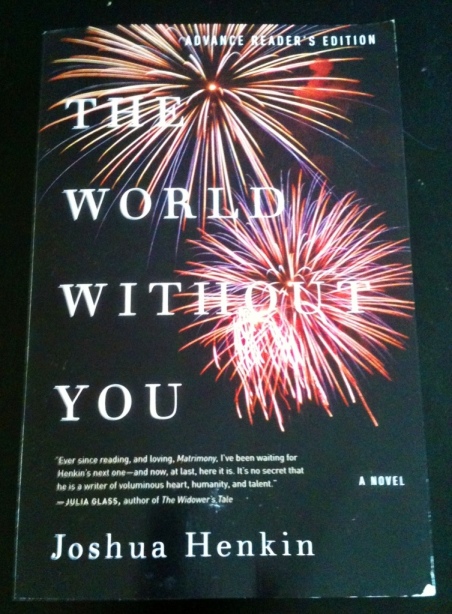
The World Without You (Book Acquired, 4.19.2012)

20120426-161547.jpg

The World Without You is forthcoming this summer from Joshua Henkin (Pantheon). Write up from Publisher’s Weekly:

Like a more bittersweet version of Jonathan Tropper’s This Is Where I Leave You or a less chilly variation on Jonathan Franzen’s The Corrections, Henkin (Matrimony) tenderly explores family dynamics in this novel about the ties that bind, and even lacerate. One year after the death of their kidnapped journalist son, Leo, in Iraq, David and Marilyn Frankel, non-practicing Jews, call their entire mishpocha to their summer home in the Berkshires to attend his memorial service: Clarissa and her husband, Nathaniel, who, after years of putting off parenthood, are having a difficult time getting pregnant; Lily, a D.C. lawyer who shows up without Malcolm, her restaurateur boyfriend of 10 years; Noelle, an Orthodox Jew who arrives from Jerusalem with her husband, Amram, and their four children; and Thisbe, Leo’s widow, a grad student who flies in from Berkeley with their three-year-old son, Calder. Over the course of the Fourth of July holiday, David and Marilyn will make a stunning announcement; Thisbe will reveal a secret; a game of Celebrity will cause Amram to drive off into the night; Leo will be remembered; and someone will pee on the carpet. The author has created an empathetic cast of characters that the reader will love spending time with, even as they behave like fools and hurt one another. An intelligently written novel that works as a summer read and for any other time of the year.

The Canterbury Tales — Pier Paolo Pasolini (Entire Film with Subtitles)

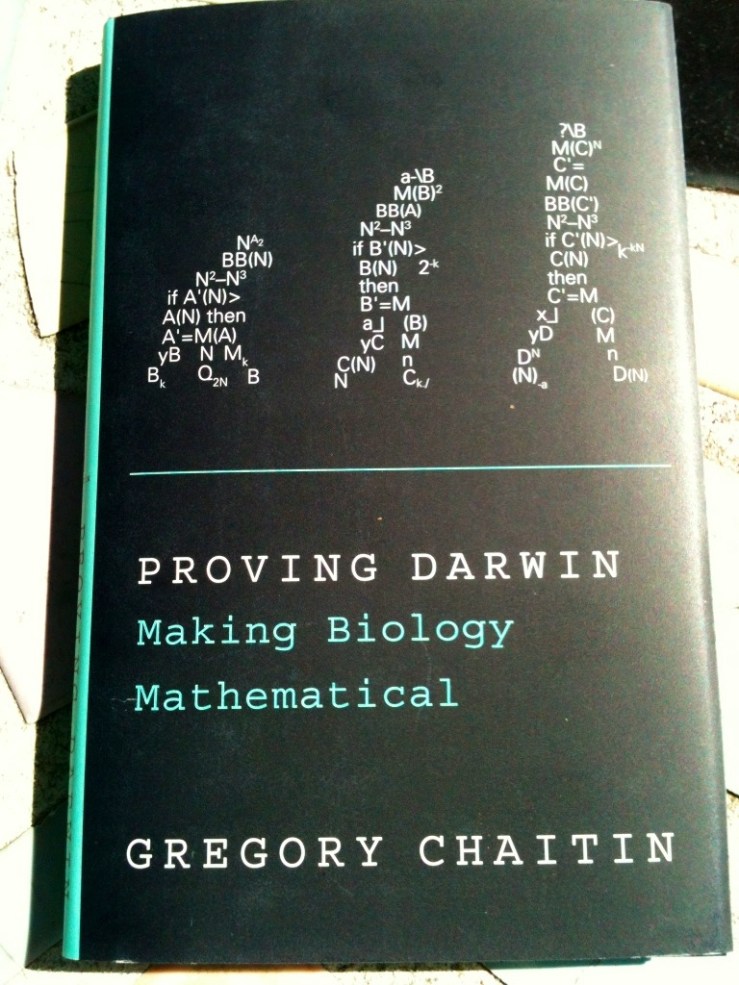
Proving Darwin (Book Acquired, 4.23.2012)

20120426-161632.jpg

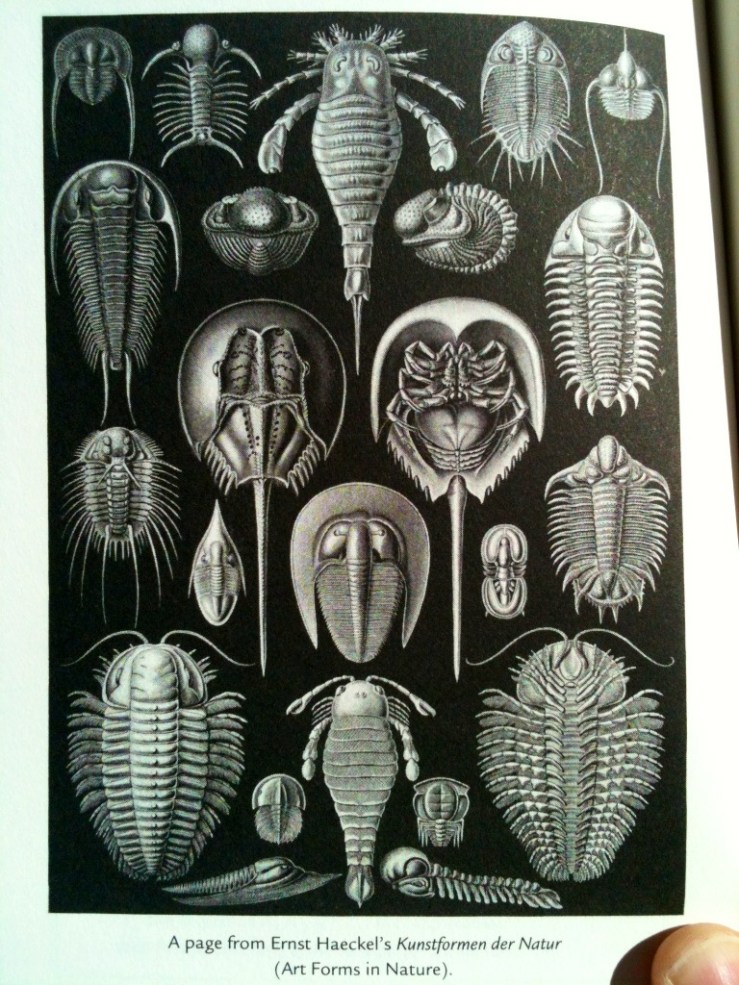
Gregory Chaitin’s Proving Darwin: Making Biology Mathematical is forthcoming in hardback from Random House. It’s a great-looking book, slim and neat with graphs and plenty of explications of the math for fellas like me. There’s also illustrations from Biblioklept fave Ernst Haeckel:

20120426-161640.jpg

Random House’s copy:

Groundbreaking mathematician Gregory Chaitin gives us the first book to posit that we can prove how Darwin’s theory of evolution works on a mathematical level.

For years it has been received wisdom among most scientists that, just as Darwin claimed, all of the Earth’s life-forms evolved by blind chance. But does Darwin’s theory function on a purely mathematical level? Has there been enough time for evolution to produce the remarkable biological diversity we see around us? It’s a question no one has yet answered—in fact, no one has even attempted to answer it until now.

In this illuminating and provocative book, Gregory Chaitin argues that we can’t be sure evolution makes sense without a mathematical theory. He elucidates the mathematical scheme he’s developed that can explain life itself, and examines the works of mathematical pioneers John von Neumann and Alan Turing through the lens of biology. Chaitin presents an accessible introduction to metabiology, a new way of thinking about biological science that highlights the mathematical structures underpinning the biological world. Fascinating and thought-provoking, Proving Darwin makes clear how biology may have found its greatest ally in mathematics.

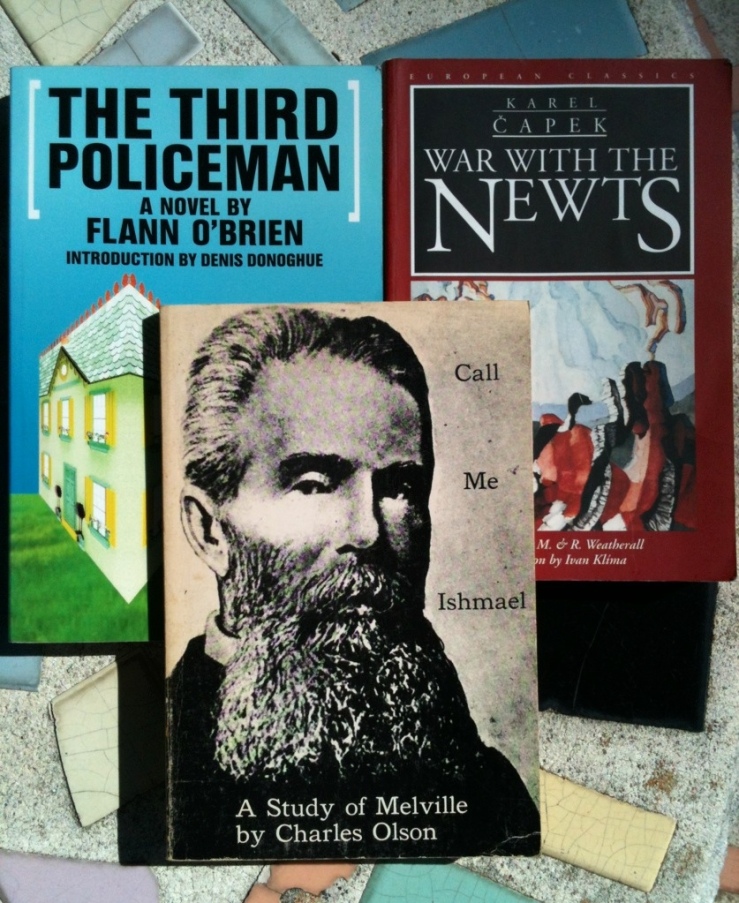
Flann O’Brien, Charles Olson, Karel Capek (Books Acquired, Earlier This Week)

20120426-161730.jpg

Steinbeck on Critics: “Curious Sucker Fish Who Live with Joyous Vicariousness on Other Men’s Work”

ON CRITICS

This morning I looked at the Saturday Review, read a few notices of recent books, not mine, and came up with the usual sense of horror. One should be a reviewer or better a critic, these curious sucker fish who live with joyous vicariousness on other men’s work and discipline with dreary words the thing which feeds them. I don’t say that writers should not be disciplined, but I could wish that the people who appoint themselves to do it were not quite so much of a pattern both physically and mentally.

I’ve always tried out my material on my dogs first. You know, with Angel, he sits there and listens and I get the feeling he understands everything. But with Charley, I always felt he was just waiting to get a word in edgewise. Years ago, when my red setter chewed up the manuscript of Of Mice and Men, I said at the time that the dog must have been an excellent literary critic.

Time is the only critic without ambition.

Give a critic an inch, he’ll write a play.

From John Steinbeck’s 1969 interview in The Paris Review.

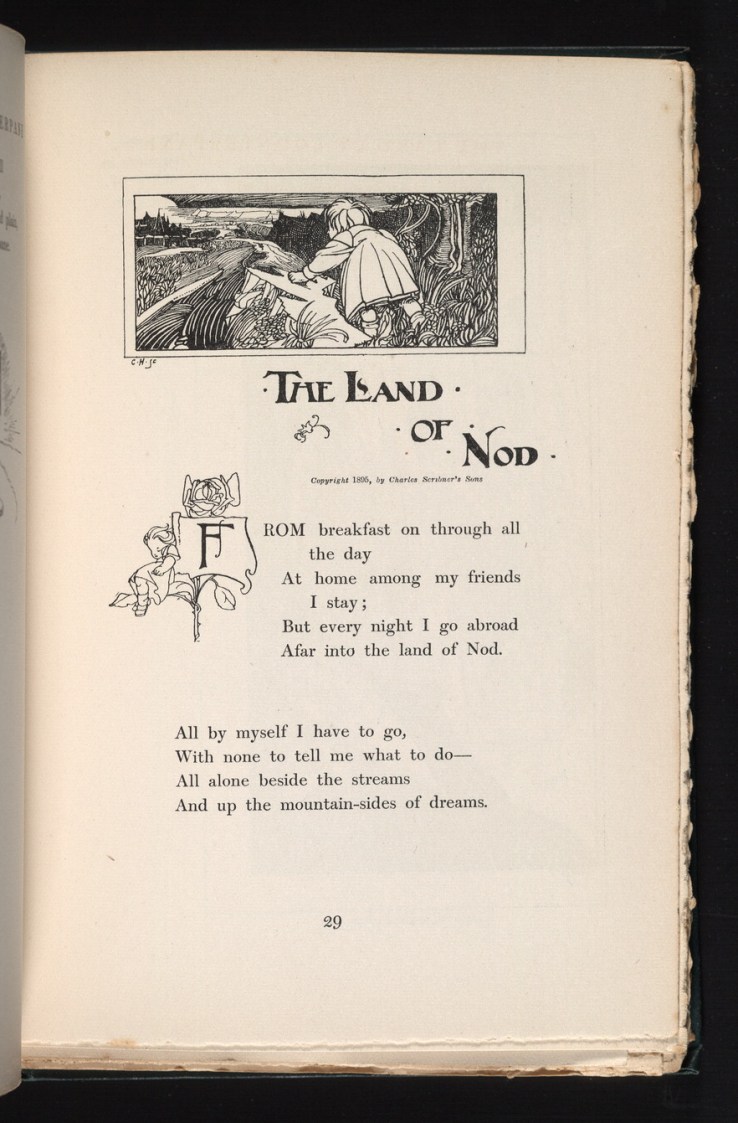
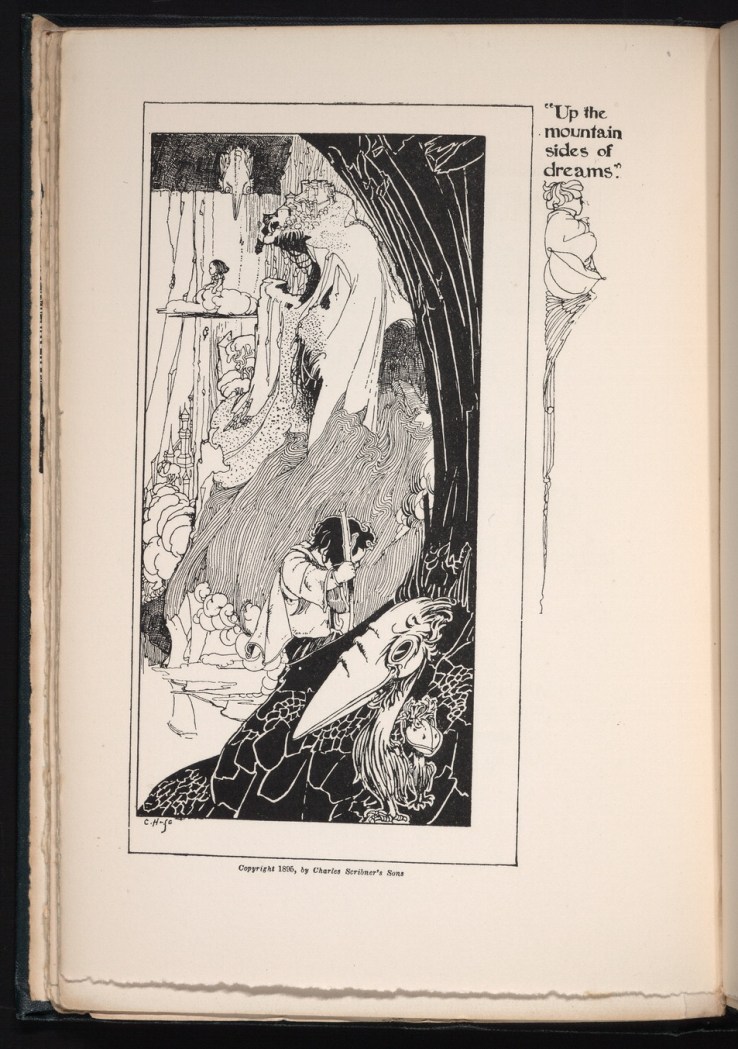
“The Land of Nod” — An Illustrated Poem by Robert Louis Stevens

(From A Child’s Garden of Verses by Robert Louis Stevenson; illustrated by Charles Robinson, 1895. Via the LOC’s rare books collection.)

Books Acquired, This Week and Last

20120426-161440.jpg

Reading for Our Time by J. Hillis Miller from Columbia University Press. Their copy:

A masterclass in attentive reading that opens up brilliant insights into two of George Eliot’s novels. J. Hillis Miller shows how reading Eliot’s great novels Adam Bede and Middlemarch can provide the pleasure and insight unique to reading fiction. The readings focus on famous passages in which the narrator reflects about the story and its characters. What do these passages really say? What role does Eliot’s figurative language play in her storytelling? These stories deal with uncovering their characters’ ideological illusions. By understanding how to expose these illusions, readers will be able to recognize how easy it is to be taken in by such mistakes, both in the personal and in the political worlds.

20120426-161452.jpg

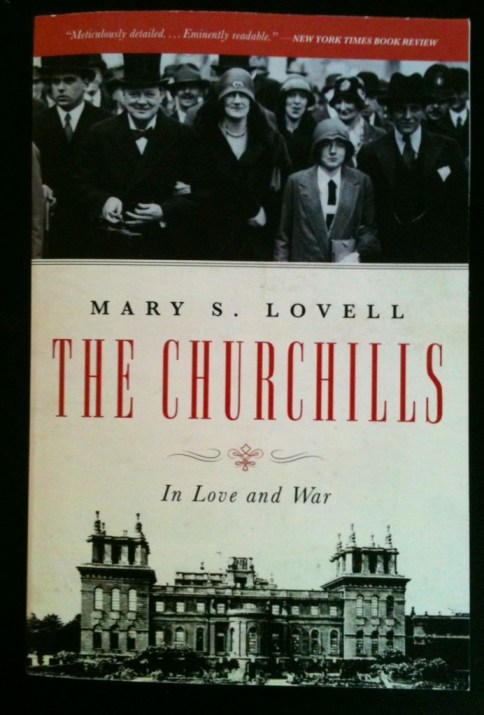
Mary S. Lovell’s The Churchills is new in trade paperback from Norton. From the LA Times review:

Intelligent and well-written, like all of Mary S. Lovell’s biographies, “The Churchills” provides a vivid introduction to the family of English aristocrats whose nation-preserving achievements stretch from the Battle of Blenheim to the Battle of Britain and beyond. The Churchills are a much-chronicled clan, and although footnotes indicate that Lovell has read all the relevant books and delved into vast archives of personal papers, there’s nothing startlingly new here. Instead, as she did in “The Mitford Girls,” the author synthesizes a variety of familiar material to create a lively collective portrait.

20120426-161503.jpg

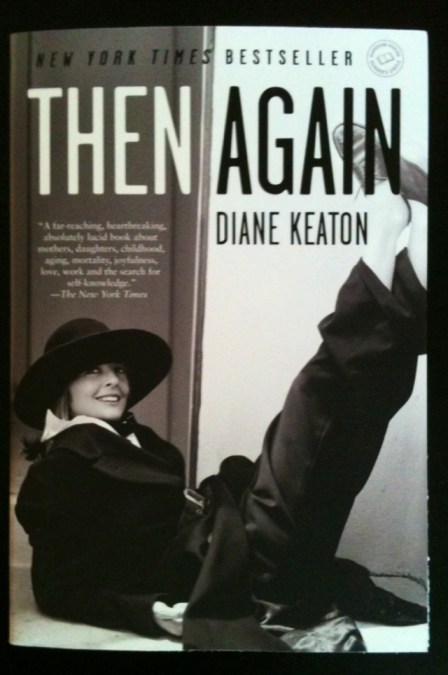
Diane Keaton’s memoir is out in trade paperback. It’s a handsome book with stylish color inserts. New from Random House.

20120426-161518.jpg

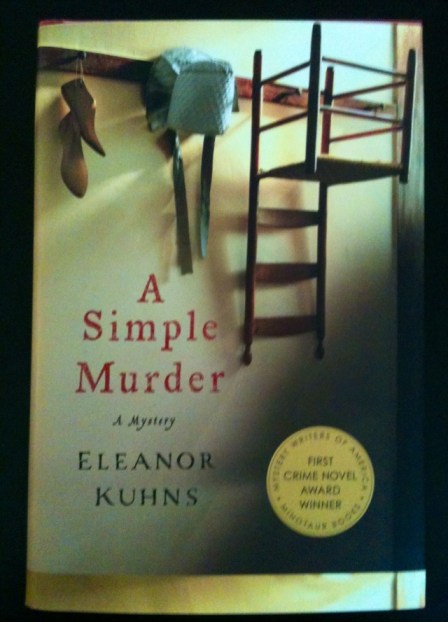
 Great cover on A Simple Murder, new from Eleanor Kuhns. Publisher Minotaur/Macmillan’s write-up:

Five years ago, while William Rees was still recovering from his stint as a Revolutionary War soldier, his beloved wife died. Devastated, Rees left his son, David, in his sister’s care, fled his Maine farm, and struck out for a tough but emotionally empty life as a traveling weaver. Now, upon returning unexpectedly to his farm, Rees discovers that David has been treated like a serf for years and finally ran away to join a secluded religious sect—the Shakers.

Overwhelmed by guilt and hoping to reconcile with his son, Rees immediately follows David to the Shaker community. But when a young Shaker woman is brutally murdered shortly after Rees’s arrival, Rees finds himself launched into a complicated investigation where the bodies keep multiplying, a tangled web of family connections casts suspicion on everyone, and the beautiful woman on the edge of the Shaker community might be hiding troubling ties to the victims. It quickly becomes clear that in solving Sister Chastity’s murder, Rees may well expose some of the Shaker community’s darkest secrets, not to mention endanger his own life.

An atmospheric portrait of a compelling time in American history, A Simple Murder is an outstanding debut from Eleanor Kuhns, Minotaur Books/Mystery Writers of America’s 2011 First Crime Novel Competition Winner.

Microreviews

Henry David Thoreau’s Walden: The Video Game

(About; via Scott Esposito).

E-Books of the Future! (Retrofuture Fun from 1959)

(Via Disonancia, which is probably my favorite thing on the internet right now).

Ezra Pound Shares Poetry Tips from Hardy, Yeats, Ford, and Bridges

Ezra Pound’s poetry tips; from The Paris Review interview:

INTERVIEWER

You once wrote that you had four useful hints from living literary predecessors, who were Thomas Hardy, William Butler Yeats, Ford Madox Ford, and Robert Bridges. What were these hints?

POUND

Bridges’s was the simplest. Bridges’s was a warning against homophones. Hardy’s was the degree to which he would concentrate on the subject matter, not on the manner. Ford’s in general was the freshness of language. And Yeats you say was the fourth? Well, Yeats by 1908 had written simple lyrics in which there were no departures from the natural order of words.

Ben Marcus Talks About His Novel The Flame Alphabet

Life: “A Queer Contraption, Very Dangerous, a Certain Death-trap” (A Passage from Flann O’Brien’s The Third Policeman)

I started Flann O’Brien’s novel The Third Policeman yesterday, on the recommendation of a few readers who commented on a post last week. Just a few chapters in, I felt the thrill of really great, strange writing, coupled with the bizarre, almost unwieldy disbelief that I hadn’t read the novel before, or more to the point, and most ashamedly, that it wasn’t even on my radar. I felt a strange antipathy to the name Flann O’Brien whenever I came across it in the past—too close to Flannery O’Connor, if I’m being honest. This is all silly and I’m embarrassed to write it now. Anyway, the novel is amazing so far. Here’s a passage that maybe stands alone. We have the (as yet?) unnamed narrator, his soul (in italics), and an old man (who may or may not be a version of the narrator?):

I smiled at him in good-humoured and said:

‘Tricky-looking man, you are hard to place and it is not easy to guess your station. You seem very contented in one way but then again you do not seem to be satisfied. What is your objection to life?’ He blew little bags of smoke at me and looked at me closely from behind the bushes of hair which were growing about his eyes.

‘Is it life?’ he answered. ‘I would rather be without it,’ he said, ‘for there is a queer small utility in it. You cannot eat it or drink it or smoke it in your pipe, it does not keep the rain out and it is a poor armful in the dark if you strip it and take it to bed with you after a night of porter when you are shivering with the red passion. It is a great mistake and a thing better done without, like bed-jars and foreign bacon.’

‘That is a nice way to be talking on this grand lively day,’ I chided, ‘when the sun is roaring in the sky and sending great tidings into our weary bones.’

‘Or like feather-beds,’ he continued, ‘or bread manufactured with powerful steam machinery. Is it life you say? Life?’

Explain the difficulty of life yet stressing its essential sweetness and desirability.

What sweetness?

Flowers in the spring, the glory and fulfilment of human life, bird-song at evening – you know very well what I mean. I am not so sure about the sweetness all the same.

‘It is hard to get the right shape of it,’ I said to the tricky man, ‘or to define life at all but if you identify life with enjoyment I am told that there is a better brand of it in the cities than in the country parts and there is said to be a very superior brand of it to be had in certain parts of France. Did you ever notice that cats have a lot of it in them when they are quite juveniles?’

He was looking in my direction crossly.

‘Is it life? Many a man has spent a hundred years trying to get the dimensions of it and when he understands it at last and entertains the certain pattern of it in his head, by the hokey he takes to his bed and dies! He dies like a poisoned sheepdog. There is nothing so dangerous, you can’t smoke it, nobody will give you tuppence-halfpenny for the half of it and it kills you in the wind-up. It is a queer contraption, very dangerous, a certain death-trap. Life?’