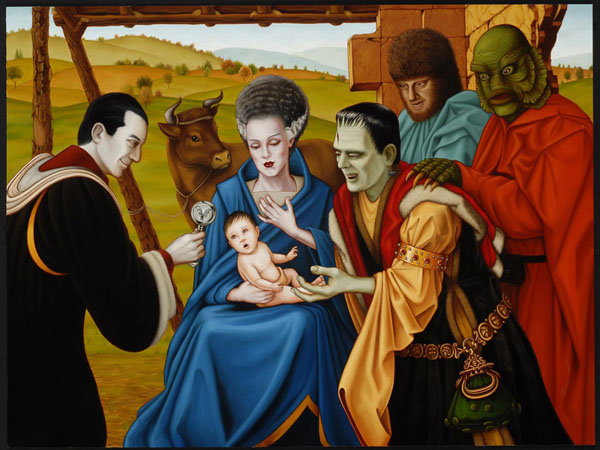
“The Magi” by William Butler Yeats. A Christmas poem that’s not about Christmas, I guess. I love the final image:
Now as at all times I can see in the mind’s eye,
In their stiff, painted clothes, the pale unsatisfied ones
Appear and disappear in the blue depth of the sky
With all their ancient faces like rain-beaten stones,
And all their helms of silver hovering side by side,
And all their eyes still fixed, hoping to find once more,
Being by Calvary’s turbulence unsatisfied,
The uncontrollable mystery on the bestial floor.
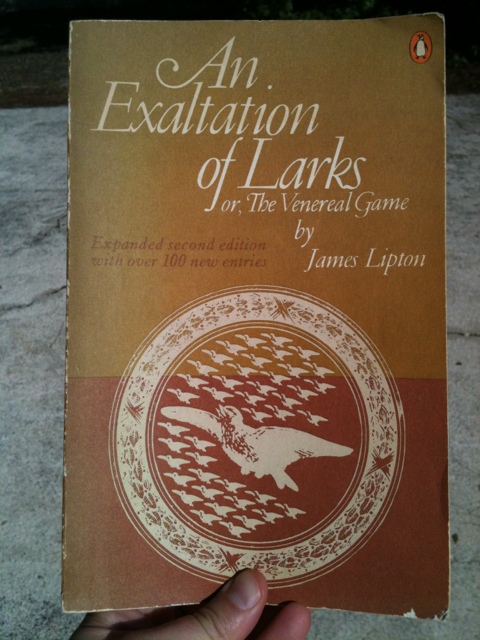
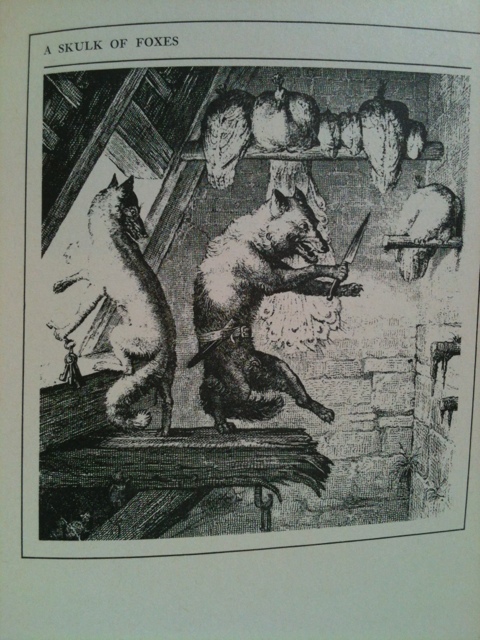
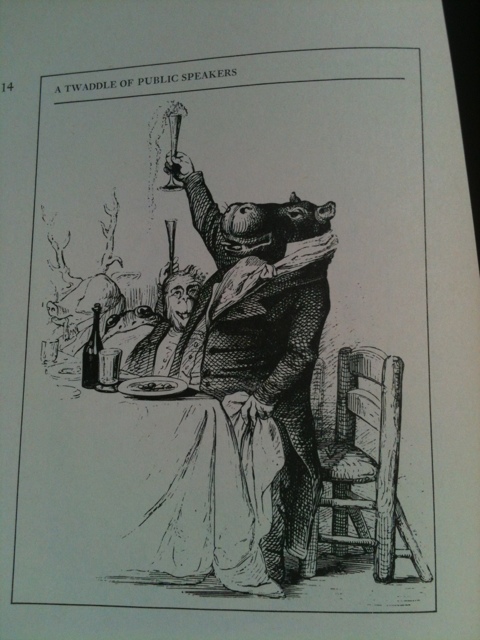
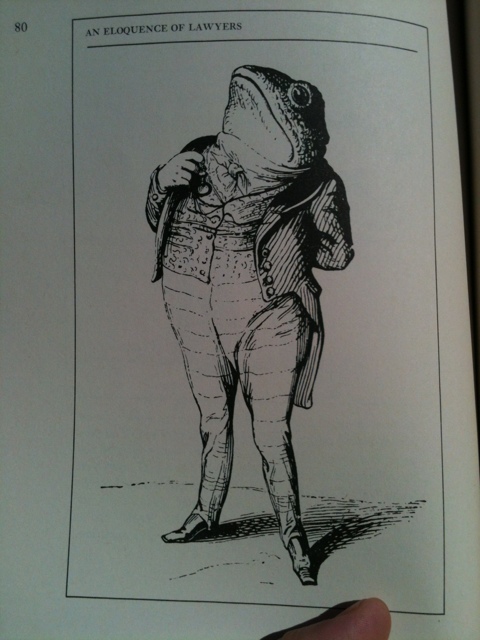
I had never heard of James Lipton’s dictionary of terms of venery, An Exaltation of Larks, or The Venereal Game before I found it wedged between some old etymological dictionaries I was browsing in my favorite book store, but when I picked it up I knew I was going to buy it almost immediately. Part dictionary, part etymology, and part linguistic game, An Exaltation explores those strange collective noncount nouns of English that anglophiles (like me) find so charming and weird. The first part of the book deals with some of the more common terms of venery, like “pride of lions,” or “skulk of foxes”:
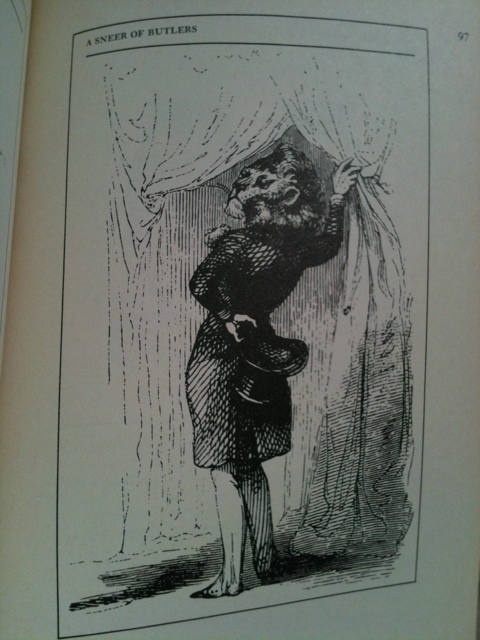
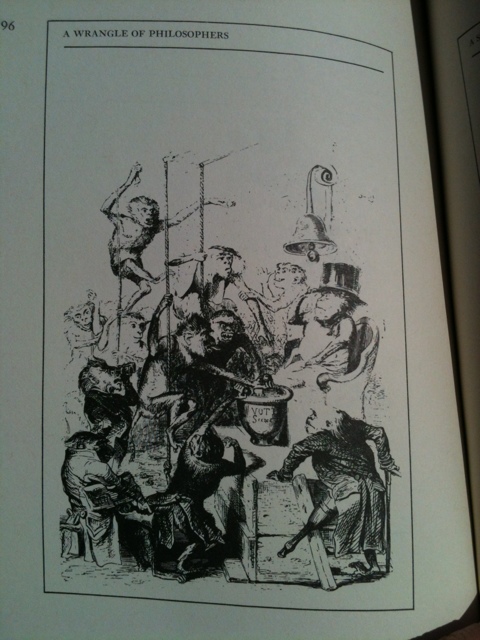
But Lipton soon gives over to more esoteric terms, and then eventually plays with outright invention. The book’s illustrations recall Max Ernst’s surrealist graphic novel Une Semaine de Bonté; they also remind me of the recapitations of recent Biblioklept interviewee Click Mort. Anyway, a very cool book, likely a cult favorite, and lots and lots of fun.
It’s hard to underestimate the influence that Def Jam Records brought to bear on contemporary culture. Not only did the label help to legitimize rap and hip hop as commercially viable (and artistic) art form, it also helped to redefine attitudes about fashion, culture, race, and even business. At its core, the early days of Def Jam were an energetic experiment in synthesis, combining the DIY spirit of punk rock with the nascent rhythms of hip hop, all twisted up in a graffiti writer’s aesthetic. Def Jam 25, a huge, overstuffed illustrated oral history of the label’s first quarter century, details the fascinating beginnings, successes—and many, many troubles—of the strange child of Rick Rubin and Russell Simmons.
Rick Rubin Hard at Work
Def Jam 25 focuses its initial energy on Rick Rubin, who comes across as the dark, eccentric spirit whose aesthetic and temperament would come to define the label’s early successes. Rubin started the label out of his NYU dorm to release a single by his artcore band Hose. Rubin was soon introduced to Simmons (by Vincent Gallo, of all people), and the duo would go on to produce and release huge hits from the Beastie Boys, L.L. Cool J, Run DMC, and a host of others.
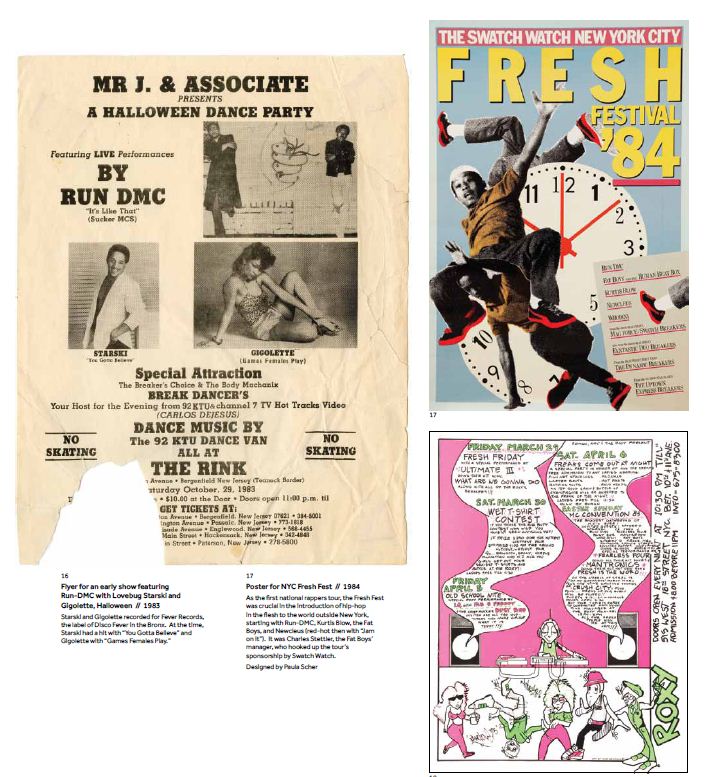
Early Flyers
Def Jam 25 combines photographs and essays with shorter eyewitness commentaries from the artists, designers, musicians, producers, and business guys who helped define Def Jam. The effect is intriguing, often insightful, occasionally funny, and especially fascinating when folks share very different accounts of how things went down. The early years of the label are documented with an energy that matches the verve of Def Jam’s pioneering work in the ’80s, and if I dwell on the first thirds, it’s only because there’s something so electrifying about those early years, when Slayer and Public Enemy were labelmates and Aerosmith and Run DMC could craft a top ten hit together.
From the "Walk This Way" Sessions
Def Jam’s success continued unabated after Rubin’s departure in 1988, and it’s hard to argue that a label putting out records by EPMD, Nas, De La Soul, Public Enemy, and the Roots was somehow less artistic and more commercial after that point. Still, Rubin’s strange punk rock energy was clearly irreplaceable, and while it remains part of the Def Jam template to this day, it’s hard to get as psyched about Rihanna and Ja Rule as it is about Slick Rick or even Onyx. But that has little to do with the actual book I suppose, which is lovingly crafted and impeccably designed.
Def Jam 25 is a great big coffee table book for people who actually like to read (and for your guests who don’t like to read, the book explodes with vivid imagery). The book reveals (and reflects) Def Jam Records as a marvelous synthesis of art, design, fashion, and business, a label that was (and is) dramatically unstable and also wildly innovative. The book will appeal to fans of music and culture alike. Def Jam 25 is new in hardback from Rizzoli.
The original SNL cast’s take on “Winter Wonderland” is one of my favorite Christmas recordings ever. It’s from the first season of Saturday Night Live; Candice Bergen is hosting, and you can see her singing along with Gilda Radner, Jane Curtin, and Laraine Newman. The underrated Garrett Morris delivers the powerful lead vocal, and there’s something magical about the moment when the boys — Chevy, Aykroyd, Belushi — come in for support.
When I was a kid, I was always puzzled by the clip. I saw it several times on Comedy Central reruns; this is back when Comedy Central was a fledgling network that ran SNL about 8hrs a day, along with lots of bad ’80s stand up shows, MST3K, and a show I loved called Short Attention Span Theater hosted by some guy named John Stewart. Anyway, I guess what puzzled me so much was that it seemed so damn sincere, and so good. I suppose Morris’s vocal provides much of the earnest authenticity that so baffled me when set against the goofy, ironic sloppiness of those (very) early SNL skits. I guess I was looking for a joke and couldn’t find one. They didn’t seem to be mocking the song. In retrospect, I can see that there’s something of a loving parody at work in their version of “Winter Wonderland,” a gentle poke at old, hokey Christmas musicals, but the emphasis is on loving — it’s almost bizarre in its tenderness and earnest emotion.
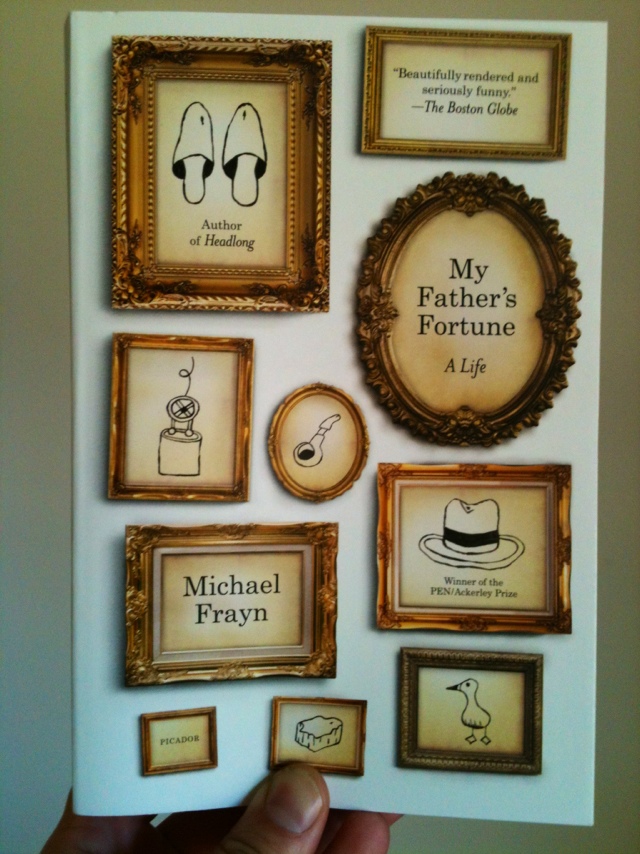
Michael Frayn’s memoir My Father’s Fortune. Publisher Picador’s (trade paperback) description:
Winner of the PEN/Ackerley Prize
Award-winning playwright and novelist Michael Frayn “makes the family memoir his own” (The Daily Telegraph) as he tells the story of his father, Tom Frayn. A clever lad, an asbestos salesman with a winning smile and a racetrack vocabulary, Tom Frayn emerged undaunted from a childhood spent in two rooms with six other people, all of them deaf. And undaunted he stayed, through German rockets, feckless in-laws, and his own increasing deafness; through the setback of a son as bafflingly slow-witted as the father was quick on his feet; through the shockingly sudden tragedy that darkened his life. As Peter Kemp wrote in The Sunday Times (London), “Frayn has never written with more searching brilliance than in his quest for his past.”
Russell Hoban, author of Riddley Walker and other cult classics, died last night at the age of 86. The first “review” I ever wrote on this site was for Riddley Walker (the review is so bad that I won’t link to it out of shame); that was back when Biblioklept’s primary mission was to document stolen books. I stole the book from a dear friend and subsequently lent it to a student who never returned it. Oh, the circle of theft! Riddley Walker is the sort of book that begs to be stolen (or never returned, or passed on to another). It’s an apocalyptic Huckleberry Finn, a coming of age story set against the backdrop of a new dark age. Riddley Walker is deeply weird and strongly strange; I don’t know what a “cult” novel is, but I know of no better example.
Riddley Walker might be Hoban’s most famous work (aside from his children’s works, including the Frances the Badger series), but readers who stopped there would do well to pick up some of his earlier books. The Lion of Boaz-Jachin and Jachin-Boaz is a fantasy piece about fathers, sons, and map-making; Kleinzheit, a baffling schizophrenic novel, explores death and illness in an animistic world; Pilgermann plumbs the medieval intersection of Judaism, Christianity, and Islam, narrated through the eyes of the ghost of a castrated European Jew on a bizarre holy quest—it’s like Hieronymous Bosch on LSD.
Death, Hoban predicted in 2002, would “be a good career move”. “People will say, ‘yes, Hoban, he seems an interesting writer, let’s look at him again’,” he said.
The grim humor there was always part of Hoban’s program, and I hope that he’s right: I hope that folks who haven’t heard of Hoban will pick up Riddley Walker, and perhaps those who haven’t read beyond that book will make time to read another.









 Biblioklept