Books Acquired, Sometime Last Week (I Don’t Know, Maybe on Thursday or Friday)

I picked up a bevy of books at my favorite bookstore sometime last week ; can’t remember the day, exactly. Anyway, some of these selections come from reader recommendations re: nonconventional lit.

20111103-155310.jpg

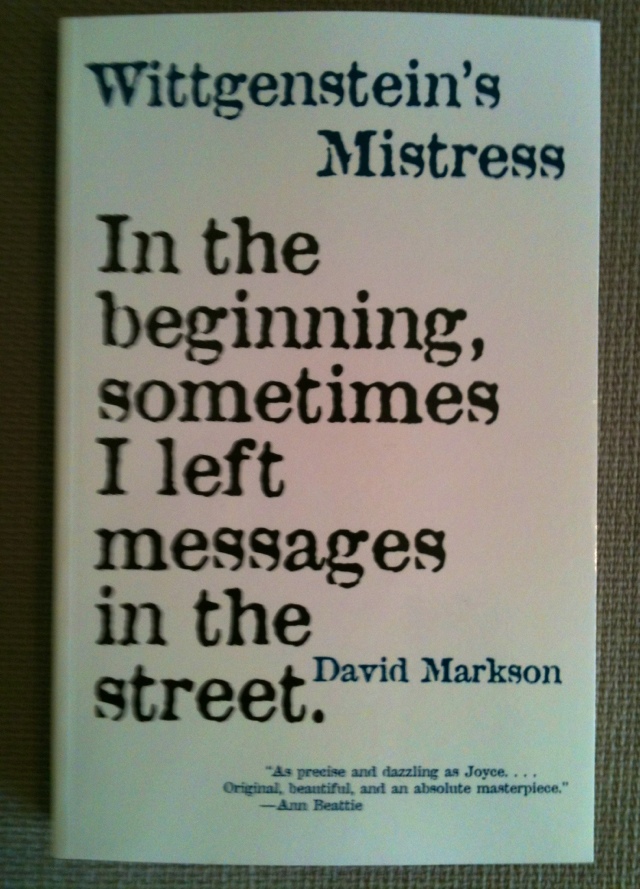
I ordered David Markson’s novel Wittgenstein’s Mistress, which I’ve been meaning to read for yonks but had never found used. Horrible, horrible cover

20111103-155319.jpg

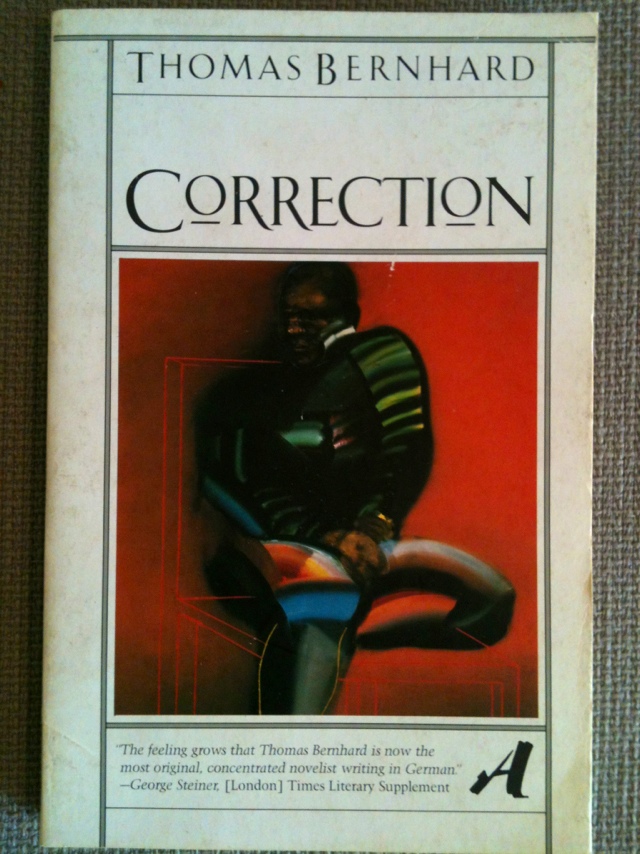
Bernhard’s Correction: Thomas Bernhard came recommended by a number of readers in the aforelinkedto post; dipping into Correction immediately recalled Sebald’s The Rings of Saturn for some reason.

20111103-155327.jpg

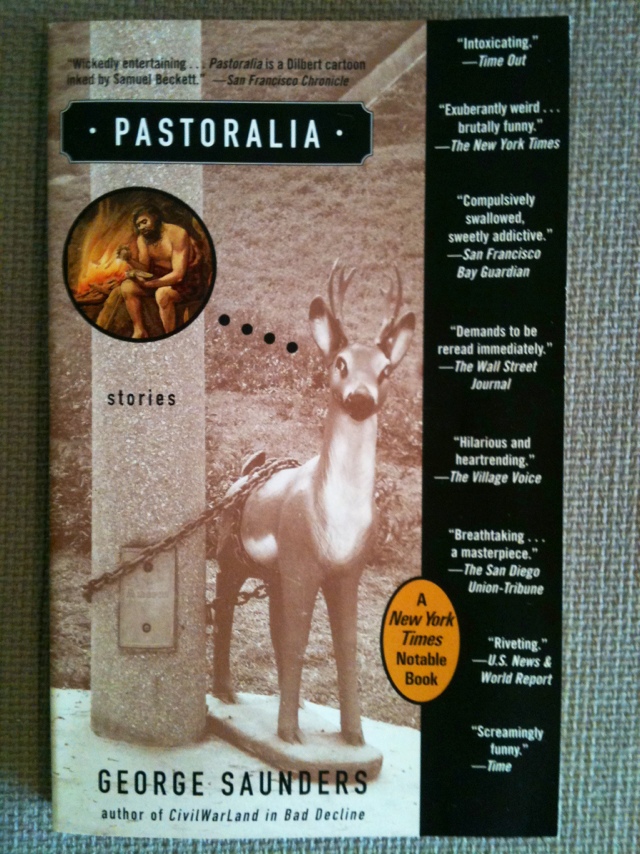
George Saunders: another reader recommendation. I actually read Pastoralia this week. I love short stories. Anyway, full review forthcoming. Short version: good stuff, but DFW casts a pretty big shadow.

20111103-155351.jpg

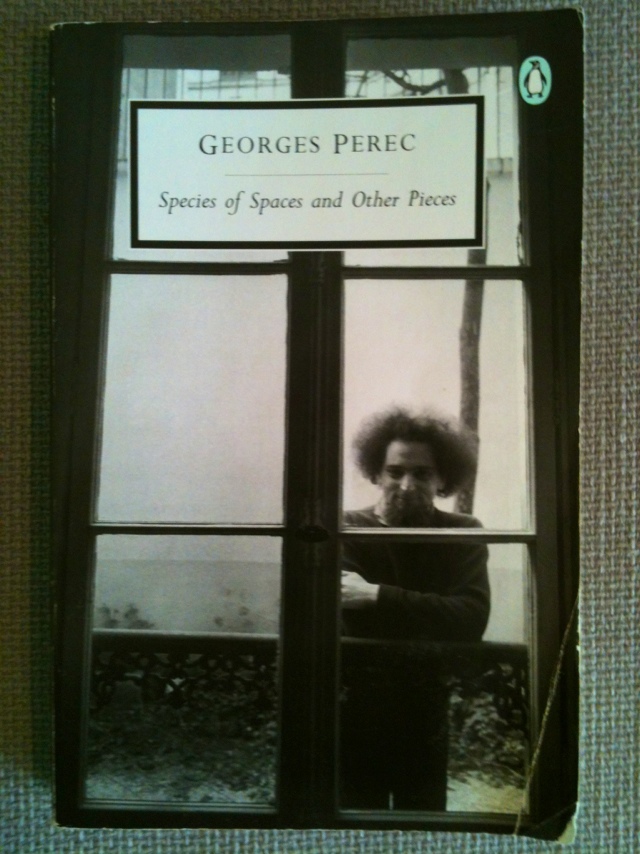
Georges Perec was another reader rec, but it was his novel Life: A User’s Manual that kept popping up. I found Species of Spaces and Other Pieces, his collection of essays and other stray bits, by sheer chance. I think I was looking for something by De Sade, actually. Anyway, I love, love, love this book—it kinda reminds me of Bolaño’s Between the Parentheses or even the Vollmann reader Expelled from Eden—the kind of book I see myself dipping into again and again, a little mini-labyrinth of ideas.

20111103-155359.jpg

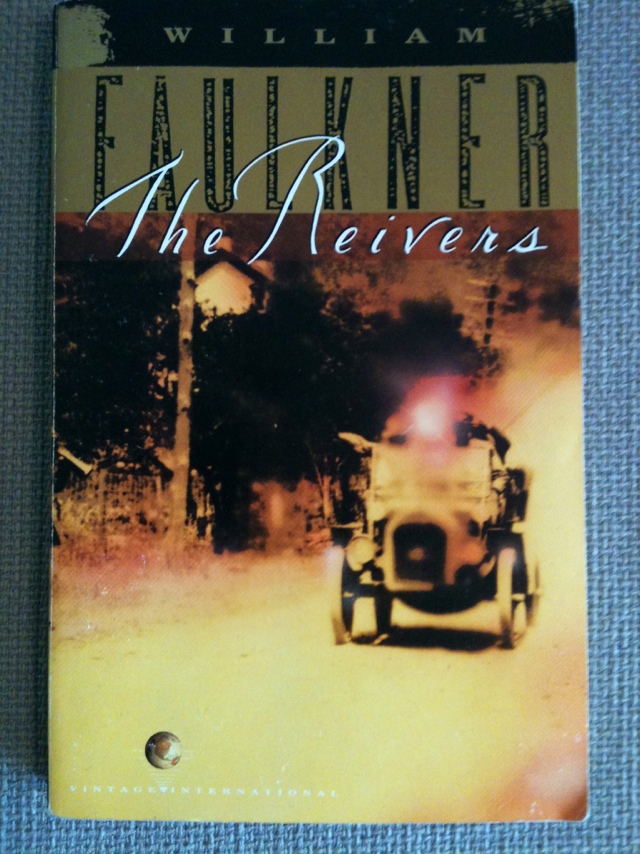
I also picked up Faulkner’s last novel, The Reivers; been wanting to read it for a long time now. I’ll try to get it in over the Christmas break.

“The Golden Bull” (From the Occupy Wall Street Coloring Book)

(More).

The Second Issue of Litmag C4 Is Out

The new issue of C4 is out now, featuring original short stories, nonfiction, art, and poetry. Good stuff (and free).

“We Needed Weenies” — Capitalism Explained

Derrida Talks About Biography, Authority, and Stability


Seven Stories of Deadly Sins — Stefan Glerums

“Gotta Get Up” — Harry Nilsson

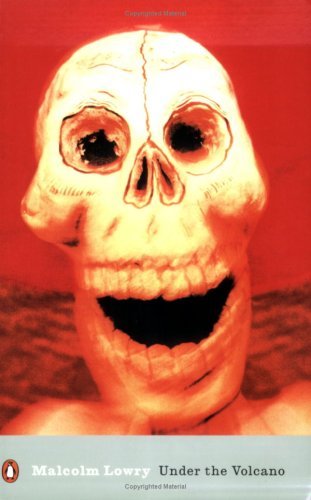
Under the Volcano — Malcolm Lowry

Most of Malcolm Lowry’s dense, depressing novel Under the Volcano takes place over the course of November 2nd, 1938, the Mexican Day of the Dead. Like a reticent, dour Virgil, Lowry guides the reader through the day’s tragic arc, floating between the minds of his novel’s three protagonists: Geoffrey Firmin, his half-brother Hugh, and Geoffrey’s estranged wife Yvonne. Geoffrey is British Consul to Mexico — ex-Consul, really, as British-Mexican relations sour against the backdrop of Spanish fascism and the rise of nationalism in Mexico — but he is almost always referred to as “the Consul,” a blackly ironic title. See, the Consul bears little authority aside from an extreme expertise on how to stay drunk (or “drunkly sober un-drunk”) 24/7. He’s ambassador to bar stools, a manager of mescal and little else (certainly not his own life; certainly not diplomatic affairs). The Consul is a wreck, an alcoholic to put Hemingway and Fitzgerald’s (and even Bukowski’s) alter-egos to shame.

After a first chapter that seems to derail all but the most patient readers, the narrative conflict arrives when Yvonne returns to Quauhnahuac, Mexico, a year after leaving (and divorcing) the Consul. She arrives to find the Consul (“Geoffrey,” as he’s called when the free indirect style inhabits her mind) drinking whiskey in a hotel bar in order to sober up (yep). It’s not immediately clear why Yvonne has returned to the Consul, but it seems that she hopes to save him from drowning in a drunken downward spiral. As the pair walks to the Consul’s house, they pass numerous advertisements for a boxing match; a child’s funeral proceeds down the avenue. These motifs of fighting, death, and futility permeate the novel.

During the walk we learn that Yvonne is not the only one concerned about the Consul’s health; his (much) younger brother Hugh has come to stay with him in the hopes of sobering him up. (Hugh employs a revolting and unsuccessful “strychnine cure”). That Hugh has also returned doubly complicates the plot. Much of Under the Volcano remains implicit, unnamed, hinted at, and this seems especially true of the implication that Yvonne cheated on the Consul with Hugh in the recent past (this implication may have been stated conclusively at some point in the novel, but I’ve only read the book once, which is perhaps like not having read it at all). What’s certainly clear is that Yvonne cheated on the Consul with a French filmmaker, Jacques Laruelle, a man whom the Consul, through sheer bizarre coincidence (but of course it isn’t sheer bizarre coincidence), spent a childhood summer with, an experience which bonded them as brothers in an Edenic holiday that eventually (inevitably) soured.

Despite her infidelities, Yvonne is generally present (I choose the verb “present” over “presented as” to highlight Lowry’s impeccable Modernist style) as a sympathetic character. Still, it is hard not to identify with the Consul (with “Geoffrey,” I suppose, if we are going to be familiar), the dark soul of this novel, and his complicated, painful feelings for Yvonne form the core of Volcano’s tragedy. He longs for her, pines for a complete life with her, yet resents her, cannot forgive her, hates her. For what? For leaving him. For betraying him. But perhaps foremost, he despises her inability to understand his alcoholism (he is particularly upset when she refuses to share a morning libation with him when they meet for the first time in a year). I’ll quote a passage at length now, one that showcases Lowry’s free indirect style, and one that reveals the strange indignities of the Consul’s sense of his own alcoholism. For context, dear reader, you must only know that Yvonne has suggested that she and the Consul might make long-term plans when he is sober “in a day or two”—

The Consul sat perfectly still staring at the floor while the enormity of the insult passed into his soul. As if, as if, he were not sober now! Yet there was some elusive subtlety in the impeachment that still escaped him. For he was not sober. No, he was not, not at this very moment he wasn’t! But what had that to do with a minute before, or half an hour ago? And what right had Yvonne to assume it, assume either that he was not sober now, or that, far worse, in a day or two he would be sober? And even if he were not sober now, by what fabulous stages, comparable indeed only to the paths and spheres of the Holy Cabbala itself, had he reached this stage again, touched briefly once before this morning, this stage at which alone he could, as she put it, “cope,” this precarious precious stage, so arduous to maintain, of being drunk in which alone he was sober! What right had she, when he had sat suffering the tortures of the damned and the madhouse on her behalf for fully twenty-five minutes on end without having a decent drink, even to hint that he was anything but, to her eyes, sober? Ah, a woman could not know the perils, the complications, yes, the importance of a drunkard’s life! From what conceivable standpoint of rectitude did she imagine she could judge what was anterior to her arrival? And she knew nothing whatever of what all too recently he had gone through, his fall in the Calle Nicaragua, his aplomb, coolness, even bravery there—the Burke’s Irish whiskey! What a world! And the trouble was she had now spoiled the moment.

The “fall in the Calle Nicaragua” the Consul references is quite literally a drunkard’s blackout (followed by the aforementioned fortifying whiskey, courtesy of a tourist), but it — falling — is perhaps the dominant motif in a novel crammed with motifs. In allegorical terms, if we want to ruin a good book (I don’t recommend this, of course), Volcano is pure Faust-stuff: end of innocence, fall of man, intractability of the human condition, ethical peril, moral inertia. While the Consul’s fall dominates the novel, Lowry brings this decline into dramatic relief in a late, climactic episode when his (anti-)heroic trio encounter a dying (dead?) man on the side of the road. Hugh tries to help, but the Darwinian venality of Mexican commonplace law makes his attempt impotent. Yvonne and the Consul are basically paralyzed.

Hugh’s attempt to save the man is a desperate call to action, an endeavor to perform some good in a world dominated by war and fascism. Hugh’s character fascinates. We learn of his past in one of the novel’s most intriguing episodes, a mini-bildungsroman that finds young Hugh working in the merchant marine as a calculated ploy to lend romance to his persona — he longs to prevail as a songwriter. He returns to find that no one cares about — has even heard — his guitar compositions; his publicity stunt fails. Although Hugh is only twenty-nine, he already seems himself as a failure, a fallen hero; he obsesses over the Battle of Ebro, daydreaming of helming a ship laden with hidden arms that he will deliver to the Loyalists who oppose the Fascists. Hugh’s greatest pain — and perhaps (only perhaps) Lowry’s greatest cruelty — is the awareness that the idealism of romantic heroism is intrinsically bound to a kind of selfish egoism. Hugh, perhaps with the visceral signal of his half-brother as a kind of radical prescience, can already see his own fall; his parts in Volcano are in a sense a constant meditation on falling. Hugh tries to save the dying man on the road, the cold double of his brother, whom he also tries to save — and yet it is all to little avail.

In Lowry’s world, in the volcano-world, there is only expulsion from the Eden. Lowry spells out this theme near the middle of his novel in a strange episode. The Consul wanders into his neighbor’s garden and reads a sign —

¿LE GUSTA ESTE JARDÍN?
¿QUE ES SUYO?
¡EVITE QUE SUS HIJOS LO DESTRUYAN!

The Consul stared back at the black words on the sign without moving. You like this garden? Why is it yours? We evict those who destroy! Simple words, simple and terrible words, words which one took to the very bottom of one’s being, words which, perhaps a final judgement on one, were nevertheless unproductive of any emotion whatsoever, unless a kind of colourless cold, a white agony, an agony chill as that iced mescal drunk in the Hotel Canada on the morning of Yvonne’s departure.

Significantly, either the sign is posted with improper punctuation, or (and?) the Consul’s translation is wrong — in either case a meaningful misreading occurs. We later receive the “proper” version of the sign: “¿Le gusta este jardín, que es suyo? ¡Evite que sus hijos lo destruyan! – “Do you like this garden that is yours? See to it that your children do not destroy it!”  The Consul’s first reading is a corruption, a cruel misreading that questions humanity’s right to happiness, and, tellingly, he connects the sign to the end of his relationship with Yvonne. The second version of the sign, while still foreboding, perhaps signals a kernel of hope in Lowry’s bleak work — the idea that a garden might be preserved, might be tended to; that children might be raised who do not kill, cheat, steal, rape, enslave, or otherwise prey on each other. Still, Lowry refuses to imagine what such a world might look like for us. Did I mention that Volcano is really, really sad?

For all its bleak, bitter bile, Volcano contains moments of sheer, raw beauty, especially in its metaphysical evocations of nature, which always twist back to Lowry’s great themes of Eden, expulsion, and death. Lowry seems to pit human consciousness against the naked power of the natural world; it is no wonder then, against such a grand, stochastic backdrop, that his gardeners should fall. The narrative teems with symbolic animals — horses and dogs and snakes and eagles — yet Lowry always keeps in play the sense that his characters bring these symbolic identifications with them. The world is just the world until people walk in it, think in it, make other meanings for it.

In many ways, Under the Volcano is an antipodal response to Joyce’s Ulysses. Both novels stream through a number of consciousnesses over the course of one day; both novels invert and subvert mythical frameworks against diurnal concerns; both novels point to the ways that the smallest meannesses — and kindnesses — can color and affect our lives. And while there are many divergences (chiefest, I believe, the spirit of redemption in Ulysses that seems entirely absent from Volcano), the greatest similarity may be their difficulty. Simply put, Lowry, like Joyce, throws his readers into the deep end. The first chapter of the novel inhabits the mind of Jacques Laruelle and takes place exactly one year after the events of the rest of the novel. It is both overture and context for all that follows, and yet it is radically alienating; indeed, it only fully makes sense after one finishes the novel and goes back and reads it again, realizing it is the rightful coda, the sad epilogue of a sad story. Lowry leads with his conclusion, show us the fall-out up front, the splinters and shards of the narrative to come. Picking up these pieces is hardly easy and never joyful, but it is a rewarding experience. Very highly recommended.

[Editorial note: Biblioklept ran this review in March of 2011; we run it again in honor of The Day of the Dead]
 

“The Impulse Is to Record” — Martin Scorsese Talks About Storytelling

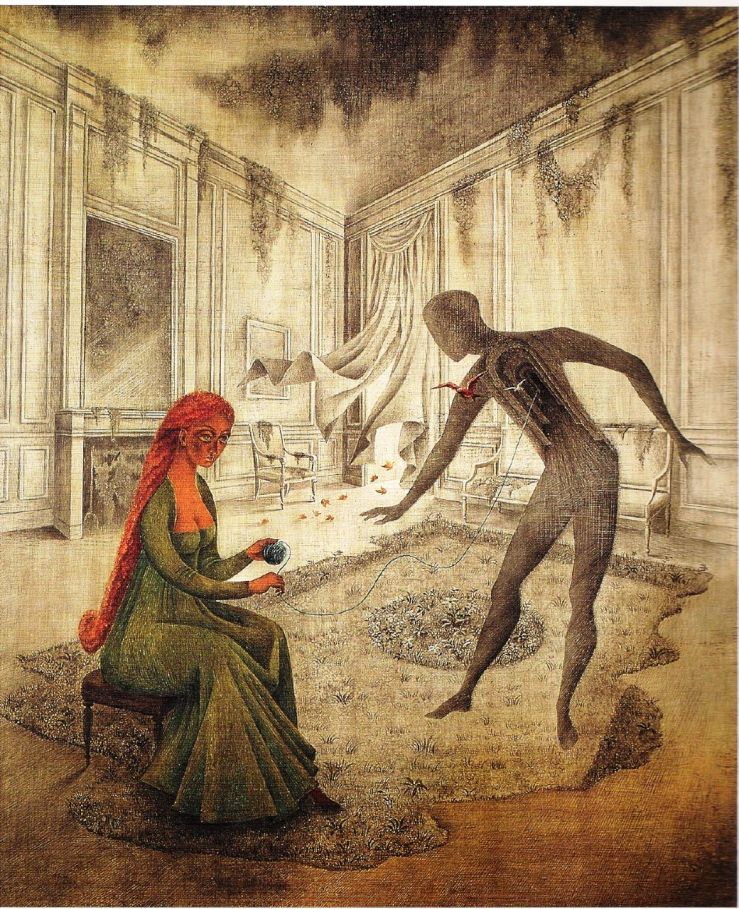
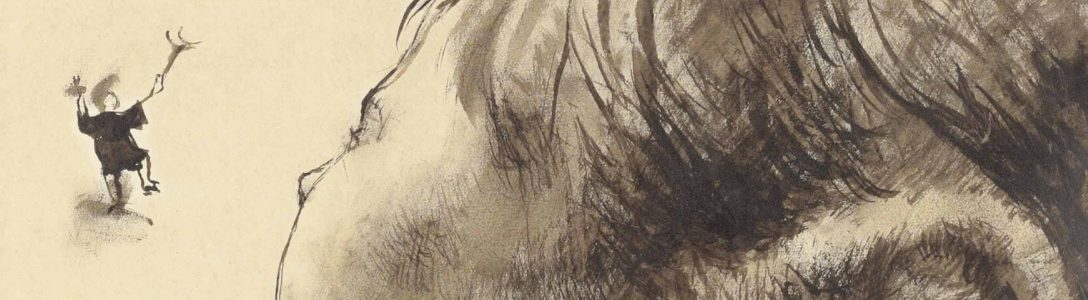
Les Feuilles Mortes — Remedios Varo

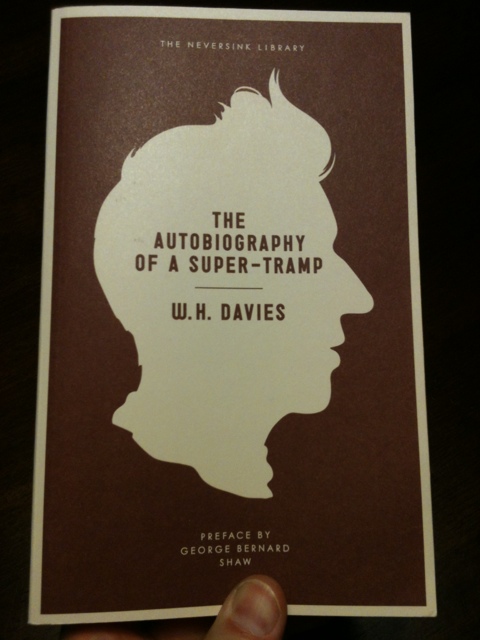
The Autobiography of a Super-Tramp — W.H. Davies

The Autobiography of a Super-Tramp documents W.H. Davies’s picaresque adventures in America in the last decade of the nineteenth century. In bildungsroman mode, Davies begins by relating the story of his childhood in Wales, where he was raised by his grandparents after his father died and his mother essentially abandoned her children. Despite his grandparents’ care, Davies soon turns to petty crime, shoplifting for sport (as well as to provide trifles for his girlfriend). He’s caught, tried,  and beaten, an early run-in that would set a template for future dealings with authority figures. A restless spirit with a hankering for adventure, Davies has trouble attaining steady work; he’s a bit of a romantic, always stuck in a book. He elects to set off for America. In one of the funnier moments in the book, Davies describes writing a letter comparing America to England. Davies mails the missive home—only he’s still in Liverpool and has yet to see the New World, let alone the open sea. Of course, after years trekking across the US, Davies got to know much of the national characteristic; here he is reflecting—

My impression of Americans from the beginning is of the best, and I have never since had cause to alter my mind. They are a kind, sympathetic race of people and naturally proud of their country. The Irish-American is inclined to be the most bitter, remembering from his youth the complaints of his parents, who were driven through unjust laws from their own beloved land; and such a man is not to be idly aggravated, for life is a serious subject to him. This man is not to be aggravated, especially under the consideration that our conscience is not too clean in this respect, and that we are apt to be very slow in making that open confession which is good for the soul. The most pleasing trait in Americans, which cannot for long escape us, is their respect for women and the way in which the latter do deserve it.

In a strange moment that’s never quite fully explained (there are lots of these in Super-Tramp), upon arrival in America, our hero elects to take up with a vagabond named Brum, who teaches the would-be tramp the ins-and-outs of jumping rail, beating trail, and begging from town to town. In one inspired episode, Brum takes our hero to Michigan, where vagabonds could wait out the winter in warm jails with plenty of food (and tobacco). Here, the tramps could barter their own sentences with the complicity of the judge and jailers, who were basically working a scam on the taxpayers. (Luckily, no one makes undue profits by overcrowding prisons in America today. Right? Right?) Brum is one of the first players in a large cast of indigents and outsiders, men of dubious honesty and strange talents whose common thread is that they are all aliens to mainstream society. These are self-exiles whose only telos is movement itself.

These themes of travel and outsider status link Davies’s narratives strongly to those two Jacks of all trades, London and Kerouac, although the clean, spare style of Super-Tramp shares more blood with London’s reportorial rhythms than Kerouac’s unbound typing. It’s also hard to read Super-Tramp without recalling Steinbeck’s bindlestiffs, and just as in Steinbeck’s finest works, there’s depth, humility, and pathos in Davies’s writing, whether he’s describing picking berries, sharing a drink with the fellows, or moving cattle across the Atlantic.

And if Davies demonstrates empathy for his fellow man, that empathy extends to his keen descriptions of nature and animals; his tender descriptions of the poor cattle he helps transport to England are especially moving. Here, Davies shows the reader his naturalist sympathies—

I like to see to a good scientific bout by men who know the use of their hands, but would rather walk twenty miles than see animals in strife. Although of a quiet disposition, my fondness for animals is likely at any time to lead me into danger. After reading cases of vivisection I have often had dreams of boldly entering such places, routing the doctors with an iron bar, cutting the cords and freeing the animals, despite of any hurt I might receive from bites and scratches. Perhaps I should cut a ridiculous figure, walking the crowded streets with a poor meek creature under each arm, but that would not bother me in the performance of a humane action.

These dual drives—empathy and outrage against injustice—guide Super-Tramp, set against an abiding spirit of freedom and nature. As the narrative progresses, Davies repeatedly foregrounds the Darwinian peril the emerging capitalist industrial culture places on ordinary people. His note on vivisection above becomes tragically ironic late in the book when a terrible accident on the rails claims one of his feet.

Despite his hard (if self-elected) life, Davies would later become more comfortable as one of the most famous poets of his age in England, lauded for his plain, naturalist style, and championed by George Bernard Shaw (who wrote the preface to Super-Tramp and helped get the book published). The Autobiography of a Super-Tramp is an engaging page-turner that will likely appeal to fans of Jack London and John Steinbeck or anyone fascinated by the grime and romance of a hobo jungle. With its emphasis on the human face of those who refuse to play into the capitalist system, the book is as timely as it ever was.

And yes, the band got their name from the book.

The Autobiography of a Super-Tramp is part of Melville House’s new Neversink line.

“The Artist Was Much Ahead of Me” — Woody Allen Talks About Seeing 2001: A Space Odyssey

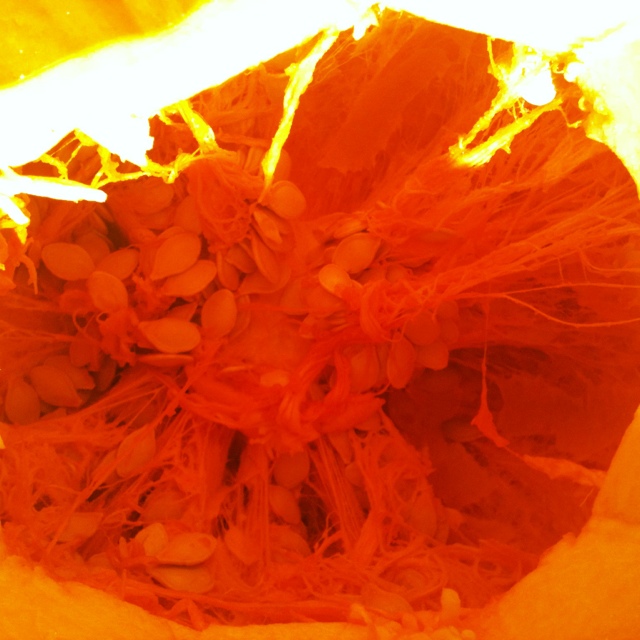
Jack O ‘Lantern, 2011

20111031-203939.jpg

20111031-203947.jpg

20111031-204000.jpg

20111031-204008.jpg

Seven More Horror Stories Masquerading in Other Genres

We often identify genre simply by its conventions and tropes, and, when October rolls round and we want scary stories, we look for vampires and haunted houses and psycho killers and such. And while there’s plenty of great stuff that adheres to the standard conventions of horror (Lovecraft and Poe come immediately to mind) let’s not overlook novels that offer horror just as keen as any genre exercise. Hence: Seven horror stories masquerading in other genres (and see our first post for more):

Oedipus Rex — Sophocles

Sure, Aristotle tells us that tragedy, by its very nature, must involve pity and terror, two emotions fundamental to horror as well. But the Oedipus story is so fundamental to our culture and its narratives that we easily overlook the plain fact that it is a horror story. Oedipus Rex begins with the attempted infanticide of the hero, including the brutal pinning of his feet, from which his name derives. Spared, Oedipus must endure the horrific uncertainty that he is not his parents’ natural son, a problem compounded when he learns from the Delphic oracle that he is predestined to kill his father and mate with his mother. You know what unfolds: a murder on the high road, a monster with riddles, a curse of famine, a horrible revelation, a suicide, and a bloody blinding.

Julius Caesar — William Shakespeare

History is its own horror show; Julius Caesar might be about the Roman Empire or the price of a republic, but it’s also very much a tale of paranoia, murder, and ghosts. Poor wavering Brutus recapitulates the crime of Oedipus when he stabs father-figure Brutus. The conspirators bathe their hands in Caesar’s blood, hoping to signal rebirth and shared responsibility, but the marking gestures are ultimately ambiguous. Great Caesar’s ghost will return, suicides will abound (Portia swallowing hot coals is particularly gruesome), and war will ravage the Republic.

“A Good Man Is Hard to Find” — Flannery O’Connor

This one may be a bit of a cheat, because I’m sure plenty of folks have the good sense to see “A Good Man Is Hard to Find” as the horror story it is. Still, O’Connor’s short masterpiece too often gets pushed into the “Southern Gothic” or even “Southern Grotesque” mini-genre, one which belies the story’s intense powers of horror. The intensity of “A Good Man” comes largely from its crystalline reality; half a century after its publication, the Misfit still has the power to shock readers (notice too that the Misfit’s first crime was again Oedipal—he was jailed for patricide). Here’s O’Connor on her story:

Our age not only does not have a very sharp eye for the almost imperceptible intrusions of grace, it no longer has much feeling for the nature of the violence which precede and follow them.  The devil’s greatest wile, Baudelaire has said, is to convince us that he does not exist.
I suppose the reasons for the use of so much violence in modern fiction will differ with each writer who uses it, but in my own stories I have found that violence is strangely capable of returning my characters to reality and preparing them to accept their moment of grace.  Their heads are so hard that almost nothing else will do the work.  This idea, that reality is something to which we must be returned at considered cost, is one which is seldom understood by the casual reader . . .

The Kindly Ones — Jonathan Littell

Keeping our Oedipal theme alive is Littell’s enormous novel The Kindly Ones, a horror story masquerading as a historical epic. The Kindly Ones, taking its name from the Greek tragedy, is about an SS officer who carries out probably every taboo one can think of during WWII, including incest, patricide, fantasies of coprophilia and cannibalism, and child murder. Oh, and mass murder. Lots and lots of mass murder. In my review, I argued that, “This is a novel that might as well take place in the asshole,” and I stick by that.

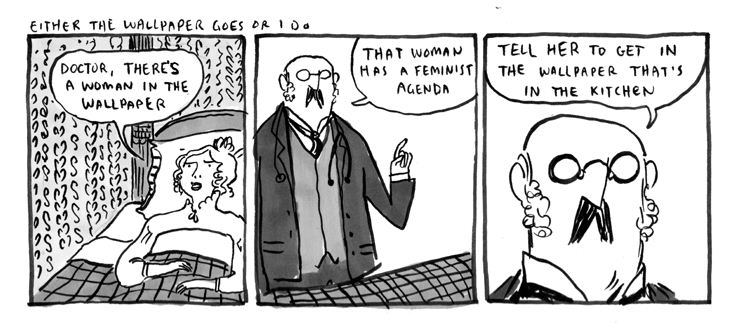
Kate Beaton's Take on "The Yellow Wallpaper"

“The Yellow Wallpaper” — Charlotte Perkins Gilman 

“The Yellow Wallpaper” has become a central text in feminist criticism for good reason. The story, told in first person POV, is a sad, scary descent into madness. And while it’s easy to point toward postpartum depression as the culprit, the story deserves a much more considered analysis, one which addresses the literal and metaphorical constraints placed upon the female body—a body that literary traditions have often tried to keep lying down (consider Sleeping Beauty, for example).

Steps — Jerzy Kosinski

Steps is an odd duck even for this list, because I’m not even sure if it’s ever been identified within a genre by any large group of readers. From my review:

At a remove, Steps is probably about a Polish man’s difficulties under the harsh Soviet regime at home played against his experiences as a new immigrant to the United States and its bizarre codes of capitalism. But this summary is pale against the sinister light of Kosinski’s prose. Consider the vignette at the top of the review, which begins with an autophagous octopus and ends with a transvestite. In the world of Steps, these are not wacky or even grotesque details, trotted out for ironic bemusement; no, they’re grim bits of sadness and horror. At the outset of another vignette, a man is pinned down while his girlfriend is gang-raped. In time he begins to resent her, and then to treat her as an object–literally–forcing other objects upon her. The vignette ends at a drunken party with the girlfriend carried away by a half dozen party guests who will likely ravage her. The narrator simply leaves. Another scene illuminates the mind of an architect who designed concentration camps. “Rats have to be removed,” one speaker says to another. “Rats aren’t murdered–we get rid of them; or, to use a better word, they are eliminated; this act of elimination is empty of all meaning. There’s no ritual in it, no symbolism. That’s why in the concentration camps my friend designed, the victim never remained individuals; they became as identical as rats. They existed only to be killed.” In another vignette, a man discovers a woman locked in a metal cage inside a barn. He alerts the authorities, but only after a sinister thought — “It occurred to me that we were alone in the barn and that she was totally defenseless. . . . I thought there was something very tempting in this situation, where one could become completely oneself with another human being.” But the woman in the cage is insane; she can’t acknowledge the absolute identification that the narrator desires. These scenes of violence, control, power, and alienation repeat throughout Steps, all underpinned by the narrator’s extreme wish to connect and communicate with another. Even when he’s asphyxiating butterflies or throwing bottles at an old man, he wishes for some attainment of beauty, some conjunction of human understanding–even if its coded in fear and pain.

“The Shawl” — Cynthia Ozick

Ozick’s short story “The Shawl” is a study in desperation and fear, and while any hack can milk horror from a concentration camp setting and a sick child, Ozick’s psychological study of a mother and her children skewers any hope of a simple sympathetic reading. At its core, “The Shawl” is about the dramatic Darwinism that underpins our fragile bodies, a Darwinism that can, under the right circumstances, remove our humanity. I never want to read “The Shawl” again.

Biblioklept’s Halloween Costume, 2011 (Punctuation Edition)

This is my Halloween costume—at least the one that I wore to my composition classes. Most of my students didn’t get it:

20111031-114856.jpg

I was a cereal comma. Fun stuff.

Five Creepy Scenes from David Lynch

Michael Jackson’s Death Mask (Sorta, But Not Really)

Regular readers of Biblioklept may know that for the past year or so I’ve posted a death mask every Sunday. Sometimes these “death masks” are actually life masks or even busts made years after burial. Obviously, these bizarre statues—which belonged to Jackson himself—are not death masks in any literal sense, but I think that they capture some of the strange horror of MJ. As I argued in an essay written shortly after his death, Jackson’s physical body was a concentrated site and signal of the American Dream as process, as change, as commodity capital written on the physical self. The death masks above (as I choose to call them) embody the bizarre fascination that will always mark any serious consideration of Jackson’s career as a public figure. As he showed us repeatedly in his music videos and short films — not to mention in his multiple radical plastic surgeries — Jackson posited his physical body as a site of mutation, transformation, and disruptive change; these changes ran the gamut of physical possibility, from the organic werebeast/zombie dancing king at the center of “Thriller” to the mechanized cyborg we see above. In any case, forgive this post’s (probably) lurid title—it is simply offered in the spirit of consistency, affording me an opportunity to share some strange pics of a tragic, horrific figure this Halloween.