Even a die-hard Simpsons fan such as myself–I’ve been watching the show for over half of my life on a near-daily basis–cannot deny that the show has been in a slump for the past couple (some might say dozen) years. And so far, the 2007 season has been pretty awful–even the highly anticipated “Treehouse of Horror” episode failed to elicit a single laugh. So I was unduly excited by the first segment of last night’s episode, which featured three of our favorite comic book writers: Art Spiegelman, Daniel Clowes, and Alan Moore. Jack Black guest-starred as the owner of Coolsville, a new comic book shop where the elite underground trio gathers for a book signing (much to the ire of Comic Book Guy, of course). Somehow (and of course, if you watch The Simpsons, you know exactly how), this plot lasts exactly until the commercial break: in part two Marge opens a gym, and in part three Homer gets plastic surgery. Sigh. Luckily, Youtube allows us to preserve and isolate the most pleasing fragment of last night’s episode and watch it again and again obsessively.
Check out the super trio here (and take note of the prominent display of one of our favorite graphic novels ever, From Hell):
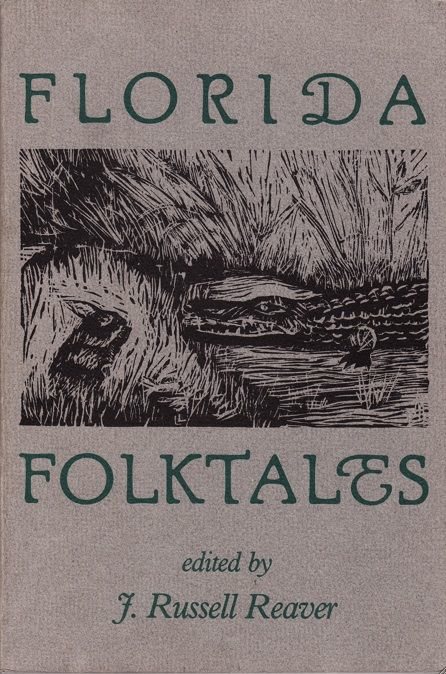
I found this little gem at the bottom of a cardboard box in a locked cabinet in an abandoned teacher’s lounge. I had to break the lock: hidden treasure. Florida Folktales collects a range of folklore, ranging from ghost stories and trickster tales, to modern urban legends. I was intrigued by the back cover blurb by my one of my old professors at the University of Florida, Dr. Robert Thomson (he was the instructor for a folklore class I took. My project: I collected stories told by people who claimed to have had supernatural experiences while on drugs. Lots of LSD angels-and-demons stuff. I think I got an A-). Lovely book, University of Florida Presses.
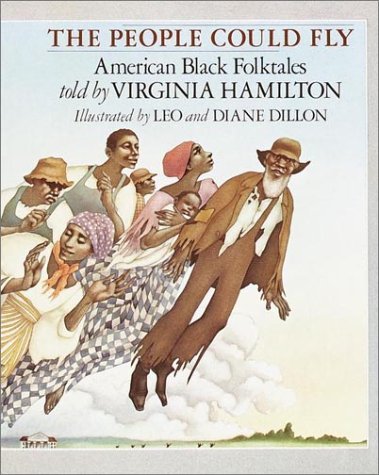
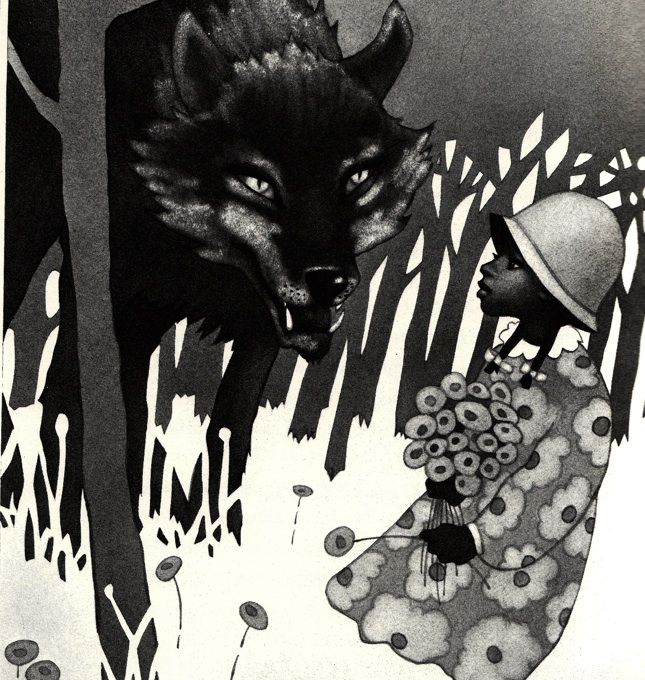
Under Florida Folktales I was pleased as punch (yes, punch: like this guy) to discover Virginia Hamilton’s retelling of traditional American Black folktales, The People Could Fly. I used a few of the tales the same day in class. Beautiful illustrations by Leo and Diane Dillon perfectly capture the axis of waking life and dreamworld these folktales express. Again, a lovely book.
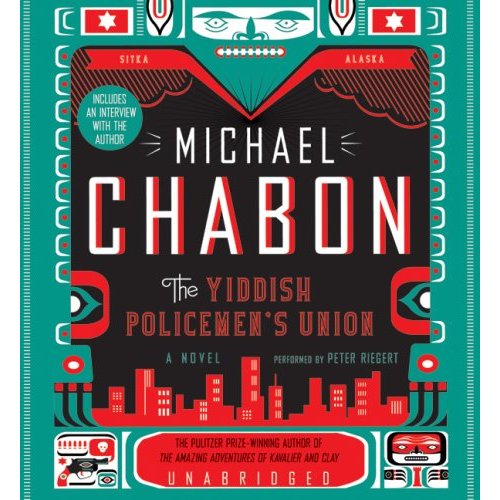
Yesterday afternoon, I finished listening to the audiobook version of Michael Chabon’s much heralded 2007 novel, The Yiddish Policemen’s Union, read quite competently by Peter Riegert.
I like audiobooks. They give me a chance to catch up with a lot of stuff that I otherwise wouldn’t have the time to read. Some people have a problem with audiobooks; apparently no one ever read a story to them. Or they’re just uptight. But that’s not what this is about. See, before I start picking at TYPU, I just want to preempt any Chabon fans saying: “Well, if you actually read the book, you would’ve liked it better.” No. I’m really good at listening to books on CD. Like, I can even make mental annotations. And I’ve enjoyed plenty of audiobooks in the past. This one, however? Nah.
I’m sure that many of you out there are staunch defenders of Chabon, and I won’t deny that he’s a “literary” writer, and one who, like one of my faves Jonathan Lethem, uses genre tropes and styles to great rhetorical effect. That said: this “detective story” is a completely overwritten, self-conscious barrage of hyperboles that rarely engaged me; worst of all, the book leads nowhere. In Chabon’s alternate reality, the Jewish diaspora continues into the Alaskan frontier. On the eve of the Yiddish settlement of Sitka’s Reversion–and the attendant displacement of the Jews–Detective Landsman investigates the murder of a young man, the son of an Orthodox gangster, who may or may not have been the messiah. There are all sorts of other problems, too, of course. Lots of problems=good writing, right?
In short, Chabon takes a cool premise–(what he believes to be) a Chandleresque detective story set in an alternate universe (à la PK Dicks’ The Man in the High Tower)–and crams in far too many tertiary plots, red herrings, and awkward symbols. Although Chabon’s prose is often funny and sometimes moving, in TYPU, his love for his own exaggerated metaphors and overstuffed similes distracts from the pacing and rhythm in what should be a gripping murder-mystery full of intrigue and suspense. Instead, I found TYPU to be clunky, and at times down right dull, but I kept listening: this book had gotten rave reviews, right? It was at the end of the book, when Chabon suddenly shifts perspective and lazily dumps an entire plot-essential back story on the reader, that I began to realize that this book was not the detective story it was claiming to be. No, the detective story was, like, a ruse, a trope, a form for Chabon to utilize in telling a story of Jewish identity, loss (infanticide lurks at the heart of this novel), and the metaphysical significance of chess. Chabon doesn’t really care about telling a good detective story (compare to Lethem’s lovelier and leaner Motherless Brooklyn, a detective novel that succeeds in telling a good mystery story and being all deep and shit). Instead, Chabon is happy to deadpan pseudophilosophy and use dippy conspiracy theories to help resolve his dangling plot threads. Not recommended.
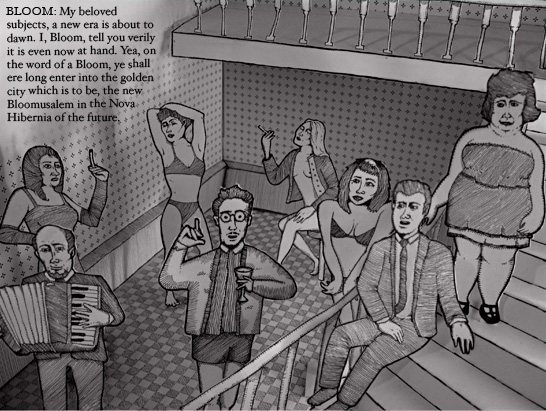
I was delighted to stumble across the design work of Itamar Lerner whilst looking for Joycean images on the web (I now give myself one demerit for using the execrable phrasal verb “stumble across” to describe a web search, two demerits for using the unforgivably pretentious and archaic conjunction “whilst,” a hundred demerits for not editing the original sentence in the first place, and a thousand demerits for this long-winded excuse).
Lerner’s images of Ulysses do justice to both the humor and the pathos of Joyce’s complex episodes. Lerner’s self-described medium of “ink on cut out papers” creates a shaded depth that evokes comic strip art by way of a Punch and Judy show. I like it!
Lerner’s portfolio attests to his masterful fontsciousness: in addition to his original typefaces, he’s designed alphabets in wax, cement, and–my favorite–potatoes:
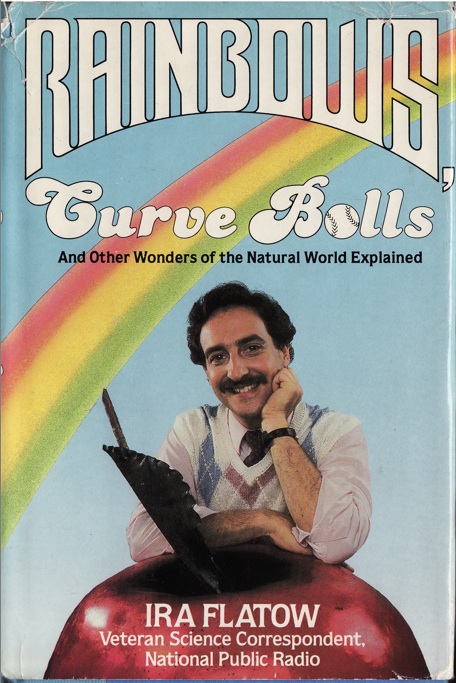
Who can resist a face like that? I found Rainbows, Curve Balls this week in a super-secret cache of books (dusty box inside of locked cabinet in corner of former teachers’ lounge). Some fool was going to throw the whole dealy away; luckily I was armed with curiosity and my trusty hammer (yes, I keep a hammer in my classroom)
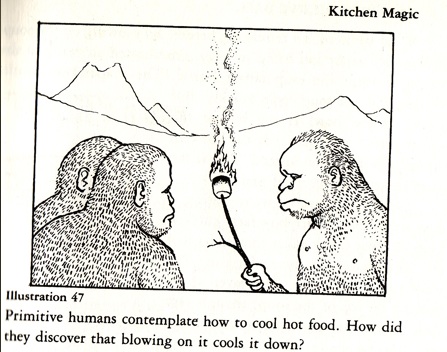
In 1988’s Rainbows, Curve Balls, NPR’s own Ira Flatow explains belching, “Kitchen Magic,” the difference between vinyl and CDs and answers the age-old question, “Do airplane wings flap?” Good stuff.
Felici@ Noll*y’s “Eyes of a Baby” makes stunning use of what I like to call “the fetal voice.” Noll*y’s narrative begins in a “bubble […] so safe and warm with extra soft walls.” However, her hapless narrator is soon confronted with “monsters” who “torture” the poor kid, ripping it out of its safe haven, depriving it of its immediate source of food. The poor dear ends up in a “jail cell with big bars,” contemplating a strange new existence in a world populated by demons. Noll*y’s narrative captures the jarring dissonance of new beginnings contrasted with the ever-present ideal of a perfect, unattainable “safe haven.”
L@ur@ Cunningh@m submitted a trio of vignettes, each as unfinished as a fetus, each showing some serious promise as contenders in an Anne Rice parody contest–only I think Cunningh@m’s serious about her work. In “Implied Consent,” she dips into her idea of an adult vampire world, one reminiscent of the early nineties goth scene. She also uses the phrase “nary a word.” Yes, “nary.” Ugh. In “Duality,” she takes a stab at a postmodern trope–the characters in the story are being written into existence by other characters in the story (somebody get Charlie Kaufman on the phone). In the blandly-titled “Something,” Cunningh@m demonstrates public high school’s complete failure to teach human anatomy with this clunker: “Hot bile rose to the back of her throat.” Bile is produced by the liver, sweetheart. Maybe it’s just a very, very complicated metaphor.
Sh@t@vi@ E@dy’s “Down in the Crowd,” written as a screenplay, finds rumors to be the root of all evil. I’m not sure exactly what happened in E@dy’s tale, but I do know that gossip and misinformation are sites of extreme horror for her. Also, there’s a predominate preoccupation with “the cool kids” and the “not cool kids”–social scientists are now clamoring to adopt these specialized terms as their own.
M@tik@ Bl@l@rk’s “Taken” begins in media res, a bold step that none of the other young writers attempted. Good for her! Unfortunately, Bl@l@rk’s cluttered imagery and frantic pace leave no room for the reader to have any sense of what’s going on. In the end, she pulls what is to be a recurring motif in many of these stories: “It was all just a dream” (alternately: “It was all just a nightmare”). So says I: “It was all just a cop out.” People didn’t like that shit on Dallas back in the 1980s, and I don’t like it now.
Far more ambitious is Ch@ntel R**d*r’s “Fight of the Gods,” written entirely in a marvelous backwoods dialect (at one point, her narrator points out that the “man war havin’ a Caesar,”–he means “seizure”–a line compounded in semiotic resonance when one considers the fact that Caesar suffered from epileptic fits. I applaud R**d*r’s Joycean wordplay!) After thirty-five pages, it became clear that R**d*r had submitted not a self-contained story, but the initial chapter of a book about demonic possession over the ages of man. She says she has more, and I’d love to read it.
Mel@nie River@’s “Breathe,” like a number of the stories this year, seems to take several of its cues from the recent Saw franchise: torture chambers as puzzles, ambitious killers, that sort of thing. River@’s story stands out on several counts, beginning with her adventurous use of verbs: in “Breathe,” we find that bones can be “emasculated” (these are not metaphorical bones; she is referring to ulnas and tibias and metatarsils and shit like that). There is a fascinating episode where a bus driver bites a hapless victim, who astoundingly replies: “Who are you to put your hands on someone else’s child, huh?!” I was astounded because that’s just what I say when a weirdo stranger bites me unprovoked out of nowhere. It turns out that the bus driver is a killer, and not just “a normal killer, he was an advanced killer.” Coming soon to a theater near you: Advanced Killers 4: The Matriculation.
As its title suggests, D@nchelle Jon*s’s “Scary Story” is a self-reflexive postmodern comment that seeks to pull at the very roots of just what can qualify as a “scary story,” or for that matter, as a story at all! Who says you have to have mood, tone, or setting? What traditionalists (patriarchalists, no doubt!) decree that a story should have a beginning, middle and end? Jon*s attacks our notions of just what the narrative arts can do, leaving us scratching our heads as we applaud her audacity.
In “REVENGE OF THE EX!!!!!”, M@h@ Mi@n also pushes the limits of traditional writing, this time challenging those awful standards of typography and punctuation: why can’t a story be typed in italicized, 18-point font? Isn’t it obvious that some questions deserve multiple question marks???? And who’s to say that multiple exclamation marks are redundant?!!!!?!?!?!?!?!?!?!?
Sh@net@ Oliv*r’s “Black Outs” examines the mood swings typical of teenagers, pushing those mood swings into the fascinating trope of split personalities. Also, the first half of Oliv*r’s story consists of rhymed couplets, a rhetorical strategy that mirrors the tension between conflict and harmony inherent in every person afflicted with multiple personality disorder.
Finally, M@j@ C@v@r makes a bold move by naming her story “Extra Credit.” Again, I can only assume this is a kind of postmodern tongue-in-cheek gesture on C@v@r’s part, a reference to the fact that I offered the “Scary Story” assignment as a way to earn–you guessed it–extra credit. Nothing slips by these kids. C@v@r is an innovator in what I like to call the “I-filled-up-all-the-lines-on-the-paper-so-now-the-story’s-over-regardless-of-the fact-that-so-much-still-remains-unresolved” style of writing. Courageously sacrificing any sense of closure, C@v@r instead opts for this stunning closer, shifting jarringly from third-person omniscient to first-person singular: “I only need a point from only a B and I really need a B, okay?” Sorry, sweetheart, I don’t think that’ll quite do it.
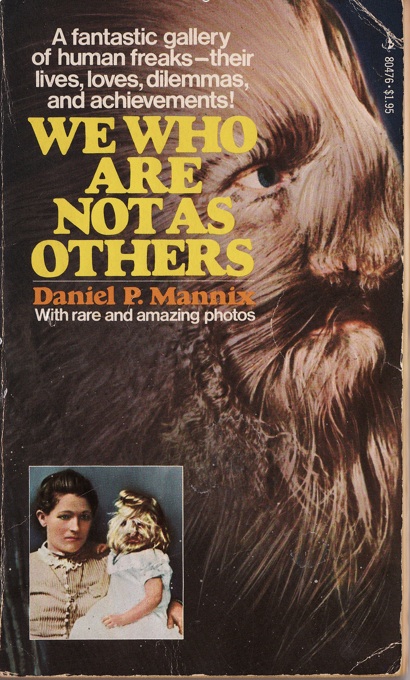
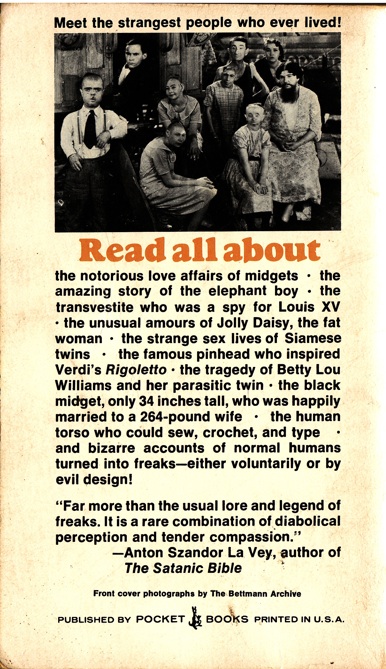
I’m not exactly sure if I stole Daniel P. Mannix’s immortal classic We Who Are Not as Others or if it was in a box of free books. I was in the eighth grade; it was the tail-end of a class trip to colonial Williamsburg, and I guess we had some time to kill, because they (they being the adults in charge) took us to a huge outdoor flea market. This was 1991 and Spike Lee’s Malcolm X had initiated a fad of wearing ball caps with a large solitary X emblazoned upon said cap. Some jokers at the flea market were selling hats emblazoned with a large solitary O, which the nimrod jocks in our class really thought was funny. They all bought the O hats; the counter-fad lasted about a fortnight after the Virginia trip. My love for We Who Are Not as Others, however, is immortal. My friend Tilford was rooting through a box of books: he claimed that the books were all free, although there was really nothing to indicate this. The mercenary setting of the flea market I now recall doesn’t seem to support Tilford’s assessment of the box. Nevertheless, we each wound up with a copy of We Who Are Not as Others. I read this book every year at some point. I implore you to read the back cover:
Look, I can’t top that, and I’m not going to even try. The blurb is wholly accurate. Anton LaVey’s assessment (and the fact that the leader of the Church of Satan endorses the book also attests to its literary merit) is spot on: this is a tender, tender piece of literature. Although We Who Are Not as Others was withdrawn only a month after its initial 1976 publication, it was fortunately reprinted in 2000 by Juno books, and is still available.
“[…] only one anus between them”–you must admire Mannix’s attention to detail. Good stuff.
Eve Arnold’s famous photo of Marilyn Monroe reading Ulysses. Supposedly, she’s reading Molly Bloom’s sexy monologue at the end of Joyce’s novel. This pic is good too–
Plenty of cool stencils to be found here, including this Imperial Storm Trooper design that my wife talked me out of attempting (not “Halloweeny” enough):
And, in our sorry tradition of lazy blogging, we still stand by everything we did last year around Halloween:
1. Rent or queue up Michael Bay’s 2007 “live action” version of Transformers (NOTE: this “How to” addresses the 2007 version of Transformers, not the superior 1986 animated version).
2. Put the DVD in the DVD player.
3. Go directly to the chapter selection menu.
4. Select chapter 18.
5. Begin watching the movie. Disregard the clunky, superfluous plot that’s been leading up to this over the past hour and forty minutes. It doesn’t matter if you don’t know what’s going on. You’ve gotten to the part of the movie that you want to see–giant robots fighting giant robots. Additionally, don’t worry about who the characters are. You can figure it out pretty easily, if you like–they’re all types (stereo- or arche-). Alternately, don’t even worry about who the characters are.
6. Enjoy the mayhem and violence and spectacle of Transformers.
7. Now, as a form of penance, watch a movie by Akira Kurosawa, Peter Greenaway, Nic Roeg, Werner Herzog, Pedro Almodovar, David Lynch, or any other director worth a damn.
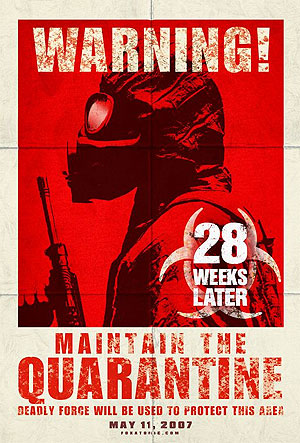
As that most sacred of holidays, Halloween, draws closer, Biblioklept begins our annual celebration with a review of 28 Weeks Later, the sequel to future cult classic 28 Days Later. Look forward to all kinds of horror for the rest of the month!
At Sam Kimball’s talk at UNF last week, he put forth several ideas that would not be wholly unfamiliar to students and former students of his, or to anyone who’s read his book, The Infanticidal Logic of Evolution and Culture. Just a few of these ideas: cultural and biological evolution rests on an encoded infanticidal threat that no one wants to own up to, existence costs, and the ability of humans to smile represents a Darwinian miracle. The first two of these ideas provide an excellent lens from which to examine 28 Weeks Later; however, I’m not going to strain myself looking for smiles or hope in this awfully bleak, absolutely horrific movie.
It’s instructive to begin with a paraphrase of the infanticidal logic Kimball suggests underpins social order, and I think that can be done best by using Kimball’s own re-reading of the Oedipus story. The story of Oedipus, who outwits the Sphinx, kills his father, marries his mother, brings a plague to his city, and then stabs out his eyes, is–and here comes an understatement–a story foundational to psychoanalysis. In most readings, Oedipus is the tragically flawed hero who brings shame, disease, sin, and death to an entire society through his multiple transgressions. Kimball points out that most readings of this story focus on Oedipus’ relationship with his mother and father (sex and death), and that little attention is paid to the very beginning of the story. Recall now that the infant Oedipus is cast by his royal parents (metonymy for all parents), feet bound, into the wilderness to die, for fear that he will bring about chaos and death. The story is thus initiated in an infanticidal gesture, the willingness to kill a child for the good of the family, the tribe, the kingdom (see: Abraham and Isaac, Saturn gobbling his kids, Noah and flood, the crucifixion of Christ, etc. etc. etc.). Kimball sees structural infanticide as the blame for sin and corruption and death being put on the child; Oedipus is not the sinner in this reading, but the one who has been wronged from the beginning. Let’s see if we can’t apply some of this to a zombie flick. And, uh, a SPOILER WARNING is in order, I suppose (although I don’t think anything I’ll write can really spoil this film).
28 Weeks Later opens up with a last supper, the communion of a childless, makeshift family who’ve managed to avoid the infected zombies that plague Britain, spreading murder and chaos wherever they go. The communion is interrupted by a child who bangs on the door. After some indecision, he’s admitted by the wary adults, who ask him, of course, “What happened?” “My parents…they tried to kill me,” he answers. Within minutes of his arrival, the zombies are at the door, ready to spread their infection, annihilating the dinner party: the child, on the run from his infanticidal parents, brings disease and death to the community. Only Don (Robert Carlyle) escapes, and he does so by abandoning his wife, who clings to the newly arrived child.
Twenty-eight weeks later, the US military has quarantined part of London, and begun the repatriation of British citizens, including Don’s son and daughter, Andy and Tammy (played by the improbably named Mackintosh Muggle and Imogen Poots). Chief medical officer, Major Ross is deeply upset when she sees the children disembark the plane, declaring that the Green Zone the US military has established is not equipped for kids. Furthermore, she points out that they know little about the disease, and that kids might actually facilitate spreading it. Sure enough, Andy and Tammy run away from the Green Zone, heading back to their apartment, where they find Mom, who’s gone feral. Their Mom has some kind of genetic resistance to the effects of the disease (figured in her mismatched brown and blue eyes, a trait shared by Andy); she exhibits mild symptoms and is a carrier. This is discovered by Major Ross when the trio are forcibly returned to the Green Zone. Don, swamped in guilt, sneaks in to see his wife. He kisses her, immediately gets the disease, then goes on a murderous rampage. The US military, in a moment of shining brilliance, move all the non-military personnel to a locked basement. Don gets in nonetheless, the infection spreads like a dirty rumor, and the army begins killing everyone indiscriminately. Again, the children bring the infection to the community, and the entire society must pay with wholesale apocalyptic genocide, ultimately figured in the firebombing of the city.
Andy and Tammy escape this fate when Major Ross and Sergeant Doyle, a kindly sniper, escort them out of the city. Ross and Doyle symbolize a set of “good parents,” in direct opposition to Don, a rampaging zombie who somehow singles out his children in particular. Just like the child at the beginning, the two are on the run from not just the patriarchal US army “protectorate,” now annihilating everything that moves, but also their own biological father. In the course of aiding the children’s escape, both Ross and Doyle meet grisly yet heroic ends. Believing that the children may carry a genetic clue to a vaccine for the virus, the “good parents” give their own lives to save the children. Still, the children are the cause of their death. Don eventually catches up with his kids and bites Andy, before he’s shot to death by Tammy. Andy, like his mom, doesn’t go nuts when he gets infected, but he’s still a carrier. Doyle’s buddy, helicopter pilot Flynn, transports the kids across the English Channel (that is, after making the tough decision not to just kill them). The movie ends with shots of rampaging zombies near the Eiffel Tower: a child has again carried infection, disease, and death to a once-pure, contained area, continental Europe.
Upon its theatrical release earlier this year, most critics focused on 28 Weeks Later as an allegory of US military involvement gone awry, a thinly-disguised critique of the Iraq invasion. And while many arguments could be made for this analysis, I think its important to realize that the actions of the US military in the film are not ultimately the cause of the apocalyptic genocide at its center; rather, the military responds appropriately to contain the very real threat of contagion, the risk of total death figured in the disease the zombies carry. The cost of continued existence here is the realization that everyone in the Green Zone must die. The movie invites us to see both the military and the zombies as the bad guys, but ultimately the movie blames the children for the downfall of mankind: the army is just trying save the rest of the world, making a calculated cost analysis (albeit, one measured in human lives); the zombies are, well, uh, mindless rampaging zombies–animals, running ids with teeth, but not really evil. No, it’s the kids here who bring about sin and shame, death and disease. The infanticidal structure of the film argues for the execution of children, those dirty little harbingers of contagion. Paradoxically, the film hides this gesture under the heroic self-sacrifice of the “good parents,” Ross and Doyle, who give up their lives to save the kids. The audience is invited to empathize and identify with Ross and Doyle, who reject both the patriarchal authoritarianism of the US military (despite the fact that they are both military officers) as well as the mindless entropy of zombism. In the end though, their self-sacrifice is pointless–Andy spreads disease into another “pure” area, putting the entire world at risk. Flynn should have executed the children, like he was supposed to. The movie thus acts as a warning against the dangers of sin and infection that are presented in the children, and in turn, 28 Weeks Later upholds patriarchal, sacrificial, infanticidal values.
In my ranting and raving and raging and rampaging, I forgot to point out that I enjoyed the movie very much: it was truly terribly awfully bloodily unceasingly horrific.
Sure, founding member Peter Green had a pretty cool guitar style, but really, Lindsay Buckingham and Stevie Nicks made Fleetwood Mac. Buckingham’s guitars achieve a strange, almost paradoxical tone: hard rock chunkiness by way of New Wave-thin; Brian Wilson-influenced melodies by way of punk rock; songs that ache with classic pop harmony but still remain unavoidably dark. Coke-fueled Rumours secured an already great legacy, but my favorite Mac album is, of course, their WhiteAlbum, Tusk.
I hate to admit it, but I prefer this version of “Go Your Own Way” (dig the percussive guitar solo at the end)–
–to this one from the 70s. You tell me which is better.
Genre-defying Junior Brown built his own guitar/steel guitar hybrid, “Big Red,” an improbably shrewd instrument of shred. Brown’s eclectic mix of country, blues, rock and roll, hillbilly, and even classical playing has probably kept him off of more radio stations than is fair, but his brilliant music has led to a huge following. Observe:
Self-confessed one-time Deadhead, Lee Renaldo was the “old guy” in Sonic Youth from the outset. I’ve always imagined that his sense of melody and his quiet, intense disposition are what anchored Thurston Moore’s manic tendencies and Kim Gordon’s dour art poses. Plus, I’ve always liked Renaldo’s solo stuff the best. And then, of course, there’s the Reed Richards look he’s been kickin’ for the past couple of years.
When Les Paul was injured in a terrible car accident in 1948, he had his arm set at a permanent right angle so that he could still play guitar. Now that’s dedication. Les Paul’s flashy, futuristic multi-layered tracks still sound ahead of their time.
Ben Chasny is heir to a tradition that began with Robbie Basho and John Fahey. As Six Organs of Admittance, he makes strange, beautiful psychedelic music that mixes tropes of Western folk with the exotic motifs of Eastern ragas. Very heady stuff. His new album, Shelter from the Ash, set to drop any day now from Drag City records, picks right up where last year’s gorgeous Sun Awakens left off. Great stuff.
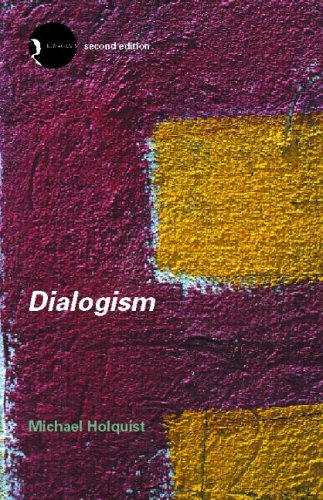
Michael Holquist’s Dialogism, a highly approachable introduction to the theory of Mikhail Bakhtin, is the most enjoyable book of literary theory I’ve wrapped my head around in quite a while. Bakhtin’s dialogism is–and I’m drastically paraphrasing here–a way of interpreting texts in terms of the way that they “speak” to other texts. In Bakhtinian dialogism, language exists in an endless play of call and response, of modulation and echo of all language that has come before and all language that is to come after. Written in short, concise bursts of information, Holquist’s Dialogism illuminates Bakhtin’s complex ideas; additionally, Holquist reads Bakhtin against heavyweights like Roman Jakobson, Kant, Saussure, and, uh, Albert Einstein. Most useful and enlightening of all are Holquist’s own dialogical readings, particularly his reading of Shelley’s Frankenstein. Dialogism is an essential introduction to an important philosopher, and, more importantly, a pretty good read.
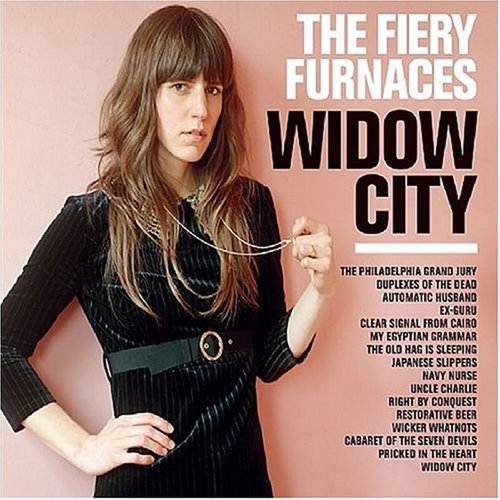
Fiery Furnaces latest, Widow City drops today. I love it. It’s really good rocknroll. It’s great. You should buy it. You’ll love it. Or maybe you hate music? You don’t hate music, do you? Then prove it, sucker.
Also out today: the Vintage paperback edition of Dave Egger’s sorta fictionalized memoir What Is the What? I haven’t read this yet, but my copy should be showing up by next week via Amazon. So I can’t say if you should buy it or not. A lot of folks tend to hate on Eggers without having read his work (I’ve seen people on the net identify his writing as extremely ironic: all one has to do is read A Heartbreaking Work of Staggering Genius (an overrated, completely self-indulgent, but still enjoyable read) to see that this guy is completely earnest. But: many who have read Eggers hate on him as well. So. Granted: McSweeney’s tends to be pretty hipster-smartassed-ironic at times. Still. Earnest, people, earnest). I think it’ll be pretty good though. Will let you know.
If you’re ordering all this stuff online, you might as well pre-order the paperback printing of Chris Adrian’s The Children’s Hospital: it drops later this month. I read it and loved it, despite the fact that my edition was hardback (I find hardback books, particularly those of epic length, awfully difficult to read). You can read all about my love for The Children’s Hospitalhere.
And while I’m completely shilling for McSweeney’s, and championing capitalism in general, I should point out that the October issue of The Believer has a pretty cool interview with Animal Collective’s Panda Bear (or maybe he’s just Panda Bear’s Panda Bear, after the shining genius of Person Pitch) as well as a great essay weighing psychoanalysis against neuroscience. But this is really just a segue to an attempt to redeem my rapacious shilling for the industrial-military complex that is propped up on book and CD and magazine sales. Said segue:
You can read the aforementioned essay without shelling out eight bucks by simply going here, to The Believer‘s website. The current issue’s interview with Optic Nerve writer-artist Adrian Tomine is also up.
But “So what?” you say, “there are plenty of interviews and essays out there. Who cares? Give me something substantial!”
Something substantially funny: Clarke and Michael, the not-so-real-life (but-maybe-sort-of-real-life?) adventures of Clarke and Michael as they shop their screenplay around LA. I love this show.
Also, great archive of free e-books here, if you’re into permanent eye damage.
Finally, you probably don’t know about this yet: Biblioklept has a major scoop: British band Radio Heads plans to release their new album, In Rainbows, tomorrow, for free (technically, you can pay what you want to for it. Which, if you are like me, is probably nothing).
That’s right, folks: you can get music on the internet for free. More italics to emphasize this point. You can get that Radio Heads album here starting tomorrow October 10th.
First off–yes, the entire list could be comprised of Dylan songs. I choose this one simply because it’s one of my favorites, and also from the first Dylan album I ever bought. Dylan visits a psychiatrist and tells him about the awful dreams he’s been having. Dylan is “down in the sewer with some little lover” when the bomb goes off; upon surfacing he discovers a post-apocalyptic world where the survivors aren’t to friendly–in fact, he’s even accused of being a Commie at one point. Even the abandoned Cadillac he finds–a “good car to drive after a war”–brings him no pleasure, and in his loneliness, he takes to calling the automated time update service, but it’s no longer being updated. The doctor cuts him off, saying that he’s been having similar dreams, only he was the only one left alive in his dreams. Dylan ends the song by declaring “I’ll let you be in my dreams if I can be in yours,” the subtlest anti-war slogan I’ve ever heard.
2. Stephen Malkmus, “Jenny and the Ess-Dog”
The tragic story of Jennifer, an 18 year “rich girl,” and her 31 year old boyfriend, “the Ess-dog, or Sean if you wish.” The Ess-Dog plays in a 60s cover band, drives a Volvo, and loves to play frisbee with their dog Trey (um, shades of Malkmus himself?) They love to make out to Dire Straits’ Brothers in Arms and do cocaine (Trey observes their “baby talk voices and post Class-A nasal drip”). Of course, such a romance can’t last: Jenny heads up to college in Boulder and pledges Kappa; the poor Ess-Dog starts waiting tables and even “sells his guitar.” Sad, sad, sad.
3. Roy Orbison, “Running Scared”
In just three verses and under two and a half minutes, Orbison captures all of the paranoia, fear, and triumph of teenage romance. The narrator is always “running scared, feeling low,” afraid that his girl’s ex might show up and try to get her back. Sure enough, his shaky confidence is put to the test: the ex shows up, “so sure of himself, his head up in the air.” The poor narrator’s heart is breaking, but in the final glorious moments, his girl chooses to stay with him. Classic.
4. Kate Bush, “Wuthering Heights”
So you’ve always wanted to read Emily Brontë’s Gothic romance Wuthering Heights but you just don’t have the time? And you don’t even have time to read the Sparknotes version? Or even the Wikipedia entry? Well, never fear–singer-songwriter/space alien Kate Bush recorded a chilling version of the story (okay a tiny little fragment of the story), told from the perspective of poor dead Cathy, pining for Heathcliff–the adoptive brother she spurned (ooh! Incest! uh…sorta). Even if it’s just a take on one part of the novel, it’s still a good story, a great song, and a truly ethereal vocal.
Pretty much every song by my favorite band Fiery Furnaces is some kind of zany adventure narrative, full of places and names and numbers. Blueberry Boat in particular has any number of good narratives–the title track, “Chris Michaels,” “Quay Cur”–but my personal favorite is the rivalry between two brothers at the end of “Chief Inspector Blancheflower.” “Blancheflower,” like many Furnaces’ songs, is a suite; the final segment of the suite is cleverly framed within the rest of the narrative as part of a story told over a “Woodpecker cider with a local fratricider” to the previous narrator. Despite “Mom’s oxycontin and the Amstel light,” the narrator finds that he’s doing all of the talking during a visit to his “younger brother Michael,” prompting him to get “both remotes and turn off the DVD” and confront his brother. It turns out that little Michael is now dating the narrator’s ex, Jenny. “My Jenny?” he asks, dumbfounded, to which little brother replies: “You know damn well she ain’t your Jenny no more.” He confronts Jenny the next day outside her “dad’s bakery,” accusing her of messing with Michael’s head as “some kind of revenge” against him. In the end though, it’s futile. He winds up at a bar, telling the story to the previous narrator.
6. De La Soul, “Millie Pulled a Pistol on Claus”
Dillon, the seemingly benevolent social worker who mentors the fellas in De La Soul, is actually a monster who molests his teenage daughter Millie. She takes her revenge at the local mall, coldly executing her pop who is volunteering as Santa Claus: “Millie bucked him with the quickness/ It was over.” Classic track, classic album.
Unfortunately, no vid for “Millie,” but you can still enjoy “A Rollerskating Jam Named “Saturdays”” (with a sweet Chicago sample, to boot):
7. Public Enemy, “Black Steel in the Hour of Chaos”
“I got a letter from the government the other day/ I opened and read it/ It said they were suckers/ They wanted me for their army or whatever/ Picture me givin’ a damn–I said never.” This is possibly the best opening in the history of rap, but Chuck D only keeps upping the ante: the narrator soon realizes that “the suckers had authority,” and before you can blink, he’s “sittin’ in the state pen,” planning his escape. He attacks a “C-O,” steals his gun, and goes on a prison rampage, “52 brothers” behind him. The faithful S1Ws arrive (with bazookas!) to escort the escapees to northern freedom. Great stuff.
Tricky’s version is pretty good too:
8. Leonard Cohen, “The Partisan”
Cohen adapted “The Partisan” from an old WWII French Resistance song, “La Complainte du Partisan” by Emmanuel D’Astier de la Vigerie and Anna Marly. The historical significance only adds to the song’s haunting melody and diffident spirit. “The Partisan” recounts the sad story of a freedom fighter who has lost his wife and children, but keeps on fighting. “There were three of us this morning,” he says, ominously adding, “I’m the only one this evening.” Grim stuff.
9. Johnny Cash, “Cocaine Blues”
“Cocaine Blues” begins with narrator Willy Lee telling us: “I took a shot of cocaine and I shot my woman down” for messing around on him. He sleeps on the murder, then wakes up the next morning and “takes a shot of cocaine” before taking off. Unfortunately, the cops catch up with him down in Juarez, Mexico. He’s sent to trial, and the “little judge” hands him his sentence “in about five minutes”–“99 years in the Folsom pen.” He laments that he can’t forget the day he “shot that bad bitch down,” warning the listener to “lay off that whiskey, and let that cocaine be.”
I couldn’t find footage of Cash doing the song, but this isn’t so bad:
And if you insist on seeing Cash sing a narrative song:
10. Tom Waits, “Christmas Card from a Hooker in Minneapolis”
The saddest Christmas song ever begins with a junkie whore’s plaintive salutation to her ex-lover: “Hey Charlie I’m pregnant.” She goes on to explain that life now isn’t so bad: her old man, who “works out at the track” knows that the kid isn’t his but promises to “raise him up like he would his own son”; he even gives her a ring that was “worn by his mother” and takes her out dancing “every Saturday night.” Still though, things aren’t great. The hapless narrator delivers one of the saddest lines in any song I’ve ever heard: “I still have that record of Little Anthony and the Imperials/ But someone stole my record player/ How do you like that?” Things get even sadder when the narrator laments: “I wish I had all the money we used to spend on dope.” By the end of the song she comes clean, admitting that she doesn’t have a husband, and that she’s writing because she needs to borrow money. It turns out she’s in prison, and she’ll be “eligible for parole come Valentine’s Day.”
11. New Order, “Love Vigilantes”
“Love Vigilantes” is now over twenty years old and just as relevant as it ever was. This is a love song, a protest song, and a ghost story all in one. The biggest irony isn’t the O. Henry-by-way-of-Poe twist ending, it’s the discrepancy between the ebullient rhythm and pop melody of the music clashing against the mournful lyrics.
12. Belle and Sebastian, “Jonathan David”
On the surface, “Jonathan David” appears to be a song about two guys who like the same girl: “I know you like her/ Well I like her too/ I know she likes you.” However, pick up the Biblical allusion to find the subtext. The narrator says, “I was Jonathan to your David/ You’re still king.” In the Old Testament Book of Samuel, Jonathan takes an extreme liking to future-king David, pledging his undying service to the handsome young hero. For centuries, whether the relationship was platonic, romantic, or sexual has been under debate. Read more here. In the light of the Book of Samuel, Belle and Sebastian’s “Jonathan David” is still about a friendship split by a girl, only it becomes clear now that the narrator is really in love with his friend. In typical B&S fashion, the narrator wavers between hope and despair, declaring at one point that “It’s not like we’ll be parted/ It’s not like we’ll never know love,” before ending on a melancholy note: “You and her in the local newspaper/ You will be married and you’ll be gone.” In the end, his adolescent homosexual infatuation has to give way to public expectation (“local newspaper”), and the simple fact that his friend digs girls.
K is for King Richard III, the misanthropic Machiavellian megolomaniacal hero of Shakespeare’s Richard III. Marvel as cruel Richard psychotically removes all those who stand in between him and the throne of England, including his own little nephews. At the same time, sympathize for poor “deformed, unfinish’d” Richard, whose hunchedback and game leg have kept him from any saucy fun with the ladies. Throughout his ambitious quest, Richard wavers from a proto-Iago, devilishly–gleefully even–manipulating the hapless pawns around him, to a manic depressive unhorsed on the battlefield, less than half a man. Poor guy.
Check out Sir Ian McKellen (y’know, Gandalf) doing Richard III in the 1995 film version set in a fictional fascist England of the 1930s. Because, um, Shakespeare’s like, um, better when recontextualized.
UNF English Professor and super smart genius Sam Kimball will give a talk entitled “When Does Jesus Smile?” on October 11, at 7:00 pm in the UNF Gallery. In the talk, Dr. Kimball will explain the thesis and outline the content of his new book, The Infanticidal Logic of Evolution and Culture. Dr. Kimball has also promised to try to answer the question posed in the title of his presentation.
Dr. Kimball specializes in psychoanalysis and deconstruction. He’s an expert in sci-fi movies and Greek myths, etymology and pop culture, nineteenth-century American literature and Derrida (basically, all that is cool). Dr. Kimball tends to produce disciples instead of students. He’s consistently challenging, bewildering, enlightening, and affirming, one of those teachers who manages to turn a “no” into a “yes.” Plus, his initials spell “A.S.K.” So there’s that. The UNF Gallery isn’t that big, and space will undoubtedly fill up quickly. Check it out if you can.














 Biblioklept