Incantation — Felicien Rops

Two Bombings (The Battle of Algiers)

(Watch the entire film).

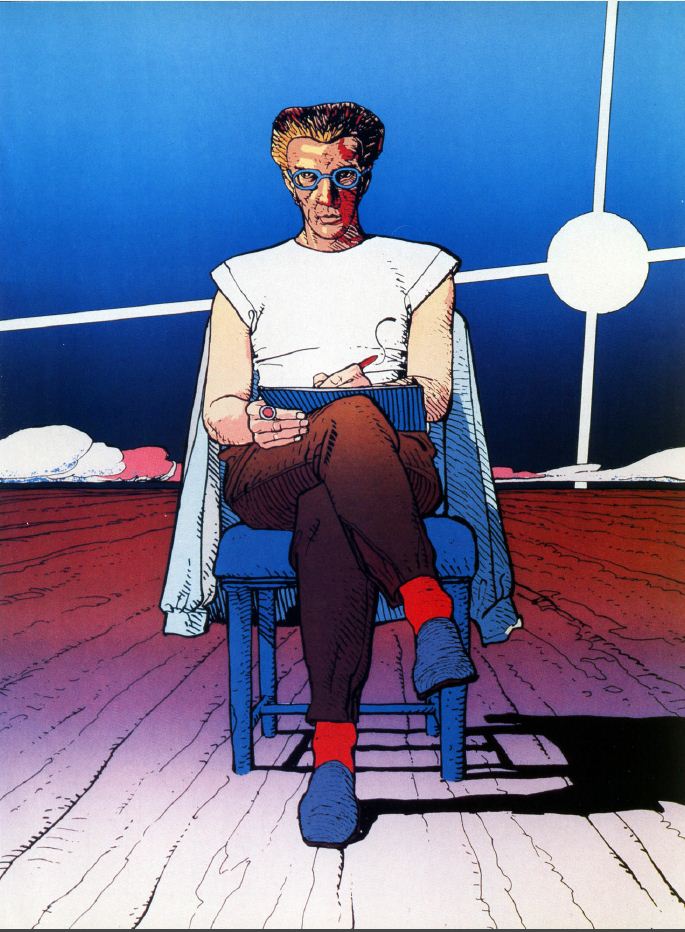
Self Portrait — Moebius

The Cook & The Dinner — Giuseppe Arcimboldo

Evening in the Studio — Lucian Freud

Feast of the Redeemer — Maurice Prendergast

Teorema — Pier Paolo Pasolini (Full Film)

Land of Cockaigne — Pieter Bruegel the Elder

Bookshop — Ben Shahn

Spike Lee, Mira Nair, and Steven Soderbergh on The Battle of Algiers

Fireplace (Night) — Boris Kustodiev

Portrait of Walt Whitman — Thomas Eakins

Virginia Woolf’s On Being Ill (Book Acquired, Some Time Last Month)

20121117-101041.jpg

The kind people of Paris Press were good enough to send me a reader copy of their 10th anniversary edition of Virginia Woolf’s essay “On Being Ill,” which they’ve collected with “Notes from Sick Rooms,” an essay by Julia Stephen—Woolf’s mother. Paris Press’s blurb:

Published together for the first time, Woolf and Stephen create a literary conversation between parent and child, patient and care giver, from the vantage points each experience in the world of illness. Originally published by Paris Press in 2002, this new edition doubles the length of the original book and includes a new introduction to Notes from Sick Rooms by eminent Woolf scholar Mark Hussey, and a new afterword by Rita Charon, founder and director of the Narrative Medicine program at Columbia University, along with the original introduction to On Being Ill by Hermione Lee, Woolf’s biographer.

Lee’s introduction seems to be an expansion of a piece she wrote for The Guardian in 2004; in that piece she wrote:

The story of the body’s life, and the part the body has to play in our lives, is one of Virginia Woolf’s great subjects. Far from being an ethereal, chill, disembodied writer, she is always transforming thoughts and feelings and ideas into bodily metaphors. She writes with acute – often extremely troubling – precision about how the body mediates and controls our life stories. Body parts are strewn all over her pages. Rage and embarrassment are felt in the thighs; a headache can turn into a whole autobiography; dressing up the body is an epic ordeal; and a clenched fist, feet in a pair of boots, the flash of a dress or the fingertip feel of a creature in a salt-water pool, can speak volumes.

Nowhere is her attention to body parts more eloquent and intense than in the essay “On Being Ill”. It is one of Woolf’s most daring, strange and original short pieces of writing, and it has more subjects than its title suggests. Like the clouds that its sick watcher, “lying recumbent”, sees changing shapes and ringing curtains up and down, this is a shape-changing essay.

Woolf announces her theme in a long, winding opening sentence that showcases some of the “shape-shifting” Lee alludes to:

Considering how common illness is, how tremendous the spiritual change that it brings, how astonishing, when the lights of health go down, the undiscovered countries that are then disclosed, what wastes and deserts of the soul a slight attack of influenza brings to view, what precipices and lawns sprinkled with bright flowers a little rise of temperature reveals, what ancient and obdurate oaks are uprooted in us by the act of sickness, how we go down in the pit of death and feel the waters of annihilation close above our heads and wake thinking to find ourselves in the presence of the angels and the harpers when we have a tooth out and come to the surface in the dentist’s arm-chair and confuse his “Rinse the mouth-rinse the mouth” with the greeting of the Deity stooping from the floor of Heaven to welcome us – when we think of this, as we are so frequently forced to think of it, it becomes strange indeed that illness has not taken its place with love and battle and jealousy among the prime themes of literature.

20121117-101050.jpg

And what of Stephen’s essay? It’s a practical, concrete, and mostly pragmatic approach to caring for sick people. Some parts compel more than others, as when Stephen discusses the absurd flights of fancy that might afflict the ill. In his introduction to “Notes from Sick Rooms,” Mark Hussey tries to amplify connections between the two texts that are either obvious (the texts share a common subject) or speculative (Stephen’s essay “foreshadows the wit and sharp observation that is characteristic of her famous daughter’s style”).  Hussey’s comments are best when they provide basic context and don’t try to force the reader into making connections. There’s also an afterward by Rita Charon, an internist, who again tries to synthesize the two texts. I suppose context is important, but there’s a sense of inflation here that I’m not entirely sure either essay (Woolf’s or Stephen’s) necessarily merits.

Geometrician — Antoine Pesne

Reading Chris Ware’s Building Stories / Big Four Panel Board Book

Continuing reading Chris Ware’s Building Stories; also, continuing the ad hoc naming of its “chapters”: let’s call this one the Big Four Paneled Board Book.

It’s big. Shown here in relation to a local brew (clearly the best way to illustrate scale):

20121116-170448.jpg

It’s difficult to describe how each chapter enriches the story of Building Stories. There’s something Borgesian about Ware’s novel—not in the sense that it’s something that Borges would have written—what I mean to suggest is it’s like something out of a Borges story—winding, maze-like, self-referential, but not solipsistic. Building Stories doesn’t come with a set of instructions, so the reader has to interact with it in a random way. What’s really thrilling and emotionally impactful is the way that each piece deepens the story and develops each character a little bit more.

In the forked path I’ve been following, Lonely Girl (this is the building’s name for her; we might also call her the Would-be Writer, The Diarist, or, perhaps, The Amputee) emerges as the central character, and she gets the lead story in the Big Four Panel Board book. She’s looking for a companion, so she places an ad:

20121116-170502.jpg

This tiny little square says so much: Ware wastes no space. Lonely Girl’s personal ad is in some ways a metonymy of Building Stories (and Ware’s oeuvre all together): it combines ironic, self-aware humor with a stark and devastating sense of loneliness.

Lonely Girl shows up as a character in the lives of her downstairs neighbors, the Sour Couple. The soda-swilling boyfriend wonders how she might have lost her leg. In some ways he serves as audience surrogate here—I doubt we’ll get the full story. (The boyfriend also entertains other fantasies about Lonely Girl’s body).

20121116-170509.jpg

Of course, the Lonely Landlady also gets her panel. We see more of her stunted life, her mother (and the building itself) a proverbial albatross around her neck. Ware uses the size and scope of the Big Book to optimum advantage; he knows that the book is so big (and his panels so small) that the reader simultaneously sees everything and comprehends nothing. Ware employs lines that crisscross from section to section, often running through narrative elements we’ve yet to engage, or sometimes tracing over what we’ve already seen. The effect is not disorienting, though—rather, Ware uses the visual space to show the ways in which his characters and narratives cross, abut, or fail to connect.

20121116-170524.jpg

The Big Book’s theme is in fact about cross-pollination, about the ways that different strands intersect, conmingle, blend (or fail to). It’s appropriate then when our old friend Branford the bee arrives:

20121116-170533.jpg

More to come.


Head of a Woman with Flowers — Gustave Courbet

Study of the Hanged Bernardo di Bandino Baroncelli, Assassin of Giuliano de Medici — Leonardo da Vinci