Blog about Nathaniel Hawthorne’s journal entry for April 14th, 1841 (including a recipe for buckwheat cakes)

For years now, I’ve been reading, rereading, and sharing on this website excerpts from Nathaniel Hawthorne’s journals. I like to post selections that share dates. For example, yesterday, April 13th, I posted Hawthorne’s notebook entry from April 13th, 1841. This particular post, which records Hawthorne’s arrival at Brook Farm, was especially felicitous, as I’m currently reading Hawthorne’s novel The Blithedale Romance, which is loosely based on the author’s time at Brook Farm.

In the novel’s second chapter, the Hawthorne-figure (Coverdale) arrives at Blithedale on “an April day, as already hinted, and well towards the middle of the month.” He complains that though the morning could be described as “balmy,” by noon it was snowing. Hawthorne’s corresponding journal entry (composed over a decade before he published Blithedale) perhaps-mockingly refers to Brook Farm as a “polar Paradise”; some of this language finds its way into the protagonist’s description of Blithdale: “Paradise, indeed! Nobody else in the world, I am bold to affirm—nobody, at least, in our bleak little world of New England,—had dreamed of Paradise that day except as the pole suggests the tropic.”

There are twenty-four chapters to Blithedale, and Hawthorne devotes the first five to that first day (presumably April 13th, 1841). The novel’s sixth chapter, “Coverdale’s Sick Chamber,” begins the next morning with our narrator too sick to attend to his first day of farm work. However, Hawthorne’s journal makes clear that the real-life Hawthorne did not fall ill until a few weeks later, around April 28th, and that he recovered around May 4th (“My cold no longer troubles me, and all the morning I have been at work under the clear, blue sky, on a hill-side”).

(I know my audience—you come to this site to read about Nathaniel Hawthorne’s head colds, right?).

Unlike his stand-in Coverdale, Hawthorne went to work at Brook Farm almost immediately. He recounts his first morning’s work in his journal entry for April 14, which I have annotated via footnotes:

April 14th, 10 A.M.–. . . I did not milk the cows last night, 1 because Mr. Ripley 2 was afraid to trust them to my hands, or me to their horns 3, I know not which. But this morning I have done wonders. 4 Before breakfast, I went out to the barn and began to chop hay for the cattle, and with such “righteous vehemence,” as Mr. Ripley says, did I labor, that in the space of ten minutes I broke the machine. 5 Then I brought wood and replenished the fires; and finally went down to breakfast, and ate up a huge mound of buckwheat cakes. 6 After breakfast, Mr. Ripley put a four-pronged instrument into my hands, which he gave me to understand was called a pitchfork 7; and he and Mr. Farley being armed with similar weapons, we all three commenced a gallant attack upon a heap of manure. This office being concluded 8, and I having purified myself, I sit down to finish this letter. . . .

Miss Fuller’s cow hooks the other cows, and has made herself ruler of the herd, and behaves in a very tyrannical manner. . . . I shall make an excellent husbandman,–I feel the original Adam 10 reviving within me.

Nathaniel Hawthorne’s journal entry for April 14th, 1841. From Passages from the American Note-Books.

1 Coverdale’s first night at Blithedale ends with Slias Foster (the only real farmer there) telling everyone to go to sleep early as they have “nine cows to milk, and a dozen other things to do, before breakfast.”

2 George Ripley, a Unitarian minister and charter member of the Transcendentalist Club, founded Brook Farm in 1840. Following Charles Fourier’s brand of communal socialism,  Brook Farm was intended to put transcendentalist idealism into concrete action. Ripley has no clear corollary in Blithedale as far as I can tell.

Never fear—Hawthorne reports in his journal a few days later (April 16th): “I have milked a cow!!!” What charming enthusiasm! Not two !! but three exclamation marks!!! Hawthorne only deploys a triple exclamation one other time in the journals collected as The American-Notebooks: On May 31st, 1844, he joyously notes, “P.S. 3 o’clock.–The beef is done!!!” Dude got excited for bovines.

I genuinely love Hawthorne’s ironic humor, which I think is often overlooked by some readers.

Good job breaking the farm equipment there, city boy! The reference to “machine” here is vague; you can read more about 19th-century feed-cutters (and see some images of them) here.

A contemporaryish recipe for buckwheat cakes from S. S. Schoff and ‎B. S. Caswell’s 1867 cookbook The People’s Own Book of Recipes and Information for the Million: Containing Directions for the Preservation of Health, for the Treatment of the Sick and the Conduct of the Sick-room : with a Full Discussion of the More Prominent Diseases that Afflict the Human Family, with Full Directions for Their Rational Treatment : Also, 1000 Practical and Useful Recipes, Embracing Every Department of Domestic Economy and Human Industry : with Copious Notes and Emendations, Explanatory and Suggestive:

buckwheat cakes

7 If you haven’t caught on, Hawthorne (and the rest of these fops too) is going to be a terrible farmer.

Hawthorne’s phrase “a gallant attack upon a heap of manure” is a wonderfully poetic turn, but his referring to finishing his shit-shoveling as “this office being concluded” straight up kills me.

Margaret Fuller was the author of Woman in the Nineteenth Century, one of American feminism’s earliest works. She was also the first editor of The Dial, (first a transcendentalist journal, and later a vehicle for modernist literature). Fuller spent time at Brook Farm, although she was never a full member. Many critics and historians suggest that Fuller is in part the inspiration for Zenobia, the soul of Hawthorne’s Blithedale.

10 The biblical Adam was of course the first gardener. Hawthorne’s romantic turn of phrase points to the idealism of Brook Farm’s utopian experiment—but also underscores the eventual fall.
Blog about “The Silvery Veil” allegory in Nathaniel Hawthorne’s The Blithedale Romance (and David Foster Wallace’s Madame Psychosis)

This afternoon I got to Ch. XIII of Nathaniel Hawthorne’s novel The Blithedale Romance. Titled “Zenobia’s Legend,” most of the chapter is given over to the titular heroine’s tale “The Silvery Veil,” a wonderfully pre-postmodern moment in Hawthorne’s novel.

Let’s look lookingly at the layers: The Blithdale Romance is Hawthorne’s ironic-but-sincere dark-romantic semi-autobiographical account of his time at Brook Farm, a failed utopian community of Transcendentalists who maybe didn’t quite, uh, transcend. Zenobia is based partially on the great American feminist Margaret Fuller (who also did time on Brook Farm).  Taking center stage here in (the aptly-numbered) thirteenth chapter of Blithedale, Zenobia extemporizes a story about The Veiled Lady. This Veiled Lady is a local celebrity, a clairvoyant of some renown who (we learn in the opening chapter of the novel) has recently disappeared. Zenobia’s yarn is a leisure-time amusement, one she contends that she’ll spin to get out of an apparent rut:

“I am getting weary of this,” said she, after a moment’s thought. “Our own features, and our own figures and airs, show a little too intrusively through all the characters we assume. We have so much familiarity with one another’s realities, that we cannot remove ourselves, at pleasure, into an imaginary sphere. Let us have no more pictures to-night; but, to make you what poor amends I can, how would you like to have me trump up a wild, spectral legend, on the spur of the moment?”

Ironically however, Zenobia clearly relies on her “own features” as well as the features of Blithedale’s spectral ingenue Priscilla to inform her performance. Despite her declaration to “remove” herself and her auditors “into an imaginary sphere,” Zenobia essentially recasts poor Priscilla’s waifery into a supernatural ultraromantic mode. The story’s basic conceit is thus: There is a famous veiled lady who may be extraordinarily beautiful or who may be extraordinarily ugly. No one knows what she looks like because like the the veil obviously hides her face, preventing any viewer’s agency to interpret for himself.

Zenobia’s legend is a tale within a tale within a tale—a performance that each member of the small Blithedale community will recode into their own readings. However, Zenobia guides her audience toward a certain conclusion, all but declaring that meek Priscilla is in fact the Veiled Lady—hell, Zenobia even throws a bit of gauze she’d been vamping with over the poor dear’s head at the climax of her tale.

“The Silvery Veil,” in another pre-postmodern layer, is a thin but clear echo of Hawthorne’s famous allegory “The Minister’s Black Veil,” which was published 15 years before The Blithedale Romance, and would clearly have been known to Hawthorne’s intended audience of Transcendentalites. (There’s perhaps a more clear connection between “The Silvery Veil” and “The Minister’s Black Veil” : Hawthorne likely based the titular minister on the real-life preacher Joseph Moody, who wore a handkerchief over his faceBlithedale features a character named “Old Moodie” who we eventually learn is Pricilla’s secret father).

So Hawthorne overloads the allegory with meaning and misdirection—is Zenobia’s legend “The Silvery Veil” the secret key to Priscilla’s identity? A clue to Blithedale’s destiny? A watery paraphrase of Hawthorne’s own stronger story, “The Minister’s Black Veil”? Simply a Saturday night’s entertainment?

The trick of the tale I think rests in the undecidability of what’s under the veil, in the not knowing, which is neatly summed up in a paragraph:

Some upheld that the veil covered the most beautiful countenance in the world; others,—and certainly with more reason, considering the sex of the Veiled Lady,—that the face was the most hideous and horrible, and that this was her sole motive for hiding it. It was the face of a corpse; it was the head of a skeleton; it was a monstrous visage, with snaky locks, like Medusa’s, and one great red eye in the centre of the forehead. Again, it was affirmed that there was no single and unchangeable set of features beneath the veil; but that whosoever should be bold enough to lift it would behold the features of that person, in all the world, who was destined to be his fate; perhaps he would be greeted by the tender smile of the woman whom he loved, or, quite as probably, the deadly scowl of his bitterest enemy would throw a blight over his life.

Hawthorne’s description here immediately reminded me of Joelle van Dyne aka Madame Psychosis aka the P.G.O.A.T., a character in David Foster Wallace’s novel Infinite Jest who wears a veil either because she’s too beautiful to behold and/or because she bears a physical deformity to abject to bear. I can’t actually remember if it’s the “and” or the “or” in that previous sentence that’s correct, even though I’ve read IJ a few times (and even not that long ago). Which is like, maybe the point of this literary veiling—what I mean is that we read faces, we read expressions, and the veil covers over what we would read directly, giving us a blank space to interpret through the lens of our wild (or not so wild) imaginations. Hawthorne’s veils (and maybe Wallace’s veils) require an inward reading, asking us to interpret a signifier that does not bear a clear signified—a most puzzling sign.

Blog about “a perfectly inextricable knot of polygamy” (in Hawthorne’s The Blithedale Romance)

img_9506

I hit Chapter XII of Nathaniel Hawthorne’s novel The Blithedale Romance this afternoon and was delighted by some lines from its first paragraph, wherein Our Narrator Coverdale retreats to a little fort he’s made in the woods:

Long since, in this part of our circumjacent wood, I had found out for myself a little hermitage. It was a kind of leafy cave, high upward into the air, among the midmost branches of a white-pine tree. A wild grapevine, of unusual size and luxuriance, had twined and twisted itself up into the tree, and, after wreathing the entanglement of its tendrils around almost every bough, had caught hold of three or four neighboring trees, and married the whole clump with a perfectly inextricable knot of polygamy.

I was deeply disappointed that the version of myself who had read this same physical copy of The Blithedale Romance almost 15 years earlier had failed to muster a single annotation on the passage (despite having left like 10,000 other scratches and loops on the yellow pages).

Hawthorne’s naturalism is fantastically naturalistically fantastical. The wild grapevine he conjures here that “married the whole clump with a perfectly inextricable knot of polygamy” is simultaneously a physical entity “wreathing” itself around the surrounding trees and at the same time a metonymy for the Bacchic spirit that pulls the souls of Blithedale into a weird marriage, an “inextricable knot of polygamy.” Hawthorne’s image points to exuberant and wild joy on one hand, but also to the thick bonds that tightly tie desire down in any moral system. The grapevine image serves as shorthand for the entire novel, underlining the push-pull tension of the narrator’s (and author’s!) conflict between Puritanism and Transcendentalism. The “inextricable knot of polygamy” is wonderfully pure in its impurity, in its radical transcendence.

Blog about Ursula K. Le Guin’s short story “Schrödinger’s Cat”

Screenshot 2018-04-08 at 7.02.26 PM

Ursula K. Le Guin’s 1982 short story “Schrödinger’s Cat” is a tale about living in radical uncertainty. The story is perhaps one of the finest examples of postmodern literature I’ve ever read. Playful, funny, surreal, philosophical, and a bit terrifying, the story is initially frustrating and ultimately rewarding.

While I think “Schrödinger’s Cat” has a thesis that will present itself to anyone who reads it more than just once or twice, the genius of the story is in Le Guin’s rhetorical construction of her central idea. She gives us a story about radical uncertainty by creating radical uncertainty in her reader, who will likely find the story’s trajectory baffling on first reading. Le Guin doesn’t so much eschew as utterly disrupt the traditional form of a short story in “Schrödinger’s Cat”: setting, characters, and plot are all presented in a terribly uncertain way.

The opening line points to some sort of setting and problem. Our first-person narrator tells us: “As things appear to be coming to some sort of climax, I have withdrawn to this place.” The vagueness of “things,” “some sort,” and “this place” continues throughout the tale, but are mixed with surreal, impossible, and precise images.

The first characters the narrator introduces us to are a “married couple who were coming apart. She had pretty well gone to pieces, but he seemed, at first glance, quite hearty.” The break up here is literal, not just figurative—this couple is actually falling apart, fragmenting into pieces. (Although the story will ultimately place under great suspicion that adverb actually). Le Guin’s linguistic play points to language’s inherent uncertainty, to the undecidability of its power to fully refer. As the wife’s person falls into a heap of limbs, the husband wryly observes, “My wife had great legs.” Horror mixes with comedy here. The pile of fragmented parts seems to challenge the reader to put the pieces together in some new way. “Well, the couple I was telling you about finally broke up,” our narrator says, and then gives us a horrific image of the pair literally broken up:

The pieces of him trotted around bouncing and cheeping, like little chicks; but she was finally reduced to nothing but a mass of nerves: rather like fine chicken wire, in fact, but hopelessly tangled.

Nothing but a mass of nerves hopelessly tangled: one description of the postmodern condition.

The bundle of tangled nerves serves as something that our narrator must resist, and resistance takes the form of storytelling: “Yet the impulse to narrate remains,” we’re told. Narration creates order—a certain kind of certainty—in a radically uncertain world. The first-time reader, meanwhile, searches for a thread to untangle.

Like the first-time reader, our poor narrator is still terribly awfully apocalyptically uncertain. The narrator briefly describes the great minor uncertain grief she feels, a grief without object: “…I don’t know what I grieve for: my wife? my husband? my children, or myself? I can’t remember. My dreams are forgotten…”  Is grief without object the problem of the postmodern, post-atomic world? “Schrödinger’s Cat” posits one version of uncertainty as a specific grief , a kind of sorrow for a loss that cannot be named. The story’s conclusion offers hope as an answer to this grief—another kind of uncertainty, but an uncertainty tempered in optimism.

This optimism has to thrive against a surreal apocalyptic backdrop of speed and heat—a world that moves too fast to comprehend, a world in which stove burners can’t be switched Off—we have only heat, fire, entropy. How did folks react? —

In the face of hot stove burners they acted with exemplary coolness. They studied, they observed. They were like the fellow in Michelangelo’s Last Judgment, who has clapped his hands over his face in horror as the devils drag him down to Hell—but only over one eye. The other eye is looking. It’s all he can do, but he does it. He observes. Indeed, one wonders if Hell would exist, if he did not look at it.

Screenshot 2018-04-08 at 7.02.50 PM

—Hey, like that’s Le Guin’s mythological take on Erwin Schrödinger’s thought experiment!—or at least, part of it.

(Hell exists because we keep one eye on it, folks. Look away, maybe).

I have failed to mention the titular cat thus far. Schrödinger’s cat is the Cheshire cat, the ultimate escape artist and trickster par excellence who triggers this tale (tail?!). He shows up to hang out with the narrator.

Le Guin peppers her story with little cat jokes that highlight the instability of language: “They reflect all day, and at night their eyes reflect.” As the thermodynamic heat of the universe cools around our narrator and the feline, the narrator remarks that the story’s setting is cooler— “Here as I said it is cooler; and as a matter of fact, this animal is cool. A real cool cat.” In “Schrödinger’s Cat,” Le Guin doubles her meanings and language bears its own uncertainty.

A dog enters into the mix. Le Guin’s narrator initially thinks he’s a mailman, but then “decides” he is a small dog. The narrator quickly decides that not only is the non-mailman a dog, she also decides that his name is Rover. In naming this entity, the narrator performs an act of agency in a world of entropy—she makes certain (at least momentarily) an uncertain situation.

Our boy Rover immediately calls out Schrödinger’s cat, and gives the narrator (and the reader) a fuzzy precis of the whole experiment, an experiment that will definitely give you a Yes or No answer: The cat is either alive or the cat is not alive at the end of our little quantum boxing. Poor Rover gives us a wonderful endorsement of the experiment: “So it is beautifully demonstrated that if you desire certainty, any certainty, you must create it yourself!” Rover gives us an unintentionally ironic definition of making meaning in a postmodern world. Agency falls to the role of the reader/agent, who must decide (narrate, choose, and write) in this fragmented world.

For Rover, Schrödinger’s thought experiment offers a certain kind of certitude: the cat is alive or dead, a binary, either/or. Rover wants to play out the experiment himself—force the cat into the box and get, like, a definitive answer. But the curious playful narrator pricks a hole in the experiment: “Why don’t we get included in the system?” the narrator questions the dog. It’s too much for him, a layer too weird on an already complex sitch. “I can’t stand this terrible uncertainty,” Rover replies, and then bursts into tears. (Our wordy-clever narrator remarks sympathy for “the poor son of a bitch”).

The narrator doesn’t want Rover to carry out the experiment, but the cat itself jumps into the box. Rover and narrator wait in a moment of nothingness before the somethingness of revelation might happen when they lift the lid. In the meantime, the narrator thinks of Pandora and her box:

I could not quite recall Pandora’s legend. She had let all the plagues and evils out of the box, of course, but there had been something else too. After all the devils were let loose, something quite different, quite unexpected, had been left. What had it been? Hope? A dead cat? I could not remember.

Le Guin tips her hand a bit here, like Nathaniel Hawthorne, the great dark romantic she is heir to; she hides her answer in ambiguous plain sight. Hope is the answer. But hope is its own radical uncertainty, an attitudinal answer to the postmodern problem—but ultimately a non-answer. The only certainty is non-certainty.

What of the conclusion? Well, spoiler: “The cat was, of course, not there,” when Rover and narrator open the box. But that’s not the end. The last lines of Le Guin’s story see “the roof of the house…lifted off just like the lid of a box” — so the setting of our tale this whole time, as we should have guessed, was inside the apocalyptic thought experiment of Schrödinger. Apocalyptic in all sense of the word—in the connotation of disaster, but also revelation. The revelation though is a revelation of uncertainty. In the final line, the narrator, musing that she will miss the cat, wonders “if he found what it was we lost.”

What I think Le Guin points to here as the “it” that we lost in these hot and fast times is the radical uncertainty of hope.

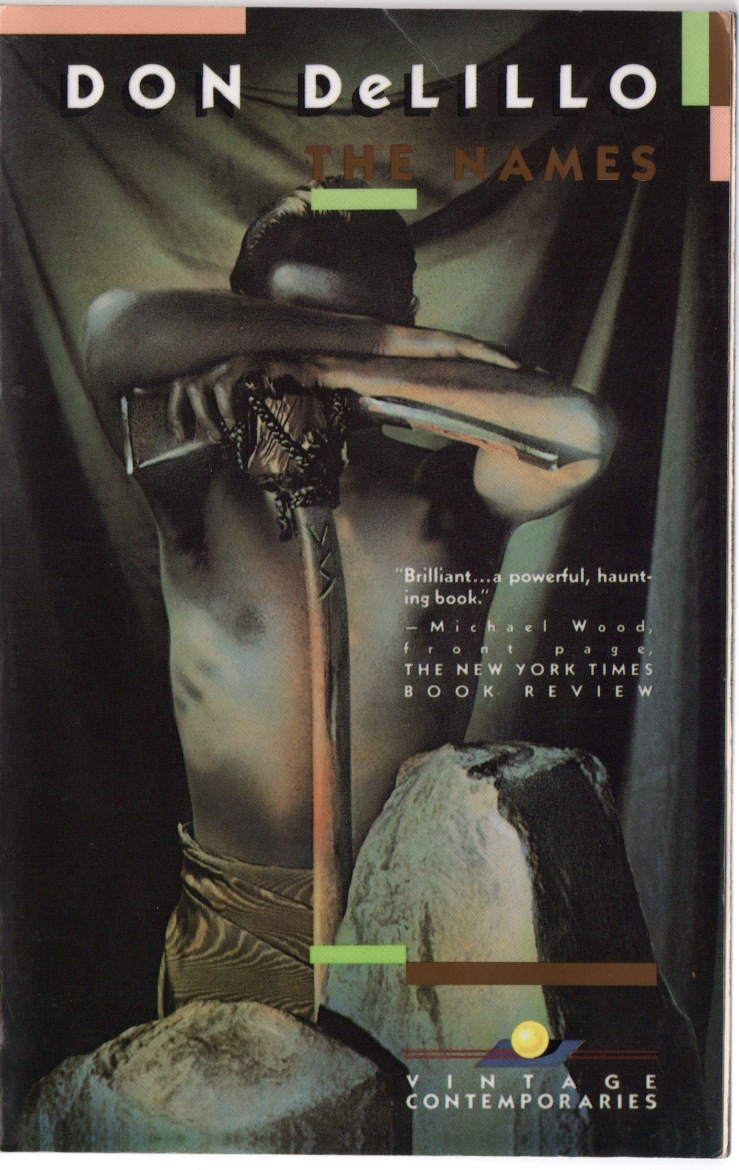
Blog about Don DeLillo’s novel The Names, which I read a few weeks ago and now only half remember

img_2722

A physical copy of Don DeLillo’s 1982 novel The Names is on a shelf a few steps away from me. Normally I’d pick it up and thumb through it before writing about it—or better yet, reread it before writing about it—or even better, simply not write about it at all. But none of that would be in the spirit of these Blog about posts.

The plot of The Names, such as I remember it, is something like this: the novel’s protagonist and narrator (whose name may or may not be named Nick—I don’t really remember) is an American operative of some kind who basically works for the CIA. This specific job description is never really clear to the American protagonist or anyone else in the novel. He moves to Greece to be closer to his wife, who has left him, and his son, a budding novelist of sorts (despite being like nine or ten), whom DeLillo based on Atticus Lish (son of Gordon Lish and now a superb novelist in his own right)  The protagonist’s estranged wife works an archaeological dig headed by an older dude named Owen (the protagonist’s son’s novel is Owen’s fictional biography). Owen, and later (or is it before—I can’t remember?!) the protagonist, encounter a weird language cult that performs ritualistic linguistic murders.

The Names’ great appeal is DeLillo’s riffs on language and meaning in a postmodern era. The language cult isn’t some socioculturally-realistic entity that draws the reader in, but rather an occasion for monologue. The novel is very much a monologue, no matter who is speaking. This may sound like a criticism as I now type it out (it does to me, anyway), but DeLillo’s monologue has a fun force to it. It’s sort of like a Derridean teledrama in novelistic form, all its pollyglossic intentions subsumed into a low dry clipped clever voice: DeLillo waxes on film; DeLillo waxes on pleasure; DeLillo waxes on Americanism; DeLillo waxes on expatriation; DeLillo waxes on globalism; DeLillo waxes on airports; DeLillo waxes on terrorism. A big takeaway from the novel for me was that DeLillo wrote his 9/11 novel two decades before the fact. No wonder he wrote Falling Man so quickly; he’d already thought through the problems.

I can’t really remember the linguistic system or philosophy or language critique in The Names, but I do remember the repetitions—the word name threads throughout, usually pointing toward a symbol, a referent, a landing strip. DeLillo also repeats the word recognition—which I take to simply be the power of name(s) (why would I use the adverb “simply” there?!). But the keyword isn’t name—I think the keyword of The Names is the world, a term that seems to refer to the absolute set of possibility (linguistic or otherwise) that Exist—a shifting, unstable, but nevertheless complete set that everyone must play within.

While its expatriation visions ring true, DeLillo doesn’t fully conjure the world in The Names, although that’s never his intention, I think. The whole affair is more oblique. Clipped is the word I used before—the novel is dry, witty, but resists being pegged as glib through its strangeness and humor.  I laughed a lot in The Names. What I think I like most though is the ending, which I still remember—I haven’t read everything by DeLillo, but I’ve read a lot, and I can’t think of another of his that sticks the ending so well. And he does it by borrowing. DeLillo cribs from the protagonist’s son’s novel—which is to say from a child’s novel—which is to say from a real child’s work, Atticus Lish’s stuff—and that cribbing is somehow the magic ingredient that makes the rest of his novel rise up. It’s a second voice (or hey, the idea of a second voice) in a monologue, and it makes a huge difference.

Blog about the etymology of the word “blog”

The Oxford English Dictionary defines blog as

A frequently updated website, typically run by a single person and consisting of personal observations arranged in chronological order, excerpts from other sources, hyperlinks to other sites, etc.; an online journal or diary;

—and then notes that the term blog is in more common use than its etymon, or parent word, weblog. 

The earliest quotation the OED gives in association with the etymon weblog is from 1993: 

comp.infosystems.www (Usenet newsgroup) 10 Nov. (title of posting   Announcing getsites 1.5, a Web log analyzer.

This example though does not really point to the source of blog; rather, it’s an example of the OED’s first definition of weblog:

Usually as two words. A file containing a detailed record of each request received by a web server, frequently recording data that allows a variety of different aspects of the web traffic reaching that server to be analysed.

This definition differs from the second definition the OED gives for weblog, which is synonymous with the definition for blog above.

A quotation given by the OED under the entry for blog from 1999 points (somewhat humorously) to the sundering of web and blog into a new word:

[1999   http://www.bradlands.com (blog) 23 May (O.E.D. Archive)    Cam points out lemonyellow.com and PeterMe decides the proper way to say ‘weblog’ is ‘wee’- blog’ (Tee-hee!).]

The OED attributes the PeterMe blog (by Peter Merholz) with a more direct citation for the word blog, dating from 1999:

For those keeping score on blog commentary from outside the blog community.

(A 1999 entry cited from the Edinburgh Scotsman cites the word with an apostrophe: ‘blog).

Blog as a verb, as well as blogger and blogging all get citations going back to 1999.

The Online Etymology Dictionary gives the following entry for blog:

1998, short for weblog (which is attested from 1994, though not in the sense “online journal”), from (World Wide)Web (n.) + log (n.2). Joe Bloggs (c. 1969) was British slang for “any hypothetical person” (compare U.S. equivalent Joe Blow); earlier blog meant “a servant boy” in one of the college houses (c. 1860, see Partridge, who describes this use as a “perversion of bloke“), and, as a verb, “to defeat” in schoolboy slang. The Blogger online publishing service was launched in 1999.

Weblog is of course a portmanteau of web and log, both of which are abstract and concrete, new and very old. In The Origins of English Words: A Discursive Dictionary of Indo-European Roots, Joseph T. Shipley gives the root of web as uebh:

uebh(s): weave, move back and forth; objects woven or the like, as a honeycomb. Pers, baft: woven cotton cloth. Gk huphe: web. hypha: threadlike part of fungus

Shipley gives over a dozen other examples that generate from uebh including hymnhymenvespawaspweaverwoofwafflewave, and gopher. 

Shipley’s root for log is presumably leg I (he doesn’t list log in his Index of English Words). Shipley gives his definition of leg I:

leg I: gather, set in order, consider, choose; then read, speak. Gk, logos, logion, horologe, horology, lexicon.

Shipley gives leg I as the source of many words, but helpful to our etymology of blog are intellect, illegitimate, select, legend, sacrilege, sortilege, collect, and cull.

The entry for leg II is of course beneath the entry for leg I. Shipley points to this as the root of (among others) lax, laxative, delay, relay, languid, languish, lash, lush, profuse, leach, leak and lack. Any of these will fit into a proper etymology of blog too, I suppose.

Blog about Goya’s Straw Man

4d4a8730-40c4-4a3e-a681-ea8787ee9e0f

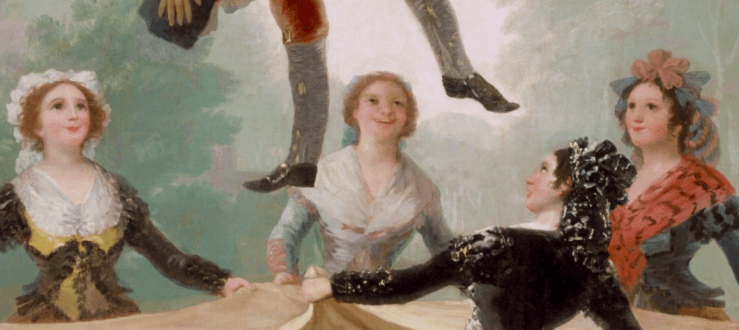
El pelele is a painting composed between 1791 and 1792 by the Spanish painter Francisco José de Goya y Lucientes (1746–1828).  El pelele is often rendered in English as The Straw Manikin, but Robert Hughes translates it as The Straw Man in his 2003 biography Goya.

I like Hughes’s translation, which carries a perhaps-unnecessary connotation of a certain logical fallacy. Hughes pegs the painting as a genre piece, one of the “bucolic amusements” of Goya’s patrons Charles IV and Maria Luisa, King and Queen of Spain. The Museo Nacional del Prado in Madrid describes the painting like this:

Four young women laugh and play at blanket-tossing a doll or manikin in the air. The latter´s movement is the result of their caprice. Its carnival origins are visible in the use of masks and joking, but the blanket-tossing of a doll is used here by Goya as a clear allegory of women’s domination of men.

Screenshot 2018-04-05 at 10.06.12 PM

Hughes also sees The Straw Man as Goya’s take on “what seemed to him [Goya] the waning of traditional Spanish masculinity,” noting that the motif was repeated throughout Goya’s work (notably in Goya’s etching Disparate femenino).

Screenshot 2018-04-05 at 10.21.11 PM

Hughes perceives a “disenchanted edge” to Goya’s Straw Man. The edge here is what most engages me about the image. To this scene any contemporary viewer—by which I mean any post-postmodern viewer—must bring a certain horrific viewpoint. The free and freeing sky juxtaposes with the wobbly jelly limbs of the empty hero at the core of the painting. His face is a literal mask, a mask itself painted into a mock ebullience of servitude. The manikin is a big nothing painted as a happy something, a doll to be tossed around for amusement. The creeping fun under the whole business is undeniable. What’s key here, at least for me, is Goya’s composition of expression in the manikin’s face. Hughes points out that the figure is a mockery of the French court and all its foppish manners, Goya’s satirical jab at his benefactors’ pretensions — “silly French pigtails and spots of rouge on its cheeks…vacuous to perfection” — but there’s also a strange humanity to the face that I don’t think a contemporary viewer should overlook. The eyes assert themselves to the grayblue Spanish heaven above, even as the body fails to resemble all but the idea of a body—an idea most heavily felt in the body’s own gravity, the force which will return it to be tossed again and again—without hope of transcendence.

Screenshot 2018-04-05 at 10.05.58 PM

Blog about a particular Gordon Lish sentence

A new literary magazine called Egress debuts in the UK this month and in the US next month. I have read an advance copy and it is Very Good. Egress features, for lack of a better term (although there are better terms; I’m just being lazy) experimental short fiction. It might be better just to list some of the authors featured in the inaugural issue: Diane Williams, Christine Schutt, David Hayden, Sam Lipsyte, Evan Lavender-Smith, and Gordon Lish (there are more).

There are two shorties by Lish in the collection. Both are Very Good and Very Funny. One of them, “Jawbone,” is about a narrator killing two bugs.

Have I spoiled Lish’s “Jawbone” by revealing its intricate plot (i.e., the murder (murders?) of a pair of (possibly copulating) bugs)? No, not really—for the story is really about language itself (which like so a lot of Lish’s fictions are ultimately about, yes?)

There’s a sentence in “Jawbone” that I could not leave alone. I kept reading it and rereading it, and then read it aloud almost rapturously:

Like lucky thing for the local citizenry someone on your side was there in there on duty on the nightbeat last night in the crapper last night.

The line is simultaneously gorgeous and ugly, elegant and clunky, elevated and base, smooth and harsh. The alliteration is at once sumptuous and unbearable–ells and kays fray into esses and zees; tittering alveolar touches stutter throughout the thirty-six syllables. The repetitions clip along, cleverer in the end than they at first seem: “was there in there on duty on the nightbeat” builds with a force that shuttles into not one but two “last nights,” a bit of redundant fun. Should a sentence of 27 words contain so many prepositions? I guess this one should. I would go on about the hyperbolic brilliance of the line but maybe that’s pinning it down a bit too much, which is not what one should really do with such a clean upstanding decent ugly sentence. (“Crapper”!).

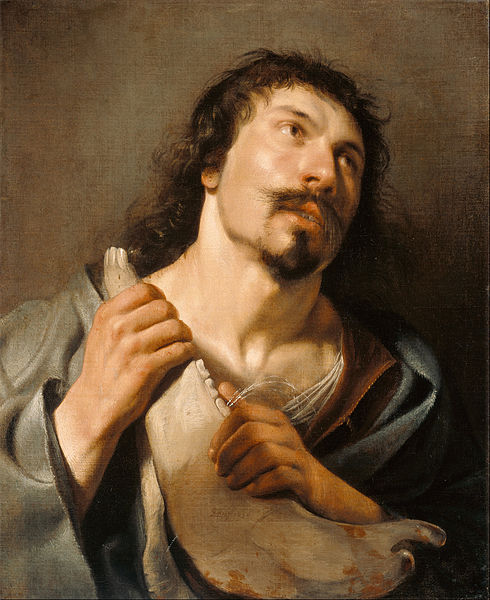
Let’s close by connecting Lish’s ironic hyperbolic sentence to what I take to be the namesake of his short vengeful tale, an episode in the book of Judges. After tying together 300 fox tails and lighting them on fire, the great (and eventually-blinded) hero Samson kills a bunch of Philistines (Philistines!) with the jawbone of an ass. He then gets thirsty and God Provides Some Water from yon jawbone. Here is Judges 15:16, King James Version on this matter: “And Samson said, With the jawbone of an ass, heaps upon heaps, with the jaw of an ass have I slain a thousand men.

490px-salomon_de_bray_28dutch_-_samson_with_the_jawbone_-_google_art_project
Samson with the Jawbone, 1636 by Salomon de Bray (1597 – 1664)

And here—I mean, I hope I’m not being too tacky in revealing the last line but, Lish, but—

Well, fuck, bugs – I mean, what can anyone really do?

Blog about starting Nathaniel Hawthorne’s novel The Blithedale Romance

img_9465

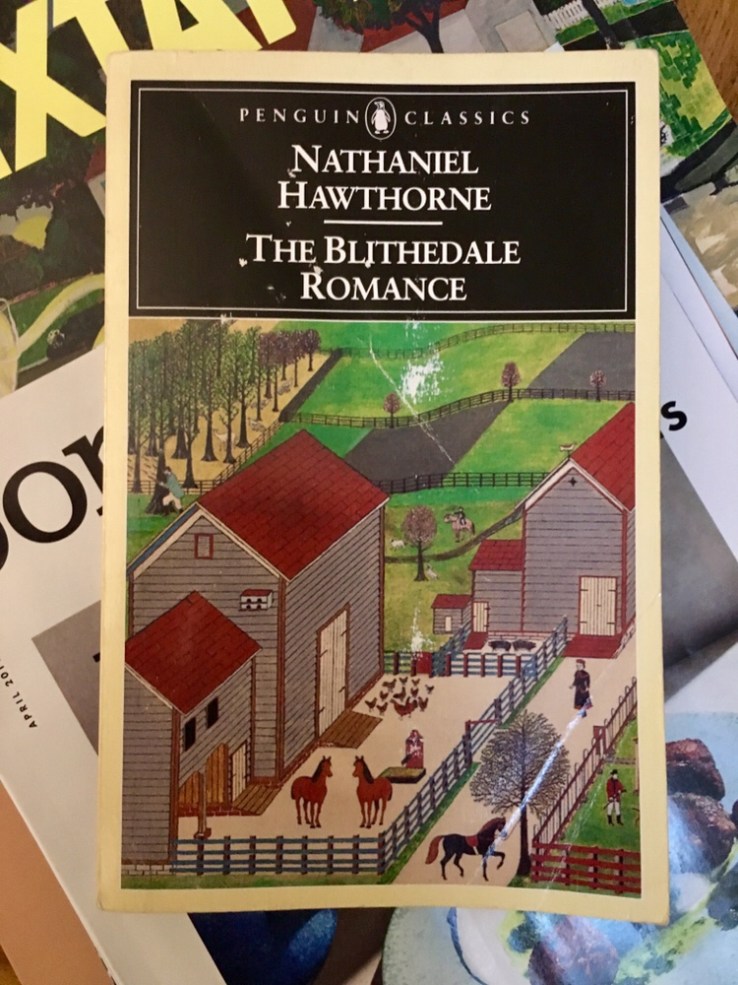
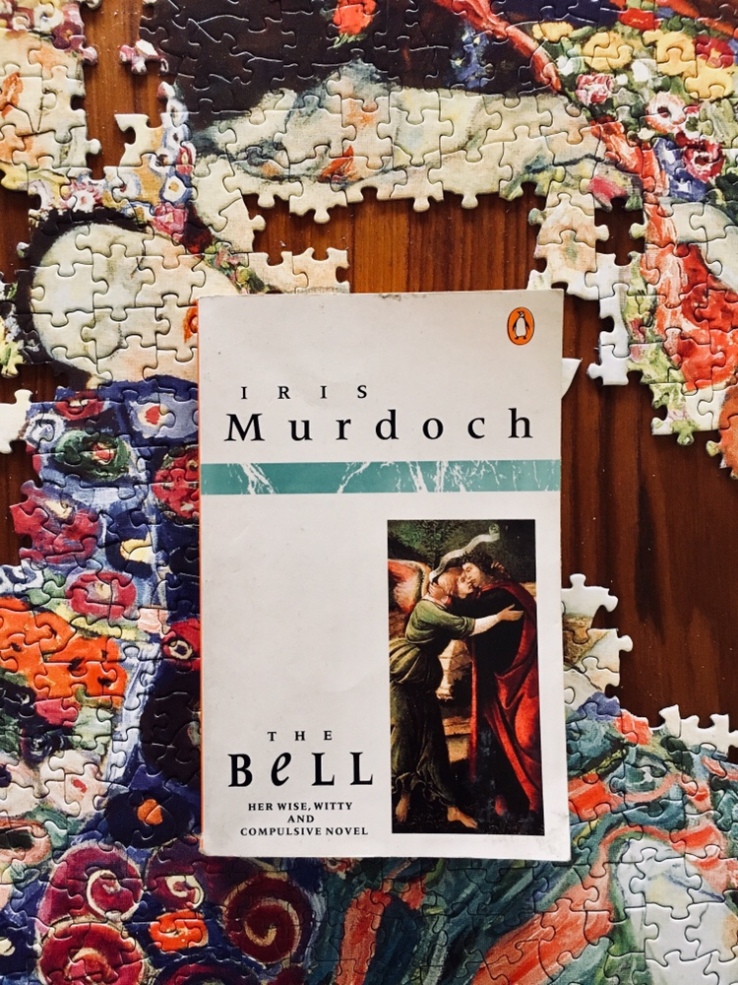
I started a reread of Nathaniel Hawthorne’s 1852 novel The Blithedale Romance this afternoon, prompted by Iris Murdoch’s novel The Bell and its utopian commune setting. I don’t think I’ve read Blithedale in a dozen or so years; the copy I’m reading is from grad school. The margins brim with every sort of nonsense, every damn adjective circled, etc.

My son, seven, picked up the novel and remarked that he didn’t know that I read romances. I tried to explain Romance here; failed. Then my daughter read the blurb. I asked her what she thought and she said the she liked the betrayal part but wasn’t sure about the rest. I flipped it over and read the blurb, which I’m not sure I’d read before. The blurb is all about sex, which seems about right.

The Blithedale Romance is Hawthorne’s horniest novel. Here is a passage from just three chapters in, where protagonist Miles Coverdale conjures some delight in imagining his lively host Zenobia au naturale (right after damning domestic work altogether)—

“What a pity,” I remarked, “that the kitchen, and the housework generally, cannot be left out of our system altogether! It is odd enough that the kind of labor which falls to the lot of women is just that which chiefly distinguishes artificial life—the life of degenerated mortals—from the life of Paradise. Eve had no dinner-pot, and no clothes to mend, and no washing-day.”

“I am afraid,” said Zenobia, with mirth gleaming out of her eyes, “we shall find some difficulty in adopting the paradisiacal system for at least a month to come. Look at that snowdrift sweeping past the window! Are there any figs ripe, do you think? Have the pineapples been gathered to-day? Would you like a bread-fruit, or a cocoanut? Shall I run out and pluck you some roses? No, no, Mr. Coverdale; the only flower hereabouts is the one in my hair, which I got out of a greenhouse this morning. As for the garb of Eden,” added she, shivering playfully, “I shall not assume it till after May-day!”

Assuredly Zenobia could not have intended it,—the fault must have been entirely in my imagination. But these last words, together with something in her manner, irresistibly brought up a picture of that fine, perfectly developed figure, in Eve’s earliest garment. I almost fancied myself actually beholding it!

Ah Hawthorne! The “fault must have been entirely in my imagination,” Miles muses. That last line — “I almost fancied myself actually beholding it!” — doesn’t appear in the Gutenberg version of The Blithedale Romance I linked to above (and here too, I guess). The editors of my Penguin Classics edition note that the line was probably deleted from the original manuscript “due to Sophia Hawthorne’s prudishness.” But the line—and really, here, I mean that that adverb almost—tells us so much about our unreliable narrator, Miles Coverdale. To almost fancy beholding an imaginative vision is to have absolutely imaginatively beheld the vision, and then applied a second consciousness to the whole affair—a witness to the sinful vision, a witness who reports to one’s own awkward soul.

Coverdale is the Hawthorne-figure, or rather an ironized version of Hawthorne, who recalls his memories of his time on real-life Brook Farm, an experimental utopian community founded by Unitarian preacher George Ripley and his wife Sophia in the mid-1850s. Hawthorne brings his pessimistic bent to the whole business (failed business), but shows us this perspective though Coverdale’s Romantic, even nostalgic optimism—an optimism clouded by experience:

The better life! Possibly, it would hardly look so now; it is enough if it looked so then. The greatest obstacle to being heroic is the doubt whether one may not be going to prove one’s self a fool; the truest heroism is to resist the doubt; and the profoundest wisdom to know when it ought to be resisted, and when to be obeyed.

Yet, after all, let us acknowledge it wiser, if not more sagacious, to follow out one’s daydream to its natural consummation, although, if the vision have been worth the having, it is certain never to be consummated otherwise than by a failure. And what of that?

So the sex of sexy Blithedale, even in its first chapters, is to be “consummated…by a failure.” But if I recall, there’s a lot of blithely lively fun in getting to that failure, and I’m enjoying Hawthorne’s often-ironic but always deeply-felt sentences, sentences that dwell on the ways in which we imagine and then try to create (and perhaps fail to create) the better life.

Blog about Iris Murdoch’s novel The Bell

img_9112

I have just finished Iris Murdoch’s 1958 novel The Bell. This is the first novel I have read by Murdoch and I now want to read more novels by Murdoch, which I suppose is the best praise I can offer the novel.

The Bell is set primarily in Imber House, a large old mansion in the English countryside. Imber House adjoins a Benedictine abbey; this nunnery is essentially closed off to the outside world. The residents of Imber House form a “brotherhood,” a laity of would-be acolytes who strive to find spiritual meaning in the commercial and often venal world of the postwar era. Various conflicts between these characters drive the plot of The Bell.

One of these conflicts, especially notable for a novel published in 1958, involves Michael, the leader of the Imber House community. A former schoolmaster who dreamed of joining the clergy, Michael lost his job in a small scandal for “seducing” one of his students, Nick, a teenage boy at the time. Over a decade later, circumstance brings Nick to Imber House, where his twin sister Katherine is staying. Katherine plans to join Imber Abbey; in the meantime, her family hopes that the religious solitude at Imber House will help Nick recover from his alcoholism. The conflict between Michael and Nick becomes further charged when the youngest member of Imber House, a teenager named Toby, befriends both of them.

I could go on about Michael and Nick and Toby and Katherine and etc., but the real star of The Bell is Dora Greenfield, a wonderfully complicatedly simple unassuming unpretentious flighty former art student who has recently left her demanding husband Paul. Through Murdoch’s precise free indirect style, we get to inhabit Dora’s constantly vacillating mind. Like many people, Dora does not know what she is going to do, and even when she thinks through a plan, she often ends up doing the opposite of what she had intended to do. There is a hilarious passage in the novel’s first chapter when Dora goes through a lengthy imaginative exercise about giving up her train seat to an elderly woman. Dora’s thought experiment ends like this:

She decided not to give up her seat.

She got up and said to the standing lady ‘Do sit down here, please. I’m not going very far, and I’d much rather stand anyway.’

The blank space between those sentences highlights a radical gap between contemplation and action.

The train-seat passage is one of many humorous episodes in The Bell, but Murdoch’s humor is underwritten by a deeper menacing anxiety, which can be neatly summed up in the novel’s opening sentences:

Dora Greenfield left her husband because she was afraid of him. She decided six months later to return to him for the same reason.

Those opening lines basically summarize the big thematic plot of The Bell—the conflict between controlling and ultimately abusive Paul and his much younger wife. (“She married him a little for his money,” Murdoch writes just a few paragraphs in, wedging the detail between more positive aspects of Paul’s character–the “a little” is just genius there, the slightest omission from Dora’s consciousness slipping into the third-person narrator for the briefest of moments). The opening lines of The Bell also showcase Murdoch’s rhetorical powers. Her comic precision here reverberates with a hazardous undertone.

Will Dora really return to her husband? Or will she become her own person—whatever that means? The Bell satisfies these questions with complex answers. The novel has every opportunity to veer toward pat conclusions. Murdoch fills her novel with images that suggest a conventional tragic conclusions, and then surpasses these conventions, turning them into something else. A death by drowning might be foreshadowed, but someone will learn to swim; an epiphany achieved in an art museum might not meet its achievement outside of aesthetic response; the Blakean contraries of innocence and experience might be synthesized into a new, original viewpoint. There’s something real about The Bell—it offers a realism that points outside of its own literary contours. The English novelist A.S. Byatt puts it far better than I can in her essay “Shakespearean Plot in the Novels of Irish Murdoch”:

 …The Bell seems to me arguably Miss Murdoch‘s most successful attempt at realism, emotional and social—the tones of voice of the members of the religious community are beautifully caught, the sexual, aesthetic and religious passions and confusions of the three main characters, Dora, Michael, and, to a lesser extent, Toby, are delicately analysed with the combination of intellectual grasp and sensuous immediacy of George Eliot.

Byatt’s comparison to Eliot reminds me that I had intended to read Middlemarch some time this year—but to be fair to myself, I put The Bell on the same list. I won’t be reading Middlemarch next though; The Bell, with its story of a would-be utopian community, strongly reminded me of Nathaniel Hawthorne’s The Blithedale Romance, which I haven’t read in ages. And after I read that, I’d like to read another one by Iris Murdoch. Any recommendations?

Blog about Blog about

img_9457

For a few years now I’ve tallied the absence of words I write myself on this website, this blog, with a kind of apprehensive anxiety I don’t know how to name, let alone measure.

I used the word write in the sentence above, but the word I suppose I want, the right verb, or righter verb I want, is the blogging verb post. See, I write things—posts, riffs, bits of riffs, rants—and then I delete these things, or let them languish in a drafts folder for whatever small eternity they might be afforded. I write a bit and then decide that the world doesn’t need my (half-assed) opinion or impression or interpretation or whatever on, say—

—Don DeLillo’s novel The Names (his real 9/11 novel), or the aesthetics of breakfast in Claire-Louise Bennett’s story-novel-thing Pond, or the cinematography in Sofia Coppola’s reinterpretation of The Beguiling, or my inability to get through the first 100 pages of William H. Gass’s The Tunnel, or Transcendentalism in the Predator films, or finally reading Eudora Welty’s short story “The Death of a Traveling Salesman” and being utterly stunned by its strangeness, or having to suspend all my cynicism and ironic impulses to find a spark of joy in Ava DuVernay’s film A Wrinkle in Time, or the small connections I note between Iris Murdoch’s The Bell and Nathaniel Hawthorne’s The Blithedale Romance, or watching Hayao Miyazaki’s film Ponyo in the theater with my children, or my strange joy in the “steamed hams” microgenre, or etc.—

—so, I guess what I’m saying is—

I’m going to try to blog on this stupid blog more, in a freer way, without the pretense of applying any kind of strong critical acumen to what I’m blogging about. For years I thought of this blog as a sketchpad. Then I started taking the reviews I wrote more seriously, then too seriously. This blog has been an excuse for me to learn about things—a kind of mixtape of quotes and art and etc.—but the more I’ve learned the more I realize that I really know almost nothing about literature and art, and that I usually cannot say what I mean to say (about how I think and feel about what I do know and don’t know about literature art) clearly, so I should do better to pass over in silence (etc.). But this silence mutates into an applied anxiety; it hangs like a big non-attempt in the shallow back of my mind—this silence is its own kind of pretension, or cowardice even, if I’m feeling cruel towards myself.

So like let’s try a Thing on this blog. What if I try to, like, just blog about something every day this month? I could title each post “Blog about X” (let X stand for any old thing—a Gordon Lish sentence that I kept tripping over, or a ditty on light in certain George Frederic Watts, or maybe my recipe for caramelized onions and peppers). How many days are in April? 30 I think? I’ll look it up later. I guess I’ll try to commit to post 30 of these things and see how that feels, although it might feel terrible and I might even let myself fall way short of that goal. This particular Easter Sunday/April Fool’s Day seems like a good day to start a bad project though—an earnest hope for fresh newness as a sort of fool’s errand. So I’ll be the fool.