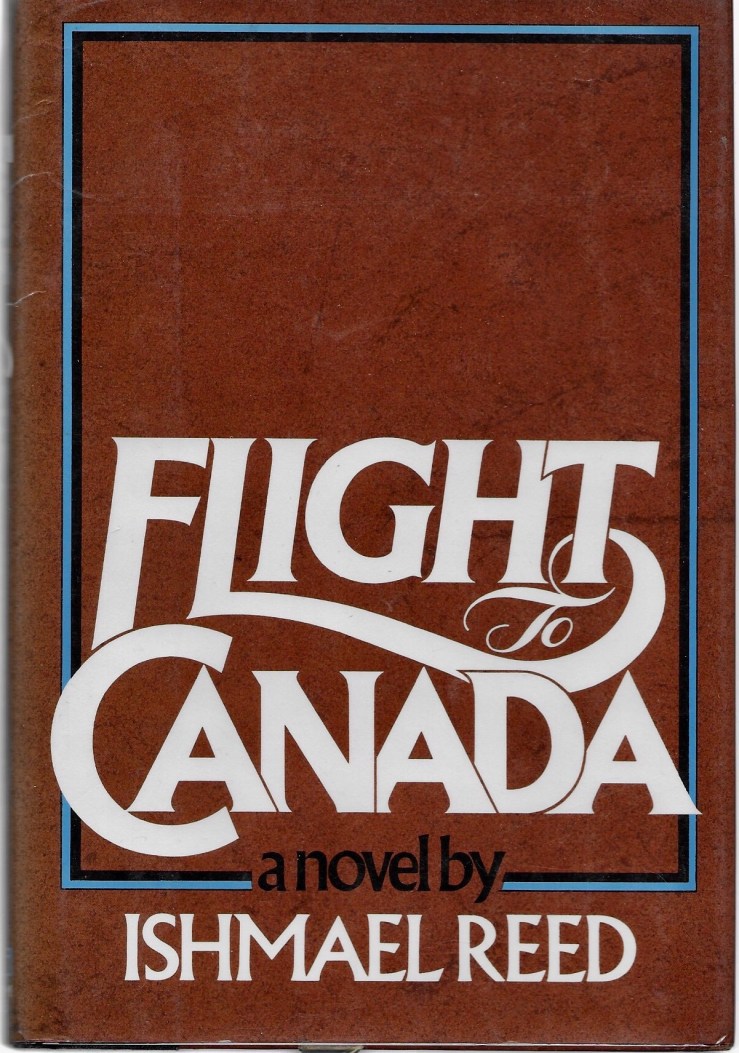
Blog about Ishmael Reed’s novel Juice! (Book acquired, 10 Dec. 2019)

img_4550

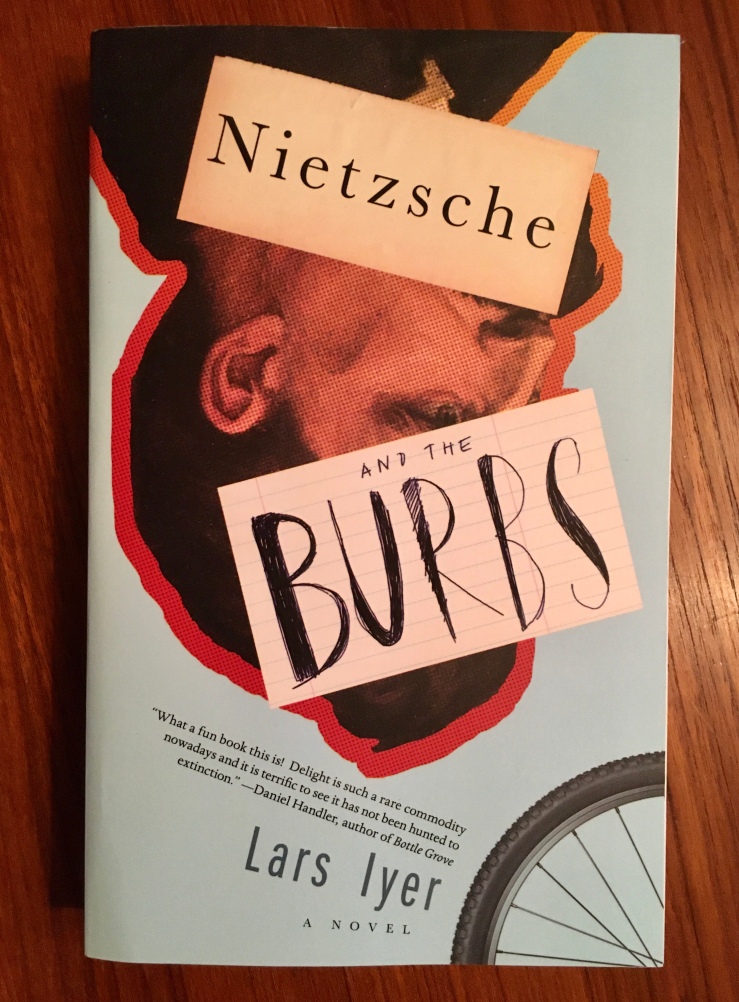
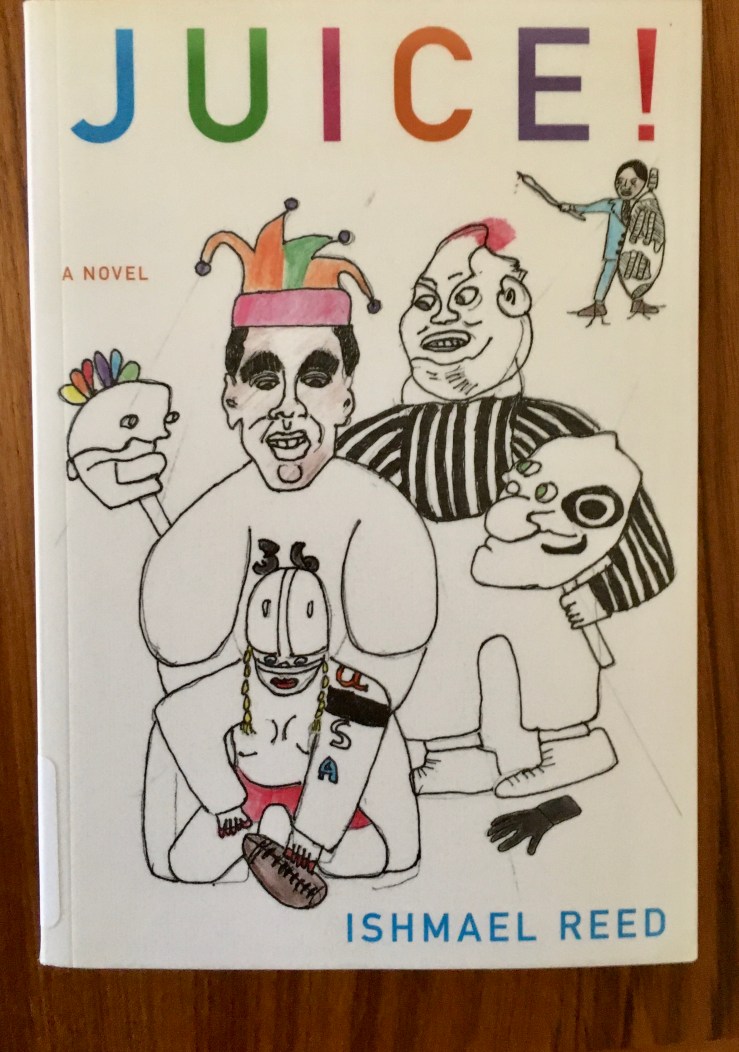
I was having a hard time getting into any of the books piled up around my house after I finished Paul Beatty’s fantastic and scathing satire The Sellout a few weeks ago, so I picked up Ishmael Reed’s 2011 novel Juice! It did the trick.

Here’s Reed describing the novel in a short Paris Review interview he did to promote the novel:

I began this one as soon as I heard about the murders. I was vacationing in Hawaii, and the murders ruined my vacation. The media went berserk over the murder of Nicole Simpson, the kind of ideal white woman—a Rhine maiden—one finds in Nazi art and propaganda, murdered allegedly by a black beast. It was a story that reached into the viscera of the American unconscious, recalling the old Confederate art of the black boogeyman as an incubus squatting on top of a sleeping, half-clad white woman. It was also an example of collective blame. All black men became O. J. The murders ignited a kind of hysteria.

Juice! is told in first-person by an aging cartoonist who goes by “Bear” whose obsession with the O.J. Simpson case(s) begins to cost him his friends, family, and career. Reed’s narrator bears more than a passing similarity to Reed himself, and the style of Juice! is decidedly different from Reed’s earlier, zanier novels like Yellow Back Radio Broke-Down and The Terrible Twos. However, the novel, like every novel I’ve read by Reed, diagnoses and dissects the American zeitgeist with howling humor and wild anger. There’s something of a reactionary flavor to Juice! though—its aging narrator has an ugly misogynistic/homophobic/transphobic streak, which the other characters, as well as the narrative construction, continually critique. Juice! creates a strange space of self-satire and self-critique that’s really…ugly—but also reflective and even elegiac in a way. Our narrator “Bear” paces through the realizations of someone whose ideological complaints remain unanswered, outpaced. His story is a howl against a system that, by design, cannot amend itself with its own tools.

While “Bear” is certainly a version of Reed, he is not Reed (an “Ishmael Reed” actually shows up late in the novel, in fact). “Bear” may in fact be a cartoonized Reed, Reed’s self-caricature. Supposedly-well-meaning white women are a favorite target in Juice! In his short Paris Review interview, Reed addressed accusations against him of sexism:

In the 1960s, when black nationalism was in vogue, all black characters had to be portrayed in a positive way, and when the feminist movement was born out of black nationalism, so did all black women. Since the mid-1970s, white feminists have had great influence over which black fiction gets marketed. I’ve gotten a lot of heat from some women in parts of academia, publishing, and book reviewing. On some occasions, they’ve censored my work. The late Joe Wood asked me to write a piece about Oakland politics for The Village Voice. He said that a feminist editor at the time wouldn’t even read it on the grounds that I was a “notorious sexist.”

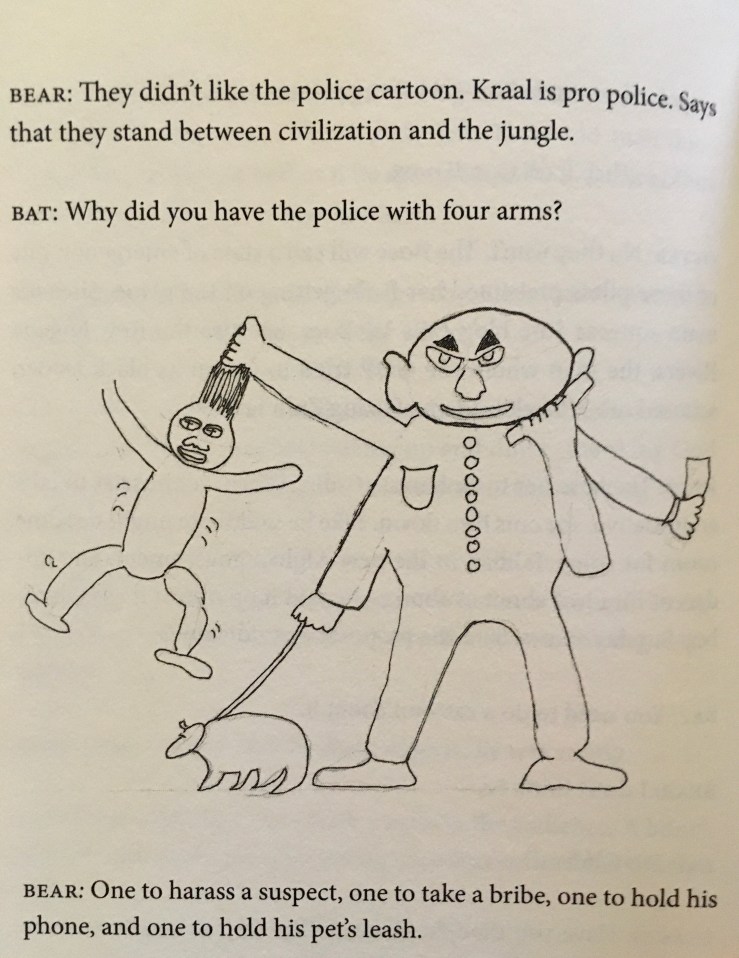
In that same interview, Reed discussed the cartoons he did (as “Bear”) for Juice!–

A publisher wanted to publish Juice! but decided that the cartoons weren’t up to par. So, at the age of seventy, I studied at the Cartoon Art Museum of San Francisco…

img_4553

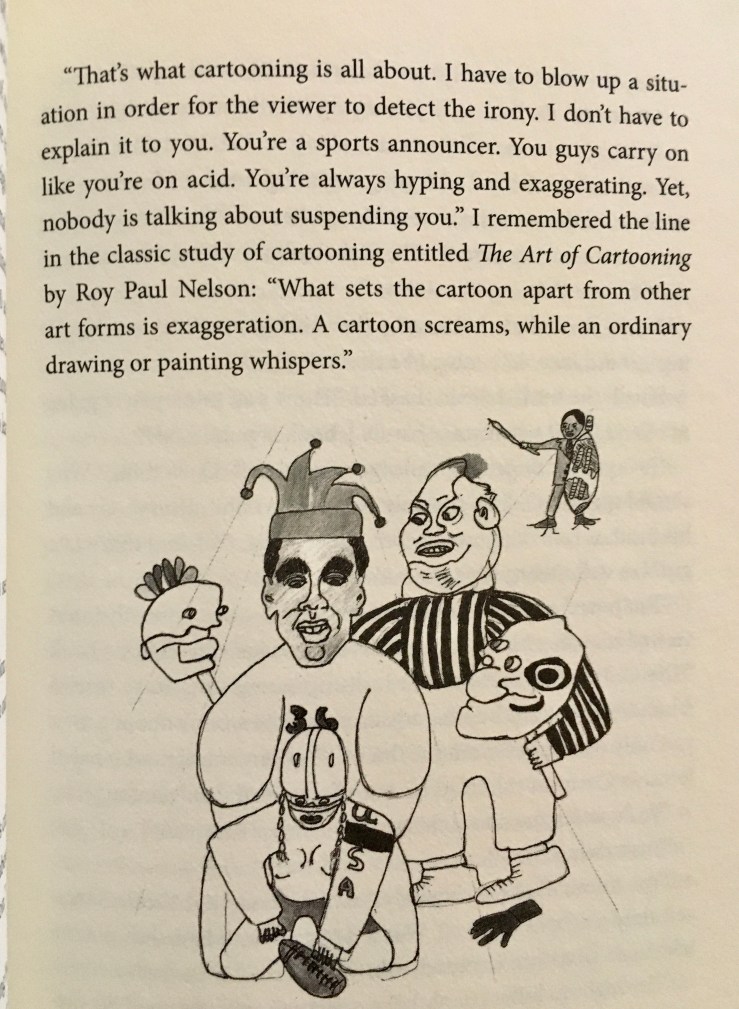
Reed’s cartoons are sharp and grotesque, and several of them are major plot points in the novel. One of the cartoons (also the novel’s cover illustration), featuring O.J. Simpson taking a direct snap from the US of A (a blonde, natch) is misunderstood—or perhaps understood too well—and Bear nearly loses his job.

img_4554

I haven’t finished Juice! yet—I’m about 50 or so pages from the end—but it’s fascinating both in its structure (discursive, achronological reportorial collage) and its tone (a kind of push-pull of an aging obsessive in crisis). Juice! isn’t my favorite Reed novel, but I’m thankful for this late work’s diagnosis of the Clinton years and beyond.

Jonathan Buckley’s The Great Concert of the Night (Book acquired, sometime early December 2019)

img_4539

Jonathan Buckley’s novel The Great Concert of the Night is forthcoming from NYRB early next year (like, in a few weeks). NYRB’s blurb:

David has just spent New Year’s Eve alone, watching Le Grand Concert de la Nuit, a film in which his former lover Imogen starred. In the early hours of the new year, consoled and tormented by her ethereal presence, he begins to write. What follows is a brilliantly various journal, chronicling a year in the life of a thinking man. David works as a curator at the ailing Sanderson-Perceval Museum in southern England, whose small collection of porcelain, musical instruments, crystals, velvet mushrooms, and glass jellyfish is as eccentric and idiosyncratic as the long-dead collectors’ tastes. David himself is a connoisseur of the derelict and nonutilitarian, of objects removed from the flow of time. Refusing the imposed order of a straightforward chronology, his journal moves fluidly back and forth in time, filled with fragments of life remembered, imagined, and recorded, from memories of his past life with Imogen or with his ex-wife, Samantha, to reflections on the lives and relics of female saints or the history of medicine. There are quotations from Seneca, Meister Eckhart, and the Goncourt brothers mixed in with the equally compelling imagined words of fictional film directors, actors, and, always, the fascinating Imogen, who is alive now only “in the perpetual present of the sentence.” In The Great Concert of the Night, Jonathan Buckley expertly interweaves sexual despair, cultural critique, the plot lines of one man’s quietly brilliant life, and the problems and paradoxes of writing, especially writing about and to the dead.

John Barth’s Giles Goat-Boy (Book acquired, 30 Nov. 2019)

img_4536

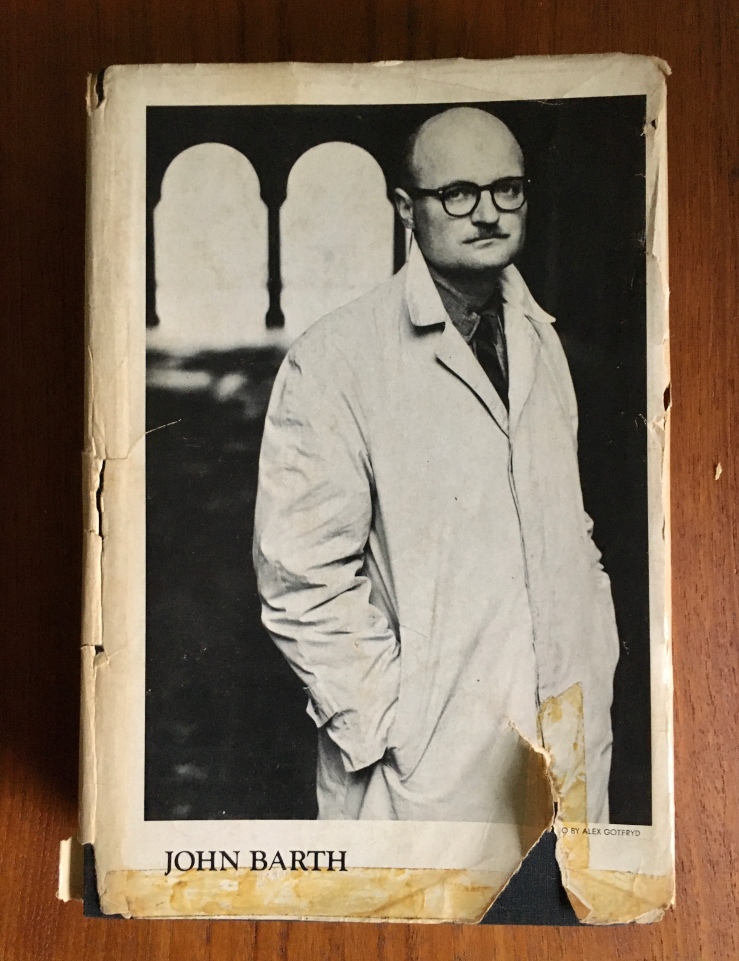
I couldn’t pass up on this used first edition of John Barth’s 1966 novel Giles Goat-Boy when I visited Haslam’s Book Store in downtown St. Petersburg over the Thanksgiving break. Here’s the back cover:

img_4537

From Eliot Fremont-Smith’s 1966 review of Giles Goat-Boy in The New York Times:

There follows the novel proper, which tells how George Giles was born (possibly a computer accident) into a goat herd, made his way into New Tammany College (the world of men), became Grand Tutor and prophet of the West Campus (the Western world as opposed to the Eastern) and, like Don Quixote, Candide, Leopold Bloom, etc., sought the meaning of good and evil, innocence and existence, action and identity, passion and thought.

The message of the syllabus is ambiguous — except perhaps that absolutes are noncognizable, that thinking is a passion and most passionately expressed in humor, and that, except for these, the world is going to hell. Fortunately, it won’t get there because — Mr. Barth proves once more — old jokes never die, they just lie in wait for resurrection. The jokes here — sexual, scatological, gastronomical, existential, political, linguistic, literary conventions and parodies — can be traced to Rabelais, “Tristram Shandy,” Lewis Carroll, Joyce, Nabokov, the Beatles and Bennett Cerf, among others, which should given an idea of the truly astonishing flavor of this lemon meringue pie of a book.

Machines in the Head: Selected Stories of Anna Kavan (Book acquired, 18 Nov. 2019)

img_4405

I’m really excited about this one. Anna Kavan’s novel Ice is one of the best books I read this year (I blogged about it here and here and here. T Machines in the Head: Selected Short Stories of Anna Kavan is out early next year from NYRB. Their blurb:

Anna Kavan is one of the great originals of twentieth-century fiction, comparable to Leonora Carrington and Jean Rhys, a writer whose stories explored and plumbed the depths of her long addiction to heroin. This anthology of Kavan’s stories draws together a selection of her best writing from across her long career. Stories from across her collections show the range of her style: oblique and elegiac tales of breakdown and asylum incarceration from Asylum Piece (1940), moving evocations of wartime from I Am Lazarus (1945), fantastic and surrealist pieces from A Bright Green Field (1958), and stories of addiction from Julia and the Bazooka. Her late sci-fi stories will appeal to fans of her last novel, Ice. “Five Days to Countdown,” first published in Encounter (1968) and later collected in My Soul in China, is preoccupied with Cold War concerns and the sartorial aesthetics of the 1960s, and, published here for the first time, “Starting a Career” is a futuristic spy thriller, whose protagonist sets out to become the world’s greatest enigma.

Kavan was determined to experiment throughout her writing career, and this collection is moving, funny, bizarre, poignant, often unsettling, but always distinctive and often unique. And even though better known as a writer than an artist, Kavan painted throughout her life.

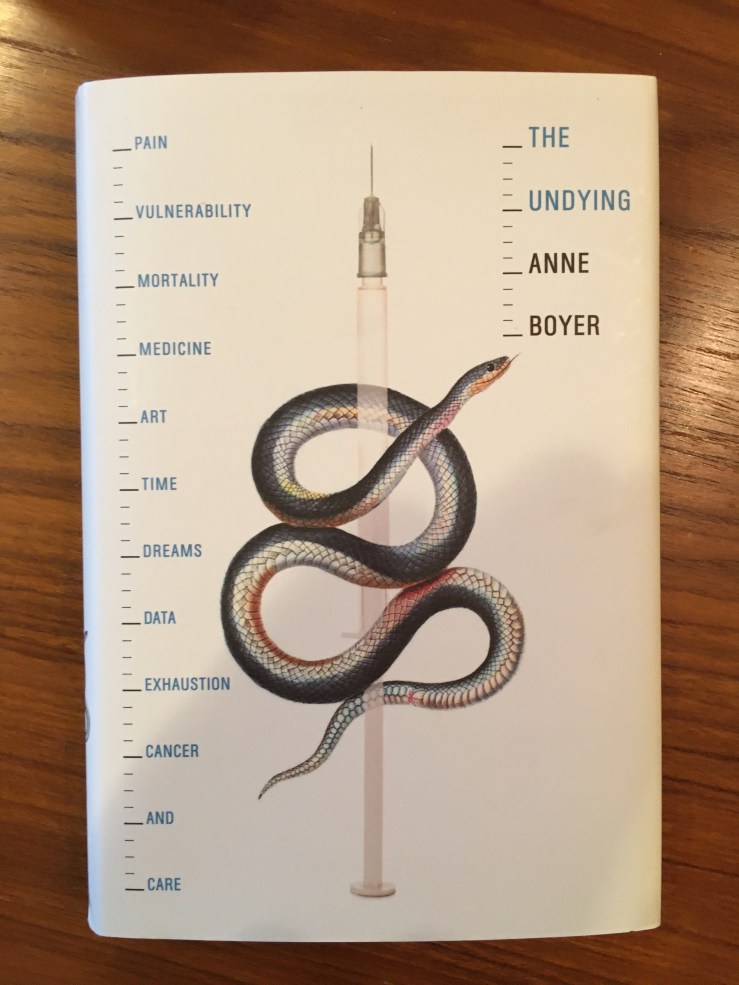
Anne Boyer’s The Undying (Book acquired 12 Nov. 2019)

img_4281

Huge thanks to BLCKDGRD for sending me Anne Boyer’s aphoristic, poetic memoir-essay The Undying. I guess he read that I went to my bookstore to buy it a few weeks ago and came home not empty handed but nevertheless Undyingless. I wanted to read Boyer’s book after reading her essay collection (“essay” isn’t really the right word, but)  A Handbook of Disappointed Fate this summer—-also sent to me by generous Mr. BLCKDGRD

I’m about 100 pages away from finishing The Undying, a book that doesn’t so much chronicle Boyer’s 2014 diagnoses and treatment of breast cancer as it explores and explodes what cancer—a “twentieth-century disease” that we still treat with “twentieth-century” methods, in Boyer’s words—means and is and does in our neoliberal late-capitalist early twenty-first century. Boyer writes,

To become a cancer patient is to become a system-containing object inside another system that only partially allows the recognition of the rest of the systems in which one is a node and also almost wholly obscures the heaviest system of the arrangement of the world as it is, which hangs around, too, in the object that contains a system (by which I mean “me”) as part of the problem in the first place, requiring our latent unhealth just as it profits from our active one.

Later, again addressing that “latent unhealth” which is part and parcel of the system, Boyer declares: “I would rather write nothing at all than propagandize the world as is.” This is a wonderfully angry book.

This is a wonderfully angry, discursive, recursive book: literary biography, literary criticism, art history, art criticism, Foucault, John Donne, Susan Sontag, Lucretius, Virginia Woolf; a howl at the hoaxers, frauds, self-helperists and their pinkwashed platitudes. And lots of pain, expressed with sentiment that bears no trace of sentimentality.

Boyer’s aphoristic style is engrossing. Her paragraphs and one-liners bear a ludic stamp seemingly at odds with her subject matter. The work of the writing, the heavy burden of smithing those sentences is all but elided—instead we get the clarity of a focused mind drawing together seemingly-disparate threads into a cohesive and compelling memoir that transcends the personal without necessarily meaning to.

Showing is a betrayal of the real, which you can never quite know with your eyes in the first place, and if you are trying to survive for the purpose of literature, showing and not telling is reason enough to endure the disabling processes required for staying alive.

Everything here feels and reads True. 

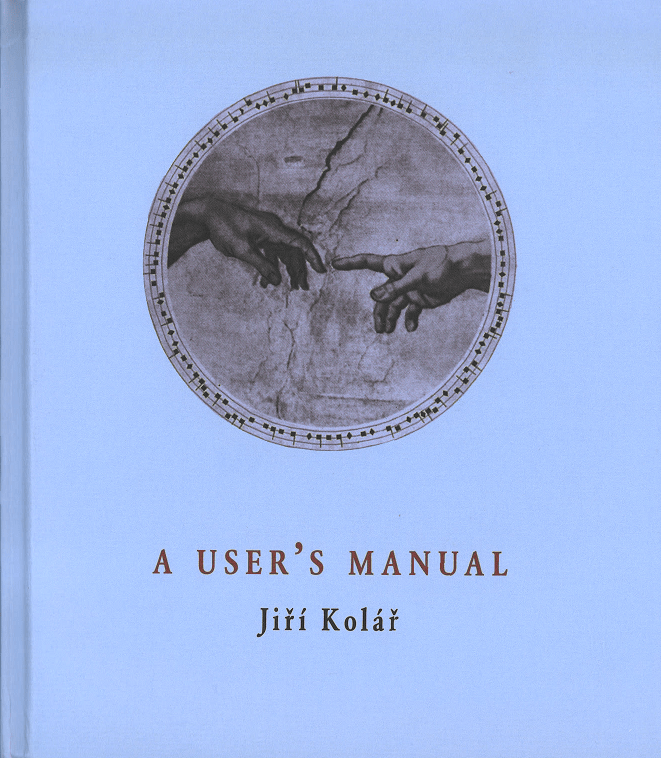
Jiří Kolář’s A User’s Manual (Book acquired, some time in late October)

z

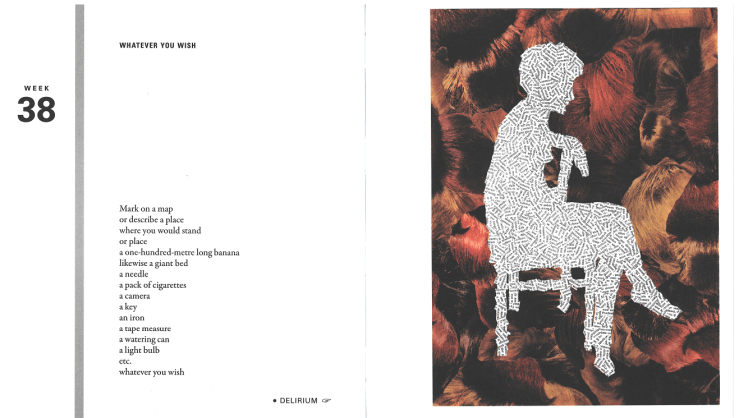
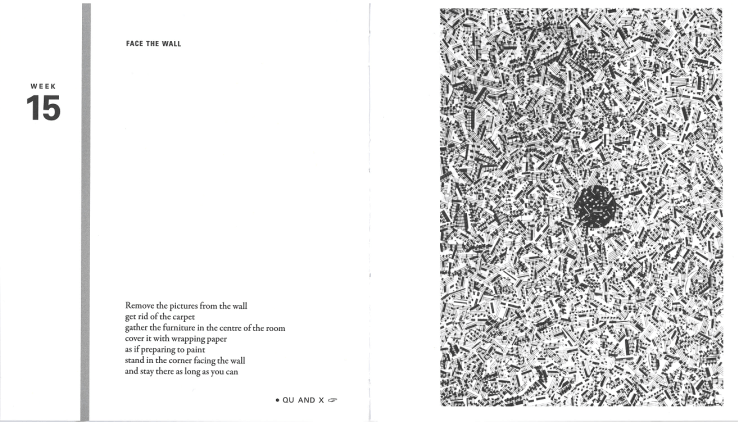
I’ve been slowly enjoying the poems and collages that comprise Jiří Kolář’s collection A User’s Manual (in English translation by Ryan Scott). There are 52 poems and collages here. Each poem is a kind of surrealist recipe, a set of commands that I’ve been trying to follow (in my imagination, I mean).

Capturea

The book itself is beautiful—hardback with full color and black and white illustrations, it fits perfectly with the aesthetic that its publisher Twisted Spoon has been developing for ages now.

Capture

Here’s Twisted Spoon’s blurb:

Written in the 1950s and ’60s, the “action poems” comprising a A User’s Manual were published in their complete form in 1969 when they were paired with the 52 collages of Weekly 1967, the first of Kolář’s celebrated series in which he commented visually on a major event for each week of
the year. Taking the form of directives, largely absurd, the poems mock communist society’s officialese while offering readers an opportunity to create their own poetics by performing the given directions. The collages on the facing pages to the poems are composed of layered documents, image cutouts, newspaper clippings, announcements, letter fragments, reports, or decontextualized words, oftentimes forming concrete patterns or the outlines of figures, to create a sort of “evidential” report on the year. Text and image taken together, the volume displays Kolář’s enduring interest in extracting poetry from the mundane to demolish the barrier separating art from reality, or even to elevate reality itself through this dual poetics to the level of art. What art historian Arsén Pohribný wrote about Weekly 1968 equally applies to Weekly 1967: it “shocks with its abrupt stylistic twists” and is “a Babylonian, hybrid parable of multi-reality.” The volume also includes the complete Czech text as an appendix.

D.H. Lawrence’s The Bad Side of Books (Book acquired 16 Oct. 2019)

img_4071

NRYB has compiled a collection of essays from D.H. Lawrence entitled The Bad Side of Books. I’ve always appreciated Lawrence’s nonfiction (particularly Apocalypse) more than his fiction, so this collection (with its great title) piques my interest. NYRB’s blurb:

You could describe D.H. Lawrence as the great multi-instrumentalist among the great writers of the twentieth century. He was a brilliant, endlessly controversial novelist who transformed, for better and for worse, the way we write about sex and emotions; he was a wonderful poet; he was an essayist of burning curiosity, expansive lyricism, odd humor, and radical intelligence, equaled, perhaps, only by Virginia Woolf. Here Geoff Dyer, one of the finest essayists of our day, draws on the whole range of Lawrence’s published essays to reintroduce him to a new generation of readers for whom the essay has become an important genre. We get Lawrence the book reviewer, writing about Death in Venice and welcoming Ernest Hemingway; Lawrence the travel writer, in Mexico and New Mexico and Italy; Lawrence the memoirist, depicting his strange sometime-friend Maurice Magnus; Lawrence the restless inquirer into the possibilities of the novel, writing about the novel and morality and addressing the question of why the novel matters; and, finally, the Lawrence who meditates on birdsong or the death of a porcupine in the Rocky Mountains. Dyer’s selection of Lawrence’s essays is a wonderful introduction to a fundamental, dazzling writer.

Drew Lerman’s Snake Creek

2019-10-14_163321

I got a copy of Drew Lerman’s Snake Creek strips a few weeks ago and have been reading a strip a day, or sometimes reading two or four strips a day, or sometimes reading no strips a day.

Snake Creek comprises the first volume of Snake Creek comix created by Lerman between the summers of ’18 and ’19. Lerman made one each day, as far as I can tell, which, like props.

The heroes of Snake Creek are maybe-human Dav (an altar-ego for Lerman?) and maybe walkin-talkin potato/maybe-mutant Roy, who spend their days and nights strolling the beaches, riffing on life, and extemporizing poems and songs. They take up with a dog and one point, and later encounter strange ducks. (I’m sure there’s more—I’ve been trying, like I said, to limit myself to a few strips a day.) It’s all a big anarchic kick.

2019-10-14_163456

Snake Creek has an absurdist and occasionally nihilist bent, flavors I love. Never too bitter, the strip’s sweetness is anchored in the weird friendship betwixt Dav and Roy, who wander and wonder along a Miami Beach that Lerman turns into a kind of desert island running on Prospero’s magic.

2019-10-14_163605

Snake Island’s chords and rhythms resonate with Walt Kelly’s Pogo, another Floridaish strip, as well as George Herriman’s zany strip Krazy Kat. Lerman seems like a willing descendant of Kelly and Herriman, but Snake Island is also wholly contemporary, a comic that begins with a discussion of old G-chats.

I’m really digging the collection, and I hope not to gobble it up too fast.

2019-10-14_163713

Carl Shuker’s novel A Mistake (Book acquired 27 Sept. 2019)

img_3969

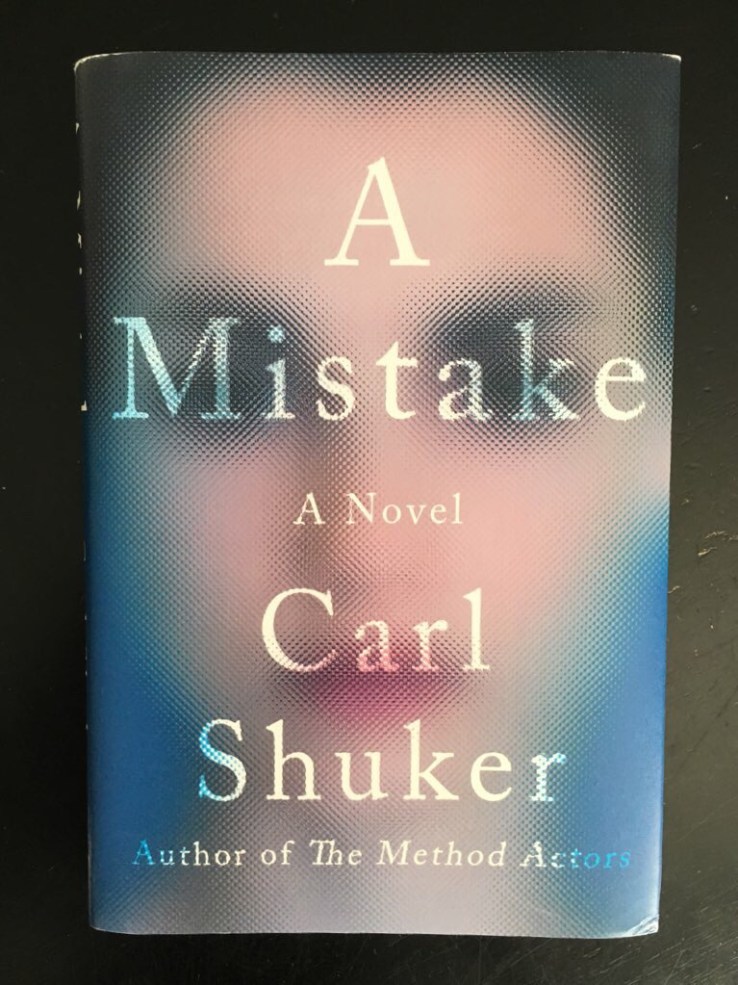
Carl Shuker’s fourth novel A Mistake is new from Counterpress. Their blurb–

Elizabeth is a gifted surgeon—the only female consultant at her hospital. But while she operates on a young woman with life-threatening blood poisoning, something goes horribly wrong. In the midst of a new scheme to publicly report surgeons’ performance, her colleagues begin to close ranks, and Elizabeth’s life is thrown into disarray. Tough and abrasive, Elizabeth has survived and succeeded in this most demanding, palpably sexist field. But can she survive a single mistake?

A Mistake is a page-turning procedural thriller about powerful women working in challenging spheres. The novel examines how a survivor who has successfully navigated years of a culture of casual sexism and machismo finds herself suddenly in the fight of her life. When a mistake is life-threatening, who should ultimately be held responsible?

Carl Shuker has produced some of the finest writing on the physicality of medical intervention, where life-changing surgery is detailed moment by moment in a building emergency. A Mistake daringly illustrates the startling mix of the coolly intellectual and deeply personal inherent in the life and work of a surgeon.

Howard Jacobson’s Live a Little (Book acquired, some time near the end of August, 2019)

img_3917

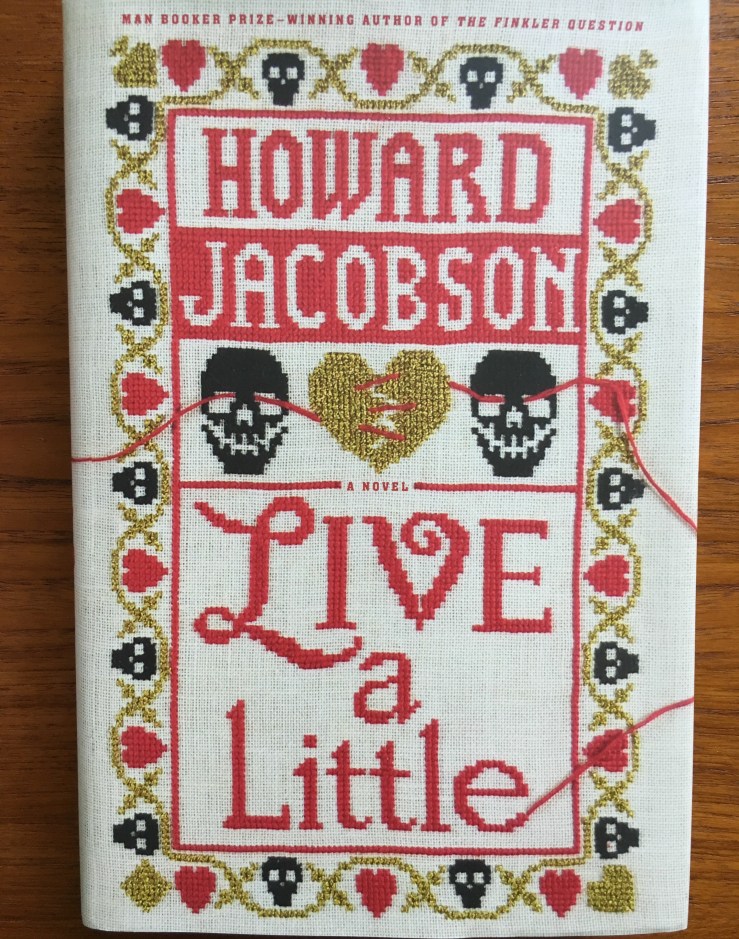
Howard Jacobson’s Live a Little is new in hardback in the US this month from Penguin Random House. Their blurb–

At the age of ninety-something, Beryl Dusinbery is forgetting everything – including her own children. She spends her days stitching morbid samplers and tormenting her two long-suffering carers, Nastya and Euphoria, with tangled stories of her husbands and love affairs.

Shimi Carmelli can do up his own buttons, walks without the aid of a frame and speaks without spitting. Among the widows of North London, he’s whispered about as the last of the eligible bachelors. Unlike Beryl, he forgets nothing – especially not the shame of a childhood incident that has hung over him ever since.

There’s very little life remaining for either of them, but perhaps just enough to heal some of the hurt inflicted along the way, and find new meaning in what’s left. Told with Jacobson’s trademark wit and style, Live a Little is equal parts funny, irreverent and tender – a novel to make you consider all the paths not taken, and whether you could still change course.

Daniel Mendelsohn’s Ecstasy and Terror (Book acquired, some time last week)

img_3918

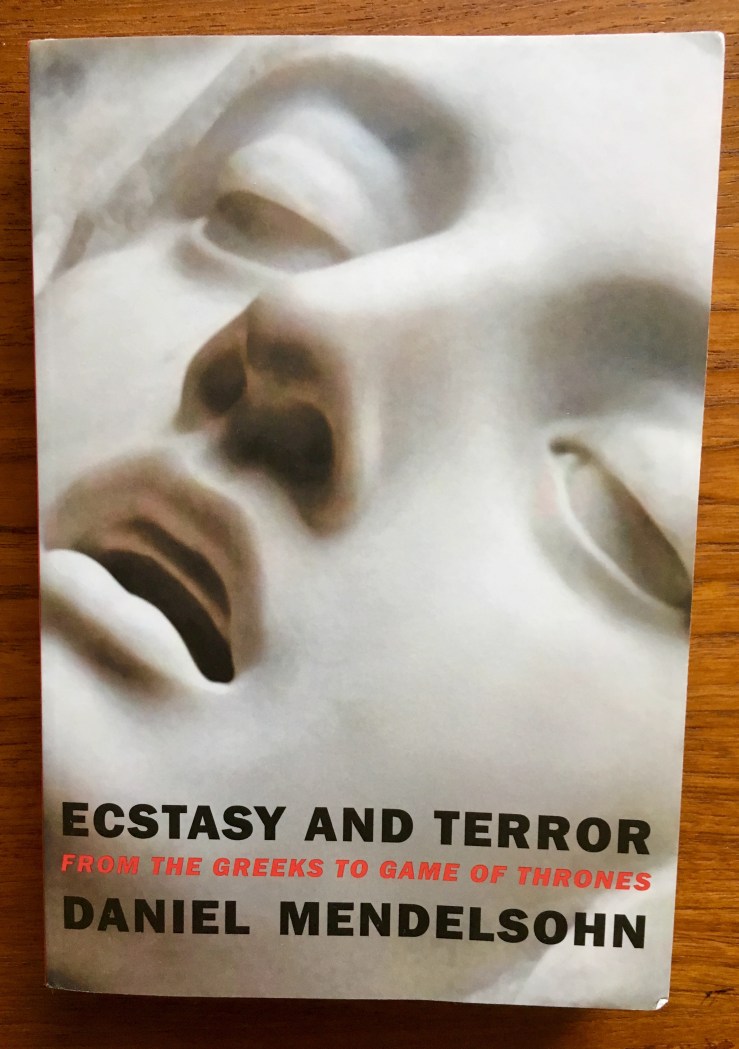
I got a review copy of Daniel Mendelsohn’s collection Ecstasy and Terror some time early last week. I’ve read a few of the pieces in here before (“A Critic’s Manifesto” is one that I recalled in particular). Ecstasy and Terror is out in October from NYRB. Their blurb:

This collection of essays exemplifies the range, depth, and erudition that have made Daniel Mendelsohn “required reading for anyone interested in dissecting culture” (The Daily Beast). Here Mendelsohn once again casts an eye at literature, film, television, and the personal essay, filtering his insights through his training as a scholar of classical antiquity in surprising and illuminating ways.

Many of these essays examine how we continue to look to the Greeks and Romans as models: some argue for the surprising modernity of canonical works (Bacchae, the Aeneid), while others detect a “Greek DNA” in our responses to the Boston Marathon bombings and the assassination of JFK. Modern topics are treated, too, from the “aesthetics of victimhood” in Hanya Yanagihara’sA Little Life to the novels of Karl Ove Knausgaard, and from Game of Thrones to recent films about artificial intelligence—a subject, Mendelsohn reminds us, that was already of interest to Homer.

The collection also brings together for the first time a number of Mendelsohn’s personal essays, including his “critic’s manifesto” and a touching memoir of his boyhood correspondence with the historical novelist Mary Renault.

Blog about Chris Ware’s Rusty Brown (Book acquired, 7 Aug 2019)

img_3799-1

I finally dug into Chris Ware’s forthcoming graphic novel, Rusty Brown yesterday. A finished review copy arrived on August 7th, 2019, the day that David Berman died.

I had spent some time simply looking at the book’s exquisite book jacket, which unfolds into a kind of two-sided poster thing, complete with notes and suggestions how the reader might personalize the jacket by folding it in different ways. The spine section of the jacket is also quite amusing—a sort of TV Guide goof that stages Rusty Brown as a television special (in four parts, including comedy, western, sci-fi, and drama). There’s also a crossword puzzle, a maze, and other minutiae. If you’ve read Ware, you’ll know that his work is often crammed with little details like this. Here are two pictures that fail to capture how gorgeous this thing is:

img_3802-2img_3801-2

Here’s the inside cover, too:

img_3800-1

So well and anyway. I tooled around with the cover for a half hour or so on that Wednesday then started in on making dinner, the making of which was interrupted by a text from a friend telling me about Berman’s suicide.

If you’ve read Chris Ware—maybe you’ve read Jimmy Corrigan: The Smartest Kid on Earth or Building Stories, both of which are exceptional—hell, Building Stories is like the invention of a new genre of reading itself—if you’ve read Chris Ware you likely know that his work can be really fucking sad.

I have not wanted to read anything really fucking sad for the past few days.

(I’ve been rereading Berman’s collection Actual Air and reading Charles Portis’s comic picaresque The Dog of the South.)

On Sunday afternoon I decided to dig in. I met the cast of Rusty Brown:

img_3803-1img_3804-2

–and picked up the setting:

img_3806-1

The introduction of Rusty Brown runs over a 100 pages and intertwines several of the characters’ perspectives. If there’s a lead though, it’s Woody Brown, a miserable son of a bitch who hates his life (wife, kid, teaching job) and daydreams about running away or even killing himself.

img_3782-1

Woody’s poor son, the titular Rusty, daydreams as well, fantasizing that he’s gained superpowers (well, a superpower—incredible hearing) and fixating on his Supergirl action figure, who enters his bored mind when he’s at school. School is bad for Rusty, too; he’s bullied terribly. Ware depicts these scenes with honesty and pathos, but also humor. Consider this little cut scene:

img_3783-1

The comic timing frequently leavens the first part of Rusty Brown. The thought bubble here cracked me up:

img_3805-1

We also meet Alison and Chalky White, a brother and sister who are starting their first day at a new school. They’ve moved in with their grandmother; they’re new to Nebraska, and they’re miserable. Ware runs their story concurrently with the Browns’ story, and the two occasionally sync up in wonderful little plays on perspective.

img_3808

Ware also inserts a version of himself into the story. Mr. Ware is the art teacher at Rusty’s school. Ware’s depiction of Mr. Ware is a kind of mean self-parody, but also very funny and even warm at times.

img_3786-1

Mr. Ware has been working on a series of Pop Art paintings that he hopes will achieve “an intuitive transcendence of culture and corpus.”

img_3785-1

Ware has been working on Rusty Brown for over a decade and a half now (you might’ve read bits of it here and there over the years), and the depth of storytelling here shows. Full review forthcoming, but for now, here’s publisher Pantheon’s blurb:

Rusty Brown is a fully interactive, full-color articulation of the time-space interrelationships of three complete consciousnesses in the first half of a single midwestern American day and the tiny piece of human grit about which they involuntarily orbit. A sprawling, special snowflake accumulation of the biggest themes and the smallest moments of life, Rusty Brown literately and literally aims at nothing less than the coalescence of one half of all of existence into a single museum-quality picture story, expertly arranged to present the most convincingly ineffable and empathetic illusion of experience for both life-curious readers and traditional fans of standard reality. From childhood to old age, no frozen plotline is left unthawed in the entangled stories of a child who awakens without superpowers, a teen who matures into a paternal despot, a father who stores his emotional regrets on the surface of Mars and a late-middle-aged woman who seeks the love of only one other person on planet Earth.


William Burroughs’ Nova Express (Book acquired sometime last week)

img_2863

So I couldn’t pass up this first edition hardback Grove Press edition of William Burroughs’ 1964 novel Nova Express (with cover design by Grove Press stalwart Roy Kuhlman) that I found a few hot days ago, wandering decomposing stacks of pressed leaves here in North Florida. It ate up half of my credit at this particular used bookstore and yet was still cheaper than a new hardback NYT bestseller. Haven’t read the damn thing since college, and don’t own a copy so. Here’s the back cover with an author photo of Burroughs in which he looks like a goddamn baby (how did he live so long?):

img_2866

“[T]he greatest satirical writer since Jonathan Swift”! I’m sure Jack Kerouac wouldn’t like hyperbolize even a smidge. What was Burroughs satirizing? Like modernism, modern machine life, etc. Control, as in all Burroughs.

Biologic Agent K9 called for his check and picked up supersonic imitation blasts of The Death Dwarfs — “L’addition — Laddition — Laddittion — Garcon — Garcon — Garcon” — American tourist accent to the Nth power — He ordered another coffee and monitored the café — A whole table of them imitating word forms and spitting back at supersonic speed — Several patrons rolled on the floor in switch fits — These noxious dwarfs can spit out a whole newspaper in ten seconds imitating your words after you and sliding in suggestion insults — That is the entry gimmick of The Death Dwarfs: supersonic imitation and playback so you think it is your own voice — (do you own a voice?) they invade The Right Centers which are The Speech Centers and they are in the right — in the right — in thee write — “RIGHT” — “I’m in the right — in the right — You know I’m in the right so long as you hear me say inside your right centers ‘I am in the right’” — While Sex Dwarfs tenderize erogenous holes — So The Venusian Gook Rot flashed round the world —

Read the rest of the death dwarf routine.

Gerald Murnane’s Border Districts (Book acquired, 20 May 2019

img_2844

I picked up a hardback copy of Gerald Murnane’s latest novel Border Districts on something of a whim today. It’s only 120 pages in hardback, and, despite Murnane’s metamodernist mode, is probably a bit more cohesive than the last few novels I’ve read (Thomas Pynchon’s Vineland, Kathy Acker’s Don Quixote, and Marlon James’s Black Leopard, Red Wolf). First two paragraphs—

Two months ago, when I first arrived in this township just short of the border, I resolved to guard my eyes, and I could not think of going on with this piece of writing unless I were to explain how I came by that odd expression.

I got some of my schooling from a certain order of religious brothers, a band of men who dressed each in a black soutane with a bib of white celluloid at his throat. I learned by chance last year, and fifty years since I last saw anyone wearing such a thing, that the white bib was called a rabat and was a symbol of chastity. Among the few books that I brought here from the capital city is a large dictionary, but the word rabat is not listed in it. The word may well be French, given that the order of brothers was founded in France. In this remote district, I am even less inclined than I was in the suburbs of the capital city to seek out some or another obscure fact; here, near the border, I am even more inclined than of old to accept as well founded any supposition likely to complete a pattern in my mind and then to go on writing until I learn the meaning for me of such an image as that of the white patch which appeared just now against a black ground at the edge of my mind and will not be easily dislodged.


Pynchon in Public Post, 2019

img_2774

Today is the 82nd birthday of the American author Thomas Ruggles Pynchon, which a lot of jokers on the internet have turned into Pynchon in Public Day.

The spirit of Pynchon in Public Day is zany fun, and mostly centers around reading Pynchon’s works in public and spreading the muted post horn symbol from The Crying of Lot 49 around as much as possible. I am the last person in the world who will read a book in a coffee shop, but I did don my second 49 shirt today—-

66581c11-b06d-4dfe-89e3-0bc25fa0c64c

—and head to the bookstore to pick up the only Pynchon novel I don’t own, Bleeding Edge. More on that in second, but—no real recognition on the shirt today, although I’ve gotten some reactions to the other muted post horn shirt I own over the years, mostly from booksellers (not that interesting I know).

A few years ago though, wandering around downtown Los Angeles (wearing a muted post horn shirt), a stranger passing opposite me on the sidewalk hailed me with this question: “Are you the Trystero, guy?” At least that’s what I thought I said. I looked confused, asked, “What?” and he repeated — “Are you the Trystero guy?”

This particular moment struck me with a neat silly wave of minor paranoia, a Pynchonian moment, maybe—was this some kind of call sign for me to repeat, a password in a game of good fun? So I did the only thing that seemed sensible and replied, “Yes, I am the Trystero.”

The guy then proceeded to tell me that he loved my coffee. This confused me, so I told him that loved his coffee. Then he looked confused. After a few minutes on the hot July L.A. sidewalk we finally figured out a few things: He was referring to Trystero Coffee, which he showed me all about on his iPhone, and I was referring to The Crying of Lot 49, which he promised to read at the end of our exchange.

So anyway I went to the bookstore and picked up Bleeding Edge (and a few other books too, I admit). Along with Vineland, it’s the only Pynchon novel I haven’t read (despite two attempts on each). I’ll read Bleeding Edge before May 8th, 2020 though.

I started a retry of Vineland though. I had hoped to get past the farthest I remember going in—like the first 90 pages—before this post—-but I only made it through the first five chapters these past two days (through page 67). Still, I’d forgotten all about Ch. 5, the “Kahuna Airlines” chapter, which steers the book into new territory, and even though it still hasn’t hooked me yet (unlike the other Pynchons at this point), I’m starting to appreciate it for what I guess it is: Pynchon’s analysis of the eighties, of the absorption of the counterculture into culture, of nostalgia. The jokes are often hilarious and terrible, sometimes simultaneously. Pynchon sets up a Loony Tunes diner bit to deliver the execrable punchline, “Check’s in the mayo” for example. Pynchon names a lawn care company “The Marquis de Sod.” There’s a moment where protagonist Zoyd Wheeler pays for a ludicrous psychedelic party dress with “a check both he and the saleslady shared a premonition would end up taped to this very cash register after failing to clear,” a wonderful little throwaway line that shows Zoyd’s brokeassedness and empathy (and also highlights the Lebowski-Pynchon overlap, if you like). The line that’s cracked me up each time I’ve read it though is Zoyd’s daughter Prairie’s punker boyfriend being described as “the NBA-sized violence enthusiast who might or might not be fucking his daughter.” It’s just so dumb and poetic. I had also missed a few things — the night manager of Bodhi Dharma Pizza is named “Baba Havabananda,” a reference I’m thinking to Gravity’s Rainbow (“Have a banana”). There’s also a reference to the Vulcan hand salute, which shows up improbably in Pynchon’s next novel, Mason & Dixon (more on that here). And there’s the whole Bigfoot motif too, which Pynchon would echo in Inherent Vice, with Zoyd and Zuniga prefigurations of Doc Sportello and Bigfoot Bjornsen. And like every Pynchon novel, I’m sure I’ve already missed a ton of stuff.

Anyway, more on Vineland to come. In the meantime, if you haven’t read Pynchon–why not check him out?

Baudelaire/Musil (Books acquired, mid-April 2019)

img_2678

Contra Mundum has two new ones in translation.

Robert Musil’s Unions, translated by Genese Grill, comprises two early stories, “The Completion of Love” and “The Temptation of Quiet Veronica.” From Contra Mundum’s blurb.


The stories in Unions, drawn from Martha’s [Marcovaldi, Musil’s wife] life, explode conventional morality; explore questions of self, union, and dissolution of self; and approximate exceptional sensations of erotic and intellectual perception in a shimmering and exceedingly dense proliferation of metaphors. The images, Musil tells us in a note, are the bone, not just the skin, of these carefully crafted stories. Each word is as motivated as the internal and external moments it attempts to embody in language. Although Musil did not continue to work in this experimental style in his later writing, in a late note he affirmed that Unions, the fruit of much artistic struggle and deep personal engagement, was the only one of his books that he sometimes still read from.

Belgium Stripped Bare is bad boy Baudelaire’s bad-mood visit to Belgium in the mid-1860s. This translation by Rainer J. Hanshe is comprised of Baudelaire’s journal entries, observations, and clippings of his time in Belgium, the place he left Paris for in 1864 in self-imposed exile. The entries, like this one, are fucking mean:

Screenshot 2019-04-25 at 5.25.28 PM

And I have no idea what to make of this—

Screenshot 2019-04-25 at 5.30.48 PM

I have yet to read Hanshe’s lengthy introduction for context, though—but from the blurb:

 Belgium Stripped Bare is an aesthetico-diagnostic litany of often vitriolic observations whose victory is found in the act of analysis itself, in the intoxication of diagnosis, just as great comedians exult in caustic and biting observations of society, a slap in the face of the status quo.

Anne Boyer’s A Handbook of Disappointed Fate (Book acquired, 8 April 2019)

img_2617

A tremendous thank you to to BLCKDGRD for sending me a copy of Anne Boyer’s strange discursive book of essays-poems-critiques-I-do-not-know-whats A Handbook of Disappointed Fates. It showed up in the mail unexpectedly, and I figured it might be from him (he posted excerpts last week). I’m really digging the book so far, although I haven’t been reading it in a straight line. I did start at the beginning though, which starts like this:

img_2624

(Bartleby prefers not to arrive in this essay on “No,” but it is nevertheless rather rich in its refusals).

Thanks to my friend again.