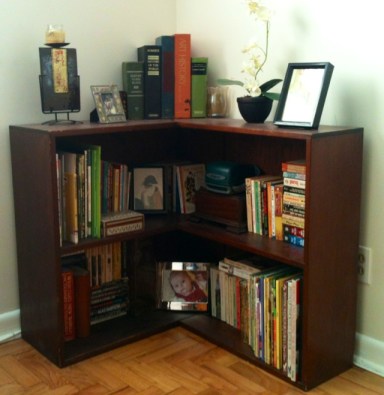
Book shelves series #3, third Sunday of 2012: In which we revisit the master bedroom corner piece bookshelf in the southwest corner; two tiers + top shelf.
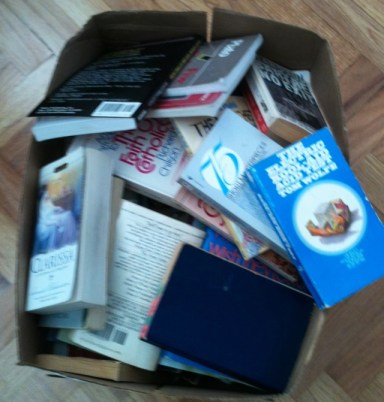
The post optimistically concluded: “So we’ve made it out of my bedroom” — but not so, dear reader, as post-Christmas/New Year cleaning up type activities led to a box of books, still in a storage room in the back of my house, needing to finally be shelved or ejected from the house. Said box:
Most of the volumes herein are aesthetically-challenged/of a certain sentimental value: lots of books from my youth and the youth of my wife; lots of books that taught me how to read, books that weirded me out, books that I hope my kids will want to read in a few years. The corner piece bookshelf had the most (only, really) free space for shelving; it’s also tucked away from public view where an eyesore like my crumbling copy of Vonnegut’s Cat’s Cradle won’t sore eyes:
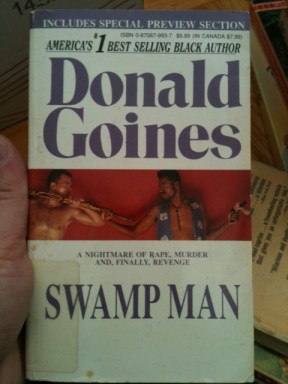
I actually read Goines’s Swamp Man. It’s not the Deliverance knock off you might expect, although it is singularly horrific.
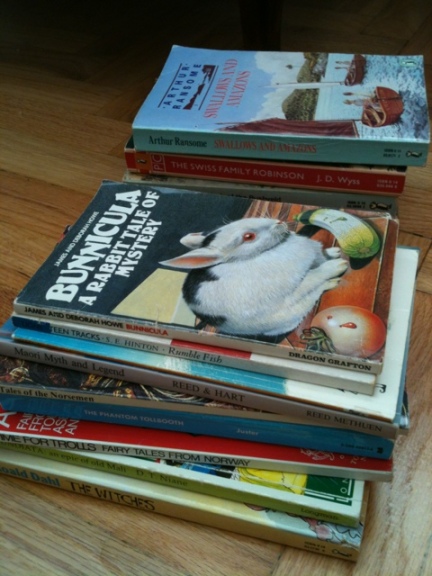
Some beloved childhood classics. Arthur Ransome, S.E. Hinton, various myths and legends, Roald Dahl, etc.:
Two books I hated. Hated. I keep them as badges of a strange honor, a sort of “I did it, okay?”:
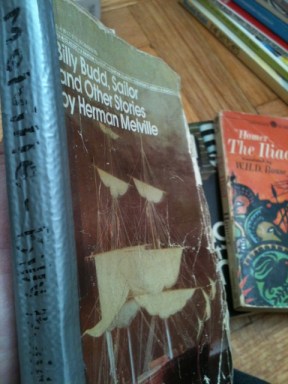
Melville stories held together with duct tape. This was the copy my 11th grade teacher assigned; I stole it of course. I used it in numerous subsequent courses and the annotations I made are somehow (unduly) precious to me. I can’t part with it even though I have at least two other volumes of Melville stories;
Never sure where to shelve this RAW volume:
Not sure if you can make out the title of this one, but it’s Alcoholic Anonymous’s Big Book. I found it on the beach one night when I was maybe 17 or 18. It’s full of highlighted passages and annotations and I’ve always been intrigued at what led the former owner to cast it away into cattailed dunes, as if the person couldn’t wait to be rid of it but couldn’t bear to bury it in a garbage can. Anyway, I picked it up because I pick up any discarded book, but I’ve kept it because I don’t know why I’ve kept it. Maybe it helped inform my reading of Infinite Jest, I don’t know:
And here’s the “after” shot. I’ll try not to fret over re-shooting shelves again. But moving the box of books yesterday, knowing I was going to do the book shelf post today, I couldn’t help but photograph some of these as I went.
Every library answers a twofold need, which is often also a twofold obsession: that of conserving certain objects (books) and that of organizing them in certain ways.
—Georges Perec, from “Brief Notes on the Art and Manner of Arranging One’s Books” (1978)
For all of 2011 and half of 2010, I ran a death mask on this blog every Sunday. I liked the idea of having a regular, uniform post on the blog, and I enjoyed searching for death masks (and life masks) and learning about them. However, my interest is waning; it’s time to move on.
Still wanting to run a regular post each Sunday, I’ve elected to photograph the bookshelves, or the surfaces that hold books in my house. These will not be beautiful, arranged pictures, but rather simple pics from my iPhone documenting the spaces that books occupy. I will photograph each space “as is” and then remove a book or two, photograph it, and then comment on it.
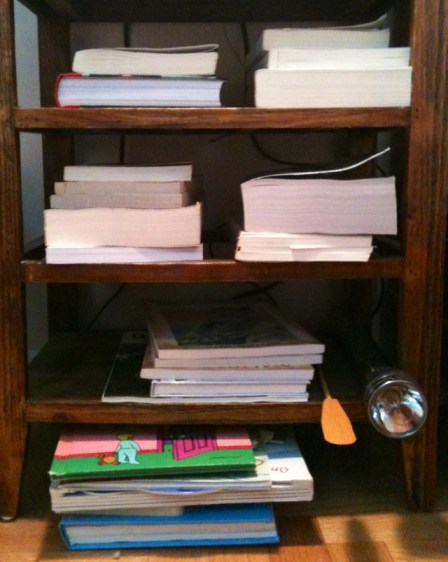
I didn’t know where to start, so I started with what may be the most plain book shelves in my home, the nightstand next to my bed. (Right now it is unusually tidy, having been cleaned out and partially restocked for the new year; in a week or two it will be crammed to its wooden gills). Here is what it looks like:
Not very exciting, I know! This is perhaps the only photo in this book shelf series that will not feature shots of spines. Like I said, I don’t plan to arrange any of the shots in this series. I talked about a lot of what’s in here in yesterday’s riff on recent reading and a post last week on stuff I plan to read in 2012.
Stuff on the top tier tends to be stuff I’m currently reading; the second shelf is filled with books I’m always rereading, or picking at slowly. The third shelf is where stuff goes to marinate or get dusty or cry to be shelved.
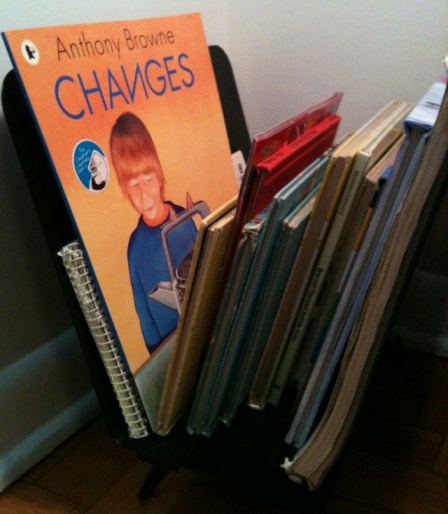
There’s also a bunch of kids book on the floor. More kids books are in this giant magazine stand, along with some notebooks, art pads, and probably an actual magazine or two (Anthony Browne’s book Changes is a surrealist masterpiece for kids, by the way):
The Perec quote above comes from an essay collected in Species of Spaces and Other Pieces. “Brief Notes on the Art and Manner of Arranging One’s Books” will be in some ways the guiding inspiration for the Biblioklept book shelf series; my aim is not so much to present beautiful pictures that show off my books (I’m not equipped to do that, and other people do it very well already), but to comment on how my books are arranged and how they move and flow throughout the house; it will also give me a good opportunity to pick up books that might have been lingering (do books linger?) on a shelf for sometime.
I pulled these three books, not quite at random, from the shelves. The Perec book is one of those volumes I like to read scattershot-style. The latest issue of Paris Review still has a few pieces I haven’t read. Nausicaa: I meant to start it the other night. It will migrate to another room, a day-reading room, not a night-reading room:
I don’t anticipate future book shelf posts being quite this long; my intention here is to kind of set the ground rules (for myself) or delineate both spirit and letter to this project. As such, a final note on movement: I will move “outward” from this nightstand, photographing any place where books are set. I will photograph every kind of book in this house in its natural habitat; this includes children’s books and cookbooks, but does not include personal photograph albums, instruction manuals, or anything else of that nature. I plan to do 53 total book shelf posts, including this one (there are 53 Sundays in 2012).
My hope is that readers will respond to these posts by sharing their own bookshelving habits.
Now, if you have even a passing acquaintance with this little blog, you know that I love novels, that Biblioklept primarily focuses on novels, and that I love books in general. I am not anti-novel or anti-giving-novels-as-gifts. Send me a novel as a gift. I will appreciate it (or trade it toward another book, which is kinda sorta a form of appreciation).
I went to my favorite bookstore today, in fact, to buy some books for Christmas presents. But I restrained myself from picking up novels as gifts.
If you love books like I do, I’m sure that some of your most favorite gifts ever have been novels. Some of my most favorite gifts have been novels. The remaindered copy of The Lord of the Rings (from the South Barwon Library that some friends of the family gave me on Dec. 5th, 1990 when we visited Melbourne (the one in Australia, not Florida)) is probably one of my all-time favorite gifts. I know the exact date because the nice lady who gave it to me wrote a kind note in book and included the date in her note.
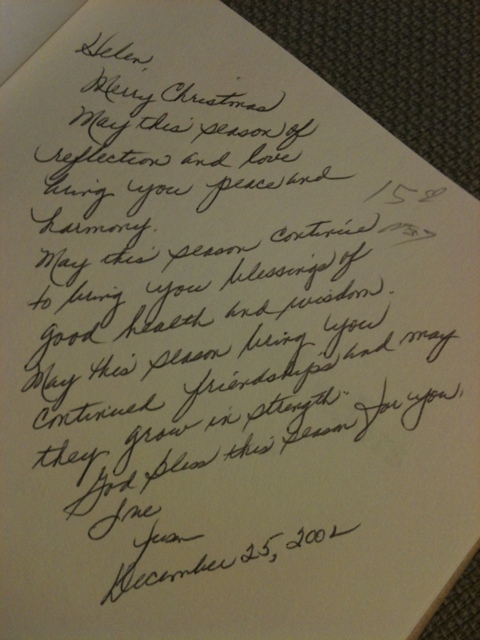
I could never bear to get rid of an inscribed book given as a gift, but lots of people do get rid of inscribed books. This is a monstrous practice, one that attests to just how easily people will discard your oh-so-earnest gifts. If you spend a lot of time in used bookstores (I do) you will come across these sad markings. Because it’s close at hand, and I’m aware of its inscription, I’ll share the note that Jean wrote to Helen (no, of course I know neither of them) in my copy of Balthus’s memoir, Vanished Splendors:
I am aware that the memoir of a pervy artist is not the same as a novel, and that, as my first illustrating example, I already seem to be losing my metaphorical balance, but again, it was close at hand, right near the Tolkien in fact (by the bye, Vanished Splendors is pure gold).
In any case, I think Balthus’s memoir “reads” like a novel, which is to say that it’s mostly big chunks of text that require time and energy to decipher, set against the backdrop of TV, internet, movies, etc. It has some pictures, but not many. There’s no gimmick to it. I’m guessing that Helen just wasn’t into Balthus, or, if she had a passing interest in his art, it didn’t translate into wanting to read his memoir. She certainly didn’t read any of it (yes, I have a special sense that tells me when a book has been read. This baby was a virgin). Every time I look over the book, I feel sorta bad for Jean, whose gift seems to have gone unappreciated (by Helen; not by me. I was happy to pick it up used).
To return to an earlier point: yes, some of our favorite gifts ever might be novels. However, most of the life-changing novels I received were rarely given as birthday or Christmas gifts. They weren’t gifts of obligation, if you’ll forgive the ugliness of that term. Most of the great novels that were given to me were handed along free of occasion, given because the giver thought (knew) I should read them.
At Christmas though, we feel obliged to give. Sometimes we get some great novels as gifts. More often though, it seems like that relative who knows you “like to read” gives you a novel by, I dunno, Clive Cussler or Tom Clancy. The worst though are those tiny little hardback books that are designed specifically to be gifts, little faux-tomes of faux-philosophy usually connected to golf or angels or some other bullshit (I was horrified last year when DFW’s “This Is Water” speech got this treatment). Anyway, if you like books, you probably just go trade in this bullshit toward the books you like.
But this post isn’t really about the problem of getting airport novels or gimmick books as gifts. This post is about those of us who insist on giving novels we love to people who we know don’t really love reading novels. Especially really big, somewhat (or very) experimental novels. Important novels. Those novels that we read and decide that everyone needs to read this to become a fully realized human being [gags on that phrase].
I think sometimes we give our friends and relatives novels as gifts because we love them so much and we also love the book so much that we are maybe gunning for an intellectual three-way. We want them to read the novel so that we can share in it together, discuss it, rant about it, argue about it (remember though: that’s what the internet is for).
What often happens though is that these gifted novels (forgive the ambiguous, awkward modifier) tend to lurk about the giftee’s abode, brickishly unread, like dour unwanted houseguests. They skulk at the margins of bookshelves or migrate to the bottom of “to read” stacks; a lucky one might find occasional fingering above a commode. They are ugly reminders to the giftee, signals of how he or she has failed to meet your expectations (your expectations re: 9 or 15 or 25 or 30 hours of her time). (Young people, by which I mean college students in the liberal arts, are the exception here; they probably aren’t going to read the novel, but they are absolutely fine with putting it out for show).
People like books with pictures though, generally.
Even though I think novels tend to make lousy gifts, we should give them to our friends and loved ones anyway, even on those days of obligated giving. We should still offer novels up like they were somehow a part of our own selves in the deluded hope that the giftee will read them and discuss them with us, and that the novel will become an internal, virtual, shared experience. We should give them knowing that it’s likely they’ll go unread, that they may even be a point of shame for the giftee (especially when we ask, “Have you started . . . ?”). We should give them aware that they might point toward our own selfish desires.
Even if a novel may be a gift that implies a certain level of intellectual work, it also implies a sense of trust and respect toward the giftee, and in this sense, giving a loved novel is a clear way to show love.
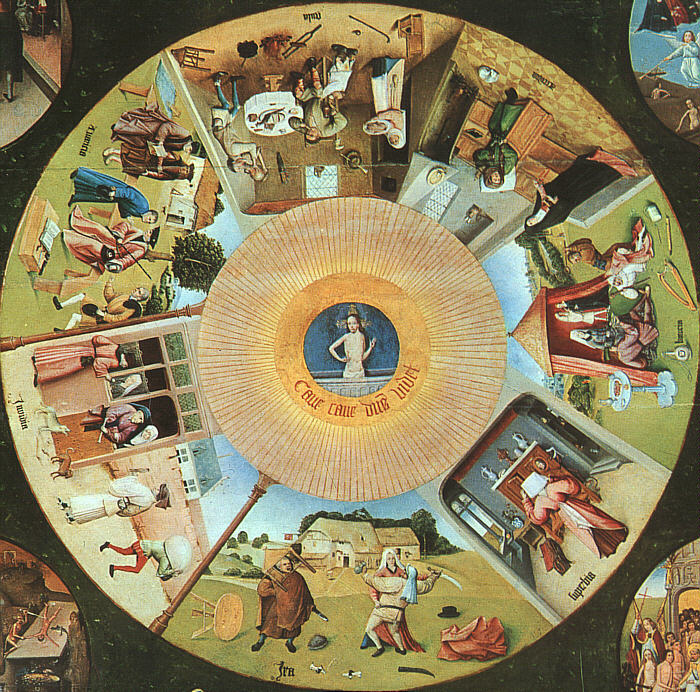
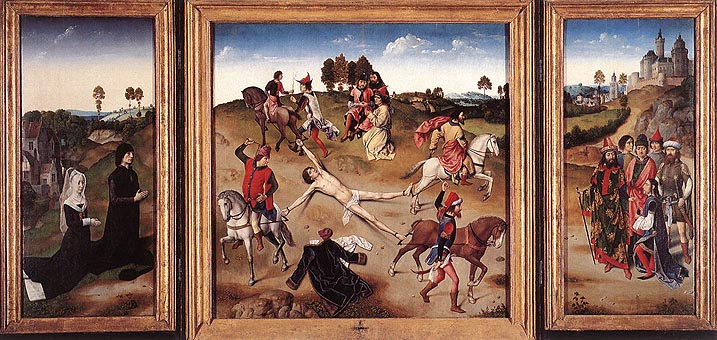
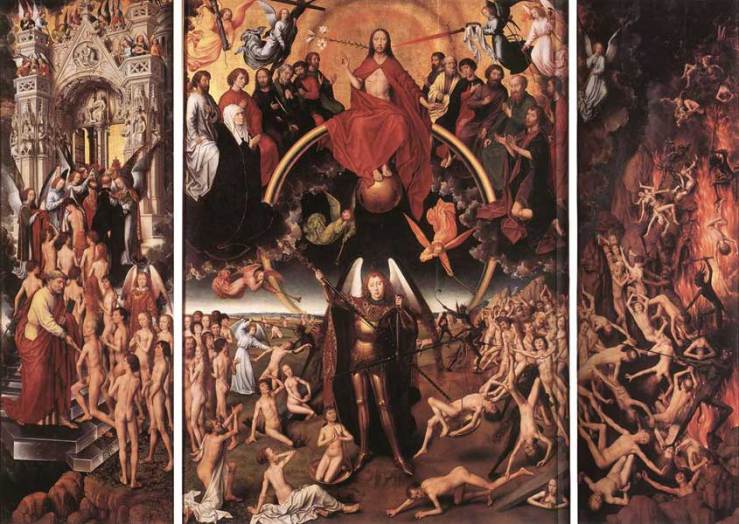
In William Gaddis‘s massive first novel, The Recognitions, Wyatt Gwyon forges paintings by master artists like Hieronymous Bosch, Hugo van der Goes, and Hans Memling. To be more accurate, Wyatt creates new paintings that perfectly replicate not just the style of the old masters, but also the spirit. After aging the pictures, he forges the artist’s signature, and at that point, the painting is no longer an original by Wyatt, but a “new” old original by a long-dead genius. The paintings of the particular artists that Wyatt counterfeits are instructive in understanding, or at least in hoping to understand how The Recognitions works. The paintings of Bosch, Memling, or Dierick Bouts function as highly-allusive tableaux, semiotic constructions that wed religion and mythology to art, genius, and a certain spectacular horror, and, as such, resist any hope of a complete and thorough analysis. Can you imagine, for example, trying to catalog and explain all of the discrete images in Bosch’s triptych, The Garden of Earthly Delights? And then, after creating such a catalog, explaining the intricate relationships between the different parts? You couldn’t, and Gaddis’s novel is the same way. I’ve finished the first of the novel’s three parts, 277 of 956 pages, and I’m going to go out on a limb and guess that the Gaddis has structured the novel as a triptych. The first part, like Bosch’s painting, The Seven Deadly Sins, is comprised of seven sections.
The Seven Deadly Sins – Hieronymous Bosch
Early in The Recognitions, teenage Wyatt copies The Seven Deadly Sins–his father owns the original, a painted table top he purchased in Europe. Wyatt replaces the original with his own and gets away with this strange crime–no small feat considering the genius of his father, the Rev. Gwyon, a New England priest who, after the death of his wife at sea, comes to reject the austere puritanism of his order and embrace (much to the consternation of his dwindling congregation) a pluralistic religious world view. In one of many stunning passages centering on Gwyon and religion, the congregation is “stirred with indignant discomfort after listening to the familiar story of virgin birth on December twenty-fifth, mutilation and resurrection, to find they had been attending, not Christ, but Bacchus, Osiris, Krishna, Buddha, Adonis, Marduk, Balder, Attis, Amphion, or Quetzalcoatl.” This series of substitutions enacts a chain of recognitions, and, in a sense, compartmentalizes much of the thematic material of the novel: What is it to be a hero, a redeemer, a savior? What is originality, and how does one recognize it? Who originates whom? What does it mean to create? How is art separate from religion? Clearly, these are not simple questions, and The Recognitions is not a simple book.
Triptych with the Martyrdom of St. Hippolytus — Dierck Bouts and Hugo van der Goes
In order to pose (and perhaps offer varying answers to) these questions, Gaddis employs daring, richly detailed prose, larded with esoteric (and not so esoteric) references to mythology, religion, art, music, and literature. Like the discrete sections of Bosch’s Sins, each of the chapters of the first section of The Recognitions has its own distinct idiom, comportment, and rhythm; yet, even as Gaddis’s approaches seem discontinuous from chapter to chapter, these coalesce to a larger picture.
The first chapter is the best first chapter of any book I can remember reading in recent years. It tells the story of Rev. Gwyon looking for solace in the Catholic monasteries of Spain after his wife’s death at sea under the clumsy hands of a fugitive counterfeiter posing as a doctor (already, the book posits the inherent dangers of forgery, even as it complicates those dangers by asking who isn’t in some sense a phony). There’s a beautiful line Gaddis treads in the first chapter between pain, despair, and melancholy and caustic humor, as Gwyon slowly realizes the false limits of his religion. The chapter continues to tell the story of young Wyatt, growing up under the stern care of his puritanical Aunt May, whose religious attitude is confounded by the increasingly erratic behavior of Wyatt’s often-absent father. While deathly ill, Wyatt teaches himself to paint by copying masterworks. He also attempts an original, a painting of his dead mother, but he cannot bear to finish it because, as he tells his father, “There’s something about . . . an unfinished piece of work . . . Where perfection is still possible. Because it’s there, it’s there all the time, all the time you work trying to uncover it.” This problem of originality, of Platonic perfection guides much of the novel’s critique on Modernism.
The Last Judgment – Hans Memling
Wyatt studies but ultimately rejects the ministry, opting instead to become an artist. The second chapter finds him in Paris, attempting to sell his original work. The chapter is a bravura shift into the sounds, sights, and consciousness of another world, another distinct mythology–ex-patriot Paris, Hemingway’s Paris, Woolf’s Paris. Gaddis shows a heavy debt to James Joyce‘s innovations in Ulysses here (and throughout the book, of course), although it would be a mistake to reduce the novel to a mere aping of that great work. Rather, The Recognitions seems to continue that High Modernist project, and, arguably, connect it to the (post)modern work of Pynchon, DeLillo, and David Foster Wallace. (In it’s heavy erudition, numerous allusions, and complex voices, the novel readily recalls both W.G. Sebald and Roberto Bolaño as far as I’m concerned). By the third chapter we find Wyatt married, quite unhappily, producing hack work, copies he lets his boss put his name on. The chapter is painful and often ugly, as we see his marriage disintegrate. In this chapter he meets Recktall Brown, the Mephistophelean business man who will arrange Wyatt’s future career as a counterfeiter of original paintings. As the chapter ends, Wyatt is no longer referred to by his name, a device that continues throughout the rest of part one (and perhaps the whole book). It’s as if he’s lost something intrinsic, some core originality in exchange for the ability to “become” the artist he is emulating. Wyatt now disintegrates into the background of the narrative, and is exchanged for a young Harvard grad named Otto. Otto follows Wyatt around like a puppy, writing down whatever he says, absorbing whatever he can from him, and eventually sleeping with his wife. Otto is the worst kind of poseur; he travels to Central America to finish his play only to lend the mediocre (at best) work some authenticity, or at least buzz. He fakes an injury and cultivates a wild appearance he hopes will give him artistic mystique among the Bohemian Greenwich Villagers he hopes to impress. In the fifth chapter, at an art-party, Otto, and the reader, learn quickly that no one cares about his play–everyone’s busy making their own original art. Gaddis’s evocation of a Village party in the late forties/early fifties here is wonderful, fly-on-the-wall stuff. His rhetoric captures the buzzing musicality of a raucous house party, and even if his mockery of the assembled artists, critics, and wannabes is savage, it’s also loving. Gaddis has an astute ear for the mid-twentieth century, where gossip infiltrates debate on aesthetics, and commercials punctuate classical scores on the radio.
Wyatt (unnamed) returns for the seventh (and longest) chapter of part one. He’s been very successful at his work, although he seems not to care at all for the money he’s making. Instead, he seems obsessed with channeling these ancient masters, for only in this pre-modern world is originality possible. Of course, the levels of irony are confounding here: Wyatt’s only access to originality is to pretend to be another person. The originality of the paintings he creates is subject to the condition that they be not original to him (their creator) but to another. While this attack on Modernity–namely, that originality is impossible–is severe, it’s also worth noting that Gaddis’s writing enacts originality, even as it cobbles together disparate sources. This is what makes the novel such an addictive pleasure to read. While I cannot make any final claims about a novel before finishing it, I will go out on another limb and suggest that those who already own this novel and have not yet made a crack at it for fear of its massive size and allusive structure should go ahead and take it up: it’s dark, erudite, sad, and very, very funny. It’s also not that hard to read, and if the allusions get too dense, there’s always Steven Moore‘s fantastic resource, A Reader’s Guide to William Gaddis’s The Recognitions, now available in its entirety online. Have at it. More when I finish Part II.
Australian director John Hillcoat’s movie adaptation of Cormac McCarthy‘s bleak and beautiful novel The Roadfinally has a proper trailer as well as (another) release date, October 16th, 2009. Here’s the trailer:
The trailer makes the movie look kinda “big”–explosions, way more people than I remember being in the novel, and what appears to be a heavily expanded role for the wife, played by Cherlize Theron. Still. I wanna see this. At the same time, the trailer seems to scream “Go read the book, now!” And you should. It’s great.






 Biblioklept