Reading Chris Ware’s Building Stories / Untitled Wordless Loop

20121109-140907.jpg

Continuing this project:

I’ve thus far titled the pieces I’ve been reading of Chris Ware’s Building Stories in a rather ad hoc fashion, but this entry is a wordless affair.

It continues the story of the “lonely girl,” the “cripple” who is the primary narrator of September 23rd, 2000.

Here, we see her raising her daughter in a series of wordless, precise panels that span roughly a decade.

Building Stories’s brilliance derives in large part from its precision and economy—Ware tells a story on every page, a chapter in every small panel:

20121109-140920.jpg

I’m a parent (my daughter is five, my son is two), and so much of this untitled piece struck me as utterly real and authentic—so true in the details.

There’s a moment when our mother looks up to see her daughter reading—silently, to herself—that is bittersweet, a kind of gentle heartbreak:

20121109-140926.jpg

There’s a fine line between the precise evocation of emotion and sentimental schlock, but Ware never comes close to treading it here—he’s always firmly on the side of the real.

And yet this doesn’t come at the expense of evocations of wonder, as we can see in the panels below:

20121109-140934.jpg

As I’ve suggested a few times already, Building Stories is a sort of  Möbius strip; this particular comic nearly literalizes this metaphor.

It begins with our mother drifting from sleep to waking memory, and ends thusly, a strange loop documenting how fast and how slow life changes.

Jared Yates Sexton’s An End to All Things (Book Acquired Sometime Last Month)

20121018-174605.jpg

Jared Yates Sexton’s An End to All Things immediately appealed to me when it arrived last month. This collection is stocked with short, precise, unpretentious stories. Great sentences—shades of Hannah, Carver, Pancake. I’ve read about half a dozen so far, parceling them out over spare afternoon minutes and it’s good stuff—feels real without the strains of literary realism. You can read a story at publisher Atticus Books’ site, “You Never Ask Me About My Dreams” (great title). The first few paragraphs:

At that point things had been rough for a couple of months and I would’ve done anything to ease the tension. I set an alarm for half an hour earlier than usual. I thought if I had some breakfast going when Cathy got up she’d have to see that I cared.

After all, cooking wasn’t the easiest thing to do in our house. Both of us hated dishes so the kitchen was always a mess. There were pots and pans stacked on the counters and plates in the sink. Some still had clumps of food stuck to them. I even had to rinse out a bowl to use. Somehow there were a couple of clean forks and knives in the drawer. I got some eggs from the fridge and went to work scrambling the yolks.

A Girl Reading — Pierre-Auguste Renoir

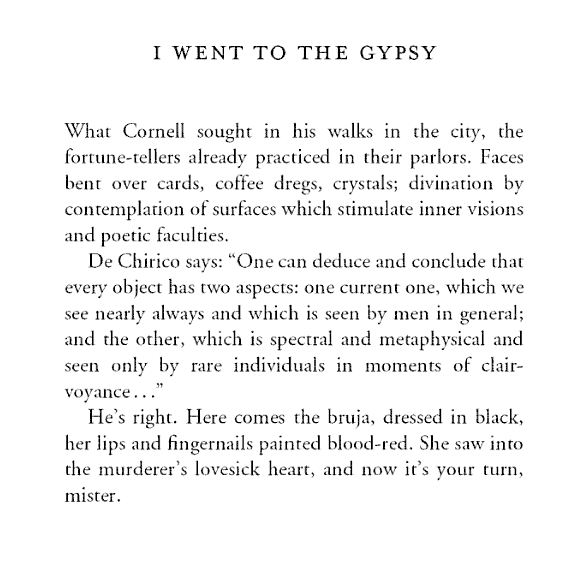
“I Went to the Gypsy” — Charles Simic

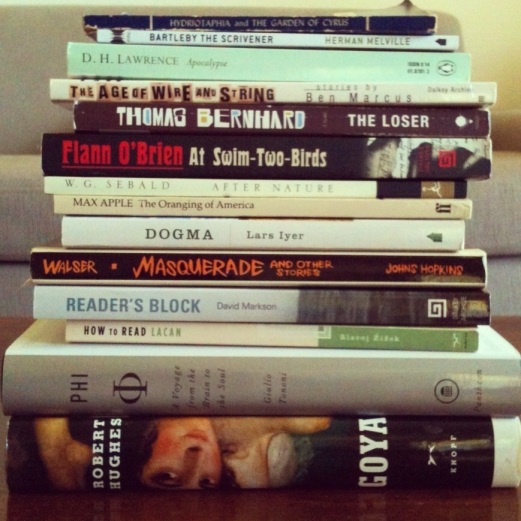
Books I’ve Read All or Most of in the Past Eight Months and Failed to Write About

20121108-160535.jpg

Sweet Doing Nothing — Auguste Toulmouche

Still Life with Drawing Board, Pipe, Onions and Sealing-Wax — Vincent van Gogh

“Of the PRESIDENT next you will hear me declare / That altho’ neither silver nor gold does he wear”

(More/via).

The Precious Book — Gwen John

Turin Spring — Giorgio de Chirico

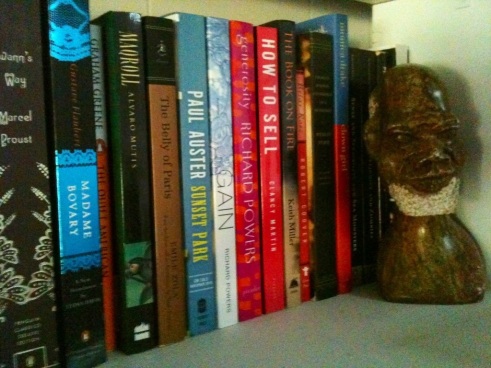
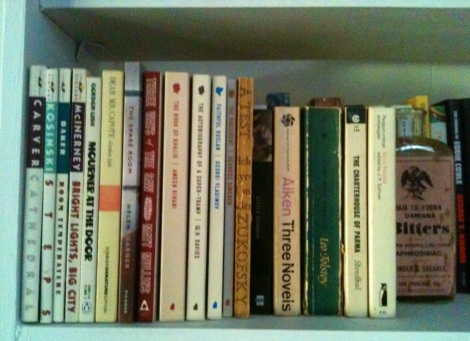
Book Shelves #45, 11.04.2012

20121103-171422.jpg

Book shelves series #45, forty-fifth Sunday of 2012

Yon shelf, murky, dim:

20121103-171436.jpg

Homeboy on the end, once my parents’,  tschotchke of time in ’80s South Africa, used to work as a bookend, now he just hangs out on this double-booked shelf.

20121103-171448.jpg

Front layer:

20121103-171458.jpg

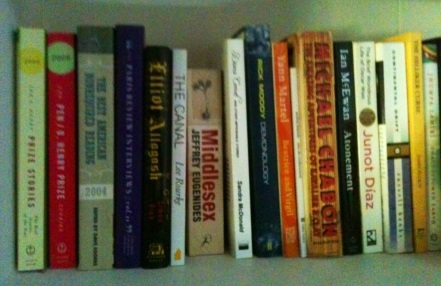
Back layer, including a number of volumes (to be clear: Chabon, Martel, Diaz, Eugenides) I should just trade in.

20121103-171526.jpg

(Also: I hate this project and wish I’d never started it).

Woman Reading — Mary Cassatt

D.T. Max Talks About His David Foster Wallace Biography

Reading — Henri Fantin-Latour

The Reader — Felicien Rops

The Maid with the Yellow Hair — Frederic Leighton

Adoration of the Moon — Max Weber