William Burroughs’ Nova Express (Book acquired sometime last week)

img_2863

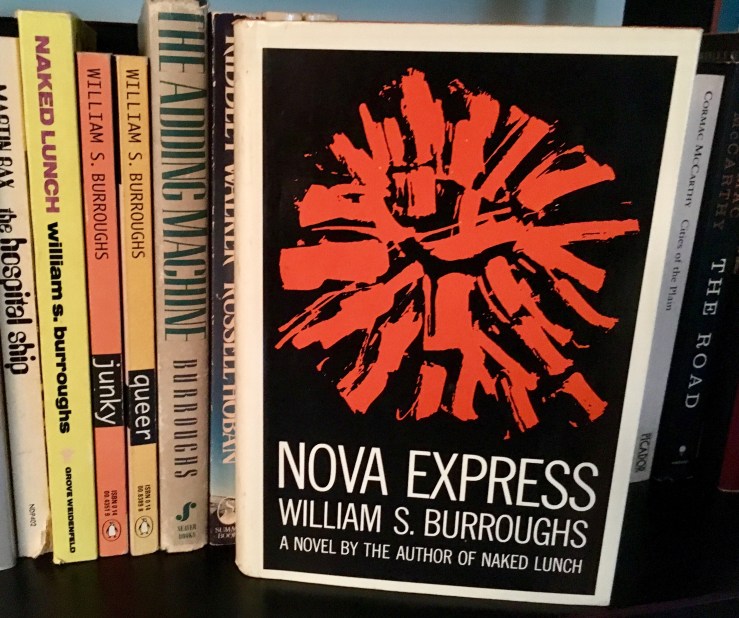
So I couldn’t pass up this first edition hardback Grove Press edition of William Burroughs’ 1964 novel Nova Express (with cover design by Grove Press stalwart Roy Kuhlman) that I found a few hot days ago, wandering decomposing stacks of pressed leaves here in North Florida. It ate up half of my credit at this particular used bookstore and yet was still cheaper than a new hardback NYT bestseller. Haven’t read the damn thing since college, and don’t own a copy so. Here’s the back cover with an author photo of Burroughs in which he looks like a goddamn baby (how did he live so long?):

img_2866

“[T]he greatest satirical writer since Jonathan Swift”! I’m sure Jack Kerouac wouldn’t like hyperbolize even a smidge. What was Burroughs satirizing? Like modernism, modern machine life, etc. Control, as in all Burroughs.

Biologic Agent K9 called for his check and picked up supersonic imitation blasts of The Death Dwarfs — “L’addition — Laddition — Laddittion — Garcon — Garcon — Garcon” — American tourist accent to the Nth power — He ordered another coffee and monitored the café — A whole table of them imitating word forms and spitting back at supersonic speed — Several patrons rolled on the floor in switch fits — These noxious dwarfs can spit out a whole newspaper in ten seconds imitating your words after you and sliding in suggestion insults — That is the entry gimmick of The Death Dwarfs: supersonic imitation and playback so you think it is your own voice — (do you own a voice?) they invade The Right Centers which are The Speech Centers and they are in the right — in the right — in thee write — “RIGHT” — “I’m in the right — in the right — You know I’m in the right so long as you hear me say inside your right centers ‘I am in the right’” — While Sex Dwarfs tenderize erogenous holes — So The Venusian Gook Rot flashed round the world —

Read the rest of the death dwarf routine.

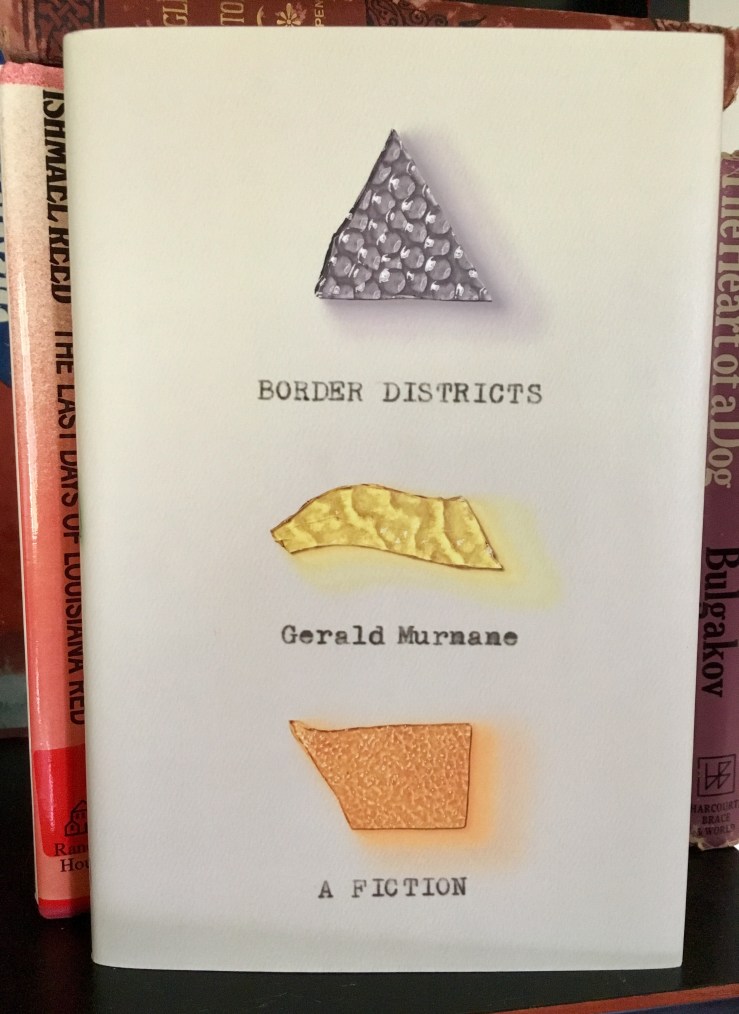
I consider myself a student of colours and shades and hues and tints (From Gerald Murnane’s Border Districts)

I consider myself a student of colours and shades and hues and tints. Crimson lake, burnt umber, ultramarine … I was too clumsy as a child to paint with my moistened brush the scenery that I would have liked to bring into being. I preferred to leave untouched in their white metallic surroundings my rows of powdery rectangles of water-colours, to read aloud one after another of the tiny printed names of the coloured rectangles, and to let each colour seem to soak into each word of its name or even into each syllable of each word of each name so that I could afterwards call to mind an exact shade or hue from an image of no more than black letters on a white ground.

Deep cadmium, geranium lake, imperial purple, parchment … after the last of our children had found employment and had moved out of our home, my wife and I were able to buy for ourselves things that had previously been beyond our means. I bought my first such luxury, as I called it, in a shop selling artists’ supplies. I bought there a complete set of coloured pencils made by a famous maker of pencils in England: a hundred and twenty pencils, each stamped with gold lettering along its side and having at its end a perfectly tapered wick. The collection of pencils is behind me as I write these words. It rests near the jars of glass marbles and the kaleidoscope mentioned earlier. None of the pencils has ever been used in the way that most pencils are used, but I have sometimes used the many-striped collection in order to confirm my suspicion as a child that each of what I called my long-lost moods might be recollected and, perhaps, preserved if only I could look again at the precise shade or hue that had become connected with the mood – that had absorbed, as it were, or had been permeated with, one or more of the indefinable qualities that constitute what is called a mood or a state of feeling. During the weeks since I first wrote in the earlier pages of this report about the windows in the church of white stone, I have spent every day an increasing amount of time in moving my pencils to and fro among the hollow spaces allotted to them in their container. I seem to recall that I tried sometimes, many years ago, to move my glass marbles from place to place on the carpet near my desk with the vague hope that some or another chance arrangement of them would restore to me some previously irretrievable mood. The marbles, however, were too variously coloured, and each differed too markedly from the other. Their colours seemed to vie, to compete. Or, a single marble might suggest more than I was in search of: a whole afternoon in my childhood or a row of trees in a backyard when I had wanted back only a certain few moments when my face was brushed by a certain few leaves. Among the pencils are many differing only subtly from their neighbours. Six at least I might have called simply red if I had not learned long ago their true names. With these six, and with still others from each side of them, I often arrange one after another of many possible sequences, hoping to see in the conjectured space between some or another unlikely pair a certain tint that I have wanted for long to see.

From Gerald Murnane’s 2018 novel Border Districts.

I failed as a reader of fiction (From Gerald Murnane’s Border Districts)

Whenever I tried long ago to learn from books about the workings of minds, I was equally troubled whether I read fiction or non-fiction. In the same way that I struggled and failed to follow plots and to comprehend the motives of characters, so did I struggle to follow arguments and to understand concepts. I failed as a reader of fiction because I was constantly engaged not with the seeming subject-matter of the text but with the doings of personages who appeared to me while I tried to read and with the scenery that appeared around them. My image-world was often only slightly connected with the text in front of my eyes; anyone privy to my seeming-sights might have supposed I was reading some barely recognisable variant of the text, a sort of apocrypha of the published work. As a reader of texts intended to explain the mind, I failed because the words and phrases in front of my eyes gave rise only to the poorest sort of image. Reading about our minds or the mind, and about purported instincts or aptitudes or faculties, not to mention such phantasms as ego, id, and archetype, I supposed the endless-seeming landscapes of my own thoughts and feelings must have been a paradise by comparison with the drab sites where others located their selves or their personalities or whatever they called their mental territories. And so, I decided long ago to take no further interest in the theoretical and to study instead the actual, which was for me the seeming-scenery behind everything I did or thought or read.

From Gerald Murnane’s 2018 novel Border Districts.

img_2844

Book Party — Jansson Stegner

903f24c59e384c0ba0376ba728674765

Book Party, 2016 by Jansson Stegner (b. 1972)

I guess it’s over (From Thomas Pynchon’s Vineland)

Mucho blinked sympathetically, a little sadly. “I guess it’s over. We’re on into a new world now, it’s the Nixon Years, then it’ll be the Reagan Years—”

“Ol’ Raygun? No way he’ll ever make president.”

“Just please go careful, Zoyd. ’Cause soon they’re gonna be coming after everything, not just drugs, but beer, cigarettes, sugar, salt, fat, you name it, anything that could remotely please any of your senses, because they need to control all that. And they will.”

“Fat Police?”

“Perfume Police. Tube Police. Music Police. Good Healthy Shit Police. Best to renounce everything now, get a head start.”

“Well I still wish it was back then, when you were the Count. Remember how the acid was? Remember that windowpane, down in Laguna that time? God, I knew then, I knew. . . .”

They had a look. “Uh-huh, me too. That you were never going to die. Ha! No wonder the State panicked. How are they supposed to control a population that knows it’ll never die? When that was always their last big chip, when they thought they had the power of life and death. But acid gave us the X-ray vision to see through that one, so of course they had to take it away from us.”

“Yeah, but they can’t take what happened, what we found out.”

“Easy. They just let us forget. Give us too much to process, fill up every minute, keep us distracted, it’s what the Tube is for, and though it kills me to say it, it’s what rock and roll is becoming—just another way to claim our attention, so that beautiful certainty we had starts to fade, and after a while they have us convinced all over again that we really are going to die. And they’ve got us again.” It was the way people used to talk.

“I’m not gonna forget,” Zoyd vowed, “fuck ’em. While we had it, we really had some fun.”

“And they never forgave us.” Mucho went to the stereo and put on The Best of Sam Cooke, volumes 1 and 2, and then they sat together and listened, both of them this time, to the sermon, one they knew and felt their hearts comforted by, though outside spread the lampless wastes, the unseen paybacks, the heartless power of the scabland garrison state the green free America of their childhoods even then was turning into.

An elegiac passage from Thomas Pynchon’s 1990 novel Vineland.

The spilled, the broken world (From Thomas Pynchon’s Vineland)

So the bad Ninjamobile swept along on the great Ventura, among Olympic visitors from everywhere who teemed all over the freeway system in midday densities till far into the night, shined-up, screaming black motorcades that could have carried any of several office seekers, cruisers heading for treed and more gently roaring boulevards, huge double and triple trailer rigs that loved to find Volkswagens laboring up grades and go sashaying around them gracefully and at gnat’s-ass tolerances, plus flirters, deserters, wimps and pimps, speeding like bullets, grinning like chimps, above the heads of TV watchers, lovers under the overpasses, movies at malls letting out, bright gas-station oases in pure fluorescent spill, canopied beneath the palm trees, soon wrapped, down the corridors of the surface streets, in nocturnal smog, the adobe air, the smell of distant fireworks, the spilled, the broken world.

A description of the postmodern Preterite world from Thomas Pynchon’s 1990 novel Vineland. 

Pynchon in Public Post, 2019

img_2774

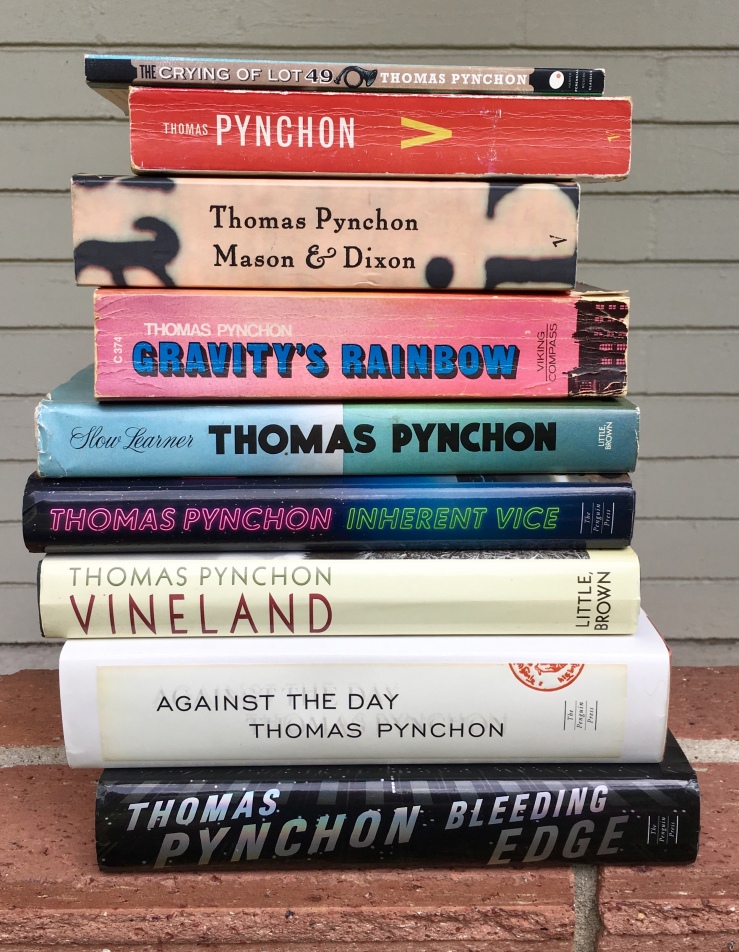
Today is the 82nd birthday of the American author Thomas Ruggles Pynchon, which a lot of jokers on the internet have turned into Pynchon in Public Day.

The spirit of Pynchon in Public Day is zany fun, and mostly centers around reading Pynchon’s works in public and spreading the muted post horn symbol from The Crying of Lot 49 around as much as possible. I am the last person in the world who will read a book in a coffee shop, but I did don my second 49 shirt today—-

66581c11-b06d-4dfe-89e3-0bc25fa0c64c

—and head to the bookstore to pick up the only Pynchon novel I don’t own, Bleeding Edge. More on that in second, but—no real recognition on the shirt today, although I’ve gotten some reactions to the other muted post horn shirt I own over the years, mostly from booksellers (not that interesting I know).

A few years ago though, wandering around downtown Los Angeles (wearing a muted post horn shirt), a stranger passing opposite me on the sidewalk hailed me with this question: “Are you the Trystero, guy?” At least that’s what I thought I said. I looked confused, asked, “What?” and he repeated — “Are you the Trystero guy?”

This particular moment struck me with a neat silly wave of minor paranoia, a Pynchonian moment, maybe—was this some kind of call sign for me to repeat, a password in a game of good fun? So I did the only thing that seemed sensible and replied, “Yes, I am the Trystero.”

The guy then proceeded to tell me that he loved my coffee. This confused me, so I told him that loved his coffee. Then he looked confused. After a few minutes on the hot July L.A. sidewalk we finally figured out a few things: He was referring to Trystero Coffee, which he showed me all about on his iPhone, and I was referring to The Crying of Lot 49, which he promised to read at the end of our exchange.

So anyway I went to the bookstore and picked up Bleeding Edge (and a few other books too, I admit). Along with Vineland, it’s the only Pynchon novel I haven’t read (despite two attempts on each). I’ll read Bleeding Edge before May 8th, 2020 though.

I started a retry of Vineland though. I had hoped to get past the farthest I remember going in—like the first 90 pages—before this post—-but I only made it through the first five chapters these past two days (through page 67). Still, I’d forgotten all about Ch. 5, the “Kahuna Airlines” chapter, which steers the book into new territory, and even though it still hasn’t hooked me yet (unlike the other Pynchons at this point), I’m starting to appreciate it for what I guess it is: Pynchon’s analysis of the eighties, of the absorption of the counterculture into culture, of nostalgia. The jokes are often hilarious and terrible, sometimes simultaneously. Pynchon sets up a Loony Tunes diner bit to deliver the execrable punchline, “Check’s in the mayo” for example. Pynchon names a lawn care company “The Marquis de Sod.” There’s a moment where protagonist Zoyd Wheeler pays for a ludicrous psychedelic party dress with “a check both he and the saleslady shared a premonition would end up taped to this very cash register after failing to clear,” a wonderful little throwaway line that shows Zoyd’s brokeassedness and empathy (and also highlights the Lebowski-Pynchon overlap, if you like). The line that’s cracked me up each time I’ve read it though is Zoyd’s daughter Prairie’s punker boyfriend being described as “the NBA-sized violence enthusiast who might or might not be fucking his daughter.” It’s just so dumb and poetic. I had also missed a few things — the night manager of Bodhi Dharma Pizza is named “Baba Havabananda,” a reference I’m thinking to Gravity’s Rainbow (“Have a banana”). There’s also a reference to the Vulcan hand salute, which shows up improbably in Pynchon’s next novel, Mason & Dixon (more on that here). And there’s the whole Bigfoot motif too, which Pynchon would echo in Inherent Vice, with Zoyd and Zuniga prefigurations of Doc Sportello and Bigfoot Bjornsen. And like every Pynchon novel, I’m sure I’ve already missed a ton of stuff.

Anyway, more on Vineland to come. In the meantime, if you haven’t read Pynchon–why not check him out?

Thomas Pynchon’s recipe for what is arguably the first British Pizza | A passage from Mason & Dixon

“Lud wishes to know,” Whike relays at last, “Mr. Emerson’s Cousin’s Views, upon the Structure of the World.”
“A Spheroid, the last I heard of it, Sir.”
“Ahr Ahr ahr, ’ahr ahhrr!”
“ ’And I say, ’tis Flat,’” the Jesuit smoothly translates. “Why of course, Sir, flat as you like, flat as a Funnel-Cake, flat as a Pizza, for all that,— ”
“Apologies, Sir,—” Whike all Unctuosity, “the foreign Word again, was . . . ?”
“The apology is mine,— Pizza being a Delicacy of Cheese, Bread, and Fish ubiquitous in the region ’round Mount Vesuvius. . . . In my Distraction, I have reach’d for the Word as the over-wrought Child for its Doll.”
“You are from Italy, then, sir?” inquires Ma.
“In my Youth I pass’d some profitable months there, Madam.”
“Do you recall by chance how it is they cook this ‘Pizza’? My Lads and Lasses grow weary of the same Daily Gruel and Haggis, so a Mother is ever upon the Lurk for any new Receipt.”
“Why, of course. If there be a risen Loaf about . . . ?”
Mrs. Brain reaches ’neath the Bar and comes up with a Brown Batch-Loaf, rising since Morning, which she presents to “Cousin Ambrose,” who begins to punch it out flat upon the Counter-Top. Lud, fascinated, offers to assault the Dough himself, quickly slapping it into a very thin Disk of remarkable Circularity.
“Excellent, Sir,” Maire beams, “I don’t suppose anyone has a Tomato?”
“A what?”
“Saw one at Darlington Fair, once,” nods Mr.”“Brain.
“No good, in that case,— eaten by now.”
“The one I saw, they might not have wanted to eat . . . ?”
Dixon, rummaging in his Surveyor’s Kit, has come up with the Bottle of Ketjap, that he now takes with him ev’rywhere. “This do?”
“That was a Torpedo, Husband.”
“That Elecktrickal Fish? Oh . . . then this thing he’s making isn’t elecktrical?”
“Tho’ there ought to be Fish, such as those styl’d by the Neopolitans, Cicinielli. . . .”
“Will Anchovy do?” Mrs. Brain indicates a Cask of West Channel ’Chovies from Devon, pickl’d in Brine.
“Capital. And Cheese?”
“That would be what’s left of the Stilton, from the Ploughman’s Lunch.”
“Very promising indeed,” Maire wringing his Hands to conceal their trembling. “Well then, let us just . . .”
By the Time what is arguably the first British Pizza is ready to come out of the Baking-Oven beside the Hearth, the Road outside has gone quiet and the Moorland dark, several Rounds have come and pass’d, and Lud is beginning to show signs of Apprehension. “At least ’tis cloudy tonight, no Moonlight’ll be getting thro’,” his Mother whispers to Mr. Emerson.”

From Thomas Pynchon’s novel Mason & Dixon.

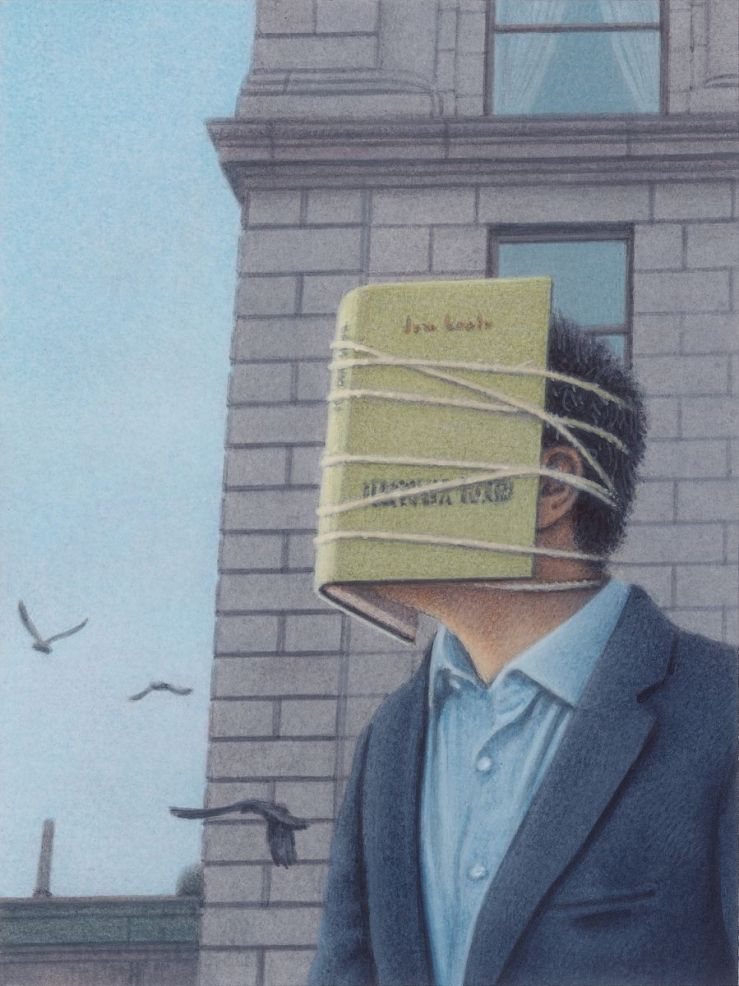
Boy with Book — Quint Buchholz 

quint-buchholz-boy-with-book-2013

Boy with Book, 2013 by Quint Buchholz (b. 1957)

Blog about acquiring some books (Books acquired, 3 May 2019)

img_2751

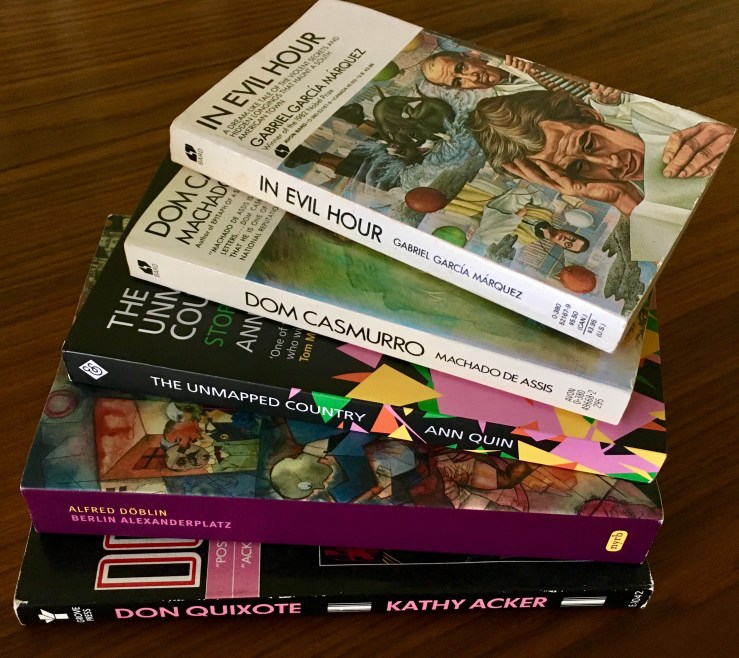
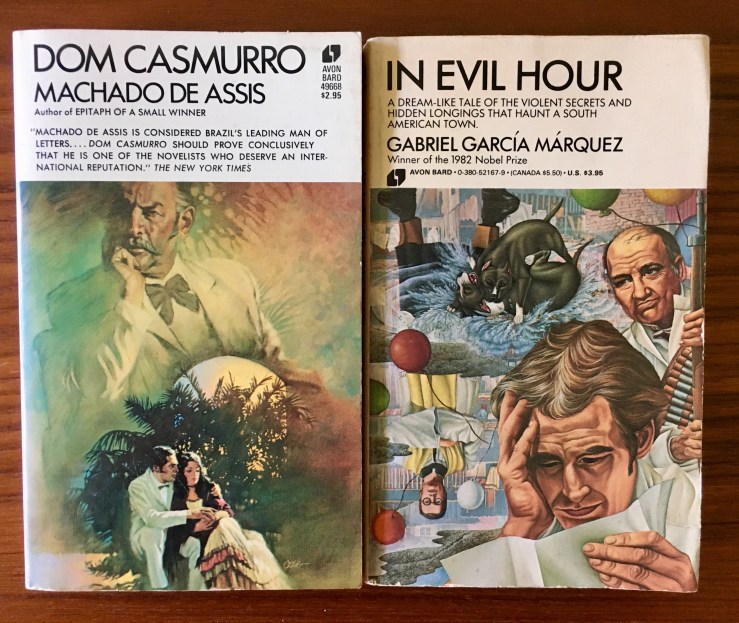
Yesterday marked both my wedding anniversary and the end of my spring semester, so I celebrated by spending a spare hour browsing my beloved used bookshop. I had dropped by last week to drop off a box of trade books—mostly old instructor editions of textbooks no longer in use—but I didn’t pick anything up. I did, however, snap a few photographs of the covers of the old 1980s Latin American authors series that Avon Bard put out. I love these covers, and have bought a few over the years.

I ended up picking up two yesterday: Gabriel Garcia Marquez’s In Evil Hour and Machado de Assis’s Dom Casmurro. The cover for Dom Casmurro is pretty bad, actually, but I want to read it.

img_2752

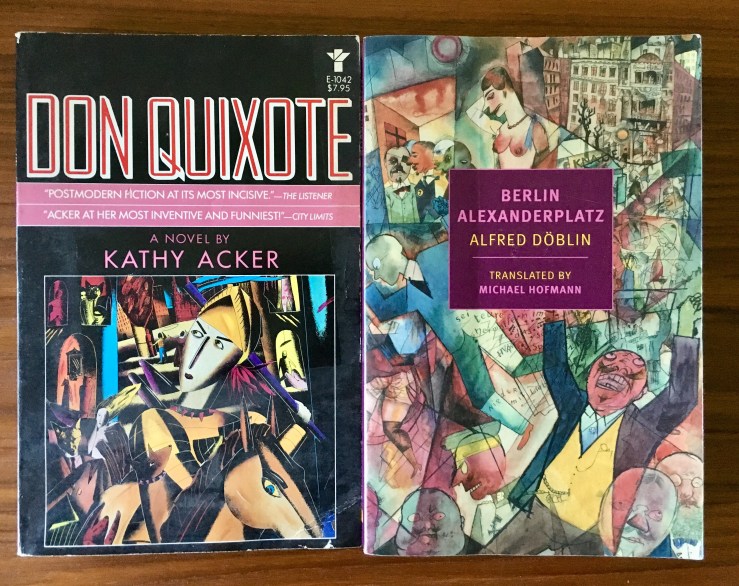
Near the Machado de Assis, I found a used copy of Berlin Alexanderplatz by Alfred Döblin, which I couldn’t resist. I also found a Grove edition of Kathy Acker’s Don Quixote, which I haven’t read since college.

img_2753

I also got a book in the mail. I loved Ann Quin’s novel Berg so much that I had to get more Quin, so I ordered The Unmapped Country from publisher And Other Stories. Very excited for this one.

img_2754

Problem with you Markson you’ve got no God damned fellow feeling in bosom (William Gaddis)

Problem with you Markson you’ve got no God damned fellow feeling in bosom, put yourself in the poor bastard’s place: like if your wife wrote a novel and the best agent in town declined to handle it, would you go around giving a free ride to the agent’s clients? I mean why the hell do you think some poor bastard wants to be a book calumnist in the first place.

–A 1975 letter from William Gaddis to David Markson. Collected in Letters of William Gaddis, edited by Steven Moore. Moore provides this context for Gaddis’s satirical letter:

When Christopher Lehmann-Haupt’s negative review of J R appeared in the daily New York Times on 30 October, Markson sent a postcard the same day to WG reading: “Dear Bill—Fuck Christopher Lehmann-Haupt!” (Lehmann-Haupt had also written a negative review of Markson’s Going Down five years earlier.) Gaddis’s reply, undated and without salutation, plays on a joke in J R whereby a foreigner takes literally a dictionary definition of “sympathy” (488–89)…

Man, Reading — Quint Buchholz

5ee93cc53ecf525917e9035bd1fe303a

Man, Reading (III), 2014 by Quint Buchholz (b. 1957)

Cigarette Bunnies 1 and 2 — Laurie Hogin

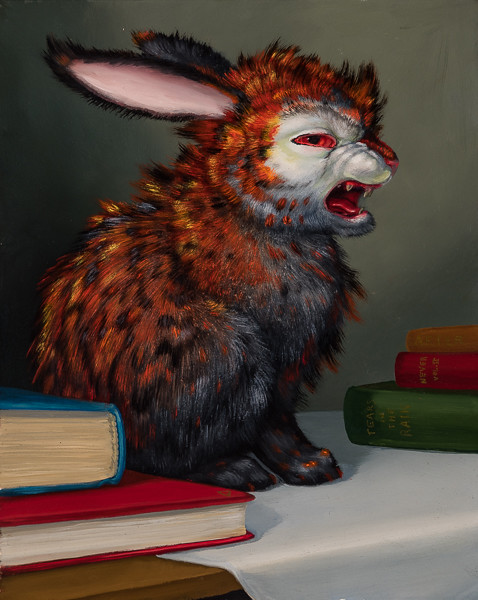
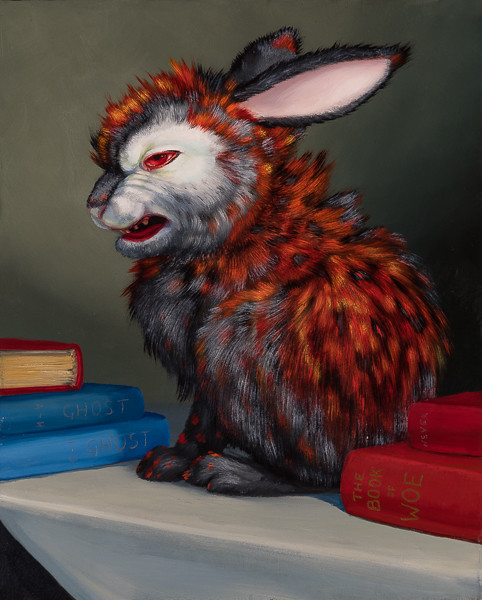
35442627762_717aa8934e_b35442627722_267d012529_b

Cigarette Bunnies 1 and Cigarette Bunnies 2, 2016 by Laurie Hogin (b. 1963)

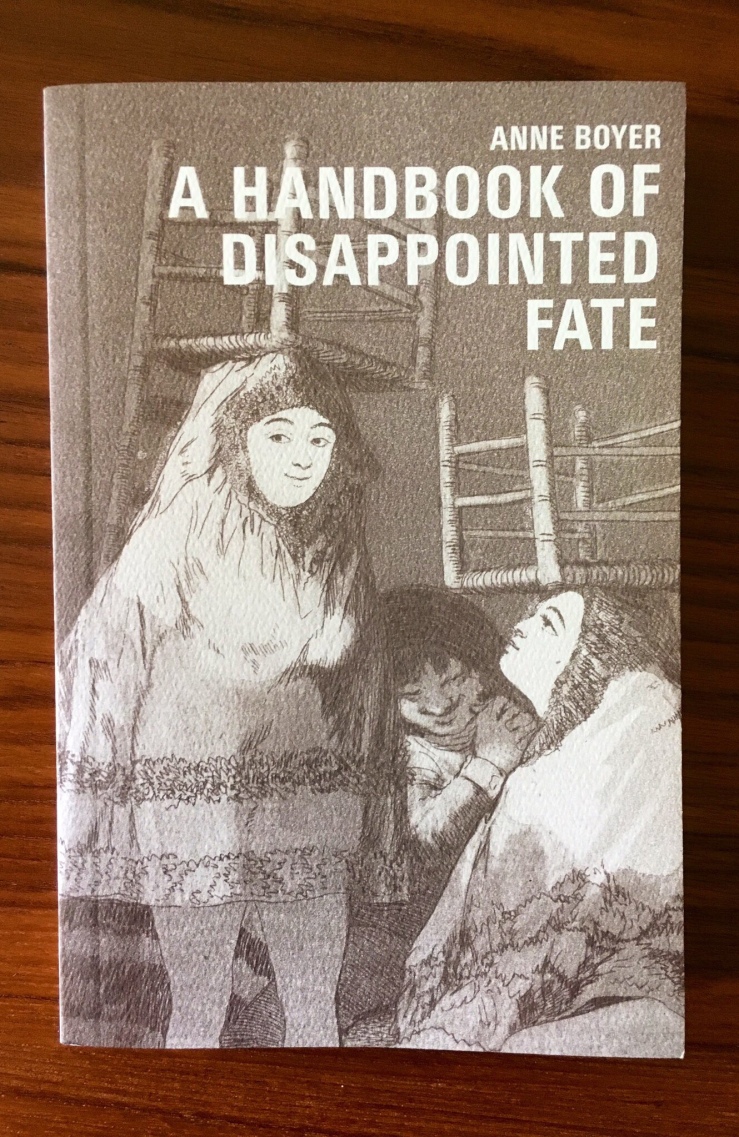
Anne Boyer’s A Handbook of Disappointed Fate (Book acquired, 8 April 2019)

img_2617

A tremendous thank you to to BLCKDGRD for sending me a copy of Anne Boyer’s strange discursive book of essays-poems-critiques-I-do-not-know-whats A Handbook of Disappointed Fates. It showed up in the mail unexpectedly, and I figured it might be from him (he posted excerpts last week). I’m really digging the book so far, although I haven’t been reading it in a straight line. I did start at the beginning though, which starts like this:

img_2624

(Bartleby prefers not to arrive in this essay on “No,” but it is nevertheless rather rich in its refusals).

Thanks to my friend again.

Blog about giving books away and buying books for a friend and acquiring some books for myself

img_2588

This morning my dean told me that I needed to pack up my office over the summer as the building I’m in will be undergoing a renovation. Even though I knew this was coming, the prospect hit me as a series of big anxiety waves. My walls are covered with masks, art, pictures. I have file drawers of student work going back over a decade. And books. Lots and lots of books. Books and art and stuff that I don’t really have room for anywhere else, even for a season.

Three shelves in my office are doublestacked with old mass market paperbacks from my youth—-Vonnegut, Edgar Rice Burroughs, Hemingway, Jack London, Philip K. Dick, Richard Adams, Stephen Crane, etc. Shabby books, well worn, glue splitting. Over the years I’ve acquired nicer versions of the ones I want to reread, but my sentimental attachment to this small library of paperbacks doesn’t quite fade. When I taught high school, they were the bulk of my classroom library. I insisted on their return, and was always disappointed in students who seemed interested in certain novels but never quite managed to steal them. I was always thrilled when a student would ask to borrow one “over the summer” and then forget to return it.

This sorry shabby mass-market library has been depleted over my past decade teaching community college. Every semester, a few students ask if they can borrow something they see on the shelves when they stop by to chat. It is the most wonderful feeling to give a young person a copy of Brave New World (“I’ve heard it’s good”) or Cat’s Cradle (“Is it as good as Slaughterhouse Five?”) of Studies in Classic American Literature and then insist that they keep it and not worry about returning it.

This morning, a young man approached me after class and told me he’d noticed I had a copy of Do Androids Dream Electric Sheep? in my office—could he maybe borrow it? He made a point of calling it Do Androids Dream Electric Sheep? and not Blade Runner, despite the fact that it’s a movie tie-in. He seemed so happy when I repeated that the book was his now.

Earlier that morning I gave another student my copy of Howard Zinn’s A People’s History of the United States. He’s taken a couple of classes with me, and based on our conversations and his writing, I thought he could us the book more than I could. Again—young kid so happy to get a book, to think that someone thought he should read a particular book—I recall the feeling so vividly, from the other side. I love watching the old library dwindle away. Maybe I can give away more before I have to pack it up again.

img_2578

After classes and office hours I swung by my beloved bookstore. I do this a lot on Fridays, in the spare hour that I have between work and picking up kids. I had a little mission this time—buying some books for a great old friend who turns forty this weekend. He loves hiking and camping and poetry—more than I love those things, I think—so I asked twitter to throw out some recommendations, which they did. I had fun browsing the “Nature” section. I ended up getting three: Tom Clark’s Fractured Karma (a favorite of mine), Gary Snyder’s Turtle Island (I had never heard of it until today), and Annie Dillard’s Teaching a Stone to Walk (I dug a few of the short essays I read in the store). I enjoyed buying books for my friend. I am almost 100% he never reads this blog so I’m sure my posting this will not spoil his present, and, if not, Happy Birthday.

While browsing the “Nature” section, I resisted Shelters Shacks and Shanties—for now. Apologies to D.C. Beard, whose hut diagrams are exquisite:

img_2575

I of course selfishly picked up books for myself, although I didn’t browse for myself. I keep a silly geeky list of names to check in on, including Robert Coover. Even though I’m slogging my way through his first novel, The Origin of the Brunists, I still have a desire to read its sequel, The Brunist Day of Wrath. No wrath, but I picked up Plume editions of Pricksongs & Descants (which I’ve read but didn’t own) and Gerald’s Party (which I haven’t read and now own). The editions match the copy of  The Universal Baseball AssociationInc., J. Henry Waugh, Prop. I picked last summer (and no I have not read goddamn it).

img_2589

I was also thrilled to pick up a 1974 Daw Paper edition of Wendayne Ackerman’s translation of Arkadi and Boris Strugatsky’s Hard to Be a God. I read Olena Bormashenko’s translation as an e-book a few years ago, after seeing Aleksei German’s film adaptation. (I loved Bormashenko’s translation of Snail on the Slope, by the way).

img_2577

This copy of Hard to Be a God, blurbed by Ursula K. Le Guin, will end up in a stack on my shelf of massmarket paperbacks, cheap pulp editions with colorful, zany, vibrant covers. Lovely unroughed, somehow pristine copies of Philip K. Dick and Stanislaw Lem and Ishmael Reed and Ursual K. Le Guin and J.G. Ballard and etcetera that’s been building up over the years, a private collection—but another library I’m sure I’ll eventually end up giving away.

Weissmann’s Tarot | Gravity’s Rainbow

img_4289-1

WEISSMANN’S TAROT

Weissmann’s Tarot is better than Slothrop’s. Here are the real cards, exactly as they came up.

Significator: Knight of Swords

Covered by: The Tower

Crossed by: Queen of Swords

Crowning: King of Cups

Beneath: Ace of Swords

Before: 4 of Cups

Behind: 4 of Pentacles

Self: Page of Pentacles

House: 8 of Cups

Hopes and Fears: 2 of Swords

What will come: The World

From page 746 of Gravity’s Rainbow. 

img_4301
A diagram of the Celtic cross spread that Pynchon uses for Blicero’s tarot. From A.E. Waite’s The Pictorial Key to the Tarot (1910). The tarot cards I’ve used in this post were illustrated by Pamela Colan Smith.

img_4292

He appears first with boots and insignia shining as the rider on a black horse, charging in a gallop neither he nor horse can control, across the heath over the giant grave-mounds, scattering the black-faced sheep, while dark stands of juniper move dreamily, death-loving, across his path in a parallax of unhurrying fatality, presiding as monuments do over the green and tan departure of summer, the dust-colored lowlands and at last the field-gray sea, a prairie of sea darkening to purple where the sunlight comes through, in great circles, spotlights on a dancing-floor.

He is the father you will never quite manage to kill. The Oedipal situation in the Zone these days is terrible. There is no dignity. The mothers have been masculinized to old worn moneybags of no sexual interest to anyone, and yet here are their sons, still trapped inside inertias of lust that are 40 years out of date. The fathers have no power today and never did, but because 40 years ago we could not kill them, we are condemned now to the same passivity, the same masochist fantasies they cherished in secret, and worse, we are condemned in our weakness to impersonate men of power our own infant children must hate, and wish to usurp the place of, and fail… . So generation after generation of men in love with pain and passivity serve out their time in the Zone, silent, redolent of faded sperm, terrified of dying, desperately addicted to the comforts others sell them, however useless, ugly or shallow, willing to have life defined for them by men whose only talent is for death.

img_4293

Of 77 cards that could have come up, Weissmann is “covered,” that is his present condition is set forth, by The Tower. It is a puzzling card, and everybody has a different story on it. It shows a bolt of lightning striking a tall phallic structure, and two figures, one wearing a crown, falling from it. Some read ejaculation, and leave it at that. Others see a Gnostic or Cathar symbol for the Church of Rome, and this is generalized to mean any System which cannot tolerate heresy: a system which, by its nature, must sooner or later fall. We know by now that it is also the Rocket.

Members of the Order of the Golden Dawn believe The Tower represents victory over splendor, and avenging force. As Goebbels, beyond all his professional verbalizing, believed in the Rocket as an avenger.

On the Kabbalist Tree of Life, the path of The Tower connects the sephira Netzach, victory, with Hod, glory or splendor. Hence the Golden Dawn interpretation. Netzach is fiery and emotional, Hod is watery and logical. On the body of God, these two Sephiroth are the thighs, the pillars of the Temple, resolving together in Yesod, the sex and excretory organs.

But each of the Sephiroth is also haunted by its proper demons or Qlippoth. Netzach by the Ghorab Tzerek, the Ravens of Death, and Hod by the Samael, the Poison of God. No one has asked the demons at either level, but there may be just the wee vulnerability here to a sensation of falling, the kind of very steep and out-of-scale fall we find in dreams, a falling more through space than among objects. Though the different Qlippoth can only work each his own sort of evil, activity on the path of The Tower, from Netzach to Hod, seems to’ve resulted in the emergence of a new kind of demon (what, a dialectical Tarot? Yes indeedyfoax! A-and if you don’t think there are Marxist-Leninist magicians around, well you better think again!). The Ravens of Death have now tasted of the Poison of God… but in doses small enough not to sicken but to bring on, like the Amanita muscaria, a very peculiar state of mind… . They have no official name, but they are the Rocket’s guardian demons.

img_4294

Weissmann is crossed by the Queen of his suit. Perhaps himself, in drag. She is the chief obstacle in his way.

img_4296

At his foundation is the single sword flaming inside the crown: again, Netzach, victory. In the American deck this card has come down to us as the ace of spades, which is a bit more sinister: you know the silence that falls on the room when it comes up, whatever the game.

img_4298

Behind him, moving out of his life as an influence, is the 4 or Four of Pentacles, which shows a figure of modest property desperately clutching on to what he owns, four gold coins—this feeb is holding two of them down with his feet, balancing another on his head and holding the fourth tightly against his stomach, which is ulcerous. It is the stationary witch trying to hold her candy house against the host of nibblers out there in the dark.

img_4299

Moving in, before him, comes a feast of cups, a satiety. Lotta booze and broads for Weissmann coming soon.

img_4300-4

Good for him—although in his house he is seen walking away, renouncing eight stacked gold chalices. Perhaps he is to be given only what he must walk away from.

img_4300-2

Perhaps it is because in the lees of the night’s last cup is the bitter presence of a woman sitting by a rocky shore, the Two of Swords, alone at the Baltic edge, blindfolded in the moonlight, holding the two blades crossed upon her breasts… the meaning is usually taken as “concord in a state of arms,” a good enough description of the Zone nowadays, and it describes his deepest hopes, or fears.

img_4300-3

Himself, as the World sees him: the scholarly young Page of Pentacles, meditating on his magic gold talisman. The Page may also be used to stand for a young girl. But Pentacles describe people of very dark complexion, and so the card almost certainly is Enzian as a young man. And Weissmann may at last, in this limited pasteboard way, have become what he first loved.

img_4295-1

The King of Cups, crowning his hopes, is the fair intellectual-king.

If you’re wondering where he’s gone, look among the successful academics, the Presidential advisers, the token intellectuals who sit on boards of directors. He is almost certainly there. Look high, not low.

img_4289

His future card, the card of what will come, is The World.

img_4289-1

The language in this post is from pages 746-49 of Thomas Pynchon’s novel Gravity’s Rainbow. Elements of this post found their way into some annotations I made a few years ago on page 539 of Gravity’s Rainbow.

Blog about starting Marlon James’s novel Black Leopard, Red Wolf (Book acquired, 23 March 2019)

img_2496

I was skeptical about Marlon James’s new novel Black Leopard, Red Wolf when it came out earlier this year in hardback. The novel had plenty of buzz and a big blurb from Neil Gaiman on the back—two things that often turn me off. I was also a bit skeptical about some of the novel’s marketing hype. James referred to his novel as an “African Game of Thrones,” and a lot of folks ran with that tag. James has since professed in an interview that this comparison was a joke.

A friend had read something about the book and texted me questions about it, so I thought, Hey, why not go to my favorite source of literary criticism: What did people who really hated this book have to say about it? And as usual, the one-star reviews at Amazon did not disappoint. Indeed, I was a bit optimistic about Black Leopard, Red Wolf after seeing this curve:

curve

Just look at that! Amazon stats for big publisher/big buzz books tend to be suspiciously positive, but here I saw a sign of something that intrigued me—a book that a lot of people either loved or hated. And some of those one-star reviews?

Filled with gratuitous and rampant cursing, sexuality, violence and brutality. Too much even for fans of dark fantasy. I could not finish it.

…Confusing, nasty, all-over-the-place, just plain LOST. Sorry, but this needs a particular kind of person to stomach or understand.

If you don’t mind being confused and unsure of the direction of a story, this book is for you. You must have patience to read this book. 

sounds like it was written by someone on hallucinogens.

I knew at this point I wouldn’t wait for the paperback.

If James’s comparing Black Leopard, Red Wolf to Game of Thrones was a joke, it’s a pretty good one, the kind of joke that could sell a lot of copies of his novel to fantasy fans who want a plot-driven tale. From the four baffling, surreal, vivid (and often lurid) chapters I’ve read so far, Black Leopard, Red Wolf isn’t really like Game of Thrones at all. There’s an opaqueness to James’s prose, a distancing effect to the language that alienates the reader in the most wonderful way. It’s all so terribly strange! Fans of plot-centric fantasy where the author explains and explicates what’s happening will likely be very quickly bothered by what James is doing here.

So far, Black Leopard, Red Wolf is first-person narrative of a man who may or may not be named Tracker, who is telling his story—or rather, manymany stories—to someone called Inquisitor (shades of One Thousand and One Nights?). These stories flow and roil into and out of each other. The minute James lets us find our bearings a bit, we’re out into new territory—one moment fighting “Omoluzu…Roof walkers” who seem to exist on a tangential plane to our own, and not long after running through a jungle of giant trees with a shapeshifting Leopard who leads us to a village of cursed children. Black Leopard, Red Wolf overflows with energy: the novel is kinetic, bright, and sharp, but also dark, eerie, and upsetting—it’s abject, puzzling, slippery. I love it so far.

The novel completely won me over on its tenth page, with this wild episode:

I kept walking until I came to an old woman by a river with a tall stick sitting at the banks. Her hair white at the sides, her head bald at the top. Her face had lines like paths in the forest and her yellow teeth meant her breath was foul. The stories say she rises each morning youthful and beautiful, blooms full and comely by midday, ages to a crone by nightfall, and dies at midnight to be born again the next hour. The hump in her back was higher than her head, but her eyes twinkled, so her mind was sharp. Fish swam right up to the point of the stick but never went beyond.

“Why have you come to this place?” she asked.

“This is the way to Monono,” I said.

“Why have you come to this place? A living man?”

“Life is love and I have no love left. Love has drained itself from me, and run to a river like this one.”

“It’s not love you have lost, but blood. I will let you pass. But when I lay with a man I live without dying for seventy moons.”

So I fucked the crone. She lay on her back by the bank, her feet in the river. She was nothing but bones and leather, but I was hard for her and full with vigor. Something was swimming between my legs that felt like fishes. Her hand touched my chest and my white clay stripes turned into waves around my heart. I thrust in and out of her, unnerved by her silence. In the dark I felt she was getting younger even though she was getting older. Flame spread inside me, spread to the tips of my fingers and the tip of me inside her. Air gathered around water, water gathered around air and I yelled, and pulled out, and rained on her belly, her arms, and her breasts. A shudder ran through me five times. She was still a crone, but I was not angry. She scooped my rain off her chest and flicked it off in the river. At once fish leapt up and dived in, leapt up again. This was a night when dark ate the moon, but the fishes had a light within them. The fishes had the head, arms, and breasts of women.

“Follow them,” she said.

I followed them through day and night, and day again. Sometimes the river was as low as my ankle. Sometimes the river was as high as my neck. Water washed all the white from my body, leaving just my face. The fish- women, womenfish, took me down the river for days and days and days until we came to a place I cannot describe. It was either a wall of river, which stood firm even though I could push my hand through it, or the river had bent itself downward and I could still walk, my feet touching the ground, my body standing without falling.

So the narrator ejaculates on a witch, she flicks his semen into a river, and the fish who eat it turn into mermaids who lead him to the land of the dead. There, he accomplishes on of the earliest quests in this very-questy novel. Instead of my describing the quest, I’ll point you instead to the publisher’s website–you can read the full first chapter there.

Did I mention that Black Leopard, Red Wolf has maps in it?  Black Leopard, Red Wolf has maps in it.

img_2497

More to come in the future. For now, I’m really digging the novel’s surreal, lurid thrusts into wild territory.