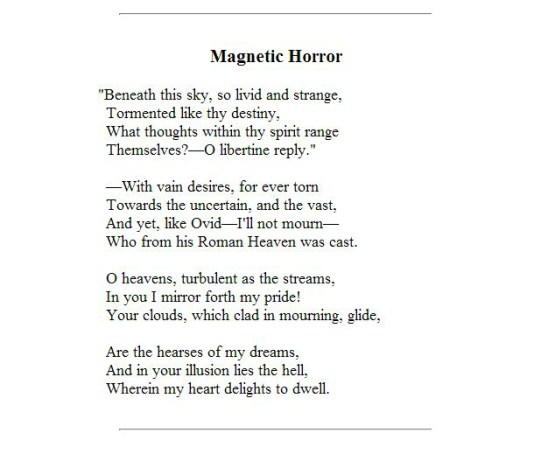
“Magnetic Horror” — Charles Baudelaire

mafg

“Beckett is a very blue man” (William H. Gass)

Remember how the desperate Molloy proceeds:

I took advantage of being at the seaside to lay in a store of sucking stones. They were pebbles but I call them stones I distrutibed them equally between my four pockets, and sucked them turn and turn about. This raised a problem which I first solved in the following way. I had say sixteen stones, four in each of my four pockets these being the two pockets of my trousers and the two pockets of my greatcoat. Taking a stone from the right pockct of my greatcoat, and putting it in mv mouth , I replaced it in the right pocket of my greatcoat bv a stone from the right pocket of my trousers, which I replaced by a stone from the left pocket of my trousers, which I replaced by a stone from the left pocket of my greatcoat, which I replaced by the stone which was in my mouth, as soon as I had fin-ished sucking it. Thus there were still four stones in each of my four pockets , but not quite the same stones…. But this solution did not satisfy me fully. For it did not escape me that, by an extraordinary hazard, the four stones circulating thus might always be the same four. In which case, far from sucking the sixteen stones turn and turn about, I was really only sucking four, always the same, turn and turn about.

Beckett is a very blue man, and this is a very blue passage.

From William H. Gass’s On Being Blue: A Philosophical Inquiry (and of course, Samuel Beckett’s Molloy).

Blue Girl Reading — Frederick C. Frieseke

blue girl

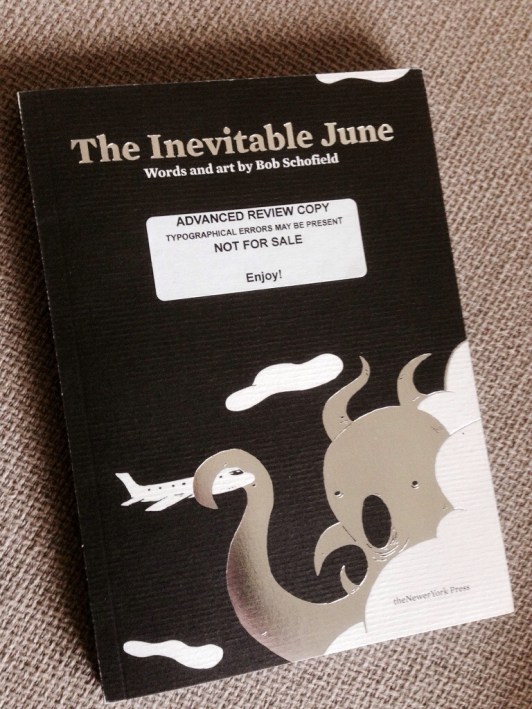
The Inevitable June (Book Acquired, 3.31.2014)

20140407-144637.jpg

20140407-160351.jpg

20140407-144655.jpg

20140407-160358.jpg

Portrait of Emile Zola — Edouard Manet

“Vermin is the rule everywhere in the world” (Schopenhauer)

No greater mistake can be made than to imagine that what has been written latest is always the more correct; that what is written later on is an improvement on what was written previously; and that every change means progress. Men who think and have correct judgment, and people who treat their subject earnestly, are all exceptions only. Vermin is the rule everywhere in the world: it is always at hand and busily engaged in trying to improve in its own way upon the mature deliberations of the thinkers. So that if a man wishes to improve himself in any subject he must guard against immediately seizing the newest books written upon it, in the assumption that science is always advancing and that the older books have been made use of in the compiling of the new. They have, it is true, been used; but how? The writer often does not thoroughly understand the old books; he will, at the same time, not use their exact words, so that the result is he spoils and bungles what has been said in a much better and clearer way by the old writers; since they wrote from their own lively knowledge of the subject. He often leaves out the best things they have written, their most striking elucidations of the matter, their happiest remarks, because he does not recognise their value or feel how pregnant they are. It is only what is stupid and shallow that appeals to him. An old and excellent book is frequently shelved for new and bad ones; which, written for the sake of money, wear a pretentious air and are much eulogised by the authors’ friends. In science, a man who wishes to distinguish himself brings something new to market; this frequently consists in his denouncing some principle that has been previously held as correct, so that he may establish a wrong one of his own. Sometimes his attempt is successful for a short time, when a return is made to the old and correct doctrine. These innovators are serious about nothing else in the world than their own priceless person, and it is this that they wish to make its mark. They bring this quickly about by beginning a paradox; the sterility of their own heads suggests their taking the path of negation; and truths that have long been recognised are now denied—for instance, the vital power, the sympathetic nervous system,generatio equivoca, Bichat’s distinction between the working of the passions and the working of intelligence, or they return to crass atomism, etc., etc. Hence the course of science is often retrogressive.

From Essays of Schopenhauer, translated by Rudolf Dircks.

Sunday Reading at a Country School — Nikolay Bogdanov-Belsky

Cuore (Portrait of Edmundo d’Amicis) — Eduardo Arroyo

Charles I Insulted by Cromwell’s Soldiers (Detail) — Paul Delaroche

“Once upon a time there was a forest” (Brian Wildsmith)

Brian Wildsmith

Robinson Crusoe and His Man Friday — John Charles Dollman

crusoe

The Readers — Alberto Magnelli

Riff on Not Writing

1. Let’s start with this: This is for me, this is not for you.

2. The above statement is not a very inviting invitation to the audience, is it? Sorry. Look. I have the Writer’s Block. The blockage. The being-stuckness. Etc.

3. Writer’s block, for me anyway, is not the inability to write. It’s more like some kind of inertia, some kind of anxiety, some little whisper of doom, hopelessness about the futility of shaping feelings into ideas and ideas into words. (That last phrase is, I believe, a paraphrase of Robert Frost’s definition of poetry).

4. Anyway, sometimes it’s best just to write—and write with the intention to make the writing public, to publish it (even on a blog!)—to put something (the publishing, that is) at stake.

5. (And so I’ve done this before).

6. I’ve read or audited nearly a dozen books this year that I’ve failed to write about on this site. Ostensibly, at some point, writing about books was like, the mission of Biblioklept, which maybe that mission has been swallowed  up by some other mission, some non-mission, some other goal or telos or whatever.

7. But you see there are some books I’ve read or audited that I really, really want to write about! (Sorry for this dithering but hey wait why am I apologizing I already said that this is for me this is not for you did I not?).

8. These books are:

Enormous Changes at the Last Minute by Grace Paley

Leaving the Sea by Ben Marcus

Every Day Is for the Thief by Teju Cole

Concrete by Thomas Bernhard

Middle C by William H. Gass

Save Me the Waltz by Zelda Fitzgerald

Goings in Thirteen Sittings by Gordon Lish

Not quite half a dozen books of poetry by Tom Clark

The majority of Donald Barthelme.

9. (I am also reading half a dozen books right now, even though I made a vow years ago not to do that).

10. A common theme to some of the books listed in point 8: The difficulty of words to mean, the toxic power of language, the breakdown of communication.

Continue reading “Riff on Not Writing” →

Interior with a Reading Lady — Vilhelm Hammershoi

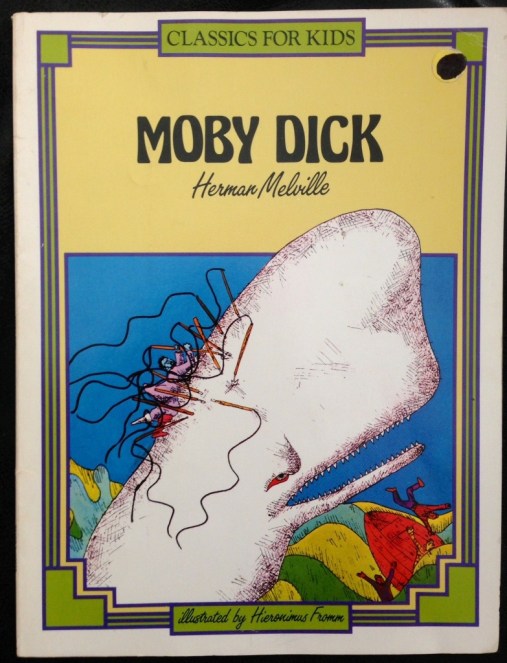
Another Moby-Dick (Book Acquired, 3.29.2014)

20140329-170830.jpg

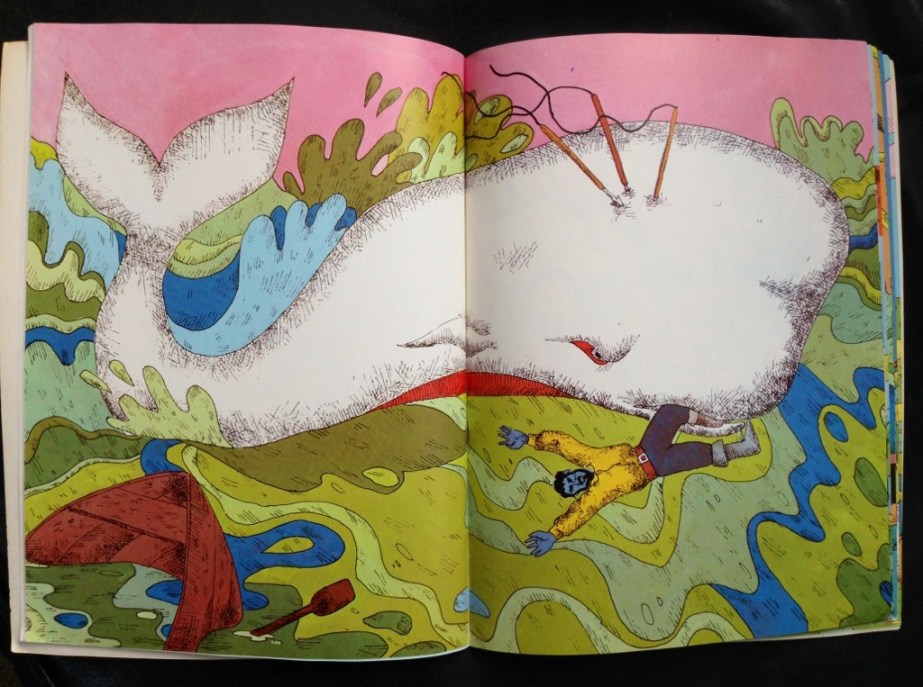
At the bookstore today with my youngest child, I couldn’t resist yet another copy of Moby-Dick, despite the many several editions already in our home.

Just love Hieronimus Fromm’s vivid illustrations here.

20140329-170846.jpg

20140329-170912.jpg

20140329-170928.jpg

Theory (Pessoa)

theory

Gottfried Keller — Valerio Adami