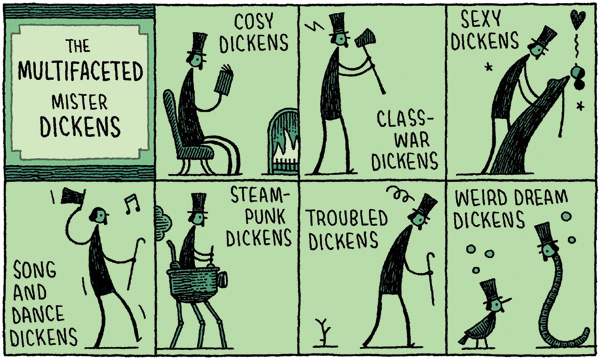
“The Multifaceted Mr. Dickens” — Tom Gauld

dickens(Via/more).

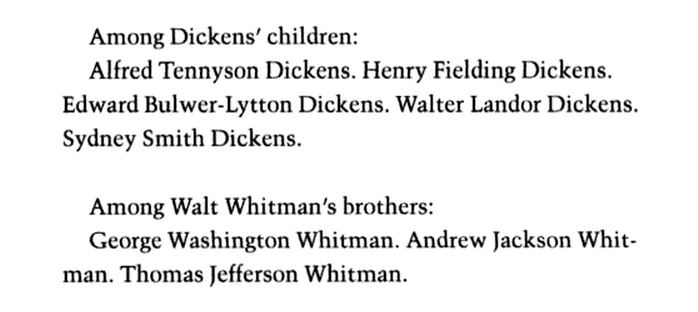
Dickens’ Children // Whitman’s Brothers — David Markson

Capture

Anthony Burgess (and Others) on Charles Dickens

Enjoy Thanksgiving with Our Literary Recipes Roundup

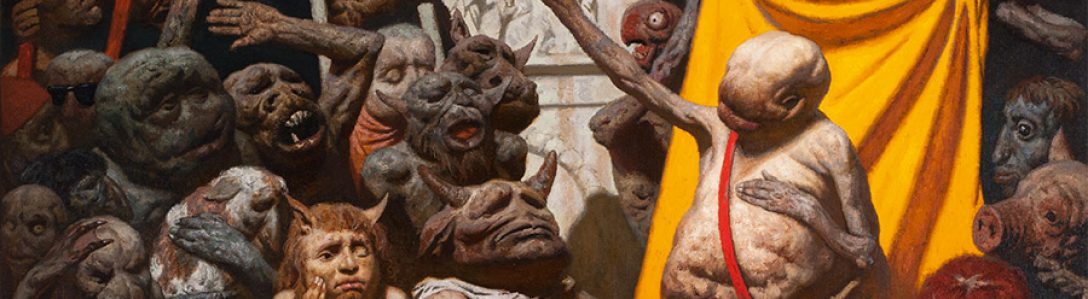
Fat Kitchen, Jan Steen

***

Enjoy Thanksgiving with our menu of literary recipes:

F. Scott Fitzgerald’s Turkey Twelve Ways

Zora Neale Hurston’s Mulatto Rice

Ian McEwan’s Fish Stew

James Joyce’s Burnt Kidney Breakfast

Herman Melville’s Whale Steaks

Ernest Hemingway’s Absinthe Cocktail, Death in the Afternoon

Vladimir Nabokov’s Eggs à la Nabocoque

Thomas Pynchon’s Banana Breakfast

Cormac McCarthy’s Turtle Soup

Robert Crumb’s Macaroni Casserole

Truman Capote’s Caviar-Smothered Baked Potatoes with 80-Proof Russian Vodka

Emily Dickinson’s Cocoanut Cake

Thomas Jefferson’s Vanilla Ice Cream

Charles Dickens’s Own Punch

Ben Jonson’s Egg Wine

Christmas Bonus:  George Orwell’s Recipes for Plum Cake and Christmas Pudding

Charles Dickens’s Own Punch

At Victorian Web, Philip V. Allingham shares a recipe for Charles Dickens’s punch:

“Charles Dickens’s Own Punch,” according to Brenda Marshall in The Charles Dickens Cookbook (1981), was that with which Mr. Micawber regales the eponymous youth in Chapter XXVIII of David Copperfield , the literary progeny with whom Dickens most closely identified himself. In an 1847 letter Dickens gave the following recipe for this second punch:

Peel into a very common basin (which may be broken in case of accident, without damage to the owner’s peace or pocket) the rinds of three lemons, cut very thin and with as little as possible of the white coating between the peel and the fruit, attached. Add a double handful of lump sugar (good measure [although Dickens had rather small hands]), a pint of good old rum, and a large wine-glass of good old brandy‹if it be not a large claret glass, say two. Set this on fire, by filling a warm silver spoon with the spirit, lighting the contents at a wax taper, and pouring them gently in. Let it burn three or four minutes at least, stirring it from time to time. Then extinguish it by covering the basin with a tray, which will immediately put out the flame. Then squeeze in the juice of the three lemons, and add a quart of boiling water. Stir the whole well, cover it up for five minutes, and stir again.

At this moment of crisis, the inimitable Boz suggests skimming off the lemon pips and doing some judicious sampling before one places the jug (sealed with leather on top) in a hot oven for ten minutes. However, the text’s editor proposes stove-top heating instead — “it could possibly alight in a modern oven.”


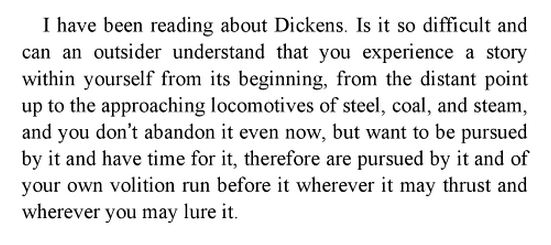
“I have been reading about Dickens” (Kafka)

(From Kafka’s Diaries).

Charles Dickens’s Walking Stick

(Via/about).

Charles Dickens’s Traveling Cutlery Kit

(Via the Library of Congress).

(An Incomplete) List of Ridiculous Names in Charles Dickens Novels

Abel Garland

Abel Magwich

Adolphus Tetterby

Alfred Jingle

Affery Flintwinch

Anne Chickenstalker

Anthony Jeddler

Augustus Snodgrass

Barnaby Rudge

Bayham Badger

Bazzard

Bella Wilfer

Bentley Drummle

Betsy Prig

Betsy Quilp

Betsy Trotwood

Brownlow

Bucket

Bumble

Caroline “Caddy” Jellyby

Charity Pecksniff 

Clara Peggotty

Cleopatra Skewton

Clickett

Cornelia Blimber

Canon Crisparkle

Charles Cheeryble

Chevy Slyme

Clarence Barnacle

Clarriker

Creakle

Dick Datchery

Dick Swiveller

Dolge Orlick

Duff

Durdles

Ebenezer Scrooge

Elijah Pogram

Ephraim Flintwinch

Fanny Cleaver

Fanny Squeers

Flora Finching

Fagin

Fezziwig

Fledgeby “Fascination”

Grace Jeddler

Gaffer Hexam

General Cyrus Choke

Grewgious

Helena Landless

Henrietta Boffin

Henrietta Petowker

Ham Peggotty

Hannibal Chollop

Harold Skimpole

Herbert Pocket

Isabella Wardle

Jemima Bilberry

Jerry Cruncher

Job Trotter

John Peerybingle

Josiah Bounderby

Kit Nubbles

Kenge

Krook

Lavinia Wilfer

Lucretia Tox

Luke Honeythunder

Malta Bagnet

Mercy Pecksniff 

Martin Chuzzlewit

M’Choakumchild

Mealy Potatoes

Mould

Ninetta Crummles

Nadgett

Nathaniel Winkle

Neckett

Nemo

Newman Noggs

Noddy Boffin

Oliver Twist

Peg Sliderskew

Pet Meagles

Pleasant Riderhood

Polly Toodle

Paul Sweedlepipe

Perker

Phil Squod

Prince Turveydrop

Pumblechook

Quinion

Ruth Pinch

Redlaw

Rogue Riderhood

Sairey Gamp

Sissy Jupe

Sophronia Lammle

Susan Nipper

Sleary

Sloppy

Slurk

Smalweed

Smike

Snagsby

Snawley

Stryver

Tartar

Theophile Gabelle

Toots

Trabb

Tulkinghorn

Tungay

Tattycoram

Uriah Heap

Vholes

Vincent Crummles

Volumnia Dedlock

Wackford Squeers

Zephaniah Scadde


The Life of Charles Dickens (BBC)

Italo Calvino on Charles Dickens

Italo Calvino on Charles Dickens’s last novel Our Mutual Friend. Essay from Why Read the Classics?:

The Thames at nightfall, dark and muddy, with the tide rising up the piers of the bridges: against this backdrop, which this year’s news stories have brought to our attention in the most lugubrious light, a boat approaches, almost touching the floating logs, barges and rubbish. At its prow stands a man staring with vulture-like eyes at the current as though looking for something; at the oars, half-hidden by the hood of her cheap cloak, is a girl with an angelic face. What are they looking for? We soon learn that the man recovers the corpses of suicides or murder victims who have been flung into the river: the waters of the Thames seem to contain every day a rich catch for this particular fisherman. As soon as he sees a corpse floating on the water’s surface, the man removes the gold coins from his pockets, and then drags him with a rope to a riverside police station, where he will receive a reward. The angelic girl, the daughter of the boatman, tries not to look at this macabre booty: she is terrified, but continues to row.

The openings of Dickens’ novels are often memorable, but none is better than the first chapter of Our Mutual Friend, the second last novel he wrote, and the last one he completed. Carried along on the corpse-fisher’s boat, we seem to enter the dark side of the world.

In the second chapter everything changes. We are now surrounded by characters out of a comedy of manners, attending a dinner-party at the house of parvenus where everyone pretends to be old friends but in fact they barely know each other. However, before the chapter ends the guests’ conversation suddenly turns to the mystery of a man who drowned just as he was about to inherit a vast fortune, and this takes us back to the suspense of the opening chapter.

Continue reading “Italo Calvino on Charles Dickens”

William Gibson: “Bleak House Is the Best Steampunk Landscape That Will Ever Be”

From The Paris Review interviewWilliam Gibson on on Charles Dickens’s Bleak House

INTERVIEWER

The Victorians invented science fiction.

GIBSON

I think the popular perception that we’re a lot like the Victorians is in large part correct. One way is that we’re all constantly in a state of ongoing t­echnoshock, without really being aware of it—it’s just become where we live. The Victorians were the first people to experience that, and I think it made them crazy in new ways. We’re still riding that wave of craziness. We’ve gotten so used to emergent technologies that we get anxious if we haven’t had one in a while.

But if you read the accounts of people who rode steam trains for the first time, for instance, they went a little crazy. They’d traveled fifteen miles an hour, and when they were writing the accounts afterward they struggled to describe that unthinkable speed and what this linear velocity does to a perspective as you’re looking forward. There was even a Victorian medical complaint called “railway spine.”

Emergent technologies were irreversibly altering their landscape. Bleak House is a quintessential Victorian text, but it is also probably the best steam­punk landscape that will ever be. Dickens really nailed it, especially in those proto-Ballardian passages in which everything in nature has been damaged by heavy industry. But there were relatively few voices like Dickens then. Most people thought the progress of industry was all very exciting. Only a few were saying, Hang on, we think the birds are dying.


In the Company of Strangers — We Review Barry McCrea’s New Book About Queer Family Ties in Dickens, Joyce, and Proust

Barry McCrea’s In the Company of Strangers: Family and Narrative in Dickens, Conan Doyle, Joyce, and Proust is one of the more engaging works of literary criticism I’ve seen in some time. And while I’m interested in McCrea’s subjects (the weird lines between the Victorian era and modernism, family and marriage plots, Dickens and Joyce, etc.), it’s the clarity of his writing that I find most impressive. Clear, frank writing is too rare in current literary criticism. Here’s McCrea describing his project—

This book argues that the formal innovations of the high-modernist novel are inseparable from a fundamental rethinking of how family ties are formed and sustained. Genealogy was thematically and structurally central to the English nineteenth-century novel. In the Company of  Strangers shows how the formal strategies employed by Joyce and Proust grow out of an attempt to build a fully coherent narrative system that is not rooted in the genealogical family. Modernism’s rejection of the familiar and cultivation of the strange, in other words, are inseparable from its abandonment of the family and embrace of the bond with the stranger as an alternative to it.

[In the Company of Strangers] offers a reassessment of the relationship between the modernists and their Victorian predecessors, suggesting that the key precursor to this queer model of narrative can be located, paradoxically, in the genealogical obsession of the English nineteenth-century novel. Far from representing a clean break with the Victorian family novel, the radical narrative formalism of high modernism exploits the potential of an alternative queer plot that was already present as a formal building block in the nineteenth-century novel.

McCrea’s queer theory lens is keenly attuned to the homoerotic content present in the novels he examines, but his critical gaze is ultimately more interested in how “queer time” functions as an organizing principle throughout the structure of these narratives. McCrea argues that this queer model of time is a central and defining characteristic of literary modernism. The agent (or one agent) of queer time is “the stranger,” the character who figuratively threatens (and paradoxically defines) the family. McCrea points out that the typical Victorian marriage plot resolves the problem of the stranger by incorporating him or her into the family as a point of narrative resolution. In contrast, in “the queer modernist narrative strategies of Ulysses and the Recherche, the stranger rivals and ultimately usurps the family plot.”

McCrea sifts through family plots (and the strangers who would challenge or queer them) in Dickens (Oliver Twist, Bleak House, Great Expectations), Arthur Conan Doyle’s Sherlock Holmes stories, Ulysses (“a queer family epic”), and Proust’s big book. In the Company of Strangers constantly scrutinizes the ways that family organizes narrative (and narrative organizes family). The book also analyzes what “urban literature” might mean, examining what it means to live in proximity to one’s fellows, and the ways in which urban living necessitate ad hoc families.

In the Company of Strangers does a lovely job of tracing the strange currents that run from Victorian lit to modernism and beyond—currents that extend from our conceptions of family itself, and indeed, our conceptions of life and an end to life. McCrea’s writing is precise, supported by a close textual readings, and if I didn’t always agree with his conclusions, he achieved what every critic ought to aim for: he made me want to read the books he was writing about again.

In the Company of Strangers is new from Columbia University Press.