“The Christmas Banquet” — Nathaniel Hawthorne

“The Christmas Banquet”

by

Nathaniel Hawthorne

from Mosses from an Old Manse


In a certain old gentleman’s last will and testament there appeared a bequest, which, as his final thought and deed, was singularly in keeping with a long life of melancholy eccentricity. He devised a considerable sum for establishing a fund, the interest of which was to be expended, annually forever, in preparing a Christmas Banquet for ten of the most miserable persons that could be found. It seemed not to be the testator’s purpose to make these half a score of sad hearts merry, but to provide that the stern or fierce expression of human discontent should not be drowned, even for that one holy and joyful day, amid the acclamations of festal gratitude which all Christendom sends up. And he desired, likewise, to perpetuate his own remonstrance against the earthly course of Providence, and his sad and sour dissent from those systems of religion or philosophy which either find sunshine in the world or draw it down from heaven.

The task of inviting the guests, or of selecting among such as might advance their claims to partake of this dismal hospitality, was confided to the two trustees or stewards of the fund. These gentlemen, like their deceased friend, were sombre humorists, who made it their principal occupation to number the sable threads in the web of human life, and drop all the golden ones out of the reckoning. They performed their present office with integrity and judgment. The aspect of the assembled company, on the day of the first festival, might not, it is true, have satisfied every beholder that these were especially the individuals, chosen forth from all the world, whose griefs were worthy to stand as indicators of the mass of human suffering. Yet, after due consideration, it could not be disputed that here was a variety of hopeless discomfort, which, if it sometimes arose from causes apparently inadequate, was thereby only the shrewder imputation against the nature and mechanism of life. Continue reading ““The Christmas Banquet” — Nathaniel Hawthorne”

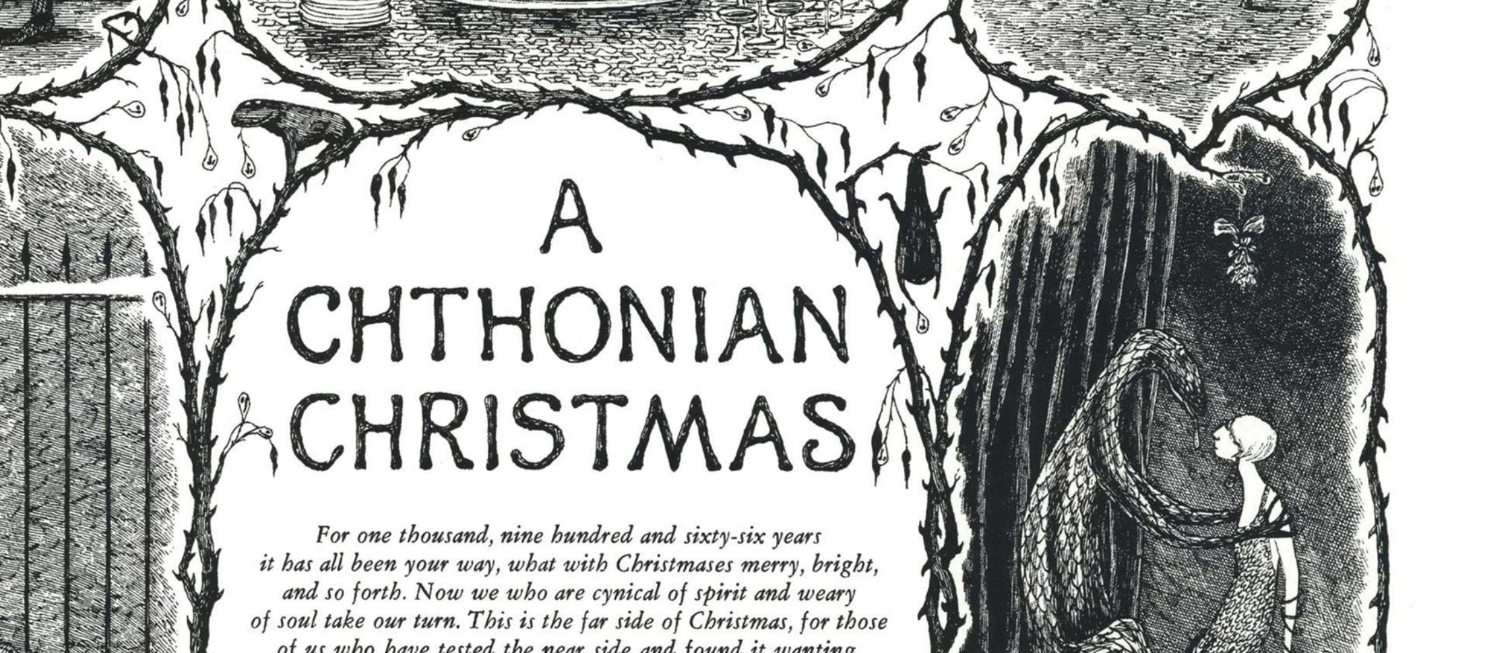
“A Chthonian Christmas” — Edward Gorey


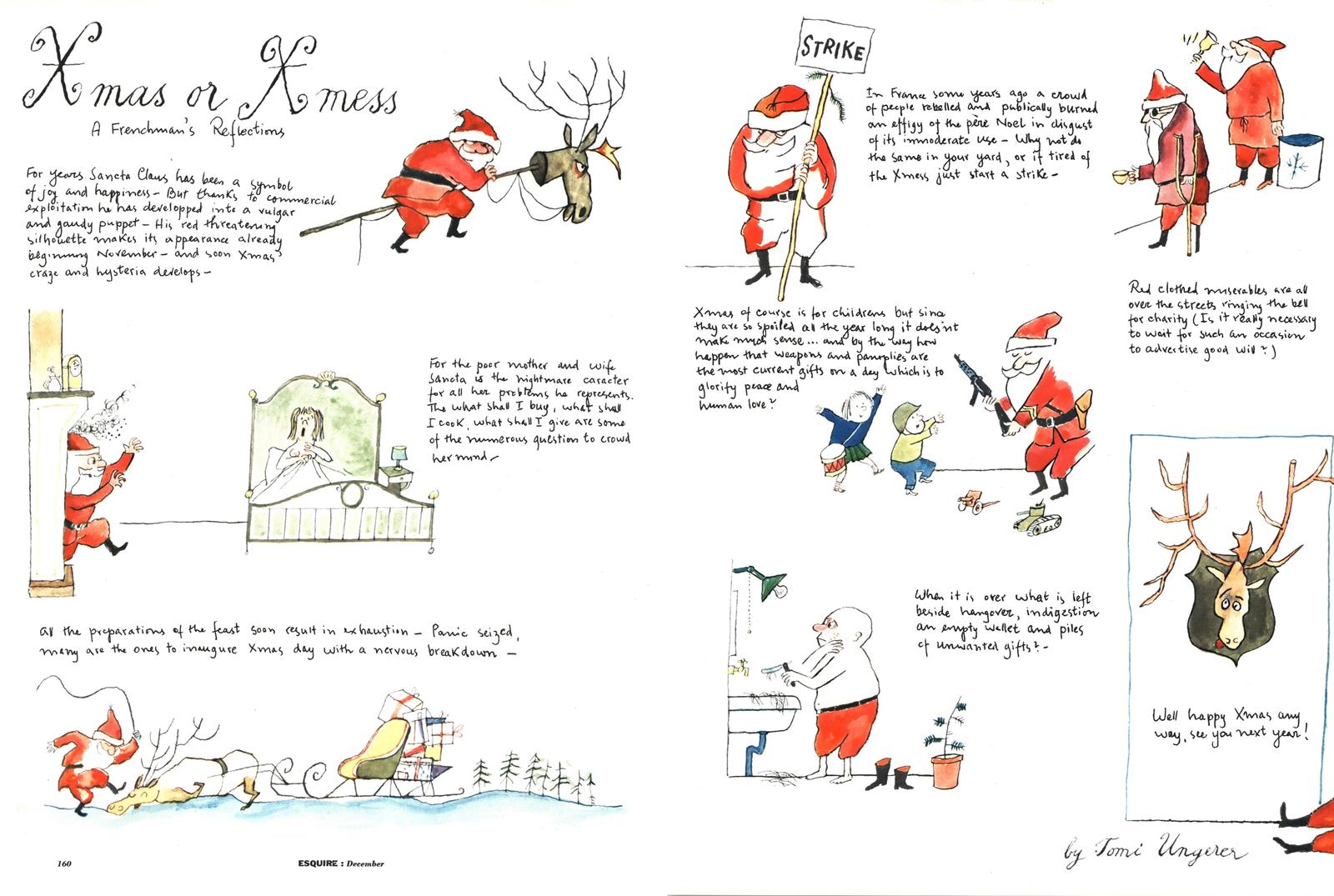
Xmas or Xmess — Tomi Ungerer

A comic by Tomi Ungerer, from the 1 Dec. 1958 issue of Esquire.

Read “Nackles,” Donald E. Westlake’s horror story about the Anti-Claus

“Nackles”

by

Donald E. Westlake


Did God create men, or does Man create gods? I don’t know, and if it hadn’t been for my rotten brother-in-law the question would never have come up. My late brother-in-law? Nackles knows.

It all depends, you see, like the chicken and the egg, on which came first. Did God exist before Man first thought of Him, or didn’t He? If not, if Man creates his gods, then it follows that Man must create the devils, too.

Nearly every god, you know, has his corresponding devil. Good and Evil. The polytheistic ancients, prolific in the creation (?) of gods and goddesses, always worked up nearly enough Evil ones to cancel out the Good, but not quite. The Greeks, those incredible supermen, combined Good and Evil in each of their gods. In Zoroaster, Ahura Mazda, being Good is ranged forever against the Evil one, Ahriman. And we ourselves know God and Satan.

But of course it’s entirely possible I have nothing to worry about. It all depends on whether Santa Claus is or is not a god. He certainly seems like a god. Consider: He is omniscient; he knows every action of every child, for good or evil. At least on Christmas Eve he is omnipresent, everywhere at once. He administers justice tempered with mercy. He is superhuman, or at least non-human, though conceived of as having a human shape. He is aided by a corps of assistants who do not have completely human shapes. He rewards Good and punishes Evil. And, most important, he is believed in utterly by several million people, most of them under the age of ten. Is there any qualification for godhood that Santa Claus does not possess?

And even the non-believers give him lip-service. He has surely taken over Christmas; his effigy is everywhere, but where are the manger and the Christ child? Retired rather forlornly to the nave. (Santa’s power is growing, too. Slowly but surely he is usurping Chanukah as well.)

Santa Claus is a god. He’s no less a god than Ahura Mazda, or Odin, or Zeus. Think of the white beard, the chariot pulled through the air by a breed of animal which doesn’t ordinarily fly, the prayers (requests for gifts) which are annually mailed to him and which so baffle the Post Office, the specially-garbed priests in all the department stores. And don’t gods reflect their creators’ society? The Greeks had a huntress goddess, and gods of agriculture and war and love. What else would we have but a god of giving, of merchandising, and of consumption? Secondary gods of earlier times have been stout, but surely Santa Claus is the first fat primary god.

And wherever there is a god, mustn’t there sooner or later be a devil?

Which brings me back to my brother-in-law, who’s to blame for whatever happens now. My brother-in-law Frank is – or was – a very mean and nasty man. Why I ever let him marry my sister I’ll never know. Why Susie wanted to marry him is an even greater mystery. I could just shrug and say Love is Blind, I suppose, but that wouldn’t explain how she fell in love with him in the first place.

Frank is – Frank was – I just don’t know what tense to use. The present, hopefully. Frank is a very handsome man in his way, big and brawny, full of vitality. A football player; hero in college and defensive line-backer for three years in pro ball, till he did some sort of irreparable damage to his left knee, which gave him a limp and forced him to find some other way to make a living.

Ex-football players tend to become insurance salesmen; I don’t know why. Frank followed the form, and became and insurance salesman. Because Susie was then a secretary for the same company, they soon became acquainted.

Was Susie dazzled by the ex-hero, so big and handsome? She’s never been the type to dazzle easily, but we can never fully know what goes on inside the mind of another human being. For whatever reason, she decided she was in love with him.

So they were married, and five weeks later he gave her her first black eye. And the last, though it mightn’t have been, since Susie tried to keep me from finding out. I was to go over for dinner that night, but at eleven in the morning she called the auto showroom where I work, to tell me she had a headache and we’d have to postpone the dinner. But she sounded so upset that I knew immediately something was wrong, so I took a demonstration car and drove over, and when she opened the front door there was the shiner.

I got the story out of her slowly, in fits and starts. Frank, it seemed, had a terrible temper. She wanted to excuse him because he was forced to be an insurance salesman when he really wanted to be out there on the gridiron again, but I want to be President and I’m an automobile salesman and I don’t go around giving women black eyes. So I decided it was up to me to let Frank know he wasn’t to vent his pique on my sister any more.

Unfortunately, I am five feet seven inches tall and weigh one hundred thirty-four pounds, with the Sunday Times under my arm. Were I just to give Frank a piece of my mind, he’d surely give me a black eye to go with my sister’s. Therefore, that afternoon I bought a regulation baseball bat, and carried it with me when I went to see Frank that night.

He opened the door himself and snarled, “What do you want?”

In answer, I poked him with the end of the bat, just above the belt, to knock the wind out of him. Then, having unethically gained the upper hand, I clouted him five or six times more, and then stood over him to say, “The next time you hit my sister I won’t let you off so easy.” After which I took Susie home to my place for dinner.

And after which I was Frank’s best friend.

People like that are so impossible to understand. Until the baseball bat episode, Frank had nothing for me but undisguised contempt. But once I’d knocked the stuffing out of him, he was my comrade for life. And I’m sure it was sincere; he would have given me the shirt off his back, had I wanted it, which I didn’t.

(Also, by the way, he never hit Susie again. He still had the bad temper, but he took it out on throwing furniture out windows or punching dents in walls or going downtown to start a brawl in some bar. I offered to train him out of maltreating the house and furniture as I had trained him out of maltreating his wife, but Susie said no, that Frank had to let off steam and it would be worse if he was forced to bottle it all up inside him, so the baseball bat remained in retirement.)

Then came the children, three of them in as many years. Frank Junior came first, and then Linda Joyce, and finally Stewart. Susie had held the forlorn hope that fatherhood would settle Frank to some extent, but quite the reverse was true. Shrieking babies, smelly diapers, disrupted sleep, and distracted wives are trials and tribulations to any man, but to Frank they were – like everything else in his life – the last straw.

He became, in a word, worse. Susie restrained him I don’t know how often from doing some severe damage to a squalling infant, and as the children grew toward the age of reason Frank’s expressed attitude toward them was that their best move would be to find a way to become invisible. The children, of course, didn’t like him very much, but then who did? Continue reading “Read “Nackles,” Donald E. Westlake’s horror story about the Anti-Claus”

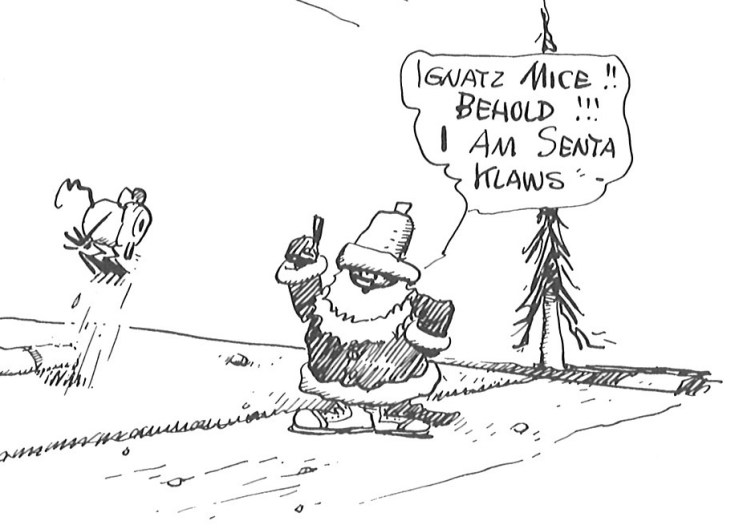
Behold!!! I am Senta Klaws (George Herriman)

Santa-Kat-1

(Via/more).

“A Little Girl’s Xmas in Moderan” — David R. Bunch

img_1036

“”A Little Girl’s Xmas in Moderan”

by

David R. Bunch

from Moderan


IT WAS in Jingle-Bell weather that Little Sister came across the white yard, the snow between her toes all gray and packed and starting to ball up like the beginnings of two snowmen. For clothing she had nothing, her tiny rump sticking out red-cold, and blue-cold, and her little-jewel knees white almost as bones. She stuck up ten stiff fingers, and she said, “Daddy! Something is wrong at my place! Come see!” She lisped a little perhaps and did not say it all as precisely as grownups, because she was just past four.

He turned like a man in the bottom third of bad dreaming; he pointed two bored eyes at her. Damn the kid, he thought. “What the hell deal has Mox got us into now?” he said. And he sang the little rhyme that made the door come open. Then as she stepped toward him he saw the snowballs on her feet. They were melting now, making deep furrows in the green rug spread across his spacious thinking room. The tall nap, like flooded grass now along little canals bending away from her feet, was speckled white here and there with crumpled paper balls. His trial plans and formulas peeped out like golf balls.

Coming back across the iron fields of nightmare that always rose to confront him at such times, he struggled to make the present’s puzzling moment into sense. Damn the kid, he thought, didn’t wipe her feet. All flesh, as yet—her own—and bone and blood, and didn’t wipe her feet. The snow melts!

He motioned her to him. “Little Sister,” he began in that tired dull-tinny voice that was his now, and must be his, because his larynx was worked all in gold against cancer, “tell me slowly, Little Sister. Why don’t you stay in your plastic place more? Why don’t you use the iron Mox more? Why do you bother me at all? Tell me slowly.”

“Daddy!” she cried and started to jig up and down in the fits that he hated so, “come over to my place, you old boogie. Something needs fixing.”

So they went across the big white yard to her place, past Mother’s place, past Little Brother’s place, with her snow-hurt limping and naked, and him lumbering in strange stiff-jointedness, but snug in a fire-red snuggie suit of fine insulation with good black leather space high-tops. Arrived at her place he whistled at the door the three sharp notes. The door moved into the wall and Mox the iron one stood sliding the iron sections of his arms up into one another until he had only hands hanging from shoulders. It was his greeting way. He ogled with bulb eyes and flashed his greeting code. Continue reading ““A Little Girl’s Xmas in Moderan” — David R. Bunch”

Christmas — Alexander Aksinin

Christmas, 1983 by Alexander Aksinin (1949–1985)

It Is December and Already Dark Forces Are Gathering — Glen Baxter

To escape the insidious commercial excesses of Christmas (Glen Baxter)

f808a93d773c76507943e1eaee91ebe6-christmas-humor-merry-christmas

Read “Mamsell Fredrika,” a haunted Christmas tale by Selma Lagerlöf

“Mamsell Fredrika”

by

Selma Lagerlöf

translated by

Pauline Bancroft Flach


It was Christmas night, a real Christmas night.

The goblins raised the mountain roofs on lofty gold pillars and celebrated the midwinter festival. The brownies danced around the Christmas porridge in new red caps. Old gods wandered about the heavens in gray storm cloaks, and in the Österhaninge graveyard stood the horse of Hel. He pawed with his hoof on the frozen ground; he was marking out the place for a new grave.

Not very far away, at the old manor of Årsta, Mamsell Fredrika was lying asleep. Årsta is, as every one knows, an old haunted castle, but Mamsell Fredrika slept a calm, quiet sleep. She was old now and tired out after many weary days of work and many long journeys,— she had almost traveled round the world,—therefore she had returned to the home of her childhood to find rest.

Outside the castle sounded in the night a bold fanfare. Death mounted on a gray charger had ridden up to the castle gate. His wide scarlet cloak and his hat’s proud plumes fluttered in the night wind. The stern knight sought to win an adoring heart, therefore he appeared in unusual magnificence. It is of no avail, Sir Knight, of no avail! The gate is closed, and the lady of your heart asleep. You must seek a better occasion and a more suitable hour. Watch for her when she goes to early mass, stern Sir Knight, watch for her on the church-road! Continue reading “Read “Mamsell Fredrika,” a haunted Christmas tale by Selma Lagerlöf”

“Scrooge” — Kate Beaton

A Mason & Dixon Christmastide | Thomas Pynchon

They discharge the Hands and leave off for the Winter. At Christmastide, the Tavern down the Road from Harlands’ opens its doors, and soon ev’ryone has come inside. Candles beam ev’rywhere. The Surveyors, knowing this year they’ll soon again be heading off in different Directions into America, stand nodding at each other across a Punch-bowl as big as a Bathing-Tub. The Punch is a secret Receipt of the Landlord, including but not limited to peach brandy, locally distill’d Whiskey, and milk. A raft of long Icicles broken from the Eaves floats upon the pale contents of the great rustick Monteith. Everyone’s been exchanging gifts. Somewhere in the coming and going one of the Children is learning to play a metal whistle. Best gowns rustle along the board walls. Adults hold Babies aloft, exclaiming, “The little Sausage!” and pretending to eat them. There are popp’d Corn, green Tomato Mince Pies, pickl’d Oysters, Chestnut Soup, and Kidney Pudding. Mason gives Dixon a Hat, with a metallick Aqua Feather, which Dixon is wearing. Dixon gives Mason a Claret Jug of silver, crafted in Philadelphia. There are Conestoga Cigars for Mr. Harland and a Length of contraband Osnabrigs for Mrs. H. The Children get Sweets from a Philadelphia English-shop, both adults being drawn into prolong’d Negotiations with their Juniors, as to who shall have which of. Mrs. Harland comes over to embrace both Surveyors at once. “Thanks for simmering down this Year. I know it ain’t easy.”
“What a year, Lass,” sighs Dixon.
“Poh. Like eating a Bun,” declares Mason.”

The last paragraphs of Ch. 52 of Thomas Pynchon’s novel Mason & Dixon.

A Blood Meridian Christmas

Cormac McCarthy’s seminal anti-Western Blood Meridian isn’t exactly known for visions of peace on earth and good will to man. Still, there’s a strange scene in the book’s final third that subtly recalls (and somehow inverts) the Christmas story. The scene takes place at the end of Chapter 15. The Kid, erstwhile protagonist of Blood Meridian, has just reunited with the rampaging Glanton gang after getting lost in the desert and, in a vision-quest of sorts, has witnessed “a lone tree burning on the desert” (a scene I once argued was the novel’s moral core).

Glanton’s marauders, tired and hungry, find temporary refuge from the winter cold in the town of Santa Cruz where they are fed by Mexicans and then permitted to stay the night in a barn. McCarthy offers a date at the beginning of the chapter — December 5th — and it’s reasonable to assume, based on the narrative action, that the night the gang spends in the manger is probably Christmas Eve. Here is the scene, which picks up as the gang — “they” — are led into the manger by a boy–

The shed held a mare with a suckling colt and the boy would would have put her out but they called to him to leave her. They carried straw from a stall and pitched it down and he held the lamp for them while they spread their bedding. The barn smelled of clay and straw and manure and in the soiled yellow light of the lamp their breath rolled smoking through the cold. When they had arranged their blankets the boy lowered the lamp and stepped into the yard and pulled the door shut behind, leaving them in profound and absolute darkness.

No one moved. In that cold stable the shutting of the door may have evoked in some hearts other hostels and not of their choosing. The mare sniffed uneasily and the young colt stepped about. Then one by one they began to divest themselves of their outer clothes, the hide slickers and raw wool serapes and vests, and one by one they propagated about themselves a great crackling of sparks and each man was seen to wear a shroud of palest fire. Their arms aloft pulling at their clothes were luminous and each obscure soul was enveloped in audible shapes of light as if it had always been so. The mare at the far end of the stable snorted and shied at this luminosity in beings so endarkened and the little horse turned and hid his face in the web of his dam’s flank.

The “shroud of palest fire” made of sparks is a strange image that seems almost supernatural upon first reading. The phenomena that McCarthy is describing is simply visible static electricity, which is not uncommon in a cold, dry atmosphere–particularly if one is removing wool clothing. Still, the imagery invests the men with a kind of profound, bizarre significance that is not easily explainable. It is almost as if these savage men, naked in the dark, are forced to wear something of their soul on the outside. Tellingly, this spectacle upsets both the mare and her colt, substitutions for Mary and Christ child, which makes sense. After all, these brutes are not wise men.

[Ed. note–Biblioklept first ran a version of this post in 2010. I’m currently rereading Blood Meridian and the strange rare pockets of peace and goodness stand out to me more–the woman who tends the kid’s gunshot wound early in the novel, the cattle drovers who feed him and give him a Green River knife—and maybe even the weirdo hermit who offers him shelter. I’ll look for more moments of peace in all the violence.]

Christmas etymologies

A selection from

Christmas in Ritual and Tradition, Christian and Pagan (1912)

by

Clement A. Miles


The names given to the feast by different European peoples throw a certain amount of light on its history. Let us take five of them—ChristmasWeihnachtNoëlCalendas, and Yule—and see what they suggest.

I. The English Christmas and its Dutch equivalent Kerstmisse, plainly point to the ecclesiastical side of the festival; the German Weihnacht (sacred night) is vaguer, and might well be either pagan or Christian; in point of fact it seems to be Christian, since it does not appear till the year 1000, when the Faith was well established in Germany. Christmas and Weihnacht, then, may stand for the distinctively Christian festival, the history of which we may now briefly study. Continue reading “Christmas etymologies”

“A Tale of Christmas” — Moebius

tumblr_nh5dkjptau1rhjbado3_1280tumblr_nh5dkjptau1rhjbado2_1280tumblr_nh5dkjptau1rhjbado1_1280

“A Tale of Christmas” by Moebius. Published in Heavy Metal, December 1979. Via the Bristol Board.

“Christmasse-Eve, Another Ceremonie” — Robert Herrick

herrick

“Christmas Guilt” — Tom Disch

Screenshot 2020-03-25 at 6.29.15 PM