The Special Pleasures of Guest Room Reading

20130120-102259.jpg

A few years ago, The New York Times ran a little wisp of an article describing the pleasures many readers take in reading “the moldy, dog-eared paperbacks found on the shelves and bedside tables of summer guest rooms.” The article features writers explaining how, staying somewhere, they reach for books they’d normally never pick up, like Wells Tower describing how he ended up reading The Bridges of Madison County. Like most ardent readers, I take a book (or two or three, or, more recently, a Kindle loaded with hundreds) with me anywhere I’m going to stay a night—but I’ll invariably read something I find in the room I’m staying if possible.

Sometimes I’ll end up reading something terrible—once, staying at a beachfront condo, I read an entire serialized Annie Oakley novel even though it was awful. Other times a stay prompts me to pick up a book I’d never reach for in my civilian life. For example, in a cabin in the Blue Ridge Mountains a few years ago I read a naturalist field guide for the area, written and published in the 1950s. More often than not, guest room reading leads me to read much faster and stay up reading much longer than I normally would, simply because I’m trying to finish the book before I leave. This is how I read Gabriel Garcia Marquez’s Memories of My Melancholy Whores in one long sitting (the book was my uncle), and how I ate up John Barth’s novel The End of the Road in friend’s mother’s childhood room—the book was hers, she had lots of cool books, and I wished I could’ve read more.

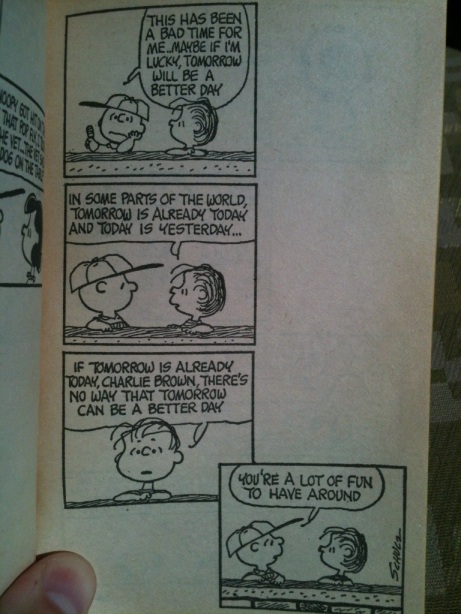
The other night, staying with some longtime friends, I reached for a brittle yellowed Peanuts collection on the nightstand by my bed. There were a few volumes of prose and poetry there, but Charles M. Schulz’s comics seemed more likely to make it through the haze of half a dozen beers. Plus, I’ve always loved Peanuts. I read the book entire, an arc beginning with the gang heading off to summer camp and ending, more or less, with Snoopy’s failed attempts at writing.

20130120-102308.jpg

Like many kids, I grew up with Peanuts, reading Schulz’s work in the paper and also in collected volumes that my grandparents would give me (my grandfather was an especially big fan). The comics were often funny—not funny like my favorite at the time, Gary Larson’s The Far Side to be sure—but they were just as often full of melancholy or even despair, a despair that was mediated, but not necessarily assuaged by, the consolations of friendship.
20130120-102345.jpg

I read as gently as possible, trying (and not always succeeding) to prevent any more pages from falling out of the collection. I mentally bookmarked several panels and a few entire strips to photograph the next day to maybe share on the blog. The next morning it occurred to me that I own almost a half dozen Peanuts collections—but I probably hadn’t picked them up in years. And I suppose this is one of the strange pleasures of guest room reading—that it might reintroduce us to an old favorite—but that seems like too pat a conclusion to me. I’ve found over the years that I’m just as likely to remember an awful book I read at random as a guest—and that for some reason the experience of reading someone else’s books—in a guest room, at a river house, in a cabin, at a hostel—is somehow always heightened. I don’t have a distinct explanation, other than the very obvious and simple one that I usually read in the same few places—a chair in my living room, a couch, my office, the bed, the bath, my back porch—and that reading other people’s texts in unfamiliar places estranges what I think of as reading—and that estrangement is invigorating. And pleasurable. 
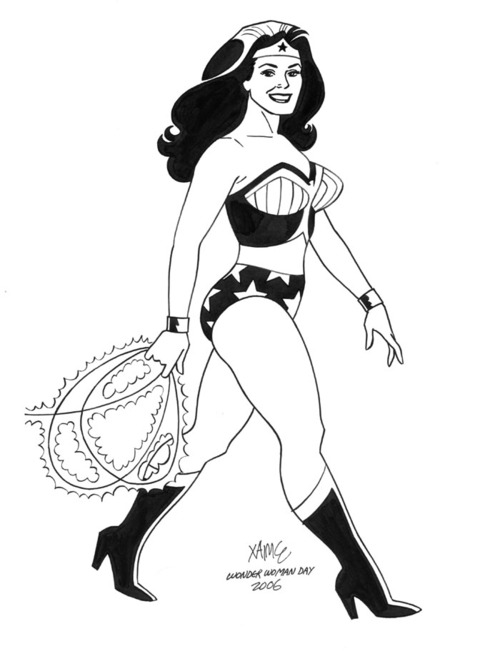
Wonder Woman — Jaime Hernandez

tumblr_l7c39wmpdh1qawvuyo1_500

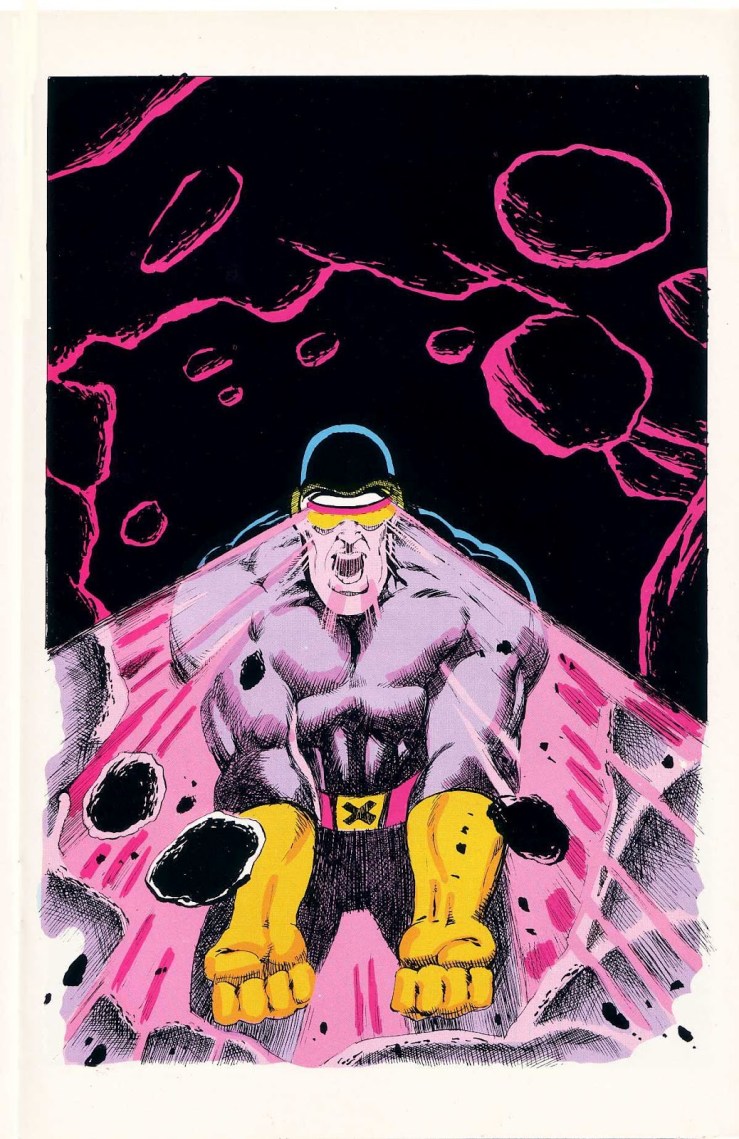
Cyclops — Dave Sim

cyclops dave sim

(Via).

Totoro — Geof Darrow

darrow-sc-totoromouth

Wonder Woman — Gilberto Hernandez

10_GilbertHernandez

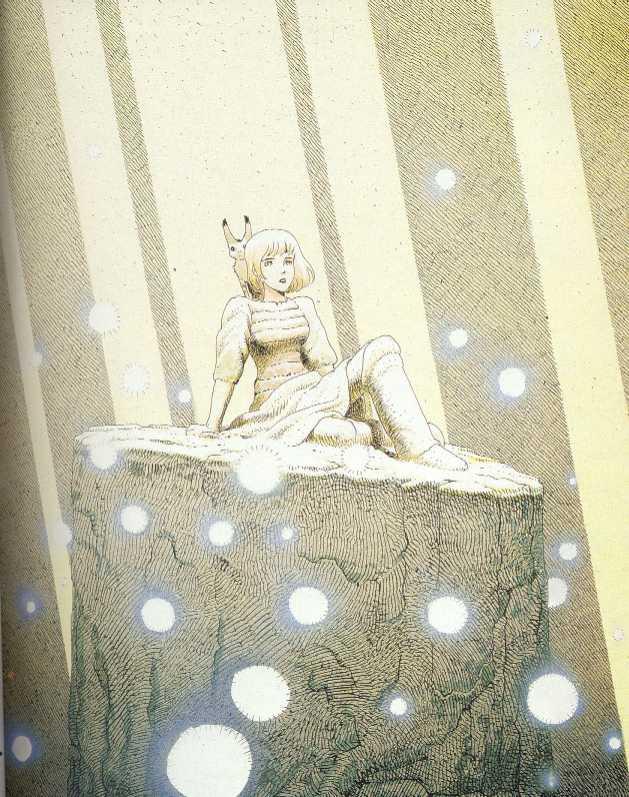
Nausicaä of the Valley of the Wind — Moebius

nausicaa-moebius

Hemingway and His Infernal Sleeping Bag — Eddie Campbell

campbell_hemingway

(Via).

Tarzan (Via William Burroughs)

tarzan

“Tarzan Based on the works of Burroughs”— Comic by Kelly Shane & Woody Compton, part of their Is This Tomorrow? series.

Little Nemo Strip — Winsor McCay

Carolyn (Perry Bible Fellowship)

Walt Kelly’s Pogo Does “Twas the Night Before Christmas”

Read the rest of Walt Kelly’s Pogo take on “Twas the Night Before Christmas” here.

Merry Christmas from Winsor McCay

Reading Chris Ware’s Building Stories / It All Happened So Fast

20121213-185225.jpg

As seems to be the case more often than not in this series of write-ups on reading Chris Ware’s Building Stories, I’ve taken the title from the first line of the first panel (below); you can see the scale of this chapter in folded broadside in the pic above (which also reveals the heart of this episode).

20121213-185234.jpg

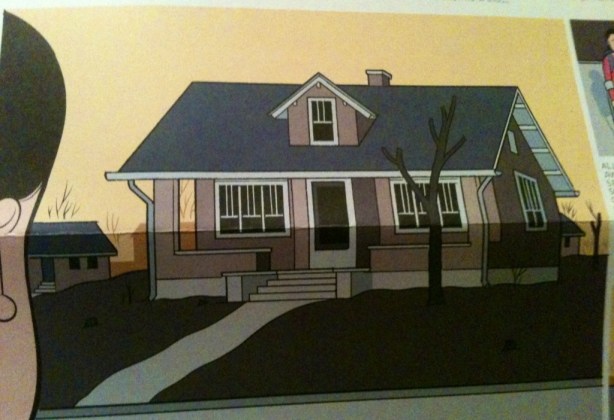
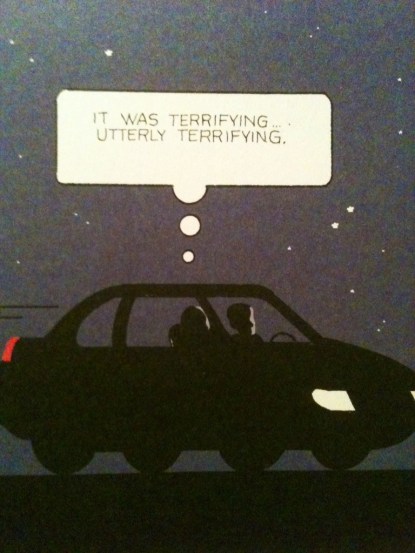
This particular episode focuses again on Lonely Girl/Married Mom/The Amputee, who has slowly emerged as the protagonist of Ware’s novel. Here, she deals with the news of her father’s illness, an event that brings her back to her childhood home repeatedly. The motif of homes and buildings evinces again too, of course—it’s a subtle but omnipresent device in Building Stories:

20121213-185305.jpg

20121213-185312.jpg

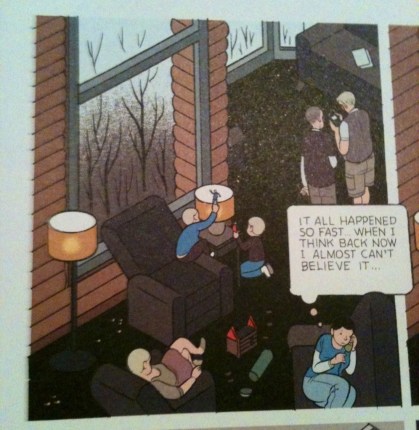
And as always, Ware’s genius shows in the way he conveys so much truth in the smallest detail. Below he illustrates Lonely Girl’s disconnected relationship with her architect husband in just a panel:

20121213-185243.jpg

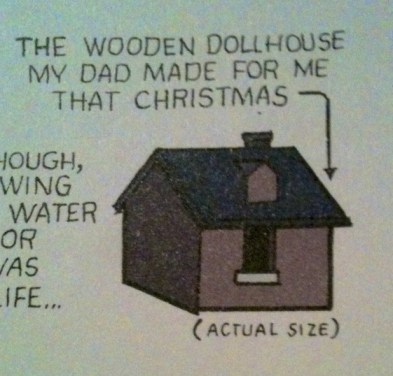
“It All Happened So Fast” is a fair name for this chapter—Ware’s panels illustrate the way that our lives (and the narrativizing of those lives) can become radically compressed, how our memories fail us, how seemingly trivial details anchor themselves to the emotional strata of our personalities even as concrete fact slips away. Still, another title could come from this panel:

20121213-185256.jpg

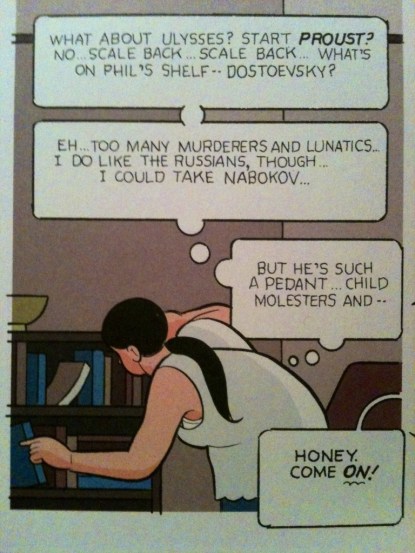
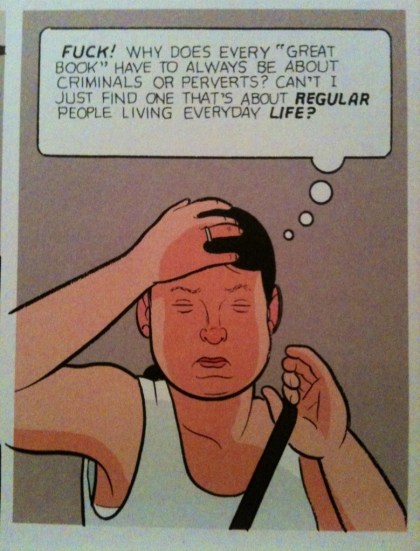
I’ll close this out by offering three panels that strike me as so utterly real, so wonderfully truthful, that I won’t bother to comment further:

20121213-185321.jpg

20121213-185328.jpg

20121213-185336.jpg

Nemo — Moebius

Nemo

Reading Chris Ware’s Building Stories / Disconnect

20121206-181909.jpg

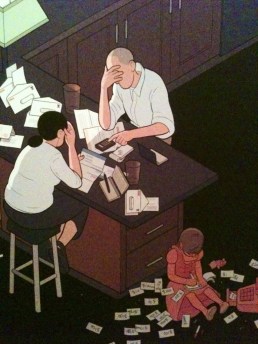
“Disconnect,” one of the longer episodes in Chris Ware’s novel Building Stories, serves as a reminder of Ware’s strength as a prose writer. Wordiness tends to kill illustrated storytelling, at least in my estimation. Sure, there are exceptions—Joe Sacco and Harvey Pekar come to mind—but in general, I think comics are at their best when thought and word bubbles are uncluttered (or nonexistent).  Ware clearly understands the economy of his medium, and some of Building Stories’ finest moments have been wordless ones where Ware constructs the story in pure imagery. We can see so much of the plot and themes of  “Disconnect” in this full page, for instance:

20121206-181944.jpg

But Ware also packs plenty of storytelling into his prose in “Disconnect,” where he continues the story of Lonely Girl, who it’s probably better to now call Married Mom—I still think of her as Lonely Girl though, after first really meeting her in “September 23rd, 2000,” an episode ostensibly narrated by her diary. “Disconnect” is a second diary of sorts, her internal narration guiding us subtly through episodes in her life over a series of years. “Disconnect” focuses on LG/MM raising her young daughter against the backdrop of a strained marriage.

Lonely Girl/Married Mom’s observations ring particularly true. She points out that “When your children aren’t around, you miss them with every fiber of your being—but when they are, you just want to get them to bed so you can go read the news or something,” an observation simultaneously profound, disturbing, and banal. When our heroine recalls how her relationship to her pet cat changed after her child was born, I also saw shades of myself:  “The day we brought Lucy home, almost to the minute, all applied personality to Miss Kitty evaporated, and we saw her for what she was—an animal—and an animal who we were beholden to feed and house, with, suddenly it seemed, little to offer in return.”

Through Lonely Girl/Married Mom, Ware paints a portrait of modern disconnection and alienation, and, even as we sympathize with the heroine, Ware also allows us to see through her—or rather, to see what she can’t see, or to see what she refuses to see. The effect is an irony that tips into small, banal tragedy.

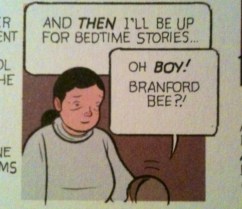
Ware’s prose is usually overshadowed by his gifts as a draftsman, an architect—he’s the builder of Building Stories, a fact that this chapter alludes to, both internally, intertextually, and metatextually. We learn, for example, that Branford the Bee is a story within a story:

20121206-181917.jpg

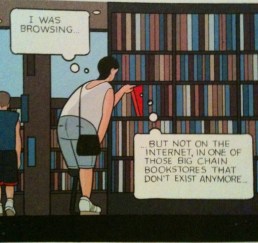
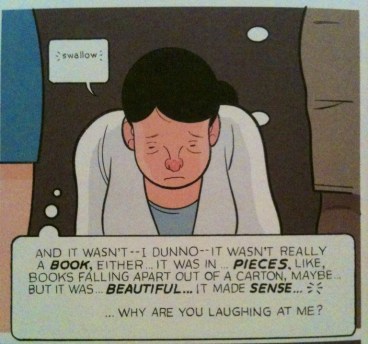
This nesting of stories emerges in the final part of “Disconnect,” wherein our aged narrator—addressing her grown daughter—relates a dream:

20121206-181924.jpg

The scene culminates so beautifully that it brought a little tear to my eye. Most postmodern novels contain (often more than once) their own descriptions, and Building Stories is no exception:

20121206-181934.jpg

And yet what we see here isn’t postmodern cleverness or empty gimmickry, but the evocation of dream and imagination and desire and creation—the spirit of the book, of what it means to build stories. Reading the final panels of “Disconnect,” I immediately recalled the epigraph to Building Stories (it’s on the interior of the box lid, by the colophon and dedication):

20121206-181951.jpg


Wonder Woman Sketch — Bill Sienkiewicz

RIP Comix Legend Spain Rodriguez

RIP Spain.