The Instructions — Adam Levin

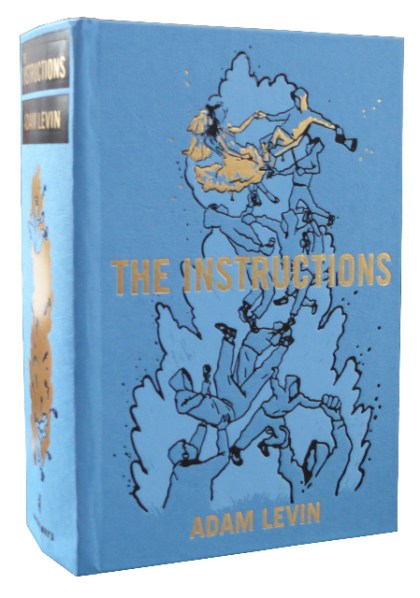
Adam Levin’s début novel The Instructions is long. It’s very long. It’s too long.

Or, more to the point, it’s too long to be so mediocre.

This is not a fair criticism, especially considering that I have only read about 35.5% of the book. 8 chapters. 366 pages. I have no conclusive evidence that the next 664 pages won’t be the kind of mind-blowing read that can justify taking up over a thousand pages. Significantly though, there’s nothing in the first 366 pages that especially compels me to continue reading. I give up. I abandon it. Although reading is hardly a quantitative experience — reading and digesting a page of Melville requires more sustained concentration and energy than a page of, say, Bukowski — it stands to reason that I can read two or three novels in the time it would take finish The Instructions. And if I spend my (limited, I am a human and am going to die at some point) reading time reading three novels instead of finishing Levin’s book, it’s likely that at least one of them might be good, even great, while I’m pretty sure that The Instructions is going to continue its middling trajectory.

So what’s it about? It must have had an interesting premise for me to read 366 pages, right?

Gurion ben-Judah Maccabee is a 10 year-old seventh grader (he’s been promoted, sort of) who is forced to attend a special program called “The Cage” after being expelled from his first three schools for various violent acts. Gurion is a hyper-intelligent, budding rabbinical scholar with serious Torah-interpreting skills. He’s also pretty much the toughest kid at Aptakisic Junior High, where, despite being only ten, he kicks ass left and right (his mom is a former Israeli commando). The novel takes place over four days in 2006, as Gurion declares his love for June Watermark, meets a new friend, and begins to rally the behavioral disorder kids against The Cage’s totalitarianism.

The opening scene of the novel is an engaging piece — Gurion and two friends take turns simulating water boarding on each other during a gym class held in a pool. Then, in the locker room, a fight. Gurion loves to fight, despite his inkling — or, at least the inkling of others — that he may be the potential messiah. This obsession with Jewish (“Israelite,” Gurion would correct me) identity seems to be the main thrust of the novel. Gurion, who is the “author” of the novel (which he refers to as “scripture”) speaks authoritatively and eruditely about Torah and religious philosophy. In fact, he speaks like a fully matured scholar who has taught and studied religious philosophy for decades. One can allow this conceit of the novel: sure, Gurion is special, he can fight, he’s a genius, sure, that’s what drives the plot–but Levin wants to extend this genius, or at least rhetorical flair, to almost every other character.

The effect is by turns grating and numbing, as we are subjected to page after page of dialog that is meant to sound witty or empathetic or just plain flavorful but is more often silly or inauthentic or, at worst, too fucking precious for words. The cartoonish dialog, rife with fake slang that no middle school kids ever used, wouldn’t be so bad on its own; in fact, it seems to go hand in hand with Levin’s goal, which appears to be slapstick of some kind. Only he (or Gurion) repeatedly calls attention to the slapstick, commenting on it, even pointing out how the reader should appreciate it.

This meta-textual attention is at work at all times. In particular, it’s there in the long (oh my god are they long) descriptions of each and every action that takes place in the prose. Gurion feels the need to analyze every last little detail, to load it with preternatural significance; these lengthy passages scream for an editor. The arrangement of the text is of course meta-textual as well: it purports to be a work of Gurion’s authorship, and includes a variety of texts from his “personal file” including emails, detention records, essay assignments, and, in one glaring case of squandered potential, a psychological report. And yet in all these documents, there does not seem to be any perspective outside of Gurion’s; when Gurion’s therapist comments on his behavior we learn nothing new, nothing different — we only see a confirmation of Gurion’s highly perceptive intelligence. It is grand solipsism on the largest of scales.

Which brings me to the David Foster Wallace comparisons, which are probably what got me interested in The Instructions in the first place. Granted, The Instructions may have facile similarities to Infinite Jest, but the books differ tremendously in how the reader must engage them. IJ is pluralistic and heteroglossic; The Instructions is essentially a monologue. IJ invites the reader to play, to pursue mystery; The Instructions, despite its volume, seems to contain just one mind. And maybe that’s the problem. Reviewers have compared Gurion to Hal Incandenza — and it’s true, both are bright, troubled young men — but The Instructions seems to be lacking a Don Gately.

Looking over my comments, they seem harsher than I perhaps intended. I believe that Levin has great talent and is surely a keen intellect with stories worth sharing. More to the point, I think that there might be a good novel somewhere inside of The Instructions — only I’m pretty sure it’s much, much shorter.

The Instructions is new in hardback from McSweeney’s.

Books I Am Always (Re-)Reading

Trudging through a very long book the other night–never mind the title, at least now anyway–it occurred to me that I’d rather be reading from 2666; that, at that particular moment, I’d rather re-read from “The Part About the Crimes.” I don’t know if it was the effete dullness of the first volume that made me want to pick up Bolaño’s epic, perhaps trying to zap some life into my waning eyeballs; perhaps it was just the sense that I was wasting my time with the merely good, which, after all, is mediocrity when set against genius (yes, these are subjective terms).

Anyway, I didn’t have to go looking for 2666 — I have a copy (yes, I have two) right there jammed into my nightstand, along with a few other books that I realize that I’m always reading. Furthermore, I’m always reading these books in the most discontinuous, stochastic fashion, often picking them up at random and thumbing through them. I think I use these books to clear my literary palate, to get a bad (or worse, boring) taste out of my brain, to inspire me, to suggest another book. Some of these books, like 2666 are big, fat volumes, volumes that I set close at hand in the hopes of rereading in full. Sometimes I’ve met this goal; in the case of Moby-Dick, I’ve read the book through at least three times now, and yet never tire of it. I’m always picking it up again and again, sometimes to find Elijah’s rant or to dip into Ahab’s mad monologue or perhaps just to hear Stubb comment on the proper preparation of shark steaks. Of a piece with those big novels is David Foster Wallace’s Infinite Jest, which I turn to repeatedly, reading over a riff or two at a time, perhaps still trying to figure out the ending, or some clue of the ending, perhaps trying to figure out why Hal can’t speak (you know, beyond like, a a metaphorical level).

There’s also Blood Meridian.

A book I always keep proximal is D.H. Lawrence’s Studies in Classic American Literature, which, if this were a dictatorship under Biblioklept might replace the Constitution (jaykay, Tea Partiers!). Tellingly, I’ve never managed to finish one of Lawrence’s novels (I even struggle through his much-anthologized piece, “The Rocking Horse Winner”), but I consider his dissertations on Hawthorne, Poe, and Melville indispensable (and creative in their own right). I guess I just like lit crit; Harold Bloom’s too-huge volume The Western Canon is a book I return to again and again. Sometimes I find myself throwing it to the ground, quite literally (if I’ve enjoyed a drink or two, that is), in disgust. Bloom’s battle with “The School of Resentment” can be maddening, especially when he’s so up front about essentially making Shakespeare God. Still, Shakespeare doesn’t seem like a bad God to have.

I should point out that I’ve made no attempt to read The Western Canon the whole way through; in fact, I’ve never made a single attempt to read it systematically. I just sort of pick it up, thumb through it, occasionally plumb the index. There are several books that I am always rereading in this category: Books That I Am Always Reading and Yet Have Never Finished. Foremost among these is Nietzsche’s Human, All Too Human, a book that I probably, at this point, have read in full, but never fully through. Its aphorisms beg to be read discontinuously; I think Nietzsche wet-dreamed about his fragmentary works being literally fragmented and then later found, read piecemeal against some newer, more garish culture. Or perhaps that’s just my metaphorical wet dream.

Other Books That I Am Always Reading and Yet Have Never Finished — The Life and Opinions of Tristram Shandy, Gentleman stands out, as does Finnegans Wake. Sterne’s book is such an oddity: I remember picking it up in a stack of books to be shelved at my college library, thumbing through it, bewildered, thinking that it must be contemporary with John Barth. A bit of research left me even more perplexed. Like Tristram, who can’t seem to finish his story, I can’t seem to actually finish it, but I’m okay with picking it up again and again. Similarly, Finnegans Wake strikes me as an unfinished-unfinishable volume (I do not mean this literally; I know that Joyce “finished” the book as an infinite strange loop, just as I know that the book can be read). I have an audio recording of Finnegans Wake that I like to listen to occasionally (especially while driving), as well as William York Tindall’s  guide (which is fun), but I’d rather just sort of grab the thing at random and read a page or two. I know, in an intellectual sense, that is, that I could easily read the book in a calendar year by committing to three pages a day (plus a few pages of Tindall), but I don’t think that I can read books in an intellectual sense. I think, at the risk of sounding unbearably corny, that books have to call to their readers in an emotional and perhaps even spiritual sense. Otherwise, what’s the point?

Books I Will (Make Every Reasonable Attempt to) Read in 2011

If you’re looking for a comprehensive “Books to Look Forward to in 2011” kind of list, The Millions has you covered. This post is not about books that are coming out in 2011, although some books mentioned here will come out in 2011. This post is really just about books I’d like to/plan to read in 2011 (it’s also kind of a dare to myself).

First up, I will finish the books I’m reading/listening to now. This means Adam Levin’s The Instructions (reading; McSweeney’s) and Lydia Millet’s Oh Pure and Radiant Heart (listening; Iambik Audio). I’m on page 342 of The Instructions; there are 1030 pages; a calculator tells me that that is 33.2%. It’s easy reading, often entertaining, but it’s hard to see, even a third of the way in, how Levin can justify taking up this much space. Oh, what is it about? Okay, this kid Gurion Maccabee may or may not be the Messiah. In the meantime, he rules the special ed program at his suburban Chicago school, writes scripture, and gets in lots of fights. The best parts of the book (so far, anyway) are Gurion’s comments on Torah (I would’ve written “the Torah,” but this book seems to suggest that the definite article is pretty Gentile).

Oh Pure and Radiant Heart has been enjoyable, sardonic — funny but sad — and I’m coming up to the end soon. Basically, a trinity of scientists who helped invent the atom bomb (Robert Oppenheimer is the famous one) come back from the dead (sort of) to . . . I don’t know yet. It’s unclear. To hang out with a quiet librarian and her gardener husband as their marriage slowly dissolves? To lead our nation to world wide peace? To take part in a movable circus of weirdos and End Times prophets? Not sure. Full review forthcoming.

I already wrote about one of the Tintin collections I picked up late last year; I will read the other three collections (and likely hunt down more). I’ll also read (hopefully; that is, hopefully it will come out) the next installment in Charles Burns’s X’ed Out trilogy.

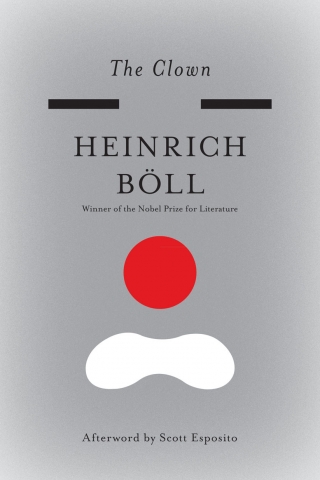
Also on the proverbial plate, non-illustratedwise, is Heinrich Böll’s The Clown, the story of a clown in post-Reich Germany who can smell through the phone (I think there’s more to it than that). Melville House is actually releasing several new editions of Böll’s novels this year, and they have a pretty excellent track record with the Germans, what with Hans Fallada and all, so hey, why not.

On the I-will-read-everything-Sam-Lipsyte-writes front, Picador is putting out a new edition of his first novel The Subject Steve (perhaps in concordance with The Ask coming out in paperback?). I will read The Subject Steve.

Books I bought this year and didn’t read but will make every reasonable attempt to read this year—

William Gaddis’s JR was, I think anyway, the last book I picked up in 2010. It’s really long, seems to be written entirely as a dialog, and hey, I read 2/3rds of The Recognitions and then didn’t even finish it (yet?) which is kinda remarkable/totally lazy. Maybe I should just finish The Recognitions. I just feel like “I get it already.” Lazy, lazy, lazy.

Loved the first chapter of Katherine Dunn’s Geek Love, even though it was really silly. Stay tuned, folks.
I read the first two stories in Barry Hannah’s Airships and then a few galleys bombed my doorstep and then I got distracted, but these things have Spring Break written all over them, so, yes, look for the Airships report in the future (or be a hipster douchebag and write in to tell me how awesome you already know Hannah is now that he’s dead blah blah blah).

I remember that I bought Renata Adler’s Speed Boat the same day I bought Airships (because, y’know, the titles). I read the first 30 or so pages and then read them again and then read them again a week or so ago. Kind of dumbfounding stuff. It’s been hovering around the coffee table, the nightstand; it’s been jammed in briefcases, wedged in coat pockets. What is it? What is she doing?

After slowing down my consumption in 2010, I’m ready to feed the addiction again in 2011: Bolaño, Bolaño, Bolaño. I need to read Amulet; I’ll also read The Insufferable Gaucho and probably something else.

And:

The Pale King

But everyone’s buzzing about that already, right?

David Foster Wallace Describes Poststructuralism

Thumbed through my copy of A Supposedly Fun Thing I’ll Never Do Again yesterday and ended up re-reading David Foster Wallace’s essay “Greatly Exaggerated,” ostensibly a review of H.L. Hix’s book Morte d’Author: An Autopsy, considers the literary fall-out after Roland Barthes declared the “death of the author.” Anyway, I thought Wallace’s description of poststructuralism was worth sharing–

The deconstructionists (“deconstructionist” and “poststructuralist” mean the same thing, by the way: “poststructuralist” is what you call a deconstructionist who doesn’t want to be called a deconstructionist) . . . see the debate over the ownership of meaning as a skirmish in a larger war in Western philosophy over the idea that presence and unity are ontologically prior to expression. There’s been this longstanding deluded presumption, they think, that if there is an utterance then there must exist a unified, efficacious presence that causes and owns that utterance. The poststructuralists attack what they see as a post-Platonic prejudice in favor of presence over absence and speech over writing. We tend to trust speech over writing because of the immediacy of the speaker: he’s right there, and we can grab him by the lapels and look into his face and figure out just exactly what one single thing he means. But the reason why poststructuralists are in the literary theory business at all is that they see writing, not speech, as more faithful to the metaphysics of true expression. For Barthes, Derrida, and Foucault, writing is a better animal than speech because it is iterable; it is iterable because it is abstract; and it is abstract because it is a function not of presence but of absence: the reader’s absent when the writer’s writing, and the writer’s absent when the reader’s reading.

For a deconstructionist, then, a writer’s circumstances and intentions are indeed a part of the “context” of a text, but context imposes no real cinctures on the text’s meaning, because meaning in language requires a cultivation of absence rather than presence, involves not the imposition but the erasure of consciousness. This is so because these guys–Derrida following Heidegger and Barthes Mallarme and Foucault God knows who–see literary language as a not a tool but an environment. A writer does not wield language; he is subsumed in it. Language speaks us; writing writes; etc.

Fate, Time, and Language: An Essay on Free Will — David Foster Wallace

Sometime last year, during a rare visit to a big chain bookstore, I was disgusted to see what had happened to David Foster Wallace’s amazing Kenyon College commencement speech, “This Is Water.” Wallace’s speech, about 3,815 words, give or take (maybe twelve standard typed pages), was being sold as a 144 page hardback volume with only a sentence or two printed per page. The book was (and is) a nakedly commercial attempt to turn a text that is widely available on the web into the sort of thing that well-meaning uncles give to their nephews or nieces as graduation gifts. Of course, hardcore Wallace fans might want such a book — and I’d never begrudge them that — but it’s hard to imagine that Wallace would have been comfortable with how his book was marketed.

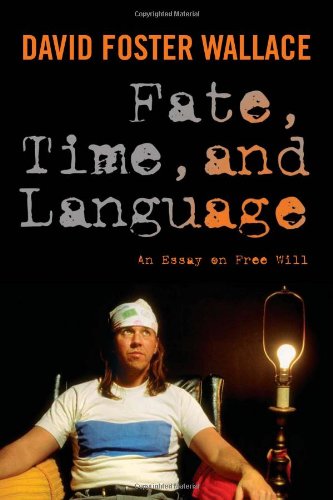
Which brings us to Fate, Time, and Language: An Essay on Free Will, new from Columbia University Press this week. The book publishes the 1985 honors thesis that Wallace submitted to the Amherst College’s Department of Philosophy, “Richard Taylor’s ‘Fatalism’ and the Semantics of Physical Modality.” The essay’s title alone signals a prohibitive level of academic specialization. In his introductory essay to the volume, “A Head That Throbbed Heartlike,” New York Times Magazine editor James Ryerson points out, “Its obscurity is easy to appreciate. A highly specialized, seventy-six page work of logic, semantics, and metaphysics, it is not for the philosophically faint of heart.” Ryerson then warns his reader to “Brace yourself for a sample sentence,” before offering a sample from Wallace’s essay that I do not have the patience or fortitude to type out (it would take me too long to locate all the diacritical marks and special logic symbols). Ryerson concludes the paragraph with this wry remark: “There are reasons that he’s better known for an essay about a cruise ship.”

Fortunately, the editors of Fate, Time, and Language make every effort to contextualize Wallace’s essay in a way that explains its aims, strengths, and even shortcomings. There’s Ryerson’s lengthy introduction, which provides an overview to Wallace’s life in philosophy. Then there’s Taylor’s “Fatalism” of course, a short, provocative argument combining six presuppositions that led Taylor to declare that humans have no control — none, whatsoever — over any future event. The volume collects four other essays by Taylor on fatalism, as well as eight other essays responding to his arguments, before delivering Wallace’s essay (the longest in the collection). Here’s Wallace—

So Taylor’s central claim, the Taylor problem, is that just a few basic logical and semantic presuppositions, regarded as uncontroversially true by most philosophers, lead directly to the metaphysical conclusion that human beings, agents, have no control over what is going to happen.

I ain’t even gonna front–pretty much everything that Wallace says after this was lost on me; if you want to read and comprehend the details of his argument you will need to have a grasp on the basics of Montague grammar and tensed modal logic. If you lack these skills, there will be skimming. Lots and lots of skimming. So, in short, I have no ideawhether Wallace’s logic is sound, although I find his conclusion (minus all the modal evidence) quite compelling—

This essay’s semantic analysis has shown that Taylor’s proof doesn’t “force” fatalism on us at all. We should now recall that Taylor was offering a very curious sort of argument: a semantic argument for ametaphysical conclusion. In light of what we’ve seen about the semantics of physical modality, I hold that Taylor’s semantic argument does not in fact yield his metaphysical conclusion.

After Wallace’s honors thesis, there’s a wonderful little memoir essay by his adviser on the project, Jay L. Garfield, who offers up this nugget—

I knew at the time, as I mention above, that David was also writing a novel as a thesis in English. But I never took that seriously. I though of David as a very talented young philosopher with a writing hobby, and did not realize that he was instead one of the most talented fiction writers of his generation who had a philosophy hobby.

These little pockets of insight appeal to me most in Fate, Time, and Language, and as such, Ryerson’s essay “A Head That Throbbed Heartlike” is the highpoint of the book. It weaves together Wallace’s personal life, writing career, and academic pursuits into a moving elegy of sorts, although one more rooted in ideas than feelings. He also spells out the book’s mission quite clearly—

For all its seeming inscrutability, though, the thesis is lucidly argued and–with some patience and industry on the part of the lay reader–ultimately accessible, which is welcome news for those looking to deepen their understanding of Wallace. The paper offers a point of entry into an overlooked aspect of his intellectual life: a serious early engagement with philosophy that would play a lasting role in his work and thought, including his ideas about the purpose and possibilities of fiction.

Many of us might shudder at the idea of our college essays being published posthumously. Of course, most of us aren’t Wallace, but there are undoubtedly critics out there who will cry foul at this publication. Fortunately, the team behind Fate, Time, and Language has produced a book of remarkable integrity, one that understands why it exists, readily acknowledges its obscurity without trying to gloss over that obscurity, and makes every effort to communicate with and engage its readers without sacrificing erudition. To return to my opening anecdote, this is not the naked commercialism that motivated a gimmicky edition This Is Water; rather, this is a book delivered by people who genuinely care about Wallace and his ideas. Make no mistake–it’s very dry and very specialized, but fanatics will no doubt want it.

Jonathan Franzen on Underappreciated Books

Vodpod videos no longer available.

“Crash of ’69” — David Foster Wallace

“Crash of ’69” is a short story by David Foster Wallace. It was originally published in the New York-based literary quarterly Between C & D in winter of 1989. Between C & D published their journal on dot matrix paper and distributed it in plastic bags–not exactly the best way to preserve something.

CRASH OF ‘69 by David Foster Wallace

KARRIER

It’s great. I’m always wrong. It’s great.
Ask anybody except my agent if it’s great. He’ll be in checks and Weejuns, pointing binoculars at narrow horses hung with satin as they’re led toward their boxes. Mr. Diggs will say it’s great. He holds his racing form a certain way. He folds both sides together, to compare possibilities.
He’ll say So what about Rusty Hull in the Fourth, kid.
And I’ll say A winner, so sure a thing it’s almost boring, money in the account of our choice, Mr. Diggs.
He’ll put the forms side by side and feel the square of hair on his chin and say So then what about Siberian Saber-Toothed Crotch-Cricket, Karrier? Does Siberian Saber-Toothed Crotch- Cricket have a chance here in the Fourth?
I’ll say Mr. Diggs sir, no way. As in no chance. As in I feel in my chest, bowels the absence of even one slim snowball’s chance for Siberian Saber-Toothed Crotch-Cricket.
The form trembles a certain way in his hands as he trains the glasses on a certain horse, from here a tiny hull atop legs.
But are you sure Karrier.
I feel it, Mr. D. It’s that feeling, with the tight hide and velvet lips. That no-way certainty.

THE WOMAN WHO’S GOING TO BE HIS LOVER

I’ll take Father’s arm and we’ll take our constitutional together through the dawning halls of the Federal Reserve, to the sound of the click of my heels and the squeak of his chair, as the fire in the East window yellows. He says We can’t live like this, child. A whole nation has lost the cool side of the pillow. First thing every morning I taste in my mouth the human potential for evil.

His neck’s slow tic sends his head around over his shoulder. It has ceased to be great. The only brilliance he sees is over his shoulder, now.

Continue reading ““Crash of ’69” — David Foster Wallace”

Read the Complete Transcript of a 1998 David Foster Wallace Interview

Tom Scocca interviewed David Foster Wallace in 1998. A short version of the interview ran in The Boston Phoenix in February of ’98; Slate published a transcript the entire interview this week. It begins with phones and beards–

Q: For basic reader orientation here, are you doing this from Bloomington?

DFW: Speaking to you? Yes, sir.

Q: What sort of phone?

DFW: What sort of phone? What kind of phone is this? This is a Panasonic Easa-Phone. E-A-S-A, hyphen, P-H-O-N-E. And I don’t see a model number on it. It’s got a little answering machine attached, although the answering machine doesn’t work as often as the average consumer probably would like it to.

Q: OK. Let’s see.

DFW: You’re really going to orient that reader, aren’t you?

Q: Yeah. You have to bring the color in somehow.

DFW: Uh-huh.

Q: Any particular configuration of beard or bandana or glasses? It seems to change over time.

DFW: So what, we’re going to pretend, we’re going to pretend that we’re sitting in the same room?

Q: No.

DFW: I’ve never had a beard. I’ve tried periodically to grow a beard, and when it resembles, you know, the armpit of a 15-year-old girl who hasn’t shaved her armpit, I shave it off. I do not have a head hanky on at this point, although I did recently, ’cause I just got back from running my dogs around the countryside.

Newsweek Publishes Deleted Scenes from David Foster Wallace’s Infinite Jest

Newsweek has published a series of scenes David Foster Wallace cut from his manuscript of Infinite Jest. Fascinating for fans. (Thanks to @mattbucher for the tip). Here’s “Hal’s Essay on Ducks”–

Read (and Listen to) Another Unpublished Fragment from David Foster Wallace

Yesterday, we linked to an unpublished fragment by David Foster Wallace, and included the original audio from which it was transcribed. The Chief Howling Fantod himself, Nick Maniatis , was kind enough to point out that the fragments have been available for a few years now thanks to the transcription efforts of Matt Hale. You can get the pdf here, but we’ve gone ahead and reproduced our favorite section of the fragments (the audio is great too).

2nd FRAGMENT (Different boy mentioned in this; utterly different boy)

It is this boy who dons the bright-orange bandolier and shepherds the really small ones through the crosswalk outside school. This is after finishing the meals-on-wheels breakfast tour of the hospice downtown, whose administrator lunges to bolt her office door when she hears his cart’s wheels in the hall. He has paid out-of-pocket for the steel whistle and the white gloves held palm-out at cars while children who did not dress themselves cross behind him, some trying to run despite WALK DON’T RUN, the happy faced sandwich board he also made himself. The autos whose drivers he knows he waves at and gives an extra-big smile and tosses some words of good cheer as the crosswalk clears and the cars peel out and move through, some joshing around a little by swerving to miss him only by inches as he laughs and dances aside and makes faces of pretended terror at the flank and rear bumper. The one time that station wagon didn’t miss him really was an accident and he sent the lady several notes to make absolutely sure she knew he understood that and asked a whole lot of people he hadn’t yet gotten the opportunity to make friends with to sign his cast and decorated the crutches very carefully with bits of colored ribbon and tinsel and adhesive sparkles and even before the six weeks the doctor sternly prescribed, he’d given them away to the children’s wing to brighten up some other less lucky and happy kid’s convalescence and by the end of the whole thing he’d been inspired to write a very long theme to enter into the annual Social Studies theme competition about how a positive attitude can make even an accidental injury into an occasion for new friends and bright new opportunities for reaching out to others and while the theme didn’t even get honorable mention he honestly didn’t care because he felt like writing the theme had been its own reward and he’d gotten a lot out of the whole nine-draft process and was honestly happy for the kids whose themes did win awards and told them he was 100-plus percent sure they deserved it and that if they wanted to preserve their prize themes and maybe even make displayed items out of them for their parents, he’d be happy to type them up and laminate them and even fix any spelling errors he found if they’d like him to and at home his father puts his hand on Leonard’s shoulder and says he’s really proud that his son’s such a good sport and offers to take him to Dairy Queen as a kind of reward and Leonard tells his father he’s grateful and that the gesture means a lot to him but that in all honesty he’d like it even more if they took the money his father would have spent on the ice-cream and instead donated it either to Easter Seals or, better yet, to UNICEF to go toward the needs of famine-ravaged Biafran kids who he knew for a fact had probably never even heard of ice cream and says that he bets it’ll end up giving both of them a better feeling even then the DQ would and as the father slips the coins in the coin-slot at the special bright-orange UNICEF volunteer cardboard pumpkin bank, Leonard takes a moment to express concern about the father’s facial tick again and to gently rib him about his reluctance to go in and have the family’s MD look at it, noting again that according to the chart on the back of his bedroom door the father is four months overdue for his annual physical and that it’s almost eight months past the date of his recommended tetanus and T.B. boosters. He serves as hall monitor for period’s one and two but gives far more official warnings than actual citations. He’s there to serve he feels, not run people down. Usually with the official warnings he dispenses a smile and tells them you’re young exactly once so enjoy it and to go get-out here and make this day count why don’t they. Heroes UNICEF and Easter Seals and starts a recycling program in three straight grades. He is healthy and scrubbed and always groomed just well enough to project basic courtesy and respect for the community of which he is a part and he politely raises his hand in class for every question, but only if he’s sure he knows not only the correct answer but the formulation of that answer that the teacher’s looking for that will help advance the discussion of the overall topic they’re covering that day, often staying after class to double-check with the teacher that his take on her general objectives is sound and to ask whether there was any way that his answers could have been better or more helpful. The boy’s mom has a terrible accident while cleaning the oven and is rushed to the hospital and even though he’s beside himself with concern and says constant prayers former safety, he volunteers to stay home and field calls and relay information to an alphabetized list of concerned family friends and relatives and to make sure the mail and newspaper are brought in and to keep the home’s lights turned on and off in a random sequence at night as officer Chuck of the Michigan State police’s Crime Stoppers public school outreach program sensibly advises when grown-ups are suddenly called away from home and also to call the gas company’s emergency number, which he has memorized, to come check on what may well be a defective valve or circuit in the oven before anyone else in the family is exposed to risk of accidental harm and also, in secret, to work on massive display of bunting and penance and Welcome Homeland World’s Greatest Mom signs which he plans to use the garage’s extendible aluminum ladder—with a responsible neighborhood adult holding it and supervising—to very carefully affix to the front of the home with water-soluble glue so they’ll be there to greet the mom when she’s released from the I.C.U. with a totally clean bill of health which Leonard calls his father repeatedly at the I.C.U. payphone to assure the father that he has absolutely no doubt of (the totally clean bill of health), calling hourly, right on the dot, until there is some kind of mechanical problem with the payphone and when he dials it he just gets a high tone which he duly reports to the telephone company’s new automated 1618 Trouble Line. He can do several kinds of calligraphy and has been to origami camp twice and can do extraordinary free-hand sketches of local flora with either hand and can whistle all six of Telemann’s Nouveaux Equators and can imitate any birdcall Autobahn could even ever have thought of, don’t even mention spelling bees. He can make over twenty different kinds of admiral, cowboy, clerical and multi-ethnic hats out of ordinary newspaper and he volunteers to visit the school’s K-through-2nd classrooms teaching the little kids how, a proposal the Carl P. Robinson Elementary principal says he appreciates and has considered very carefully before turning down. The principle loathes the mere sight of the boy but does not quite know why. He sees the boy in his sleep, at nightmares’ ragged edges; the pressed checked shirt and hair’s hard little part, the freckles and ready, generous smile; anything he can do. The principle fantasizes about sinking a meat hook into Leonard Steel’s bright-eyed little face and dragging the boy face down behind his Volkswagen Beetle over the rough new streets of suburban Grand Rapids. The fantasies come out of nowhere and horrify the principal, who is a devout Mennonite. Everyone hates the boy. It is a complex hatred that makes the hater feel guilty and awful and to hate themselves for feeling this way and so makes they involuntarily hate the boy even more for arousing such self-hatred. The whole thing is totally confusing and upsetting. People take a lot of Aspirin when he’s around. The boy’s only real friends among kids are the damaged, the handicapped, the slow, the clinically fat, the last-picked, the non-grata. He seeks them out. All 316 invitations to his eleventh birthday Blow-Out Bash—322 invitations if you count the ones made on audiotape for the blind—are off, sent printed on quality velum with matching high-rag envelopes addressed in ornate Philippian calligraphy he spent three weekends on and each invitation details in Roman Numerated outline-form the itinerary’s half-day at Six Flags, private Ph.D.-guided tour of the Blanford Nature Center and reserved banquette-area-with-free-play at Shakey’s Pizza & Indoor Arcade on Remembrance Drive, the whole day gratis and paid-for out of the paper and aluminum drives the boy got up at 4 a.m. all summer to organize and spearhead, the balance of the drive’s receipts going to the Red Cross and the parents of a Kentwood, MI third-grader with terminal spina bifida who dreams above all-else of seeing Landry and Greer and ‘Night Train’ Lane live from his motorized wheelchair and the invitations explicitly call the party this: A Blow-Out Bash in balloon-shaped font as the caption to an illustrated explosion of good cheer and good will and no-holds-barred, let-out-all-the-stops fun with the bold-faced proviso: Please, no presents required in each of each card’s four corners and the 316 invitations—sent via first-class mail to every student, instructor, substitute, aid, administrator, custodian and physical plant employee at C. P. Robinson Elementary—yield a total attendance of nine celebrants, not counting parents and L.P.N.s of the incapacitated, and yet an undauntedly fine time was had by all was the consensus on the Honest Appraisal and Suggestion cards circulated at party’s end. The massive remainders of chocolate cake, Neapolitan ice cream, pizza, chips, caramel corn, Hershey’s kisses, United Way and Officer Chuck pamphlets on organ tissue donation and the correct procedures to follow if approached by a stranger respectively, kosher pizza for the Orthodox, biodegradable napkins and dietetic soda in souvenir Survived Leonard Steel’s Eleventh Birthday Blow-Out Bash, 1964 plastic glasses with built-in crazy-straws the guests were to keep as mementos all donated to the Kent County Children’s Home via procedures and transport that the birthday-boy had initiated even while the big Twister free-for-all was underway, out of concerns about melted ice cream and staleness and flatness and the waste of a chance to help the less blessed and his father, driving the wood-paneled station wagon and steadying his cheek with one hand, avowed again that the boy beside him had a large, good heart and that he was proud and that if the boy’s mother ever regained consciousness as they so very much hoped, he knew she’d be just awful proud as well.


Read (and Listen to) an Unpublished David Foster Wallace Fragment

Read an unpublished fragment of a story (or novel?) by David Foster Wallace at  454 W 23rd St New York, NY 10011-2157 (uh, that’s a blog, not, like, an actual physical address (although I guess it could be an actual physical address to. But, you don’t have to go there to read the story. Just click on the link. You know how the internet works, don’t you?)). Not sure who actually transcribed the piece (maybe the folks at 454?), but die-hard DFW fans will likely have heard the author read it himself. If you want to hear it, download it here (it also includes a hilarious reading (also unpublished) about a perfect boy who everyone hates). Here’s the first paragraph of the audio transcription–

Every whole person has ambitions, projects, objectives. This particular boy’s objective was to press his lips to every square inch of his own body. His arms to the shoulders and most of the legs beneath the knee were child’s play but after these areas of his body, the difficulty increased with the abruptness of a coastal shelf. The boy came to understand that unimaginable challenges lay ahead of him. He was six.

“David Was A Big Sweater” — The NYT Profiles Karen Green, David Foster Wallace’s Widow

Dear Dr./Bolinas Lagoon -- Karen Green

The New York Times profiles Karen Green, David Foster Wallace’s widow. The article details Green’s new art show Sure Is Quiet at the Space Arts Center and Gallery in South Pasadena,California. The article is worth reading in full, of course (it’s actually quite moving), but here are some of Green’s own words from the piece, on Wallace and her art—

David was a big sweater, and I just remember the sweat marks on his pillow when I changed the cases.

. . .

I wanted to redirect my anger, which is useless and fuels nothing, by invading my own privacy and then covering it up.

. . .

There’s been so much chaotic conversation in my head . . . I’ve been thinking, thinking so much. I wanted to take all the chaotic stuff and make it quiet.

. . .

David could be the great artist in the household, I didn’t care . . . I’ve been accused by academic friends of not having the right dialogue with the art world — not being knowledgeable about what’s cool, what’s desirable out there right now. But I’d rather work at Starbucks and make what I want.

. . .

I kept making art because I didn’t know what else to do, and that’s what I’ve always done . . . I felt everyone else was so much more advanced in the grieving process.

. . .

I really was thinking about language, the power of it . . . The power of David’s work, for example, which meant so much to people. But when you get as sick as he was, everything loses meaning.

. . .

You can be charmed and fooled by language .  .  It doesn’t stop, but it’s never enough.

A Plot Diagram of Infinite Jest

David Foster Wallace on Blood Meridian

David Foster Wallace on Cormac McCarthy’s Blood Meridian: “Don’t even ask.” From his 1999 piece in Salon, “Five direly underappreciated U.S. novels > 1960.”

The Strange and Disorienting World of Authors’ Personal Libraries

Craig Fehrman’s new article “Lost Libraries” (at The Boston Globe) provides a fascinating overview of how author libraries — that is, the books, usually heavily annotated, that authors own — find their way into archives, and why those archives matter. Fehrman begins by detailing the strange case of recently-deceased novelist David Markson, whose personal library was kinda sorta reassembled by fans after a reader named Annecy Liddell bought Markson’s (cleverly-annotated) copy of Don DeLillo’s White Noise–

The news of Liddell’s discovery quickly spread through Facebook and Twitter’s literary districts, and Markson’s fans realized that his personal library, about 2,500 books in all, had been sold off and was now anonymously scattered throughout The Strand, the vast Manhattan bookstore where Liddell had bought her book. And that’s when something remarkable happened: Markson’s fans began trying to reassemble his books. They used the Internet to coordinate trips to The Strand, to compile a list of their purchases, to swap scanned images of his notes, and to share tips. (The easiest way to spot a Markson book, they found, was to look for the high-quality hardcovers.) Markson’s fans told stories about watching strangers buy his books without understanding their origin, even after Strand clerks pointed out Markson’s signature. They also started asking questions, each one a variation on this: How could the books of one of this generation’s most interesting novelists end up on a bookstore’s dollar clearance carts?

Fehrman g0es on to point out that–

David Markson can now take his place in a long and distinguished line of writers whose personal libraries were quickly, casually broken down. Herman Melville’s books? One bookstore bought an assortment for $120, then scrapped the theological titles for paper. Stephen Crane’s? His widow died a brothel madam, and her estate (and his books) were auctioned off on the steps of a Florida courthouse. Ernest Hemingway’s? To this day, all 9,000 titles remain trapped in his Cuban villa.

Why does this matter? As Fehrman notes, “authors’ libraries serve as a kind of intellectual biography.” And while universities do their best to archive these materials, as Fehrman’s article reveals, much of what gets saved is left to chance. For instance, how did David Foster Wallace’s personal library get to the Harry Ransom Archive?

When Wallace’s widow and his literary agent, Bonnie Nadell, sorted through his library, they sent only the books he had annotated to the Ransom Center. The others, more than 30 boxes’ worth, they donated to charity. There was no chance to make a list, Nadell says, because another professor needed to move into Wallace’s office. “We were just speed skimming for markings of any kind.”

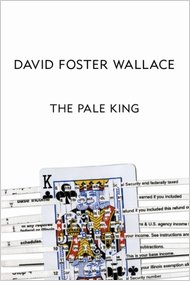
David Foster Wallace’s Posthumous Novel The Pale King Gets A Cover and Release Date

The New York Times reports that David Foster Wallace’s posthumous, unfinished novel The Pale King has the release date of April 15th, 2011–Tax Day–a fitting date, considering that the book is about an IRS tax return processing center. Little, Brown will publish the book. Here’s the cover–

“Your Liberal Arts $ at Work” — David Foster Wallace

From the David Foster Wallace Archive at the Harry Ransom Center.