- A Tale of Two Cities
- Robinson Crusoe
- The Iliad
- Maggie: A Girl of the Streets
- Tender Is the Night
- Catch-22
- Native Son
Tag: Lists
List with No Name #3
- Don Quixote & Sancho Panza
- Tom & Huck
- Huck & Jim
- Candide & Pangloss
- Stephen Dedalus & Leopold Bloom
- Hal Incandenza & Mario Incandenza
- Hal Incandenza & Michael Pemulis
- Mason & Dixon
- Arturo Belano & Ulisses Lima
- Prince Hal & Falstaff
- Frodo Baggins & Sam Gamgee
- Bast & JR
- The kid & Toadvine
- Romeo & Mercutio
- Ishmael & Queequeg
- George Milton & Lennie Small
- Raoul Duke & Dr. Gonzo
List with No Name #2
- The first 20 minutes of 2001: A Space Odyssey
- The last 10 minutes of if . . . .
- The first half of Barry Lyndon but not the second half
- Every minute of Days of Heaven
- Every minute of Russian Ark
- The opening sequence of Ponyo
- The last five minutes of Aguirre, the Wrath of God
- The closing titles sequence of INLAND EMPIRE
List with No Name #1
- Bleak House
- A Frolic of His Own
- Babbitt
- Fathers and Sons
- The Magic Mountain
- Middlemarch
- Moll Flanders
- The Tin Drum
- Life and Fate
- R.U.R.
- The Dwarf
- Zeno’s Conscience
“On Getting Started” — John Steinbeck Shares Writing Tips
From John Steinbeck’s 1969 “interview” in The Paris Review (the piece reads more like a series of short writings than a conventional interview):
ON GETTING STARTED
It is usual that the moment you write for publication—I mean one of course—one stiffens in exactly the same way one does when one is being photographed. The simplest way to overcome this is to write it to someone, like me. Write it as a letter aimed at one person. This removes the vague terror of addressing the large and faceless audience and it also, you will find, will give a sense of freedom and a lack of self-consciousness.
Now let me give you the benefit of my experience in facing 400 pages of blank stock—the appalling stuff that must be filled. I know that no one really wants the benefit of anyone’s experience which is probably why it is so freely offered. But the following are some of the things I have had to do to keep from going nuts.
1. Abandon the idea that you are ever going to finish. Lose track of the 400 pages and write just one page for each day, it helps. Then when it gets finished, you are always surprised.
2. Write freely and as rapidly as possible and throw the whole thing on paper. Never correct or rewrite until the whole thing is down. Rewrite in process is usually found to be an excuse for not going on. It also interferes with flow and rhythm which can only come from a kind of unconscious association with the material.
3. Forget your generalized audience. In the first place, the nameless, faceless audience will scare you to death and in the second place, unlike the theater, it doesn’t exist. In writing, your audience is one single reader. I have found that sometimes it helps to pick out one person—a real person you know, or an imagined person and write to that one.
4. If a scene or a section gets the better of you and you still think you want it—bypass it and go on. When you have finished the whole you can come back to it and then you may find that the reason it gave trouble is because it didn’t belong there.
5. Beware of a scene that becomes too dear to you, dearer than the rest. It will usually be found that it is out of drawing.
6. If you are using dialogue—say it aloud as you write it. Only then will it have the sound of speech.
The Obligatory Best of 2011 List(s)
Best Books I Read in 2011 That Were Published in 2011 (Or Close Enough to 2011)
MetaMaus, Art Spiegelman
The Third Reich, Roberto Bolaño
Humiliation, Wayne Koestenbaum
The Pale King, David Foster Wallace
Between Parentheses, Roberto Bolaño
***
Best Books I Read in 2011 That Were Published Before 2011
The Elementary Particles, Michel Houellebecq
Wittgenstein’s Mistress, David Markson
Expelled from Eden: A William Vollmann Reader
Trans-Atlantyk, Witold Gombrowicz
The Garden of Eden, Ernest Hemingway
Light in August, William Faulkner
First Love and Other Sorrows, Harold Brodkey
Speedboat, Renata Adler
Under the Volcano, Malcolm Lowry
***
Best Rereading
***
Best Audiobook of 2011
The Collected Fictions of Gordon Lish, read by Gordon Lish
***
Best Film of 2011
***
Most Charming Film of 2011
***
Most Overhyped Book of 2011
The Art of Fielding, Chad Harbach
***
Best Book Cover of 2011

***
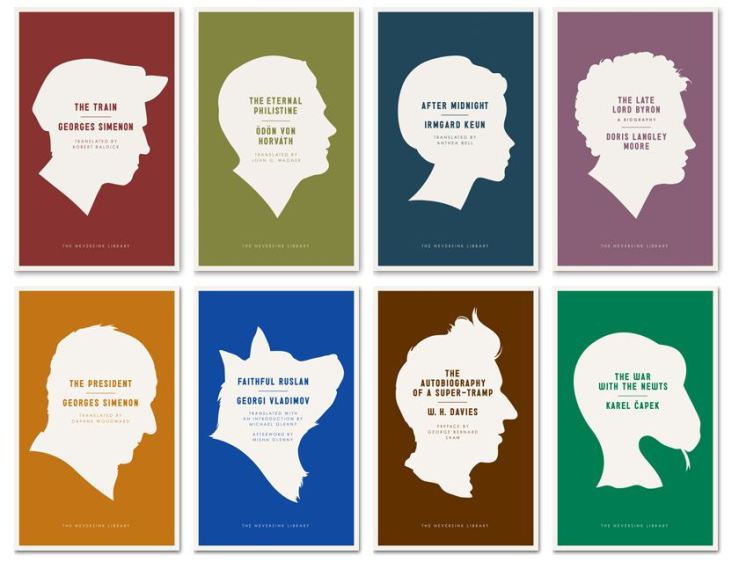
Best Book Series Design
Melville House’s Neversink Imprint
***
Weirdest (Yet Nevertheless Moving) Novel of 2011
How to Keep Your Volkswagen Alive, Chris Boucher
***
Book I Read in 2011 That Still Confounds and Haunts Me
The Kindly Ones, Jonathan Littell
***
Saddest Book I Read in 2011
Tie: Under the Volcano, Malcolm Lowry; The Stories of Breece D’J Pancake, Breece D’J Pancake
***
Best Essay (Print)
“Some Notes on Translation and on Madame Bovary,” Lydia Davis (The Paris Review)
***
Best Essay (Online)
“Nude in Your Hot Tub, Facing the Abyss (A Literary Manifesto After the End of Literature and Manifestos),” Lars Iyer (White Review)
***
Worst Literary Trend of 2011
Tie: Lame “literary fiction” novels; Articles that link everything to David Foster Wallace
***
Best Literary Trend of 2011
Plagiarism!
***
Most Obvious Disclaimer
I did not read or see or hear every book or essay or audiobook or film or TV show or record or video that came out in 2011. Also, there are some days left in the year. These are all, just like, opinions man.
“List of Troubles” — F. Scott Fitzgerald
F. Scott Fitzgerald’s “List of Troubles” (from his Notebooks)—
List of troubles
- Heart burn
- Eczema
- Piles
- Flu
- Night sweats
- Alcoholism
- Infected Nose
- Insomnia
- Ruined Nerves
- Chronic Cough
- Aching teeth
- Shortness of Breath
- Falling Hair
- Cramps in Feet
- Tingling Feet
- Constipation
- Cirocis of the liver
- Stomach ulcers
- Depression and Melancholia
Three (Somewhat Literary) Lists for 11 | 11 | 11
Eleven Authors Who Were Also Veterans of War
1. Stendahl (Napoleonic Wars)
2. Ambrose Bierce (Union Army, American Civil War)
3. Erich Maria Remarque (German Army, WWI)
4. George Orwell (Republican Army, Spanish Civil War)
5. Kurt Vonnegut (U.S. Army, WWII)
6. Joseph Heller (U.S. Air Force, WWII)
7. Eveyln Waugh (British Royal Marines, WWII)
8. Norman Mailer (U.S Army, WWII)
9. Gore Vidal (U.S. Army, WWII)
10. Tim O’Brien (U.S. Army, Vietnam War)
11. Anthony Swofford (U.S. Marine Corps, Persian Gulf War)
* * *
Eleven Encyclopedic Books, Overstuffed with References, That Compel Compulsive Reading
2. Finnegans Wake, James Joyce
3. Expelled from Eden, A WilliamVollmann Reader
4. Species of Spaces and Other Pieces, Georges Perec
5. Wittgenstein’s Mistress, David Markson
6. The Silmarillion, J.R.R. Tolkien
7. Foucault’s Pendulum, Umberto Eco
8. The Rings of Saturn, W.G. Sebald
9. The Recognitions, William Gaddis
10. Between Parentheses, Roberto Bolaño
11. The Architecture of the Arkansas Ozarks, Donald Harrington
* * *
Eleven Excellent Films About Films and Film-making
1. Hearts of Darkness, Eleanor Coppola, et al
2. Lost in La Mancha, Keith Fulton et al
3. Burden of Dreams, Les Blank
4. Adaptation, Spike Jonze
5. Be Kind Rewind, Michel Gondry
6. The Player, Robert Altman
7. Ed Wood, Tim Burton
8. Stardust Memories, Woody Allen
9. Sullivan’s Travels, Preston Sturges
10. American Movie, Chris Smith
11. Barton Fink, Coen Brothers
Seven Horror Stories Masquerading In Other Genres
We often identify genre simply by its conventions and tropes, and, when October rolls round and we want scary stories, we look for vampires and haunted houses and psycho killers and such. And while there’s plenty of great stuff that adheres to the standard conventions of horror (Lovecraft and Poe come immediately to mind) let’s not overlook novels that offer horror just as keen as any genre exercise. Hence: Seven horror novels masquerading in other genres:
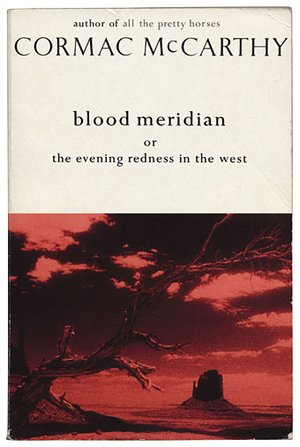
Blood Meridian — Cormac McCarthy
In my review (link above), I called Blood Meridian “a blood-soaked, bloodthirsty bastard of a book.” The story of the Glanton gang’s insane rampage across Mexico and the American Southwest in the 1850s is pure horror. Rape, scalping, dead mules, etc. And Judge Holden. . . [shivers].
Rushing to Paradise — J.G. Ballard
On the surface, Ballard’s 1994 novel Rushing to Paradise seems to be a parable about the hubris of ecological extremism that would eliminate humanity from any natural equation. Dr. Barbara and her band of misfit environmentalists try to “save” the island of St. Esprit from France’s nuclear tests. The group eventually begin living in a cult-like society with Dr. Barbara as its psycho-shaman center. As Dr. Barbara’s anti-humanism comes to outweigh any other value, the island devolves into Lord of the Flies insanity. Wait, should Lord of the Flies be on this list?
Okay. I know. This book ends up on every list I write. What can I do?
While there’s humor and pathos and love and redemption in Bolaño’s masterwork, the longest section of the book, “The Part about the Crimes,” is an unrelenting catalog of vile rapes, murders, and mutilations that remain unresolved. The sinister foreboding of 2666‘s narrative heart overlaps into all of its sections (as well as other Bolaño books); part of the tension in the book–and what makes Bolaño such a gifted writer–is the visceral tension we experience when reading even the simplest incidents. In the world of 2666, a banal episode like checking into a motel or checking the answering machine becomes loaded with Lynchian dread. Great horrific stuff.
King Lear — William Shakespeare
Macbeth gets all the propers as Shakespeare’s great work of terror (and surely it deserves them). But Lear doesn’t need to dip into the stock and store of the supernatural to achieve its horror. Instead, Shakespeare crafts his terror at the familial level. What would you do if your ungrateful kids humiliated you and left you homeless on the heath? Go a little crazy, perhaps? And while Lear’s daughters Goneril and Regan are pure mean evil, few characters in Shakespeare’s oeuvre are as crafty and conniving as Edmund, the bastard son of Glouscester. And, lest I forget to mention, Lear features shit-eating, self-mutilation, a grisly tableaux of corpses, and an eye-gouging accompanied by one of the Bard’s most enduring lines: “Out vile jelly!” Peter Brook chooses to elide the gore in his staging of that infamous scene:
The Trial — Franz Kafka
Kafka captured the essential alienation of the modern world so well that we not only awarded him his own adjective, we also tend to forget how scary his stories are, perhaps because of their absurd familiarity. None surpasses his unfinished novel The Trial, the story of hapless Josef K., a bank clerk arrested by unknown agents for an unspecified crime. While much of K.’s attempt to figure out just who is charging him for what is hilarious in its absurdity, its also deeply dark and really creepy. K. attempts to find some measure of agency in his life, but is ultimately thwarted by forces he can’t comprehend–or even see for that matter. Nowhere is this best expressed than in the famous “Before the Law” episode. If you’re too lazy to read it, check out his animation with narration by the incomparable Orson Welles:
In my original review of Sanctuary (link above), I noted that “if you’re into elliptical and confusing depictions of violence, drunken debauchery, creepy voyeurism, and post-lynching sodomy, Sanctuary just might be the book for you.” There’s also a corn-cob rape scene. The novel is about the kidnapping and debauching of Southern belle Temple Drake by the creepy gangster Popeye–and her (maybe) loving every minute of it. The book is totally gross. I got off to a slow start with Faulkner. If you take the time to read the full review above (in which I make some unkind claims) please check out my retraction. In retrospect, Sanctuary is a proto-Lynchian creepfest, and one of the few books I’ve read that has conveyed a total (and nihilistic) sense of ickiness.
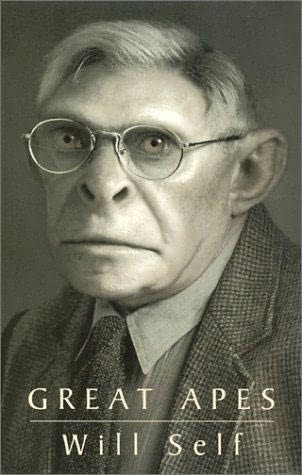
Great Apes — Will Self
Speaking of ickiness…Self’s 1997 novel Great Apes made me totally sick. Nothing repulses me more than images of chimpanzees dressed as humans and Great Apes is the literary equivalent (just look at that cover). After a night of binging on coke and ecstasy, artist Simon Dykes wakes up to find himself in a world where humans and apes have switched roles. Psychoanalysis ensues. While the novel is in part a lovely satire of emerging 21st-century mores, its humor doesn’t outweigh its nightmare grotesquerie. Great Apes so deeply affected us that I haven’t read any of Self’s work since.
[Ed. note: This post is a few years old. We run it again for Halloween and will run a follow up post later today].
William T. Vollmann’s Favorite “Contemporary” Books
In a 1990 interview between William T. Vollmann and one of his editors Larry McCaffery. An excerpt from the interview appears as a list in the Vollmann reader Expelled from Eden, which is quickly becoming one of my favorite books (seriously, let’s have another volume—this is clearly the optimum Vollmann delivery system). I’ve kept Expelled from Eden’s list format because, hey, let’s face it, we like lists—
LM: Who are your favorite contemporary authors?
WV: By “contemporary” I assume you mean “from the last two hundred years.”
1./2./3. Right now it seems like I’ve learned a lot from Mishima, Kawabata, and Tolstoy;
4. Hawthorne may be the best;
5. Then Faulkner;
6. Hemingway is usually a wonderful read, especially Islands in the Stream and For Whom the Bell Tolls—that is to say, the grandly suicidal narratives;
7. Tadeusz Konwicki’s A Dreambook for Our Time is beautiful;
8. I also love everything I’ve read by Mir Lagerkvist;
9. Sigrid Undset’s trilogy Kristin Lavransdatter;
10. Multatuli’s Max Havalaar, or the Coffee Auctions of the Dutch Trading Company;
11. Kundera’s Laughable Loves;
12. Andrea Freud Lowenstein’s This Place (which deserves more recognition than it has received);
13. Jane Smiley’s The Greenlanders (which I had the wonderful experience of finding and reading a few months after completing my own book about Greenlanders, The Ice-Shirt).
14. Evans and Agee’s Let Us Now Praise Famous Men;
15. Farley Mowat’s The People of the Deer;
16. The first three books of Mishima’s Sea of Fertility tetralogy (how could I have forgotten that?);
17. Random bits of Proust, Zola’sL’Assommoir;
18. Shusaku Endo’s The Samurai;
19.The first two books of Mervyn Peake’s Gormenghast trilogy;
20. William Hope Hodgson’s The Night Land;
21. Poe’s stories about love;
22. Everything by Malraux (especially his Anti-Memoirs);
23. Nabokov’s Glory and Transparent Things and Ada;
24. Melville’s Pierre;
25. Thomas Bernhard’s Correction;
26. David Lindsay’s Voyage to Acturus;
27. Philip K. Dick’s A Scanner Darkly;
28. A few of Boll’s short novels (Wo warst du, Adam? and The Train Was on Time);
29. Elsa Morante’s History: A Novel;
30. Maria Dermout’s The Ten Thousand Things;
31. Walter M. Miller’s A Canticle for Leibowitz;
32. James Blish’s Cities in Flight tetralogy (which is just plane fun);
33. The first three volumes of Lawrence Durrell’sAlexandria Quartet, and I don’t know what all.
There’s lots more. I am sorry not to be able to put down less contemporary things such as Tale of Genji, which is one of my all-time favorites.
“List of Social Changes that Would Assist the Flourishing of Literary Beauty” — William T. Vollmann
“List of Social Changes that Would Assist the Flourishing of Literary Beauty” by William T. Vollmann. Originally published in his essay, “Something to Die For” (Review of Contemporary Fiction) but excised here from Expelled from Eden, the Vollmann reader I’m finding addictive—-
1. Abolish television, because it has no reverence for time.
2. Abolish the automobile, because it has no reverence for space.
3. Make citizenship contingent upon literacy in every sense. Thus, politicians who do not write every word of their own speeches should be thrown out of office in disgrace. Writers who require editors to make their books “good” should be depublished.
4. Teach reverence for all beauty, including that of the word.
Three Literary Lists for 10-10-10
You may have noticed (and probably don’t care) that today is October 10, 2010, 0r 10/10/10 (or 10.10.10, or 10-10-10, or whatever iteration you prefer). But some people like lists. So, with very little thought put into the process, here are three literary lists to celebrate 10 Oct. 10–
Ten Ridiculous Character Names
1. Stephen Dedalus (A Portrait of the Artist as a Young Man and Ulysses, James Joyce. Even Stephen ponders how ridiculous and overdetermined his name is)
2. Major Major Major Major (Catch-22, Joseph Heller)
3. Bilbo Baggins (The Hobbit and The Lord of the Rings, J.R.R. Tolkien. Sure, he’s a hobbit, but “Bilbo Baggins” is still pretty much off the silly scale)
4. Brackett Omensetter (Omensetter’s Luck, William Gass)
5. Horselover Fat (VALIS, Philip K. Dick)
6. Milkman Dead (Song of Solomon, Toni Morrison)
7. Humbert Humbert (Lolita, Vladimir Nabokov)
8. Lionel Essrog (Motherless Brooklyn, Jonathan Lethem)
9. Tie: Wang-Dang Lang/Peter Abbott/Candy Mandible/Judith Prietht/Biff Diggerance (David Foster Wallace suffers from Pynchon-fever in his début novel, Broom of the System)
10. Tie: Benny Profane/Oedipa Maas/Tyrone Slothrop/Zoyd Wheeler/Rev. Wicks Cherrycoke et al. — (Various novels by Thomas Pynchon. Yes, Pynchon should probably get his own list)
Ten Excellent Dystopian/Post-apocalyptic Novels That Aren’t Brave New World or 1984
1. Riddley Walker, Russell Hoban
2. Camp Concentration, Thomas Disch
3. A Clockwork Orange, Anthony Burgess
4. Oryx and Crake and The Year of the Flood, Margaret Atwood
5. The Hospital Ship, Martin Bax
6. Naked Lunch, William S. Burroughs
7. VALIS, Philip K. Dick
8. Ronin, Frank Miller
9. Ape and Essence, Aldous Huxley
10. The Road and Blood Meridian, Cormac McCarthy
Ten Movies Better Than or Equal to the Books On Which They Were Based
1. The Godfather
2. The Shining
3. The Thin Red Line
4. Children of Men
5. Harry Potter and the Prisoner of Azkaban
6. Trainspotting
7. No Country for Old Men
8. The Grapes of Wrath
9. There Will Be Blood
10. Jaws
The Believer’s 2010 Reader Survey: (What Some Jokers Thought Were) The Best Books of 2009
The Believer‘s annual reader survey is always kinda sorta interesting. Here’s the top 20; linked titles go to Biblioklept reviews:
- Buffalo Lockjaw—Greg Ames
- Everything Ravaged, Everything Burned—Wells Tower
- Let the Great World Spin—Colum McCann
- Invisible—Paul Auster
- A Gate at the Stairs—Lorrie Moore
- Inherent Vice—Thomas Pynchon
- Juliet, Naked—Nick Hornby
- Chronic City—Jonathan Lethem
- Wolf Hall—Hilary Mantel
- The Anthologist—Nicholson Baker
- Await Your Reply—Dan Chaon
- Ablutions—Patrick deWitt
- The Interrogative Mood—Padgett Powell
- The Financial Lives of the Poets—Jess Walter
- This Is Where I Leave You—Jonathan Tropper
- Sag Harbor—Colson Whitehead
- The Way Through Doors—Jesse Ball
- The Children’s Book—A. S. Byatt
- Summertime—J. M. Coetzee
- The Selected Works of T. S. Spivet—Reif Larsen
Read the rest of the list–honorable mentions–here. Read Biblioklept’s Best of 2009 list here.
The Believer Book Award Editors’ Shortlist Announced
The new issue of The Believer popped up in the mail today (just as I’m finishing up the art issue from way back in November). This issue announces the editors’ short list, full of books I haven’t read. Here’s the list with editors’ comments (from their website):
Christopher Miller, “The Cardboard Universe: A Guide to the World of Phoebus K. Dank” (Harper Perennial)
Miller’s second novel is a delight: an antic encyclopedia, a remarkably sustained (five-hundred-plus-page) riff on the life and work of Philip K. Dick, a Day-Glo Pale Fire, and maybe the best pure comic novel of the year. Dueling annotators pick over the writings of the late Phoebus K. Dank, endlessly drawing and erasing the line between genius and hack.Percival Everett, “I Am Not Sidney Poitier” (Graywolf)
With more than twenty books to his name, Percival Everett is not only one of the most prolific modern American writers, but one of the most diverse, tackling just about every genre there is, and freely mixing them. He is also one of our best: I Am Not Sidney Poitier is further proof of that. Not Sidney is the name of the modest, unflappable protagonist, who happens to inherit wealth at an early age and winds up spending a lot of time with Ted Turner. Race, class, TBS, the films of Sidney Poitier, and the value of a college education are but some of the themes. It’s also funny as hell.Mary Robison, “One D.O.A., One on the Way” (Counterpoint)
Eve Broussard is a Hollywood location scout in her post-apocalyptic hometown of New Orleans. Her experience in this profession is matched only by her cynicism. Eve is married to Adam Broussard, who has inherited land and money, is chronically ill, and has an identical (and mostly interchangeable) twin brother, Saunders. With Eve as our guide, we ride shotgun through kudzu-laden landscapes, bourbon-drenched love affairs, and an education in Louisiana gun laws. Robison’s ultraterse “chapters” and deadpan dialogue create a visceral New Orleans, and the effect of a morning-after Southern gothic.Blake Butler, “Scorch Atlas” (featherproof)
Like the best sur-reality, Butler’s alien world is made from the building blocks of everyday life—rooms filled with hair and “teeth that wouldn’t fit inside a car.” His novels and stories are linguistically twisted dispatches from a half-house, half-body in which the author himself seems to be imprisoned. While he struggles to escape into the outside world, he remains obsessed with what’s at the end of the next abysmal hallway.Padgett Powell, “The Interrogative Mood” (Ecco)
Padgett Powell’s newest novel is unlike his past novels, and is unlike any novel—every sentence in this 164-page book is a question directed at “you.” Prying, intimate, damning, insulting, inane, and innocent are these inquisitions. What at first might strike as a literary gimmick, impossible to sustain, becomes (as “you” surrender to it) an act of intense private meditation, as well as a flagrantly solipsistic display of your most private self.
Heroes of 2009







-
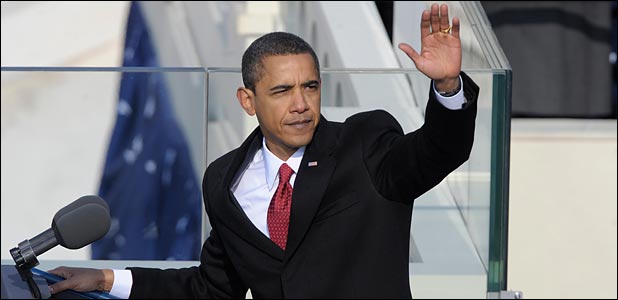
BARRY MIGHT NOT WALK ON WATER BUT HIS INAUGURATION BROUGHT TEARS TO OUR EYES
(An Incomplete List of) Writers Who Died in 2009
John Updike
Blair Lent
Hortense Calisher
John Mortimer
Philip José Farmer
James Purdy
Billy C. Clark
Horton Foote
Santha Rama Rau
J.G. Ballard
Eve Kosofsky Sedgwick
Bob Hamm
Tim Guest
Gordon Burn
Frank McCourt
Stanley Middleton
E. Lynn Harris
Jim Carroll
Keith Waterhouse
William Safire
William Hoffman
Lionel Davis
Norma Fox Mazer
Claude Lévi-Strauss
Raymond Federman
Christopher Anvil
Robert Holdstock
D0nald Harington
Stephen Toulmin
Milorad Pavić
The Best Books We Abandoned in 2009
It’s an old story. Or maybe it’s just a common story. Anyway, Biblioklept World Headquarters, as one might reasonably expect, is larded with books, bursting at metaphorical seams, etc. Bibliophilia, that terrible disease, drives us to buy new (and old books) with a ridiculous frequency, a frequency that could never match a realistic able-to-be-read-in-the-allotted-time-we-have-to-read matrix. The Biblioklept Mission to review new books ironically compounds this problem. Advance review copies and galleys arrive, solicited or no, with publication dates stamped boldly on publicity sheets, publication dates that remind the reviewer that timeliness matters, that a Serious Editor would get out reviews in a Timely Manner. So. What happens? You know what happens, dear reader: books begun with the best intentions are brushed aside for just a week so that forthcoming novels might be appraised; but rhythm is lost; narrative drops away. We lose the thread. And before you know it, another set of new books crowds the doorstep. The following books were all great, in so far as we got into them, and we will do our best to finish them sometime in the near future.
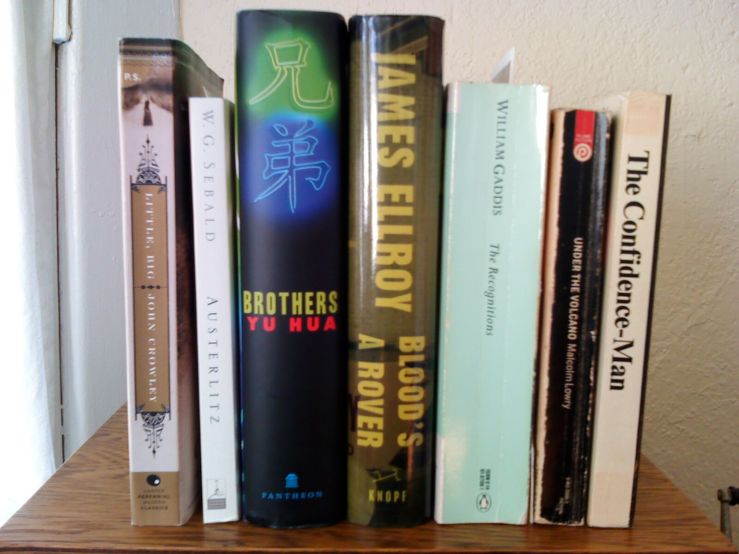
The Recognitions — William Gaddis
We had the foresight to review the first book of this massive, massive novel. The first chapter is probably the best thing we read all year, but the book seemed to lose some of that initial energy, instead settling into a frustrating and ungenerous rhythm. But there we go, blaming the book, when its difficulty was also very rewarding. It’s embarrassing really. We read 342 of the book’s 956 pages and then turned our attention, for just a second, to a few new paperbacks, and poof! — we lost it.
The Confidence Man — Herman Melville
We got about 50 pages into the Norton annotated edition we found for a dollar at the Friends of the Library sale. And that was that. Will try again in 2010.
Under the Volcano — Malcolm Cowley
We’d been wanting to read this for awhile now, after reading David Foster Wallace cite it as a special kind of book, or a book that needed to be read (or maybe he said it was a book that people needed to be made to read . . . Hang on, was it even Wallace who told us to read it?) Abandoned about 30 pages in.
Little, Big — John Crowley
Little, Big is the one on this list that we’ll take for granted is as good as everyone says it is. We tried to read it with the AV Club’s book club, Wrapped Up In Books, but no. Harold Bloom says it’s one of his favorites, too. We got about 60 pages in, but it wasn’t exactly compelling, and Crowley’s rhetorical style was kinda infuriating in its contrived simplicity. The only book on this list we willingly put down.
Brothers — Yu Hua
We got over 100 pages into this ribald satire, but again, put it down to read a book about the moral panic comic books inspired. Probably the best unsolicited review copy we got this year. We should really go pick it up again . . .
Blood’s A Rover — James Ellroy
We read a 100 pages of Blood’s A Rover and then challenged traditional ethical notions of book reviewery and posted a review. We continued to read and then–viola!–the audiobook version came out. So, depending on how you view these things, we either technically did or did not abandon this fine crime procedural.
Austerlitz — W.G. Sebald
Oh the shame of it all. Stuck 158 pages into Sebald’s 298 page chronicle of the displaced orphan Austerlitz. The bookmark’s still there and everything. We read most of those 158 pages in two afternoon sittings. Then some book or other arrived (two, actually: Lethem’s Chronic City and Fallada’s Every Man Dies Alone). Sebald’s The Rings of Saturn is easily one of our favorite books, but it was divided into, y’know, paragraphs, sections, and chapters. Austerlitz is not–not even paragraphs. There are Sebald’s trademark black and white photos to occasionally break up the text, but otherwise, no, just long, long, chunks of texts that diverge and move through space, time, and voices. And while the book is very good, it also requires sustained concentration. It doesn’t want you cheating on it with another book. It’s quite selfish. But there are still a few days left in the year, and perhaps we’ll finish it one afternoon–although a quick glance over page 158 reveals that we are stuck in the text’s inertia.
 Biblioklept