“The Shot” — Alexander Pushkin

“The Shot” by Alexander Pushkin

We were stationed in the little town of N—-. The life of an officer in the army is well known. In the morning, drill and the riding-school; dinner with the Colonel or at a Jewish restaurant; in the evening, punch and cards. In N—- there was not one open house, not a single marriageable girl. We used to meet in each other’s rooms, where, except our uniforms, we never saw anything.

One civilian only was admitted into our society. He was about thirty-five years of age, and therefore we looked upon him as an old fellow. His experience gave him great advantage over us, and his habitual taciturnity, stern disposition and caustic tongue produced a deep impression upon our young minds. Some mystery surrounded his existence; he had the appearance of a Russian, although his name was a foreign one. He had formerly served in the Hussars, and with distinction. Nobody knew the cause that had induced him to retire from the service and settle in a wretched little village, where he lived poorly and, at the same time, extravagantly. He always went on foot, and constantly wore a shabby black overcoat, but the officers of our regiment were ever welcome at his table. His dinners, it is true, never consisted of more than two or three dishes, prepared by a retired soldier, but the champagne flowed like water. Nobody knew what his circumstances were, or what his income was, and nobody dared to question him about them. He had a collection of books, consisting chiefly of works on military matters and a few novels. He willingly lent them to us to read, and never asked for them back; on the other hand, he never returned to the owner the books that were lent to him. His principal amusement was shooting with a pistol. The walls of his room were riddled with bullets, and were as full of holes as a honey-comb. A rich collection of pistols was the only luxury in the humble cottage where he lived. The skill which he had acquired with his favourite weapon was simply incredible; and if he had offered to shoot a pear off somebody’s forage-cap, not a man in our regiment would have hesitated to place the object upon his head.

Our conversation often turned upon duels. Silvio — so I will call him — never joined in it. When asked if he had ever fought, he drily replied he had; but he entered into no particulars, and it was evident that such questions were not to his liking. We came to the conclusion that he had upon his conscience the memory of some unhappy victim of his terrible skill. Moreover, it never entered into the head of any of us to suspect him of anything like cowardice. There are persons whose mere look is sufficient to repel such a suspicion. But an unexpected incident occurred which astounded us all.

One day, about ten of our officers dined with Silvio. They drank as usual, that is to say, a great deal. After dinner we asked our host to hold the bank for a game at faro. For a long time he refused, for he hardly ever played, but at last he ordered cards to be brought, placed half a hundred ducats upon the table, and sat down to deal. We took our places round him, and the play began. It was Silvio’s custom to preserve a complete silence when playing. He never disputed, and never entered into explanations. If the punter made a mistake in calculating, he immediately paid him the difference or noted down the surplus. We were acquainted with this habit of his, and we always allowed him to have his own way; but among us on this occasion was an officer who had only recently been transferred to our regiment. During the course of the game, this officer absently scored one point too many. Silvio took the chalk and noted down the correct account according to his usual custom. The officer, thinking that he had made a mistake, began to enter into explanations. Silvio continued dealing in silence. The officer, losing patience, took the brush and rubbed out what he considered was wrong. Silvio took the chalk and corrected the score again. The officer, heated with wine, play, and the laughter of his comrades, considered himself grossly insulted, and in his rage he seized a brass candlestick from the table, and hurled it at Silvio, who barely succeeded in avoiding the missile. We were filled with consternation. Silvio rose, white with rage, and with gleaming eyes, said:

“My dear sir, have the goodness to withdraw, and thank God that this has happened in my house.” Continue reading ““The Shot” — Alexander Pushkin”

“Flight” — John Steinbeck

“Flight” by John Steinbeck

Out fifteen miles below Monterey, on the wild coast, the Torres family had their farm, a few sloping acres above a cliff that dropped to the brown reefs and to the hissing white waters of the ocean. Behind the farm the stone mountains stood up against the sky. The farm buildings huddled like the clinging aphids on the mountain skirts, crouched low to the ground as though the wind might blow them into the sea. The little shack, the rattling, rotting barn were gray-bitten with sea salt, beaten by the damp wind until they had taken on the color of the granite hills. Two horses, a red cow and a red calf, half a dozen pigs and a flock of lean, multicolored chickens stocked the place. A little corn was raised on the sterile slope, and it grew short and thick under the wind, and all the cobs formed on the landward sides of the stalks.

Mama Torres, a lean, dry woman with ancient eyes, had ruled the farm for ten years, ever since her husband tripped over a stone in the field one day and fell full length on a rattlesnake. When one is bitten on the chest there is not much that can be done.

Mama Torres had three children, two undersized black ones of twelve and fourteen, Emilio and Rosy, whom Mama kept fishing on the rocks below the farm when the sea was kind and when the truant officer was in some distant part of Monterey County. And there was Pepe, the tall smiling son of nineteen, a gentle, affectionate boy, but very lazy. Pepe had a tall head, pointed at the top, and from its peak coarse black hair grew down like a thatch all around. Over his smiling little eyes Mama cut a straight bang so he could see. Pepe had sharp Indian cheekbones and an eagle nose, but his mouth was as sweet and shapely as a girl’s mouth, and his chin was fragile and chiseled. He was loose and gangling, all legs and feet and wrists, and he was very lazy. Mama thought him fine and brave, but she never told him so. She said, “Some lazy cow must have got into thy father’s family, else how could I have a son like thee.” And she said, “When I carried thee, a sneaking lazy coyote came out of the brush and looked at me one day. That must have made thee so.”

Pepe smiled sheepishly and stabbed at the ground with his knife to keep the blade sharp and free from rust. It was his inheritance, that knife, his father’s knife. The long heavy blade folded back into the black handle. There was a button on the handle. When Pepe pressed the button, the blade leaped out ready for use. The knife was with Pepe always, for it had been his father’s knife.

One sunny morning when the sea below the cliff was glinting and blue and the white surf creamed on the reef, when even the stone mountains looked kindly, Mama Torres called out the door of the shack, “Pepe, I have a labor for thee.”

There was no answer. Mama listened. From behind the barn she heard a burst of laughter. She lifted her full long skirt and walked in the direction of the noise.

Pepe was sitting on the ground with his back against a box. His white teeth glistened. On either side of him stood the two black ones, tense and expectant. Fifteen feet away a redwood post was set in the ground. Pepe’s right hand lay limply in his lap, and in the palm the big black knife rested. The blade was closed back into the handle. Pepe looked smiling at the sky.

Suddenly Emilio cried, “Ya!”

Pepe’s wrist flicked like the head of a snake. The blade seemed to fly open in midair, and with a thump the point dug into the redwood post, and the black handle quivered. The three burst into excited laughter. Rosy ran to the post and pulled out the knife and brought it back to Pepe. He closed the blade and settled the knife carefully in his listless palm again. He grinned self-consciously at the sky.

“Ya! ”

The heavy knife lanced out and sunk into the post again. Mama moved forward like a ship and scattered the play. Continue reading ““Flight” — John Steinbeck”

Don Quixote, Sancho Panza and the Dead Mule — Honore Daumier

Patricio Pron Novel (Book Acquired, 5.08.2013)

pron

I got a review copy of My Father’s Ghost Is Climbing in the Rain, the first novel from Patricio Pron a few days ago and wandered into it a bit yesterday afternoon but then got distracted by something else. Anybody read this one—or anything by Pron? Curious what you think…

From a Granta interview:

Name the five writers you most admire at the moment (any period, language or genre).

David Foster Wallace, Vladimir Nabokov, Flannery O’Connor, W. G. Sebald, Roberto Bolaño.

Here is publisher Knopf’s blurb for My Father’s Ghost Is Climbing in the Rain:

The anticipated American debut of one of Granta’s Best Young Spanish-Language Novelists: a daring, deeply affecting novel about the secrets buried in the past of an Argentine family.

A young writer, living abroad, makes the journey home to South America to say good-bye to his dying father. In his parents’ house, he finds a cache of documents—articles, maps, photographs—and unwittingly begins to unearth his father’s obsession with the disappearance of a local man. Suddenly he comes face-to-face with the ghosts of Argentina’s dark political past and with the long-hidden memories of his family’s underground resistance against an oppressive military regime. As the fragments of the narrator’s investigation fall into place—revealing not only a part of his father’s life he had tried to forget but also the legacy of an entire generation—this audacious novel tells a completely original story of corruption and responsibility, history and remembrance.

You can also read “Ideas,” a story by Pron published in The Paris Review, which I think is an excerpt from the book. First paragraph:

On April 16, 1981, at approximately three P.M., little Peter Möhlendorf, whom everyone called der schwarze Peter, “black Peter,” went home from the village school. His house was on the eastern edge of Sterberode, a town of some five thousand inhabitants outside the East German town of Magdeburg whose main economic activity is farming—asparagus, mostly. His father, who was in the basement of the house when little Möhlendorf arrived, would later say that he heard him come in and then could infer from the sounds in the kitchen, which was above the basement, what he was doing: he flung his backpack beneath the staircase landing, went to the kitchen, took a carton of milk out of the refrigerator, and poured himself a glass, which he drank standing; then he put the carton back in the refrigerator and went out into the backyard. Anyway, that was what he did every day when he came home from school and it could be that his father hadn’t really heard the noises he later would say he heard but rather had heard Peter come home and from that had guessed the rest of the series of actions. However, what his father did not know, as he listened or thought he listened to the noises his son was making above his head, was that little Peter was not going to return home that night or the nights that would follow, and that something incomprehensible and frightening was going to open up before him and the rest of the townspeople, and it would swallow everything up.

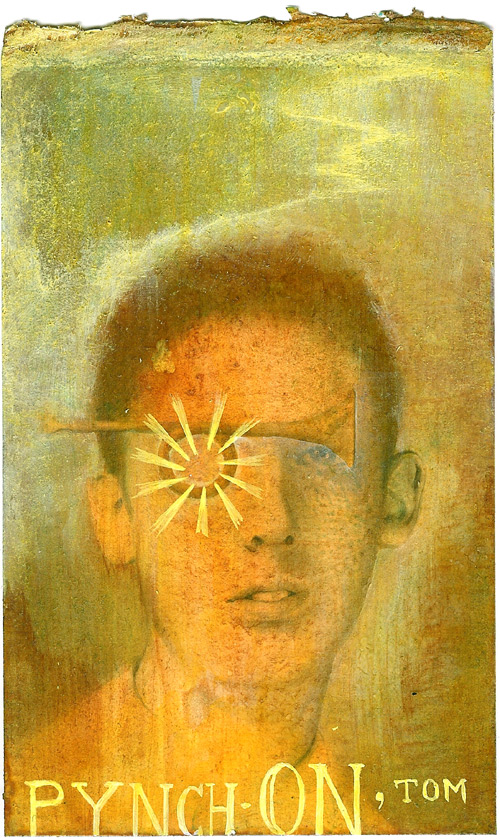
Thomas Pynchon Portrait — James Jean

James Jean does Thomas Pynchon. (Via Hey Oscar Wilde!).

“An Ideal Family” — Katherine Mansfield

“An Ideal Family” by Katherine Mansfield

That evening for the first time in his life, as he pressed through the swing door and descended the three broad steps to the pavement, old Mr. Neave felt he was too old for the spring. Spring—warm, eager, restless—was there, waiting for him in the golden light, ready in front of everybody to run up, to blow in his white beard, to drag sweetly on his arm. And he couldn’t meet her, no; he couldn’t square up once more and stride off, jaunty as a young man. He was tired and, although the late sun was still shining, curiously cold, with a numbed feeling all over. Quite suddenly he hadn’t the energy, he hadn’t the heart to stand this gaiety and bright movement any longer; it confused him. He wanted to stand still, to wave it away with his stick, to say, “Be off with you!” Suddenly it was a terrible effort to greet as usual—tipping his wide-awake with his stick—all the people whom he knew, the friends, acquaintances, shopkeepers, postmen, drivers. But the gay glance that went with the gesture, the kindly twinkle that seemed to say, “I’m a match and more for any of you”—that old Mr. Neave could not manage at all. He stumped along, lifting his knees high as if he were walking through air that had somehow grown heavy and solid like water. And the homeward-looking crowd hurried by, the trams clanked, the light carts clattered, the big swinging cabs bowled along with that reckless, defiant indifference that one knows only in dreams…

It had been a day like other days at the office. Nothing special had happened. Harold hadn’t come back from lunch until close on four. Where had he been? What had he been up to? He wasn’t going to let his father know. Old Mr. Neave had happened to be in the vestibule, saying good-bye to a caller, when Harold sauntered in, perfectly turned out as usual, cool, suave, smiling that peculiar little half-smile that women found so fascinating.

Ah, Harold was too handsome, too handsome by far; that had been the trouble all along. No man had a right to such eyes, such lashes, and such lips; it was uncanny. As for his mother, his sisters, and the servants, it was not too much to say they made a young god of him; they worshipped Harold, they forgave him everything; and he had needed some forgiving ever since the time when he was thirteen and he had stolen his mother’s purse, taken the money, and hidden the purse in the cook’s bedroom. Old Mr. Neave struck sharply with his stick upon the pavement edge. But it wasn’t only his family who spoiled Harold, he reflected, it was everybody; he had only to look and to smile, and down they went before him. So perhaps it wasn’t to be wondered at that he expected the office to carry on the tradition. H’m, h’m! But it couldn’t be done. No business—not even a successful, established, big paying concern—could be played with. A man had either to put his whole heart and soul into it, or it went all to pieces before his eyes… Continue reading ““An Ideal Family” — Katherine Mansfield”

In Lieu of Original Content This Week, Here Are Three Books I’m Keen On, Presented Without Comment

IMG_5647

“Grace” — James Joyce

“Grace” by James Joyce

TWO GENTLEMEN who were in the lavatory at the time tried to lift him up: but he was quite helpless. He lay curled up at the foot of the stairs down which he had fallen. They succeeded in turning him over. His hat had rolled a few yards away and his clothes were smeared with the filth and ooze of the floor on which he had lain, face downwards. His eyes were closed and he breathed with a grunting noise. A thin stream of blood trickled from the corner of his mouth.

These two gentlemen and one of the curates carried him up the stairs and laid him down again on the floor of the bar. In two minutes he was surrounded by a ring of men. The manager of the bar asked everyone who he was and who was with him. No one knew who he was but one of the curates said he had served the gentleman with a small rum.

“Was he by himself?” asked the manager.

“No, sir. There was two gentlemen with him.”

“And where are they?”

No one knew; a voice said:

“Give him air. He’s fainted.”

The ring of onlookers distended and closed again elastically. A dark medal of blood had formed itself near the man’s head on the tessellated floor. The manager, alarmed by the grey pallor of the man’s face, sent for a policeman.

His collar was unfastened and his necktie undone. He opened eyes for an instant, sighed and closed them again. One of gentlemen who had carried him upstairs held a dinged silk hat in his hand. The manager asked repeatedly did no one know who the injured man was or where had his friends gone. The door of the bar opened and an immense constable entered. A crowd which had followed him down the laneway collected outside the door, struggling to look in through the glass panels.

The manager at once began to narrate what he knew. The constable, a young man with thick immobile features, listened. He moved his head slowly to right and left and from the manager to the person on the floor, as if he feared to be the victim of some delusion. Then he drew off his glove, produced a small book from his waist, licked the lead of his pencil and made ready to indite. He asked in a suspicious provincial accent:

“Who is the man? What’s his name and address?”

A young man in a cycling-suit cleared his way through the ring of bystanders. He knelt down promptly beside the injured man and called for water. The constable knelt down also to help. The young man washed the blood from the injured man’s mouth and then called for some brandy. The constable repeated the order in an authoritative voice until a curate came running with the glass. The brandy was forced down the man’s throat. In a few seconds he opened his eyes and looked about him. He looked at the circle of faces and then, understanding, strove to rise to his feet. Continue reading ““Grace” — James Joyce”

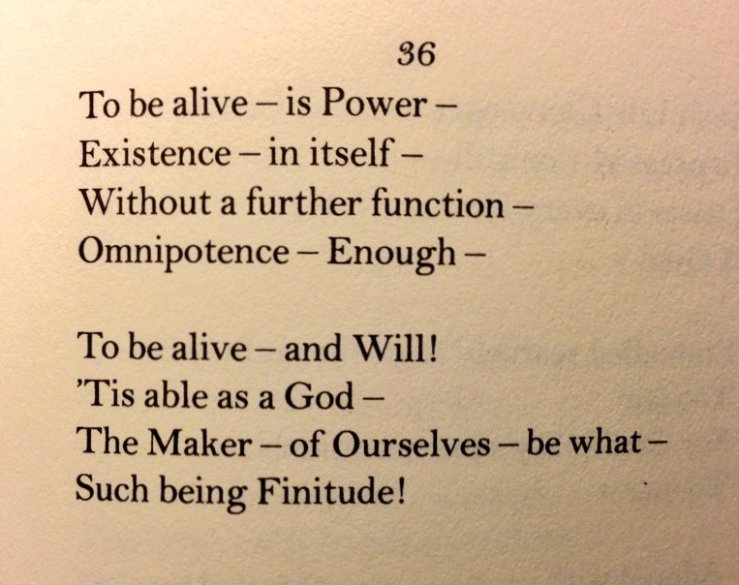
To be alive — is Power — (Emily Dickinson)

20130502-093439

Heavy Dreams (Sigizmund Krzhizhanovsky)

Quantin followed the procession for a few minutes out of morbid curiosity. The choice of narrower side streets, where it was easier to enlist the wall’s support, was probably deliberate, he thought, but then a long notice stuck to the stone exactly at eye level arrested his attention and, with it, his progress. The notice—in the manner of a proper, not overly pushy advertisement—listed the advantages ofso-called heavy dreams. Having come across the subject once before, Quantin read the fine print carefully, line by line: “The main advantage of the heavy industry of nightmares over the light industry of golden threads plunged into brain fibrils, over the production of so-called sweet dreams, is that in marketing our nightmares we can guarantee that they will come true, we can hand our customers ‘turnkey dreams.’ Sweet dreams cannot withstand reality, sleepy reveries wear out faster than socks; whereas a heavy dream, a simple but well-made nightmare, is easily assimilated by life. Where dreams unburdened by anything disappear like drops of water in the sand, dreams containing a certain harshness will, as they evaporate in the sun, leave a hard kernel on the roof of Plato’s famous cave: these dposits will collect and accrue, eventually forming a swordlike stalactite.

“Speaking in more modern terms,” the fine print went on, “our nightmares, weighing as they do on the brain, gradually form a sort of moral ceiling that is always about to come crashing down on one’s head: some of our customer’s call this ‘world history.’ But that’s not the point. The point is the durability, unwakeability, high depressiveness, and wide availability of our nightmares: mass-market products good for all eras and classes, nighttime and daytime, moonlight and sunlight, closed eyes and open.”

From Sigizmund Krzhizhanovsky’s short story “The Branch Line,” collected in NYRB’s Memories of the Future (translation by Joanne Turnbull).

Henry Miller/Georg Büchner (Books Acquired, 4.30.2013)

20130430-165618.jpg

Needing another book the same way I need another hole in the head, I nevertheless dropped by my local used bookstore to browse—the place is huge, and a day of grading term papers made me feel zapped and perhaps depressed. Anyway. Spotted a beautiful Penguin edition of Henry Miller’s The Colossus of Maroussi and had to have it. Here’s a passage some soul saw fit to dogear:

20130430-165623

I had never heard of Georg Büchner or his novella fragment Lenz, but it was shelved next to Blake Butler’s Scorch Atlas and both stood out because of their odd shapes.

20130430-165633.jpg

Here are the blurbs for Lenz, which more or less sold me:

20130430-165639.jpg

Finally, I did not buy yet another edition of Moby-Dick, despite this midcentury Rinheart cover—but I had to snap it to share:

20130430-165646.jpg


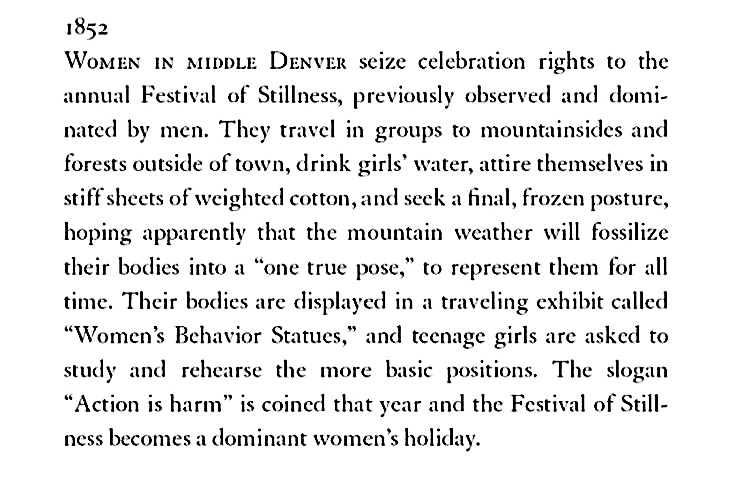
“1852” — Ben Marcus

Capture

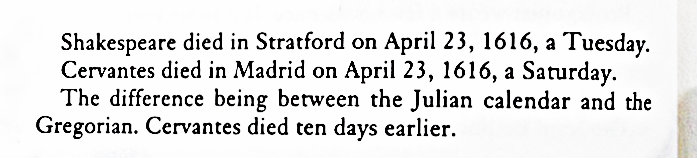
April 23, 1616 (David Markson)

dm


Novels That Will Be Considered the Most Important Literary Works of the Twentieth Century in the Year 2100 (According to Dalkey Archive)

Novels That Will Be Considered the Most Important Literary Works of the Twentieth Century in the Year 2100

Nightwood, Djuna Barnes
Malone Dies, Samuel Beckett
Molloy, Samuel Beckett
The Unnamable, Samuel Beckett
The Lime Works, Thomas Bernhard
Nostromo, Joseph Conrad
JR, William Gaddis
The Recognitions, William Gaddis
Ulysses, James Joyce
One Hundred Years of Solitude, Gabriel Garcia Marquez
At Swim-Two-Birds, Flann O’Brien
The Inquisitory, Robert Pinget
Remembrance of Things Past, Marcel Proust
Gravity’s Rainbow, Thomas Pynchon
Mulligan Stew, Gilbert Sorrentino

Speculative list from the Dalkey Archive (from an issue of their journal Context; compiled from responses  of “advisors at universities and bookstores”). I’m sure the fact that they publish several of these titles has nothing to do with these books’ inclusion. I’ve read all of seven of these, some of five of these, and none of three of these.

Tim O’Brien Documentary

“One must refute the author and vindicate oneself” (Sigizmund Krzhizhanovsky)

And an invented person makes the greatest impression, naturally, on the seemingly not-invented, real person who, upon finding his reflection in a book, feels replaced and redoubled. This person cannot forgive his feeling of double insult: here I, a real, not-invented person, shall go to my grave and nothingness in ten or twenty years, whereas this fabricated, not-real “almost I” shall go on living and living as though it were the most natural thing in the world; more unforgivable still is the awareness that someone, some author, made you up like an arithmetic problem, what’s more he figured you out, arrived at an answer over which you struggled your entire life in vain, he divined your existence without ever having met you, he penned his way into your innermost thoughts, which you tried so hard to hide from yourself. One must refute the author and vindicate oneself. At once!

From Sigizmund Krzhizhanovsky’s short story “Someone Else’s Theme,” collected in NYRB’s Memories of the Future.

Mutual Appreciation Society (David Markson)

Capture