“The Yellow Paint” — Robert Louis Stevenson


“The Yellow Paint,” a short fable by Robert Louis Stevenson—

In a certain city there lived a physician who sold yellow paint. This was of so singular a virtue that whoso was bedaubed with it from head to heel was set free from the dangers of life, and the bondage of sin, and the fear of death for ever. So the physician said in his prospectus; and so said all the citizens in the city; and there was nothing more urgent in men’s hearts than to be properly painted themselves, and nothing they took more delight in than to see others painted. There was in the same city a young man of a very good family but of a somewhat reckless life, who had reached the age of manhood, and would have nothing to say to the paint: “Tomorrow was soon enough,” said he; and when the morrow came he would still put it off. She might have continued to do until his death; only, he had a friend of about his own age and much of his own manners; and this youth, taking a walk in the public street, with not one fleck of paint upon his body, was suddenly run down by a water-cart and cut off in the heyday of his nakedness. This shook the other to the soul; so that I never beheld a man more earnest to be painted; and on the very same evening, in the presence of all his family, to appropriate music, and himself weeping aloud, he received three complete coats and a touch of varnish on the top. The physician (who was himself affected even to tears) protested he had never done a job so thorough.

Some two months afterwards, the young man was carried on a stretcher to the physician’s house.

“What is the meaning of this?” he cried, as soon as the door was opened. “I was to be set free from all the dangers of life; and here have I been run down by that self-same water-cart, and my leg is broken.”

“Dear me!” said the physician. “This is very sad. But I perceive I must explain to you the action of my paint. A broken bone is a mighty small affair at the worst of it; and it belongs to a class of accident to which my paint is quite inapplicable. Sin, my dear young friend, sin is the sole calamity that a wise man should apprehend; it is against sin that I have fitted you out; and when you come to be tempted, you will give me news of my paint.”

     “Oh!” said the young man, “I did not understand that, and it seems rather disappointing. But I have no doubt all is for the best; and in the meanwhile, I shall be obliged to you if you will set my leg.”

“That is none of my business,” said the physician; “but if your bearers will carry you round the corner to the surgeon’s, I feel sure he will afford relief.”

Some three years later, the young man came running to the physician’s house in a great perturbation. “What is the meaning of this?” he cried. “Here was I to be set free from the bondage of sin; and I have just committed forgery, arson and murder.”

“Dear me,” said the physician. “This is very serious. Off with your clothes at once.” And as soon as the young man had stripped, he examined him from head to foot. “No,” he cried with great relief, “there is not a flake broken. Cheer up, my young friend, your paint is as good as new.”

“Good God!” cried the young man, “and what then can be the use of it?”

“Why,” said the physician, “I perceive I must explain to you the nature of the action of my paint. It does not exactly prevent sin; it extenuates instead the painful consequences. It is not so much for this world, as for the next; it is not against life; in short, it is against death that I have fitted you out. And when you come to die, you will give me news of my paint.”

“Oh!” cried the young man, “I had not understood that, and it seems a little disappointing. But there is no doubt all is for the best: and in the meanwhile, I shall be obliged if you will help me to undo the evil I have brought on innocent persons.”

     “That is none of my business,” said the physician; “but if you will go round the corner to the police office, I feel sure it will afford you relief to give yourself up.”

Six weeks later, the physician was called to the town gaol.

“What is the meaning of this?” cried the young man. “Here am I literally crusted with your paint; and I have broken my leg, and committed all the crimes in the calendar, and must be hanged tomorrow; and am in the meanwhile in a fear so extreme that I lack words to picture it.”

“Dear me,” said the physician. “This is really amazing. Well, well; perhaps, if you had not been painted, you would have been more frightened still.”


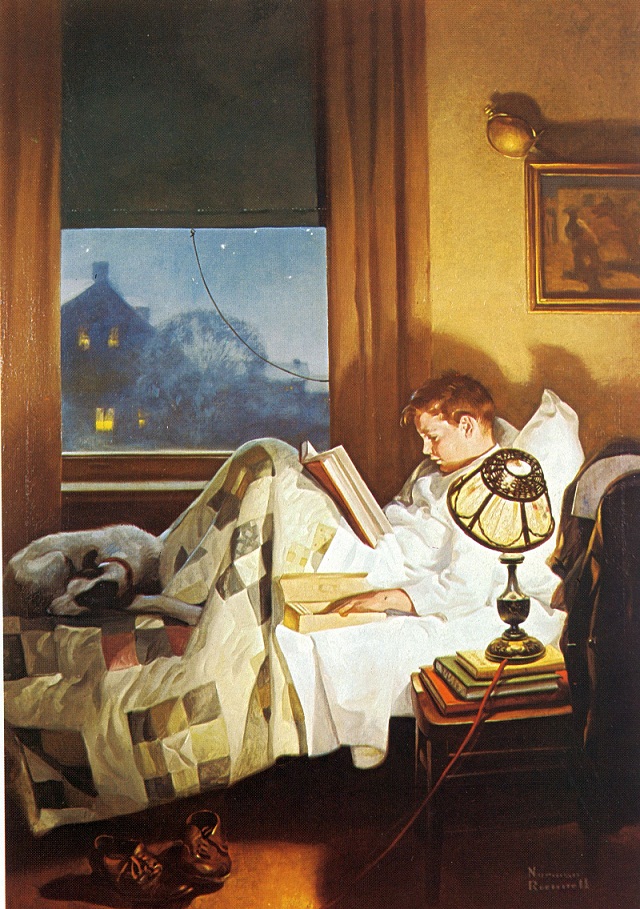
Crackers in Bed — Norman Rockwell

“The Five Boons of Life” — Mark Twain


“The Five Boons of Life,” a short fable from Mark Twain:

CHAPTER I

In the morning of life came a good fairy with her basket, and said:”Here are gifts. Take one, leave the others. And be wary, chose wisely; oh, choose wisely! for only one of them is valuable.”The gifts were five: Fame, Love, Riches, Pleasure, Death. The youth said, eagerly:”There is no need to consider”; and he chose Pleasure.He went out into the world and sought out the pleasures that youth delights in. But each in its turn was short-lived and disappointing, vain and empty; and each, departing, mocked him. In the end he said: “These years I have wasted. If I could but choose again, I would choose wisely.

CHAPTER II

The fairy appeared, and said:”Four of the gifts remain. Choose once more; and oh, remember-time is flying, and only one of them is precious.”The man considered long, then chose Love; and did not mark the tears that rose in the fairy’s eyes.After many, many years the man sat by a coffin, in an empty home. And he communed with himself, saying: “One by one they have gone away and left me; and now she lies here, the dearest and the last. Desolation after desolation has swept over me; for each hour of happiness the treacherous trader, Love, as sold me I have paid a thousand hours of grief. Out of my heart of hearts I curse him.”

CHAPTER III

“Choose again.” It was the fairy speaking.”The years have taught you wisdom — surely it must be so. Three gifts remain. Only one of them has any worth — remember it, and choose warily.”

The man reflected long, then chose Fame; and the fairy, sighing, went her way.Years went by and she came again, and stood behind the man where he sat solitary in the fading day, thinking. And she knew his thought:”My name filled the world, and its praises were on every tongue, and it seemed well with me for a little while. How little a while it was! Then came envy; then detraction; then calumny; then hate; then persecution. Then derision, which is the beginning of the end. And last of all came pity, which is the funeral of fame. Oh, the bitterness and misery of renown! target for mud in its prime, for contempt and compassion in its decay.”


CHAPTER IV

“Choose yet again.” It was the fairy’s voice.”Two gifts remain. And do not despair. In the beginning there was but one that was precious, and it is still here.””Wealth — which is power! How blind I was!” said the man. “Now, at last, life will be worth the living. I will spend, squander, dazzle. These mockers and despisers will crawl in the dirt before me, and I will feed my hungry heart with their envy. I will have all luxuries, all joys, all enchantments of the spirit, all contentments of the body that man holds dear. I will buy, buy, buy! deference, respect, esteem, worship — every pinchbeck grace of life the market of a trivial world can furnish forth. I have lost much time, and chosen badly heretofore, but let that pass; I was ignorant then, and could but take for best what seemed so.”Three short years went by, and a day came when the man sat shivering in a mean garret; and he was gaunt and wan and hollow-eyed, and clothed in rags; and he was gnawing a dry crust and mumbling:”Curse all the world’s gifts, for mockeries and gilded lies! And miscalled, every one. They are not gifts, but merely lendings. Pleasure, Love, Fame, Riches: they are but temporary disguises for lasting realities — Pain, Grief, Shame, Poverty. The fairy said true; in all her store there was but one gift which was precious, only one that was not valueless. How poor and cheap and mean I know those others now to be, compared with that inestimable one, that dear and sweet and kindly one, that steeps in dreamless and enduring sleep the pains that persecute the body, and the shames and griefs that eat the mind and heart. Bring it! I am weary, I would rest.”

CHAPTER V

The fairy came, bringing again four of the gifts, but Death was wanting. She said:     “I gave it to a mother’s pet, a little child. It was ignorant, but trusted me, asking me to choose for it. You did not ask me to choose.””Oh, miserable me! What is left for me?””What not even you have deserved: the wanton insult of Old Age.”

 

Watch Steven Soderbergh’s Kafka (Full Film)

List with No Name #4

  1. A Tale of Two Cities
  2. Robinson Crusoe
  3. The Iliad
  4. Maggie: A Girl of the Streets
  5. Tender Is the Night
  6. Catch-22
  7. Native Son

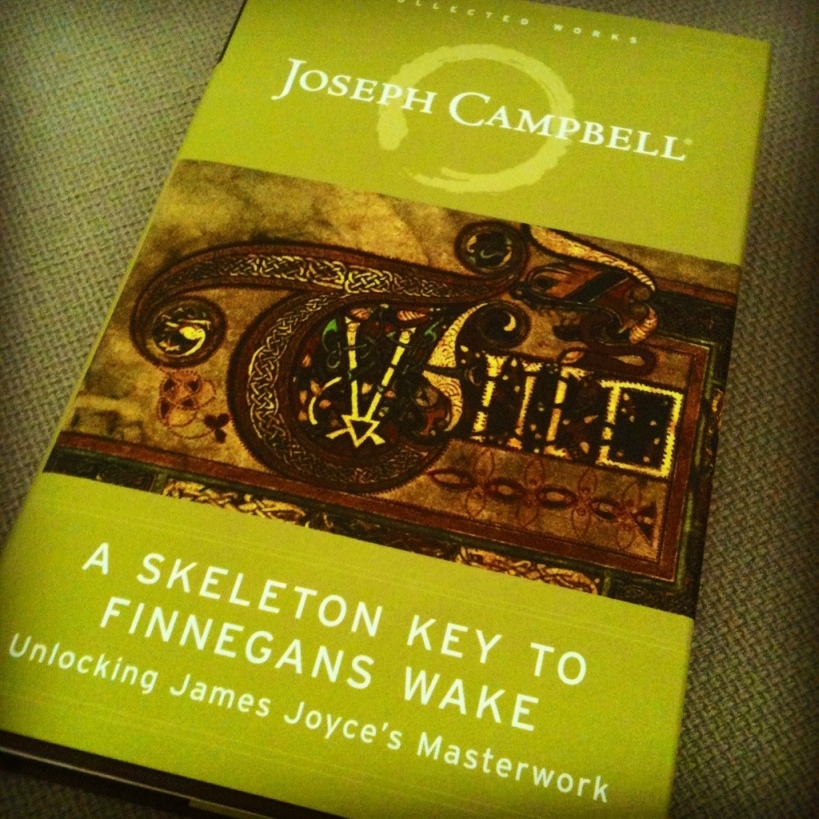
A Skeleton Key to Finnegans Wake (Book Acquired, 8.18.2012)


20120818-174214.jpg

A few weeks ago, for some reason beyond my ken, I stumbled into Finnegans Wake, read on the gentle glow of my Kindle Fire. I’ve been poking into the book for years now, but that particular night I read it with an ease—not an ease of understanding, but an ease of spirit, or of mind. Or ear, really. I had fun with it. I went back each night since then, sometimes only going through a page or two before slipping into slumbers.

Anyway, I’ve been searched for a used copy of Joseph Campbell’s Skeleton Key to the Wake for years, but I finally just broke down and ordered a new copy through my bookstore.  My plan is to read Finnegans Wake next year. It’s not a plan, so much as something I’ve just typed.


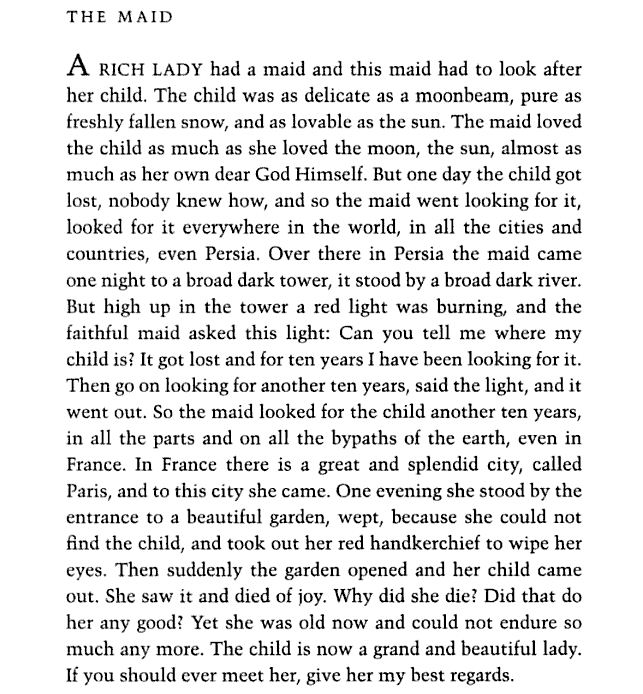
“The Maid” — Robert Walser

List with No Name #3

  1. Don Quixote & Sancho Panza
  2. Tom & Huck
  3. Huck & Jim
  4. Candide & Pangloss
  5. Stephen Dedalus & Leopold Bloom
  6. Hal Incandenza & Mario Incandenza
  7. Hal Incandenza & Michael Pemulis
  8. Mason & Dixon
  9. Arturo Belano & Ulisses Lima
  10. Prince Hal & Falstaff
  11. Frodo Baggins & Sam Gamgee
  12. Bast & JR
  13. The kid & Toadvine
  14. Romeo & Mercutio
  15. Ishmael & Queequeg
  16. George Milton & Lennie Small
  17. Raoul Duke & Dr. Gonzo

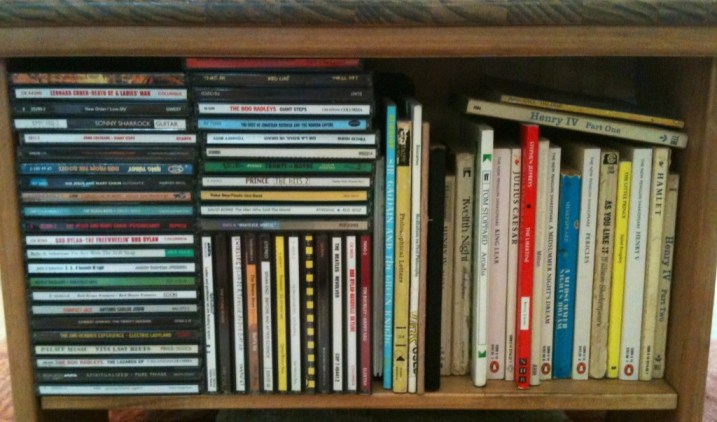
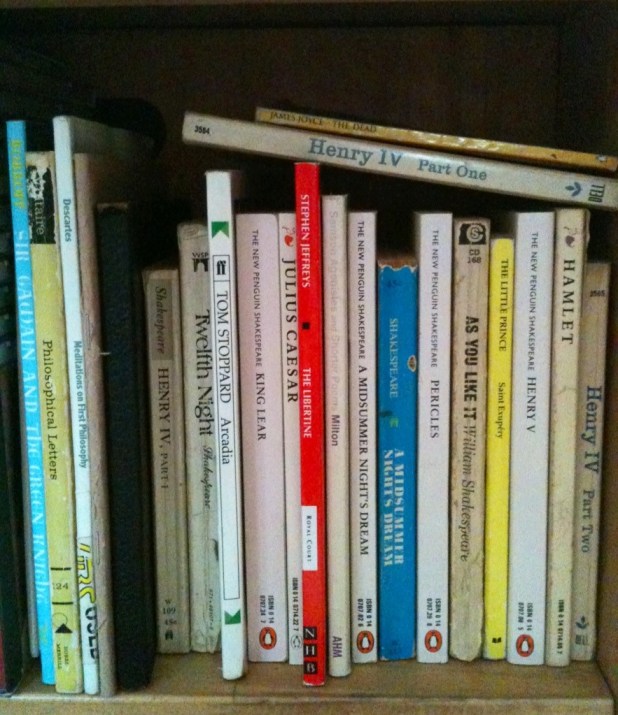
Book Shelves #33, 8.12.2012

20120812-142154.jpg

Book shelves series #33, thirty-third Sunday of 2012

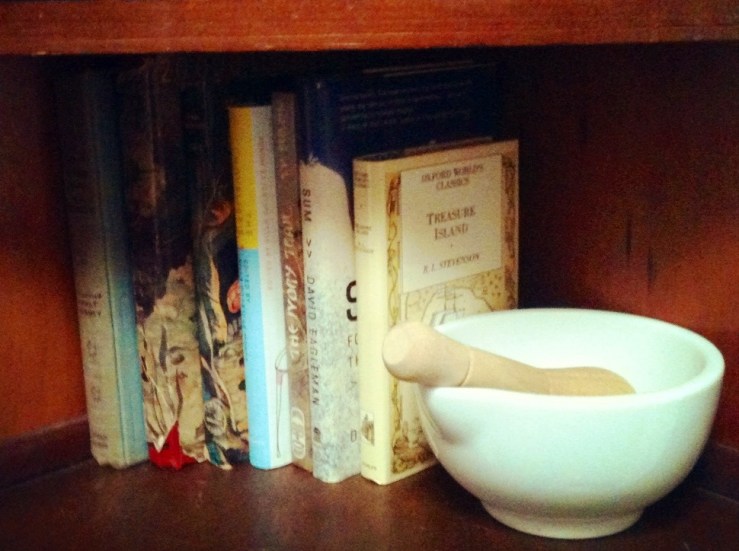
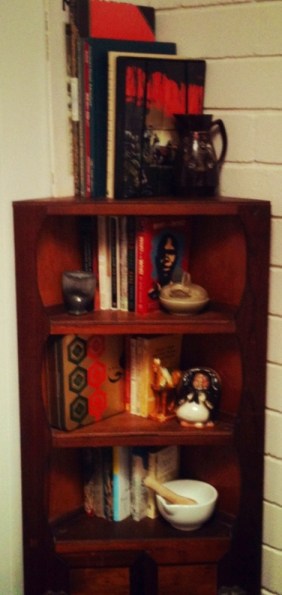
This is the end cap shelf of the coffee table in our family room, which is really the room where the kids play.

Mostly old ratty Shakespeare paperbacks and other slim volumes. Some of the hundreds of CDs I have that I haven’t played in ages.

Books:

20120812-142142.jpg

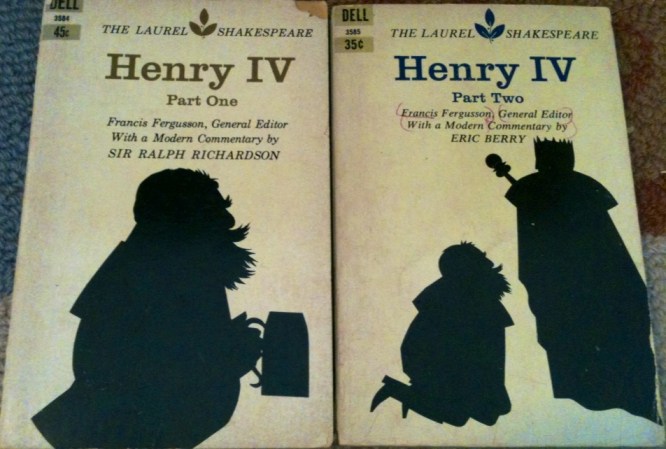
I reread Henry IV last year, using these editions; still one of my favorite plays.

Contains some of my favorite moments in literature (I especially love the part where Falstaff calls his soldiers his “rag of Muffins”):

20120812-142208.jpg

“The Man with the Pumpkin Head” — Robert Walser

“The Wish To Be a Red Indian” — Franz Kafka

The Wish To Be a Red Indian

If one were only an Indian, instantly alert, and on a racing horse, leaning against the wind, kept on quivering jerkily over the quivering ground, until one shed one’s spurs, for there needed no spurs, threw away the reins, for there needed no reins, and hardly saw that the land before one was smoothly shorn heath when horse’s neck and head would be already gone.

“The Wish To Be a Red Indian” by Franz Kafka.

“In a House Besieged” — Lydia Davis

In a house besieged lived a man and a woman. From where they cowered in the kitchen the man and woman heard small explosions. “The wind,” said the woman. “Hunters,” said the man. “The rain,” said the woman. “The army,” said the man. The woman wanted to go home, but she was already home, there in the middle of the country in a house besieged.

“In a House Besieged,” from Lydia Davis’s first collection Break It Down (1986); available in The Collected Stories.

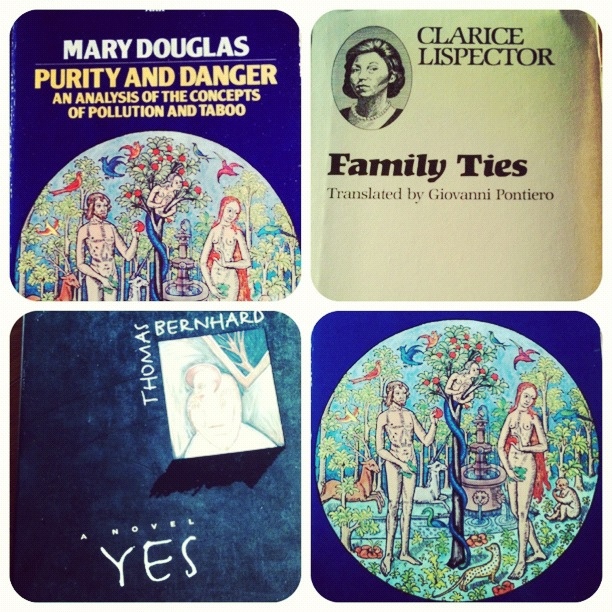
Thomas Bernhard/Mary Douglas/Clarice Lispector (Books Acquired, 7.19.2012)

20120724-194225.jpg

“Losing Memory” — Lydia Davis

“Losing Memory” by Lydia Davis:

You ask me about Edith Wharton.
Well, the name is very familiar.

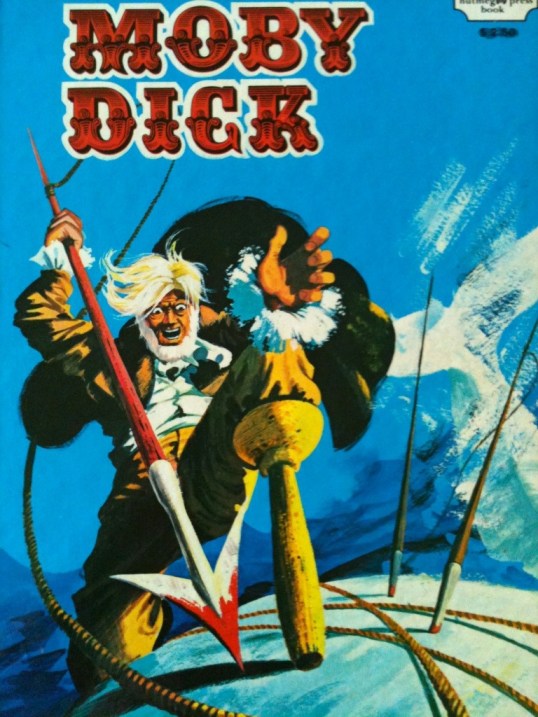
Moby Dick (Unhyphenated Kids Book Acquired 6.30.2012)

20120716-124132.jpg

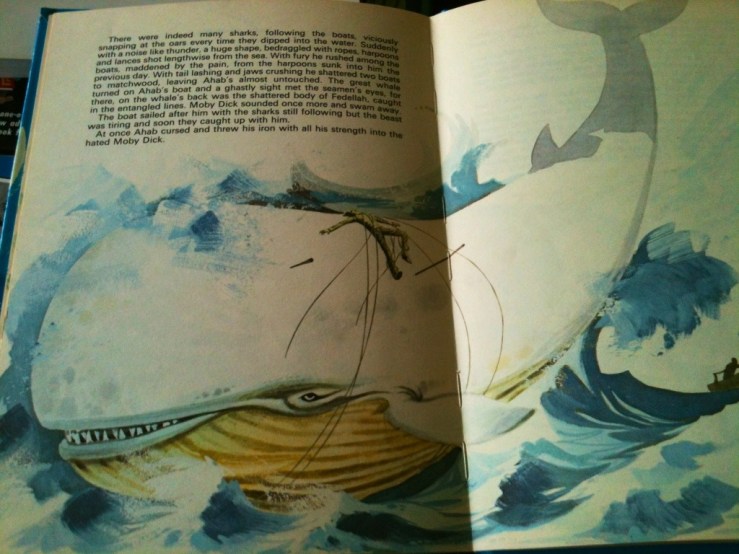
I picked this one up a few weeks ago to add to a small collection of Moby-Dick adaptations. It’s especially weird: I can’t find the name of an illustrator or author anywhere (it doesn’t even mention Herman Melville!). The adaptation is also kinda weird, lingering on the gold piece scene. Anyway. Some of the pics are cool, I guess.

20120716-124139.jpg

Italo Calvino’s List of Reasons Why We Should Read the Classics

From Italo Calvino’s The Uses of Literature

  1. The classics are the books of which we usually hear people say, “I am rereading . . . ” and never “I am reading . . . “
  2. We use the words “classics” for books that are treasured by those who have read and loved them; but they are treasured no less by those who have the luck to read them for the first time in the best conditions to enjoy them
  3. The classics are books that exert a peculiar influence, both when they refuse to be eradicated from the mind and when they conceal themselves in the folds of memory, camouflaging themselves as the collective or individual unconscious.
  4. Every rereading of a classic is as much a voyage of discovery as the first reading.
  5. Every reading of a classic is in fact a rereading.
  6. A classic is a book that has never finished saying what it has to say.
  7. The classics are the books that come down to us bearing the traces of readings previous to ours, and bringing in their wake the traces they themselves have left on the culture or cultures they have passed through (or, more simply, on language and customs).
  8. A classic does not necessarily teach us anything we did not know before. In a classic we sometimes discover something we have always known (or thought we knew), but without knowing that this author said it first, or at least is associated with it in a special way. And this, too, is a surprise that gives much pleasure, such as we always gain from the discovery of an origin, a relationship, an affinity.
  9. The classics are books which, upon reading, we find even fresher, more unexpected, and more marvelous than we had thought from hearing about them.
  10. We use the word “classic” of a book that takes the form of an equivalent to the universe, on a level with the ancient talismans. With this definition we are approaching the idea of the “total book,” as Mallarmé conceived of it.
  11. Your classic author is the one you cannot feel indifferent to, who helps you to define yourself in relation to him, even in dispute with him.
  12. A classic is a book that comes before other classics; but anyone who has read the others first, and then reads this one, instantly recognizes its place in the family tree.
  13. A classic is something that tends to relegate the concerns of the moment to the status of background noise, but at the same time this background noise is something we cannot do without.
  14. A classic is something that persists as a background noise even when the most incompatible momentary concerns are in control of the situation.


Minor Works & Masterpieces — An Excerpt from Bolaño’s Novel 2666

Another stand-alone segment from Roberto Bolaño’s novel 2666—from “The Part About Archimboldi”:

Our hero Reiter (writer!)—who at this moment (or just before it, unbeknownst to the reader) adopts the ridiculous nom de thing Archimboldi (!!!)—secures a rented typewriter from a failed writer, an old man who takes the time to lecture on writing and camouflage and masterpieces and Jesus &c.—and writing as channeling (or maybe a type of divine madness), as a ventriloquist act (which I touched on here). (Perhaps I’m pushing the limits of copyright law here. Look, I think you should all buy and read this book and give copies to loved ones and enemies alike).

“I was a writer,” said the old man.

“But I gave it up. This typewriter was a gift from my father. An affectionate and cultured man who lived to the age of ninety-three. An essentially good man. A man who believed in progress, it goes without saying. My poor father. He believed in progress and of course he believed in the intrinsic goodness of human beings. I too believe in the intrinsic goodness of human beings, but it means nothing. In their hearts, killers are good, as we Germans have reason to know. So what? I might spend a night drinking with a killer, and as the two of us watch the sun come up, perhaps we’ll burst into song or hum some Beethoven. So what? The killer might weep on my shoulder. Naturally. Being a killer isn’t easy, as you and I well know. It isn’t easy at all. It requires purity and will, will and purity. Crystalline purity and steel-hard will. And I myself might even weep on the killer’s shoulder and whisper sweet words to him, words like ‘brother,’ ‘friend,’ ‘comrade in misfortune.’ At this moment the killer is good, because he’s intrinsically good, and I’m an idiot, because I’m intrinsically an idiot, and we’re both sentimental, because our culture tends inexorably toward sentimentality. But when the performance is over and I’m alone, the killer will open the window of my room and come tiptoeing in like a nurse and slit my throat, bleed me dry.

“My poor father. I was a writer, I was a writer, but my indolent, voracious brain gnawed at my own entrails. Vulture of my Prometheus self or Prometheus of my vulture self, one day I understood that I might go so far as to publish excellent articles in magazines and newspapers, and even books that weren’t unworthy of the paper on which they were printed. But I also understood that I would never manage to create anything like a masterpiece. You may say that literature doesn’t consist solely of masterpieces, but rather is populated by so-called minor works. I believed that, too. Literature is a vast forest and the masterpieces are the lakes, the towering trees or strange trees, the lovely, eloquent flowers, the hidden caves, but a forest is also made up of ordinary trees, patches of grass, puddles, clinging vines, mushrooms, and little wild-flowers. I was wrong. There’s actually no such thing as a minor work. I mean: the author of the minor work isn’t Mr. X or Mr. Y. Mr. X and Mr. Y do exist, there’s no question about that, and they struggle and toil and publish in newspapers and magazines and sometimes they even come out with a book that isn’t unworthy of the paper it’s printed on, but those books or articles, if you pay close attention, are not written by them.

“Every minor work has a secret author and every secret author is, by definition, a writer of masterpieces. Who writes the minor work? A minor writer, or so it appears. The poor man’s wife can testify to that, she’s seen him sitting at the table, bent over the blank pages, restless in his chair, his pen racing over the paper. The evidence would seem to be incontrovertible. But what she’s seen is only the outside. The shell of literature. A semblance,” said the old man to Archimboldi and Archimboldi thought of Ansky. “The person who really writes the minor work is a secret writer who accepts only the dictates of a masterpiece. Continue reading “Minor Works & Masterpieces — An Excerpt from Bolaño’s Novel 2666”