The Origin of “Moby Dick”

Where did Herman Melville get the strange, marvelous name of the leviathan at the center of his strange, marvelous novel Moby-Dick? The name of the great white whale derives from  an 1839 article by Jeremiah Reynolds, “Mocha Dick: or The White Whale of the Pacific” (originally published in Knickerbocker Magazine). As the editors of Melville.org point out though (and thanks be unto them for all their hard, excellent work), how “Mocha Dick” morphed into “Moby Dick” remains “some strange piece of hermetic Melvillean arcana.” From Reynolds’s article

But to return to Mocha Dick — which, it may be observed, few were solicitous to do, who had once escaped from him. This renowned monster, who had come off victorious in a hundred fights with his pursuers, was an old bull whale, of prodigious size and strength. From the effect of age, or more probably from a freak of nature, as exhibited in the case of the Ethiopian Albino, a singular consequence had resulted — he was white as wool! Instead of projecting his spout obliquely forward, and puffing with a short, convulsive effort, accompanied by a snorting noise, as usual with his species, he flung the water from his nose in a lofty, perpendicular, expanded volume, at regular and somewhat distant intervals; its expulsion producing a continuous roar, like that of vapor struggling from the safety-valve of a powerful steam engine. Viewed from a distance, the practised eye of the sailor only could decide, that the moving mass, which constituted this enormous animal, was not a white cloud sailing along the horizon. On the spermaceti whale, barnacles are rarely discovered; but upon the head of this lusus naturae, they had clustered, until it became absolutely rugged with the shells. In short, regard him as you would, he was a most extraordinary fish; or, in the vernacular of Nantucket, “a genuine old sog”, of the first water.

William T. Vollmann’s Favorite “Contemporary” Books

In a 1990 interview between William T. Vollmann and one of his editors Larry McCaffery. An excerpt from the interview appears as a list in the Vollmann reader Expelled from Eden, which is quickly becoming one of my favorite books (seriously, let’s have another volume—this is clearly the optimum Vollmann delivery system). I’ve kept Expelled from Eden’s  list format because, hey, let’s face it, we like lists—

LM: Who are your favorite contemporary authors?

WV: By “contemporary” I assume you mean “from the last two hundred years.”

1./2./3. Right now it seems like I’ve learned a lot from Mishima, Kawabata, and Tolstoy;

4. Hawthorne may be the best;

5. Then Faulkner;

6. Hemingway is usually a wonderful read, especially Islands in the Stream and For Whom the Bell Tolls—that is to say, the grandly suicidal narratives;

7. Tadeusz Konwicki’s A Dreambook for Our Time is beautiful;

8. I also love everything I’ve read by Mir Lagerkvist;

9. Sigrid Undset’s trilogy Kristin Lavransdatter;

10. Multatuli’s Max Havalaar, or the Coffee Auctions of the Dutch Trading Company;

11. Kundera’s Laughable Loves;

12. Andrea Freud Lowenstein’s This Place (which deserves more recognition than it has received);

13. Jane Smiley’s The Greenlanders (which I had the wonderful experience of finding and reading a few months after completing my own book about Greenlanders, The Ice-Shirt).

14. Evans and Agee’s Let Us Now Praise Famous Men;

15. Farley Mowat’s The People of the Deer;

16. The first three books of Mishima’s Sea of Fertility tetralogy (how could I have forgotten that?);

17. Random bits of Proust, Zola’sL’Assommoir;

18. Shusaku Endo’s The Samurai;

19.The first two books of Mervyn Peake’s Gormenghast trilogy;

20. William Hope Hodgson’s The Night Land;

21. Poe’s stories about love;

22. Everything by Malraux (especially his Anti-Memoirs);

23. Nabokov’s Glory and Transparent Things and Ada;

24. Melville’s Pierre;

25. Thomas Bernhard’s Correction;

26. David Lindsay’s Voyage to Acturus;

27. Philip K. Dick’s A Scanner Darkly;

28. A few of Boll’s short novels (Wo warst du, Adam? and The Train Was on Time);

29. Elsa Morante’s History: A Novel;

30. Maria Dermout’s The Ten Thousand Things;

31.  Walter M. Miller’s A Canticle for Leibowitz;

32. James Blish’s Cities in Flight tetralogy (which is just plane fun);

33. The first three volumes of Lawrence Durrell’sAlexandria Quartet, and I don’t know what all.

There’s lots more. I am sorry not to be able to put down less contemporary things such as Tale of Genji, which is one of my all-time favorites.

In the Company of Strangers — We Review Barry McCrea’s New Book About Queer Family Ties in Dickens, Joyce, and Proust

Barry McCrea’s In the Company of Strangers: Family and Narrative in Dickens, Conan Doyle, Joyce, and Proust is one of the more engaging works of literary criticism I’ve seen in some time. And while I’m interested in McCrea’s subjects (the weird lines between the Victorian era and modernism, family and marriage plots, Dickens and Joyce, etc.), it’s the clarity of his writing that I find most impressive. Clear, frank writing is too rare in current literary criticism. Here’s McCrea describing his project—

This book argues that the formal innovations of the high-modernist novel are inseparable from a fundamental rethinking of how family ties are formed and sustained. Genealogy was thematically and structurally central to the English nineteenth-century novel. In the Company of  Strangers shows how the formal strategies employed by Joyce and Proust grow out of an attempt to build a fully coherent narrative system that is not rooted in the genealogical family. Modernism’s rejection of the familiar and cultivation of the strange, in other words, are inseparable from its abandonment of the family and embrace of the bond with the stranger as an alternative to it.

[In the Company of Strangers] offers a reassessment of the relationship between the modernists and their Victorian predecessors, suggesting that the key precursor to this queer model of narrative can be located, paradoxically, in the genealogical obsession of the English nineteenth-century novel. Far from representing a clean break with the Victorian family novel, the radical narrative formalism of high modernism exploits the potential of an alternative queer plot that was already present as a formal building block in the nineteenth-century novel.

McCrea’s queer theory lens is keenly attuned to the homoerotic content present in the novels he examines, but his critical gaze is ultimately more interested in how “queer time” functions as an organizing principle throughout the structure of these narratives. McCrea argues that this queer model of time is a central and defining characteristic of literary modernism. The agent (or one agent) of queer time is “the stranger,” the character who figuratively threatens (and paradoxically defines) the family. McCrea points out that the typical Victorian marriage plot resolves the problem of the stranger by incorporating him or her into the family as a point of narrative resolution. In contrast, in “the queer modernist narrative strategies of Ulysses and the Recherche, the stranger rivals and ultimately usurps the family plot.”

McCrea sifts through family plots (and the strangers who would challenge or queer them) in Dickens (Oliver Twist, Bleak House, Great Expectations), Arthur Conan Doyle’s Sherlock Holmes stories, Ulysses (“a queer family epic”), and Proust’s big book. In the Company of Strangers constantly scrutinizes the ways that family organizes narrative (and narrative organizes family). The book also analyzes what “urban literature” might mean, examining what it means to live in proximity to one’s fellows, and the ways in which urban living necessitate ad hoc families.

In the Company of Strangers does a lovely job of tracing the strange currents that run from Victorian lit to modernism and beyond—currents that extend from our conceptions of family itself, and indeed, our conceptions of life and an end to life. McCrea’s writing is precise, supported by a close textual readings, and if I didn’t always agree with his conclusions, he achieved what every critic ought to aim for: he made me want to read the books he was writing about again.

In the Company of Strangers is new from Columbia University Press.

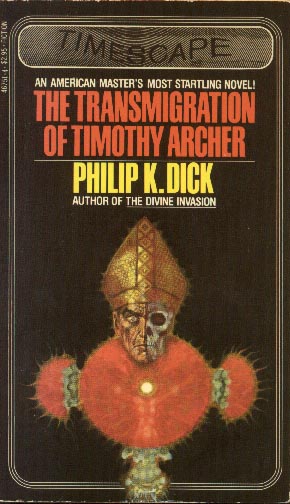
The Transmigration of Timothy Archer — Philip K. Dick

Suffering is the core of The Transmigration of Timothy Archer, a novel published just months after Philip Dick’s death in 1982. This is a book written by an author sure of his abilities, one who could confidently make this novel about big ideas turn on his characters’ struggles to control the trivialities of their day to day lives. While they attempt to make sense of the nature of God and unravel the mysteries of Christian teaching, they confront the questions that must have puzzled even Jesus’ own early advocates: is joy possible when good people are randomly confronted with confusion, pain, and death?  Dick tries to locate a mushy but viable middle ground in this sad, nimble, and touching novel.  Opening on the date of John Lennon’s assassination, Dick writes to commemorate the grinders, the survivors who manage to keep waking up, day after day, despite knowing that life often destroys those who dream too large.

The book is ostensibly based on the life and times of Timothy Archer, the iconoclastic American Episcopalian bishop of California in the 1960s whose unending search for truth led to his becoming friends with Robert Kennedy and Martin Luther King, Jr., advocating for the rights of women, homosexuals, and the transgendered, and time in the national spotlight.  The quest for knowledge led him also to adopt a number of intellectual positions that conflicted directly with his duties as a representative of the Episcopalian church — for example, he was brought to trial for heresy for openly questioning the existence of hell and the Holy Ghost.  The character of Bishop Archer was based almost entirely on the life of Bishop James Pike, Dick’s friend, who, like his fictional counterpart, died of exposure in Israel’s Dead Sea Desert searching for the sources of early Christian doctrine.  Bishop Archer is the bright flame in this book, the Gatsby who pulls in everyone he encounters — not because he’s influential and wealthy, but because his personality is that rare combination of knowledge and empathy, a true man of God who recognizes no difference between the important writer and the indigent cancer patient.  The actions of Bishop Archer form the arc of the book, and his deeds are a mirror to the other characters.  They struggle to shape their own individual visions for their lives because they must work in the shadow cast by a giant they love.

Angel Archer, the bishop’s daughter-in-law and the narrator of the novel, becomes one of Dick’s most realistically drawn characters.  She’s tough, articulate, and well-read.  While those around her succumb to suicidal impulses and mental illness she survives by searching her mind for poems and plays she’s read and committed to memory.  She finds uncomfortable parallels between books and her life.  She values her education and her self-identification as a “Berkeley intellectual” but makes light of her own pretension, telling us that she’s read all the long books but remembers nothing about them.  Do we become apathetic to our own experiences if we’ve read previously about something similar?  Angel fears ennui but describes her own artistic awakening as a ridiculous mixture of pleasure and pain — an agonizing night spent reading Dante’s Commedia while drinking a bottle of bourbon to dampen the pain of an abscessed tooth.  Aware that intellectual exercises and games both trivial and consequential have led to the deaths of her husband, the bishop, and his mistress, she still can’t escape her own self-made prison of words.  “The problem with introspection,” she states while contemplating her own death, “is that it has no end.”  When nobody is left, she soldiers on, dedicating herself, a fragile shell, to driving and working and walking and talking, a person “who records on a notepad the names of those who die.”

Like the narrator, this book reveals its depth rapidly, in spurts of astounding erudition and scholarship.  Dick writes masterfully about nuances of early Judaic law and the formation of Christian thought, illustrates the petty jealousy, kindness, and warmth that seems inherent to certain friendships between between intelligent, rival women, and indicts our perception and treatment of mental illness.  He quotes John Donne, Henry Vaughn, and discusses Virgil and Goethe without arrogance and without disturbing the flow of his story.  Like his best works — A Scanner Darkly, The Man in the High Castle, and Do Androids Dream of Electric Sheep?  — The Transmigration of Timothy Archer is fully drawn and completely real.  His best works seem to be filled with screwed up people trying to get by in a world that has been arbitrarily fucked up by war or technology or drug abuse.  This one is distinctly alive not because it’s set in an alternative world, but in sunny California that existed just three decades ago, close to the environs we currently abide.  A beautiful, moving coda from a man whose vision and prose changed and continues to challenge American writers.

Wherever He Goes, He Provokes the Terrified Dismay of the Guardians of Order

From Roland Barthes’ “Life of Sade,” a short biography of The Marquis de Sade. Translated from the French by Richard Miller.  Read the entire essay at Supervert (or here over the next few days, parceled out over 22 sections)—

7. The Lady President of Montreuil was objectively responsible for her son-in-law’s persecutions during the entire first years of his life (perhaps she loved him? One day, someone told the Marquise that the Lady President “loved M. de Sade to distraction”). The impression we have of her character, however, is one of continual fear: fear of scandal, of “difficulties.” Sade seems to have been a triumphant, troublesome victim; like a spoiled child, he is continually “teasing” (teasing is a sadistic passion) his respectable and conformist relations; wherever he goes, he provokes the terrified dismay of the guardians of order: everyone responsible for his confinement at the fort of Miolans (the King of Sardinia, the minister, the ambassador, the governor) is obsessed by the possibility of his escape — which does not fail to occur. The couple he forms with his persecutors is an aesthetic one: it is the malicious spectacle of a lively, elegant animal, both obsessed and inventive, mobile and tenacious, continually escaping and continually returning to the same area, while the giant mannequins, stiff, timorous, pompous, quite simply attempt to contain him (not punish him: this will only come later).

Household Sadism

From Roland Barthes’ “Life of Sade,” a short biography of The Marquis de Sade. Translated from the French by Richard Miller.  Read the entire essay at Supervert (or here over the next few days, parceled out over 22 sections)—

6. Household Sadism: at Marseilles, Sade wants Marianne Lavergne to whip him with a parchment beater with bent pins which he takes from his pocket. The girl quails before so exclusively functional an object (like a surgical instrument), and Sade orders the maidservant to bring a heather broom; this utensil is more familiar to Marianne and she has no hesitation in employing it to strike Sade across the buttocks.

Section 5, “Life of Sade” — Roland Barthes’ Short Biography of The Marquis de Sade

From Roland Barthes’ “Life of Sade,” a short biography of The Marquis de Sade. Translated from the French by Richard Miller.  Read the entire essay at Supervert. (or here over the next few days, parceled out over 22 sections)—

5. Sade likes theater costumes (forms which make the role); he wore them in his own daily life. When whipping Rose Keller, he disguises himself as a flogger (sleeveless vest over a naked torso; kerchief around the head as is worn by young Japanese cooks as they swiftly cut up live eels); later on, he prescribes for his wife the mourning costume she must wear for visiting a captive, unhappy husband: Dress as dark in color as possible, the bosom covered, “a large, very large bonnet without the hair it covers being dressed in any way, merely combed, a chignon, no braids.”

Section 4, “Life of Sade” — Roland Barthes’ Short Biography of The Marquis de Sade

From Roland Barthes’ “Life of Sade,” a short biography of The Marquis de Sade. Translated from the French by Richard Miller.  Read the entire essay at Supervert. (or here over the next few days, parceled out over 22 sections)—

4. On Easter Sunday, 1768, at 9 A.M., on the Place des Victoires, accosting Rose Keller, a beggar (whom he was to whip several hours later in her house at Arcueil), the young Sade (twenty-eight years of age) was wearing a gray redingote, carrying a cane, a hunting knife — and a white muff. (Thus, at a time when the I.D. photograph was nonexistent, it is a paradox that the police report reveals the signifier in its description of the suspect’s clothing: such as this delicious white muff, an article obviously donned to satisfy the principle of tact which seems always to have presided over the Marquis’s sadistic activity — but not necessarily over that of sadists).

Section 3, “Life of Sade” — Roland Barthes’ Short Biography of The Marquis de Sade

From Roland Barthes’ “Life of Sade,” a short biography of The Marquis de Sade. Translated from the French by Richard Miller.  Read the entire essay at Supervert. (or here over the next few days, parceled out over 22 sections)—

3. In the spring of 1779, when Sade was imprisoned at Vincennes, he received a letter telling him that the orchard at La Coste was dazzling: cherry trees in bloom, apple trees, pear trees, hop bine, grapes, not to mention the burgeoning cypresses and oaks. For Sade, La Coste was a multiple, a total site; first, a Provençal site, the site of origin, of Return (throughout the first part of his life, Sade, although a fugitive, hunted, continued to return there, flouting prudence); next: an autarchic site, a miniature and total society over which he was the master, the unique source of his income, the site for study (his library was there), the site for theater (they acted comedies), and the site for debauchery (Sade had servants, young peasant girls, young secretaries, brought in for séances at which the Marquise was also present). If, therefore, Sade kept returning to La Coste after his restless travels, it was not for the elevated purpose of purification in the countryside that impels the gangster in The Asphalt Jungle to return to die at the gate to the farm where he was born; as always, it had a plural, super-determined, probably contradictory meaning.


Section 1, “Life of Sade” — Roland Barthes’ Short Biography of The Marquis de Sade

From Roland Barthes’ “Life of Sade,” a short biography of The Marquis de Sade. Translated from the French by Richard Miller.  Read the entire essay at Supervert. (or here over the next few days, parceled out over 22 sections)—

1. Etymological chain: Sade, Sado, Sadone, Sazo, Sauza (village of Saze). Again, lost in this lineage, the evil letter. In attaining the accursed name, brilliantly formulated (it has engendered a common noun), the letter that, as we say in French, zebras, fustigates, the z, has given way to the softest of dentals.


On Overrated Books

There’s a silly little article at Slate today about “overrated” books. The article collects a decent survey of critics and writers discussing the “great books” that they find boring, difficult to read, or otherwise overrated. There are a few tomes I agree with on the list—I am proud that I read all of Tess of the D’Ubervilles in the 10th grade, unlike most of my peers who, undoubtedly wiser than I, resorted to Cliffs Notes, but Hardy’s book was the biggest chore of my young reading life. There are plenty of books targeted in the article that may be overrated, but that doesn’t mean that they are bad or terrible books. But Slate is always quick to post a catchy, “provocative” headline, no doubt intended to generate hits; indeed, they’re almost as bad as Huffington Post, which has published similar articles in the past, including this recent execrable example of “literary criticism,” “Bad Classics: Books We Think Are Overrated.” Huffington Post’s list is ridiculous, taking weak stabs at Waiting for Godot, Moby-Dick, and that most sacred of cows, Ulysses.

Joyce’s big book shows up on the Slate list too. I’ll be the first to admit that the book is likely overrated, held in perhaps too high esteem by those who haven’t read it, and the academic industry it has produced does its reputation no favors among a general reading public. But it’s not a “bad classic.” It’s a beautiful, moving, and, yes, important book, and because of its status, both in the academy and in popular culture, it has become yet another easy target for contrarians. From the Slate piece, here’s Daniel Mendelsohn of the NYRB, explaining why Ulysses is inauthentic and has never “persuaded” him —-

. . . it’s as if Joyce were both the author of his book and the future comp lit grad student who’s trying to decipher it. Indeed, it’s small wonder that Ulysses has become the bible of academic lit departments; it seems to have been practically written for literary theorists. (Dubliners, by contrast, is a book for “ordinary readers”—a term I use admiringly.)

I understand that Ulysses’ place in the academy can be terribly frustrating, but Mendelsohn’s critique strikes me as populist rubbish; it’s more an attack on the reputation of the book than the book itself. But I don’t really care; I mean, Mendelsohn is entitled to his opinion, which I’m sure is well-informed.

What I’m ultimately concerned about here is the potential effect that pieces like these at Slate and Huffington Post (and similar sites) can have on a reading public. How freeing to be told by the experts that Ulysses or Moby-Dick or Gravity’s Rainbow is not worth my time! I can get back to those Swedish crime novels now, or those vampire books written at a 4th grade reading level, or, better yet, fuck books. I’m sure there are spoiled rotten housewives throwing chardonnay at each other on TV.

Author Elif Batuman also didn’t care for Ulysses, but she offers the most sensible response in the entire article—-

Like many people, I enjoy learning which canonical books are unbeloved by which contemporary writers. However, I don’t think participants in such surveys ought to blame either themselves (“I’m so lazy/uneducated”) or the canonical books (“Ulysses is so overrated”). My view is that the right book has to reach you at the right time, and no person can be reached by every book. Literature is supposed to be beautiful and/or necessary—so if at a given time you don’t either enjoy or need a certain book, then you should read something else, and not feel guilty about it.

Canonical books I did not enjoy include The Iliad and The Sound and the Fury, and, although I did read Ulysses with some degree of technical interest, it wasn’t fun for me. I maintain that this doesn’t reflect badly on Homer, Faulkner, Joyce, or me.

I think Batuman’s tone and approach is perfect here; I also admire her complete avoidance of playing those favorite games of internet writers: swiping at sacred cows and trying to point out that the emperor is naked. Instead, Batuman acknowledges the inherent fun in articles like the one she’s participating in and then quickly points out that reading is not a contest. She saliently points out that “the right book has to reach you at the right time, and no person can be reached by every book.” To my shame, a younger version of myself wrote some nasty things about William Faulkner on this blog, suggesting that he was the most overrated American writer of all time. I took it all back, of course, and now would rate Light in August and Go Down, Moses as two of my favorite books. I am happy that I read Go Down, Moses at the right time—like Batuman says, timing is a huge factor in how a reader receives a book.

It seems to me that articles like the ones at Slate and HuffPo are symptomatic of an empty populism sweeping through much of America today. I am in no way suggesting that the writers and critics in the surveys are practitioners or purveyors of empty populism; rather, their estimable talents have been circumscribed by engines of culture-production (and culture-absorption) to absolve an increasingly distracted populace from even making a pretense of reading some really great and important books. Articles like these engender slapdash and shallow thinking, licensing poseurs to make claims about books they’ve failed to read. Even worse, these kinds of surveys provide ammunition to the those who hold the word “elite” as an insult. I am not suggesting that articles like these will undo the Western canon, or that they signal the death of the novel, or an end to complex reading — but they certainly don’t help.

William Gaddis — A 1986 Filmed Interview

The Pale King’s Opening Lines Vs. Hadji Murad’s Opening Lines

Putting together a review of David Foster Wallace’s The Pale King right now, I realize I have no place to put , nor anything intelligent or even thoughtful to say, about an observation I made about its opening lines (you know, that sentence you halfway paid attention to on some dude’s tumblr), which seem to echo the opening of Leo Tolstoy’s Hadji Murad, which said observation I only observed because I read the books at the same time, and in fact read the opening chapters on the same day. Anyway.

First lines of The Pale King

Past the flannel plains and blacktop graphs and skylines of canted rust, and past the tobacco-​brown river overhung with weeping trees and coins of sunlight through them on the water downriver, to the place beyond the windbreak, where untilled fields simmer shrilly in the a.m. heat: shattercane, lamb’s‑quarter, cutgrass, sawbrier, nutgrass, jimsonweed, wild mint, dandelion, foxtail, muscadine, spinecabbage, goldenrod, creeping charlie, butter-​print, nightshade, ragweed, wild oat, vetch, butcher grass, invaginate volunteer beans, all heads gently nodding in a morning breeze like a mother’s soft hand on your cheek.

First lines of Hadji Murad—-

I was returning home by the fields. It was midsummer, the hay harvest was over and they were just beginning to reap the rye. At that season of the year there is a delightful variety of flowers —red, white, and pink scented tufty clover; milk-white ox-eye daisies with their bright yellow centers and pleasant spicy smell; yellow honey-scented rape blossoms; tall campanulas with white and lilac bells, tulip-shaped; creeping vetch; yellow, red, and pink scabious; faintly scented, neatly arranged purple plaintains with blossoms slightly tinged with pink; cornflowers, the newly opened blossoms bright blue in the sunshine but growing paler and redder towards evening or when growing old; and delicate almond-scented dodder flowers that withered quickly.

I’m not suggesting that Wallace is consciously following Tolstoy here, although the structures of the openings are remarkably similar, and in each case, the flora imagery is ultimately ironized by the narrative that follows.

Biblioklept Does Bloomsday

Bloomsday blah blah blah — (all links lead to Biblioklept posts (yeah, we’re solipsists around here))—

How to read Ulysses

James Joyce talks dirty

Filming Finnegans

William Faulkner’s Joyce anxiety

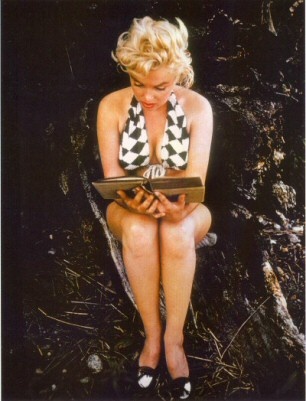
Marilyn Monroe reads Molly 

Biblioklept’s lousy review (the review is lousy, not the book) of Dubliners

Joyce’s entry on the 1901 Irish Census

Biblioklept’s review (not so lousy, the review) of a superior full-cast audio recording of Ulysses

James Joyce explains why Odysseus is the most “complete man’ in literature

Leopold’s Bloom’s recipe for burnt kidney breakfast

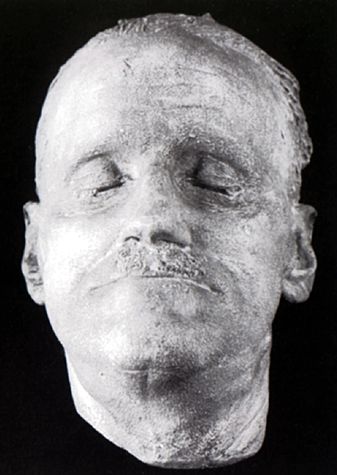
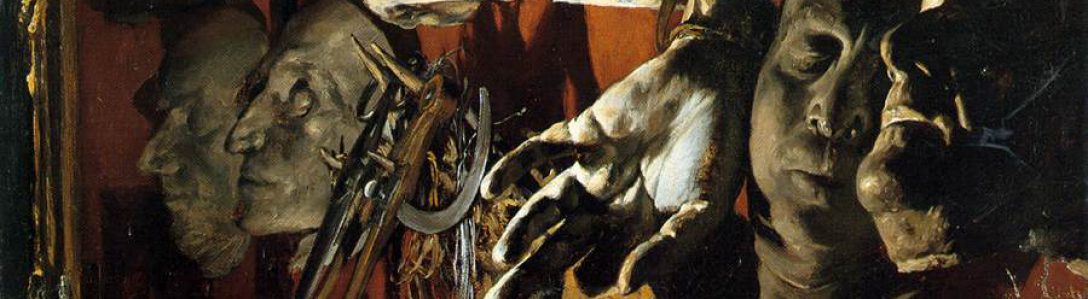
James Joyce’s death mask—


Is American Psycho Profound, Artistic Nihilism or Stupid, Shallow Nihilism? — Bret Easton Ellis vs David Foster Wallace

Bret Easton Ellis’s controversial novel American Psycho turns 20 this year. The folks at Vintage were kind enough to send me a copy of the book to promote the anniversary, and despite a mounding stack of review copies, I took a few hours to re-read parts of Ellis’s third novel.

I’ve only read two Ellis books and I remember the reading of them distinctly, precisely; I remember how I picked them up and where I was and what I was doing and all that jazz. The first was Ellis’s début Less Than Zero, a slim, ugly little novel that I read in one night. I was fifteen, spending a summer with my aunt and uncle, living in my cousin’s old bedroom. Less Than Zero was part of a cache of books that included Hunter S. Thompson’s Fear and Loathing in Las Vegas, Anthony Scaduto’s Bob Dylan biography, some Hemingway and Fitzgerald novels, One Flew Over the Cuckoo’s Nest, and a Kurt Vonnegut starter kit. In short, a life changing library, and most of it went home with me in my Jansport (somewhat surreptitiously, although I’m sure if I had asked I would have received). Only I didn’t take Less Than Zero, despite reading it all in one sick night, and then reading it again in pieces over the summer. The book hurt my stomach. The drugs were not the Looney Tunes business in HST’s book—they were the symptom of a blank nihilism I simply couldn’t identify with. The scene where the kids casually watch a snuff film horrified me. And the rape scene. Well. It was the first time I read something that genuinely disturbed me in a non-child, non-Grimm’s way — in a way where I felt moral outrage from an adult-psyche-type-position (whatever that means). The book genuinely concerned me; I was afraid such people existed.

I read American Psycho in 2002. I was traveling through Thailand for a month, trading books at guest houses and shops as I went, and the only book I remember being more ubiquitous than American Psycho was Alex Garland’s The Beach (which, yes, I also read there). I had seen and quite enjoyed Mary Harron’s 2000 film adaptation of American Psycho, which had the good sense to treat the whole matter as a piece of cartoonish black comedy. In Harron’s hands, the hyperbolic exploits of Patrick Bateman are considerably less ambiguous than the book’s depiction; Harron  clearly marks the narrative violence as Bateman’s internal fantasies. Of course, one of literature’s greatest tools is ambiguity, and Ellis’s American Psycho revels in it. In a sense, this is the book’s defining nihilism: its total unwillingness to make a definitive judgment about its protagonist’s violence. Instead, American Psycho’s claims to satire rely on the implicit force of the reader’s sense of humanity and morality; like Less Than Zero before it, we have a flat narrative, an utter lack of self-reflection or internal psychology. Ellis gives us only concrete contours, cocaine, hydrochloric acid, chainsaws, and a laundry list of brand names. These are novels without interiors.

American Psycho, utterly concrete, deeply ironic, and occasionally funny, is a strange beach read, but a beach read nonetheless (although all that gristle and blood (and oh the rat!) won’t go down easy for many folks). When I read it in 2002 I found it neither shocking or enlightening, just precise and ugly and grotesque, a numbing progression of concrete descriptions of clothes and restaurants punctuated by ridiculous violence. Its one-note satire would find a better home in a short story. A short short story. I’ve spent the past few days reading through its sections again, trying to reassess it against the backdrop of my current literary estimations of Bret Easton Ellis, which I hate to admit are largely informed not only by his own acerbic personality, but also by (or perhaps more accurately against) his agon with David Foster Wallace.

BEE vs. DFW is not exactly news. Ellis (b. 1964) and Wallace (b. 1962) both published their first novels in the mid-eighties. Less Than Zero made 21-year-old Ellis a star, a likely “voice of his generation.” The Broom of the System didn’t exactly go gangbusters for Wallace, but its voluminous scope, Pynchonian silliness, and its willingness to pick up the postmodern games that Ellis and the other new minimalists seemed to reject announced a major new talent who was willing to both think and feel—to go beyond the surfaces. Indeed, Wallace’s entire project might be defined as setting himself apart from the cool, detached irony that characterizes Ellis’s ethos. In a 1993 interview with Larry McCaffery,Wallace decries fiction that devotes
“a lot of energy to creating expectations and then taking pleasure in disappointing them. You can see this clearly in something like Ellis’s American Psycho: it panders shamelessly to the audience’s sadism for a while, but by the end it’s clear that the sadism’s real object is the reader herself.” I think this is an apt criticism. American Psycho is torture porn encased in a thin veneer of social satire with no interior substance. Here’s Wallace at length—

 I think it’s a kind of black cynicism about today’s world that Ellis and certain others depend on for their readership. Look, if the contemporary condition is hopelessly shitty, insipid, materialistic, emotionally retarded, sadomasochistic, and stupid, then I (or any writer) can get away with slapping together stories with characters who are stupid, vapid, emotionally retarded, which is easy, because these sorts of characters require no development. With descriptions that are simply lists of brand-name consumer products. Where stupid people say insipid stuff to each other. If what’s always distinguished bad writing—flat characters, a narrative world that’s cliched and not recognizably human, etc.—is also a description of today’s world, then bad writing becomes an ingenious mimesis of a bad world. If readers simply believe the world is stupid and shallow and mean, then Ellis can write a mean shallow stupid novel that becomes a mordant deadpan commentary on the badness of everything. Look man, we’d probably most of us agree that these are dark times, and stupid ones, but do we need fiction that does nothing but dramatize how dark and stupid everything is? In dark times, the definition of good art would seem to be art that locates and applies CPR to those elements of what’s human and magical that still live and glow despite the times’ darkness. Really good fiction could have as dark a worldview as it wished, but it’d find a way both to depict this world and to illuminate the possibilities for being alive and human in it. You can defend Psycho as being a sort of performative digest of late-eighties social problems, but it’s no more than that.

Four years before the interview—and two years before the publication of American Psycho—Wallace mocked Ellis’s void, vacuous characters in “Girl with Curious Hair,” a story about a yuppie on LSD at a Keith Jarrett concert.  With no affective life, Sick Puppy (as his low life punk rock friends call him) feels nothing. He cannot enjoy his wealth, his position—not even his acid trip. He can’t even enjoy sex unless he can burn his partner as he’s being fellated. As Marshall Boswell points out in his study Understanding David Foster Wallace, “the story eerily forecasts . . . American Psycho . . . in a grisly and hilarious pastiche of Ellis’ preposterously benumbed prose.”

Perhaps Wallace’s greatest critique of nihilism — greatest in that it escapes the confines of Ellis and his ilk’s literary purview — is Don Gately, erstwhile hero of Infinite Jest, a recovering Demerol addict and small time thief whose painful day-to-day existence figures as the existential struggle against bleak, overwhelming nothingness. Gately is the heart and spirit of IJ, a big sad throbbing heart that, to quote Wallace out of context (from above), is the writer’s way “to depict this [dark] world and to illuminate the possibilities for being alive and human in it.”

Ellis perhaps perceives a character like Gately and his illuminating possibilities as simply too affected. Last summer, at a reading in Hackney, England, Easton offered the following—

Question: David Foster Wallace – as an American writer, what is your opinion now that he has died?

Answer: Is it too soon? It’s too soon right? Well I don’t rate him. The journalism is pedestrian, the stories scattered and full of that Midwestern faux-sentimentality, and Infinite Jest is unreadable. His life story and his battle with depression however is really quite touching . . .

Then there was this cryptic tweet a few months ago—

I’m not sure what Ellis’s tweet meant, and attendees of the Hackney reading claim that he was more considered and measured in his tone than the actual words of his response seem to entail. His end of the agon with Wallace is also rife with its own set of problems—his contemporary is dead, horribly dead, a suicide, (the kind of death that makes an essay like this one, an essay that claims to find affirmation of life in DFW and empty nihilism BEE, particularly hard to swallow, I suppose)—making it all the harder to respond. I read his “too soon” remark from the Hackney reading to be in earnest.

But Ellis’s tweets are not part of his literary corpus (even though they can be entertaining), and Wallace’s suicide is not part of his text. So, I return to those texts—

Wallace’s last effort, The Pale King, contrasts strongly with American Psycho. Wallace’s novel is fractured, heteroglossic, crammed with ideas, and at times purposefully taxing on its reader’s attention. American Psycho is concise (even if its plot is messy and episodic), imagistic, lacks even the pretense of allowing a controlling voice other than Bateman’s into the narrative, and, in its fetishistic, sexualized violence, is a work designed to lock its reader’s attention in a sensationalized vice grip. It’s id-bait par excellence, seductive and stylish. Its greatest achievement may be to fool some readers into believing that its violence is simply part and parcel of its intention of being a scathing satire. The book then relies heavily — too heavily — on an exterior morality system to weigh its flat, static characters, characters who face incredible trauma and yet never process it (or even attempt to process it). And I am not just speaking of Bateman. Consider the dry cleaner who repeatedly removes bloodstains, or the maid  who mops up brain bits without a single question. Then there are the faceless, indistinguishable alpha males who populate Bateman’s yuppie corporate world, and their requisite fiancées and mistresses, weak watery women the narrative repeatedly condemns. These characters lack meaning or depth; they are essentially probable replicants of Bateman, the implication being that psychopathic tendencies lurk everywhere, that the modern condition preempts empathy or human understanding or plain old common decency. The savvy reader is supposed to admire Ellis’s satire of capitalist vacuity, and admittedly, there are some very funny riffs (Bateman’s bits on popular music like Huey Lewis and the News and Whitney Houston, replicated in the film version, still hold up well). But I think Wallace is correct when he asserts that the real violence is ultimately inflicted on the reader. Ellis’s violence is not the same as Flannery O’Connor’s, who used the shock of murder in her stories to explore the possibility of awe, transcendence, and revelation in a desacralized world. Wallace’s The Pale King tries to sanctify the costs of life (death and taxes and the deep existential crisis these costs entail) in a world that has largely abandoned the sacred, in a society where many people are incapable or unwilling to think empathetically about their relation to (via taxes and social institutions) other humans whom they do not personally know. Ellis’s American Psycho is a cartoonish, lopsided distortion of a descralized world. Its affective power is purely externalized, generated from the reader’s moral core. It replaces feeling with violence; it replaces ideas with the illusion of ideas. Its closest claim to art is its satirical power, which is ultimately puddle-shallow (did we really need Ellis to tell us that yuppies are uncaring, shallow and materialistic?) Writers need not be morally instructive, but good books are guided by a vision. Ellis’s vision is pure, bleak nihilism, abyssal and unreflecting, asking little from its reader other than to play voyeur to murder and giving back nothing in return.
Herman Melville’s 1856 Passport Application

(More).

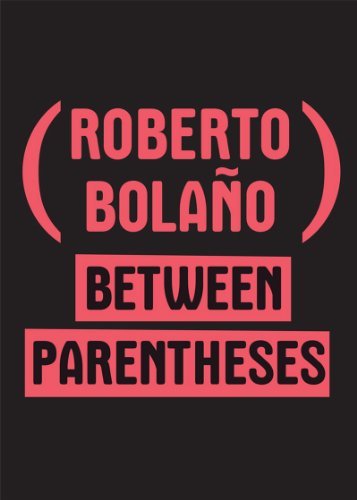
Between Parentheses — Roberto Bolaño

Between Parentheses (new from New Directions and deftly translated by Natasha Wimmer) collects over 400 pages of Roberto Bolaño’s essays, speeches, introductions, and newspaper columns, composed between 1998 and 2003, the year Bolaño died. The bulk of the book, as well as its title, comes from a column that Bolaño wrote for the Chilean newspaper Las Últimas Noticias. As one would expect, these pieces are relatively short, sometimes under 500 words, punctuated with a depth that belies their brevity. Bolaño writes about everything (or, everything worth writing about, I suppose), but, as those familiar will guess, literature is his main subject, whether he’s reviewing a Spanish-language translation of McCarthy’s Blood Meridian, comparing Kafka and Philip K. Dick, explaining his affection for William Burroughs, or discussing the merits of translating literature. If these samples tantalize you, let me go further: Bolaño writes about detective novels, Walter Mosley, Jonathan Swift, Jorge Luis Borges, magic, devils, memoirs, Gunter Grass, murder, troubadours, the Hell’s Angels, poetry, and more, more, more.

Despite its discursive topics, a unified tone inheres throughout Between Parentheses, a distinctly Bolañonian tone, at once grand and romantic (and Romantic) and profound and cynical and biting and flippant. In her blurb on the back of the book, Marcela Valdes (The Nation) declares that in Between Parentheses “we hear Bolaño’s real voice, the one he often disguised through the ventriloquism of his fiction.” This is perhaps a too-bold statement—I’m not sure if Bolaño can be said to have a “real voice”—instead, we find an author who’s constantly inventing and then reinventing, inflating and deflating, expanding and contracting.

And yet I think we’ll have to take Between Parentheses as Bolaño’s “real voice”—it’s perhaps the closest thing we’ll get to memoir or autobiography from the man (at least for now: his literary estate seems to be  in a constant state of excavation, so who knows). But Bolaño, ever the winking imp, is there to warn us against taking memoir at face value—

Of all books, memoirs are the most deceitful because the pretense in which they engage often goes undetected and their authors are usually only looking to justify themselves. Ostentation and memoirs tend to go together. Lies and memoirs get along swimmingly.

If Bolaño may occasionally employ invention in some of the passages here, it’s all to his credit, and all perhaps in the service of Higher Artistic Truth (whatever that means). He shares much of himself in Between Parentheses, especially in the book’s first section, “Three Insufferable Speeches,” (you may have already read “Literature and Exile”) and its second section, “Fragments of a Return to the Native Land,” detailing the writer’s return to Chile in 1998. These are indeed fragments, sketchy, pained moments where we glimpse Bolaño trying to process a difficult and emotional journey. The tone is at once comic, analytical, and depressive—familiar territory to Bolaño’s readers, I suppose. Besides its obvious appeal as a Bolaño memoir, “Fragments” is also fine travel literature, as is the later section “Scenes,” which comprises evocations of various locales, chief among them Bolaño’s adopted home Blanes. Several of the pieces in “Scenes” seem to extend into the realm of pure fiction; a few are narrated by speakers who are only partly-Bolaño (if such a construction can be said to exist). In any case, they are the book’s closest approximations of short fiction.

The book’s fifth section, “The Brave Librarian,” features one of the highlights (and longer pieces) of the volume, a preface for The Adventures of Huckleberry Finn called “Our Guide to the Abyss,” where Bolaño parses Twain and Melville, delving into American literature. I’m sure that for many this piece alone will be worth the price of admission. If you still need convincing, the book’s final section offers a treatise on book theft, advice on the art of writing short stories, a transcript of Bolaño’s last interview before his death, and more, more, more. “More, more, more” might be a simple way to summarize this book.

Between the Parentheses does little, ultimately, to explicate Roberto Bolaño. If anything, it helps to further confound those of us who’ve been puzzling out his fiction for the past few years. And thank God for that. I’ve written before about “the Bolañoverse,” about Bolaño’s labyrinthine genre-crossing intertextuality. Between Parentheses, despite its claims to reality or truth, is nevertheless a part of Bolaño’s maze, a maze by turns dark or illuminating, tragic or comic, and stark and enriching. Most of all, this maze is a strange joy to get lost in. Highly recommended.