“The Californian’s Tale” — Mark Twain

“The Californian’s Tale” — Mark Twain

Thirty-five years ago I was out prospecting on the Stanislaus, tramping all day long with pick and pan and horn, and washing a hatful of dirt here and there, always expecting to make a rich strike, and never doing it. It was a lovely region, woodsy, balmy, delicious, and had once been populous, long years before, but now the people had vanished and the charming paradise was a solitude. They went away when the surface diggings gave out. In one place, where a busy little city with banks and newspapers and fire companies and a mayor and aldermen had been, was nothing but a wide expanse of emerald turf, with not even the faintest sign that human life had ever been present there. This was down toward Tuttletown. In the country neighborhood thereabouts, along the dusty roads, one found at intervals the prettiest little cottage homes, snug and cozy, and so cobwebbed with vines snowed thick with roses that the doors and windows were wholly hidden from sight—sign that these were deserted homes, forsaken years ago by defeated and disappointed families who could neither sell them nor give them away. Now and then, half an hour apart, one came across solitary log cabins of the earliest mining days, built by the first gold-miners, the predecessors of the cottage-builders. In some few cases these cabins were still occupied; and when this was so, you could depend upon it that the occupant was the very pioneer who had built the cabin; and you could depend on another thing, too—that he was there because he had once had his opportunity to go home to the States rich, and had not done it; had rather lost his wealth, and had then in his humiliation resolved to sever all communication with his home relatives and friends, and be to them thenceforth as one dead. Round about California in that day were scattered a host of these living dead men—pride-smitten poor fellows, grizzled and old at forty, whose secret thoughts were made all of regrets and longings—regrets for their wasted lives, and longings to be out of the struggle and done with it all. Continue reading ““The Californian’s Tale” — Mark Twain”

Dinner Menu for Mark Twain’s 70th Birthday

“The Five Boons of Life” — Mark Twain


“The Five Boons of Life,” a short fable from Mark Twain:

CHAPTER I

In the morning of life came a good fairy with her basket, and said:”Here are gifts. Take one, leave the others. And be wary, chose wisely; oh, choose wisely! for only one of them is valuable.”The gifts were five: Fame, Love, Riches, Pleasure, Death. The youth said, eagerly:”There is no need to consider”; and he chose Pleasure.He went out into the world and sought out the pleasures that youth delights in. But each in its turn was short-lived and disappointing, vain and empty; and each, departing, mocked him. In the end he said: “These years I have wasted. If I could but choose again, I would choose wisely.

CHAPTER II

The fairy appeared, and said:”Four of the gifts remain. Choose once more; and oh, remember-time is flying, and only one of them is precious.”The man considered long, then chose Love; and did not mark the tears that rose in the fairy’s eyes.After many, many years the man sat by a coffin, in an empty home. And he communed with himself, saying: “One by one they have gone away and left me; and now she lies here, the dearest and the last. Desolation after desolation has swept over me; for each hour of happiness the treacherous trader, Love, as sold me I have paid a thousand hours of grief. Out of my heart of hearts I curse him.”

CHAPTER III

“Choose again.” It was the fairy speaking.”The years have taught you wisdom — surely it must be so. Three gifts remain. Only one of them has any worth — remember it, and choose warily.”

The man reflected long, then chose Fame; and the fairy, sighing, went her way.Years went by and she came again, and stood behind the man where he sat solitary in the fading day, thinking. And she knew his thought:”My name filled the world, and its praises were on every tongue, and it seemed well with me for a little while. How little a while it was! Then came envy; then detraction; then calumny; then hate; then persecution. Then derision, which is the beginning of the end. And last of all came pity, which is the funeral of fame. Oh, the bitterness and misery of renown! target for mud in its prime, for contempt and compassion in its decay.”


CHAPTER IV

“Choose yet again.” It was the fairy’s voice.”Two gifts remain. And do not despair. In the beginning there was but one that was precious, and it is still here.””Wealth — which is power! How blind I was!” said the man. “Now, at last, life will be worth the living. I will spend, squander, dazzle. These mockers and despisers will crawl in the dirt before me, and I will feed my hungry heart with their envy. I will have all luxuries, all joys, all enchantments of the spirit, all contentments of the body that man holds dear. I will buy, buy, buy! deference, respect, esteem, worship — every pinchbeck grace of life the market of a trivial world can furnish forth. I have lost much time, and chosen badly heretofore, but let that pass; I was ignorant then, and could but take for best what seemed so.”Three short years went by, and a day came when the man sat shivering in a mean garret; and he was gaunt and wan and hollow-eyed, and clothed in rags; and he was gnawing a dry crust and mumbling:”Curse all the world’s gifts, for mockeries and gilded lies! And miscalled, every one. They are not gifts, but merely lendings. Pleasure, Love, Fame, Riches: they are but temporary disguises for lasting realities — Pain, Grief, Shame, Poverty. The fairy said true; in all her store there was but one gift which was precious, only one that was not valueless. How poor and cheap and mean I know those others now to be, compared with that inestimable one, that dear and sweet and kindly one, that steeps in dreamless and enduring sleep the pains that persecute the body, and the shames and griefs that eat the mind and heart. Bring it! I am weary, I would rest.”

CHAPTER V

The fairy came, bringing again four of the gifts, but Death was wanting. She said:     “I gave it to a mother’s pet, a little child. It was ignorant, but trusted me, asking me to choose for it. You did not ask me to choose.””Oh, miserable me! What is left for me?””What not even you have deserved: the wanton insult of Old Age.”


John Steinbeck on Work Habits

Mark Twain used to write in bed—so did our greatest poet. But I wonder how often they wrote in bed—or whether they did it twice and the story took hold. Such things happen. Also I would like to know what things they wrote in bed and what things they wrote sitting up. All of this has to do with comfort in writing and what its value is. I should think that a comfortable body would let the mind go freely to its gathering.

You know I always smoke a pipe when I work—at least I used to and now I have taken it up again. It is strange—as soon as a pipe begins to taste good, cigarettes become tasteless. I find I smoke fewer and fewer cigarettes. Maybe I can cut them out entirely for a while. This would be a very good thing. Even with this little change, my deep-seated and perennial cigarette cough is going away. A few months without that would be a real relief.

I have dawdled away a good part of my free time now carving vaguely on a scrap of mahogany, but I guess I have been thinking too. Who knows. I sit here in a kind of a stupor and call it thought.

Now I have taken the black off my desk again, clear down to the wood, and have put a green blotter down. I am never satisfied with my writing surface.

My choice of pencils lies between the black Calculator stolen from Fox Films and this Mongol 2 3/8 F which is quite black and holds its point well—much better in fact than the Fox pencils. I will get six more or maybe four more dozen of them for my pencil tray.

I have found a new kind of pencil—the best I have ever had. Of course it costs three times as much too but it is black and soft but doesn’t break off. I think I will always use these. They are called Blackwings and they really glide over the paper.

In the very early dawn, I felt a fiendish desire to take my electric pencil sharpener apart. It has not been working very well and besides I have always wanted to look at the inside of it. So I did and found that certain misadjustments had been made at the factory. I corrected them, cleaned the machine, oiled it and now it works perfectly for the first time since I have it. There is one reward for not sleeping.

Today is a dawdly day. They seem to alternate. I do a whole of a day’s work and then the next day, flushed with triumph, I dawdle. That’s today. The crazy thing is that I get about the same number of words down either way. This morning I am clutching the pencil very tight and this is not a good thing. It means I am not relaxed. And in this book I want to be just as relaxed as possible. Maybe that is another reason I am dawdling. I want that calmness to settle on me that feels so good—almost like a robe of cashmere it feels.

It has been a good day of work with no harm in it. I have sat long over the desk and the pencil has felt good in my hand. Outside the sun is very bright and warm and the buds are swelling to a popping size. I guess it is a good thing I became a writer. Perhaps I am too lazy for anything else.

On the third finger of my right hand I have a great callus just from using a pencil for so many hours every day. It has become a big lump by now and it doesn’t ever go away. Sometimes it is very rough and other times, as today, it is as shiny as glass. It is peculiar how touchy one can become about little things. Pencils must be round. A hexagonal pencil cuts my fingers after a long day. You see I hold a pencil for about six hours every day. This may seem strange but it is true. I am really a conditioned animal with a conditioned hand.

I am really dawdling today when what I want to write is in my head. It is said that many writers talk their books out and so do not write them. I think I am guilty of this to a large extent. I really talk too much about my work and to anyone who will listen. If I would limit my talk to inventions and keep my big mouth shut about work, there would probably be a good deal more work done.

The callus on my writing finger is very sore today. I may have to sandpaper it down. It is getting too big.

The silly truth is that I can take almost any amount of work but I have little tolerance for confusion.

From John Steinbeck’s 1969 interview in The Paris Review.

Mark Twain’s Fourth of July Speech in Keokuk, Iowa July 3, 1886

Mark Twain’s Fourth of July speech, delivered in Keokuk, Iowa, 1886—

Ladies and gentlemen: I little thought that when the boys woke me with their noise this morning that I should be called upon to add to their noise. But I promise not to keep you long. You have heard all there is to hear on the subject, the evidence is all in and all I have to do is to sum up the evidence and deliver the verdict. You have heard the declaration of independence with its majestic ending, which is worthy to live forever, which has been hurled at the bones of a fossilized monarch, old King George the III, who has been dead these many years, and which will continue to be hurled at him annually as long as this republic lives. You have heard the history of the nation from the first to the last–from the beginning of the revolutionary was, past the days of its great general, Grant, told in eloquent language by the orator of the day. All I have to do is to add the verdict, which is all that can be added, and that is, ‘It is a successful day.’ I thank the officers of the day that I am enabled to once more stand face to face with the citizens that I met thirty years ago, when I was a citizen of Iowa, and also those of a later generation. In the address to-day, I have not heard much mention made of the progress of these last few years–of the telegraph, telephone, phonograph, and other great inventions. A poet has said, ‘Better fifty years of England than all the cycles of Cathay,’ but I say ‘Better this decade than the 900 years of Methuselah.’ There is more done in one year now than Methuselah ever saw in all his life. He was probably asleep all those 900 years. When I was here thirty years ago there were 3,000 people here and they drank 3,000 barrels of whisky a day, and they drank it in public then. I know that the man who makes the last speech on an occasion like this has the best of the other speakers, as he has the last word to say, which falls like a balm on the audience–though this audience has not been bored to-day–and though I can’t say that last word, I will do the next best thing I can, and that is to sit down.

(More).

“They Passed in Review” (Mark Twain Illustration)

Image by Daniel Carter Beard for Twain’s 1897 volume Following the Equator.
“The House That Twain Built” (Mark Twain Sketch)

(Via/about).

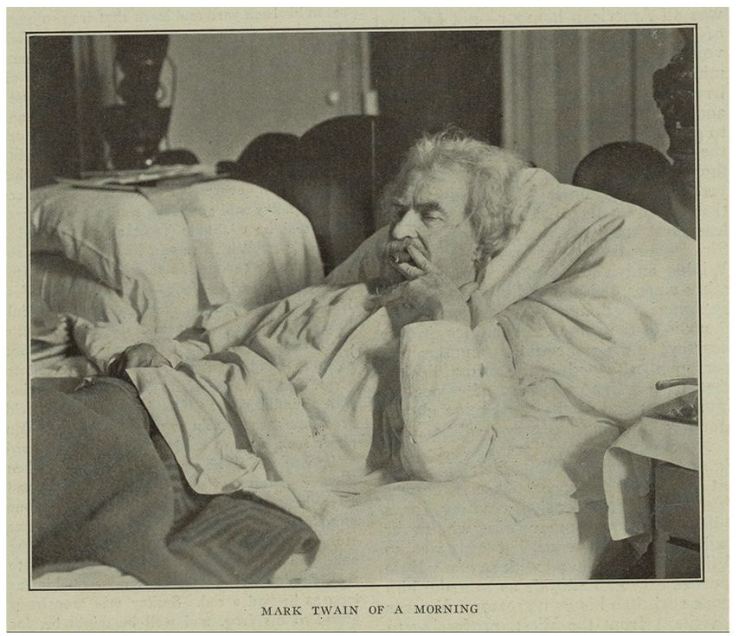
Mark Twain of a Morning

Edison Film of Mark Twain (1909)

A Scapegoat for Promiscuous Drunks, Friendly Calls, and Humbug Resolutions

mark-twain

From Mark Twain’s January 1st, 1863 column in the Territorial Enterprise:

Now is the accepted time to make your regular annual good resolutions. Next week you can begin paving hell with them as usual. Yesterday, everybody smoked his last cigar, took his last drink, and swore his last oath. To-day, we are a pious and exemplary community. Thirty days from now, we shall have cast our reformation to the winds and gone to cutting our ancient short comings considerably shorter than ever. We shall also reflect pleasantly upon how we did the same old thing last year about this time. However, go in, community. New Year’s is a harmless annual institution, of no particular use to anybody save as a scapegoat for promiscuous drunks, and friendly calls, and humbug resolutions, and we wish you to enjoy it with a looseness suited to the greatness of the occasion.

“Letter from Santa Claus” — Mark Twain

Hey, didn’t we just accuse Mark Twain of dissing Santa? Dude had a heart, of course. Here’s a letter he ghost wrote for St. Nick to his beloved daughter Susie:

Palace of St. Nicholas
In the Moon
Christmas Morning

MY DEAR SUSIE CLEMENS:

I have received and read all the letters which you and your little sister have written me by the hand of your mother and your nurses; I have also read those which you little people have written me with your own hands–for although you did not use any characters that are in grown peoples’ alphabet, you used the characters that all children in all lands on earth and in the twinkling stars use; and as all my subjects in the moon are children and use no character but that, you will easily understand that I can read your and your baby sister’s jagged and fantastic marks without any trouble at all. But I had trouble with those letters which you dictated through your mother and the nurses, for I am a foreigner and cannot read English writing well. You will find that I made no mistakes about the things which you and the baby ordered in your own letters–I went down your chimney at midnight when you were asleep and delivered them all myself–and kissed both of you, too, because you are good children, well trained, nice mannered, and about the most obedient little people I ever saw. But in the letter which you dictated there were some words which I could not make out for certain, and one or two small orders which I could not fill because we ran out of stock. Our last lot of kitchen furniture for dolls has just gone to a very poor little child in the North Star away up, in the cold country above the Big Dipper. Your mama can show you that star and you will say: “Little Snow Flake,” (for that is the child’s name) “I’m glad you got that furniture, for you need it more than I.” That is, you must write that, with your own hand, and Snow Flake will write you an answer. If you only spoke it she wouldn’t hear you. Make your letter light and thin, for the distance is great and the postage very heavy.

There was a word or two in your mama’s letter which I couldn’t be certain of. I took it to be “a trunk full of doll’s clothes.” Is that it? I will call at your kitchen door about nine o’clock this morning to inquire. But I must not see anybody and I must not speak to anybody but you. When the kitchen doorbell rings, George must be blindfolded and sent to open the door. Then he must go back to the dining room or the china closet and take the cook with him. You must tell George he must walk on tiptoe and not speak–otherwise he will die someday. Then you must go up to the nursery and stand on a chair or the nurse’s bed and put your car to the speaking tube that leads down to the kitchen and when I whistle through it you must speak in the tube and say, “Welcome, Santa Claus!” Then I will ask whether it was a trunk you ordered or not. If you say it was, I shall ask you what color you want the trunk to be. Your mama will help you to name a nice color and then you must tell me every single thing in detail which you want the trunk to contain. Then when I say “Good-by and a merry Christmas to my little Susie Clemens,” you must say “Good-by, good old Santa Claus, I thank you very much and please tell that little Snow Flake I will look at her star tonight and she must look down here–I will be right in the west bay window; and every fine night I will look at her star and say, ‘I know somebody up there and like her, too.’ ” Then you must go down into the library and make George close all the doors that open into the main hall, and everybody must keep still for a little while. I will go to the moon and get those things and in a few minutes I will come down the chimney that belongs to the fireplace that is in the hall–if it is a trunk you want–because I couldn’t get such a thing as a trunk down the nursery chimney, you know.

People may talk if they want, until they hear my footsteps in the hall. Then you tell them to keep quiet a little while till I go back up the chimney. Maybe you will not hear my footsteps at all–so you may go now and then and peep through the dining-room doors, and by and by you will see that thing which you want, right under the piano in the drawing room-for I shall put it there. If I should leave any snow in the hall, you must tell George to sweep it into the fireplace, for I haven’t time to do such things. George must not use a broom, but a rag–else he will die someday. You must watch George and not let him run into danger. If my boot should leave a stain on the marble, George must not holystone it away. Leave it there always in memory of my visit; and whenever you look at it or show it to anybody you must let it remind you to be a good little girl. Whenever you are naughty and somebody points to that mark which your good old Santa Claus’s boot made on the marble, what will you say, little sweetheart?

Good-by for a few minutes, till I come down to the world and ring the kitchen doorbell.

Your loving SANTA CLAUS
Whom people sometimes call “The Man in the Moon”

Mark Twain Disses Santa Claus

In Chapter 31 of his travel piece A Tramp Abroad, Mark Twain wonders (in typical cynical fashion) why dear ole Saint Nick, who abandoned his kids, should deserve a loving reputation:

Presently we passed the place where a man of better odor was born. This was the children’s friend, Santa Claus, or St. Nicholas. There are some unaccountable reputations in the world. This saint’s is an instance. He has ranked for ages as the peculiar friend of children, yet it appears he was not much of a friend to his own. He had ten of them, and when fifty years old he left them, and sought out as dismal a refuge from the world as possible, and became a hermit in order that he might reflect upon pious themes without being disturbed by the joyous and other noises from the nursery, doubtless.

Judging by Pilate and St. Nicholas, there exists no rule for the construction of hermits; they seem made out of all kinds of material. But Pilate attended to the matter of expiating his sin while he was alive, whereas St. Nicholas will probably have to go on climbing down sooty chimneys, Christmas eve, forever, and conferring kindness on other people’s children, to make up for deserting his own. His bones are kept in a church in a village (Sachseln) which we visited, and are naturally held in great reverence. His portrait is common in the farmhouses of the region, but is believed by many to be but an indifferent likeness. During his hermit life, according to legend, he partook of the bread and wine of the communion once a month, but all the rest of the month he fasted.

Mark Twain’s Fourth of July Speech in Keokuk, Iowa July 3, 1886

Mark Twain’s Fourth of July speech, delivered in Keokuk, Iowa, 1886—

Ladies and gentlemen: I little thought that when the boys woke me with their noise this morning that I should be called upon to add to their noise. But I promise not to keep you long. You have heard all there is to hear on the subject, the evidence is all in and all I have to do is to sum up the evidence and deliver the verdict. You have heard the declaration of independence with its majestic ending, which is worthy to live forever, which has been hurled at the bones of a fossilized monarch, old King George the III, who has been dead these many years, and which will continue to be hurled at him annually as long as this republic lives. You have heard the history of the nation from the first to the last–from the beginning of the revolutionary was, past the days of its great general, Grant, told in eloquent language by the orator of the day. All I have to do is to add the verdict, which is all that can be added, and that is, ‘It is a successful day.’ I thank the officers of the day that I am enabled to once more stand face to face with the citizens that I met thirty years ago, when I was a citizen of Iowa, and also those of a later generation. In the address to-day, I have not heard much mention made of the progress of these last few years–of the telegraph, telephone, phonograph, and other great inventions. A poet has said, ‘Better fifty years of England than all the cycles of Cathay,’ but I say ‘Better this decade than the 900 years of Methuselah.’ There is more done in one year now than Methuselah ever saw in all his life. He was probably asleep all those 900 years. When I was here thirty years ago there were 3,000 people here and they drank 3,000 barrels of whisky a day, and they drank it in public then. I know that the man who makes the last speech on an occasion like this has the best of the other speakers, as he has the last word to say, which falls like a balm on the audience–though this audience has not been bored to-day–and though I can’t say that last word, I will do the next best thing I can, and that is to sit down.

(More).

“Twain Is the Day, Melville the Night” — Roberto Bolaño on U.S. Writers

The following excerpt comes from Raul Schenardi’s 2003 interview with Roberto Bolaño, conducted at the Turin Book Fair just months before the author’s death. The interview is written in Italian (although I’m not sure if it was conducted in Italian). The translation work is the result of two programs (Google Translate and Babel Fish) and a few dictionaries; I also used this Spanish translation as a second source for comparison.

. . .  in all Latin American writers is an influence that comes from two main lines of the American novel, Melville and Twain. [The Savage] Detectives no doubt owes much to Mark Twain. Belano and Lima are a transposition of Huckleberry Finn and Tom Sawyer. It’s a novel that follows the constant movement of the Mississippi. . . . I also read a lot of Melville, which fascinates me. Indeed, I flirt with the belief that I have a greater debt to Melville than Twain, but unfortunately I owe more to Mark Twain. Melville is an apocalyptic author. Twain is the day, Melville  the night — and always much more impressive at night. In regard to modern American literature, I know it poorly. I know just up to the generation previous to Bellow. I have read enough of Updike, but do not know why; surely it was a masochistic act, as each page Updike brings me to the edge of hysteria. Mailer I like better than Updike, but I think as a writer, a prose writer, Updike is more solid. The last American writers I’ve read thoroughly and I know well are those of the “Lost Generation,” Hemingway, Faulkner, Scott Fitzgerald, Thomas Wolff.

“A Nation of Cowards” — Ta-Nehisi Coates on the New Mark Twain Edit

At The AtlanticTa-Nehisi Coates weighs in on the new edit of Mark Twain’s The Adventures of Huckleberry Finn that replaces the word “nigger” with “slave”–

I’m obviously not Mark Twain, but having written a book, I can only imagine how hard Twain worked. I would be incensed if someone went through my book and took out all the “niggers” or “bitches” or “motherfuckers.” It’s really just a hair short of some stranger, in their preening ignorance, putting their hands on your kid.

[. . .] the invocation of nigger by Twain is not a moral failing. But because of our needs, Twain isn’t good enough. Because we can’t handle the story of who we were, and evidently who we are, Twain must be summoned up from the dead and, all against himself, submitted before the edits of amateurs.This is our system of fast-food education laid bare: Children are roaming the halls singing “Sexy Bitch,” while their neo-Confederate parents are plotting to chop the penis off Michelangelo’s David, and clamoring for Gatsby and Daisy to be reunited.

The Adventures of Huckleberry Finn: One of Our Favorite Challenged Books

E.W. Kemble's frontispiece to the original 1884 edition
E.W. Kemble’s frontispiece to the original illustrated edition

The Adventures of Huckleberry Finn by Mark Twain, undoubtedly one of the Great American Novels, ranks a healthy #5 on the ALA’s list the 100 Most Frequently Challenged Books. Young Huck’s casual colloquial use of the word “nigger” and the cruel hijinks Huck and Tom play on Jim at the novel’s end are two reasons that many have sought to suppress Twain’s masterpiece, including educator and critic John Wallace, who famously called it “the most grotesque example of racist trash ever given our children to read.” Wallace went so far as to suggest that “Any teacher caught trying to use that piece of trash with our children should be fired on the spot, for he or she is either racist, insensitive, naive, incompetent or all of the above.”

I guess I should’ve been fired on the spot, as I’ve used Huck Finn in my classroom a number of times, almost always in conjunction with excerpts from Olaudah Equiano’s Interesting Narrative, some Philis Wheatley poems, and a UN report on modern human trafficking. Context is everything.

While I can concede readily that Huck, the voice of the novel, says some pretty degrading things about Jim, often meant (on Twain’s part) to create humor for the reader, to expect Twain’s treatment of race to be what we in the 21st century want it to be is to not treat the material with any justice. And while Huck Finn may be insensitive at times, it handles the issues of race, slavery, class, and escape from the dominant social order with the complexity and thought that such weighty issues deserve. Ultimately, the novel performs a critique on the hypocrisy of a “Christian,” “democratic” society that thought it was okay to buy and sell people. This critique shows up right in the second page. Consider these lines (boldface mine):

The widow rung a bell for supper, and you had to come to time. When you got to the table you couldn’t go right to eating, but you had to wait for the widow to tuck down her head and grumble a little over the victuals, though there warn’t really anything the matter with them,—that is, nothing only everything was cooked by itself. In a barrel of odds and ends it is different; things get mixed up, and the juice kind of swaps around, and the things go better.

After supper she got out her book and learned me about Moses and the Bulrushers, and I was in a sweat to find out all about him; but by and by she let it out that Moses had been dead a considerable long time; so then I didn’t care no more about him, because I don’t take no stock in dead people.

Huck’s dream is of a delicious mix, a swapping of juices — integration. Additionally, his disregard for the dead Bible heroes reveals that the white Christian society’s obsession with the ancient past comes at the expense of contemporary value. Huck, an orphan, and Jim, separated from his family, will symbolically echo Moses in the bulrushes as they use the great Mississippi as a conduit for escape, for freedom. Huck (or Twain, really) here points out that it’s not enough to look at dead words on a page, on old dead lawgivers–we have to pay attention to the evils and wrongs and hypocrisies that live today.

Twain even tells us how to read his book from the outset:

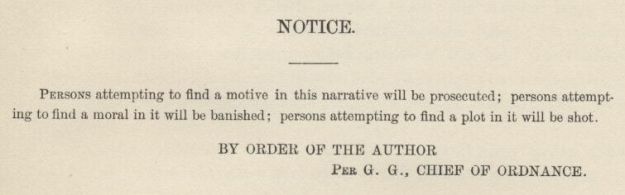
Now, it’s impossible to read a book–a good book–without finding its plot, searching for its moral, or caring about its characters, and Twain knows this. His “Notice” is tantamount to saying “don’t think about an elephant”–he uses irony to tell us we must find motive, moral, and plot here, and that we must do so through this lens of irony.

But of course, you have to read closely for all these things. I suppose it’s technically easier to call something trash, throw it in the garbage, and not have to devote time and energy to thinking about it. Who knows? You might learn something–and we wouldn’t want that, would we?

[Editorial note: Biblioklept originally published this piece in September of 2008].

Terrible Ideas

There’s a new Bowdlerized edition of Huckleberry Finn.

James Franco thinks he can adapt Faulkner’s As I Lay Dying and Cormac McCarthy’s Blood Meridian.

Snooki is a novelist.

James Frey tops The Guardian’s “Best Books of 2011” list.

Also, Frey’s MFA fiction factory scam is landing the guy movie deals.

Clarence Thomas’s ex to publish a “sexually driven” memoir.