Mass-market Monday | Harry Crews’ A Feast of Snakes

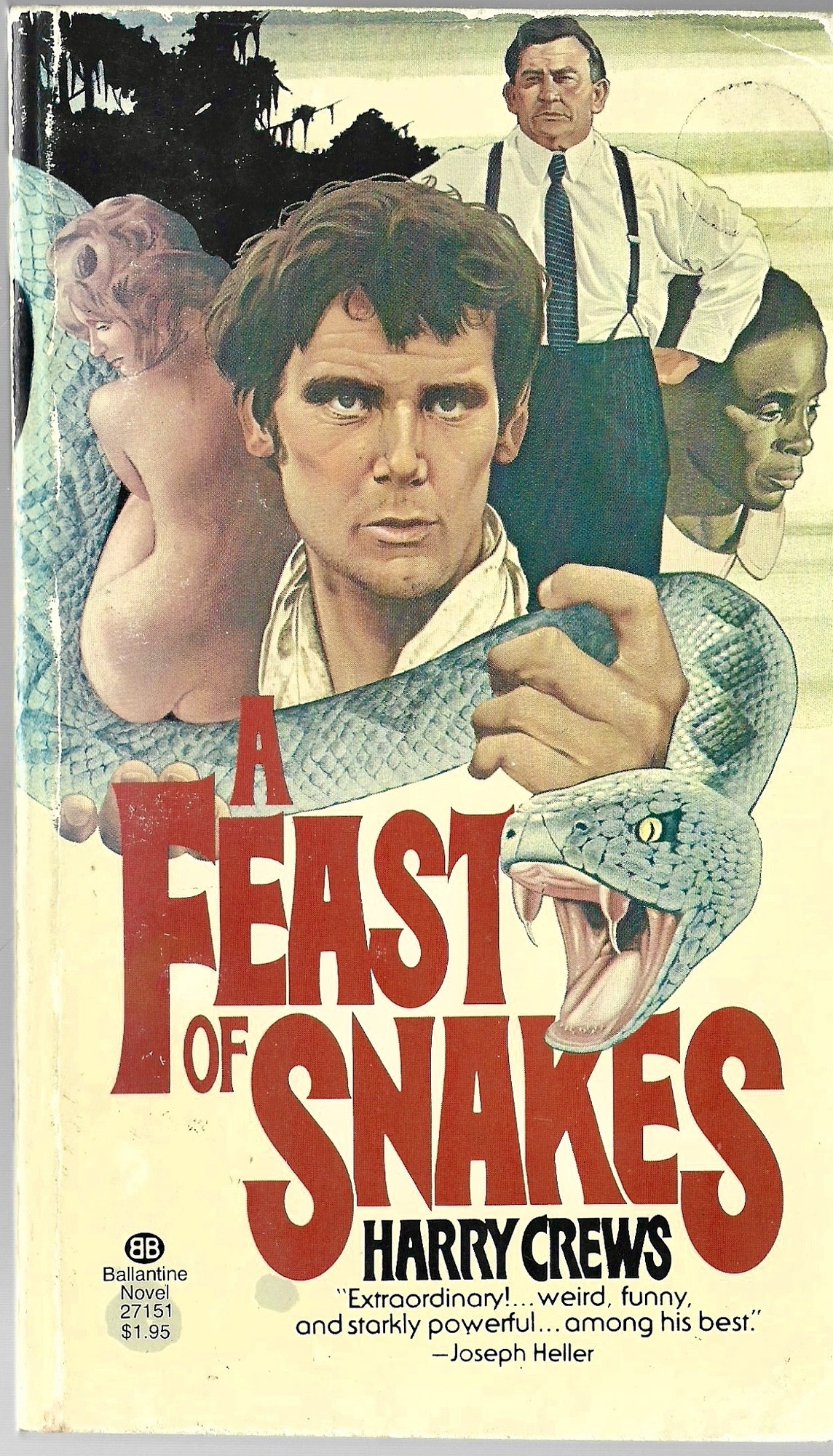
A Feast of Snakes, Harry Crews. Ballantine Books, first edition, first printing (1978). No cover artist credited. 165 pages.

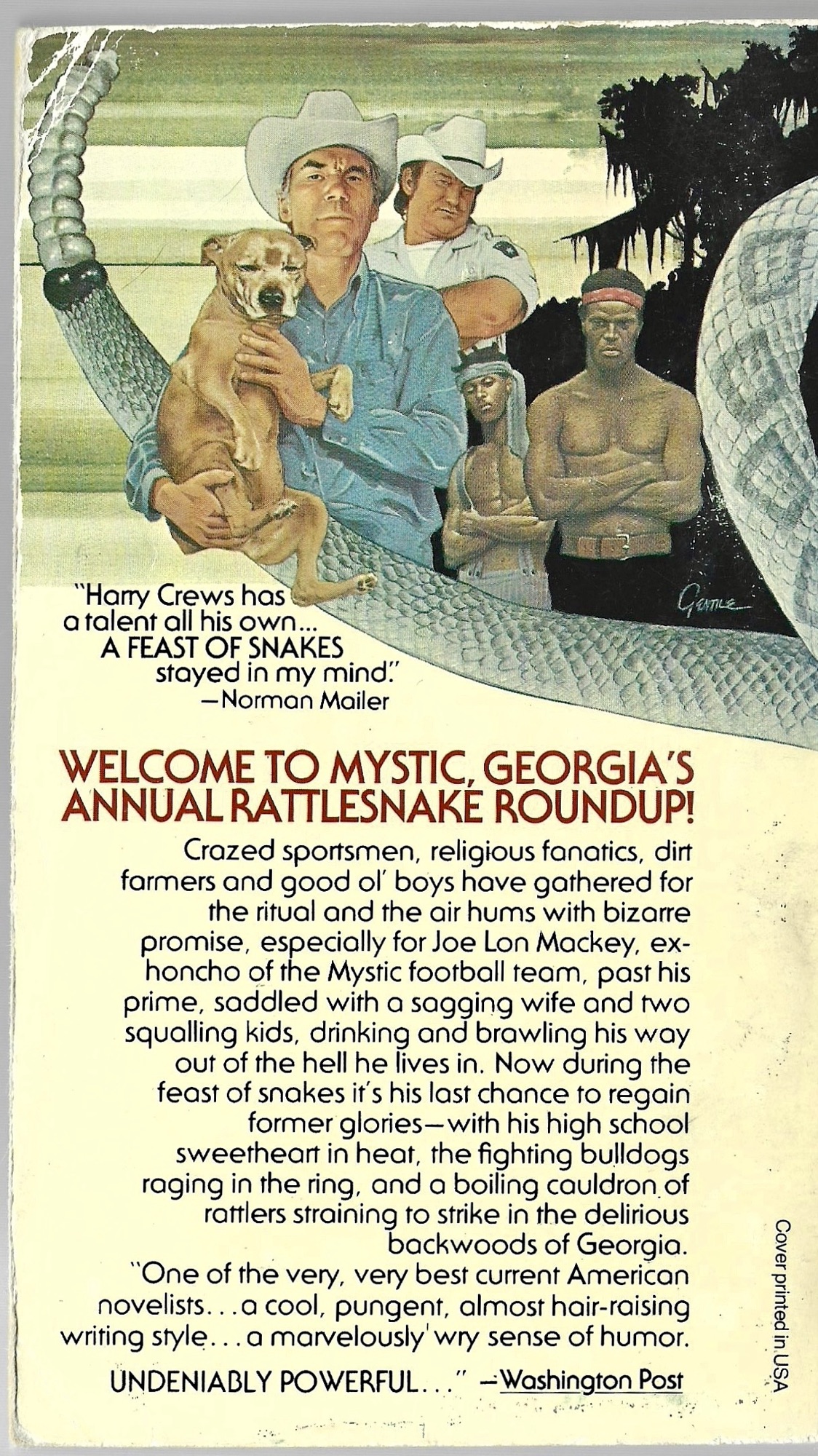
While the cover designer and artist aren’t credited, there is a signature on the back which I believe is “Gentile.” If anyone has a guess as to the artist’s full name I’d be happy to hear it.

From the novel: not quite a recipe for snakes:

When they got to his purple double-wide, Joe Lon skinned snakes in a frenzy. He picked up the snakes by the tails as he dipped them out of the metal drums and swung them around and around his head and then popped them like a cowwhip, which caused their heads to explode. Then he nailed them up on a board in the pen and skinned them out with a pair of wire pliers. Elfie was standing in the door of the trailer behind them with a baby on her hip. Full of beer and fascinated with what Joe Lon could feel—or thought he could—the weight of her gaze on his back while he popped and skinned the snakes. He finally turned and looked at her, pulling his lips back from his teeth in a smile that only shamed him.

He called across the yard to her. “Thought we’d cook up some snake and stuff, darlin, have ourselves a feast.”

Her face brightened in the door and she said: “Course we can, Joe Lon, honey.”

Elfie brought him a pan and Joe Lon cut the snakes into half-inch steaks. Duffy turned to Elfie and said: “My name is Duffy Deeter and this is something fine. Want to tell me how you cook up snakes?”

Elfie smiled, trying not to show her teeth. “It’s lots of ways. Way I do mostly is I soak’m in vinegar about ten minutes, drain’m off good, and sprinkle me a little Looseanner redhot on’m, roll’m in flour, and fry’m is the way I mostly do.”


Mass-market Monday | Ursula K. Le Guin’s The Left Hand of Darkness

The Left Hand of Darkness, Ursula K. Le Guin. Ace Books, first edition (1969). Cover art by Leo & Diane Dillon. 286 pages.

I read all of Le Guin’s Hainish novels eight years ago, and wrote this about The Left Hand of Darkness:

—The Left Hand of Darkness is amazing. Perfect in its strange imperfections and crammed with fables and myths and misunderstandings, it is the apotheosis of Le Guin’s synthesis of adventure with philosophy. Darkness is about shadows and weight. About pulling weight—literally, figuratively. It’s also the story of an ice planet. (A stranger comes to the ice planet!). It’s a political thriller. It’s a sexual thriller. But the impression that lingers strongest: The Left Hand of Darkness is one of the better literary evocations of friendship (its precarious awful strange wonderful tenuous strength) that I’ve ever read.

Mass-market Monday | American Short Stories since 1945

American Short Stories since 1945, edited by John Hollander. Perennial Classics, first edition, 1968. Cover design by Emanuel Schongut. 525 pages.

I think it was the title and the spine that first intrigued me when I pulled American Short Stories since 1945 from the shelf of a used book store: What would the selections be? How many years does the collection span? If Emanuel Schongut’s exquisite cover didn’t sell me on the book (which it did, all two dollars of it!), then the track list on the back certainly would have. And not so much for the authors I’d already read–Gass, Pynchon, Barthelme, O’Connor, Baldwin, and so on—but for the ones I hadn’t heard of, or at least didn’t think I’d heard of. Paul Goodman? Gilbert Rogin? Jeremy Larner? George P. Elliott? The poet who compiled the collection, John Hollander, writes in his introduction that it “aims to show the major shapes taken by shorter fiction in America since the end of World War II.” It’s the sort of book I wish I’d found when I was much, much younger, the kind of mixtape that would have sent me a lot of strange, wonderful directions.

Mass-market Monday | J.G. Ballard’s Crash

Crash, J.G. Ballard. Vintage Books, first Vintage Books edition (1985). Cover design by Carin Goldberg with art by Chris Moore. 224 pages.

A few sentences and fragments from The New York Time’s original 1973 review of Crash:

…hands-down, the most repulsive book I’ve yet to come across.

….as reader, I promise you, only a virtuoso foulness can turn my stomach.

…a crazed, morbid roundelay of dismemberment and sexual perversion.

…I could not, in conscience, recommend it. Indeed I most cordially advise against.

…monomaniacal drive.

…The protagonists are titillated by collisions as dogs are by curb smells.

…Punched out eyeballs. Blood. Vomit. Fecal matter. Decapitation. Sperm. Bifurcated, mashed genitals.

…Perhaps J.G. Ballard was traumatized at a drive-in theater.

…I certainly won’t read further in the Ballard oeuvre.

Mass-market Monday | David R. Bunch’s Moderan


Moderan, David R. Bunch. Avon Books, first edition (1971). No cover artist credited. 240 pages.

The uncredited Boschian cover for this 1971 mass-market paperback edition of Moderan is by Norman Adams. (Adams did a similar cover in 1972 for Jack Williamson’s novel The Humanoids.)

I think copies of this volume were expensive and hard to find previous to NYRB’s 2018 release of a new edition of Moderan (which included eleven new tales). That’s the version I read—although I was happy to snap this old paperback up for three bucks at a used bookstore. I wrote of the novel in my 2018 reading round-up:

Moderan works as a post-nuke dystopian satire on toxic masculinity. The tropes here might seem familiar—cyborgs and dome homes, caste systems and ultraviolence, a world of made and not born ruled by manunkind (to steal from E.E. Cummings)—it’s the way that Bunch conveys this world that is so astounding. Moderan is told in its own idiom; the voice of our narrator Stronghold-10 booms with a bravado that’s ultimately undercut by the authorial irony that lurks under its surface. The book seems equal to the task of satirizing the trajectory of our zeitgeist in a way that some contemporary satirists have failed to.

Mass-market Monday | Herman Melville’s Redburn

Redburn, Herman Melville. Doubleday Anchor Books (1957). Cover art by Edward Gorey. 301 pages.

Redburn is as good a place as any to start with Melville, I suppose. From Elizabeth Hardwick’s essay “Melville in Love,” which prompted me to finally read Redburn:

Melville’s state of mind is revealed…with a purity of expressiveness in the novel Redburn, one of his most appealing and certainly the most personal of his works. He is said to have more or less disowned the book, more rather than less, since he claimed it was only written for tobacco. Whether this is a serious misjudgment of his own work or a withdrawal, after the fact, from having shown his early experience of life without his notable reserve and distance is, of course, not clear. For a contemporary reader, Redburn, the grief-stricken youth, cast among the vicious, ruined men on the ship, walking the streets of Liverpool in the late 1830s, even meeting with the homosexual hustler Harry Bolton might have more interest than Typee’s breadfruit and coconut island and the nymph, Fayaway. But it is only pertinent to think of Redburn on its own: a novel written after Typee, Omoo, and Mardi in the year 1849, ten years after he left Lansingburgh to go on his first voyage.


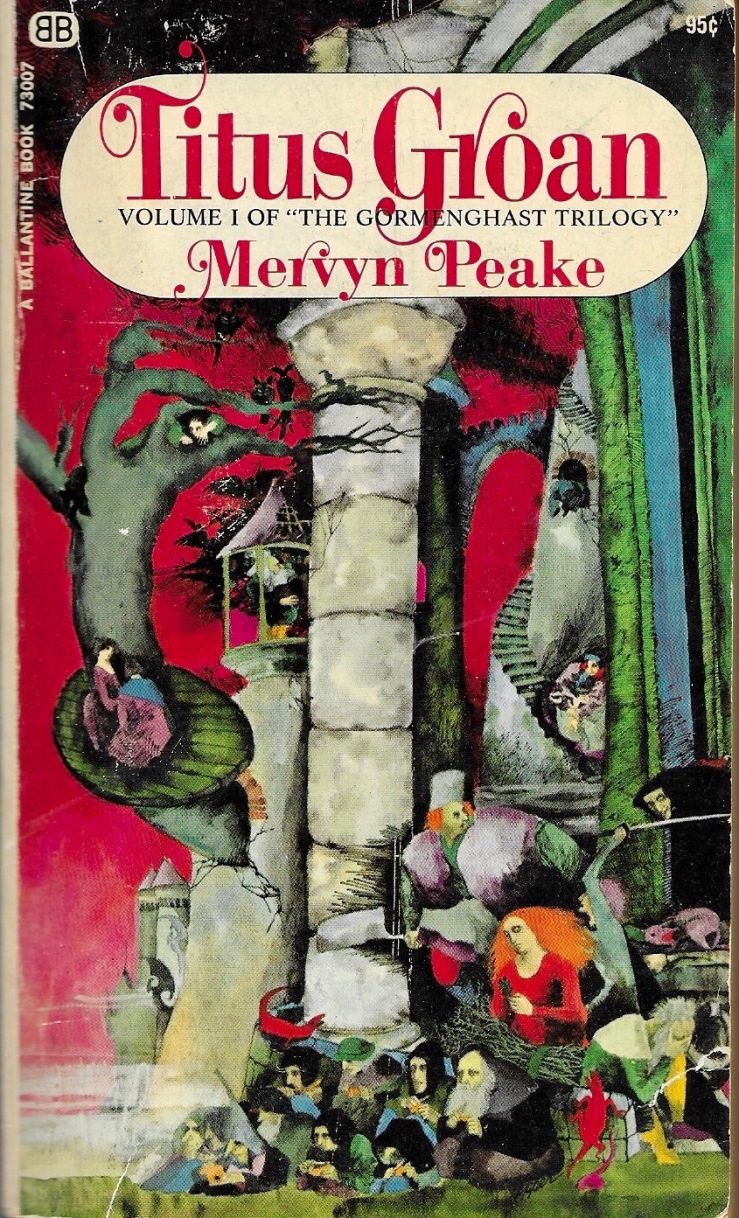
Mass-market Monday | Mervyn Peake’s Titus Groan

2020-04-05_161903

2020-04-05_161903_1

Titus Groan, Mervyn Peake. Ballantine Books (1968). No cover artist credited. 543 pages.

The uncredited cover artist is Bob Pepper, who also provided the covers for Ballantine editions of the other two novels in Peake’s Gormenghast trilogy, Gormenghast and Titus Alone. The covers are actually segments from one painting:

The edition also includes black and white illustrations by Peake (including eight glossy inset pages).

I have no idea how I had never even heard of Mervyn Peake’s Gormenghast trilogy until some point late in 2019. I grew up reading fantasy and yet somehow never encountered these strange, dense books. I consumed them in 2020, pressing extra copies on my son.

From my 2020 reading roundup end-of-year post:

Titus Groan, Mervyn Peake

The first of Mervyn Peake’s strange castle (and then not-castle trilogy (not really a trilogy, really)), Titus Groan is weird wonderful grotesque fun. Inspirited by the Machiavellian antagonist Steerpike, Titus Groan can be read as a critique of the empty rituals that underwrite modern life. It can also be read for pleasure alone.

Gormenghast, Mervyn Peake

Probably the best novel in Peake’s trilogy, Gormenghast is notable for its psychological realism, surreal claustrophobia, and bursts of fantastical imagery. We finally get to know Titus, who is a mute infant in the first novel, and track his insolent war against tradition and Steerpike. The novel’s apocalyptic diluvian climax is amazing.

Titus Alone, Mervyn Peake

A beautiful mess, an episodic, picaresque adventure that breaks all the apparent rules of the first two books. The rulebreaking is fitting though, given that Our Boy Titus (alone!) navigates the world outside of Gormenghast—a world that doesn’t seem to even understand that a Gormenghast exists (!)—Titus Alone is a scattershot epic. Shot-through with a heavy streak of Dickens, Titus Alone never slows down enough for readers to get their bearings. Or to get bored. There’s a melancholy undercurrent to the novel. Does Titus want to get back to his normal—to tradition and the meaningless lore and order that underwrote his castle existence? Or does he want to break quarantine? 

Mass-market Monday | Gabriel García Márquez’s One Hundred Years of Solitude

One Hundred Years of Solitude, Gabriel García Márquez. Translation by Gregory Rabassa. Avon Bard (1971). No cover artist credited. 383 pages.

I am a huge fan of the Avon Bard Latin American literature series. (I do wish, however, they had done a better job crediting the cover artists.)

I listened to One Hundred Years of Solitude on audiobook (narrated by John Lee) last week while undertaking a largish home project. I had read the novel maybe twelve years ago, after several false starts, and enjoyed the audiobook very much, even if the story was much, much sadder than I’d remembered. I had registered One Hundred Years of Solitude in my memory as rich and mythic, its robust humor tinged with melancholy spiked with sex and violence. That memory is only partially correct—García Márquez’s novel is darker and more pessimistic than my younger-reader-self could acknowledge.

From John Leonard’s wonderful contemporary review in The New York Times (in which he employs the word haruspex in the second sentence:

You emerge from this marvelous novel as if from a dream, the mind on fire. A dark, ageless figure at the hearth, part historian, part haruspex, in a voice by turns angelic and maniacal, first lulls to sleep your grip on a manageable reality, then locks you into legend and myth. One Hundred Years of Solitude is not only the story of the Buendia family and the Colombian town of Macondo. It is also a recapitulation of our evolutionary and intellectual experience. Macondo is Latin America in microcosm: local autonomy yielding to state authority; anticlericalism; party politics; the coming of the United Fruit Company; aborted revolutions; the rape of innocence by history. And the Buendias (inventors, artisans, soldiers lovers, mystics) seem doomed to ride biological tragi‐cycle in circles from solitude to magic to poetry to science to politics to violence back again to solitude.


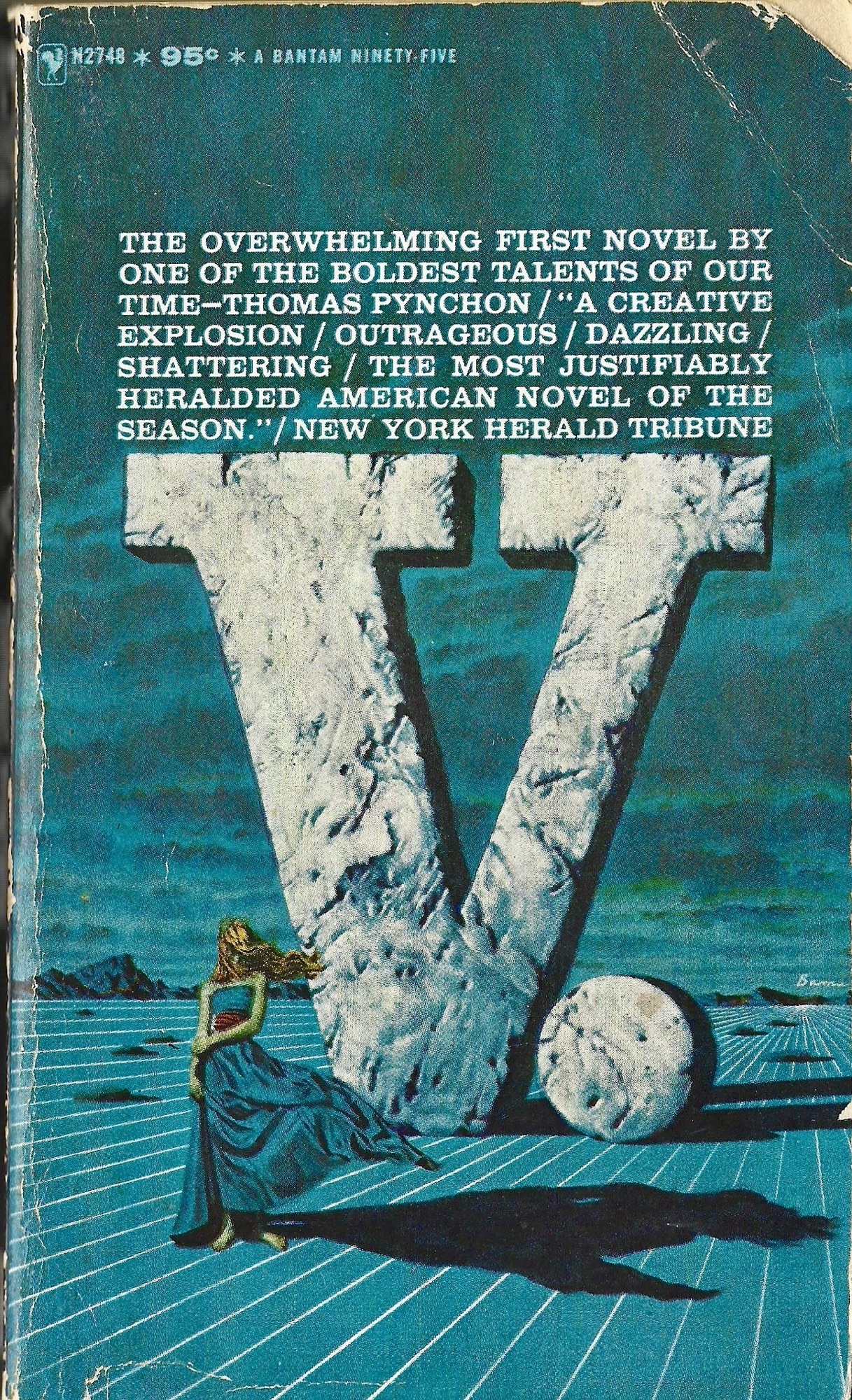
Mass-market Monday | Thomas Pynchon’s V.

V., Thomas Pynchon. Bantam Books, third printing (1964). No cover artist credited. 463 pages.

Although artist James Bama is not credited, you can see his signature on the right side of the cover, just above the horizon.

I reread V. a few years back, concluding my piece with,

The grist, grit, and horror of the big postwar world will cling to the present. Nobody’s stepping down from heaven, or Heaven, and there are no magic words—but there is a kind of love, a loving with your mouth shut, a kind of radical, earnest, transcendent love that Pynchon evokes, soils, and sanctifies here.

Mass-market Monday | Samuel R. Delany’s Nova

Nova, Samuel R. Delany. Bantam Books, ninth printing (1979). No cover artist credited. 215 pages.

Although he is not credited, Eddie Jones is the artist for this marvelous cover to Bantam’s mass-market reprint of Delany’s 1968 novel Nova. 

Nova is one of my favorite SRD novels. Let me self-plagiarize myself from a few years ago:

I couldn’t make it through Delany’s cult favorite Dhalgren a few years back, but Nova was easier sledding. The book is a riff on Moby-Dick, tarot, monoculture, and the grail quest. It’s jammed with ideas and characters, and if it never quite coheres into something transcendent, it’s a fun quick read (even if the ending, right from the postmodern metatextual playbook is too clever by half).

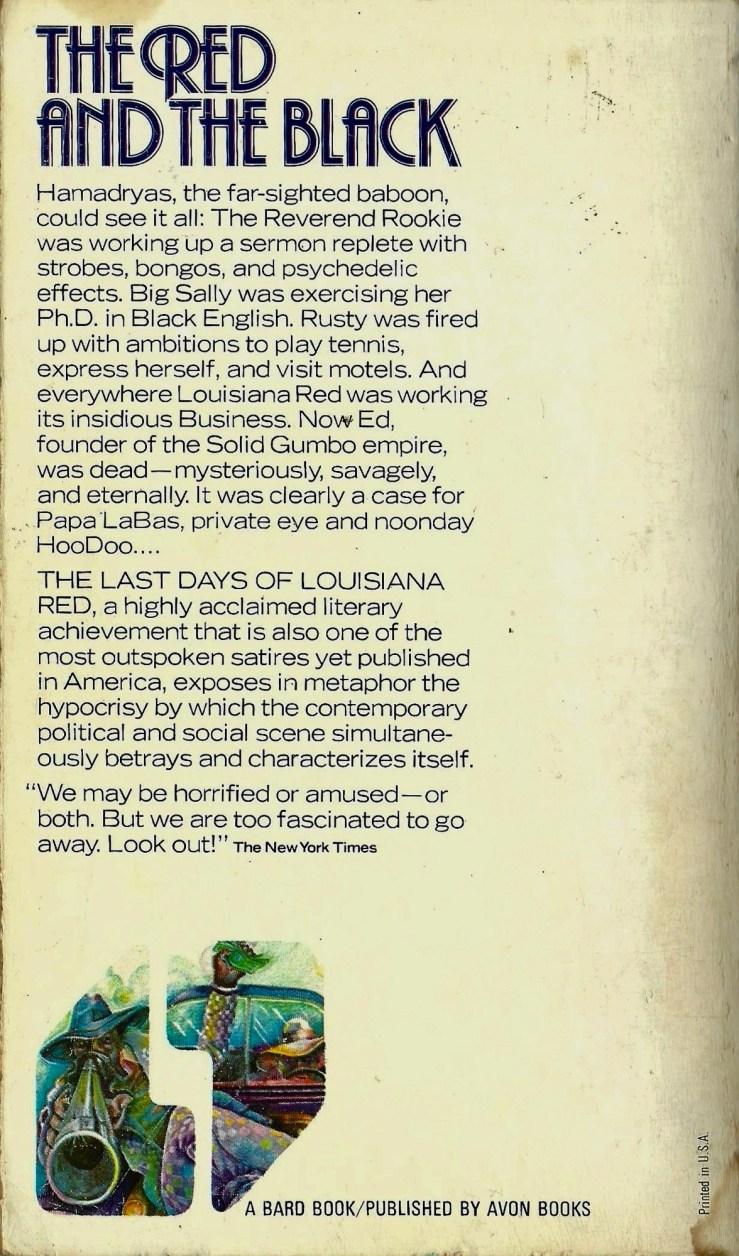
Mass-market Monday | Ishmael Reed’s The Last Days of Louisiana Red

The Last Days of Louisiana Red, Ishmael Reed. Bard Books, First Bard Printing (1976). Cover art is by Andrew Rhodes (not credited). 191 pages.

From my review of The Last Days of Louisiana Red:

Ishmael Reed’s 1974 novel The Last Days of Louisiana Red is a sharp, zany satire of US culture at the end of the twentieth century. The novel, Reed’s fourth, is a sequel of sorts to Mumbo Jumbo (1972), and features that earlier novel’s protagonist, the Neo-HooDoo ghost detective Papa LaBas.

In Mumbo Jumbo, Reed gave us the story of an uptight secret society, the Wallflower Order, and their attempt to root out and eradicate “Jes’ Grew,” a psychic virus that spreads freedom and takes its form in arts like jazz and the jitterbug. The Last Days of Louisiana Red also employs a psychic virus to drive its plot, although this transmission is far deadlier. “Louisiana Red” is a poisonous mental disease that afflicts black people in the Americas, causing them to fall into a neo-slave mentality in which they act like “Crabs in the Barrel…Each crab trying to keep the other from reaching the top.”

Mass-market Monday | Muriel Spark’s Robinson

Robinson, Muriel Spark. Penguin Books, (1964). Cover art by Terence Greer. 175 pages.

Terence Greer illustrated six midsixties Muriel Spark Penguin editions. I would love to own the other five.

Robinson is Spark’s second novel, and not her finest (of the ones I’ve read I’d argue for Loitering with Intent or The Prime of Miss Jean Brodie.)

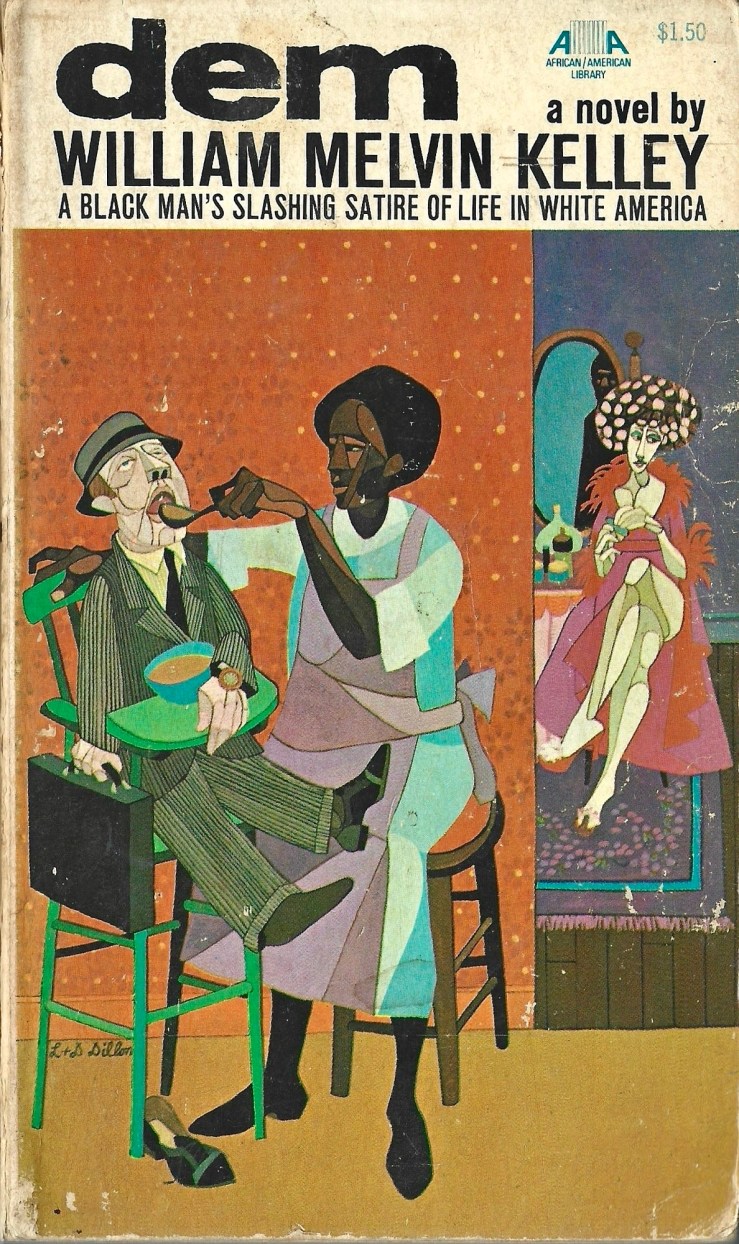
Mass-market Monday | William Melvin Kelley’s dem

dem, William Melvin Kelley. Collier Books (first Collier edition, 1969). Cover art by Leo and Diane Dillon. 141 pages.

Possibly one of my favorite covers by the Dillons. dem is not Kelley’s best novel–that would be Dunfords Travels Everywheres—but his knives are out here and the book is very funny. Thankfully, WMK’s books were reprinted a few years ago (used copies of his first novel A Different Drummer aren’t hard to find, but the rest are). Here’s a bit from my riff on dem back in 2020:

Kelley’s style in dem is choppier, sharper, more cartoonish than his Faulknerian debut A Different Drummer and if dem skews towards absurd irony where Drummer was heroic-tragic, both novels are rooted in intense anger tempered by strange empathy.

As its subheading attests, dem is, like Drummer, a take on white people viewing black people, and over a half-century after its publication, many of the tropes Kelley employs here still ring painfully true. His “hero,” Mitchell Pierce is a lazy advertising executive, bored with his wife, a misogynist who occasionally longs to return to the “wars in Asia.” He’s also deeply, profoundly racist; structurally racist; the kind of racist who does not think of his racism as racism. At the same time, Kelley seems to extend little parcels of sympathy to Pierce, even as he reveals the dude to be a piece of shit, as if to say, What else could he end up being in this system but a piece of shit?

Mass-market Monday | Arkadi & Boris Strugatski’s Hard to Be a God

Hard to Be a God, Arkadi & Boris Strugatski. Translation by Wendayne Ackerman. Daw Books, first edition, first printing (1973). Cover art by Kelly Freas. 205 pages.

Like many anglophones, I first sought out the Brothers Strugatsky–which I will continue to spell with a final –y here, in line with the spelling variation I’ve used on this blog for years now, while also above conceding this 1973 Ackerman translation uses the –variant—like many anglophones, I first sought out the Brothers Strugatsky sometime after seeing Andrey Tarkovsky’s 1979 film Stalker, an adaptation of their 1972 novel Roadside Picnic. And, as I expect is the case with many anglophones seeking out Strugatsky novels, I had to wait quite some time to get my hands on one. The English translations of the Strugatsky’s novels were out of print and hard to find second hand.

In 2012, a new translation of Roadside Picnic by Olena Bormashenko was issued by Chicago Review Press; it was the first one I was able to get my paws on. Over the next decade CRP would release several more Bormashenko’s translations of Strugatsky novels, including Hard to Be a God. It was actually this translation of Hard to Be a God that I read, not the Ackerman version above, which I was stunned to find used and in pristine condition a few years ago (I paid about three dollars for it). Bormashenko’s translation came out a year or two after Alexei German’s film adaptation came out (or at least became available for me to watch on Netflix a dozen times over six months). It would be silly to say the book is “nothing” like the film, and the book is very good, but German’s film is a masterpiece. Those interested in the Strugatsky’s sci-fi might want to start with Roadside Picnic; I think my favorite that I’ve read so far is Snail on the Slope.

The translator of this edition, Wendayne Ackerman, also translated Stanisław Lem’s 1964 novel The Invincible, working from a German translation of the book and not the Polish original. Her bread and butter though, it seems, was translating dozens and dozens of novels in the German space opera franchise, Perry Rhodan.

Kelly Freas, the cover artist of this edition, had a long and extensive career creating sci-fi covers and illustrations, including covers for novels by Philip K. Dick and Samuel R. Delany. I like his cover (and love the font!), even if it’s a bit to King-Kongy for the novel.

Mass-market Monday | Donald Barthelme’s Unspeakable Practices, Unspeakable Acts

Unspeakable Practices, Unnatural Acts, Donald Barthelme. Bantam Books, first edition, first printing (1969). No cover artist credited. 165 pages.

While there is no artist credited for the frenetic, Boschian cover of this Bantam edition of Unspeakable Practces, it is likely the work of Steele Savage — compare it in particular with Savage’s cover for Ballantine’s 1969 edition of John Brunner’s novel Stand on Zanzibar.

Barthelme’s second collection of short stories (most of which first ran in The New Yorker) is larded with some of the postmodernist’s greatest hits: “The Indian Uprising,” “The Balloon,” “Robert Kennedy Saved from Drowning, “Game,” “See the Moon?”….It would be an ideal starting point for Barthelme if Sixty Stories and Forty Stories didn’t already exist. I wrote about many of the stories collected in Unspeakable Practices, Unnatural Acts a few years ago when I revisited Sixty Stories. 

And if you want to get into Barthelme but aren’t sure of where to start, you could do far worse than to hear him read his classic, “The Indian Uprising”: