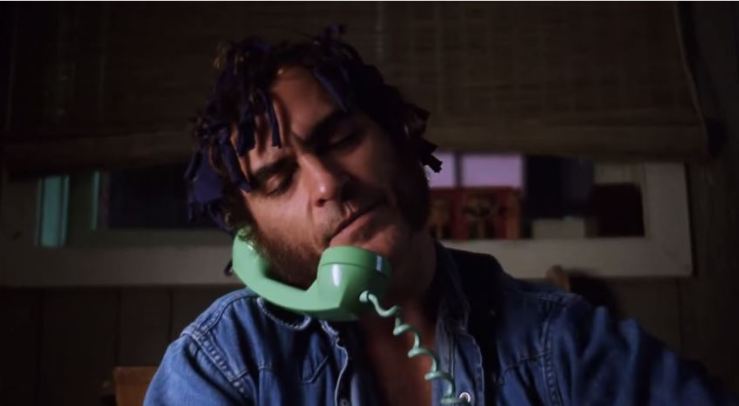
A montage of fragments deleted from Inherent Vice

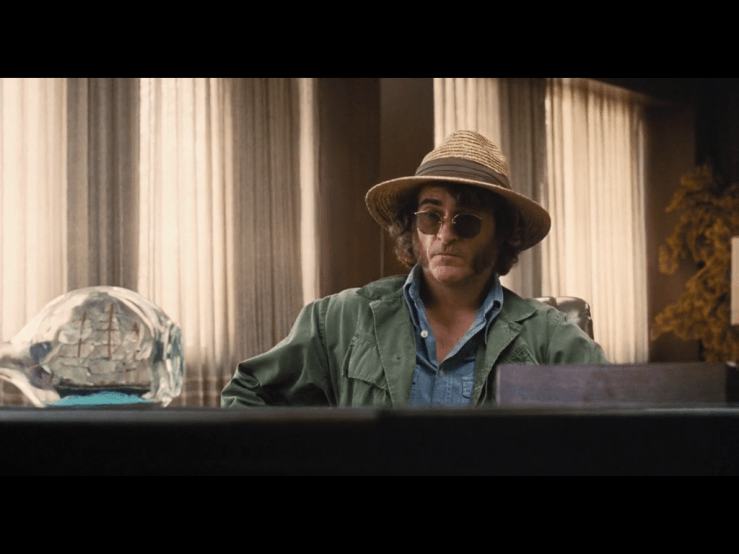
A deleted scene from Inherent Vice

Get thee behind me Satan

A rambling and possibly incoherent riff on Inherent Vice (film and novel) and The Crying of Lot 49

IMG_0200

A. The first time I saw Paul Thomas Anderson’s film Inherent Vice, I was in the middle of rereading Pynchon’s novel The Crying of Lot 49, which I hadn’t read in fifteen years. I remembered the novel’s vibe, its milieu, but not really its details.

B. I read The Crying of Lot 49 and then immediately reread it. It seemed much stronger the second time—not nearly as silly. Darker. Oedipa Maas, precursor to Doc Sportello, trying not to lose the thread as she leaves the tower for the labyrinth, rushing dizzy into the sixties.

C. Another way of saying this: Inherent Vice is sequel to The Crying of Lot 49. Any number of details substantiate this claim (and alternately unravel it, if you wish, but let’s not travel there)—we could focus on the settings, sure, or maybe the cabals lurking in the metaphorical shadows of each narrative—is The Golden Fang another iteration of The Tristero?—but let me focus on the conclusions of both novels and then discuss the conclusion of PTA’s film.

D. A favorite line from a favorite passage from The Crying of Lot 49: “the true paranoid for whom all is organized in spheres joyful or threatening about the central pulse of himself.” Paranoia as a kind of sustained hope, a way to find meaning, order, a center.

E. The final pages of The Crying of Lot 49 find Oedipa trying to make sense of the labyrinth (my emphases in bold):

For it was now like walking among matrices of a great digital computer, the zeroes and ones twinned above, hanging like balanced mobiles right and left, ahead, thick, maybe endless. Behind the hieroglyphic streets there would either be a transcendent meaning, or only the earth. In the songs Miles, Dean, Serge and Leonard sang was either some fraction of the truth’s numinous beauty (as Mucho now believed) or only a power spectrum. Tremaine the Swastika Salesman’s reprieve from holocaust was either an injustice, or the absence of a wind; the bones of the GI’s at the bottom of Lake Inverarity were there either for a reason that mattered to the world, or for skin divers and cigarette smokers. Ones and zeroes. So did the couples arrange themselves. At Vesperhaven House either an accommodation reached, in some kind of dignity, with the Angel of Death, or only death and the daily, tedious preparations for it. Another mode of meaning behind the obvious, or none. Either Oedipa in the orbiting ecstasy of a true paranoia, or a real Tristero. For there either was some Tristero beyond the appearance of the legacy America, or there was just America and if there was just America then it seemed the only way she could continue, and manage to be at all relevant to it, was as an alien, unfurrowed, assumed full circle into some paranoia.

There is either meaning, or there is not meaning. Continue reading “A rambling and possibly incoherent riff on Inherent Vice (film and novel) and The Crying of Lot 49”

Ship in a bottle (Inherent Vice)

Ship in a bottle (Inherent Vice)

Paul Thomas Anderson’s Inherent Vice Screenplay

Capture


You can (legally) download Paul Thomas Anderson’s screenplay for his adaptation of Thomas Pynchon’s Inherent Vice(Via, via, via).

That’s that! (Punch Drunk Love)

Reading There Will Be Blood as the expanded epilogue to Blood Meridian

Watching (again) Paul Thomas Anderson’s 2007 film There Will Be Blood last night, it struck me that the film can be read as an expansion of the epilogue to Cormac McCarthy’s 1985 novel Blood Meridian.

Here is that infamously perplexing passage, a strange note that punctuates the devastating infanticidal horror at the novel’s core:

In the dawn there is a man progressing over the plain by means of holes which he is making in the ground. He uses an implement with two handles and he chucks it into the hole and he enkindles the stone in the hole with his steel hole by hole striking the fire out of the rock which God has put there. On the plain behind him are the wanderers in search of bones and those who do not search and they move haltingly in the light like mechanisms whose movements are monitored with escapement and pallet so that they appear restrained by a prudence or reflectiveness which has no inner reality and they cross in their progress one by one that track of holes that runs to the rim of the visible ground and which seems less the pursuit of some continuance than the verification of a principle, a validation of sequence and causality as if each round and perfect hole owed its existence to the one before it there on that prairie upon which are the bones and the gatherers of bones and those who do not gather. He strikes fire in the hole and draws out his steel. Then they all move on again.

I’ve heard numerous interpretations of this passage over the years. Many of the interpretations dwell on the metaphorical power of the epilogue—it’s the final gnostic clue in the Judge’s web of mysteries; it’s the Promethean redemption of humanity against the Judge’s evil; it’s the spirit of civilization that will measure and conquer the bloody West, a progressive new dawn; it’s Cormac McCarthy’s signature, his designation of himself as the writer who carries the fire.

I’m fine with all of these interpretations, for I foolishly take Judge Holden at his word when he points out that, “Your heart’s desire is to be told some mystery. The mystery is that there is no mystery.” Let me eschew the symbolic then, at least momentarily, for the literal.

The epilogue’s literal imagery suggests a man working with post hole diggers: Is he building a fence? Constructing telegraph poles? Exploring? Surveying? Whatever his intentions, he marks and measures the land.

Whether the digger is a leader or not, he has followers, “the wanderers in search of bones” as well as “those who do not search.” Bones of what? Are the searchers hunting relics? (To revert to the metaphorical—sorry—are these bones the dead eyes Emerson warned us not to look through?). Or are the bones something else—dinosaur bones, Texas tea, carbon, fuel?

there will be blood

So There Will Blood and there will be bones: Daniel Day-Lewis’s Daniel Plainview, a misanthropic, near-malevolent, and ultimately murderous oil man—what I want to say is that he is (a failed version of) McCarthy’s Epilogue Digger. Is not There Will Be Blood  a film about digging, about holes, falling in holes, dying in holes, striking fire from holes? And is not There Will Be Blood also a film about the abjection of holes—the oil, the mud, the muck, the blood that coats hands and faces, eyes, lips, ears burst? Of the recapitulation of the hole as the primal space for culture—a fertile, generative, fecund, deadly space? The hole as the space of shame and possibility? Daniel Plainview, surveying California, marking lines for his followers to follow, striking oil, striking fire. No?

There-Will-Be-Blood-daniel-day-lewis-859163_427_321

We might see in Paul Thomas Anderson’s film a repetitious revision of McCarthy’s novel—a recasting of sorts, with Plainview possessed by Glanton’s maniacal spirit—and Glanton in turn possessed by the spirit of the Judge, the dark omnipresent bad father. Both film and novel mediate their Oedipal dramas in an utterly masculine world. Blood Meridian affords more speaking roles to women than There Will Be Blood does, but both see fit to discharge any notion of a mother from the Oedipal contests they depict, rendering the kid in each narrative the warden of strange gangs, strange wanderers. Anderson allows H.W. to suffer but live and perhaps thrive, to find a mate, to escape into new and alien territory, outside of the holes his surrogate father has dug. Our would-be hero of Blood Meridian, the kid, dies in an outhouse, an abject hole.

And Daniel Plainview—he murders the false priest (which the judge failed to do—although Tobin was a true priest though ex-priest), murders a version of himself—another brother, another Abel. He’s not a good guy. If we read McCarthy’s epilogue through his latest novel, The Road, or even through some of the lines in No Country for Old Men, we can see that “the good guys” are charged with carrying the fire—and is this not what the Epilogue Digger is doing? Carrying the fire, freeing the fire from the earth? Plainview would like to carry the fire, to generate new life, new communities, but he fails, he falls, he crumbles. He abandons his child, and then denies his child. “I’m finished!”

Am I finished? I’m now more confused than when I started this riff. The germ of the idea woke with me this morning—the alien landscape of PTA’s film seemed to restage for me moments in McCarthy’s novel in some waking dream—and like a dream seemed perfectly illogically logical. But bound up in my language I’m not so sure. What I did detect in the film, last night, that I had previously perhaps missed, or maybe forgotten, was how admirable Daniel Plainview often is, especially early on in the film—decisive, bold, asserting his own agency and working with his own hands, he’s a Nietzschean figure. But his paranoia gives way to madness and corruption. Okay. I’m finished.

Paul Thomas Anderson talks to VICE about Inherent Vice

Paranoia Alert (Inherent Vice)

paranoia alert

A few quick thoughts on Paul Thomas Anderson’s film Inherent Vice

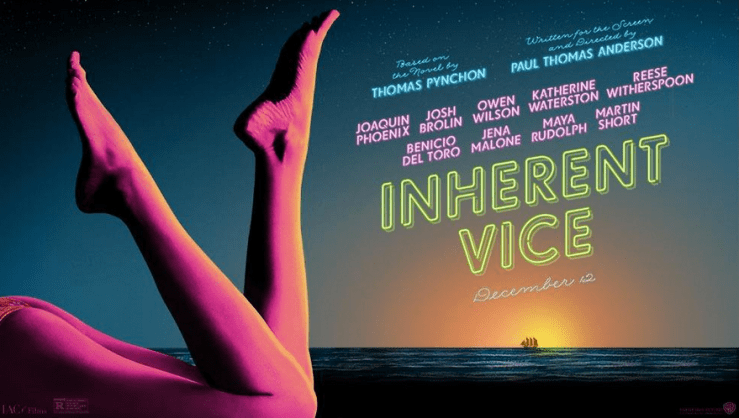
IV POSTER HORIZONTAL

A. Let’s start with this: I need to see Paul Thomas Anderson’s film adaptation of Thomas Pynchon’s novel Inherent Vice again. Like, I’m compelled. 

B. But maybe a quick sketch before, no? Like, here in my office hours, before an afternoon class, when I should be shuffling through a few early papers—and, like away from the novel, which I’ve been rereading bits of? With the intention of re: point A seeing it again this weekend.

C. A claim, bold or otherwise: PTA’s film is better than Pynchon’s novel.

D. (Apples and oranges, bro, thou protest).

E. Okay so point C: What do I mean by better? I’m not really sure.

F. Maybe what I mean is: PTA slows down Pynchon’s novel. Expands the tension, the euphoria, the weirdness under the lines of dialogue.

G. (The film’s dialogue seems composed entirely from the text of the novel. Verbatim).

H. (But verbatim—how verbatim?: There are those gaps, those wonderful gaps that PTA fills—with color and smoke and sound and legs legs legs).

I. PTA also underlines plot connections for the reader, limning the paranoid contours that connect conspiracy-theory paranoia to vertically-integrated capitalism.

J. Okay, so point I: I’m not saying that clarifying the plot for the viewer (in a way that Pynchon arguably does not) makes the film, better—what I’m saying is that critics who contend the film fails to cohere are maybe missing the point.

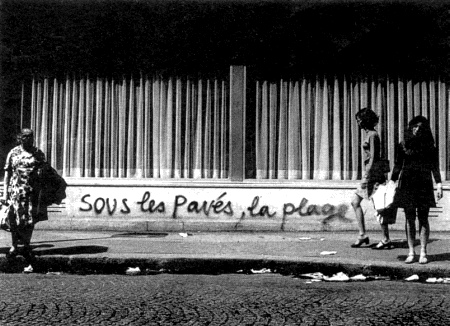
K. Here’s a point: Inherent Vice offers the most coherent and balanced conclusion of any of Paul Thomas Anderson’s film. The final act performs the spirit behind Pynchon’s letters, offering a vision of fraternal love, or of caritas, if not love—of partnerships, of how to feed the hungry, the famished. (Poor famished Bigfoot). Of resistance to the pavement.

tumblr_l13jimngTJ1qahhqf

L. Or, another way to flesh out point C, or revise point C:

PTA gives us—and by us let’s be clear I mean me—a new reading of the novel. (And of course not just PTA, but his marvelous ensemble, too marvelous to remark on at length here). PTA’s reading of Doc’s reunion with Shasta—surely one of the film’s most intense moments—is entirely different than my own reading, and rereading that scene after viewing, I feel like Anderson and Joaquin Phoenix and Katherine Waterston read the scene right, or read the scene, depict the scene, perform the scene in a way that illustrates the darkest strands of sunny smoky searing Inherent Vice.

M. The aforementioned scene—Doc reunited with one (sort of) partner—is balanced neatly against two other key scenes: The final scene between Doc and (sort of) partner Bigfoot, and the scene in which Doc restores Coy to his family. Brother’s keeper.

N. (Parenthetically: I fell in love with the movie in its opening minutes. In those opening drumbeats of Can’s “Vitamin C”).

O. So I have to rush to class and discuss Kate Chopin and not PTA’s Inherent Vice, which is what I’d rather riff on. Not really a world of inconvenience, but…(oh, and I love how that Pynchonian byword echoed through the film).

P. End on P for Pynchon and Paul TA and Promise: Promise to rewatch, reread, rewrite.

I review my review of Thomas Pynchon’s novel Inherent Vice an hour before seeing PTA’s film adaptation

I’m leaving to (finally) see Paul Thomas Anderson’s film Inherent Vice in a few minutes.

I’m going with my uncle. (I also saw No Country for Old Men with him in the theater. This point seems hardly worth these parentheses).

Below, in block quotes, is my review of Thomas Pynchon’s Inherent Vice (which I published here—the review obviously—in 2009). My 2015 comments are interposed.

inherent_vice

Thomas Pynchon’s latest novel, Inherent Vice

Oh god I used to bold face key terms jesus christ sorry.

is a detective-fiction genre exercise/parody set in a cartoonish, madcap circa-1970 L.A. redolent with marijuana smoke, patchouli, and paranoia.

“genre exercise”…”madcap”…ugh!

Navigating this druggy haze is private detective Doc Sportello, who, at the behest of his ex-girlfriend, searches for a missing billionaire in a plot tangled up with surfers, junkies, rock bands, New Age cults, the FBI, and a mysterious syndicate known as the Golden Fang–and that’s not even half of it.

Not a bad little summary, bro.

At a mere 369 pages, Inherent Vice is considerably shorter than Pynchon’s last novel Against the Day, not to mention his masterpieces Gravity’s Rainbow and Mason & Dixon, and while it might not weigh in with those novels, it does bear plenty of the same Pynchonian trademarks: a strong picaresque bent, a mix of high and low culture, plenty of pop culture references, random sex, scat jokes, characters with silly names (too many to keep track of, of course), original songs, paranoia, paranoia, paranoia, and a central irreverence that borders on disregard for the reader.

Uh…

And like Pynchon’s other works, Inherent Vice is a parody, a take on detective noir, but also a lovely little rip on the sort of novels that populate beaches and airport bookstores all over the world. It’s also a send-up of L.A. stories and drug novels, and really a hate/love letter to the “psychedelic 60s” (to use Sportello’s term), with much in common with Pynchon’s own Vineland (although comparisons to Elmore Leonard, Raymond Chandler, The Big Lebowski and even Chinatown wouldn’t be out of place either).

When I heard the PTA was adapting Inherent Vice, I thought: Wait, the Coens already did that before Pynchon wrote the book.

While most of Inherent Vice reverberates with zany goofiness and cheap thrills,

Clichés, bro.

Pynchon also uses the novel as a kind of cultural critique, proposing that modern America begins at the end of the sixties (the specter of the Manson family, the ultimate outsiders, haunts the book). The irony, of course–and undoubtedly it is purposeful irony–is that Pynchon has made similar arguments before: Gravity’s Rainbow locates the end of WWII as the beginning of modern America; the misadventures of the eponymous heroes of Mason & Dixon foreground an emerging American mythology; V. situates American place against the rise of a globally interdependent world.

Uh…

If Inherent Vice works in an idiom of nostalgia, it also works to undermine and puncture that nostalgia. Feeling a little melancholy, Doc remarks on the paradox underlying the sixties that “you lived in a climate of unquestioning hippie belief, pretending to trust everybody while always expecting be sold out.” In one of the novel’s most salient passages–one that has nothing to do with the plot, of course–Doc watches a music store where “in every window . . . appeared a hippie freak or a small party of hippie freaks, each listening on headphones to a different rock ‘n’ roll album and moving around at a different rhythm.” Doc’s reaction to this scene is remarkably prescient:

. . . Doc was used to outdoor concerts where thousands of people congregated to listen to music for free, and where it all got sort of blended together into a single public self, because everybody was having the same experience. But here, each person was listening in solitude, confinement and mutual silence, and some of them later at the register would actually be spending money to hear rock ‘n’ roll. It seemed to Doc like some strange kind of dues or payback. More and more lately he’d been brooding about this great collective dream that everybody was being encouraged to stay tripping around in. Only now and then would you get an unplanned glimpse at the other side.

Oh cool you finally quoted from the book. Not a bad little riff.

If Doc’s tone is elegiac, the novel’s discourse works to undercut it, highlighting not so much the “great collective dream” of “a single public self,” but rather pointing out that not only was such a dream inherently false, an inherent vice, but also that this illusion came at a great price–one that people are perhaps paying even today. Doc’s take on the emerging postmodern culture is ironized elsewhere in one of the book’s more interesting subplots involving the earliest version of the internet. When Doc’s tech-savvy former mentor hips him to some info from ARPANET – “I swear it’s like acid,” he claims – Doc responds dubiously that “they outlawed acid as soon as they found out it was a channel to somethin they didn’t want us to see? Why should information be any different?” Doc’s paranoia (and if you smoked a hundred joints a day, you’d be paranoid too) might be a survival trait, but it also sometimes leads to this kind of shortsightedness.

Will PTA’s film convey the ironies I found here? Or were the ironies even there?

Intrinsic ironies aside, Inherent Vice can be read straightforward as a (not-so-straightforward) detective novel, living up to the promise of its cheesy cover. Honoring the genre, Pynchon writes more economically than ever, and injects plenty of action to keep up the pace in his narrative. It’s a page-turner, whatever that means, and while it’s not exactly Pynchon-lite, it’s hardly a heavy-hitter, nor does it aspire to be.

I’m not sure if I believe any of that, bro. Did I believe it even when I wrote it? It’s a shaggy dog story, and shaggy dogs unravel, or tangle, rather—they don’t weave into a big clear picture. And maybe it is a heavy hitter. (Heavy one-hitter).

At the same time, Pynchon fans are going to find plenty to dissect in this parody, and should not be disappointed with IV‘s more limited scope (don’t worry, there’s no restraint here folks–and who are we kidding, Pynchon is more or less critic-proof at this point in his career, isn’t he?). Inherent Vice is good dirty fun, a book that can be appreciated on any of several different levels, depending on “where you’re at,” as the hippies in the book like to say. Recommended.

Oh geez.

Okay, I should write more but my uncle says it’s time to roll.

Another clip from PTA’s film Inherent Vice

A clip from Paul Thomas Anderson’s film Inherent Vice

A Short Riff on the Inherent Vice Film Trailer

2

A. It’s likely that if you care about these things you’ve already seen the first full (non-teaser) trailer for Paul Thomas Anderson’s film adaptation of Thomas Pynchon’s novel Inherent Vice.

B. Here is that trailer:


C. What do you think?

D. I think it looks pretty great.

E. Well, I mean, the trailer still has the, I don’t know, rhythms and contours and tropes of, like, quirky indie comedy film trailers—verbal slapstick, slapstick slapstick (I love the bit at 00:27 when the cop knocks Sportello down, but the callback at 1:52 seems like it could squash a punchline), an affected scream, up-tempo soundtrack (although “Don’t Know Much About History” isn’t one of the many, many songs mentioned in the book). But hey, target audience, etc. etc. etc.

F. And I’m sure the target audience here loves to get a taste of Owen Wilson looking vulnerable and sensitive and just very Owen Wilsonish. (I, a target, enjoyed the taste).

G. And apparently Michael K. Williams is in this movie making his Michael K. Williams face.

H. And also: Joanna Newsom is supposedly in the film—both as a character and narrator. She narrates the trailer, but if she’s in it, like, physically, I think I missed that.

I. And we get this:

1

J. And a New Age cult pizza party, staged in a loose approximation of The Last Supper.

K. And Eric Roberts.

L. And Josh Brolin shouting for pancakes in sloppy Japanese.

M. And guns! Yes, guns in the trailer, audience!

N. And some ass shots to boot, including our man Sportello, prostrate, cowering.

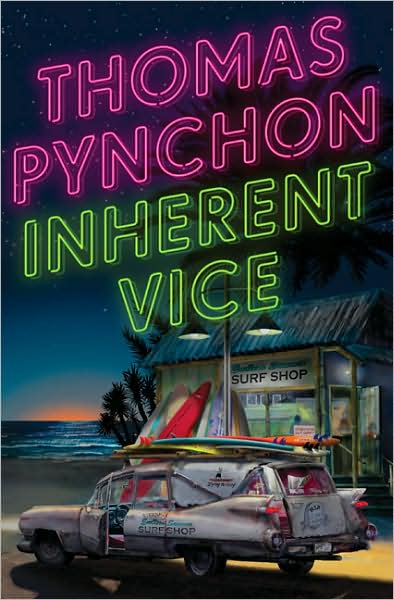
O. I like that the trailer—and I’m guessing the film itself (?)—uses the same neon-noir font that the book did; I thought the cover of Inherent Vice was horrendous, but ultimately made sense.

P. But what I find most fascinating here is how neatly Newsom’s narration sums up the novel’s plot in the first 20 seconds of the trailer, highlighting just how irrelevant the plot is in Pynchon’s novel. Inherent Vice: The Novel eschews plotting in favor of verbal style, mood, and imagery—which makes Paul Thomas Anderson an ideal filmmaker to handle the first (and maybe we should hope only) Pynchon adaptation.

Q. I’m usually pretty wary of film adaptations of big-ell Literature, but Inherent Vice is kind of on the bubble there. It’s a shaggy dog tale, just like the Coen brothers’ classic The Big Lebowski, or Tarantino’s best film Jackie Brown. (When I reviewed the book a few years ago, I brought up Elmore Leonard and Lebowski, along with Chinatown).

R. My big concern is that PTA, like his hero Robert Altman, can get a bit too shaggy. When he’s got a clear trajectory to follow (Boogie NightsPunch Drunk Love), PTA offers up a deep comic complex humanism. But then there’s that fine mess Magnolia. 

S. I loved the last film that Joaquin Phoenix and PTA did together though, 2012’s The Master.

T. And what do we think of Joaquin Phoenix as Doc Sportello? Does he look a little bit, I don’t know, too old? I don’t know. He kind of looks a little bit like a stoned Hugh-Jackman-as-Wolverine here.

U. (That’s not necessarily, like, bad).

V. The trailer makes me want to see the film more than I had wanted to see it before, which was its job, so, like, good trailer, I guess.

Paul Thomas Anderson on Max Ophuls