 Stuart Kendall is the author of several books, including The Ends of Art and Design, a work that examines the role of experience-events in the post-subjective world, and Georges Bataille, a critical biography of that influential author. Stuart also edited and contributed to Terrence Malick: Film and Philosophy. Stuart has produced and published numerous translations, including works by Bataille, Guy Debord, Paul Éluard, and Maurice Blanchot. His latest translation is a telling of Gilgamesh, one that casts the ancient epic poem in modernist poetry. Stuart has taught at several universities and colleges, including Boston University and the California College of the Arts, where he is currently Chair of Critical Studies. Stuart was kind enough to talk to me about Gilgamesh—and Malick—over a series of emails. You can read more about Stuart’s work at his website. Gilgamesh is available now from Contra Mundum Press.
Biblioklept: Why Gilgamesh?
Stuart Kendall: Gilgamesh is the oldest extended tale that has come down to us and it speaks to us from a pivotal moment in the history of human experience. It is also a particularly rich text, as rich in its depths, ranging back in time prior to its composition, as it is in its reach, remaining relevant to our own drama. Gilgamesh dates to the Bronze Age but the roots of the story, the bones of it, reflect notions about human experience that may stretch back beyond the Neolithic era to the Paleolithic. The text, to my understanding, contains layer upon layer of cultural renewal and reinterpretation. These layers of renewal are reflected in the extended life of the text beyond Gilgamesh into the related texts of the ancient world, like the Hebrew scriptures, and beyond those writings into the fundamental attitudes and ideas of Western civilization, many of which have been profoundly wrongheaded, to put the matter lightly.
From another angle, in part due to the age of the text, Gilgamesh reaches beyond relevance to Western civilization into world religious history through motifs related to shamanism, a practice that many historians of religion suggest may be at the origin of every religious tradition.
Finally, Gilgamesh is perhaps first and foremost a document of ancient Mesopotamia, ancient Iraq. It is a text that can be traced into and through the fundamentally Judaic traditions of both Christianity and Islam. Our lifetimes have been scarred by the clash of these related worlds. An encounter with Gilgamesh cannot heal the breach caused by the tragic hubris and shortsightedness of some American politicians but it certainly can serve as one part of an on-going discussion about commonalities and differences in human experience bound as we are by time and place.
I hope it is clear that I don’t think that Gilgamesh contains a positive record of something that we share, some universally valid message. Rather I view it as a product of a specific time and place, a distinct product of the process of history. But as such we can see the deeper past through it, trace our traditions to it, and measure ourselves against it in, I think, valuable ways.
Biblioklept: What motivated the project?
ST: This project was conceived in the classroom. I had been teaching Gilgamesh for a number of years, always to great interest, but also without finding a translation that both accurately and accessibly represented the text. Though there are a number of translations of Gilgamesh, they generally fall into two categories that I refer to as scholarly and popular. The scholarly translations are awkward to read since they assiduously and accurately represent areas of the text which are uncertain, either through the material decay of cuneiform tablets or through our failure to fully understanding the meaning of ancient terms. These translations also typically segregate different versions of the story — Sumerian, Akkadian, etc. — in different sections of a book, forcing a reader to flip back and forth to compare the different versions. While this is obviously the most accurate way to present the material, it is not the most expressive way to do so and students and I think other general readers often struggle with it. On the other hand, the more accessible translations of the text, like those by Herbert Mason, David Ferry or Stephen Mitchell, are often misleading, particularly in regard to the theology of the text. These translations, or versions more rightly, are also often too fluid. They emphasize the narrative flow of the story over the poetic or expressive devices at work within it and thereby offer a satisfying, but false, sense of continuity to the materials, as if it were a novel. They are if anything too accessible.
Semester after semester, I saw students respond positively to the text but always only up to a certain limit, depending upon the specific translation I assigned. Eventually I decided that I should do my own version, following a middle path between the scholarly and popular translations. About four years ago I began working on it, testing my draft in the classroom along the way. I’ve also had some friends who have tested the translation in their classes. While I don’t think that the task of translation can ever be finished, I do think that this Gilgamesh is ready for readers.

Biblioklept: Translation seems like such a daunting task . . . how did you approach and execute it?
SK: The translation process for this project was of necessity very different from the process developed through my other translations. At this point I’ve translated ten or so books directly from French to English — rather diverse books by Bataille, Char, Blanchot, Eluard, Baudrillard, and Debord, among others — as well as a large number of articles and shorter pieces. By diverse I mean that these writings have included essays, poems, lectures, letters, notes, and aphorisms across a wide range of fields from belles lettres,broadly speaking, to visual studies, cultural criticism, philosophy, and theology, all generally rooted in an avant-garde orientation to cultural change. The diversity of these texts is thus disciplinary, formal, and stylistic, as well as presenting challenging thoughts. I emphasize this diversity because it is part of what attracted me to Gilgamesh, since Gilgamesh is a text which itself includes a wide range of contents: psychological, philosophical, and religious. One of my main goals was to reveal some of this diversity in the work: this is after all a book in which gods speak. We live in a time in which the gods are silent. Entering into an alternate theological imagination presents an enormous challenge for readers, and, as a translator, I hope that I have done what I could to be helpful toward this end.
In terms of actual process, since I am not an Assyriologist by training or profession, I have had to rely upon the rigorous scholarship of leaders in the field, Andrew George foremost among them, for the core content of the work. George’s two-volume The Babylonian Gilgamesh Epic (published by Oxford) is the current standard edition of the ancient Gilgamesh materials. But there are a number of other scholarly translations of the work, in whole and in part, in its various ancient versions, that have been instructive, particularly by marking points of contrast. Beyond those materials, specifically tied to Gilgamesh there are histories of the period, cultural, religious and otherwise. And beyond that, a number of far more wide-ranging works within what I would call the history of consciousness, often of psychoanalytical inspiration — Weston La Barre’s The Ghost Dance, Norman O. Brown’s Love’s Body, Eshleman’s Juniper Fuse — books that frame human experience in the most intricate yet capacious way, have been helpful.
Comparing all of the available scholarly translations of Gilgamesh, across all of the ancient versions of the text, including the stories that migrated beyond Gilgamesh proper, like the flood story in the Hebrew Bible, allowed me to develop a basic ur-text from which to develop my version. As suggested above, the distinctions between the scholarly translations were often more instructive than the points of agreement between them. Where scholarly consensus exists, I tend to follow it. Where the scholars disagree, I fall back on my readings in history and the history of consciousness for guideposts in my interpretation.
Once I had developed the basic text, I worked with it, inspired by the formal language of twentieth century American poetry, particularly the modernist language of Pound and Williams and the postmodern projective and open verse of Olson, Duncan, Eshleman and others. The point was to carry the experience of Gilgamesh into the language of our century without compromising that experience or that language by making either one overly familiar.
I think it is important to emphasize the fact that my method was essentially the same as that of other translators who have produced popular versions of the text, like David Ferry and Stephen Mitchell, neither of whom are Assyriologists by training. I hope that readers find my Gilgamesh to be more rigorous than those versions and more imaginative than the scholarly translation.
Biblioklept: I’ve read various translations of Gilgamesh—all prose—at different times in my life, and I’ve always appreciated it as an adventure story with a mythological scope. I still remember the first time I read Gilgamesh; I was in the 10th grade and the relationship between Enkidu and Gilgamesh struck me as fascinating and strange (and seemed overtly homoerotic too, of course).
One of my favorite moments in your new translation is the first meeting of the pair, when Enkidu interrupts Gilgamesh’s lord’s rights to ravish a new bride in Uruk. The scene is energetic, violent, and sexual; it’s almost figuratively a wedding, or a replacement for Gilgamesh’s taking of the bride—it even ends in a kiss.
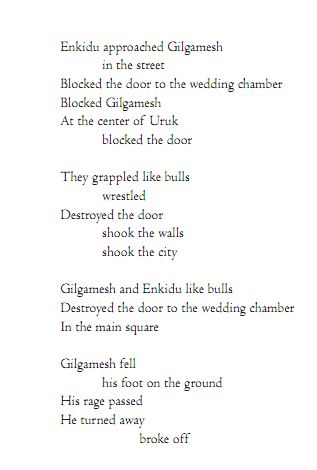
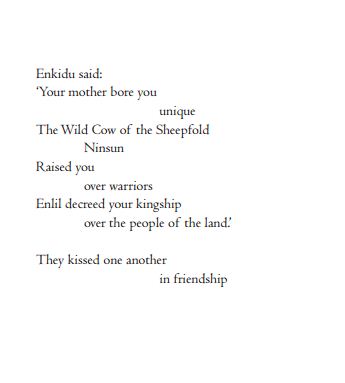
The depiction of Gilgamesh and Enkidu’s relationship is clearly important to how the narrative illustrates human consciousness. Why does their friendship (and rivalry, and love) continue to fascinate (and perhaps inform) readers?
SK: Undoubtedly some of the fascination follows from the enigmatic nature of the relationship, particularly for modern readers. The relationship is familiar, since we all have friends, but also ambiguous. Why are these two characters friends? What is the nature of their friendship? In the earliest extant versions of the tale, the two aren’t friends. Enkidu is Gilgamesh’s servant. In later versions of the story, and in the Standard Version, they are friends. The change can be explained in part as a means of lending additional drama to Enkidu’s death and also, thereafter, Gilgamesh’s quest for immortality. It is one thing for your servant to die and another for your closest friend to die. The bond between the two is obscure. They are in many ways opposites. I see them as complementary characters, Enkidu being as close to the animals as Gilgamesh is to the gods, Enkidu from the wild, Gilgamesh from the city, etc. Together they form a kind of complete composite of human experience, like two sides of one character. William Blake’s notion, from The Marriage of Heaven and Hell, that opposition is true friendship, certainly applies to Gilgamesh and Enkidu. The larger symbolic affiliations – Enkidu with the animals, Gilgamesh with the gods – are significant in almost all of their encounters both with one another and with the other characters in the major episodes in the narrative, like Humbaba and Ishtar.
The potentially homoerotic element of their relationship is of course highly contentious. For some readers, such a notion is very appealing. For others, it is repellent. I myself am reluctant to project contemporary social or sexual norms into the ancient text. There are countries in the world today where men kiss men or women kiss women without sexual connotation. Something has been lost in our contemporary discourse of physical experience and human relationship if we must treat or imagine every physical relationship as being of one kind. On this point, characters do have sex in the book. Gilgamesh clearly has sex with the young brides of Uruk and Enkidu has sex with Shamhat. But Enkidu and Gilgamesh don’t have sex. I think we go too far if we speculate as to whether or not the authors of the ancient text what readers to imagine the relationship to be sexual. The two characters are however obviously very close friends whose bond makes us reflect on the proximity of opposites and the role of opposition in friendship as well as illustrating issues in the fundamental duality of human character.
Biblioklept: How might Gilgamesh challenge contemporary readers’ attitudes and beliefs about human consciousness?
SK: Gilgamesh challenges contemporary readers in a number of ways. It challenges Jewish and Christian readers with an alternate, and very different, version of the flood story from the Hebrew Bible. It also challenges Christian readers with an alternate version of life after death. The Christian notion of heaven is entirely absent from Gilgamesh. In its place, one finds a pagan notion of a barren world of shades, where priests and kings are powerless and food and drink are tasteless. This vision — conveyed in a dream, or rather a nightmare — is not a vision of Hell or of some other kind of eternal punishment. It isn’t pleasant at all, but it isn’t torture. It is more like non-life and that is the horror of it. The pleasures and the pains of earthly life are absent after death and that is a terrifying notion. Gilgamesh, in other words, gives us a worldview that fears death as the loss of this world and that vision goes against the dogma that this world is in some way fallen, that our true reward is to be found in some alternate reality called heaven. There are many similarly challenging themes and motifs throughout the book.
 In part notions like these are so deeply disturbing because they cut to the core of our perspective on reality. As part of a thoroughly pagan text, Gilgamesh consistently encounters gods in the things and people around him. But he also fears some of those same things as much as he savors others. The text provides rich details about objects and animals. It shows people looking at and enjoying other people. It is a book of sensual celebration as much as it is a journey into despair and the two are related, as I suggested just now: death is to be feared because life is so very full.
As a drama of consciousness, then, Gilgamesh is a strange book. It is intensely physical in the sense of describing things in the world, in the same moment as it is highly symbolic. The characters are themselves symbolic and they travel through a symbolic landscape. They are recognizably human, though, and the tale is so moving, I think, because of the drama of consciousness grappling with these different registers of experience. Put a little differently, it is not hard to see that the characters are anything but fixed. They undergo changes large and small and they suffer those changes. Here I am thinking in particular of the journey to kill Humbaba, the protector of the forest. On each night of the journey, Enkidu performs a kind of shaman ritual, preparing a bed for Gilgamesh. And each night Gilgamesh has a new nightmare which Enkidu, again as a shaman, interprets for him. The immediate effect upon the reader is to elevate our foreboding about their journey to confront Humbaba. But in another way the repeated nightmares – and these aren’t the only ones in the book – testify to the porousness of consciousness within the world. The characters’ moods alternate between dream, denial and delirium through the book. For heroes, they spend a great deal of time in abject fear of the animate cosmos.
This is a startling portrait for scientifically minded contemporary readers, confident in a stable view of subjects and objects in the world. Gilgamesh shakes that confidence.
Pierre Klossowski once remarked that consciousness is never absolute. Our mind, in other words, isn’t like a light that is either on or off. It is more like a light on a dimmer switch subject to the fluctuations of an unexpected power surge. Gilgamesh is, in some ways, a guide to living with and through altered states of consciousness.
Biblioklept: I’ve read your essay on Terrence Malick’s Days of Heaven, a favorite film of mine. In the essay, you discuss the film’s disruptive, destabilizing properties. Aspects of your analysis seem equally applicable to Malick’s most recent film, The Tree of Life, a film that deeply divided audiences.
In your previous answer, you discuss how Gilgamesh potentially threatens to destabilize the reader’s sense of a world anchored in fixed, absolute meaning. Do Malick’s films operate in the same way? Why was The Tree of Life such an affront to so many people’s sense of narrative propriety?
SK: I’m glad you brought this up. Malick’s films are deeply fascinating to me and, yes, I do see a certain continuity of concern, if not necessarily technique, between Malick’s films and Gilgamesh. The continuity of concern between these two types of cultural production is what attracts me to both of them, though obviously they are world’s apart.
In the essay on Malick’s Days of Heaven that you mention, “The Tragic Indiscernability of Days of Heaven,” I attempted to show that Malick’s film style, particularly in that film, might be compared to Greek tragedy in a formal way, since both Malick’s film and Greek tragedy overdetermine language and images with religious, political, and philosophical meaning. They do so not to integrate those different types of meaning but rather to demonstrate the extent to which these different types of meaning might be incompatible with one another. The viewer is put in the awkward position of having to choose between different registers of meaning, essentially different interpretations of the object, sometimes moment by moment, or viewing by viewing. There’s that remark from Kierkegaard, that what looks like politics and imagines itself to be political will one day unmask itself as a religious movement. But in the case of Days of Heaven and tragedy, what looks like politics one day, might look more like religion the next, since it is both simultaneously and therefore also unstable.
I don’t believe one can make the same kind of claims about The Tree of Life however. The Tree of Life is a very demanding film, in part because it asks theological questions in visual terms. In a way, the film might be the direct contrary of Days of Heaven. While Days of Heaven is saturated with meaning, overdetermined, The Tree of Life is underdetermined. The viewer must constantly ask whether its images are in fact evidence of the existence of god or not. Are they, in other words, meaningful, or not. For a believer, The Tree of Life is challenging because it does not correspond to common visions of faith, even though many believers do I think recognize self-organizing systems — like a flock of birds in flight — as evidence for the existence of their god.
But The Tree of Life is challenging at the most basic level as well. In the first part of the film, the viewer is given very little narrative information. We see the parents being told that their child has died but it is far from explicit: the mother, played by Jessica Chastain, reads a telegram to herself and reacts to it. The father, played by Brad Pitt, is told over the phone while standing near an airplane. He can barely hear the call; we certainly can’t. In order to construct the narrative, the viewer has to look very deeply into the film. And once the meaning is clear, it still isn’t clear, since the entire film explores the problem of meaning in this way. There is a lot more to say about this film, obviously, particularly about the final section of the film.
Returning to Gilgamesh, I think it is important to observe that Gilgamesh is very different from both of these films even though it does share many of the same concerns. For one thing, rather than being the work of a single author — or even cultural group — Gilgamesh, I think, is best understood as a palimpsest of materials aggregated by several ancient cultures over fifteen hundred to two thousand years. Roughly contemporary works with a similar ambition include Joyce’s Finnegans Wake, Pound’s Cantos, and Olson’s Maximus Poems. In film, Jean-Luc Godard’s Histoire(s) du Cinéma offers some similarities; it is certainly a visual palimpsest, even though it only spans the 100 year history of cinema. All of these works as well are distinct from Gilgamesh because they are the products of individual authors, though Pound, Olson, and Godard all do incorporate many different types of “found” materials. As a palimpsest, Gilgamesh is far more heterogeneous than most readers, I think, give it credit for being. The tale offers several different responses to the problem of death, for example, at different points, each without referencing the others. Another example can be seen in the three different methods of obtaining immortality shoved together at the end, none of which reference the others or suggest that the series might not continue indefinitely.
The point I’m trying to make here is that Malick’s films are highly crafted, whether overdetermined or underdetermined. They are built in such a way as to give their viewer a fairly specific task. Gilgamesh, on the other hand, is overdetermined in a completely different way, in part due to the historical circumstances of its collation, composition being perhaps too strong a word for it. The challenge for readers of Gilgamesh is to get into the perspective or perspectives that originated the narratives it contains. It is much closer to the perspective expressed by Kierkegaard in the quote I referenced above. A good example of this is the encounter with Ishtar. Ishtar is the goddess of fertility, love, and war, essentially a nature goddess, and she is the patroness of the city where Gilgamesh is king. In the story, she offers herself to Gilgamesh in marriage, promising fecundity for the city. In one ancient worldview, it is the function of the king to “marry” the goddess of nature and thereby ensure the abundance of the land and safety of the people. Gilgamesh however has different ideas. He does not trust Ishtar — and how can you trust nature? Instead, he forms a community with his male companion, Enkidu. The two of them fight Ishtar together and, successful in their conquest, have a feast. The story is clear as a story. The allegory is clear as an allegory (that has been catastrophic for our civilization). But the conflict between the two historical perspectives — sacred marriage vs. community of men — is masked by the successful integration of the text.
Where Malick uses instability and overdetermination to create an aesthetic object that raises questions or creates problems for his viewer, Gilgamesh, as an object, uses integration as a mask for heterogeneous cultural and historical materials. The reader of Gilgamesh has to do the work of peeling the layers of the text apart (without hope of finding a stable, original, core meaning). That in mind, the casual reader of Gilgamesh might not realize how very complex and multi-layered it really is, whereas the complexity of Malick’s films is self-evident. Put differently, it is easy to see why Gilgamesh is quite popular among casual readers and Malick off-putting to casual viewers.
Biblioklept: Do you have another translation project on the horizon? What are you writing now?
SK: I’ve been working on some translations of René Char’s later poetry, some of which is forthcoming in Plume among other places. I’m also finishing a short book on Andy Goldsworthy and another, on Georges Bataille, Gregory Bateson, sustainability and the sacred. Both of these later projects fall under the general heading of the ecological imagination.
Biblioklept: Can you elaborate on “the ecological imagination”?
SK: I’ve been using the phrase ecological imagination as a way of evoking the history of our human awareness of and interaction with our environment. Ecology is environment or habitat, but more generally also the situation or system that supports life. I emphasize imagination here rather than “thought” because the notion of thought too quickly enters into the history of rationality or even ideas, whereas imagination retains a strong connection with the imaginary, which can include the untrue. As Nietzsche insists, untruth is often a necessary part of life. Gilgamesh is part of this ecological imagination project as well, an early panel reflecting our disconnection from nature, whereas the more contemporary panels — on Goldsworthy, Bataille and Bateson — are concerned with recent attempts to reestablish some kind of physical connection to our world.
Biblioklept: Have you ever stolen a book?
SK: I stole a copy of Shelley’s complete poetry, an Oxford edition paperback, from a public library when I was a teenager. At the time, the book seemed essential to me. The edition itself is undistinguished and, frankly, a minor annoyance to me now. I don’t enjoy reading it but I also don’t enjoy Shelley enough to replace it with a better edition. On a few other occasions I’ve walked away with a cheap paperback or two, though never from a bookstore. Books have nevertheless been my abiding passion in life, the only material possessions that really excite me.

 Lars Iyer’s first novel Spurious (
 Biblioklept