Responsibilities | Grace Paley

It is the responsibility of society to let the poet be a poet

It is the responsibility of the poet to be a woman

It is the responsibility of the poets to stand on street corners giving out poems and beautifully written leaflets also leaflets they can hardly bear to look at because of the screaming rhetoric

It is the responsibility of the poet to be lazy, to hang out and prophesy

It is the responsibility of the poet not to pay war taxes

It is the responsibility of the poet to go in and out of ivory towers and two-room apartments on Avenue C and buckwheat fields and Army camps

It is the responsibility of the male poet to be a woman

It is the responsibility of the female poet to be a woman

It is the poet’s responsibility to speak truth to power, as the Quakers say

It is the poet’s responsibility to learn the truth from the powerless

It is the responsibility of the poet to say many times: There is no freedom without justice and this means economic justice and love justice

It is the responsibility of the poet to sing this in all the original and traditional tunes of singing and telling poems

It is the responsibility of the poet to listen to gossip and pass it on in the way storytellers decant the story of life

There is no freedom without fear and bravery. There is no freedom unless earth and air and water continue and children also continue

It is the responsibility of the poet to be a woman, to keep an eye on this world and cry out like Cassandra, but be listened to this time.

From Grace Paley’s 1986 essay “Poetry and the Women of the World.” Collected in Just as I Thought.

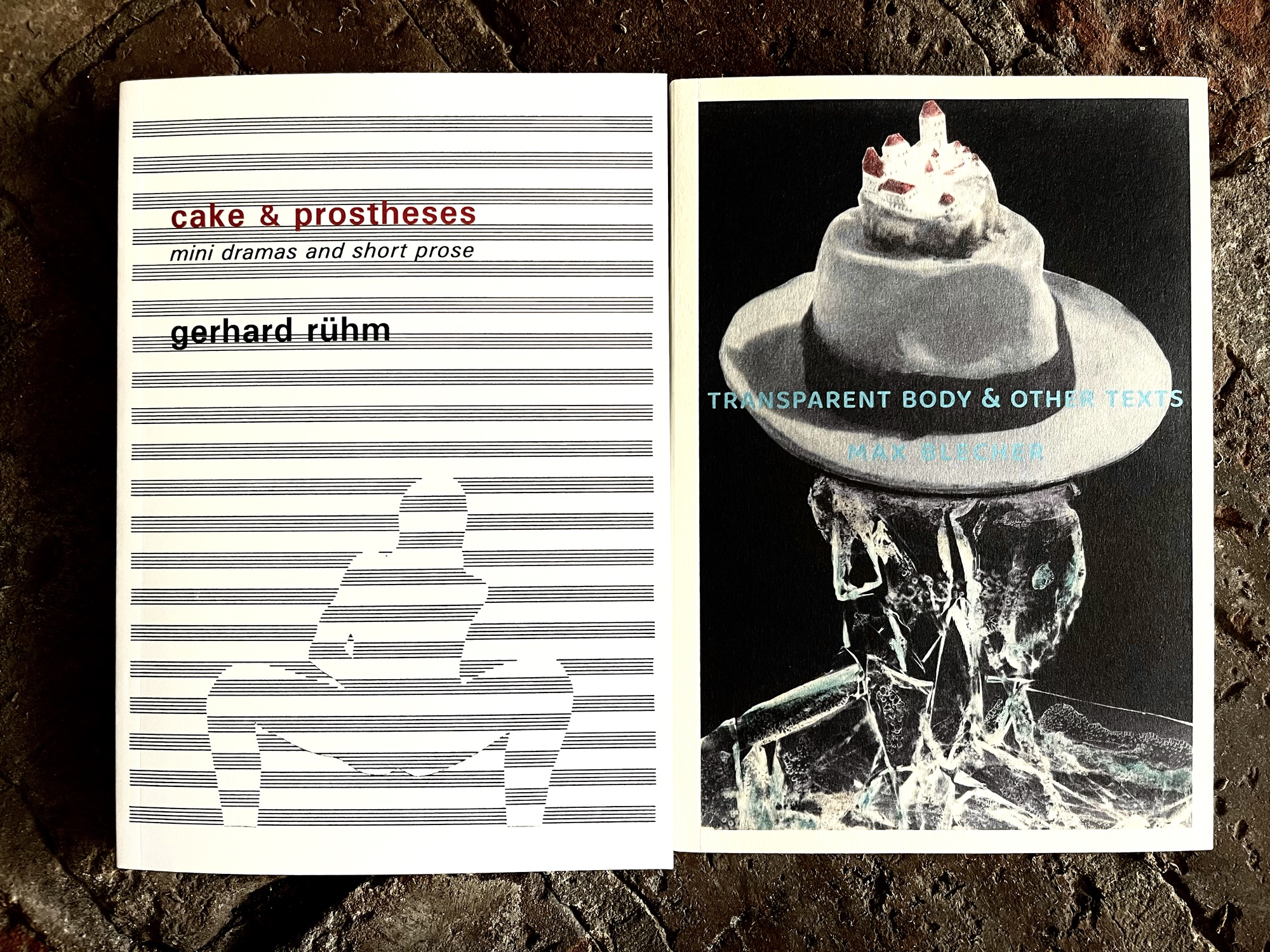
Gerhard Rühm’s Cake & Prostheses/Max Blecher’s Transparent Body (Books acquired 11 Jan. 2024)

I was quite excited earlier this week to get a pair of books in new English translations from the Czech publisher Twisted Spoon Press.

I started in on Gerhard Rühm’s Cake & Prostheses (translated from the German by Alexander Booth) late last night and kept reading and reading, greedily consuming the surreal, poetic “mini dramas” as thought experiments played out in my head. Here’s an early example of one:

practiced biblical saying

catechist : love thy neighbor as thyself.

exegete: i hate myself! (gives the former a hard hook to the chin tho crumples him to the floor).

I’ll admit I didn’t know of Gerhard Rühm, but I’m enjoying Cake & Prostheses and hope to muster a review in the next week or so. Here’s Twisted Spoon’s blurb:

An inveterate experimenter with image and text and music, Gerhard Rühm is truly one of the major figures of the postwar European avant-garde. Yet reprehensibly little of his work has appeared in English. This edition brings together a selection of his work spanning the past seven decades, displaying a wide thematic range (as he has remarked, “there is nothing that cannot become part of one’s poetic universe”) and ingenious combinations of music, pornography, banality, humor, and mythology. The first section comprises “mini dramas,” the text often combined with images and musical notation to create sensorial episodes, the expression of a singular aesthetic perception. The second section is a wry deconstruction of Grillparzer’s play Hero and Leander that juxtaposes original passages with images from a swimming manual and with a more contemporary erotic retelling of the mythological tale. The final section presents 24 short prose pieces: 12 from the early 1950s and 12 from the past few years.

had heard of the surrealist Romanian poet Max Blecher, but am still largely unfamiliar with his work. Twisted Spoon is publishing his 1934 collection Transparent Body along with some, uh, other texts, in a translation by Gabi Reigh. Blurb:

Blecher’s very first book, the poetry collection Transparent Body, appeared in 1934, in a limited edition for bibliophiles. Yet general recognition as one of the most inventive European writers of his day came only with the publication of two of his three “novels” a few years later. And then he died, at the age of twenty-eight. But since 1930 Blecher had been publishing his poetry, short prose, essays, critiques, and other texts in the leading Romanian periodicals, some even appearing in important French publications, such as Le Surréalisme au service de la révolution. In addition, the past half century has seen the posthumous first publication of many texts in a variety of Romanian editions.

Transparent Body & Other Texts brings together Blecher’s entire output of poetry and short prose, from the earliest texts published during his lifetime to those appearing for the first time only recently. They range from stories in the vein of his fantastical, hallucinatory longer work to aphorisms, reportage, and notebook fragments. The volume also includes a selection of his correspondence with such major figures of Romanian interwar modernism as Geo Bogza, Ilarie Voronca, and Saşa Pană to give a fuller picture of Blecher’s engagement with the avant-garde and literary life even as his health was progressively deteriorating over the course of the 1930s.

William Carlos Williams’ fried onion on rye bread with beer

“To Be Hungry Is to Be Great”

by

William Carlos Williams


The small, yellow grass-onion,
spring’s first green, precursor
to Manhattan’s pavements, when
plucked as it comes, in bunches,
washed, split and fried in
a pan, though inclined to be
a little slimy, if well cooked
and served hot on rye bread
is to beer a perfect appetizer——
and the best part
of it is they grow everywhere.

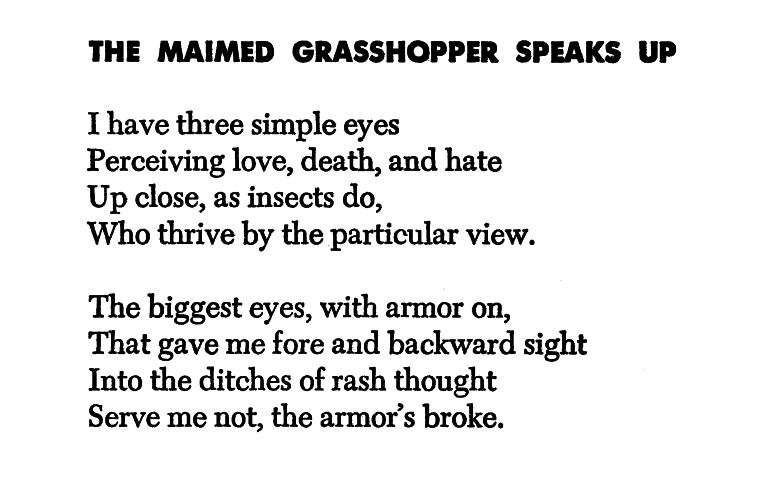
“The Maimed Grasshopper Speaks Up” — Jean Garrigue

There is no universal Poetry | Adrienne Rich

I hope never to idealize poetry—it has suffered enough from that. Poetry is not a healing lotion, an emotional massage, a kind of linguistic aromatherapy. Neither is it a blueprint, nor an instruction manual, nor a billboard. There is no universal Poetry anyway, only poetries and poetics, and the streaming, intertwining histories to which they belong. There is room, indeed necessity, for both Neruda and César Vallejo, for Pier Paolo Pasolini and Alfonsina Storni, for Audre Lorde and Aimé Césaire, for both Ezra Pound and Nelly Sachs. Poetries are no more pure and simple than human histories are pure and simple. Poetry, like silk or coffee or oil or human flesh, has had its trade routes. And there are colonized poetics and resilient poetics, transmissions across frontiers not easily traced.

From Adrienne Rich’s Plenary Lecture at the Conference on Poetry and Politics, University of Stirling, Scotland, 13 July 2006. Collected in Essential Essays.

“Before I got my eye put out” — Emily Dickinson

“Before I got my eye put out”

by

Emily Dickinson


Before I got my eye put out –
I liked as well to see
As other creatures, that have eyes –
And know no other way –
But were it told to me, Today,
That I might have the Sky
For mine, I tell you that my Heart
Would split, for size of me –
The Meadows – mine –
The Mountains – mine –
All Forests – Stintless stars –
As much of noon, as I could take –
Between my finite eyes –
The Motions of the Dipping Birds –
The Morning’s Amber Road –
For mine – to look at when I liked,
The news would strike me dead –
So safer – guess – with just my soul
Opon the window pane
Where other creatures put their eyes –
Incautious – of the Sun –

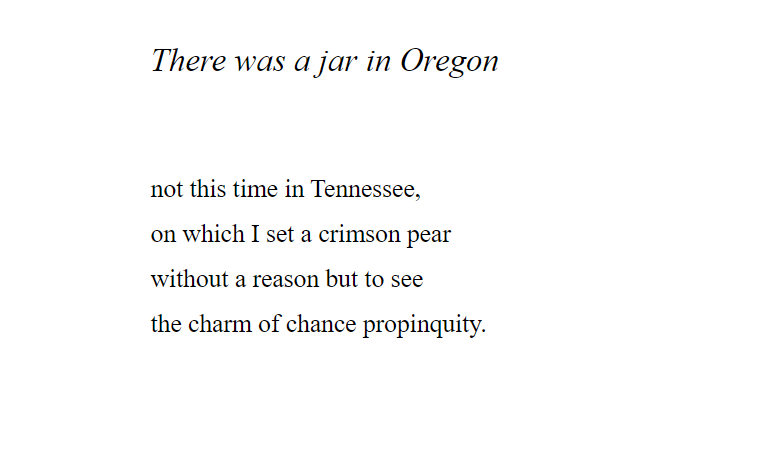
“There Was a Jar in Oregon” — Ursula K. Le Guin

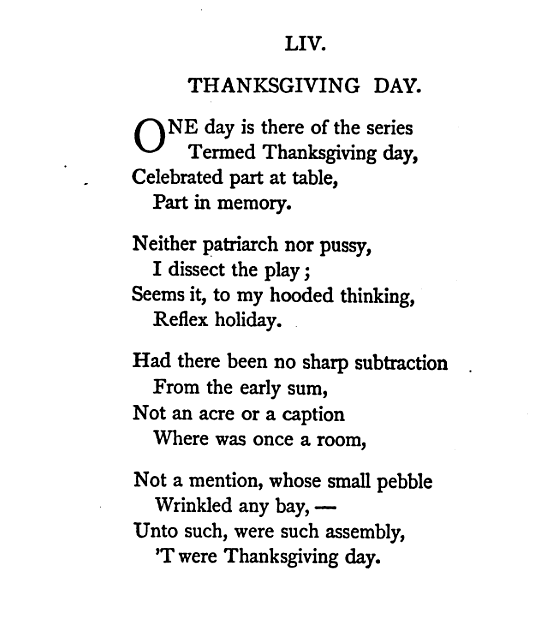
“One day is there of the series / Termed Thanksgiving day” — Emily Dickinson

ED

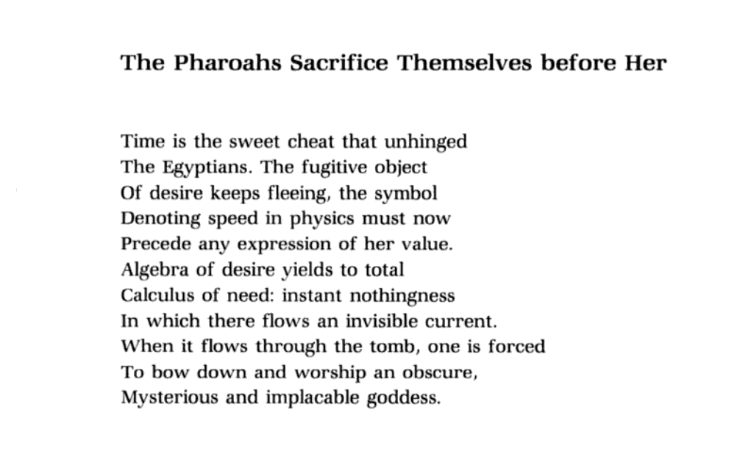
“The Pharaohs Sacrifice Themselves before Her” — Tom Clark

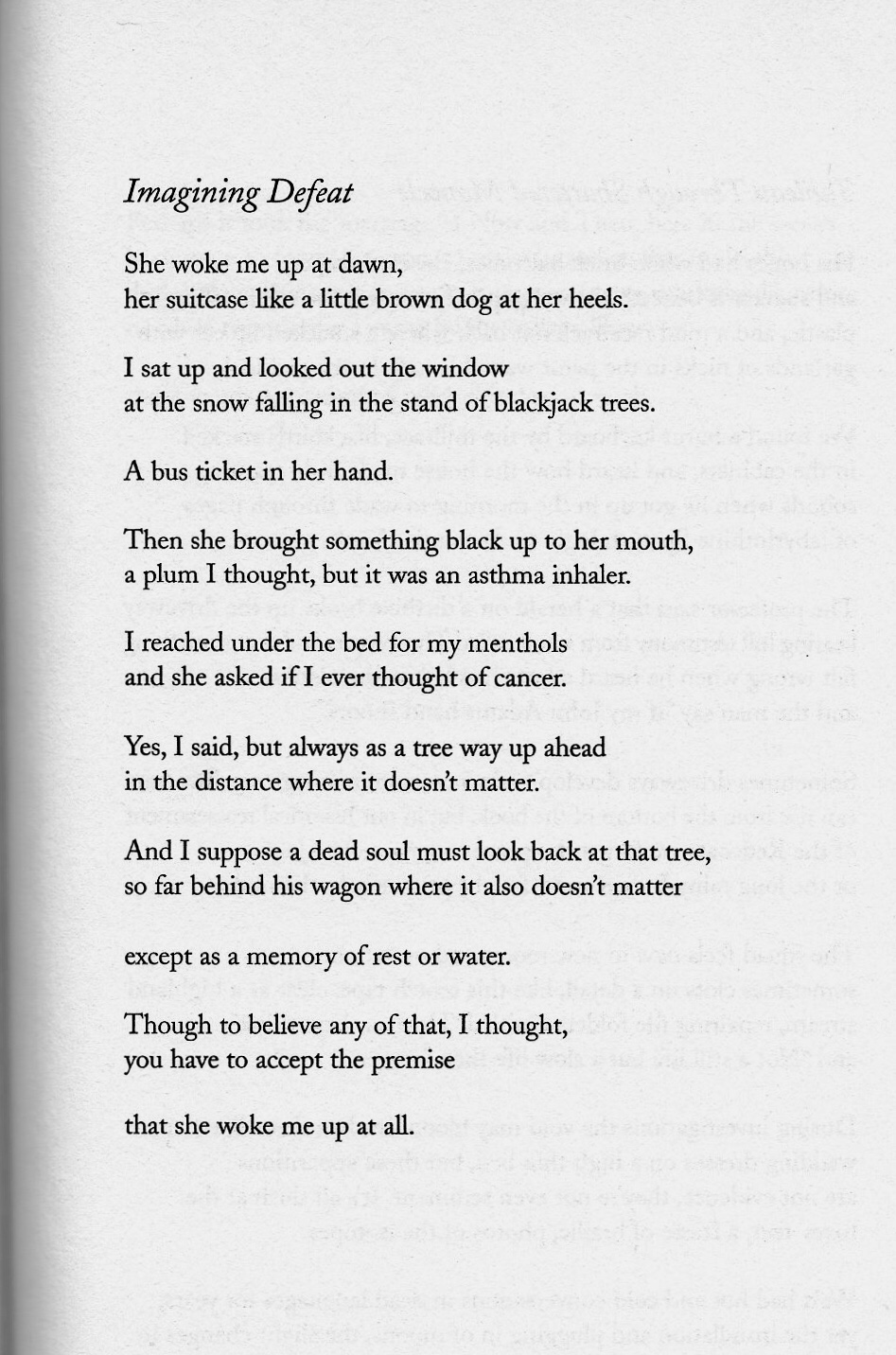
“Imagining Defeat” — David Berman

From Actual Air (Open City, 1999)

“The Surgeon General’s Report on Waiting” — David Berman

“The Surgeon General’s Report on Waiting”

by

David Berman


The situation in my country is this. Our poor love our rich, and our wives adore our wife-beaters.

It’s sad, yes, but let’s not talk about it. Even the subject of sadness will make us sad.

Here’s something else we do. In my country, when we’re waiting for someone who is very late, we stand at the meeting spot and smoke cigarette after cigarette. Then, when we die, we blame everybody who kept us waiting.


(via/more)

Look at the boy and apologize | Claudia Rankine

Behind God’s back | On Thulani Davis’s poetry collection Nothing but the Music

Here are the first lines of Thulani Davis’s 1978 poem “Mecca Flats 1907”:

On this landscape

Like a thin air

Hard to breathe

Behind God’s back

I see the doors

I wanted to underline the line Behind God’s back—such an image! But the book itself is so pretty, lithe, lovely. Better to leave it unmarked?

The book is Nothing but the Music, a new collection of Thulani Davis’s poems. Its subtitle Documentaries from Nightclubs, Dance Halls, & a Tailor’s Shop in Dakar: 1974-1992 is a somewhat accurate description of the content here. These are poems about music—about Cecil Taylor and The Commodores and Thelonious Monk and Henry Threadgill and Bad Brains and more. “About” is not really the right word, and of course these poems are their own music; reading them aloud reveals a complexity of rhyme and rhythm that might be lost to the eye on the page.

But where was I—I wanted to underline the line Behind God’s back, but I didn’t. I didn’t even dogear the page. Instead, I went back to read Davis’s acknowledgements, a foreword by Jessica Hagedorn, and an introduction by Tobi Haslett. The material sets the stage and provides context for the poems that follow. Davis’s acknowledgments begin:

I have heard this music in a lot of clubs that no longer exist, opera houses in Italy that will stand another hundred years parks in Manhattan, Brooklyn, L.A., San Francisco, and Washington, DC as well as on Goree Island and in Harare, Zimbabwe. Some of it was in lofts in lower Manhattan now inhabited by millionaires, crowded bistros in Paris that are close, and legendary sites like Mandel Hall and the Apollo, radio studios, recording studios, and my many homes.

Acknowledging the weird times that have persisted (behind God’s back or otherwise), Davis touches on the COVID-19 lockdown that took the joy of live music from her—and then returned it in the strange form of “masked protesters massed in the streets singing ‘Lean on Me'” during the protests following the murder of George Floyd.

Poems in Nothing but the Music resonate with the protests against police violence and injustice we’ve seen this year. The speaker of “Back Stage Drama (For Miami)” (surely Davis herself?) repeats throughout the poem that “I was gonna talk about a race riot,” but the folks around her are absorbed in other, perhaps more minute affairs:

They all like to hang out

Thinking is rather grim to them.

Composed in 1980, the poem documents an attempt to attempt to address the riots in May of the same year in Miami, Florida, after several police officers were acquitted in the murder of Arthur McDuffie, a black man.

The speaker of the poem embeds a poetic plea, a poem-within-a-poem:

I said, ‘they’re mad, they’re on the the bottom going down/

stung by white justice in a white town

and then there’s other colored people

who don’t necessarily think they’re colored people

taking up the middle/leaving them the ground.’

But her would-be audience is weary:

I am still trying to talk about this race riot.

Minnie looked up and said, ‘We don’t have anywhere

to put any more dead.’

Snake put on his coat to leave, ‘We never did,

we never did.’

1992’s “It’s Time for the Rhythm Revue” takes for its erstwhile subject the riots that ensued after the acquittal of the LAPD officers who beat Rodney King. The subject is far more complex though—the speaker of the poem desires joy of course, not violence:

did they acquit somebody in LA?

will we burn it down on Saturday

or dance to the Rhythm Revue

the not too distant past

when we thought we’d live on?

Is God’s back turned—or do the protagonists just live behind it?:

…I clean my house

listening to songs from the past

times when no one asked anyone

if they’d seen a town burn

cause baby everybody had.

In Nothing but the Music, music is part and parcel of the world, entangled in the violence and injustice of it all, not a mere balm or solace but lifeforce itself, a point of resistance against it all. In “Side A (Sir Simpleton/Celebration), the first of two poems on Henry Threadgill’s 1979 album X-75, Vol. I, Davis’s narrator evokes

at the turning of the day

in these winters/in the city’s bottomless streets

it seems sometimes we live behind god’s back

we/the life blood

of forgotten places/unhallowed ground

sometimes in these valleys

turning the corner of canyons now filled with blinding light streams caught between this rock & a known hard place

sometimes in utter solitude

a chorale/a sweetness/makes us whole & never lost

And again there that line, a note from a previous jam—it seems sometimes we live behind god’s back—I’ll dogear it here, digitally, underline it in my little blog scrapbook.

I think seems is the right verb though, above. Does the star of “Lawn Chair on the Sidewalk” not remain in God’s gaze?

there’s a junkie sunning himself

under my front tree

that tree had to fight for life

on this Brooklyn street

disease got to its limbs

while still young

Typing the lines out, I wonder who I meant by star above.

Nothing but the Music is filled with stars. Here’s avant-piano great Cecil Taylor in “C.T. at the Five Spot”:

this is not about romance & dream

it’s about a terrible command performance of the facts

of time & space & air

In a synesthestic moment, the speaker merges her art with its subject:

the player plays/Mr. Taylor plays

delicate separate licks of poems

brushes in tones lighter & tighter/closer in space

In the end it’s one art:

I have heard this music

ever since I can remember/I have heard this music

There are plenty more famous musicians, of course, but more often than not minor players emerge with the greatest force. There’s the unknown hornplayer whose ecstatic playing inspired 1975’s “He Didn’t Give Up/He Was Taken.” In “Leaving Goree” there are the “two Bambara women…gold teeth gleaming” who “sit like mountains” and then explode in song.

Davis crafts here characters with deft economy. Here’s the aforementioned couple of “Back Stage Drama (For Miami)”:

Snake & Minnie

who love each other dearly

drink in different bars,

ride home in separate cars.

They like to kiss goodnight

with unexplored lips.

They go out of town

to see each other open.

Or the hero of 1982’s “Bad Brains, A Band”—

the idea that they think must scare people to death

the only person I ever met from southeast DC

was a genius who stabbed her boyfriend for sneaking up on her in the kitchen

she was tone deaf and had no ear for French

she once burned her partner in bid whist

for making a mistake

At the core of it all is Davis’s strong gliding voice, pure and clean, channeling miracle music and synthesizing it into new sounds. The speaker of “C.T. at the Five Spot” assessed Taylor’s performance as a work of physics, a transcendence beyond “romance & dream,” but the speaker of 1982’s “Zoom (The Commodores)” gets caught up in the aural romance of The Commodore’s pop magic:

zoom I love you

cause you won’t say no/cause you don’t want to go

cause it’s so cruel without love

give me the tacky grandeur of Atlantic City

on the Fourth of July

the corny promises of Motown

give me the romance & the Zoom.

I love those corny promises too. The romance and the zoom are not, at least in my estimation, behind God’s back, but rather, if you believe in that sort of thing, might be God’s special dream. Nothing but the Music cooks raw joy and raw pain into something sublime. I like poems best when they tell stories, and Davis is a storyteller. The poems here capture place and time, but most of all sound, sound, rhythm, and sound. Lovely stuff.

Nothing but the Music is available from Blank Forms Editions.

[Ed. note–Biblioklept first published this review in Nov. 2020.]

“Conversation Overheard in a Graveyard” — Lucille Clifton

“Being in Plays” — Ed Skoog

“Being in Plays”

by

Ed Skoog


Ethics are learned from who you sleep with
the first few times, and theater is sex,
almost. Being in it, I mean, and being young,
with a lot of group undressing
and silence in darkness, chaste
permissions of the cast party,
spiked punch in the recreation room.
I was always cast as Old Man
with tennis-shoe polish for white hair
and lines drawn where my lines now are,
forehead haiku, the eyes’ briffits,
and parentheses around the muzzle.
I guess I miss it, achievement’s sense,
the way a show’s run ends
and everyone knows it together,
a social pain, like the death
of a popular imaginary friend.
When lights between scenes dim,
I like to see actors take props offstage
or team up with stagehands to move
the built elements of our fantasy.
I hope they keep going, and sneak
some of the properties home to mix in
with their private dramas. I pass theaters
the way I pass churches, but like
better this foldable theater
half-constructed in the mind,
sometimes thrown away
along with the day’s receipts.
Nothing’s lost. I carry my own
props in—red telephone,
bowl of apples—and then with me draw
back into the unseen.

Ed Skoog’s Rough Day (Book acquired, 13 Nov. 2021)

So we had a great long weekend with some friends in New Orleans. We stayed in Marigny—great food, great music, maybe too many drinks—but made it into the quarter for a few hours midday Saturday. I led our little group to Jackson Square where we respectfully finished our Bloody Marys before entering St. Louis Cathedral. My real aim though was Faulkner House Books on Pirate Alley right by the cathedral. Faulkner House imposed a strict four-guests-at-a-time policy, so my friends found a bar while I browsed. The stock in the small store is impeccable. Plenty of NYRB titles, a cadre of hardback Bolaños (including almost all of the poetry available in English), more Anne Carson than I’ve ever seen in a store. (I didn’t make it to Faulkner House when I visited NOLA in late 2016, but in 2012 I got some good stuff.) This time, I picked up a signed copy of Ed Skoog’s Rough Day, which seemed fitting—I’d scheduled a post that day of his poem “Run the Red Lights.”

After I finished up I headed to a bar on the outskirts of the Quarter to meet my friends, but first popped in to Arcadian Books & Prints on Orleans St.—perhaps the most chaotic bookstore I’ve ever been to. 

As always, I loved NOLA and look forward to returning sooner rather than later.

“Hell Pig” — Aimee Nezhukumatathil

“Hell Pig”
by
Aimee Nezhukumatathil

To keep me from staying out late at night,
my mother warned of the Hell Pig. Black and full
of hot drool, eyes the color of a lung—it’d follow me
home if I stayed past my curfew. How to tell my friends
to press Pause in the middle of a video, say their good-byes
while I shuffled up the stairs and into my father’s waiting
blue car? How to explain this to my dates, whisper
why we could not finish this dance? It’s not like the pig
had any special powers or could take a tiny bite
from my leg—only assurances that it was simply
scandal to be followed home. When my date and I
pull into my driveway and dim the lights, we take
care to make all the small noises that get made
in times like these even smaller: squeaks in the seats,
a slow spin of the radio dial, the silver click of my belt.
Too late. A single black hair flickers awake the ear
of the dark animal waiting for me at the end of the walk.
My fumbling of keys and various straps a wild dance
to the door—the pig grunting in tune to each hurried step, each
of his wet breaths puffing into tiny clouds, a small storm brewing.