No Poets Don’t Own Words

brion-gysin

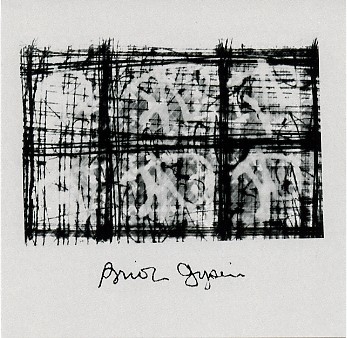
No Poets Don’t Own Words” from Brion Gysin’s Recordings 1960-1981. A very cool record, featuring lots of tape manipulation, cut-ups, poetry, and interviews with Gysin on a variety of subjects including censorship, surrealism, and art. We like it much. Much we like. It. Like much it we.

Langston Hughes Reads Three Poems

langstonhughes

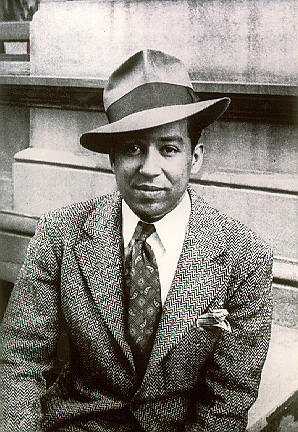
Renaissance man Langston Hughes reads three of his poems–

The Negro Speaks of Rivers

Ballad of the Gypsy

Mulatto

Also, read one of our favorite Hughes poems, “I, Too, Sing America” (a response, we believe, to Walt Whitman’s “I Hear America Singing” (Elizabeth Alexander’s inauguration poem, “Praise Song for the Day” seems to respond to both of these poems))–

I, too, sing America.

I am the darker brother.
They send me to eat in the kitchen
When company comes,
But I laugh,
And eat well,
And grow strong.

Tomorrow,
I’ll be at the table
When company comes.
Nobody’ll dare
Say to me,
“Eat in the kitchen,”
Then.

Besides,
They’ll see how beautiful I am
And be ashamed–

I, too, am America.

William S. Burroughs/John Giorno

burroughs_giorno

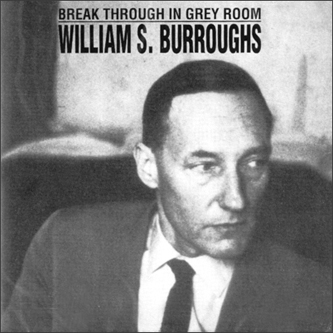
Look at these guys! I kind of have to have this record. If you have a copy, go ahead and send it to me. No? Okay, what about uploading the tracks somewhere as mp3s? No? Okay…

Image and LP info via Brainwashed.

William S. Burroughs/John Giorno (1975), GPS 006-007

William Burroughs

1. “103rd Street Boys” from Junkie 2. excerpt from Naked Lunch 3. “From Here To Eternity” from Exterminator 4. excerpt from Ah Pook Is Here 5. “The Chief Smiles” from Wild Boys 6. “The Green Nun” 7. excerpt from Cities Of The Red Night

John Giorno 8. “Eating Human Meat”

And so as not to just beg for mp3s but to also give, check out Burroughs explaining how tape manipulation helps to expand conciousness in “Origin and Theory of the Tape,” and get horrified by an example of said technique with “Present Time Exercises,” both from Break Through in Grey Room, a collection of Burroughs’s tape experiments and speeches (not to mention a dash of Ornette Coleman freaking freestyle in Morocco).

sr08_cover

“Praise Song for the Day” — Elizabeth Alexander

“Praise Song for the Day” by Elizabeth Alexander (Obama 2009 inaugural poem)

Praise song for the day.

Each day we go about our business, walking past each other, catching each others’ eyes or not, about to speak or speaking. All about us is noise. All about us is noise and bramble, thorn and din, each one of our ancestors on our tongues. Someone is stitching up a hem, darning a hole in a uniform, patching a tire, repairing the things in need of repair.

Someone is trying to make music somewhere with a pair of wooden spoons on an oil drum with cello, boom box, harmonica, voice.

A woman and her son wait for the bus.

A farmer considers the changing sky; A teacher says, “Take out your pencils. Begin.”

We encounter each other in words, words spiny or smooth, whispered or declaimed; words to consider, reconsider.

We cross dirt roads and highways that mark the will of someone and then others who said, “I need to see what’s on the other side; I know there’s something better down the road.”

We need to find a place where we are safe; We walk into that which we cannot yet see.

Say it plain, that many have died for this day. Sing the names of the dead who brought us here, who laid the train tracks, raised the bridges, picked the cotton and the lettuce, built brick by brick the glittering edifices they would then keep clean and work inside of.

Praise song for struggle; praise song for the day. Praise song for every hand-lettered sign; The figuring it out at kitchen tables.

Some live by “Love thy neighbor as thy self.”

Others by first do no harm, or take no more than you need.

What if the mightiest word is love, love beyond marital, filial, national. Love that casts a widening pool of light. Love with no need to preempt grievance.

In today’s sharp sparkle, this winter air, anything can be made, any sentence begun.

On the brink, on the brim, on the cusp — praise song for walking forward in that light.

Liquefied Brain So Backs, It

bee

When Biblioklept’s Chief Science Reporter Nicky Longlunch sent us this article about coked-up bees from The New York Times, we knew we had to give it the old Dada treatment, or in this case, the new Dada treatment. In 1920, Tristan Tzara gave the following directions:

TO MAKE A DADAIST POEM
Take a newspaper.
Take some scissors.
Choose from this paper an article of the length you want to make your poem.
Cut out the article.
Next carefully cut out each of the words that makes up this article and put them all in a bag.
Shake gently.
Next take out each cutting one after the other.
Copy conscientiously in the order in which they left the bag.
The poem will resemble you.
And there you are—an infinitely original author of charming sensibility, even though unappreciated by the vulgar herd.

Of course, scissors and cutting and actual papers and bags can be messy and tiresome, not to mention terribly old fashioned. Luckily for us, there’s a hypertext version, and we used this Dada poem generator to make our own poem out of the NYT article. Here is our poem:

liquefied brain so backs, it

liquefied brain so backs, it
scientists Australia dropped freebase cocaine
freebase liquefied brain so in
in Australia freebase cocaine bees’
circulatory backs, dropped it brain
freebase on bees’ backs, so

much judgment, their behavior makes
like stimulates their behavior and
humans much their enthusiastic them
much humans cocaine judgment, their
much like alters their their
react bees makes like enthusiastic

its odor exhibit plummets syrup
exhibit coked-up bee cold turkey
bees symptoms stop test of
bee its score standard test
turkey its test associate syrup
exhibit turkey test of bee

The real article’s actually kinda sorta better. Try this (any of it) at home.

The Savage Detectives — Roberto Bolaño

savage

I give up. I don’t know how to review The Savage Detectives.

Everyone told me I was supposed to love this book, but I didn’t. There, that’s a review. Not a good review, but there. I can’t remember a book ever taking me so long to finish or a book that I put down so often. When I truly love a book, I am moved. Often physically. Sometimes I have to stand up to read a book, I’m so moved. That’s a good book. (I never had to stand up during The Savage Detectives, although I often had to force myself to read thoroughly and not just skim). When I truly love a book, I’m a little sad and deflated when it’s over. I know a book is great if I’m compelled to go back and immediately reread sections. (Again, with Detectives, this didn’t happen). But it looks like I’m trashing the book. I shouldn’t. It has a lot going for it.

I read the first 140 pages, the journal entries of young Garcia Madero, in a blur. Funny and passionate, Madero’s voice explodes with the immediacy and intensity of youth. He joins up with the visceral realists, a group of anti-establishment poets (who no one cares about). Led by two enigmatic outsiders, Ulises Lima and Arturo Belano, the visceral realists gripe about the state of Mexican and Latin American literature, screw around, and argue with each other (no one else will listen to them). Madero paints Mexico City in the mid-1970s as vibrant, a place full of poetry and art. He becomes a biblioklept, God bless him (yet he ethically agrees not to steal from a poor old blind bookseller). He writes poems. He has sex. He runs away from home, sort of. There’s a breathless energy to Madero’s narrative that makes the book hard to put down, and the first section of The Savage Detectives, “Mexicans Lost in Mexico” culminates in one of the book’s most exciting events. Madero, Lima, and Belano help a young girl named Lupe escape from her belligerent pimp. Then, that portion of the story unresolved, the narrative shifts dramatically.

In the second section, “The Savage Detectives,” we are treated to, or subjected to, or made to endure, or made to navigate–pick your verb, please–over 450 pages of (one-sided) interviews spanning 20 years. Some of the interviewees appear consistently throughout this section, like Amadeo Salvatierra, who helps Lima and Belano in their quest to find the lost original visceral realist, Cesárea Tinajero. Other voices only pop up once to tell a weird story about Lima or Belano–or more accurately, a weird story about themselves with Lima or Belano playing bit parts. Some of these stories, like Lima’s strange time in a Tel Aviv prison, or Belano’s tenure as a national park guard in France are great; other times they are painfully tedious or repetitive (you know, like real life).

Technically, The Savage Detectives is quite an achievement. The myriad stories in the book’s main section represent the fragmented narratives that might compose a person’s life–a series of perspectives that others have about us, views that can never add up to a unified truth. The bulk of these stories are very much about poetry, art, and travel. Like Joyce’s Ulysses, Detectives is a peripatetic novel, full of specific locations and very, very explicit directions (Joyce famously claimed that were Dublin destroyed in a catastrophe, it could be rebuilt based on his novel; the same seems true for Bolaño’s Mexico City). Also like Ulysses, Detectives is an epic about the banal, ordinary things that fill our lives: jobs and eating and getting to places and having one’s friendships sour and being disappointed and so on. Lots and lots of “and so on.” This isn’t to say that there aren’t moments of heroism and adventure–saving kids from satanic caves, stow-away sea voyages, and dodging bullets from Liberian rebels make for interesting narrative peaks. However, most of the novel remains rooted in a realism that is often dreadfully visceral in its painstaking replication of just how depressing a life could be. As the seventies and eighties turn into the nineties, things get more bleak and more depressing for Lima and Belano. And it all adds up to an incomplete picture (literally; check out the last page of the book if you don’t believe me).

o_roberto-bolano

By the time we return to Madero’s journals in the third and final part of the novel, “The Sonora Desert,” the sadness and deflation of the previous section infects and tints every aspect of the narrative. Lima and Belano, with Madero and Lupe in tow, search desperately for the forgotten poet Cesárea Tinajero. Their search works as a pitiful parallel to “The Savage Detectives” section, a comment on the elusive nature of identity, and the strange disappointments that punctuate our expectations. Even the novel’s climactic ending seems understated after the monolithic middle section. And while this deflationary technique is undoubtedly a carefully considered conceit on Bolaño’s part, the payoff for the reader–this reader anyway–did not merit the effort and concentration that the book required. Or, to put it another way, after hours of time invested, I was unmoved.

As rave reviews of the English translation of his last novel 2666 begin seeping out of the critical woodwork (this month’s Harper’s has devoted a full four pages to the book), it seems that Bolaño will top most critics’ lists again this year. At over 900 pages and reportedly full of grim, bleak violence, it’s hard to imagine 2666 will be any easier to get through, and as FS&G summarily ignored our requests for a review copy, there’s no pressing obligation, I suppose. The critical praise heaped on 2666 this year will surely lead interested readers to The Savage Detectives. I think Mark Twain’s infamous note at the beginning of The Adventures of Huckleberry Finn would provide the best warning to these potential readers: “Persons attempting to find a motive in this narrative will be prosecuted; persons attempting to find a moral in it will be banished; persons attempting to find a plot in it will be shot.” While no serious critic could dismiss Bolaño’s lyrical skill and complex control of the many voices that populate Detectives, I think a number of readers–serious readers–would not be wrong for considering the tome a bit overrated.

A Desolation, A Simplicity, to Which the Trappings of a Gaudy World Make a Strange Back-ground

Drawing of Adrian Jones by Michael Fay

In Section IV of his Prelude, William Wordsworth evokes the most moving encounter with a veteran of war that I have ever read. At first reticent to be anything but a voyeur, the narrator (Wordsworth, in all likelihood), slips “into the shade/ Of a thick hawthorn” to spy on the “meagre man” with a “ghastly” mouth “in military garb” resting on a “mile-stone.” As the poor ex-soldier, “Companionless,” begins to issue “low muttered sounds, as if of pain / Or some uneasy though,” the narrator shakes his “heart’s specious cowardice” and hails the veteran as a human being, asking for his story. It turns out that the guy is slowly–and with great difficulty–returning to his “native home.” Wordsworth takes the veteran to a nearby friend’s house for companionship and rest, before returning to his own home in a contemplative mood. Full text of the “Discharged Soldier” episode after the jump–

Continue reading “A Desolation, A Simplicity, to Which the Trappings of a Gaudy World Make a Strange Back-ground”

A Swordless Conflict

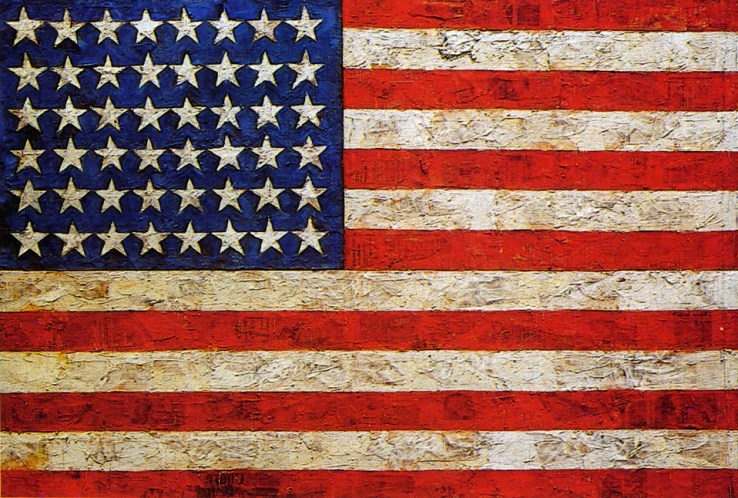
Flag -- Jasper Johns (1954)

“Election Day, November, 1884” by Walt Whitman

If I should need to name, O Western World, your powerfulest scene and
show,
‘Twould not be you, Niagara–nor you, ye limitless prairies–nor
your huge rifts of canyons, Colorado,
Nor you, Yosemite–nor Yellowstone, with all its spasmic
geyser-loops ascending to the skies, appearing and disappearing,
Nor Oregon’s white cones–nor Huron’s belt of mighty lakes–nor
Mississippi’s stream:
–This seething hemisphere’s humanity, as now, I’d name–the still
small voice vibrating–America’s choosing day,
(The heart of it not in the chosen–the act itself the main, the
quadriennial choosing,)
The stretch of North and South arous’d–sea-board and inland–
Texas to Maine–the Prairie States–Vermont, Virginia, California,
The final ballot-shower from East to West–the paradox and conflict,
The countless snow-flakes falling–(a swordless conflict,
Yet more than all Rome’s wars of old, or modern Napoleon’s:) the
peaceful choice of all,
Or good or ill humanity–welcoming the darker odds, the dross:
–Foams and ferments the wine? it serves to purify–while the heart
pants, life glows:
These stormy gusts and winds waft precious ships,
Swell’d Washington’s, Jefferson’s, Lincoln’s sails.

Anthems in New Tongues I Hear Saluting Me

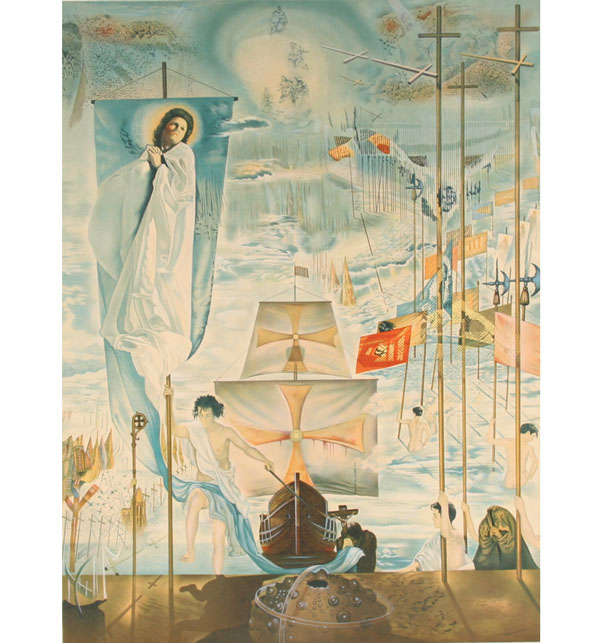
Salvador Dali Museum.
Salvador Dalí, The Discovery of America by Christopher Columbus, 1959, oil on canvas, 410 x 284 cm, St. Petersburg, Florida: Salvador Dalí Museum.

“Prayer of Columbus” by Walt Whitman

A batter’d, wreck’d old man,
Thrown on this savage shore, far, far from home,
Pent by the sea and dark rebellious brows, twelve dreary months,
Sore, stiff with many toils, sicken’d and nigh to death,
I take my way along the island’s edge,
Venting a heavy heart.
I am too full of woe!
Haply I may not live another day;
I cannot rest O God, I cannot eat or drink or sleep,
Till I put forth myself, my prayer, once more to Thee,
Breathe, bathe myself once more in Thee, commune with Thee,
Report myself once more to Thee.
Thou knowest my years entire, my life,
My long and crowded life of active work, not adoration merely;
Thou knowest the prayers and vigils of my youth,
Thou knowest my manhood’s solemn and visionary meditations,
Thou knowest how before I commenced I devoted all to come to Thee,
Thou knowest I have in age ratified all those vows and strictly kept them,
Thou knowest I have not once lost nor faith nor ecstasy in Thee,
In shackles, prison’d, in disgrace, repining not,
Accepting all from Thee, as duly come from Thee.
All my emprises have been fill’d with Thee,
My speculations, plans, begun and carried on in thoughts of Thee,
Sailing the deep or journeying the land for Thee;
Intentions, purports, aspirations mine, leaving results to Thee.
O I am sure they really came from Thee,
The urge, the ardor, the unconquerable will,

The potent, felt, interior command, stronger than words,

A message from the Heavens whispering to me even in sleep,
These sped me on.
By me and these the work so far accomplish’d,
By me earth’s elder cloy’d and stifled lands uncloy’d, unloos’d,
By me the hemispheres rounded and tied, the unknown to the known.
The end I know not, it is all in Thee,
Or small or great I know not–haply what broad fields, what lands,
Haply the brutish measureless human undergrowth I know,
Transplanted there may rise to stature, knowledge worthy Thee,
Haply the swords I know may there indeed be turn’d to reaping-tools,
Haply the lifeless cross I know, Europe’s dead cross, may bud and
blossom there.
One effort more, my altar this bleak sand;
That Thou O God my life hast lighted,
With ray of light, steady, ineffable, vouchsafed of Thee,
Light rare untellable, lighting the very light,
Beyond all signs, descriptions, languages;
For that O God, be it my latest word, here on my knees,
Old, poor, and paralyzed, I thank Thee.
My terminus near,
The clouds already closing in upon me,
The voyage balk’d, the course disputed, lost,
I yield my ships to Thee.
My hands, my limbs grow nerveless,
My brain feels rack’d, bewilder’d,
Let the old timbers part, I will not part,
I will cling fast to Thee, O God, though the waves buffet me,
Thee, Thee at least I know.
Is it the prophet’s thought I speak, or am I raving?
What do I know of life? what of myself?
I know not even my own work past or present,
Dim ever-shifting guesses of it spread before me,
Of newer better worlds, their mighty parturition,
Mocking, perplexing me.
And these things I see suddenly, what mean they?
As if some miracle, some hand divine unseal’d my eyes,
Shadowy vast shapes smile through the air and sky,
And on the distant waves sail countless ships,
And anthems in new tongues I hear saluting me.

Palin’s Poetry

This was too good not to repost. A few selections from “The Poetry of Sarah Palin,” courtesy of today’s Slate:

“On Good and Evil”

It is obvious to me
Who the good guys are in this one
And who the bad guys are.
The bad guys are the ones
Who say Israel is a stinking corpse,
And should be wiped off
The face of the earth.

That’s not a good guy.

(To K. Couric, CBS News, Sept. 25, 2008)

“Challenge to a Cynic”

You are a cynic.
Because show me where
I have ever said
That there’s absolute proof
That nothing that man
Has ever conducted
Or engaged in,
Has had any effect,
Or no effect,
On climate change.

(To C. Gibson, ABC News, Sept. 11, 2008)

And my personal favorite:

“Secret Conversation”

I asked President Karzai:

“Is that what you are seeking, also?
“That strategy that has worked in Iraq?
“That John McCain had pushed for?
“More troops?
“A counterinsurgency strategy?”

And he said, “Yes.”

(To K. Couric, CBS News, Sept. 25, 2008)

Great stuff.

Also, if Palin’s incoherence in real interviews isn’t enough absurdity for you, check out the Sarah Palin Fictional Quote Generator. Sample:

I’m not one of those who feel like whether that is part of the solution or not and we’ve got to remember what the desire is in this nation at this time.

Icarus Falls, No Big Deal

“Landscape with the Fall of Icarus” by William Carlos Williams

According to Brueghel
when Icarus fell
it was spring

a farmer was ploughing
his field
the whole pageantry

of the year was
awake tingling
near

the edge of the sea
concerned
with itself

sweating in the sun
that melted
the wings’ wax

unsignificantly
off the coast
there was

a splash quite unnoticed
this was
Icarus drowning

“Musée de Beaux Arts” by W.H. Auden

About suffering they were never wrong,
The Old Masters: how well, they understood
Its human position; how it takes place
While someone else is eating or opening a window or just walking dully along;
How, when the aged are reverently, passionately waiting
For the miraculous birth, there always must be
Children who did not specially want it to happen, skating
On a pond at the edge of the wood:
They never forgot
That even the dreadful martyrdom must run its course
Anyhow in a corner, some untidy spot
Where the dogs go on with their doggy life and the torturer’s horse
Scratches its innocent behind on a tree.

In Brueghel’s Icarus, for instance: how everything turns away
Quite leisurely from the disaster; the ploughman may
Have heard the splash, the forsaken cry,
But for him it was not an important failure; the sun shone
As it had to on the white legs disappearing into the green
Water; and the expensive delicate ship that must have seen
Something amazing, a boy falling out of the sky,
had somewhere to get to and sailed calmly on.

“Manet’s Olympia” by Margaret Atwood

“Manet’s Olympia”

She reclines, more or less.
Try that posture, it’s hardly languor.
Her right arm sharp angles.
With her left she conceals her ambush.
Shoes but not stockings,
how sinister. The flower
behind her ear is naturally
not real, of a piece
with the sofa’s drapery.
The windows (if any) are shut.
This is indoor sin.
Above the head of the (clothed) maid
is an invisible voice balloon: Slut.

But. Consider the body,
unfragile, defiant, the pale nipples
staring you right in the bull’s-eye.
Consider also the black ribbon
around the neck. What’s under it?
A fine red threadline, where the head
was taken off and glued back on.
The body’s on offer,
but the neck’s as far as it goes.
This is no morsel.
Put clothes on her and you’d have a schoolteacher,
the kind with the brittle whiphand.

There’s someone else in this room.
You, Monsieur Voyeur.
As for that object of yours
she’s seen those before, and better.

I, the head, am the only subject
of this picture.
You, Sir, are furniture.
Get stuffed.

25 Lines on Poetry

1. I do not like poetry.

2. I like folk songs, sea shanties, nursery rhymes, limericks, hymns, field hollers, riddles, epigrams, epigraphs, epitaphs, epithets, obituary notices, fortune cookie fortunes, square dance calls, confiscated notes, found diary entries, proverbs, anagrams, aphorisms, catcalls, insults, howls, air kisses, and handshakes, but I do not like poetry.

3. OK, maybe I like a poem or two. Or a poet or two.

4. I admit: I love the words of Walt Whitman. I unstop my throat to sing his praises. I lean and loafe at my ease with him. I laze it up.

5. Also, I admit: Emily Dickinson makes the good poems. Or made them (she is, I know, long dead). Her poems at first seem neat and tidy and even sparkly, but upon closer inspection bristle like riddles riddled with slant rhymes. Sex and death.

6. And, when I was younger: e.e. cummings (E.E. Cummings?). Later, I discovered that he was Not to be Taken Seriously as Serious Poet, Seriously.

7. But that was OK. Because I knew by then that I don’t like poetry.

8. I do like to read the occasional poem: William Carlos Williams, Langston Hughes, James Weldon Johnson, William Blake: all have written a verse or two worth pondering over for a few idle moments.

9. But I mistrust the reading of volumes of poetry.

10. I also mistrust contemporary poetry and contemporary poets (although I know very few poets, MFAs both of them, and they are very good people, but I don’t know where they get off calling themselves poets).

11. Rap lyrics are not poetry: I’m just saying.

12. I took a poetry class when I was in university. It was required. I didn’t enjoy it, not even a little. The only poem I remember liking even a little was Gerard Manley Hopkins’s “The Windhover.” I liked the alliteration, but I don’t remember what it was about. My teacher seemed to think it was a lesser poem and Hopkins was a lesser poet.

13. “Howl”–garbage? Garbage, am I right?

14. But then again, I didn’t care for On the Road.

15. I like to read a poem at random: perhaps in a periodical or a quarterly, sandwiched between factoids and graphics and fragments of narrative essay.

16. Poetry may or may not still be considered the highest art form: I think it is probably not considered the highest art form anymore: no one reads poetry anymore: not unless they have to: for school, y’know?

17. Ezra Pound and T.S. Eliot: Bob Dylan wrote about these guys: Bob Dylan: not a poet: Dylan Thomas: he wrote a poem or two I like: “Rage, rage against the dying of the light”: that’s a nice sentiment: a nice poem: but–

18. Ezra Pound and T.S. Eliot: hard to decipher: If I’m going to put that much effort into reading something, it’s going to be Derrida or Freud or James Joyce.

19. James Joyce: not much of a poet, strangely (maybe not strangely?) enough: not strangely, I’ve decided.

20. MFA programs now produce poets who write for an audience of other MFA poets. Meanwhile, school children sing the body electric and miss all the psychological subtlety of “The Raven.”

21. Poe: Poe is the Greatest American Writer Who Never Wrote a Great American Novel (maybe if he hadn’t died in the gutter at only 40…).

22. Poe: I like his poems, in small doses (like shots of syrupy night time cold medicine, thick and green).

23. You will now forget the awful simile above: we will all agree it was poorly written: a bad idea.

24. Also, let’s forget all about points 1-21 as well, and we might as well forget about point 23 to boot.

25. In fact, the whole post has been ridiculous and ridiculous: mea culpa.