Some notes from 299 pages into a rereading of Infinite Jest

IMG_6547

A note on the context of the first reading, subsequent ventures, and this rereading

I bought David Foster Wallace’s novel Infinite Jest in 1997 when I was a freshman in college, as required by law. I attempted reading it a few times without really getting to page 100. (I did read and reread the short stories and the essays and Wallace’s first novel in that time though. None were assigned readings. The DFW Academic Industry was not a Thing yet).

The first time I read the book the whole way through was in the weird fall of 2001, the first fall I hadn’t returned to school because I had graduated from school, the fall of 9/11, the fall I moved to Tokyo the week after 9/11, packing the book in a smallish suitcase that the airport security guy had to take everything out of with his latex-gloved hands, removing every item, all the clothes and books, because I was traveling on a one-way ticket to a foreign land. It was in that weird fall that I finally read the book, reading mostly in the very very early a.m., sometimes reading for hours, reading too late, becoming addicted.

In years since, I’ve poked at rereadings, often looking for very specific passages/sections, and always meaning to do a full reread, but there are all those other big books that need to get read (and then reread).

Well so and anyway: This reread has been prompted by back-to-back readings of Gravity’s Rainbow, which I take to be the most obvious precursor text for Infinite Jest (and likely the greatest source of Wallace’s Oedipal anxiety if we want to get all Bloomian). I thought about Infinite Jest a lot while reading GR.

So far, like any rereading of a big encyclopedic novelInfinite Jest seems much, much easier than my initial go through (although coming off GR almost anything would probably seem much, much easier). With the contours of the “big plot” in place (and the rhetorical dazzle of some of Wallace’s embedded-essays not as blinding as before), focusing on details, patterns, and motifs becomes simply more possible. (I don’t think I connected Hal’s clipping his toenails in Ch. 18 to the toenails Gately finds in Ennet House in Ch. 19 before, f’r’instance). (There are no actual chapter numbers in IJ, although there are circles separating chapters which can be counted).

A note to readers new to Infinite Jest

Infinite Jest is very long but it’s not nearly as difficult as its reputation suggests. There is a compelling plot behind the erudite essaying and sesquipedalian vocabulary. That plot develops around three major strands which the reader must tie together, with both the aid of—and the challenge of—the novel’s discursive style. Those three major plot strands are the tragic saga of the Incandenzas (familial); the redemptive narrative of Ennet House Drug and Alcohol Recovery House, with Don Gately as the primary hero (socicultural); and the the schemes of the Québécois separatists (national/international/political). An addictive and thus deadly film called Infinite Jest links these three plots (through discursive and byzantine subplots).

Wallace often obscures the links between these plot strands, and many of the major plot connections have to be intuited or outright guessed. Furthermore, while there are clear, explicit connections between the plot strands made for the reader, Wallace seems to withhold explicating these connections until after the 200-page mark. Arguably, the real contours of the Big Plot come into (incomplete) focus in a discussion between Hal Incandenza and his brother Orin in pages 242-58. While that scene by no means telegraphs what happens in IJ, it nonetheless offers some promise that the set pieces, riffs, scenes, lists, and vignettes shall add up to Something Bigger.  Continue reading “Some notes from 299 pages into a rereading of Infinite Jest”

Reviews and riffs of May 2015 (and an unrelated owl)

Reviews and riffs, May 2015

In which I read Playboy for the Pynchon article.

This is not a review of Lydia Davis’s Can’t and Won’t.

What the hell is Pynchon in Public Day?

A review of Jim O’Rourke’s new record Simple Songs.

Han Kang’s The Vegetarian reviewed.

A somewhat contrarian take on Mad Max: Fury Road.

Mad Men’s cynical finale.

Gravity’s Rainbow and Disney’s Fantasia.

Unrelated owl by Durer:


A last riff (for now) on Gravity’s Rainbow (and Disney’s Fantasia)

Screenshot 2015-04-24 at 9.27.30 PM

Disney’s Fantasia is one of the better film adaptations of Thomas Pynchon’s novel Gravity’s Rainbow. 

At least this thought zipped into my head a few weeks back, as I watched the film with my wife and kids. I was in the middle of a second reading of the novel, an immediate rereading prompted by the first reading. It looped me back in. Everything seemed connected to the novel in some way. Or rather, the novel seemed to connect itself to everything, through its reader—me—performing a strange dialectic of paranoia/anti-paranoia.

So anyway, Fantasia seemed to me an adaptation of Gravity’s Rainbow, bearing so many of the novel’s features: technical prowess, an episodic and discontinuous form, hallucinatory dazzle, shifts between “high” and “low” culture, parodic and satirical gestures that ultimately invoke sincerity, heightened musicality, themes of magic and science, themes of automation and autonomy, depictions of splintering identity, apocalypse and genesis, cartoon elasticity, mixed modes, terror, love, the sublime, etc.

(There’s even a coded orgy in Fantasia).

But Fantasia was first released in 1940 right, when Pynchon was, what, three or four? And Gravity’s Rainbow was published in 1973, and most of the events in that novel happen at the end of World War II, in like, 1944, 1945, right? So the claim that “Fantasia is one of the better film adaptations of Gravity’s Rainbow” is ridiculous, right?

(Unless, perhaps, we employ those literary terms that Steven Weisenburger uses repeatedly in his Companion to Gravity’s Rainbow: analepsis and prolepsis—so, okay, so perhaps we consider Fantasia an analepsis, a flashback, of Gravity’s Rainbow, or we consider Gravity’s Rainbow a prolepsis, a flashforward, of Fantasia…no? Why not?).

Also ridiculous in the claim that “Fantasia is one of the better film adaptations of Gravity’s Rainbow” is that modifier “better,” for what other film adaptations of Gravity’s Rainbow exist?

(The list is long and mostly features unintentional titles, but let me lump in much of Robert Altman, The Conversation, Richard Kelly’s Southland Tales, Paul Thomas Anderson’s The Master, that Scientology documentary Going Clear, a good bit of stuff by the Wachowksis, The Fisher King (hell, all of Terry Gilliam, why not?), the Blackadder series, which engenders all sorts of wonderful problems of analepsis and prolepsis…).

Gravity’s Rainbow is of course larded with film references, from King Kong and monster movies to German expressionism (Fritz Lang in particular), and features filmmakers and actors as characters. The novel also formulates itself as its own film adaptation, perhaps. The book’s fourth sentence tells us “…it’s all theatre.” (That phrase appears again near the novel’s conclusion, in what I take to be a key passage). And the book ends, proleptically, in “the Orpheus Theatre on Melrose,” a theater managed by Richard M. Nixon, excuse me, Zhlubb—with the rocket analeptically erupting from the past into “The screen…a dim page spread before us, white and silent.” Indeed, as so many of the book’s commentator’s have noted, Pynchon marks separations in the book’s sequences with squares reminiscent of film sprockets —  □ □ □ □ □ □ □. Continue reading “A last riff (for now) on Gravity’s Rainbow (and Disney’s Fantasia)”

What the hell is Pynchon in Public Day?

image

Pynchon in Public Day is tomorrow, May 8th–that’s Pynchon’s birthday if you’re keeping score. (He’ll be 78 tomorrow. Last year I put together links for his auspicious 77th birthday).

For the past couple of years, I’ve seen the phrase Pynchon in Public pop up in my Twitter timeline, often as a hashtag. I had a (willfully) vague idea about what Pynchon in Public was all about–like, reading Pynchon publicly, posting the W.A.S.T.E. horn in public places, leaving books about. Making the secret sign. Etc.

But so and anyway: I’ve been reading or re-reading Pynchon more or less non-stop for the past two years, after diving for reasons I can’t recall into Against the Day, following that up with Mason & Dixon, and then going through The Crying of Lot 49 and Inherent Vice again. (In the deepest and most sincere spirit of my Pynchon-reading-experience, I abandoned Bleeding Edge twice during this time). I’m rereading Gravity’s Rainbow now after just having finished it (after years of false starts). Reading it again is like reading it for the first time, and as I progress (and sometimes retreat) through the Zone, I experience a sympathetic fragmentation, a scattering, a sense that the novel is consuming me. Another way of saying this is that Gravity’s Rainbow is a scary book, and all of Pynchon is scary in the sense that it’s all just one big book. It kinda sorta worms its way into the ear of one’s consciousness, wriggles (Ruggles?) behind the old brainpan, performs a paranoid song and dance routine. Other fun and games too.

Wait, what? Continue reading “What the hell is Pynchon in Public Day?”

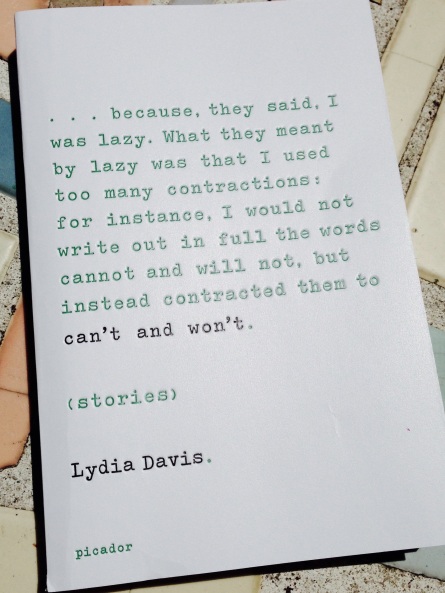
This is not a review of Lydia Davis’s Can’t and Won’t

This is the part of the not-review where I include a picture I took of the book to accompany the not-review:

image

This is the part of the not-review where I briefly restage Lydia Davis’s publishing history to provide some context for readers new to her work.

This is the part of the not-review where I submit that anyone already familiar with Lydia Davis’s short fiction is likely to already hold an opinion on it that won’t (but could) be changed by Can’t and Won’t.

This is the part of the not-review where I dither pointlessly over whether or not the stories in Can’t and Won’t are actually stories or something other than stories.

This is the part of the not-review where I state that I don’t care if the stories in Can’t and Won’t are actually stories or something other than stories.

This is the part of the not-review where I explain that I have found a certain precise aesthetic pleasure in most of Can’t and Won’t that radiates from the savory contradictory poles of identification and alienation.

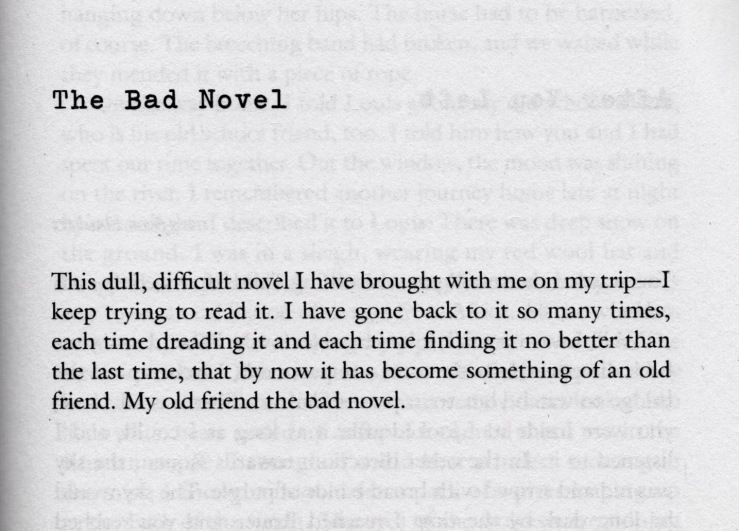
This is the part of the not-review where I cite an example of identification with Davis’s narrator-persona-speaker:

IMG_6074

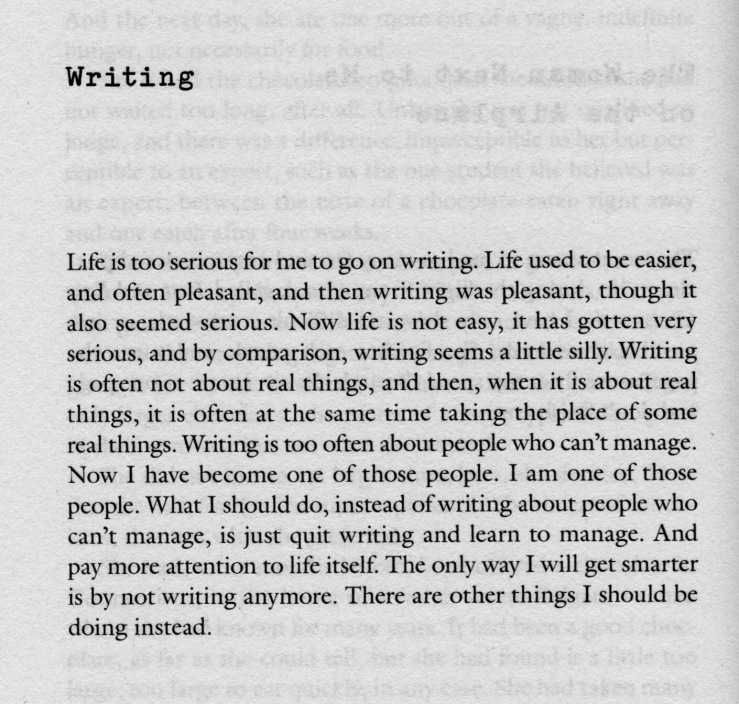
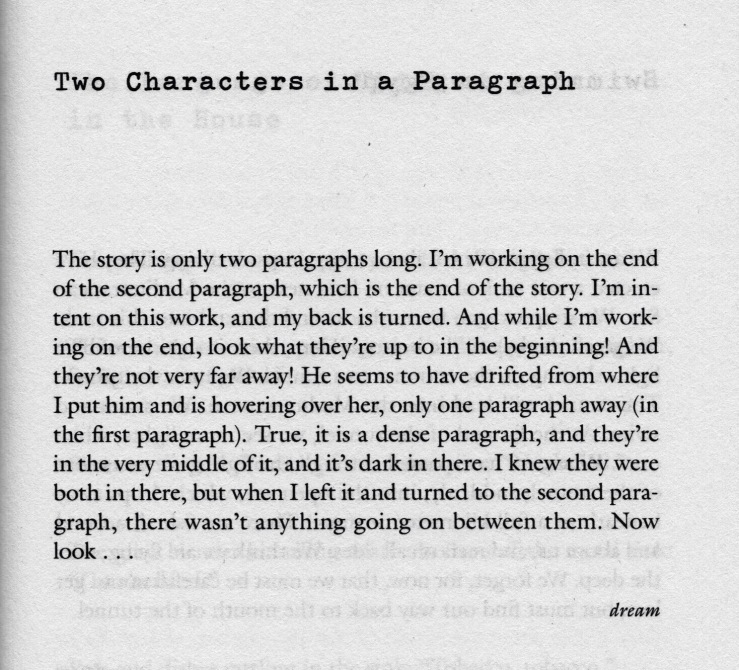
This is the part of the not-review where I claim that I used scans of the text to preserve the look and feel of Lydia Davis’s prose on the page.

This is the part of the not-review where I say that some of my favorite moments in Can’t and Won’t are Davis’s expressions of frustrated boredom with literature (or do I mean publishing?), like in the longer piece “Not Interested.”

This is the part of the not-review where I point out that Davis’s speaker-narrator-persona expresses frustration with the act of writing itself:

IMG_6072

This is the part of the not-review where I dither pointlessly over distinctions between Davis the author and Davis the persona-speaker-narrator.

This is the part of the not-review where I point out that (previous dithering and frustration-with-writing aside) writing itself is a major concern of Can’t and Won’t:

IMG_6070

This is the part of the not-review where I say that many of the stories in Can’t and Won’t are labeled dream, and I often found myself not really caring for these dreams (although I like the one above), but maybe I didn’t really care for the dreams because of their being tagged as dreams. (This is the part of the not-review where I point out that our eyes glaze over when anyone tells us their literal dreams).

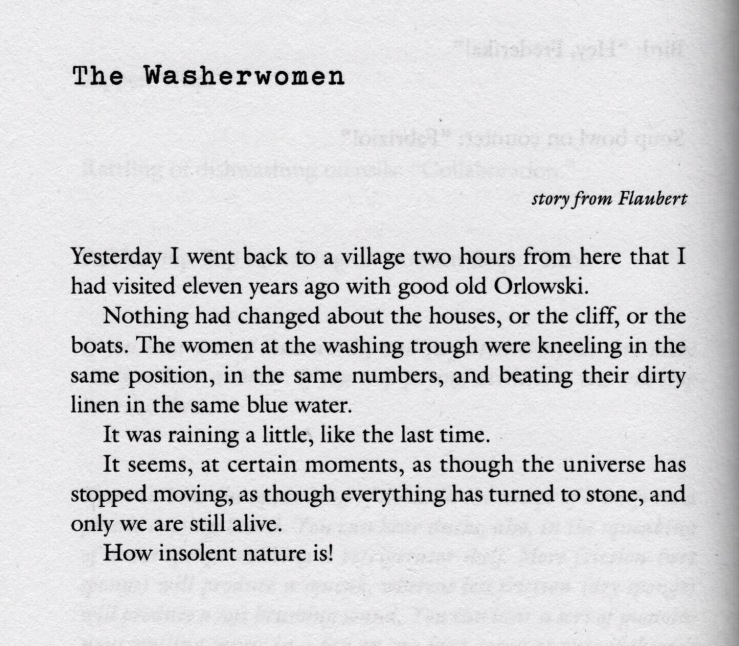
This is the part of the not-review where I transition from stories tagged dream to stories tagged story from Flaubert, like this one:

IMG_6076

This is the part of the not-review where I say how much I liked the stories from Flaubert stories in Can’t and Won’t.

This is the part of the not-review where I mention Davis’s translation work, but don’t admit that I didn’t make it past the first thirty pages of her Madame Bovary. 

This is the part of the not-review where I needlessly reference my review of The Collected Stories of Lydia Davis and point out that that collection is not so collected now.

This is the part of the not-review where I pointlessly dither over post-modernism, post-postmodernism, and Davis’s place in contemporary fiction. (This is the part of the not-review where I needlessly cram in the names of other authors, like Kafka and Walser and Bernhard and Markson and Adler and Miller &c.).

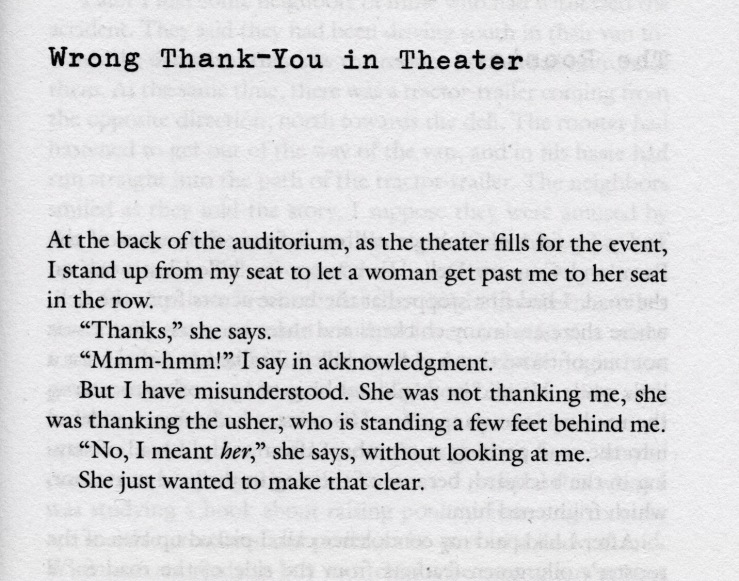
This is the part of the not-review where I claim that nothing I’ve written matters because Davis makes me laugh (this is also the part of the not-review where I use the adverb “ultimately,” a favorite crutch):

IMG_6077

This is the part of the not-review where I point out that Can’t and Won’t is not for everybody, but I very much enjoyed it.

This is the part of the not-review where I mention that the publisher is FS&G/Picador, and that the book is available in the usual formats.

A first riff on rereading Gravity’s Rainbow (and some thoughts on Weisenburger’s Companion)

I enjoy rereading more than reading. Returning to Moby-Dick2666, Ulysses, or Blood Meridian reveals so much more: More depth, more art, more structure, more precision, more humor, more pain, more more.

Thomas Pynchon’s novel Gravity’s Rainbow is all more. Rereading Gravity’s Rainbow is like reading it for the first time, or, rather, more precisely, that is how I am experiencing it now—with clarity—compelled as I was to immediately circle back through its loop again.

Gravity’s Rainbow’s cohesion hides (hides is not the right verb) under detritus, in the flux of objects and concepts that tangle and unravel throughout the text. Indeed, the novel’s themes seem to repeat (with difference, with opposition) in the lists and rants that lard it.

A simple, early example comes on page 18, where Teddy Bloat turns spying eyes over our hero Tyrone Slothrop’s desk, where “Things have fallen roughly into layers, over a base of bureaucratic smegma that sifts steadily to the bottom…” In A Gravity’s Rainbow Companion: Sources and Contexts for Pynchon’s Novel, Steven Weisenburger points out that “Among the list of objects on Slothrop’s desk are items, allusions, and brand names left in his wake throughout the novel.” Weisenburger proceeds to sift through these layers, pointing out connections, and offering (as always) helpful page numbers which attest how damn precise Pynchon’s novel is.

I picked up Weisenburger’s Companion on solicited recommendations from Twitter folk and readers of this blog, and I’ve found it unobtrusive and helpful so far. Weisenburger’s introductory essay is especially good, and foregrounds his intertextual approach to his Companion (he all but namechecks Mikhail Bakhtin: “Gravity’s Rainbow sets in motion ‘the Night’s Mad Carnvival’ (V133.38) of intertextual entertainments”; a few lines later, he describes the novel as a work of “encyclopedic heteroglossia”). Weisenburger also quickly helped to (re)confirm my sense that GR loops back into itself, its end cycling back to its beginning: “Gravity’s Rainbow is ‘heterocyclic’ (V249.26): rings are looped together in still larger, polymerized rings, looped together in the still larger cycling of its four parts.”

I’m about halfway through the second of those four parts, “Un Perm’ au Casino Hermann Goering,” but still playing catch-up with the Weisenburger. I sometimes skim—sometimes with undue pride (Hey I got that reference on my own, thanks anyway Dr. W), and sometimes, admittedly with a vague but cheerful boredom (Weisenburger has an occasional tendency to lay out Pynchon’s source texts in detailed detail).

The Companion is at its finest, in my estimation, when Weisenburger extrapolates from his sources and contexts into GR’s deepest themes, like here, where our introduction to Gottfried (a seemingly minor character) branches into etymology, mythology, and comparative religion:

image

(My favorite moment here is probably where Dr. W poses that question about Pynchon knowing Branston and Grimm, and then immediately answers it (in what I like to pretend is Robert Evans’s voice)).

While Weisenburger’s Companion often enlightens and clarifies, so does simply (or not so simply) rereading Gravity’s Rainbow enlighten and clarify the first reading. I’m thankful that I didn’t use Weisenburger’s book on my first full trip though GR. Sure, Companion hazards a number of plot spoilers, which I imagine would annoy many readers. But more significant to me is that using Weisenburger’s annotations as a first-timer’s guide through Pynchon’s detritus would have likely spoiled the aesthetic effect of that detritus. It would likely have spoiled some of the richness in the rereading that I’m enjoying so very much now.

Riff on the end/beginning of Gravity’s Rainbow

Well: “A screaming comes across the sky. It has happened before [—]”

□ □ □ □ □ □ □

So. Okay. So I finished Gravity’s Rainbow on Friday night, and reread the opening section (and more than the opening section) on Saturday morning, resisting a compulsion to immediately return to the beginning.

□ □ □ □ □ □ □

So: Okay: Right?

The ending of Gravity’s Rainbow cycles back to the beginning (like Finnegans Wake): Blicero’s rocket, screaming across the sky—yes? no?—to invade the dreams (?) of psychic Pirate Prentice? The book: a loop, a Möbius strip, a film, its reels discombobulated, jostled, scattered

□ □ □ □ □ □ □

“…it’s all theatre,” we learn on the book’s first page (page 3); the book ends in a theater—the Orpheus Theater!—where maybe scattered Slothrop is the leading man, scattered, we find ourselves in him, parts of him—where the audience demands, on the book’s last page: “Start-the-show!”

□ □ □ □ □ □ □

“You’re putting response before stimulus,” Spectro shakes his head at Pointsman, early in “Beyond the Zero,” the first section of Gravity’s Rainbow—does this describe the beginning/end of the novel? (“It has happened before”).

□ □ □ □ □ □ □

Or, a bit earlier even, at the seance, (page 32), Gloaming describes one kind of plot: “…we should get something like a straight line” — but then gives us another kind of plot — “…however we’ve data that suggest the curves for certain —conditions, well they’re actually quite different—schizophrenics for example tend to run a bit flatter in the upper part then progressively steeper—a sort of bow shape … classical paranoiac—” Is this the shape of Gravity’s Rainbow?

□ □ □ □ □ □ □

—but right this moment it’s that final dash that intrigues me—this in a novel full of dashes, this in a novel that name-checks Emily Dickinson, Eternal Empress of Dashes—the fragmented conclusion is full of dashes, lines obliterated by more perfect, straight lines, simultaneously connecting and disconnecting—like the novel’s final line:

“Now everybody—“

□ □ □ □ □ □ □ Continue reading “Riff on the end/beginning of Gravity’s Rainbow”

A scattered riff on Thomas Pynchon’s novel Gravity’s Rainbow

I’m safe here at my office, away from Thomas Pynchon’s Gravity’s Rainbow. I almost certainly would not dare to write about it were it proximal. If the book were here with me, its text would infect me, and I’d replicate it in chunks here for you, dear reader, to sort out (or not sort out) as you wish (or do not wish).

□ □ □ □ □ □ □

I’m almost finished with Gravity’s Rainbow, which is how I know that I’m not finished with Gravity’s Rainbow. I’m going to have to read it again. (I want to read it again).

□ □ □ □ □ □ □

I’m about fifty pages from the last page—just got through/endured/delighted in/icked and acked at the Gross Suckling Conference, or, as I like to think of it, the alliterative abject dinner party.

□ □ □ □ □ □ □

Gravity’s Rainbow is filled with more abject imagery than any novel I’ve ever read.

□ □ □ □ □ □ □

I mean abjection here in the general sense of degradation, etc., but also in the specific sense that Julia Kristeva uses in Powers of Horror:

The corpse (or cadaver: cadere, to fall), that which has irremediably come a cropper, is cesspool, and death; it upsets even more violently the one who confronts it as fragile and fallacious chance. A wound with blood and pus, or the sickly, acrid smell of sweat, of decay, does not signify death. In the presence of signified death—a flat encephalograph, for instance—I would understand, react, or accept. No, as in true theater, without makeup or masks, refuse and corpses show me what I permanently thrust aside in order to live. These body fluids, this defilement, this shit are what life withstands, hardly and with difficulty, on the part of death. There, I am at the border of my condition as a living being. My body extricates itself, as being alive, from that border. Such wastes drop so that I might live, until, from loss to loss, nothing remains in me and my entire body falls beyond the limit—cadere, cadaver. If dung signifies the other side of the border, the place where I am not and which permits me to be, the corpse, the most sickening of wastes, is a border that has encroached upon everything. It is no longer I who expel, “I” is expelled. The border has become an object. How can I be without border? That elsewhere that I imagine beyond the present, or that I hallucinate so that I might, in a present time, speak to you, conceive of you—it is now here, jetted, abjected, into “my” world. Deprived of world, therefore, I fall in a faint. In that compelling, raw, insolent thing in the morgue’s full sunlight, in that thing that no longer matches and therefore no longer signifies anything, I behold the breaking down of a world that has erased its borders: fainting away. The corpse, seen without God and outside of science, is the utmost of abjection. It is death infecting life. Abject. It is something rejected from which one does not part, from which one does not protect oneself as from an object. Imaginary uncanniness and real threat, it beckons to us and ends up engulfing us.

□ □ □ □ □ □ □

Forgive me for citing at such length, but perhaps Kristeva summarizes some aspect of Gravity’s Rainbow that deeply interests me: The core of the novel (the core that Pynchon atomizes, decentralizes, scatters like his main man Tyrone Slothrop)—the core of the novel rests on love and death, me and not-me: “How can I be without border?” The war and its corpses and rockets and dissolutions. Continue reading “A scattered riff on Thomas Pynchon’s novel Gravity’s Rainbow”

A rambling and possibly incoherent riff on Inherent Vice (film and novel) and The Crying of Lot 49

IMG_0200

A. The first time I saw Paul Thomas Anderson’s film Inherent Vice, I was in the middle of rereading Pynchon’s novel The Crying of Lot 49, which I hadn’t read in fifteen years. I remembered the novel’s vibe, its milieu, but not really its details.

B. I read The Crying of Lot 49 and then immediately reread it. It seemed much stronger the second time—not nearly as silly. Darker. Oedipa Maas, precursor to Doc Sportello, trying not to lose the thread as she leaves the tower for the labyrinth, rushing dizzy into the sixties.

C. Another way of saying this: Inherent Vice is sequel to The Crying of Lot 49. Any number of details substantiate this claim (and alternately unravel it, if you wish, but let’s not travel there)—we could focus on the settings, sure, or maybe the cabals lurking in the metaphorical shadows of each narrative—is The Golden Fang another iteration of The Tristero?—but let me focus on the conclusions of both novels and then discuss the conclusion of PTA’s film.

D. A favorite line from a favorite passage from The Crying of Lot 49: “the true paranoid for whom all is organized in spheres joyful or threatening about the central pulse of himself.” Paranoia as a kind of sustained hope, a way to find meaning, order, a center.

E. The final pages of The Crying of Lot 49 find Oedipa trying to make sense of the labyrinth (my emphases in bold):

For it was now like walking among matrices of a great digital computer, the zeroes and ones twinned above, hanging like balanced mobiles right and left, ahead, thick, maybe endless. Behind the hieroglyphic streets there would either be a transcendent meaning, or only the earth. In the songs Miles, Dean, Serge and Leonard sang was either some fraction of the truth’s numinous beauty (as Mucho now believed) or only a power spectrum. Tremaine the Swastika Salesman’s reprieve from holocaust was either an injustice, or the absence of a wind; the bones of the GI’s at the bottom of Lake Inverarity were there either for a reason that mattered to the world, or for skin divers and cigarette smokers. Ones and zeroes. So did the couples arrange themselves. At Vesperhaven House either an accommodation reached, in some kind of dignity, with the Angel of Death, or only death and the daily, tedious preparations for it. Another mode of meaning behind the obvious, or none. Either Oedipa in the orbiting ecstasy of a true paranoia, or a real Tristero. For there either was some Tristero beyond the appearance of the legacy America, or there was just America and if there was just America then it seemed the only way she could continue, and manage to be at all relevant to it, was as an alien, unfurrowed, assumed full circle into some paranoia.

There is either meaning, or there is not meaning. Continue reading “A rambling and possibly incoherent riff on Inherent Vice (film and novel) and The Crying of Lot 49”

A Conversation about Evan Dara’s Novel Flee (Part 1)

[Context/editorial note: I’ve been meaning to read Evan Dara’s latest novel Flee for a while nowand when Biblioklept contributor Ryan Chang told me he’d be reading it as part of a contemporary literature class I decided to join him. This is the first part of a two-part discussion which took place over a few weeks of emails. — ET].   

Edwin Turner: So you’re reading Evan Dara’s Flee for a class, right? What’s the name of the class again? What are some of the other texts in the class?

Ryan Chang: Yeah, a class called 21st Century Fiction: What is Contemporary? We started out reading Reed’s Mumbo Jumbo and Acker’s Empire of the Senseless. We just finished reading Egan’s A Visit From The Goon Squad (awful), and we’re moving onto Chaon’s Await Your Reply and Pynchon’s Bleeding Edge. Everything, up to Pynchon, has as its central conflict the dissolution of the subject vis. the postmodern. Perhaps because of the spatialization of time (Egan, Reed) or a steroidal fungibility of a self because of technology (Chaon). The awareness of how deeply we are disciplined by master narratives (Acker). We’ve yet to get to Blake Butler’s There Is No Year and Richard Powers’ The Echo Maker, which I’m looking forward to after the Chaon and Egan who, in their attempt to write novels critical of the contemporary (more so of Egan, who does nothing but neuter the very real state of late capitalism’s terror into entertainment), do not make it past the merely interesting. I liked the Egan much less than the Chaon; part of the problem is the prose style, I think — it’s characteristically white American, shaped by sentimentality and preoccupied with the syntax of conventional form. In other words, the blueberry muffin prose styles betray the experimental forms in which they’re enveloped.

ET: I always have to look up the word fungibility. Dara’s Flee seems to fit into that early theme you mention, the conflict of the dissolution of the subject, which is both the book’s formal rhetorical strategy, but also its plot program, encapsulated (maybe) on page 45: “What is the weight of we?” What do you make of Dara’s style here? Like initial impression?

RC: I’m about ~40 pages in. I think I mentioned in the Books Acquired thing I wrote that Dara, stylistically, is hitting hard on Gaddis. Admittedly, I’m most familiar with the late Gaddis — Carpenter’s Gothic. (Agape Agape, too, but this is, of course, his letter to Bernhard.) I like that both focus on voice, on streams of speech that collide or blur into each other. The Gaddis influence is more of an echo than anything.
Specifically re: Dara — the interruptions, digressions and hesitations immediately struck me as something like a Tragic Greek chorus that, having incurred some sort of its own trauma (and not acting only as the all-knowing unconscious of the play), is completely disoriented, confused of its own purpose. But amidst the cacophony–or something like a directed cacophony towards the reader–they are still unwittingly functioning as a chorus. They’re giving us the stage for Flee’s story, hinting quietly at the book’s central plot conflict. Also naming characters (Carol, Rick, Marcus, etc), which is now more intriguing to me at the passage from p.45 you mention. What’s also different in Carpenter’s Gothic is, while that whole book remains on one diegetic level (as far as I can remember, it’s been a few years) because no narrator ever announces itself, in Dara, there’s a blurring of diegetic arenas, a refusal to centralize any narrative authority. Ok, so, re: dissolution of the subject: It seems that not only are the chorus members interrupting themselves, but they’re also interrupting the narrator as well. Each left-margin emdash cuts the narrator off, in a way, if you will. That scene when they’re pitying Rick, acting as a narrator with dialogue tags. The commonly individuated voice of the narrator is subsumed into the characters’ diegetic arena; a tension between the collective and individual implicit in prose structure alone. It also seems, by “36,551,” that whatever the population is fleeing from is not collectively driven (ie., the pity for Mark’s poorly planned meetings for something, we don’t know what yet), but selfishly driven. And in the flattening power of numbers, that selfishness — a hermetic individuality — becomes collective. There is a kind of infinite distance between I and we that, perhaps, the book is trying to trace? Or its relationship in the temporality of the novel is a perpetual expanding/contracting relationship, like a rubber band?

As far as I am in the book, the interruptions and digressions also have a hysteria to them that points to something the chorus is ignoring even in the face of the beginnings of a series of rude awakenings. Each voice just bemoans this dissolution of themselves; but, especially in the scene where Rick is, like, torn apart for his idea in service of the township, each voice is just narcissistically concerned with how it’s going to inconvenience them, rather than the potential worth of Rick’s idea.

ET: I teach an introductory American lit class, and today we were talking about Faulkner’s short story “A Rose for Emily,” which I think offers this wonderful example of a first-person plural narrator, this kind of limited chorus that is not-quite omniscient, not-quite omnipresent, and hardly omnipotent. It’s this weird we that seems able to transcend time, but not space—it can live for more than eighty years but it can’t see into Emily Grierson’s house. Its limitations are human; its limitations are the limitations of all the members of a community. I had your email in the back of my head while I was riffing on all this today—that, yes, the we is this fiction that we all subscribe to (hey look, I just used it!)—it’s our linguistic tag for culture, religion, whatever—but it requires some other—a you, I guess, that we can all point to, an Emily Grierson that’s only part of the we by paradoxically not being a part of the we, by defining the weFlee doesn’t seem to have that other, at least not in the first seven chapters anyway, although it does foreground two protagonists in Rick and Carol—something that Dara’s first novel The Lost Scrapbook does not do. The Lost Scrapbook is far more polyglossic than Flee also, which again reminds me of Faulkner’s story in its unified we-ness—Flee‘s narrative voice somehow unifies entropy, breakdown, the chaotic rumbling becomes this throbbing tone of dissolution (“There’s no here here,” page 79), where the narcissistic flight of each member of the community paradoxically underwrites the viability of a community, the possibility of a community… Continue reading “A Conversation about Evan Dara’s Novel Flee (Part 1)”

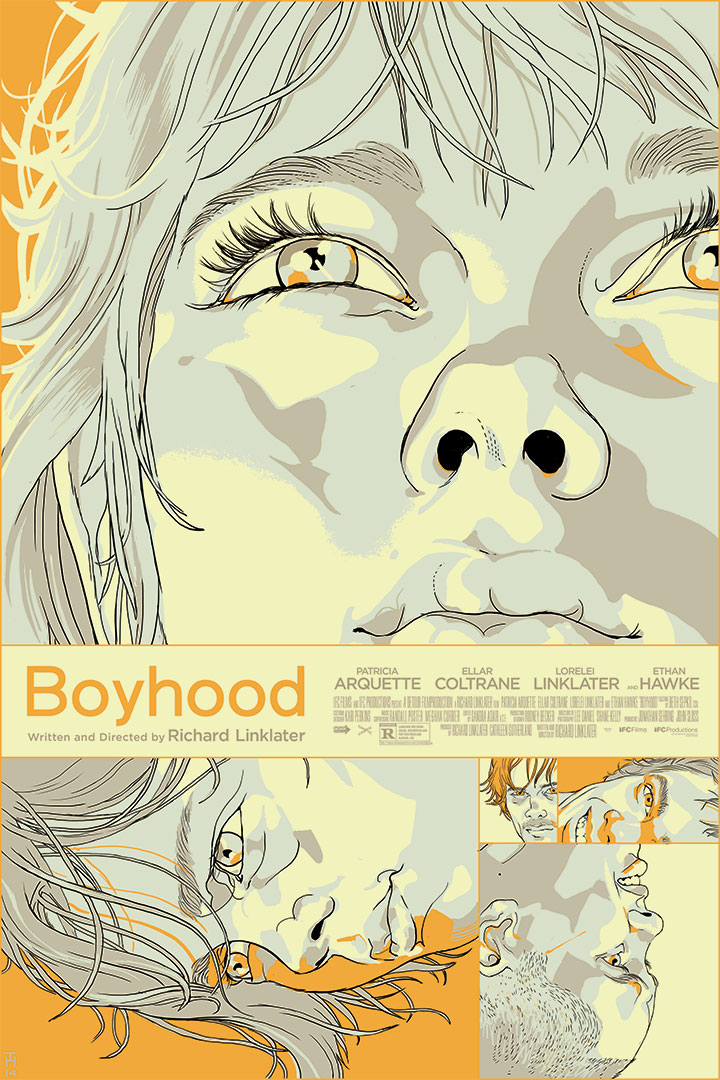
A short riff on a favorite scene from Richard Linklater’s film Boyhood

boyhood_color10

I absolutely loved Richard Linklater’s film Boyhood, which is nominated for a few Oscars this year, including Best Picture. (Boyhood is too good to win best picture; I’m fine with that prize going to Iñárritu’s faux-art film Birdman). A rich and sentimental evocation of “reality,” Boyhood synthesizes the best elements of Linklater’s previous films, and like many of those films—Slacker, the Before trilogy, Waking LifeDazed and ConfusedBoyhood isn’t really about anything. Of course it’s also kinda sorta about everything: family, love, growth, education, life. Etc.

The central formal device of Boyhood—namely, that Linklater shot the film over twelve years using the same actors—has been remarked upon at great length by others, so I won’t touch on it, other than to say that I found watching Ellar Coltrane’s Mason grow up profoundly moving. The aesthetic experience of Boyhood is its greatest pleasure, much like its sister film The Tree of Life. And although Boyhood’s aesthetic power relies in large part on our witnessing its characters grow and age, its emotional tenor, its vibe, inheres from scene to scene.

Capture

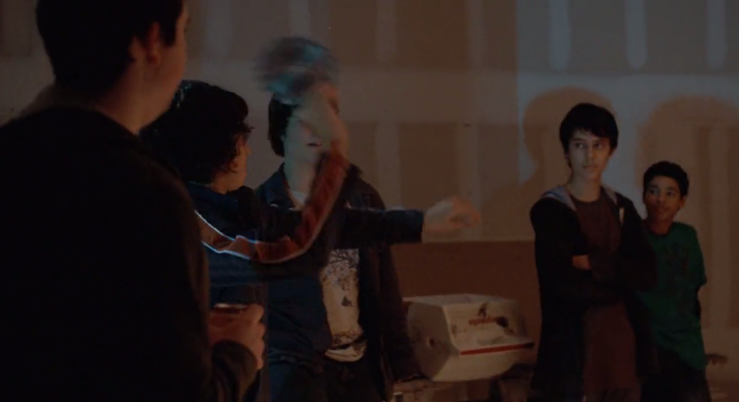
There are many wonderful moments in the film, some more memorable than others, but a favorite of mine takes place at an overnight “camping trip” in a house that’s still under construction. Mason is maybe, what, thirteen here?—I’m not quite sure, but he tells his mother the truth about where he’s going, if not entirely the truth about what he’ll be doing there…which is, what? Not much really—the younger kids hang out with the older kids, drink a beer or two, lie about sex—stuff kids do. The scene captures the same not-quite-boring hangout vibe that permeates Dazed and Confused and Waking Life—a kind of familiar realness.

Linklater is a master at evoking a sense of place. And this place, this house—it’s simultaneously boring, calming, and horrifying. On one hand, we’ve been there before—the abandoned house, the empty parking lot, the little switch of trees that aren’t quite woods, not really—the free space where we can play at being adults. On the other hand, Boyhood has allowed us—or maybe I should not extend my pronoun to the plural? No?—Okay: Boyhood has allowed me, this viewer, a kind of paternalistic view of Mason (“my-son”) who is, after all, growing up before our very eyes (sorry for slipping back into the first-person plural there). And here Linklater has young Mason—whom we trust to do the right thing and all but still—here Linklater has staged Mason & co. in an abandoned house full of scrap wood and power tools and circular saw blades which the young men are of course throwing into the sheet rock with gleeful abandon.

I flinched as the blades flew forcefully past Mason and his friend; in any other film they would have to cut into flesh and bone, be tools for forces tragic or comic. Plot devices. But in Boyhood they are the toys of boys playing at growing up. Nothing happens. No grievous injury or terrible death—the sort of thing that usually licenses, I don’t know, the central character’s maturation. Not even a comic wound. Nothing. The blade-throwing is just normal bored stupid teenage amusement. It’s the sort of thing that Mason’s mom—and a paternalistic viewer like me—might find horrifying—You could get very badly hurt, Mason!—but he doesn’t. He’s fine. He’s alive.

For me, this particular scene—not the strongest or the strangest or the most memorable or moving—is nevertheless a key moment in Boyhood, not just because it disrupts audience expectations (the film is full of such gentle disruptions), but because it engenders and then discharges my own parental anxieties. That’s a form of catharsis, I guess, but not a catharsis of tragedy. It’s catharsis for reality.

Some notes on beginning Evan Dara’s novel Flee

B8jFz0WCYAAghDz

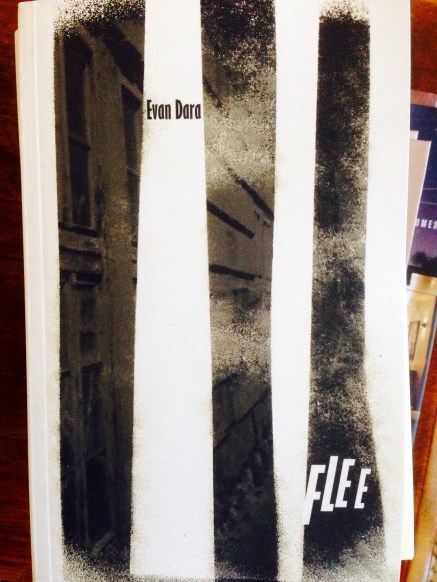
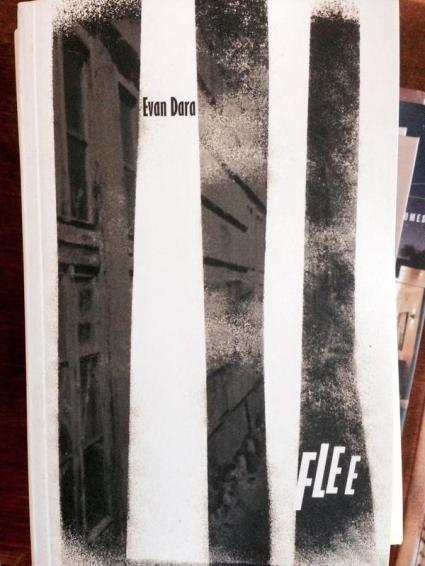
A. What a cover on Evan Dara’s 2013 novel Flee, don’t you agree?

B. From the back cover:

IMG_5030

C. That’s all there is. Well, okay, there’s an ISBN too. But no blurbs, no other text.

D. “Something always going on—” is the first line of Flee. It’s also an apt description of Dara’s formal technique, a constantly-shifting series of dialogues, monologues, overlapping, cross-cutting, diverging—always out there ahead of the reader. That dash there—that dash is the simple summative signal of it all, a little typographic pole that simultaneously connects and interrupts.

E. The most obvious point of comparison for Dara’s technique (besides his amazing debut novel The Lost Scrapbook) is William Gaddis’s stuff, particularly J Rthe verbal dazzle, the few stray lines of poetic stage-setting in lieu of traditional exposition—the throw-the-reader-in-the-deep-end stuff. David Foster Wallace frequently attempted the same rhetorical mode, most successfully in §19 of The Pale King. (It’s entirely likely that The Lost Scrapbook could have had the same following that Infinite Jest achieved had Dara done anything to promote the book. But here I think of Gaddis in his Paris Review interview: “I’d go back to The Recognitions where Wyatt asks what people want from the man they didn’t get from his work, because presumably that’s where he’s tried to distill this ‘life and personality and views’ you speak of. What’s any artist but the dregs of his work: I gave that line to Wyatt thirty-odd years ago and as far as I’m concerned it’s still valid”).

F. The point of contrast though is Dara’s abrupt transition, sometimes it seems mid-sentence, from one speaker to the next. Just as we feel (nearly) comfortable with who this particular narrator might be, another voice interjects, or rather continues, or re-trajects the discourse—as in the second chapter of Flee (“38,842”), where a college student driving home in snowy weather to pick up a book by Paul Krugman gives over to a number of speakers all describing the closing of the local university, Pitkinson (this closing’s being the presumable, like, plot of Flee so far I suppose)—faculty and staff and townies and residents—until a grad student takes over to report the speech of one Professor Gray, himself bearing witness to the downfall of the school (Ghost Sociology is the issue)—and then of course the chapter gives over to more rumor, more speculation. “Something always going on—.”

G. So I’ve read the first three chapters (“38,839,” “38,842,” “36,551”). But wait: The next chapter (“35,717”–do the titles reflect the dwindling population of the town (Anderburg)?)—but wait the next chapter, I see by scanning, offers some new, perhaps, rhetorical gesture—a section in a different font? Chunkier paragraphs?

I have to go see about this. (More to come).

Jane Bowles’s novel Two Serious Ladies confounds with sinister humor and dark delight

Two Women, Gwen John

Here’s a short review of Jane Bowles’s only novel, Two Serious Ladies: The book is amazing, a confounding, energetic picaresque suffused with sinister humor and dark delight. I read it knowing nothing about the plot on the recommendation of Ben Marcus, who described it as “so insane, so beautiful, and in some sense, unknowable to me. On the surface, it’s not really about much, but the arrangement of words does something chemical to me.” My recommendation is to dispense with the rest of my review and read Bowles’s novel.

“Unknowable” is a fair description, and Two Serious Ladies was met with bewilderment when it was first published in 1943, as Negar Azimi points out in the comprehensive essay “The Madness of Queen Jane”:

Edith Walton, writing in the Times Book Review, called the book senseless and silly: “To attempt to unravel the plot of ‘Two Serious Ladies’ would be to risk, I am sure, one’s own sanity.” Another reviewer said, simply, “The book is about nothing.” Jane’s family, in the meantime, found it unseemly in its stark depiction of lesbianism. Its characters, who have goals and motivations that are hard to grasp, were difficult to relate to. Yet another critic wrote, “The only shocking thing about this novel is that it ever managed to find its way to print.” Jane was only twenty-four.

The notion that “The book is about nothing,” is corrected by Marcus’s qualifier about its “surface”: Two Serious Ladies moves through the phenomenological world that its characters experience, but it does not mediate the concrete contours of that world in a way that its characters can name for the reader. When the characters, those two serious ladies, do stumble into language that might name, pin down, or otherwise fix their experience, fix their consciousness into a stable relation with the world, Bowles spins the wheel again, flings her characters into new scenarios. Moments of epiphany are transitory and hard-purchased. A (perhaps) illustrating passage, offered without context:

Mrs. Copperfield started to tremble after the girl had closed the door behind her. She trembled so violently that she shook the bed. She was suffering as much as she had ever suffered because she was going to do what she wanted to do. But it would not make her happy. She did not have the courage to stop from doing what she wanted to do. She knew that it would not make her happy, because only the dreams of crazy people come true. She thought that she was only interested in duplicating a dream, but in doing so she necessarily became the complete victim of a nightmare.

The free indirect style here still hides so much from the reader, who must suss the characters’ unnamed desires from bewildering details alone. The passage above shows us fear and trembling, dream, nightmare—and crazy people. What does Copperfield want to do? One subtext here is a lesbian desire seemingly comprehended by everyone but Mrs. Copperfield herself. (In some of the book’s strangest moments, Mr. Copperfield leaves his near-mad wife in a dangerous part of a foreign city to encounter hookers of every stripe). Two Serious Ladies is about women searching for something, but something they can’t name, can’t conceive in language—but can perhaps imagine. Continue reading “Jane Bowles’s novel Two Serious Ladies confounds with sinister humor and dark delight”

Reading There Will Be Blood as the expanded epilogue to Blood Meridian

Watching (again) Paul Thomas Anderson’s 2007 film There Will Be Blood last night, it struck me that the film can be read as an expansion of the epilogue to Cormac McCarthy’s 1985 novel Blood Meridian.

Here is that infamously perplexing passage, a strange note that punctuates the devastating infanticidal horror at the novel’s core:

In the dawn there is a man progressing over the plain by means of holes which he is making in the ground. He uses an implement with two handles and he chucks it into the hole and he enkindles the stone in the hole with his steel hole by hole striking the fire out of the rock which God has put there. On the plain behind him are the wanderers in search of bones and those who do not search and they move haltingly in the light like mechanisms whose movements are monitored with escapement and pallet so that they appear restrained by a prudence or reflectiveness which has no inner reality and they cross in their progress one by one that track of holes that runs to the rim of the visible ground and which seems less the pursuit of some continuance than the verification of a principle, a validation of sequence and causality as if each round and perfect hole owed its existence to the one before it there on that prairie upon which are the bones and the gatherers of bones and those who do not gather. He strikes fire in the hole and draws out his steel. Then they all move on again.

I’ve heard numerous interpretations of this passage over the years. Many of the interpretations dwell on the metaphorical power of the epilogue—it’s the final gnostic clue in the Judge’s web of mysteries; it’s the Promethean redemption of humanity against the Judge’s evil; it’s the spirit of civilization that will measure and conquer the bloody West, a progressive new dawn; it’s Cormac McCarthy’s signature, his designation of himself as the writer who carries the fire.

I’m fine with all of these interpretations, for I foolishly take Judge Holden at his word when he points out that, “Your heart’s desire is to be told some mystery. The mystery is that there is no mystery.” Let me eschew the symbolic then, at least momentarily, for the literal.

The epilogue’s literal imagery suggests a man working with post hole diggers: Is he building a fence? Constructing telegraph poles? Exploring? Surveying? Whatever his intentions, he marks and measures the land.

Whether the digger is a leader or not, he has followers, “the wanderers in search of bones” as well as “those who do not search.” Bones of what? Are the searchers hunting relics? (To revert to the metaphorical—sorry—are these bones the dead eyes Emerson warned us not to look through?). Or are the bones something else—dinosaur bones, Texas tea, carbon, fuel?

there will be blood

So There Will Blood and there will be bones: Daniel Day-Lewis’s Daniel Plainview, a misanthropic, near-malevolent, and ultimately murderous oil man—what I want to say is that he is (a failed version of) McCarthy’s Epilogue Digger. Is not There Will Be Blood  a film about digging, about holes, falling in holes, dying in holes, striking fire from holes? And is not There Will Be Blood also a film about the abjection of holes—the oil, the mud, the muck, the blood that coats hands and faces, eyes, lips, ears burst? Of the recapitulation of the hole as the primal space for culture—a fertile, generative, fecund, deadly space? The hole as the space of shame and possibility? Daniel Plainview, surveying California, marking lines for his followers to follow, striking oil, striking fire. No?

There-Will-Be-Blood-daniel-day-lewis-859163_427_321

We might see in Paul Thomas Anderson’s film a repetitious revision of McCarthy’s novel—a recasting of sorts, with Plainview possessed by Glanton’s maniacal spirit—and Glanton in turn possessed by the spirit of the Judge, the dark omnipresent bad father. Both film and novel mediate their Oedipal dramas in an utterly masculine world. Blood Meridian affords more speaking roles to women than There Will Be Blood does, but both see fit to discharge any notion of a mother from the Oedipal contests they depict, rendering the kid in each narrative the warden of strange gangs, strange wanderers. Anderson allows H.W. to suffer but live and perhaps thrive, to find a mate, to escape into new and alien territory, outside of the holes his surrogate father has dug. Our would-be hero of Blood Meridian, the kid, dies in an outhouse, an abject hole.

And Daniel Plainview—he murders the false priest (which the judge failed to do—although Tobin was a true priest though ex-priest), murders a version of himself—another brother, another Abel. He’s not a good guy. If we read McCarthy’s epilogue through his latest novel, The Road, or even through some of the lines in No Country for Old Men, we can see that “the good guys” are charged with carrying the fire—and is this not what the Epilogue Digger is doing? Carrying the fire, freeing the fire from the earth? Plainview would like to carry the fire, to generate new life, new communities, but he fails, he falls, he crumbles. He abandons his child, and then denies his child. “I’m finished!”

Am I finished? I’m now more confused than when I started this riff. The germ of the idea woke with me this morning—the alien landscape of PTA’s film seemed to restage for me moments in McCarthy’s novel in some waking dream—and like a dream seemed perfectly illogically logical. But bound up in my language I’m not so sure. What I did detect in the film, last night, that I had previously perhaps missed, or maybe forgotten, was how admirable Daniel Plainview often is, especially early on in the film—decisive, bold, asserting his own agency and working with his own hands, he’s a Nietzschean figure. But his paranoia gives way to madness and corruption. Okay. I’m finished.

Alejandro González Iñárritu’s Film Birdman Reviewed

YLSqP80

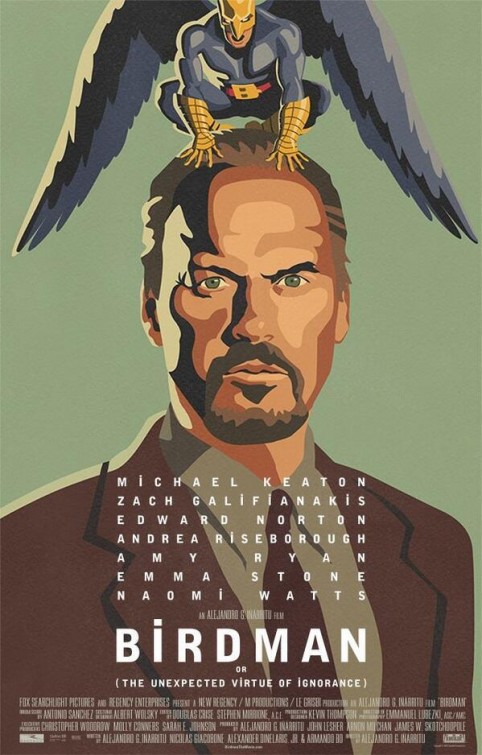
Alejandro González Iñárritu’s film Birdman relies heavily on a central stylistic conceit: The film unfolds as one continuous uninterrupted shot, the camera unblinking, restlessly moving after Riggan Thomson (Michael Keaton), a washed-up actor who has put everything he has—financially, physically, mentally—into a Broadway adaptation of Raymond Carver’s “What We Talk About When We Talk About Love.”

The shot isn’t really continuous (any savvy viewer will spot the cuts), but the effect is powerful and engaging early on, especially when Keaton shares the lens with Edward Norton, who plays Mike, a wild foil to Keaton’s Riggan. Mike is the artist, the theater actor, the method actor, the real deal; Riggan is just a celebrity—or rather was a celebrity, the star of the Birdman franchise. The nod to Keaton’s Batman films is not even a nod, but one of several meta-crutches that Iñárritu rests all the film’s supposed “weight” on. Birdman wants to be heavy, but it feels hollow. Good thing it’s always in motion.

Birdman suffers by comparison to a handful of other films, notably Aleksandr Sokurov’s masterpiece Russian Ark in particular. Sokurov’s film, also filmed in one continuous take, does a finer job plumbing the mysteries of aesthetics (and any of aesthetics’ supposed nemeses) than Birdman. Sokurov’s film also bewilders, where Birdman’s contours are fairly familiar stuff. Another film that stages (and restages) what Birdman would like to be doing with more force is Charlie Kaufman’s deeply flawed and very brilliant film Synecdoche, New York, an alienating study of art, performance, and audience.

Of course I’ve just done exactly what Keaton’s Riggan howls against late in Birdman’s second act. He confronts the theater critic who has promised to kill his play, screaming that she, as a critic, takes no risks, puts nothing on the line. Her words are just labels; all she does is make weak comparisons. Has Iñárritu built a defense into this scene? Are we to empathize with Keaton’s Riggan? Or with Norton’s Mike? Or with the other characters whom Riggan alternately alienates and draws back in, including his ex-wife, his daughter, his girlfriend, his co-star, and his best friend? Or maybe we empathize with Riggan’s Birdman, the voice that haunts him, the voice that haunts itself into existence?

Anchored by fantastic performances—what a joy to see Keaton carry a movie again—great cinematography by Emmanuel Lubezki , and a jazz percussion score, Birdman is an entertaining way to pass two hours, but the profundity it seeks in its final moments simply isn’t there. The film’s formal structuring device, the uninterrupted shot, would like to penetrate its hero’s consciousness, but always seems to fail, necessitating voice-over or dialogue to clumsily underline the main idea. (Should I unfairly contrast this weakness with the far more powerful long-takes in Gaspar Noé’s Enter the Void? No? Okay). Birdman strives to explore the tangle between art and entertainment, but at the end we’re left with yet another Hollywood satire of ego and celebrity. Birdman is amusing when it seeks to be penetrating, clever when it seeks to be profound. And it made Raymond Carver’s story look like lurid dinner theater. But these are just labels.

Reading/Have Read/Should Write About

2015/01/img_4843.jpg

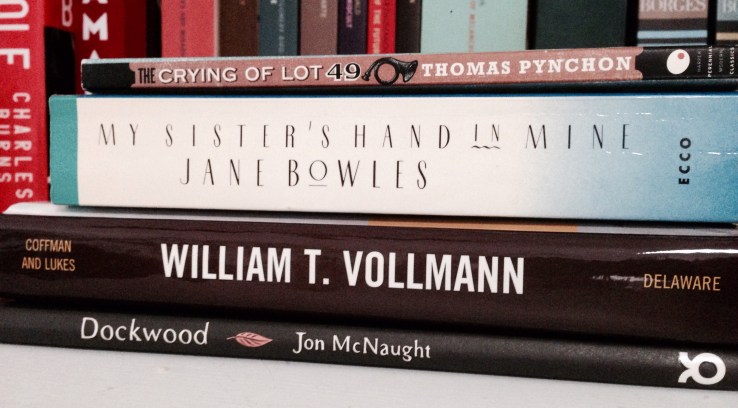
The Crying of Lot 49 by Thomas Pynchon

After a few false starts over the last decade, I finally submerged myself in Thomas Pynchon’s Mason & Dixon in those bourbon-soaked weeks between Thanksgiving and New Year. I read the book as a sort of sequel to the book Pynchon wrote after it, Against the Daysimply because I read Against the Day in 2013, before M&D. Both books are excellent, and seem to me more achieved in their vision than Inherent Vice or V or Vineland. The obvious comparison point for the pair though is Pynchon’s other big book (and, by reputation, his Big Book) Gravity’s Rainbow which I haven’t read since my freshman year of college—which is almost the same as not having read it at all. I intend to read it later this year (or maybe earlier?), but I also haven’t read The Crying of Lot 49 since my undergrad days either (which is to say, like, coming up on twenty years jesus). I’m about half way through and not zapped by it really—there are some funny jokes, but it’s just not as rich as Mason & Dixon or Against the Day (which is not meant to be a complaint, just an observation. And while I’m observing stuff parenthetically: What most bothers my attention most as I read are the reminders of David Foster Wallace’s The Broom of the System, which I have reread more recently than TCoL49).

Two Serious Ladies by Jane Bowles (collected in My Sister’s Hand in Mine)

What to say about Jane Bowles’s only novel? It goes: Propelled on its own sinister energy it goes, its vignettes flowing (or jerking or shifting or pitching wildly or dipping or soaring or sneaking) into each other with wonderfully dark comic force. I’ve sketched a full review I hope to be able to write, but for now let me excerpt a paragraph from Negar Azimi’s essay “The Madness of Queen Jane” from last summer in The New Yorker:

When it was first published, in 1943, “Two Serious Ladies” received lukewarm, even baffled, reviews. Edith Walton, writing in the Times Book Review, called the book senseless and silly: “To attempt to unravel the plot of ‘Two Serious Ladies’ would be to risk, I am sure, one’s own sanity.” Another reviewer said, simply, “The book is about nothing.” Jane’s family, in the meantime, found it unseemly in its stark depiction of lesbianism. Its characters, who have goals and motivations that are hard to grasp, were difficult to relate to. Yet another critic wrote, “The only shocking thing about this novel is that it ever managed to find its way to print.” Jane was only twenty-four.

Wharton’s line should intrigue, not repel readers. And: “The book is about nothing” — well, okay, that’s completely untrue—the book is about women searching for something, but something they can’t name, can’t conceive in language but can perhaps imagine. These women are on the brink of all those things one can be brinked upon: abysses, madness, abysses of madness, etc. But: “The book is about nothing” — well, okay, Two Serious Ladies resists unfolding in the way in which we expect narratives to be about something—Bowles withholds exposition, clarification, and motivation—well, okay, not withholds, but rather hides, or obscures, or enshadows.

I don’t have the verbs for this book.

But I loved reading it, feeling estranged from it while simultaneously invited into its darkness, bewildered by its transpositions, as Jane Bowles moves her verbal camera from one character to another—Wait, what? Okay, I guess we’re going over here now?!—its picaresque energy a strange dark joy. More to come.

William T. Vollmann: A Critical Companion, a collection of essays edited by Christopher K. Coffman and Daniel Lukes

I’ve been dipping into this kind of at random, but it’s very rewarding, and I think it would make a surprisingly good introduction to Vollmann. To be clear, academic criticism is never a substitute for, y’know, reading the author’s actual texts, the range here covers voluminous Vollmann. And look, I’ll be honest, I’ll probably never read Argall, so I very much appreciated Buell Wisner situating it for me in his essay. One of the treats of this book is how an academic essay like Wisner’s—a well-researched close reading with 64 reference notes—is followed by a reflective and informal piece by Carla Bolte on designing Vollmann’s books (“Bill’s books are not for everyone. We all know that,” she offers at one point). Good stuff, more to come.

Dockwood by Jon McNaught

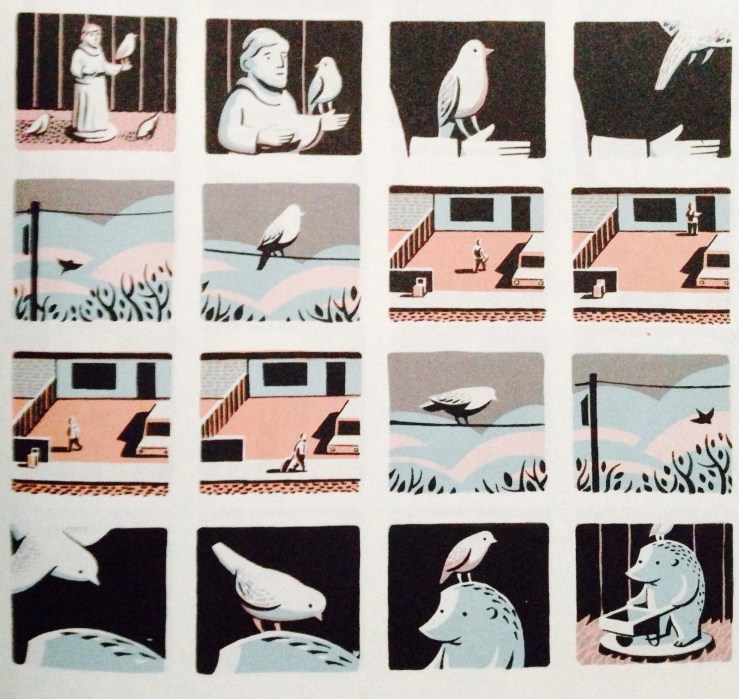
I owe this marvelous book a proper review. Dockwood is a kind of visual prose-poem, tranquil, meditative, autumnal. The book is its own total aesthetic; McNaught uses color and form to evoke feeling here, with minimal, unobtrusive dialogue that functions more as ambiance than exposition. Lovely.

IMG_4849

Thomas Pynchon’s Mason & Dixon (Third Riff: The Rabbi of Prague)

A. I’m a few chapters–three, precisely—from finishing Mason & Dixon. “Finishing” is not the right verb here, though—Pynchon’s novel is so rich, funny, strange, and energetic that I want to return to it immediately.

B. But I need to backtrack a bit, riff on one of my favorite episodes—Chapter 50.

C. (First riff and second riff for those inclined).

D. In Chapter 50,

’tis Dixon’s luck to discover The Rabbi of Prague, headquarters of a Kabbalistick Faith, in Correspondence with the Elect Cohens of Paris, whose private Salute they now greet Dixon with, the Fingers spread two and two, and the Thumb held away from them likewise, said to represent the Hebrew letter Shin and to signify, “Live long and prosper.”

Pynchon plays here on the reader’s initial understanding of the signal and phrase as a pop culture reference—


—but the goof isn’t merely postmodernist shtick—Pynchon is pointing to how the invisible manifests itself in signs and wonders, covert, cryptic, but perhaps—perhaps—decipherable.

E. (Maybe this needs clarification: The Rabbi of Prague is a tavern. I lost track of how many bars taverns pubs inns alehouses coffeehouses etc. show up in M&D). Continue reading “Thomas Pynchon’s Mason & Dixon (Third Riff: The Rabbi of Prague)”