Teju Cole on America’s Reader in Chief

Read Teju Cole’s essay “A Reader’s War,” which tries to square Obama’s reputation as a man “widely read in philosophy, literature, and history” with the White House’s policies of drone warfare. From the essay:

How on earth did this happen to the reader in chief? What became of literature’s vaunted power to inspire empathy? Why was the candidate Obama, in word and in deed, so radically different from the President he became? In Andrei Tarkovsky’s eerie 1979 masterpiece, “Stalker,” the landscape called the Zona has the power to grant people’s deepest wishes, but it can also derange those who traverse it. I wonder if the Presidency is like that: a psychoactive landscape that can madden whomever walks into it, be he inarticulate and incurious, or literary and cosmopolitan.

“T.S. Eliot” — Ezra Pound

“T.S. Eliot” by Ezra Pound (from Instigations)

Il n’y a de livres que ceux où un écrivain s’est raconté lui-même en racontant les mœurs de ses contemporains—leurs rêves, leurs vanités, leurs amours, et leurs folies.— Remy de Gourmont.

De Gourmont uses this sentence in writing of the incontestable superiority of “Madame Bovary,” “L’Éducation Sentimentale” and “Bouvard et Pécuchet” to “Salammbô” and “La Tentation de St. Antoine.” A casual thought convinces one that it is true for all prose. Is it true also for poetry? One may give latitude to the interpretation of rêves; the gross public would have the poet write little else, but De Gourmont keeps a proportion. The vision should have its place in due setting if we are to believe its reality.

The few poems which Mr. Eliot has given us maintain this proportion, as they maintain other proportions of art. After much contemporary work that is merely factitious, much that is good in intention but impotently unfinished and incomplete; much whose flaws are due to sheer ignorance which a year’s study or thought might have remedied, it is a comfort to come upon complete art, naïve despite its intellectual subtlety, lacking all pretense.

It is quite safe to compare Mr. Eliot’s work with anything written in French, English or American since the death of Jules Laforgue. The reader will find nothing better, and he will be extremely fortunate if he finds much half as good.

The necessity, or at least the advisability of comparing English or American work with French work is not readily granted by the usual English or American writer. If you suggest it, the Englishman answers that he has not thought about it—he does not see why he should bother himself about what goes on south of the channel; the American replies by stating that you are “no longer American.” This is the bitterest jibe in his vocabulary. The net result is that it is extremely difficult to read one’s contemporaries. After a time one tires of “promise.” Continue reading ““T.S. Eliot” — Ezra Pound”

Gertrude Stein on Football

In a 1934 radio interview, Gertrude Stein talks American football:

INTERVIEWER: You saw the Yale-Dartmouth game a week ago Saturday didn’t you? Did you understand that in the American way or the football way or how?

STEIN: IN the American way. The thing that interested me was that the Modern American in his movements and his actions in a football game so resembled the red Indian dance and it proves that the physical country that made the one made the other and that the red Indian is still with us. They just put their heads down solemnly together and then double over, while on the sidelines the substitutes move in a jiggly way just like Indians. Then they all get down on all fours just like Indians.

INTERVIEWER: But those jiggles are just warming-up exercises.

STEIN: It doesn’t make any difference what they are doing it for, they are just doing it, like the way the Indian jiggles in the Indian dance and then there is that little brown ball they all bend down and worship.

INTERVIEWER: But the ideas in that is to get the ball across the goal line.

STEIN: But don’t you suppose I know that, and don’t you suppose the Indians had just as much reason and enjoyed their dancing just as much?

“Cinema Is a Foreign Language” — Leos Carax

Hello, I’m Leos Carax, director of foreign-language films. I’ve been making foreign-language films my whole life. Foreign-language films are made all over the world, of course, except in America. In America, they only make non-foreign-language films. Foreign-language films are very hard to make, obviously, because you have to invent a foreign language instead of using the usual language. But the truth is, cinema is a foreign language, a language created for those who need to travel to the other side of life. Good night.

Director Leos Carax accepts his award from the Los Angeles Film Critics Association for best-foreign language film for Holy Motors. (Here’s my review of Holy Motors, by the way).

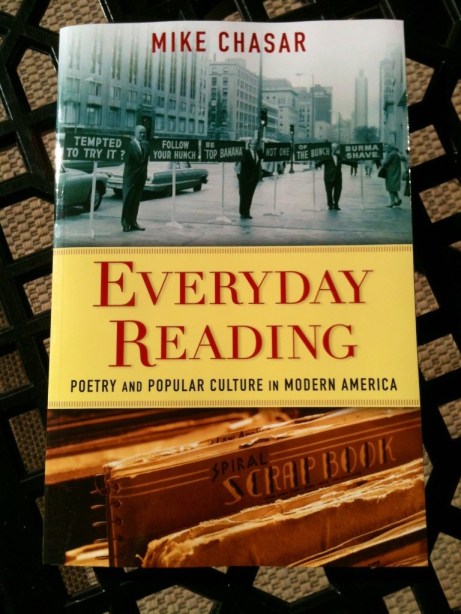
Everyday Reading: Poetry and Popular Culture in America (Book Acquired, Sometime in December of 2012)

20130105-110115.jpg

I got a little lax with these “books acquired” posts at the end of last year—chalk it up to end of semester deadlines and meetings, family-oriented holiday stuff, and an awful illness. Anyway–

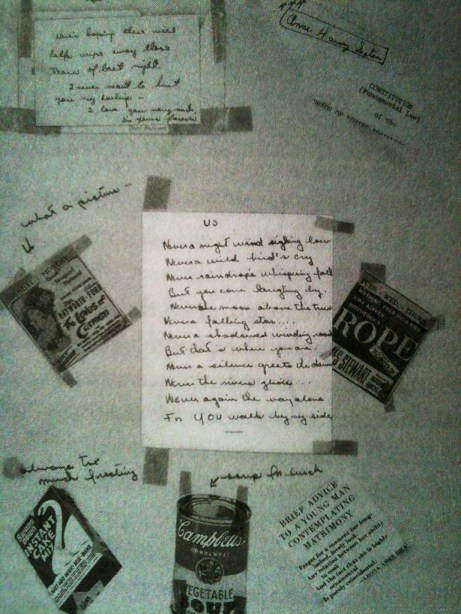
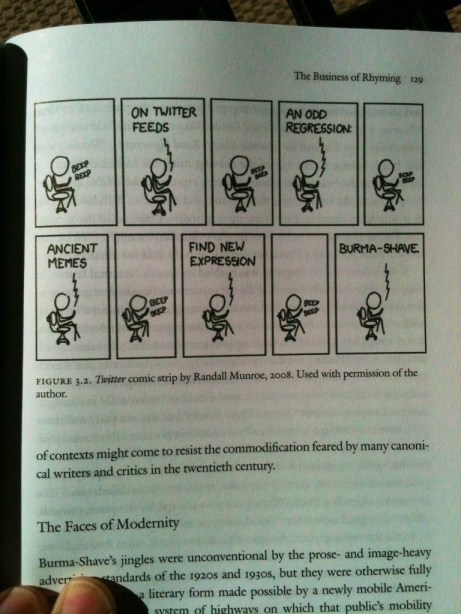
Mike Chasar’s Everyday Reading: Poetry and Popular Culture in Modern America, new from Columbia University Press is pretty cool: it’s kind of a dialogic study of how poetry evinces (or infiltrates or collides or emerges from or is bound by) a variety of popular media. Some of the most fascinating chapters dwell on scrapbooking. Here’s Columbia U of P’s blurb:

Exploring poetry scrapbooks, old-time radio show recordings, advertising verse, corporate archives, and Hallmark greeting cards, among other unconventional sources, Mike Chasar casts American poetry as an everyday phenomenon consumed and created by a vast range of readers. He shows how American poetry in the first half of the twentieth century and its reception helped set the stage for the dynamics of popular culture and mass media today.

Poetry was then part and parcel of American popular culture, spreading rapidly as the consumer economy expanded and companies exploited its profit-making potential. Poetry also offered ordinary Americans creative, emotional, political, and intellectual modes of expression, whether through scrapbooking, participation in radio programs, or poetry contests. Reenvisioning the uses of twentieth-century poetry, Chasar provides a richer understanding of the innovations of modernist and avant-garde poets and the American reading public’s sophisticated powers of feeling and perception.

A couple of snaps from the book—pics of pages from one of those scrapbooks—

20130105-110232.jpg

20130105-110245.jpg

And—

20130105-110159.jpg

Thomas Pynchon Reviews Oakley Hall’s Novel Warlock

Tombstone, Arizona, during the 1880’s is, in ways, our national Camelot: a never-never land where American virtues are embodied in the Earps, and the opposite evils in the Clanton gang; where the confrontation at the OK corral takes on some of the dry purity of the Arthurian joust. Oakley Hall, in his very fine novel Warlock (Viking) has restored to the myth of Tombstone its full, mortal, blooded humanity. Wyatt Earp is transmogrified into a gunfighter named Blaisdell who, partly because of his blown-up image in the Wild West magazines of the day, believes he is a hero. He is summoned to the embattled town of Warlock by a committee of nervous citizens expressly to be a hero, but finds that he cannot, at last, live up to his image; that there is a flaw not only in him, but also, we feel, in the entire set of assumptions that have allowed the image to exist. It is Blaisdell’s private abyss, and not too different from the town’s public one. Before the agonized epic of Warlock is over with — the rebellion of the proto-Wobblies working in the mines, the struggling for political control of the area, the gunfighting, mob violence, the personal crises of those in power — the collective awareness that is Warlock must face its own inescapable Horror: that what is called society, with its law and order, is as frail, as precarious, as flesh and can be snuffed out and assimilated back into the desert as easily as a corpse can. It is the deep sensitivity to abysses that makesWarlock one of our best American novels. For we are a nation that can, many of us, toss with all aplomb our candy wrapper into the Grand Canyon itself, snap a color shot and drive away; and we need voices like Oakley Hall’s to remind us how far that piece of paper, still fluttering brightly behind us, has to fall.

Thomas Pynchon’s 1965 review of Oakley Hall’s novel Warlock. Via/more.


David Simon on The Walking Dead . . . And Newtown

David Simon, the writer and creator behind The WireTreme, and Generation Kill, tries to tackle the tragic Newtown slayings in a post at his blog. There’s a lot of anger in the piece—rightfully so—but I find Simon’s most convincing paragraph to be the following passage, where he breaks down the fear fantasy that drives the ideology behind The Walking Dead:

On television the other evening, I caught a glimpse of a drama in which some future America was overrun by zombies, a thrilling narrative in which survivors could only rely on force of arms to keep the unthinking, unfeeling hordes at bay.  And I realized:  This isn’t mere entertainment, it’s national consensus.  More than that, it’s a well-executed and starkly visual rendering of the collective fear that governs us.  We know that they’re out there:  The less human.  The poor.  The godless.  The frightening other. And they want what we have, they are going to take what we have, and they understand nothing save for a well-placed bullet.  It’s my understanding that the show I encountered is quite popular; in this America, it may even be called populist in its argument — a morality tale that speaks to why we must arm ourselves, and carry those guns with us, and stand our fucking ground; it declares that we can’t rely on collective, utilitarian will to achieve a safe and viable society, that government by the people and for the people is, at this point, an empty catchphrase for fools and weaklings.  No, our future is every man for himself, and a gun in every outstretched hand, and if a classroom of six and seven year olds is the requisite cost every now and then, so be it.

Frederic Remington Letter

at0179.7s

From the LOC:

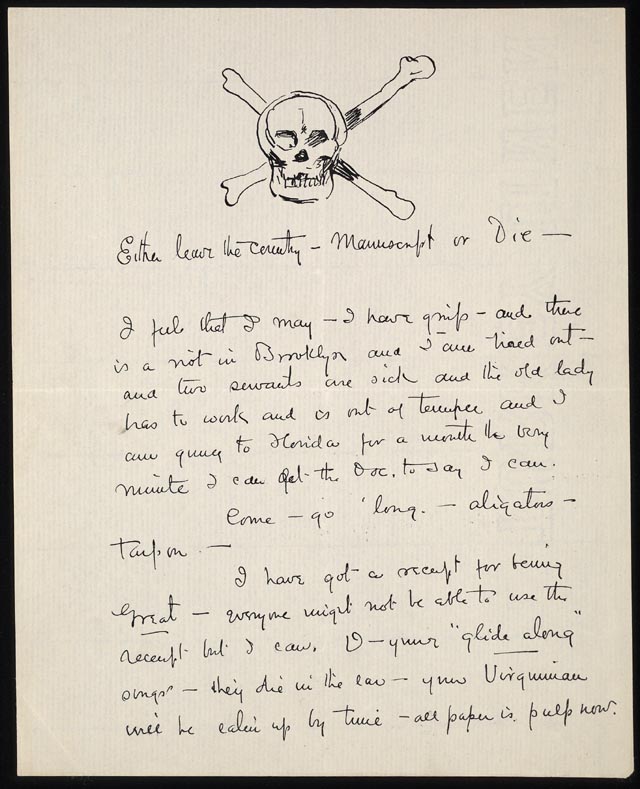
Two champions of the old West share their common interest in this illustrated letter from sculptor, illustrator, and painter Frederic Remington to writer Owen Wister. Both originally Easterners, the two men had met in 1893 when Wister went to Wyoming for his health. In this letter to his new friend, Remington muses about the instability of his paintings, which may fade in time “like pale molasses,” but he suggests that his new work in bronze–“a cowboy on a bucking broncho”–will “rattle down through all the ages.”


Emily Dickinson’s Cocoanut Cake Recipe

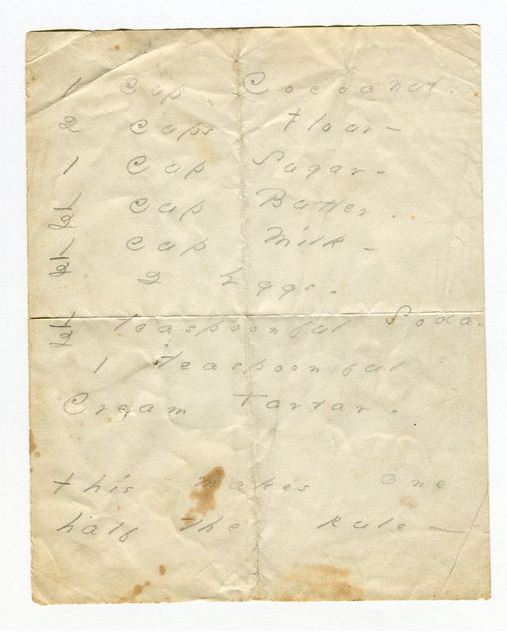
Emily Dickinson’s  recipe for cocoanut cake, via Tori Avey at the The History Kitchen. Avey’s post is great—she guides the reader through making the cake, includes photos of the process, and even pairs the recipe with an appropriate poem. And of course, she transcribes Dickinson’s scratchy notes:

Emily Dickinson’s Cocoanut Cake

1 cup cocoanut
2 cups flour
1 cup sugar
1/2 cup butter
1/2 cup milk
2 eggs
1/2 teaspoonful soda
1 teaspoonful cream of tartar

This makes one half the rule–

Judge Holden Holds Forth on War (Blood Meridian)

From Chapter XVII of Cormac McCarthy’s novel Blood Meridian

They grew gaunted and lank under the white suns of those days and their hollow burnedout eyes were like those of noctambulants surprised by day. Crouched under their hats they seemed fugitives on some grander scale, like beings for whom the sun hungered. Even the judge grew silent and speculative. He’d spoke of purging oneself of those things that lay claim to a man but that body receiving his remarks counted themselves well done with any claims at all. They rode on and the wind drove the fine gray dust before them and they rode an army of gray-beards, gray men, gray horses. The mountains to the north lay sunwise in corrugated folds and the days were cool and the nights were cold and they sat about the fire each in his round of darkness in that round of dark while the idiot watched from his cage at the edge of the light. The judge cracked with the back of an axe the shinbone on an antelope and the hot marrow dripped smoking on the stones. They watched him. The subject was war.

The good book says that he that lives by the sword shall perish by the sword, said the black.

The judge smiled, his face shining with grease.

What right man would have it any other way? he said.

The good book does indeed count war an evil, said Irving. Yet there’s many a bloody tale of war inside it.

It makes no difference what men think of war, said the judge. War endures. As well ask men what they think of stone. War was always here. Before man was, war waited for him. The ultimate trade awaiting its ultimate practitioner. That is the way it was and will be. That way and not some other way.

He turned to Brown, from whom he’d heard some whispered slur or demurrer. Ah Davy, he said. It’s your own trade we honor here. Why not rather take a small bow. Let each acknowledge each.

My trade?

Certainly.

What is my trade?

War. War is your trade. Is it not?

And it aint yours?

Mine too. Very much so.

What about all them notebooks and bones and stuff?

All other trades are contained in that of war.

Is that why war endures?

No. It endures because young men love it and old men love it in them. Those that fought, those that did not.

That’s your notion.

The judge smiled. Men are born for games. Nothing else. Every child knows that play is nobler than work. He knows too that the worth or merit of a game is not inherent in the game itself but rather in the value of that which is put at hazard. Games of chance require a wager to have meaning at all. Games of sport involve the skill and strength of the opponents and the humiliation of defeat and the pride of victory are in themselves sufficient stake because they inhere in the worth of the principals and define them. But trial of chance or trial of worth all games aspire to the condition of war for here that which is wagered swallows up game, player, all.

Suppose two men at cards with nothing to wager save their lives. Who has not heard such a tale? A turn of the card. The whole universe for such a player has labored clanking to this moment which will tell if he is to die at that man’s hand or that man at his. What more certain validation of a man’s worth could there be? This enhancement of the game to its ultimate state admits no argument concerning the notion of fate. The selection of one man over another is a preference absolute and irrevocable and it is a dull man indeed who could reckon so profound a decision without agency or significance either one. In such games as have for their stake the annihilation of the defeated the decisions are quite clear. This man holding this particular arrangement of cards in his hand is thereby removed from existence. This is the nature of war, whose stake is at once the game and the authority and the justification. Seen so, war is the truest form of divination. It is the testing of one’s will and the will of another within that larger will which because it binds them is therefore forced to select. War is the ultimate game because war is at last a forcing of the unity of existence. War is god. Brown studied the judge.

You’re crazy Holden. Crazy at last.

The judge smiled.


Eleven Authors Who Were Also Veterans of War

Eleven Authors Who Were Also Veterans of War

1. Stendahl (Napoleonic Wars)

2. Ambrose Bierce (Union Army, American Civil War)

3. Erich Maria Remarque (German Army, WWI)

4. George Orwell (Republican Army, Spanish Civil War)

5. Kurt Vonnegut (U.S. Army, WWII)

6. Joseph Heller (U.S. Air Force, WWII)

7. Eveyln Waugh (British Royal Marines, WWII)

8. Norman Mailer (U.S Army, WWII)

9. Gore Vidal (U.S. Army, WWII)

10. Tim O’Brien (U.S. Army, Vietnam War)

11. Anthony Swofford (U.S. Marine Corps, Persian Gulf War)


Why I’m Not Particularly Interested in Reading a DFW Biography

(Think about it — the personal lives of most people who spend 14 hours a day sitting there alone, reading and writing, are not going to be thrill rides to hear about.)

–David Foster Wallace on literary biography in general and Edwin Williamson’s Borges: A Life in particular; from “Borges on the Couch,” a 2004 NYT piece republished this month in the David Foster Wallace collection Both Flesh and Not.

First Page of an Early Draft of Blood Meridian


Nice article at Slate on Cormac McCarthy’s Blood Meridian, touching on how “all the way to galley proof in 1984, McCarthy whittled Blood Meridian down into the lean nightmare we now know. He cut whole characters and became more and more sparing of his description of the ones that remained. This was nowhere more pronounced than with the character of the kid, the nameless ruffian and pseudo-protagonist of the tale.” Good stuff. (Thanks to Garrett for alerting me to it).


The First Sentences of Thomas Bernhard’s Novel Correction

After a mild pulmonary infection, tended too little and too late, had suddenly turned into a severe pneumonia that took its toll of my entire body and laid me up for at least three months at nearby Wels, which has a hospital renowned in the field of so-called internal medicine, I accepted an invitation from Hoeller, a so-called taxidermist in the Aurach valley, not for the end of October, as the doctors urged, but for early in October, as I insisted, and then went on my own so-called responsibility straight to the Aurach valley and to Hoeller’s house, without even a detour to visit my parents in Stocket, straight into the so-called Hoeller garret, to begin sifting and perhaps even arranging the literary remains of my friend, who was also a friend of the taxidermist Hoeller, Roithamer, after Roithamer’s suicide, I went to work sifting and sorting the papers he had willed to me, consisting of thousands of slips covered with Roithamer’s handwriting plus a bulky manuscript entitled “About Altensam and everything connected with Altensam, with special attention to the Cone.” The atmosphere in Hoeller’s house was still heavy, most of all with the circumstances of Roithamer’s suicide, and seemed from the moment of my arrival favorable to my plan of working on Roithamer’s papers there, specifically in Hoeller’s garret, sifting and sorting Roithamer’s papers and even, as I suddenly decided, simultaneously writing my own account of my work on these papers, as I have here begun to do, aided by having been able to move straight into Hoeller s garret without any reservations on Hoeller’s part, even though the house had other suitable accommodations, I deliberately moved into that four-by-five-meter garret Roithamer was always so fond of, which was so ideal, especially in his last years, for his purposes, where I could stay as long as I liked, it was all the same to Hoeller, in this house built by the headstrong Hoeller in defiance of every rule of reason and architecture right here in the Aurach gorge, in the garret which Hoeller had designed and built as if for Roithamer’s purposes, where Roithamer, after sixteen years in England with me, had spent the final years of his life almost continuously, and even prior to that he had found it convenient to spend at least his nights in the garret, especially while he was building the Cone for his sister in the Kobernausser forest, all the time the Cone was under construction he no longer slept at home in Altensam but always and only in Hoeller’s garret, it was simply in every respect the ideal place for him during those last years when he, Roithamer, never went straight home to Altensam from England, but instead went every time to Hoeller’s garret, to fortify himself in its simplicity (Hoeller house) for the complexity ahead (Cone), it would not do to go straight to Altensam from England, where each of us, working separately in his own scientific field, had been living in Cambridge all those years, he had to go straight to Hoeller’s garret, if he did not follow this rule which had become a cherished habit, the visit to Altensam was a disaster from the start, so he simply could not let himself go directly from England to Altensam and everything connected with Altensam, whenever he had not made the detour via Hoeller’s house, to save time, as he himself admitted, it had been a mistake, so he no longer made the experiment of going to Altensam without first stopping at Hoeller’s house, in those last years, he never again went home without first visiting Hoeller and Hoeller’s family and Hoeller’s house, without first moving into Hoeller’s garret, to devote himself for two or three days to such reading as he could do only in Hoeller s garret, of subject matter that was not harmful but helpful o him, books and articles he could read neither in Altensam or in England, and to thinking and writing what he found possible to think and write neither in England nor in Altensam, here I discovered Hegel, he always said, over and over again, it was here that I really delved into Schopenhauer for the first time, here that I could read, for the first time, Goethe’s Elective Affinities and The Sentimental Journey, without distraction and with a clear head, it was here, in Hoeller’s garret, that I suddenly gained access to ideas to which my mind had been sealed for decades before I came to this garret, access, he wrote, to the most essential ideas, the most important for me, the most necessary to my life, here in Hoeller’s garret, he wrote, everything became possible for me, everything that had always been impossible for me outside Hoeller’s garret, such as letting myself be guided by my intellectual inclinations and to develop my natural aptitudes accordingly, and to get on with my work, everywhere else I had always been hindered in developing my aptitudes but in Hoeller’s garret I could always develop them most consistently, here everything was congenial to my way of thinking, here I could always indulge myself in exploring all my intellectual possibilities, here my intellectual possibilities, here in Hoeller’s garret my head, my mind, my whole constitution were suddenly relieved from all the outside world’s oppression, the most incredible things were suddenly no longer incredible, the most impossible (thinking!) no longer impossible. It was in Hoeller’s garret that he found the conditions necessary and most favorable to thought, for getting the mechanism of his thought going in the most natural, most undistracted way, all he had to do was to come to Hoeller’s garret from wherever he might be, and the mechanism worked.

—The first sentences of Thomas Bernhard’s novel Correction.

“Lobster,” a Poem by Anne Sexton


“Lobster” by Anne Sexton:

A shoe with legs,
a stone dropped from heaven,
he does his mournful work alone,
he is the old prospector for golf,
with secret dreams of God-heads and fish heads.
Until suddenly a cradle fastens round him
and his is trapped as the U.S.A. sleeps.
Somewhere far off a woman lights a cigarette;
somewhere far off a car goes over a bridge;
somewhere far off a bank is held up.
This is the world the lobster knows not of.
He is the old hunting dog of the sea
who in the morning will rise from it
and be undrowned
and they will take his perfect green body
and paint it red

(Thanks Jescie).


Chris Ware on DFW’s Novel The Pale King

Crippled Robot painting by Chris Ware

Cartoonist/graphic novelist/chronicler of shame and despair Chris Ware wrote about his favorite books for Foyles bookstore. The list includes UlyssesMoby-Dick, and works by cartoonists like Lynda Barry and Ivan Brunetti. Here’s what Ware wrote about David Foster Wallace’s posthumous novel The Pale King:

The first great novel of the 21st century uses the sinister beauty of the American Tax Code as a springboard from which to launch into a genuinely serious discussion of the origins and importance of civic responsibility amidst the hazy, blurred stupidity of a country in quick decline. Contrary to many reviews, I don’t think it’s about boredom, and it’s certainly not boring. Another posthumous editor-to-manuscript resuscitation, the book hangs heavy with the clotted spectre of Wallace’s suicide, which makes the writing glow all the more painfully through it.

Untitled List from the Fall of 1949 — Susan Sontag


From Susan Sontag’s notebooks, collected in Reborn

effete

noctambulus

perfervid

detumescence

disheveled

so alluring, so cerebral

sodden

intriguing

corrupt dignity

lotophagous

elegiac

Meleager

disponibility

pardine

demotic

Harriette Wilson

garbure

satura

succulent

competent intellectual vulgarity of Aldous Huxley

Yellow Book preciousness

secretive

sturdy

pedantry + lechery

spleen

ribaldry

ilex

Klaxon