Another Dalloway

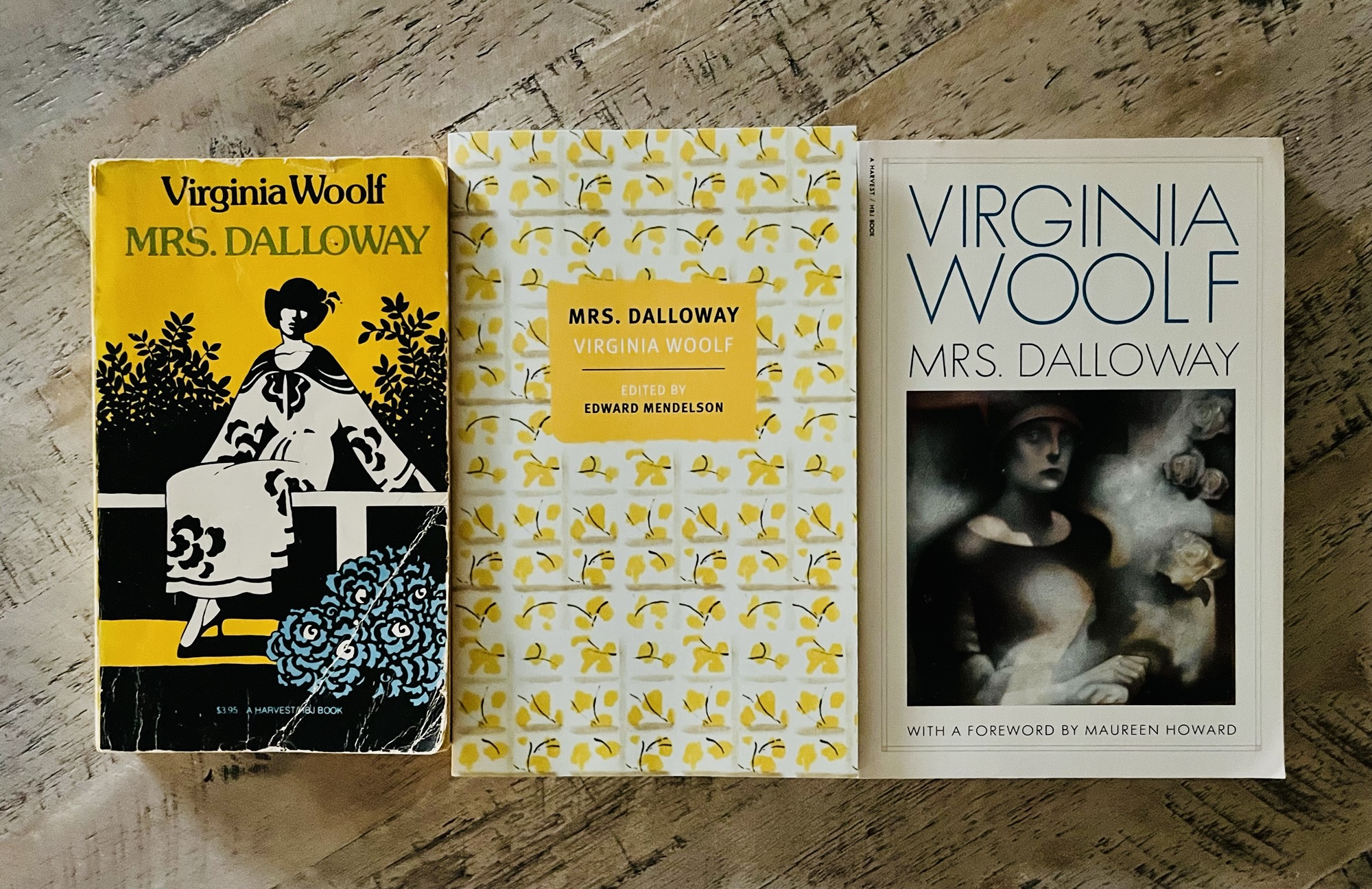
Virginia Woolf’s modernist classic Mrs Dalloway is getting a centennial update from publisher NYRB. The new edition is edited by literary critic Edward Mendelson, who makes a persuasive case for his version of the text in the book’s afterword, an essay with the appropriately flat title “The Text of This Edition.” “This edition is an attempt to provide the least bad, perhaps, among many possible editions,” Mendelson writes, before appending after a semicolon: “other editors will rank it more harshly.” I imagine it’s hard work to tidy a giant.

As a point of comparison, I pulled out the HBJ mass-market paperback of Mrs Dalloway that I read at least three times years and years ago; there’s no front or back matter, no intro or afterword, not even a credit for the lovely art. I (a version of myself) had scribbled “symbol is not universal” in the narrow margin of page 41; underlined “narrower and narrower” on page 45; boxed a paragraph catching salmon freely on page 152. Two photographs fell from the book — a picture of my wife and my infant daughter, c. 2008; the other, a picture of my wife and her eighteen-years-younger brother, also an infant in the picture, also held by wife, c. 1998. Those are probably the years I read the book. The older person made more scribbles, I think. What I most remember of the novel Mrs Dalloway is the WWI veteran, Septimus; I recall his anguish as a throbbing (organizing) pulse in the novel’s so-called stream-of-consciousness style. I remember generally enjoying the novel, but preferring Woolf’s Orlando; I remember a sort of sneer on the face of a fellow grad student after this declaration. Orlando is a more fun book, a picaresque sci-fi gender jaunt. I suppose Dalloway is more, like, important.

As another point of comparison, I pulled out the 1990 HBJ trade paperback of Mrs Dalloway that I picked up at the beginning of the summer at a Friends of the Library sale. I wrote in a post about those acquisitions that, “…I’ll be happy to trade out the cheap mass markets of Mrs. Dalloway and To the Lighthouse I’ve had forever in favor of these HBJ Woolfs (Wolves?)” — but that’s not true. I’ve decided I love the cheap mass market Dalloway. (A sixteen-year-old picture of my wife and daughter falling out of it didn’t hurt.) This 1990 edition features a 1981 introduction by novelist Maureen Howard. She voices her intro in the first-person plural, an unfortunate choice that we employed on this blog in our earlier years, insecure as we were. The occasion of Ms Howard’s introduction is, I think–we think, we mean–the fiftieth anniversary of the novel’s publication, although that math doesn’t add up. I dig Susan Gallagher’s cover art.

The cover for the new NYRB edition features a “specially commissioned” cover that pays “tribute to the original designs by Hogarth Press.” The publisher notes that forthcoming “new editions of To the Lighthouse and The Waves [reprinted] in celebration of their respective centenaries” will also get the cover updates. These editions are also Mendelson edits.

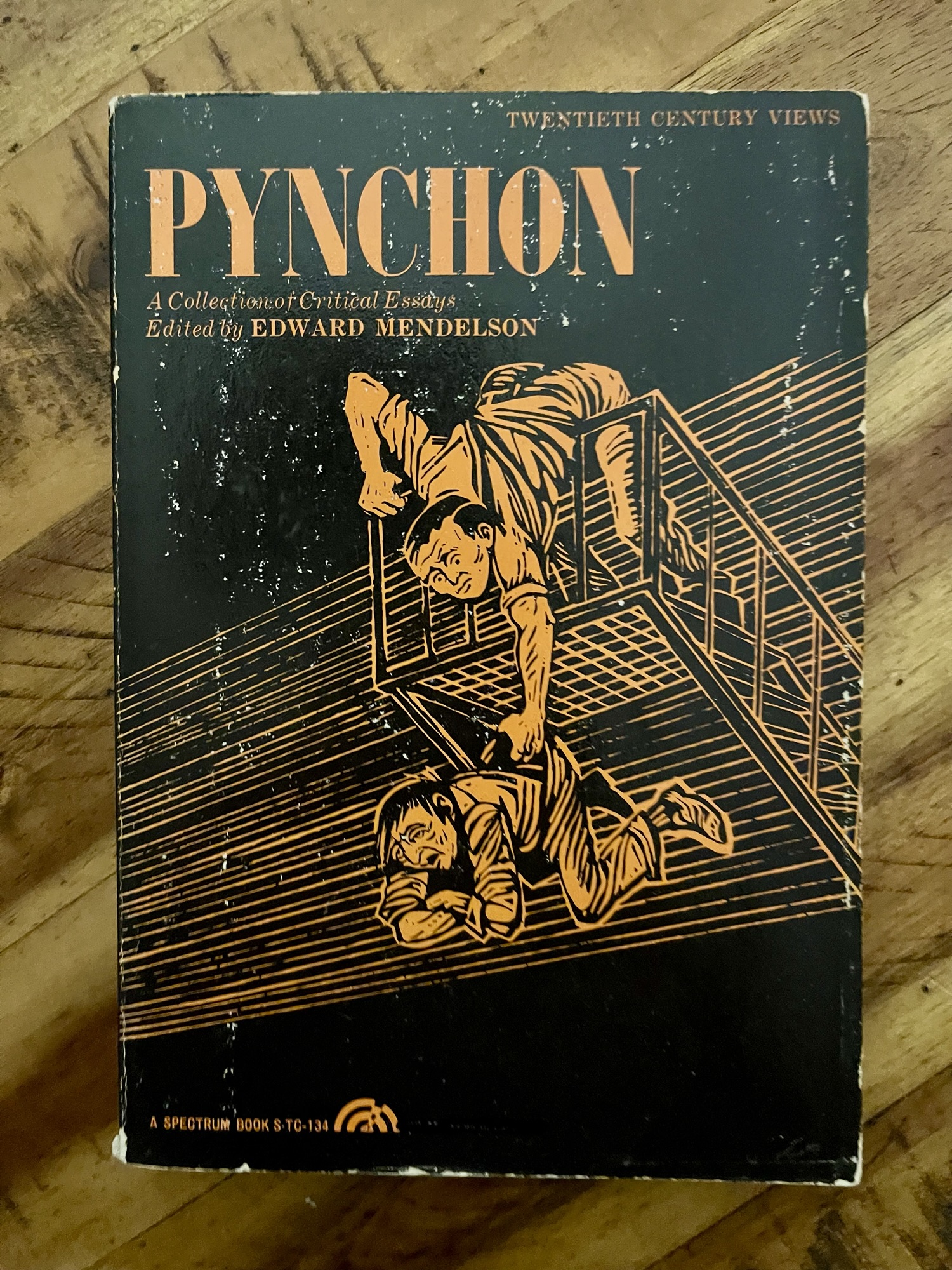
I mostly know Mendelson as the editor of Pynchon: A Collection of Critical Essays, and as the author of “The Sacred, the Profane, and The Crying of Lot 49.”

NYRB’s edition of Mrs Dalloway publishes next month.

“Solid Objects” — Virginia Woolf

“Solid Objects”

by

Virginia Woolf


The only thing that moved upon the vast semicircle of the beach was one small black spot. As it came nearer to the ribs and spine of the stranded pilchard boat, it became apparent from a certain tenuity in its blackness that this spot possessed four legs; and moment by moment it became more unmistakable that it was composed of the persons of two young men. Even thus in outline against the sand there was an unmistakable vitality in them; an indescribable vigour in the approach and withdrawal of the bodies, slight though it was, which proclaimed some violent argument issuing from the tiny mouths of the little round heads. This was corroborated on closer view by the repeated lunging of a walking-stick on the right-hand side. “You mean to tell me . . . You actually believe. . .” thus the walking-stick on the right-hand side next the waves seemed to be asserting as it cut long straight stripes upon the sand.

“Politics be damned!” issued clearly from the body on the left-hand side, and, as these words were uttered, the mouths, noses, chins, little moustaches, tweed caps, rough boots, shooting coats, and check stockings of the two speakers became clearer and clearer; the smoke of their pipes went up into the air; nothing was so solid, so living, so hard, red, hirsute and virile as these two bodies for miles and miles of sea and sandhill.
Continue reading ““Solid Objects” — Virginia Woolf”

Virginia Woolf’s Jacob’s Room, but just the punctation

” , ” , , ” . ” , ; ; , . ; ; . ‘ . . . . ; ; ; . ” … , ” . ” , ‘ ” ( , , , — — ) , ” ‘ ” — — ! . ” ? ” . ” ‘ . . . ” ” … , ” , , ” , , ‘ … . ” ‘ — — – , – . : : . , , . , ‘ , , – . ‘ , , , , , , . . . ” — — ! — — ! ” . ” , ” . , ; ; . ? ; ; , – . . — — — — ! – . . — — , — — . , , ‘ , , — — . ” — — ! — — ! ” . , , . ” — — , ” , , , , . ” — — , ” , , , ‘ . ” — — ! — — ! ” , . . , , , , , — — . ; — — . ” , ! ‘ … ” , , . . , , . , , . , , , . , , , ; , . . – , – — — ” , , ” — — . ! . . , , , , , , , , , . ( – ) , – , , , , . . . , , , . . . ” ! ! ” , . . . . . . . , , — — ‘ , , , . , – , . ” ! ” . , . ” ? , ! ! , . ‘ ? ! . , ” , ‘ . ‘ , . , , ‘ , . , . , . ‘ . , , – , – , . – ; , , , — — , , . . ‘ . ‘ . ; . ” , , , ” , ; ; , – , , . . , , , , . – ‘ . ; . . ” , ” . . ” ‘ , . ‘ , ” , , , , , , , . ‘ . . ” ? ” . ” ‘ , ” . ” , ‘ , ” , , , , , ‘ , , , , — — ? , , . . ” ! ” , . . . . ‘ ‘ . ; ; ‘ . . . ; – ; . ; ‘ . – – . , . , , . . . . . ” , ” . ” , . . , ” , ” . ” – ; ; . ” ‘ ? ” . ” ‘ , ” . . . ” , ‘ ? ” , . ” ‘ , ” . . ” ‘ . , , , . ” ” ‘ — — , ” , – . , – , . ” ? ” . , , . , , . , . – , . . . . . ” ? ” , . . . ” – , , ” . , ‘ , . . . , ; . . ; ‘ , . , , , , . ! , , ! , , . – . . . . . . . . ‘ — — , – . . ; . , . ; – . , , , , ; – . , , . ‘ . – . . . ‘ – ; – , ; , . ” . ” — — ” ” — — ” ” — — ” ‘ ” — — ” ‘ ! ” ” ‘ — — , . ” ” ‘ ‘ , ” . ” ‘ . ” ” — — . ” ” ; , . ” ( . . ) , , , , . – . ; , ; ; ; ; , ‘ , — — ? ? , — — , , ; — — , , , . , ‘ ‘ , , , , ‘ . ; ‘ . , ; ; , , , , , , – . ” , ” ; , , , , , , — — , . . , , ? , ‘ , . , ; , , , , , , , , , , ‘ , . ; , , , , ‘ — — . , . ” ‘ , ? ” . , ‘ , . ” ! ” . . – , , , . , , , . , , , . . . . , . , . . ; . . ; ; , , , . ; . ” ‘ , ” . . , , . , . , . ; , . — — , , . . , , . ‘ ; , , ; ; ; ; – ; . , , , . ; . ; ; – ; ; . ; ; . – . . . – . , , . . . , , ; . , , , , – , , ( ) , , . ; , . , ; ; . ; . . . . , , – , , , – , , , , , , , . ( ) . ‘ ; — — . ; — — ; — — ; ‘ — — ; . ? — — ‘ . , . ‘ . , ‘ , ! ‘ . – ; – ; . . — — . , ‘ ? . , ‘ ; , , , . ” , ” – , , ; ; ‘ . ” ‘ , . . , . . – ! – ! ” ” – ! – ! ” , , . , . ” ? ” . , . ” ? ” , . ” ‘ , ” . . ” ‘ — — , ‘ — — , ‘ . . , . ” ” , . ! ” , ‘ , . , , , . , , , , , — — — — , . , , , , . , , — — . ? . — — . . . . , . ” . , ? — — — — , — — ” . , . ” , – – — — — — ” ” . ” , . . . , – , – , , . . . ” ? ” , . ” ‘ ! ” , . ” ‘ . ‘ , ‘ . ‘ ! ” , . ‘ , . ” ! ” , . , , . ‘ , . – , – , . ‘ , ” , ” , , — — . , , — — . ” . , ” . — — ” ? ” , . , . ” … ” . . ” , ” , , , ; , ; . , ; , , , – , . – , ; ; , , . ‘ , , . : ” . ” . ‘ ( ) ; ( ) ; — — , , , — — , , , – , , . . ‘ — — , . , . . . ” , ” . , . , . , . , , ” . . ” . ; ; . , , . . . . ” , ” ( . ‘ , , ) . ” , ” . , , , , . , . – . . – ( ) . . . , , – . . . ; , . ‘ – . . . . . – . . . – . . , . ” . ” . , , . , , , , . . . . , . , , . ” ! ” . . , . , , , . , – . – . ‘ , — — , . . , . , , , . ; . . , . , , . , . , , . , . . , . ” ‘ , , ” , , ” ‘ – . ” . ‘ . , – — — , — — ‘ . . , – , . . ” , ” . , . , ” ‘ , , . . ” ; . , . — — ‘ . – , , , ‘ , – , ‘ – . ( ) , , , , . – — — ‘ — — , , – , . , . , . — — — — . ‘ — — — — . , — — . . . . , , ; ; , . . , . ; , . – , , – , . — — , . . , . . , , . , . , . . , . . – , . , , . . . . , , – , . . . . , , , , , . ” , ! ” . . ” – , . , ” . , . ‘ , , : ” – , . . ” . . . ? : ” , , ! ” . . , – , ; , , . , , – , , , , ‘ , . ‘ . , , , ‘ , . — — — — , , , , , … , , ; , , , ; , , ; ; , ; , , — — . , , , ” … … . ” , . ” . , , ” . – . , , , , . . ? . ” ” , ? ; , . , ” . . . , ” , , , , , , – , , . ” , ” . , , ” ‘ ‘ ‘ , ‘ ” … . , , , – . . ” , , ” . , – , ” ‘ … … … ” , , – – , , , , , , , . , – . . ; , , , — — . ” , ” , ” ‘ . . ” . . ” . … , … , , ” . . . , . ” , ” . ” . ” ” , ” , . ” , ” . , , ” , . ” ” , ” . ” ? ” . , . ” , , ” , . , , , . ” – , ” . , , . . , , , . – , – ‘ ( , ) . – , , . , . , . ; … . . ? — — . ( ) , ( ) , . . . , . , , , — — ! , , ! , , , ‘ . , … , … , , … — — — — . , . – — — . , . — — — — … . . . ‘ . ( ) : ” , ‘ ” ? : … . , , , — — — — , , , , , ? . , , . . , , — — , , . , ‘ – , , : ” ” ; . ” … ” , ; , . , – , , , – , – . . , , , , , , , . — — ‘ — — . . , ‘ , , , ? , ? , , , . , , , . . ; ; . , , , , , , . , , . — — – — — . ; , . – ; , , . … — — , , — — . , , . , ‘ ? – — — ; — — . — — , . , . ‘ — — ? , ( , , – ) , – . , — — , ; , – – . . , , , , , ( — — , ) , . — — , , , , , . . , , ‘ . . ‘ ; ; , , . ” , ” , . , , , – , . ” , ” . . ” . ? ” . ; , , , — — . . . . . . , , , , , . , . . , , — — . ” , ” . , , , , , , . , . , , , , , , , — — — — ” , , ? ” , . ” ‘ , , ” , . . . . , , . . , , , — — . , . . — — . , . . . . — — ? , – , , – ? ? ; , , . , , . ” , ” , ” . ” . – , . . ‘ . , . , . ; – — — — — . ” ‘ ‘ ! ” . , , . ” , , ! ” , . ” , ! ” ” ! ” , — — . ” , ” , – , — — — — , — — ! , , ? , , ? . . . — — . , , , . ; . . , , , — — — — ; ; ; ; ‘ ; — — ” , , ” . . . — — — — — — — — — — , , , , , , , — — , , , , , . , , , , , . , – . — — ; , , – . ‘ ; , , . , , , . , , ; ; , , , . . ” ‘ , ” . , . , , , , — — ‘ . , , , . ” – – – , ” , , , . ” – – – ! ” , . ” ‘ ‘ , ” . ” . ” . , . , – , , , … ” ‘ , ” . ” ‘ , ” ( , ) . ” , ” . ( . ) ” , ” , . ” ? ” . ‘ . ” ‘ , , ” . ” , , ‘ ! ” , , . ‘ . , , . ” … … ” . , . ; ; – . , . ‘ , , ‘ ; ; ; ‘ . , . ‘ , , . , . ; , , ; , – . . ‘ . ; ; , , ; ; — — , — — ” ? ” ; ; ‘ , , . , ; ; ; ; ; . , ‘ . , — — . , , , , ‘ . . , , – . , ; . – , . [ – ; , ] , , , , , , ; , . , , , ; , . ; . , ; ; ; . ‘ ; — — , , ; . , , , , ( ‘ , , ) , ! ! ” . ” ; . , , ; ; ; ; . . ‘ . , , , , – , , , , , , , . . ‘ , , , , , , , , , , , . — — . , . , , – , . , , ; ; . , , — — — — ‘ , . , ‘ , , . ” , . ‘ . , ‘ ? ” , , , , , ” ” — — , , , , ; , ; ; , ; . . ; — — — — , , , , . . , ‘ , , , , , , — — ‘ . . , , , , . , , , , ; , , , , . — — — — ? ” ? ” , , , , ‘ , , , , , , , , , , . . . , , , , : ” , ? ” — — , , ‘ . , , , . , . , , . , , , , ; , . , — — , , , , , . , , , , , ‘ , , — — . ” ‘ ‘ , ” , , . , , . . . ? – , , , , , , , , ; . ; . , . , , , , . . ? . , , , , ; , , ; ; , — — , , — — ; ; ; , , . : ” — — ! — — ! ” , , , , , , . . , – , ; , , ‘ . . — — , . , — — , , , , ; , , , , , . ? — — — — , ! ‘ . , , , , , , — — , , . , , , , — — , ; , , , , . , , , . ; , . . , – , ; , , , — — . , – , — — — — . . , . , , , . ? ? ? ? , — — , ; , . ‘ — — , , , , – . . . ; ; , – , , . , ? . . . ; ; , ( ) ; ; – ; ; , , , . , , , , , , , , , , . , – , ? ? ? , . . ” … … . ” ? , , ; . ” ” — — . , , , , . , , , , . ” . ” ‘ . . . ” , ” . , . , , . ” , , ” , ‘ . ; . , . . . — — , , , . , , , , , , ‘ . ‘ . . – . . . , , , . , , , , : ” — — — — – . ” ‘ , , – ? , , , . ! – – . , , , , , , , – , . , , . , ; . . , , , , . , ; ; — — . – . . , . , , , , , . . – – … . , . . , , . . . ; — — — — ? , ; – – ; , , , , . ; , , ; ; ; , , , ; . . , , , , , , , . , , — — ! . . , ; . , , , . , — — , , — — , , . , . , , , , , ; , , – , , , , . , , . , , . , , , . ; , , . , – . ? . . , . . . ‘ , , ‘ , ; . ( ) … . . ‘ . ‘ . ‘ , … . ‘ . ” … ” . . , , , ; . ; ; , , , . , , . ; . – . . ” ‘ , ” . . ” … ” . ; – . , , , , ? ” … ” . ” , ” , . ” . ” , , , , , — — , — — , , , , , – , , , ‘ , . ” , ” , ” . ” . ” ‘ ‘ ? ” . ” , ” . ” , ” . ” , ” . ” , ” . ” , ” , ” . ” ” ‘ ‘ , , ” . ” ‘ , ” . ” — — ‘ — — ” ” , , ” , . ” ‘ … ” . ” ‘ … ” ” ? ” . ” — — – , ” . ” ‘ , ” . ” ‘ , ” . ” , ” . ” ‘ . ” ” . ” ” ? ” . ; , , , . / * ” : ; ; , , ” * / . ” / * , ? ” * / . ; , , ; , , , . / * ” , , , ” * / . , ; ; . / * ” , ” * / , , , , . ‘ ; ; – – ‘ , ‘ , , . , – ; , , . . ; , , , . , . . . ‘ . , , , … , , . . ; . , . . . , , , – . ; ; , . , , , ‘ , , ‘ . . ” — — . ” ” , , . ” ‘ . , . . , . , – . , . , , . , , . ‘ , ‘ ‘ , . , . , , . , , . . , , , . , , , , , , . , , . . , , , , , , ‘ , . ‘ . , ‘ . , , . , . … . , . , – . , . , , , . , , . ‘ . . . ” . ? ” . , . , . . . ” , . , ” . , . ‘ . . . ” , ” . . ” … . , . ? ” – . , , . ; ; , , . . . . . . ( ; ) . . . . . . . ; . . . ; ; ” , ” . . ” ‘ — — ‘ , ” . . . . ‘ . ” , , ” ; ; . . , , . . ; ; , , ; . . . , . . . , , . . . ‘ . . , , , . , . , ; , ; , , , . . ; . . – ; , , . , , . ; – . . . . . , , , , , . – , , , — — — — — — — — . , , , . , , , , . , , – , . . , , , , , . – . . – ! , – . , , – , – – . ‘ . . . . , , , , . ” , , ! ” . , , ” , , ” ‘ , . . ‘ , . : ” , , . , ‘ ? … . ” , , – , . , , , – , . . . . ” , ? ” . ” . ‘ . ” . . ” , ” , ” … . ” , , . ” ? ” . ” . ” . . ” , ” , , . ” — — . . , . ” , . . ” , ” . . . , . ” , . , ” . ” . . ” ” — — , . , ” . ” ; , ” . ” , . . ” ” , ” . . ” ‘ , ” . ” … ” . ” , ” . , . . , , , ; , , , , . . ” , , ” . , ‘ . ” ? ” . ” ? , ” . . ” , . ‘ . ” ” ‘ . ” . . ‘ . , , : ” , , , … . ” ” , ” , . . . ” , ” . . – . ” , ” . ” , ” . , . ” … . ? ” – . ” , ” . ” , ” . ” , , ” . . ” , ! ‘ ! ” , . ” , ” , . . . ” ! ” . . ” ! ” . . , . ” … ” . ” ‘ … ” . ” , ” . ” , ” . ” , , , ” . ” . … ” . ” ‘ , ” . . . ” ‘ , ” . ” . ” ” ? ” . ” , ” . . ” , ; , ; , ; … ” . ” , ” . ” , ” . ‘ . ” ? ” , . ” ‘ — — ? ” . ” , , ” . . ” ? — — . ” ” , , ‘ , ” . ” , ‘ . ” ” ‘ , ” . ” , ” . ” ? ” , . ” ! ” . – . . . , , – . . . ” ; , ” . , . . ‘ , . ” , . , ” , , . . ” , ” . . , ; . ” , ” . . ” , ” . ” . ” ” , ” . . ” , ” , . ” – . ” ” … ” , … ” , , ” … , ” , ! ” . ” ? ” . ” , ” . , , . ” , . ” ; . . ” , ” … . ” ‘ … ” . ” , ” . , , . ” ‘ . ” ” ! ” , . ‘ . ” , ” . . ” ‘ — — ‘ ! ” . ” ‘ ! ” ” ‘ , ” , . . ” ! ” , . – , , , . ; . ” , ” , , , ‘ . ” , ” , . ” … ” , ” … . ” ” , ” , . ” … ” , ” , , ” , , . ” … … ” . . ” , , ” , . ” , ” , . ” , ‘ , ” . ” , , ” , ; . ” ‘ — — , ” , , . , , . , . ” ! ” . ” ? ” . ” , , ” . . ” , , , ” . , , – , . . , . ” – , ” . ” – , ” . ” – , ” . : ” – , . ! ” ” . ! ” . , . ” ! ” ” , , ” . . ” , ” , . ” , ” , , ” ‘ , ” , . , , – . ‘ , , , . ; . — — , ‘ — — ‘ , — — . , , , – , , . – . , , . ” , ; , — — , ! ” . ‘ . . . . ‘ . ‘ . . . ; , , , — — ” , ” ” . ” ; , , , — — . , ‘ , — — , . , , , , , . ‘ , , . , , , , … . ? . . , , . , ‘ ; ; . . . , , . — — . ‘ , , . ‘ , , . , ‘ , , , , , , , , … . , , . ‘ . ‘ , . ” ‘ ? , … . ‘ ‘ ? — — — — … . ? , ! ” — — — — … , , , , … , , ; . . ‘ , , ; ; . , ‘ , , ; , – , , , . . ; ; ; ; ; , . , , , , – , . ; . ; . , . , , , . , , , , ‘ , . , , , , ; . , , , , , . ” — — ‘ ” — — . — — , , , — — , , , , , , . – ‘ , , , , — — , — — , , , , ‘ , , , . . ; , , , . , , , , , , ; ; ; , . , , . , , – – – – — — , , , , . ” ? ? ? ” . ‘ . . . ; ‘ . . , . , ( ) , ; , — — , ( ) , . – , , , , – , . – , , ; , ; . , , ; . , ‘ , ; , ; … … , . , ; , , , . . . — — . — — ; ‘ ; , ; ; ? , ‘ , ‘ — — ‘ — — ; , , , . — — . ! , ; , : – ; . , – – , , . . ” ! ” . ” ‘ ! ” ; , . ” ; , ” , . . . ” ! ” , ; . , , , , , . , ; ; ; . . . , . — — , , , ; , , — — ‘ , , . . , , – . . . — — – — — . ( . ‘ , . , ) , , . , ; , ‘ , . . , – , … . ” ” — — . ” – . ” ” , ” , ” – . ” . , , : ” ” ( ) . ” ” … , , , , , , . ? – . ? ( ‘ ) . — — , . . ? ” , ” . ” . , , ‘ … ” . . . , ! ” , , , ” , , ” ‘ — — ‘ ” — — ? . , ‘ , , , , . . ‘ . , , ‘ , ” , ” , ‘ … . . ” , ” , : ” , . ” . . . ‘ ‘ , . ; ‘ . ; … . , , – . , . , . , . , , , . , — — , , , — — ? . . . ( ” ‘ – . ‘ . , . — — . — — . ” ) ” , , ? ” ( ” . — — — — ‘ . ” ) ” ‘ , . , … . ” ( ” . , , . ‘ . ‘ . ! ” ) . ” ? ” ( ” ‘ ? ” ) , – , ‘ . — — — — — — — — , – , , . , — — ; ; ; . — — , , ‘ , ‘ , , , ‘ . . , , , — — , , , ; ( ) ; . . ” , ” , ‘ , . ” , ‘ . ” . , , . ‘ . . — — ; ; — — . . ” ‘ . ‘ ! ” . ; . , ‘ . . . , – . . — — – . . , . . . , , , , , ; ; . ‘ , , – , – . , , , ; ; ; . ” , ” , , ” ‘ ! ” — — , ; , . – . ‘ ; , . , ” ” . – . , , , . . ” ‘ ! ” , , . , , , . . . ” , ” , , , ” . ” . . , , – . . ; , . ” , ” , ‘ – – , ” . ” — — , — — ‘ , ‘ ‘ , ( ‘ ) , ‘ . — — . — — ; ? , , . , ; ; , , . . . , , , , . ” , ” , ” . ” . , – , . . — — — — , , , , , , , , , , , , ; ; . . . , , ” , ” ; , , – … . . . . , , , ; ; . . . , , . ; – . , . — — , – , , , , ‘ , . ‘ , . , , , , . , ‘ ; , , . , , , ; , , . ? , : . , , ; , , ; . , , , . – . , ; ; ; ; , . . . ; ; ; ; ‘ , , ( ) , – . . , , . . , , ; ; . ‘ . . , , . . ( ) , — — — — ; , , , , , — — , . ; ; . , . ? . . , – ; — — , , , , , . . , , . . – . – . . . . , . . . , — — — — , . . , . , , , . , – , . . . . , , , , , . : ” ? … … . ‘ … . , . ” . ” . ‘ … . , ‘ ? … ” . ; . – ‘ , — — — — . ? , ‘ . ” ‘ — — … ” . ” ‘ ‘ , . ‘ . ” ; ; . ” , … ” . . ” – … … … … ! ” ! . . . . . — — ” , , ‘ . ! ? , ! ‘ , . . . ” . — — . , . . . . . – . . ” ‘ , ” . , , . ; ; . ? ? , ? ? . , , , , , . , . ; ; ‘ ; ‘ . ? — — . , . ! ‘ — — . , , – . , , , . . . , . , , , , , , – , , , , , , . ” ‘ , ” . . . . – . , . , , ; . . , . . ‘ , , , , ; ‘ , . , , . . , , – , – , , , ” ‘ , ” , , . . . – , . ; , . . . . , , . , , , . . ; ; . . , . ; ; ; — — . , , ; — — ‘ , , ‘ . . ‘ ; , , . . — — — — . . . . , , , . ‘ , ‘ , , . , , . . ; . , , , , , — — , , ‘ . ; , ? — — . . . ; , , . , . . , , – , – , . ‘ – , , , , . ‘ , , . , , , , , – , . . , , : / * ‘ , * / , , . ! , , , . ” , ” . , , — — . . . . ; , . ” , ” . ” , ” . . ” , ” . , , . . ” , ” , , ” ‘ . . , ” , . , , , , ” — — , . ” ” , ” . , ” . ! . ” ” ‘ ? ” , . ” … ? ” . , . ” … ” . . ” ‘ , ” . , ” . ‘ . . ” ” ! ” . ” , ” . . ” , ” . ” , ” . ” , ” , , ” . ” ” ? ” . . ” , ” . . ” . ! ” , . ” . . , . ? — — , — — , . . ! , . ! ” ” ‘ , ” . . ” , ” . ” , . , ‘ … . ” ” ‘ , ” . . ” , ” . ” … . . , . ” ” ? ” . . ” , ” . ” ? ” . . ” , ” . ” ? ” . . ” , ” . ” , ” . . ” ? ” . . ” … ” . ; . ; ; , . ” — — ” . . . , , , : ” ! ” ” ! ” . ” — — . ” ” , , ” . . ” . ” ” ? ” . ” — — ‘ … ” ” . , , ” . ” — — ! ” . ” ‘ , ? ” . ” . ” ” ? ” , . ” ? ” . ” , . ” ” ‘ , ” . ” , ” , . ” , . ‘ , . . ” ” ‘ , . , ” , . ” ‘ ? ” / * ” ? ? ? ” * / . , . ” , ” , , – . / * ” , ; . , ” * / . ” ! ” , ; ; . ” ? ” . ” , ” . ” ? ” ” . ” ” . . . . , . . … ” . ” ‘ . . ‘ ? , , — — , — — , , — — , , , — — . . , . , . — — , ” , . . ” ? ” . . ” . , ” . ” . ” ” , ” . . ” . , ? — — — — . . , ? ” . , , . , . ” ? ” . ” , . . , ” . . – . . , , , , , , ” . — — . . — — . — — . ” ” , ” . , . . – , , , , , , , . , , , , … . ” , ? ” … ” , . ” … , , ; – ; ‘ ; ; : ” — — — — — — , ” , , , , . , ; , , , , , , – , , . , ‘ , , — — ‘ , , . , , , , , ‘ , , , — — — — ‘ , ; ; , , . . ” , – ? ” ; ” ‘ , . . . , . , , ‘ , . ‘ . , , . , . . — — ” . . , , , ( , , ) , ‘ , ” , ” — — . . ; , . , , — — , , , – ‘ . . ” , ” , . ‘ ; ; ; ; . ; , , , , , ; . , , — — , — — ? — — , , , . ‘ . , , , , , , ; ; ; , , . ; , , , , – – . . – . ; , , . , , . – , , . , , , . , , , , , . , — — , , , , . . , , . — — , – , , , , , . , ; ; – — — ‘ . — — , , , — — ‘ ‘ . , , . , ‘ ; ; . , . , — — . , , , . . ” , , ‘ ? ? ; … . ” . . , … , – , ; ? , , — — ? ? . . . ” , ” , , , , ? , , ? , , – , , , , ? ; , , , — — ? — — . , . . . – . , , , – , ( ) , , , . ! ; , . . . . ; . ; . ; , ; , , . ‘ . — — . , , , , , . . . . — — ; — — — — . , , , – , . . , , , – , – , ( ) . ‘ . . . . , , , , . . ; ; ; ; . ; , ; , , , , . . . ‘ , ; — — , , ; — — , ; . ” ‘ ! ” , ‘ ? , . . , — — ‘ . , , . , . . . , . , . – . . … . . ; ; – ; ; ( , ) — — , , . ” — — , ” . , . ; . ? ” , ” . , , , , , , , , ‘ , ‘ ‘ , ( ) ‘ , , ; ; – , , , , — — . . . , . . ‘ , ( ) . . . – , . ; . . . ; . . . . . – . ‘ , , . . — — — — , . , ‘ ? . – . . , . . , , , . . – . – . , , . . , , . – . , — — . ; , , , . . – , , , , ‘ , . ; ; — — , . , , , – , — — ? . ? — — , ‘ . . . , . , , . ( ! . . . ‘ . ) . . . . , , , ; . ! , , . ‘ . , . , , . . . . — — . . , , ‘ . – ; , . — — . . . . . ‘ . . … . ‘ ‘ … . , , … . … . … . … . … . . … . . . . , , , . . . . . ( , ) , . , , ; ; , , . ( ) , ; . , , . ; . , . . ‘ . , ; . – , ; – – ; . , , . , , ‘ , . ” ? ” , . ” ‘ , , ” ‘ . , . . ” ” — — ” ” — — . , . — — . , , , , . , , , , . . ‘ , , , , , , . , , ; ; , , , , : ” ! ! ! ” – , , . . , , , , , , . ; , , , , ” , ” , , , , . , . . . , , , . , , , ; ; , – — — . . , , , . , ‘ , . . ; ; , ? , : : ” , ” , ” ” ” ” ” , ” ” . ” ; . ( , , ) . ” ” — — , , , — — – . ( ” ‘ , ” ) . ” , ” ; ” ” — — , . ” , ” , , , — — — — ; , , — — — — , . ” – ‘ , , ” , ; , , . . . ” , , ” , . , , , – , . – . — — , – . ” , ” , . ‘ , ‘ ? . , , , , , , ‘ , . . ” , ” , ” . ” , , , , . , , , . ‘ . ” , ” . . . . . . . ; ; . ; . ” , ” . , ‘ ; ; ; . ” , ” . ” , ” . ‘ ; ” , – — — ” ” – , ” , . ( , , ‘ ? ) ” ” — — ” ” — — ” , ” . , . ? . , ? , , , , , , – ( , ) , , , . , , – . ” ? ” . ” , ‘ — — . ” ” ‘ , ” , . ‘ , … . , . — — – . . , , , . , . ‘ , , , . . ” ‘ ‘ , ” . ” . ” ” ? ” . . ” – ? ” , – . ” , ” , . ” ‘ , ” . ” , ” . , . . . . ; ; . , , ( ) , , , . , . ” ” ‘ , . , – ; ; , . . ‘ ‘ . . , , – , ? , , — — , , . , . , ” , ‘ , ” , . — — ( ” ! ” ) , . ‘ , , ” , ” , . , ” — — . ” , . . , , , , , . — — , , ‘ . — — — — , , , , , , , . , — — ! . , , . . . . ‘ . — — — — ” , ” , ” ‘ ? ” ! , . , , , . . ? . . ; , ‘ . ‘ . . – ; , – . ? , — — — — . , . , . . . . ‘ . . . . . . , , , . . , , . – , , , , ( ) , ( ) . – . , , , . . . . — — , ! , , . . . . , , , ; , , , , . , , . ” ‘ , ” , . , . , . . — — , . , . . . . . . , , ; , , ; , . ‘ – ; – . . ; . . ( ‘ – ) ‘ , , . — — , , , . , , , — — . – . . . — — , , ‘ , . ; – . , . ; . . , , , . ; . – , , – , , — — , , , , . , . ‘ ‘ ; , , , , ; ; . , ; ; ; , ” ! ! ” ‘ . . . . , , ‘ , ‘ ; , ‘ . ; , , – , , ” ! ” , , , , . . , , , , ( ) , , , . . ‘ . ‘ ‘ , ‘ , , . , , , , , ; ; , , – , . , ; ; . , , , . ? ” ‘ . ” ” ? ” ” . ” , . . ‘ , , ‘ , ‘ , , , , : ” , , ‘ . ” … , . ‘ . , . , , , , . ; . , . ” ” , . , , , ‘ ‘ . , , , , . . – . , ( ; ) . ” ? ” , , , , , . ” , , , ” , , . . . ” , ” ( ) . , , , – , . – , ‘ , , ‘ . , , , , . — — , , … . . ‘ . , , , , , . ( ) . , – , . . , , . ; ; ; . , . . – ; – ; ; , , , . , . , , – – . . , – . , . . , , — — . . . , , ‘ . , . ; . , , , , , . , , , , , . . . . , . . . , , . ; . ‘ , , . – . ? ? , , , , . . . ; ; — — . , , , , , , , , , . . – . . ‘ . , . , . , . . , , , – , , , , ‘ , , , . , . , – , , , ‘ . . . , , , , . ‘ . , , . , . . ; . ; ; ; ; . . . , . ” , , — — , ‘ , ” , , , . , , , . . , , , , . . , , . ; . ; . . , , . – . ; , . , – , , , ; ; — — , , . . , – , , . . , , , , . , ; ; ; . , , , . . . . . . – . ” , ‘ , ” . , , , — — , , , . ‘ , , , , . . . , , . . . , , . , . ‘ . . . , . . . , , , , , , , , , . ” , , ” , . ” , ” . ” , ” . . . , – , : ” ! ” . , , . , , , ; ; ” ‘ , ” . . . , , , , , . . , , ( – , ) . , , , , – ; , — — , . . ” , ” , . ‘ , , , , ? , , , , , , . – . , . . — — , ; ; . . . . , , . . , , , . , , . . , , , . . . – . . . ; . ; . – . . . ‘ . , . , . . , , , . , . , — — ‘ — — – . , , , , ; — — , . ! , . . . . ” , , ‘ , ” ‘ . ” ‘ , ” , ; . ” , ” , ‘ . . ” , ! ” . , – . ” . . . . ” . ; . . . . , , . . ? , , , , – . ” ? ” . , . ” . . , ” . . . , , . , . , , ; ; ; ; . , , , , ? , . , , , , , , , . . . . — — . . . , , , , , . ” , . ” ” ‘ . — — ” , , , , , . ” , ” , – , – , , ” ‘ ‘ ” ; . ” ‘ ! ” . ” ‘ , , ” , – . — — ‘ ! ‘ , ‘ ? , ; , , – ” ? ” . ‘ . . . — — , – . — — , . , ‘ ‘ . . . ‘ — — ‘ , . . , , ; – ! . . ; . . , ; – , , — — , . ; ; , , ? ” , ” , . . ‘ , , — — . ( ) . . ‘ — — ; , , — — – , , – . . , , . . , . — — , – . , . – ; ; ‘ , , , ; . , , ; , , . . . ” , ” , – – . , ! . ; ; ( ) , – , , . , . , , , — — . . . . . ” ‘ ? ” . ” . ” – ; ; . ? ” , ” . – ? . ; ; ; . — — . ” ? ” . ” , ” . , , . . — — . . . . . , , . . . – . – , – – . . ; . – . . ? . . . , , , ( ) , — — . ” , ” . , ” – . ” ( , ; – ; , , ) , , , , , , , , . . – , , . , . . ( , ‘ , . ) ” ‘ , , ” , , , , . ” , , ? ” , , . , , . ” ? ” . ” , , ” . ” , ” . . ” ‘ , ” . ” ‘ . ‘ ” … . ” ‘ ‘ , ” . ” , ‘ . , ” . ” , , ” . ” . ‘ , . ‘ . . ‘ , ‘ ” , , – . ” , – ! ” . ” ‘ , ‘ ” , . ” , ” , . ” ? ” ” – , ” . ” , , ” . ” , ” . ” . . . ‘ ? , . , ‘ ? ” ” ‘ , , , ” , , , ‘ . ” ‘ , , ‘ ” , . ” – – … . , ” . ” ‘ . ” . , . ; , . ; ; ; . ” , , ” , ” ‘ ‘ . … ” … ” … . ‘ . . — — , . ” ” ‘ , ” , ” . , ‘ , . ” . ” ‘ , . ” . ” , ? ” . ” ‘ , ” , . ” , , ” , . ” ‘ , ” . ” ‘ ‘ , ” , . ” . ‘ . ‘ . ‘ … ” . ” , ” , . ” ‘ … ” , , , , . ” , ‘ . . . . . , … . ” . ” ‘ — — ‘ , ” . ” , ” . ” ‘ . ” . ” , . , . . , . . ‘ . . . — — ? ‘ . – , . ” ” ? ” . ” ? ‘ . , … . ” ” , ” . ” ‘ ? ” . ” , . ” ” … ” , . ” … ” ” , ‘ , ” . , . , ‘ . ” ! ! ” . ” ! ” , – . ” , ” , . , , . . . . – . , ! – , . , , ; ; ; – . , , – . . ” ? ” , . ; ; . ” ? ” , . ” , ” ; . , . – , , . ” ‘ , ” , . ” ‘ , ” , . ” . . — — … . ‘ ” ; . . ” ‘ , ” . ” ? … , , ‘ . — — ‘ ? — — ‘ . ‘ . — — … ” ” , ” , . ” ‘ . ” ” , ‘ , ” , . ” ‘ . ‘ . ” ” , ” . ” , ” . ” ‘ , ” , . ” ‘ . , . ” ” , . ‘ . , ? ” ” ‘ , ” . ” ! ” . ” . ” ” , , ” , ” ‘ . ” ” , ” . ” , ‘ . , . . . ” ” — — – ” . ” ‘ , ? , . . , — — ‘ . ” , , , ; . . . . ‘ . , , , , . — — . , , , ; , — — ; ; , , , , , ; ; , , . , , , ‘ . , , , , , , , . . , — — – ” ‘ , ” . , . ” … ” . , , , ” … . ” . . , ; ; . ” , ” . , , . , . ” , ” . . ” . ” . . ” ? ” . . ” , ” . . . ” , ” . , . ” ‘ , ” . ” , . ” ” , ” . . ” , , , ” . . . — — . ; . ” , ” . , . , , . , . ” ! ” . . . , . . – . . ; , , . . . . . , . . , ? . . , . , , , . ” , . , — — ” . . , ? . ‘ – ? . , , , ? . . – ” , ” , . , , ” , ” ” . ” , , , , . . , , , — — , . . , , . , , – . . , , , – . – , – . , , , . , . , , ” ! ” , ; , ; . . . . . , , . ” … , ” . , , ” . . ” ” , ” . . . . . . . . ‘ . , , , . , , — — ? ? , , . — — . , , . , . — — . ; – , . ‘ . . – , , . , . , , , , . , . , – , . . . . . , – – , . , , , , . , , . , ‘ . , , . — — — — . , . , . ” , ” . ” , ” , ” , ” . . , . — — . , , , , , , . . ; – . . — — . – , . , , — — , . . , . , . … . — — — — ‘ … . ” — — , ” , , — — , , , , . , , . ” ! ” , ” ! ” . – , . , ; ; ; ; ; ‘ ; ; ; . – ; . ? , , . , , , , , . ‘ ; — — — — . . . ( ) — — , , , , — — ; — — . . ; . — — , — — ; ” ” ; , , ; , , . , , . , , , ; ; . ” ‘ ‘ , ” . . . . . . – , — — — — , . , – , , , , , , . . . , , – , , , , . ” – , ” , . ” . ” , , . , , . . , , . — — , ? — — . , ‘ — — , , — — , . ; . ? , — — , , , , , – , . , , . , , , ” , ” . , ” ” ; . . , – , . ” , ” , ” . ” ” , , ” , . ” ‘ , ” , . , , , , , , , ‘ . ” , ” . ” . ” — — ‘ . , ‘ , , . . ‘ . — — ‘ , , , , ‘ . ‘ . , , , , , . — — , , ‘ , . . ” , ” , ” — — ” — — , . . ; ; , . ; — — , . , , ; , . ; ; ‘ ; . ; . . , — — — — ? — — — — ” , ” , , ” ‘ . ” , . ; ; ; — — — — , , , — — . . ” , ” . , ” — — — — . . , . , ” , , , . ” . ” — — — — , , , . ! . . . . . , , , , . , , . , , , . ; . ” , ” . . . , , , – . ” , ” . . ; ; ; . ; . ; . ” , ” . . ” , ; … ” ” , ” , . , . ; , , ; – – , — — , , , – , , — — , . ; . , , ; – , , , , . ” , ” , . . . ‘ . ” , ” . . ” , ” , . ( ” , , ” . ) . , ; . , , . , ( , ) , , ( , ) , . , , , . ” ! ” . ” ? ” , . ” , ” . ” . ” , , . . . ; . ( — — ‘ ? ) ‘ ; ; ( ) ? ” , ” , ” ” — — , , . , , – – , . . . . ” , ” , ” , ” . : ” . , , . ” , , , ” , ” . . . ; ; , , , . , , , , , . — — , , . ‘ . . . . , . , , , , — — ‘ . . . , , , , , , . . . , , , , , , , . ” , ” . , , . , , . , — — , , — — ! ! ! . ” , , ” , ‘ . ‘ , , , . ” , ” , ” . ” ” , ” . ” . ” ” , ” . , ‘ , , , , . – , , . ; . ” , ” . , . , . ” ‘ , ” , . ; , , , , ” ‘ . ” ; , , . ” ‘ , ” . ” ‘ – – ‘ ; … ” . . ; ; ; . ; ( , – , , , , , , , , – , ) , , . , , . ” ! ” ( ) . ” ! ” ( ) . ” … ! ” . , . , . ! ; . . ” , ” , , . . , . ; . . , . , , , , , ; , , ; , , . ; , , , ( ) ; , , . , , , , , , , , , . . , , , , , . . , — — , , , — — ; , , ( ) . , , , , ; , , , , . ” , , , ” , . ” , ” – . , . ; . . . , . . ” ‘ , ” . ” . ” ” ” , , — — — — — — ” ‘ — — — — ‘ — — , , , , ” — — , , , , , , , ‘ , . ; ; ; ; , , , , . ; , . . . ; ; . . ‘ , , , , , , . . ? . . . , , , . , ; ; ; . ( — — . ) . , , — — — — ; , , ‘ . . . ; ; , , — — ? . . ; . ! , , . , , , — — , , , , ; , . ” — — ! ” . . ” , ” , , . ( , ; . ) ” , ” , , . ( , , . ) , , , – . . , . , . , , , , , , . , , , , . . ; – ; , , , . — — ( . ) ‘ ; ; ‘ — — . ” ! ” , , , , , , ; ; . ” , ” , , ” ? — — ? ” , , , , , , , , , . , , , , , — — . ( . ) — — , , , , . ” , ” . , — — , , . , , . ; , ( ) ; ; , — — , ” , ” , ” . , . ” , — — ( , ) — — . . . . ” , ” , , , ” . . ” ” ? ” . ” ‘ . ” ” , — — . , ‘ . , ” , , . ? – ? . , , . , , . , , . . , ; , . , ‘ , . – . , — — , . ? , ( – ) ‘ , , ; , – , ‘ — — . ! , . , , — — . ‘ . . — — . ” … ” . ” , ” . , ” . ” , ‘ , . ” , , ” , ” — — . ” . — — , ‘ . ” ? ” . ” , , , ” . . ” ‘ . ” ” . ” ” , ? ” ” , ‘ . ‘ . . ” ” , . , ” . , , ” . ? , . ” . , , . — — — — – , , , , . , . ( , — — ) . ; ( ) . , , , , , , , – . , , , , , , . . , . , – ; , , – . . , , . ; . , , — — . ” ? ” , – , – . ” ? ” . . , , ; . , ( ) . ” ! ” , . , ” ! ” . . . . , . ‘ . , . ; ; . . . , , , . , . ” , ” . , . , — — — — , , , . — — . . . ” ? ” . ” , ” . , . ” , ” , . . . ” – , ” , , . . , , – : ” , — — ‘ ? , — — ? ” , , , , , , — — . , , . – , . ” , ” . ” . , … . … . … . ” ” , ” . ” . ” ” ‘ , ” . ” , ” . ” – . ” ” , ” , . . ” – , ” . ” ‘ – — — ? ” ” ? ” ” , ” . ” ? ” . ” . ” ” , ” . , , — — . ” , ” . ” — — . ? — — ! ‘ . . ” . ” ? ” . ” , ” . — — — — ? . ” ‘ , ” . ” — — . ‘ — — ! ” . ” … ” . ” , , ” . ” , ” , ” ? … . ” ” , ” . ” . ” . , . . . , . — — . ” , ” . ” . , ” . ” , ” . . ” , ” . ” . . ” . . ” , , ” . ” , … ” ” . ” ” ? ” . ” ! ” . . ; ; . , ; . , ; , . ” ‘ , , ” . ” — — , ” . ; — — . . , , . , , , . ‘ . ” , ” . ” . ? ” ( . ) . . . — — — — — — — — . . . . ; . , . – , . ‘ , , , , — — , ! — — . . . ; ? ; ; ? , ? , . ‘ – . ‘ . . , ( ) , – ; , , . . , , , ” ? ? ” ” ? ? ” , , – . , , ‘ : ” , ? ” — — ‘ . ” ? ? ” , ; ; , , – – . — — . . . , . , . , , , , . — — , , , — — . , , ; . ‘ , . ‘ . ‘ . , , . , – , — — , , . , , , – – , — — . , – , , , ? . ” , ” . , . – , . ( ) , , ” , ” , , , . . ( – ) , , . , , , . ; ; ; ; ; . — — — — , ; ; . ; ; ; ; . ; ; – . . , ; – ; – ; . – ; ; ; , , , , ‘ , ; ; ; . ” , ” . ; ; . , , . ” , ” . ; , , ; . ” , ” . ; , ; , ; ; , , . ” , ” . ” ” , , , , , , . ! ! ; ; ; , ? ” , ” . . , — — ; ; ( ) . ” ? ” . ” ? ” ” ‘ , ” . ” ‘ . , ” . ” ? ” ” , ” . , ; ‘ . ” ! ” . . . , , , , — — , ! — — , , ; ; ; ; . ‘ ? ‘ — — ‘ — — ‘ ? ? . , . — — — — , — — , ” ” — — . ” ! ” , . — — — — . , , , — — — — ” , ” ( ) . — — , . . — — , . , , ; , , , . ” , ” , . . ” , ” . ” — — – ” . . ” ‘ , ? ” . ” ‘ ? ” — — , , . , , . , . … , — — . ” ‘ , ” , ” . ” ? ? , , . ” ! ! ” ; . , , ; ; ‘ ; , — — ? — — . . . , , , . ; – . ” , ” ; . ” , ” , , , . ; . ‘ ; . ( ” ! ! ” . ) ” ‘ , ” . ” , ” . . ; ; , , . ” ‘ … ‘ ” . ” , . ! ! ” — — — — — — . ; . ” , ! , . ! ” , , , , , . ” – ! ” . – . ” – ! ” — — , , . , , , , , , . ; ; , , . ; ; – ; ; ; , , , . ‘ , , , , , , . , , . . . . . ‘ . , . ; ; ; ; , — — , , , ; , , . ; , , – , , . , , . ; ; , , . ; ; — — — — . , , . ; , , , ; . . . ” ‘ , ” , . ” . ” . , , , , , . ? , ( ) . ” , ” , ” . ” . . . ” ? ” , . ” , ” , – , ” . ” . ; , . ” ‘ , ” , . — — ? ” ! ” , – . ” , ” . ” ? ” ” , , ” – , . ” , , ” . ” . . . . ” – – , , , . , , , , ; . , . , ‘ , , . , , , ‘ , . . — — , , , – . ( ) , , , ; , , ; , , ( ) – , , , ; . ” ‘ , ” , , , — — ; , , , . ” . , ” . ” , ” , , . ” . ” . ” ? ” , . , , , . ; ; ; . ; , , – , , , , , , . , , , . ; — — ; ; ; ; ; , , . ; . – . ; ; ; ; ; ; . , ( ) , , , . , , , – , , , , – , . , , – . — — , – , – — — . , , ; , ; , , , , , , , , ; . , , , . , ; ; – ; , , , , , . , , – . , , . , , ; ; , , , , . ? , , . . , – , . , , . ” , ” . . ” ‘ ‘ , ” . ” . ” ; ; , , . ” , ” . , , ” … ” ” , ” – , ” . ” ” — — ” , ‘ , ” — — ? ” , , — — ” , ! ” . ; ; . ” ‘ , ” , , ; , , . , , . , , – , , – . – , ‘ . . , . – , . . , , , , . ” ! ” . , . ” ! ” . . ” ! , ” . . ” ‘ — — , ” , . . . ” ? ” . , . . , , ; , , , , , , , — — — — ( ) ; . ‘ . ; ; – ; ; , , . . – . – ; ; , , , . . . , – , , , , . , . . ” ? ” , , , . ” , ” . ” . ” , , , . , ; . ? ? ? . . . ” , ” . ” . . ? ? ” , ‘ . . , , . , ; ‘ . , – , . – . ” , ” . ‘ . . . … . , ; . – , . . ‘ . ‘ . , , , . . . ” ! ! ” , . . ” ! ” , . . ” , . ? ” ‘ .


Virginia Woolf’s Jacob’s Room, but just the punctuation.

“A Haunted House,” a very short story by Virginia Woolf

“A Haunted House”

by

Virginia Woolf


Whatever hour you woke there was a door shutting. From room to room they went, hand in hand, lifting here, opening there, making sure—a ghostly couple.

“Here we left it,” she said. And he added, “Oh, but here too!” “It’s upstairs,” she murmured. “And in the garden,” he whispered. “Quietly,” they said, “or we shall wake them.”

But it wasn’t that you woke us. Oh, no. “They’re looking for it; they’re drawing the curtain,” one might say, and so read on a page or two. “Now they’ve found it,” one would be certain, stopping the pencil on the margin. And then, tired of reading, one might rise and see for oneself, the house all empty, the doors standing open, only the wood pigeons bubbling with content and the hum of the threshing machine sounding from the farm. “What did I come in here for? What did I want to find?” My hands were empty. “Perhaps it’s upstairs then?” The apples were in the loft. And so down again, the garden still as ever, only the book had slipped into the grass.

But they had found it in the drawing room. Not that one could ever see them. The window panes reflected apples, reflected roses; all the leaves were green in the glass. If they moved in the drawing room, the apple only turned its yellow side. Yet, the moment after, if the door was opened, spread about the floor, hung upon the walls, pendant from the ceiling—what? My hands were empty. The shadow of a thrush crossed the carpet; from the deepest wells of silence the wood pigeon drew its bubble of sound. “Safe, safe, safe,” the pulse of the house beat softly. “The treasure buried; the room …” the pulse stopped short. Oh, was that the buried treasure?

A moment later the light had faded. Out in the garden then? But the  trees spun darkness for a wandering beam of sun. So fine, so rare, coolly sunk beneath the surface the beam I sought always burnt behind the glass. Death was the glass; death was between us; coming to the woman first, hundreds of years ago, leaving the house, sealing all the windows; the rooms were darkened. He left it, left her, went North, went East, saw the stars turned in the Southern sky; sought the house, found it dropped beneath the Downs. “Safe, safe, safe,” the pulse of the house beat gladly. “The Treasure yours.”

The wind roars up the avenue. Trees stoop and bend this way and that. Moonbeams splash and spill wildly in the rain. But the beam of the lamp falls straight from the window. The candle burns stiff and still. Wandering through the house, opening the windows, whispering not to wake us, the ghostly couple seek their joy.

“Here we slept,” she says. And he adds, “Kisses without number.” “Waking in the morning—” “Silver between the trees—” “Upstairs—” “In the garden—” “When summer came—” “In winter snowtime—” The doors go shutting far in the distance, gently knocking like the pulse of a heart.

Nearer they come; cease at the doorway. The wind falls, the rain slides silver down the glass. Our eyes darken; we hear no steps beside us; we see no lady spread her ghostly cloak. His hands shield the lantern. “Look,” he breathes. “Sound asleep. Love upon their lips.”

Stooping, holding their silver lamp above us, long they look and deeply. Long they pause. The wind drives straightly; the flame stoops slightly. Wild beams of moonlight cross both floor and wall, and, meeting, stain the faces bent; the faces pondering; the faces that search the sleepers and seek their hidden joy.

“Safe, safe, safe,” the heart of the house beats proudly. “Long years—” he sighs. “Again you found me.” “Here,” she murmurs, “sleeping; in the garden reading; laughing, rolling apples in the loft. Here we left our treasure—” Stooping, their light lifts the lids upon my eyes. “Safe! safe! safe!” the pulse of the house beats wildly. Waking, I cry “Oh, is this your buried treasure? The light in the heart.”

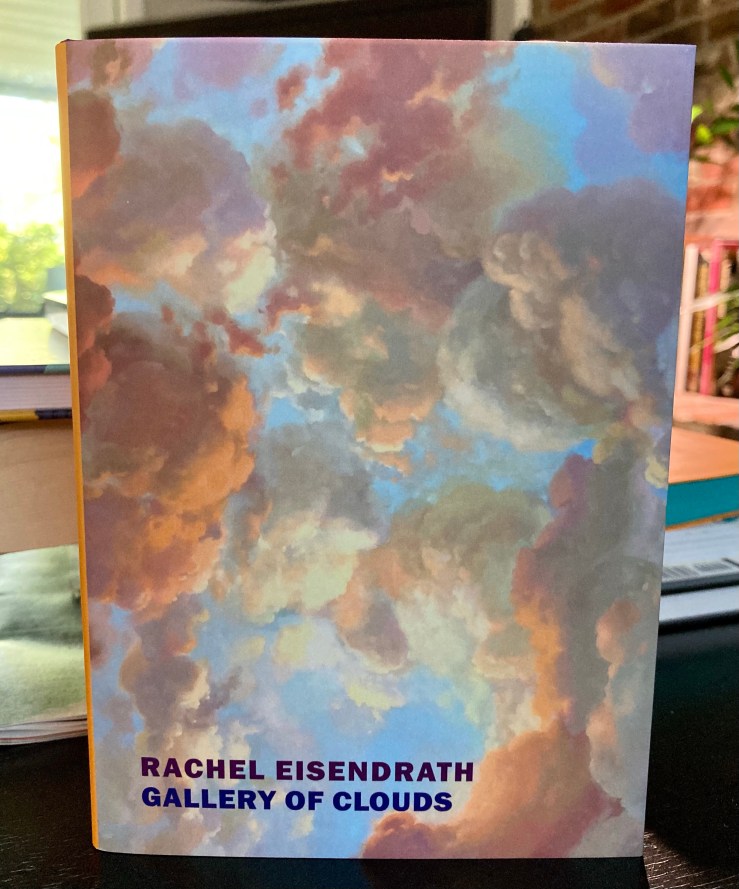
Rachel Eisendrath’s Gallery of Clouds (Book acquired, like maybe three weeks ago?)

Rachel Eisendrath’s Gallery of Clouds is new in hardback (?!) from NYRB. The book showed up a few weeks ago at Biblioklept International Headquarters on a week when like six books showed up. I finally got into it the other week, and it’s cool stuff. Gallery of Clouds has a Sebaldian vibe—discursive, academic, encyclopedic, and frank, with lots of black and white photographs—but it’s also its own thing.

NYRB’s blurb:

Largely unknown to readers today, Sir Philip Sidney’s sixteenth-century pastoral romance Arcadia was long considered one of the finest works of prose fiction in the English language. Shakespeare borrowed an episode from it for King Lear; Virginia Woolf saw it as “some luminous globe” wherein “all the seeds of English fiction lie latent.” In Gallery of Clouds, the Renaissance scholar Rachel Eisendrath has written an extraordinary homage to Arcadia in the form of a book-length essay divided into passing clouds: “The clouds in my Arcadia, the one I found and the one I made, hold light and color. They take on the forms of other things: a cat, the sea, my grandmother, the gesture of a teacher I loved, a friend, a girlfriend, a ship at sail, my mother. These clouds stay still only as long as I look at them, and then they change.”

Gallery of Clouds opens in New York City with a dream, or a vision, of meeting Virginia Woolf in the afterlife. Eisendrath holds out her manuscript—an infinite moment passes—and Woolf takes it and begins to read. From here, in this act of magical reading, the book scrolls out in a series of reflective pieces linked through metaphors and ideas. Golden threadlines tie each part to the next: a rupture of time in a Pisanello painting; Montaigne’s practice of revision in his essays; a segue through Vivian Gordon Harsh, the first African American head librarian in the Chicago public library system; a brief history of prose style; a meditation on the active versus the contemplative life; the story of Sarapion, a fifth-century monk; the persistence of the pastoral; image-making and thought; reading Willa Cather to her grandmother in her Chicago apartment; the deviations of Walter Benjamin’s “scholarly romance,” The Arcades Project. Eisendrath’s wondrously woven hybrid work extols the materiality of reading, its pleasures and delights, with wild leaps and abounding grace.

“A Haunted House,” a very short story by Virginia Woolf

“A Haunted House”

by

Virginia Woolf


Whatever hour you woke there was a door shutting. From room to room they went, hand in hand, lifting here, opening there, making sure—a ghostly couple.

“Here we left it,” she said. And he added, “Oh, but here too!” “It’s upstairs,” she murmured. “And in the garden,” he whispered. “Quietly,” they said, “or we shall wake them.”

But it wasn’t that you woke us. Oh, no. “They’re looking for it; they’re drawing the curtain,” one might say, and so read on a page or two. “Now they’ve found it,” one would be certain, stopping the pencil on the margin. And then, tired of reading, one might rise and see for oneself, the house all empty, the doors standing open, only the wood pigeons bubbling with content and the hum of the threshing machine sounding from the farm. “What did I come in here for? What did I want to find?” My hands were empty. “Perhaps it’s upstairs then?” The apples were in the loft. And so down again, the garden still as ever, only the book had slipped into the grass.

But they had found it in the drawing room. Not that one could ever see them. The window panes reflected apples, reflected roses; all the leaves were green in the glass. If they moved in the drawing room, the apple only turned its yellow side. Yet, the moment after, if the door was opened, spread about the floor, hung upon the walls, pendant from the ceiling—what? My hands were empty. The shadow of a thrush crossed the carpet; from the deepest wells of silence the wood pigeon drew its bubble of sound. “Safe, safe, safe,” the pulse of the house beat softly. “The treasure buried; the room …” the pulse stopped short. Oh, was that the buried treasure?

A moment later the light had faded. Out in the garden then? But the  trees spun darkness for a wandering beam of sun. So fine, so rare, coolly sunk beneath the surface the beam I sought always burnt behind the glass. Death was the glass; death was between us; coming to the woman first, hundreds of years ago, leaving the house, sealing all the windows; the rooms were darkened. He left it, left her, went North, went East, saw the stars turned in the Southern sky; sought the house, found it dropped beneath the Downs. “Safe, safe, safe,” the pulse of the house beat gladly. “The Treasure yours.”

The wind roars up the avenue. Trees stoop and bend this way and that. Moonbeams splash and spill wildly in the rain. But the beam of the lamp falls straight from the window. The candle burns stiff and still. Wandering through the house, opening the windows, whispering not to wake us, the ghostly couple seek their joy.

“Here we slept,” she says. And he adds, “Kisses without number.” “Waking in the morning—” “Silver between the trees—” “Upstairs—” “In the garden—” “When summer came—” “In winter snowtime—” The doors go shutting far in the distance, gently knocking like the pulse of a heart.

Nearer they come; cease at the doorway. The wind falls, the rain slides silver down the glass. Our eyes darken; we hear no steps beside us; we see no lady spread her ghostly cloak. His hands shield the lantern. “Look,” he breathes. “Sound asleep. Love upon their lips.”

Stooping, holding their silver lamp above us, long they look and deeply. Long they pause. The wind drives straightly; the flame stoops slightly. Wild beams of moonlight cross both floor and wall, and, meeting, stain the faces bent; the faces pondering; the faces that search the sleepers and seek their hidden joy.

“Safe, safe, safe,” the heart of the house beats proudly. “Long years—” he sighs. “Again you found me.” “Here,” she murmurs, “sleeping; in the garden reading; laughing, rolling apples in the loft. Here we left our treasure—” Stooping, their light lifts the lids upon my eyes. “Safe! safe! safe!” the pulse of the house beats wildly. Waking, I cry “Oh, is this your buried treasure? The light in the heart.”

Selections from One-Star Amazon Reviews of Virginia Woolf’s Mrs. Dalloway

[Editorial note: The following citations come from one-star Amazon reviews Virginia Woolf’s novel Mrs. DallowayI’ve preserved the reviewers’ original punctuation and spelling. More one-star Amazon reviews.].


I had been warned about Woolf

written, I believe, to impress rather than to relate.

I don’t appreciate her writing and keep coming back for more

I may not be giving it a fair review since I only made it to page 65

pages and pages of surreal metaphors that go on for 10 paragraphs

Woolf had a huge obsession with semi-colons

The book just does not make any sense

I really liked the movie “the Hours”

nonsensical semi-flashbacks

Groundbreaking prose?

I tried, I really did

describing nothing

Written by a lesbian

Kind of like F. Scott Fitzgerald’s works

DO read “The Hours”, you will be impressed

I kept losing track of which character was musing about nothing

I suppose Woolf is considered a genius since she was apparently a cavalier writer of her generation

Let us listen to an old farty woman stream her consciousness to us to hear, pointless thoughts that go nowhere

I’m grateful that contemporary writers can at least string together 2 sentences that follow one another in a logical sequence

Lets burn every sentence she ever penned to end all the unneccesary suffering that curious readers have to go through when they first pick up “Mrs. Dalloway.”

My suggestion: just watch The Hours – you’ll get all the beauty and none of the confusion

the person responsible, Virginia Wolf, has been dead for quite some time now

i have no interest in reading about that lifestyle

am stuck in her growling semicolons

slower than a tortoise

ramblings of a lunatic

As bad as Faulkner

So much language

dreadfully boring

run-on sentences

“literary” drivel

terribly written

so many words

and never getting to a plot

Stream of conscience you say?

I normally enjoy stream of consciousness

The narrative reads like the inner thoughts of a sugar crazed autistic kid with ADD in the middle of a carnival

everyone i know who likes this book only does so because he or she was told by some professor that it’s supposed to be good and can provide no evidence to confirm it

This book certainly shows the depravity of man and a self-centered life and the meaningless found amongst those who think of none but themselves.

The absence of spacing to differentiate between each character’s thought process makes for unnecessary confusion

I really liked the idea of the story taking place over the course of one day

THIS BOOK IS WORSE THAN AIDS!

meandering and repetetive

will suffice as kindling

The party! The party!

VW was mentally-ill

“Dense”

put me off

definitley not a fun read

pretty gross hair and stuff on it/ in it

I had had to read it, or was supposed to

haven’t been able to get past the first chapter

lovely idea, virginia and i applaud you for your creativity

I felt like I was reading some writing student’s homework assignment

The Hours is better, despite its inspiration

this story line is too depressing for me

Descriptions were beaten to death

Not one thing uplifting

I am an avid reader!

the book failed

hyphens

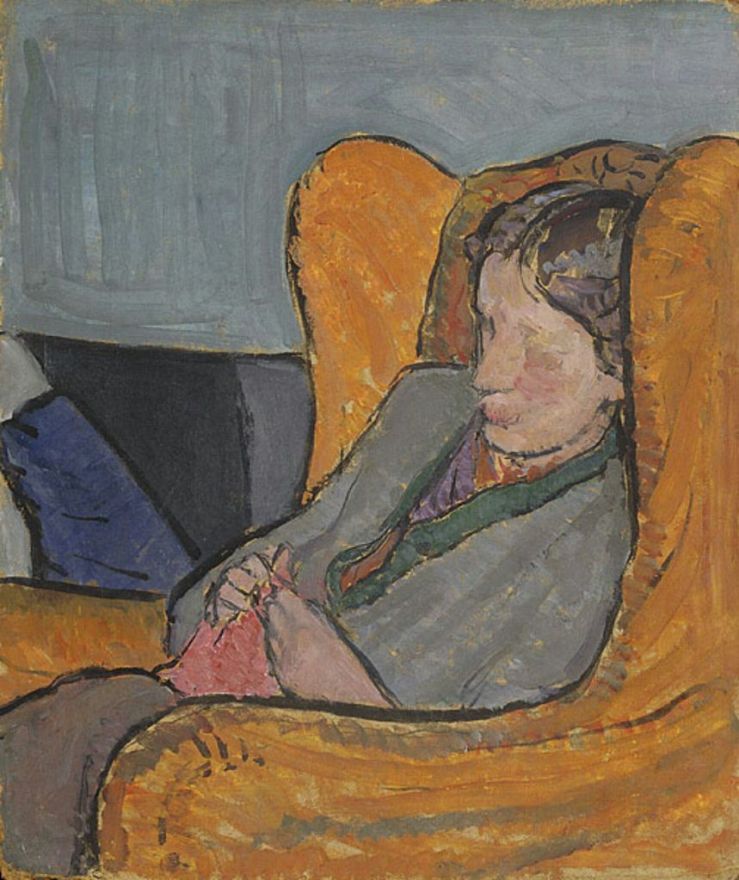
Virginia Woolf — Vanessa Bell

original (1)

“First—listen. Listen to Joyce, to Woolf, to Faulkner, to Melville” | On Audiobooks of “Difficult” Novels

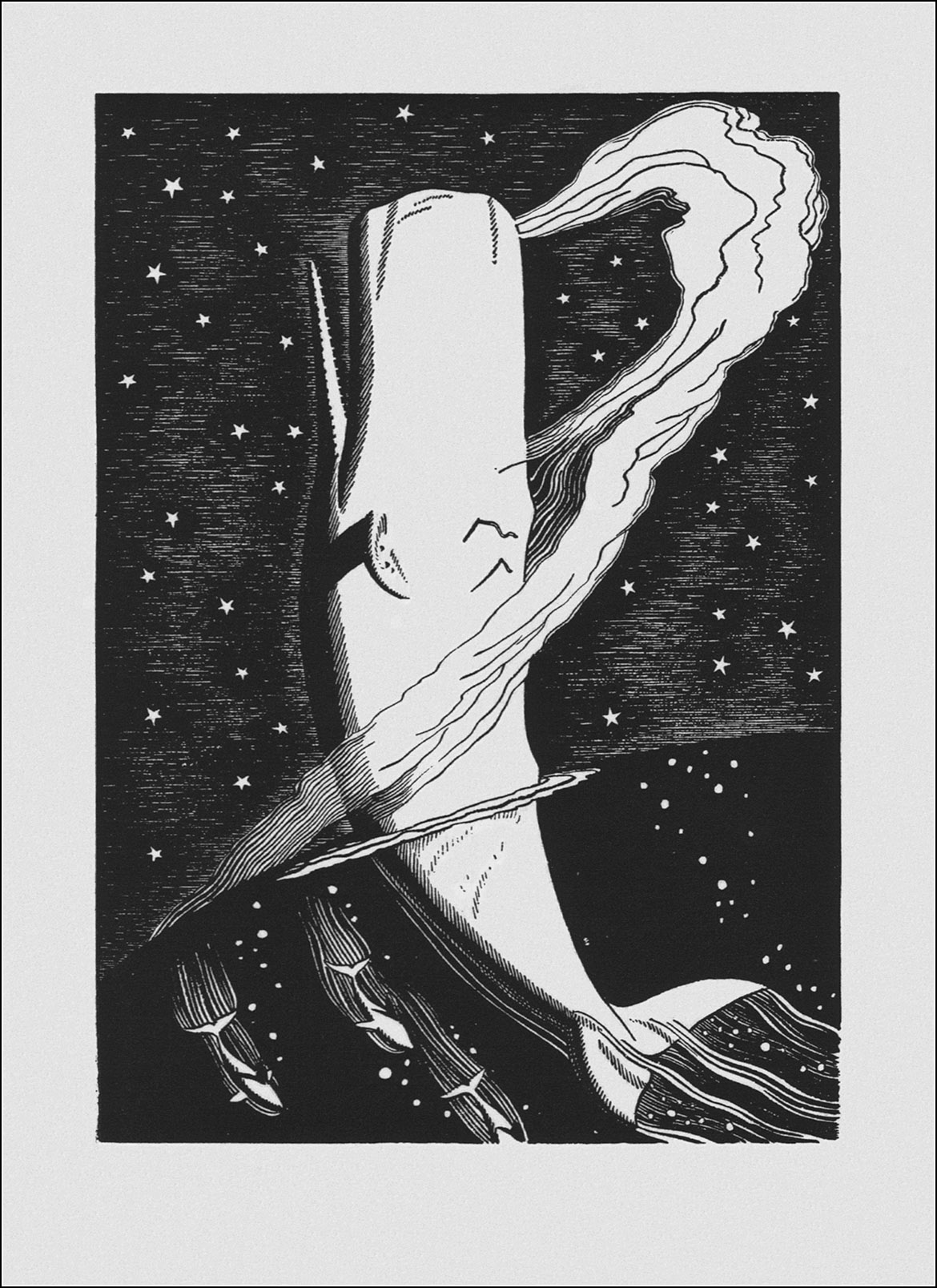
Moby-Dick, Rockwell Kent
I am a huge fan of audiobooks. I’ve pretty much always got one going—for commutes, jogs, workaday chores, etc. The usual. I love to listen to audiobooks of books I’ve already read, in particular, but I of course listen to new stuff too, or stuff that’s new to me, anyway. There just isn’t time to get to all the reading and rereading I want to do otherwise.

Beyond the fact that audiobooks allow me to experience more books than I would be able to otherwise, I like the medium itself: I like a reader reading me a story. Like a lot of people, some of my earliest, best memories are of someone reading to me. (The narrative in my family was always that my mother fell asleep while reading me The Lion, the Witch and the Wardrobe and that I picked it up and finished it on my own and that’s how I “learned” to read—I’m not really sure of this tale’s veracity, which makes it a good story, of course). So I’ve never fully understood folks who sniff their noses at audiobooks as less than real reading. 

Indeed, the best literature is best read aloud. It is for the ear, as William H. Gass puts it in his marvelous essay “The Sentence Seeks Its Form”:

Breath (pneuma) has always been seen as a sign of life . . . Language is speech before it is anything. It is born of babble and shaped by imitating other sounds. It therefore must be listened to while it is being written. So the next time someone asks you that stupid question, “Who is your audience?” or “Whom do you write for?” you can answer, “The ear.” I don’t just read Henry James; I hear him. . . . The writer must be a musician—accordingly. Look at what you’ve written, but later … at your leisure. First—listen. Listen to Joyce, to Woolf, to Faulkner, to Melville.

Joyce, Woolf, Faulkner, Melville—a difficult foursome, no? I would argue that the finest audiobooks—those with the most perceptive performers (often guided by a great director and/or producer) can guide an auditor’s ear from sound to sense to spirit. A great audiobook can channel the pneuma of a complex and so-called difficult novel by animating it, channeling its life force. The very best audiobooks can teach their auditors how to read the novels—how to hear and feel their spirit.

I shall follow (with one slight deviation, substituting one William for another) Gass’s foursome by way of example. Joyce initiates his list, so:

I had read Joyce’s Ulysses twice before I first experience RTÉ’s 1982 dramatized, soundtracked, sound-effected, full cast recording of the novel (download it via that link). I wrote about the Irish broadcast company’s production at length when I first heard it, but briefly: This is a full cast of voices bringing the bustle and energy (and torpor and solemnity and ecstasy and etc.) of Bloomsday to vivid vivacious vivifying life. It’s not just that RTÉ’s cast captures the tone of Ulysses—all its brains and hearts, its howls and its harrumphs—it’s also that this production masterfully expresses the pace and the rhythm of Ulysses. Readers (unnecessarily) daunted by Ulysses’s reputation should consider reading the book in tandem with RTÉ’s production.

Woolf is next on Gass’s list. Orlando is my favorite book of hers, although I have been told by scholars and others that it is not as serious or important as To the Lighthouse or Mrs. Dalloway. It is probably not as “difficult” either; nevertheless, put it on the list! Clare Higgins’s reading of Orlando remains one of my favorite audiobooks of all times: arch without being glib, Higgins animates the novel with a picaresque force that subtly highlights the novel’s wonderful absurdities.

Faulkner…well, did you recall that I admitted I would not keep complete faith to Gass’s short list? Certainly Faulkner’s long twisted sentences evoke their own mossy music, but alas, I’ve yet to find an audiobook with a reader whose take on Faulkner I could tolerate. I tried Grover Gardner’s take on Absalom, Absalom! but alas!—our reader often took pains to untangle what was properly tangled. I don’t know. I was similarly disappointed in an audiobook of The Sound and the Fury (I don’t recall the reader). And yet I’m sure Faulkner could be translated into a marvelous audiobook (Apprise me, apprise me!).

Let me substitute another difficult William: Gaddis. I don’t know if I could’ve cracked J R if I hadn’t first read it in tandem with Nick Sullivan’s audiobook. J R is a tragicomic opera of voices—unattributed voices!—and it would be easy to quickly lose heart without signposts to guide you. Sullivan’s reading is frankly amazing, a baroque, wild, hilarious, and ultimately quite moving performance of what may be the most important American novel of the late twentieth century. A recent reread of J R was almost breezy; Sullivan had taught me how to read it.

Mighty Melville caps Gass’s list. I had read Moby-Dick a number of times, studying it under at least two excellent teachers, before I first heard William Hootkins read it. (Hootkins, a character actor, is probably most well-known as the X-wing pilot Porkins in A New Hope). As a younger reader, I struggled with Moby-Dick, even as it intrigued me. I did not, however, understand just how funny it was, and even though I intuited its humor later in life, I didn’t fully experience it until Hootkins’ reading. Hootkins inhabits Ishmael with a dynamic, goodwilled aplomb, but where his reading really excels is in handling the novel’s narrative macroscopic shifts, as Ishmael’s ego seems to fold into the crew/chorus, and dark Ahab takes over at times. But not just Ahab—Hootkins embodies Starbuck, Flask, and Stubb with humor and pathos. Hootkins breaths spirit into Melville’s music. I cannot overstate how much I recommend Hootkins audiobook, particularly for readers new to Moby-Dick. And readers old to Moby-Dick too.

“What can we do to find out how writing is written? Why, we listen to writers who have written well,” advises (or scolds, if you like) William Gass. The best audiobook performances of difficult books don’t merely provide shortcuts to understanding those books—rather, they teach auditors how to hear them, how to feel them, how to read them.

“Blue and Green” — Virginia Woolf

“Blue and Green”

by

Virginia Woolf

from Monday or Tuesday


GREEN

The pointed fingers of glass hang downwards. The light slides down the glass, and drops a pool of green. All day long the ten fingers of the lustre drop green upon the marble. The feathers of parakeets—their harsh cries—sharp blades of palm trees—green, too; green needles glittering in the sun. But the hard glass drips on to the marble; the pools hover above the dessert sand; the camels lurch through them; the pools settle on the marble; rushes edge them; weeds clog them; here and there a white blossom; the frog flops over; at night the stars are set there unbroken. Evening comes, and the shadow sweeps the green over the mantelpiece; the ruffled surface of ocean. No ships come; the aimless waves sway beneath the empty sky. It’s night; the needles drip blots of blue. The green’s out.


BLUE

The snub-nosed monster rises to the surface and spouts through his blunt nostrils two columns of water, which, fiery-white in the centre, spray off into a fringe of blue beads. Strokes of blue line the black tarpaulin of his hide. Slushing the water through mouth and nostrils he sings, heavy with water, and the blue closes over him dowsing the polished pebbles of his eyes. Thrown upon the beach he lies, blunt, obtuse, shedding dry blue scales. Their metallic blue stains the rusty iron on the beach. Blue are the ribs of the wrecked rowing boat. A wave rolls beneath the blue bells. But the cathedral’s different, cold, incense laden, faint blue with the veils of madonnas.

Selections from One-Star Amazon Reviews of Virginia Woolf’s Mrs. Dalloway

[Editorial note: The following citations come from one-star Amazon reviews Virginia Woolf’s novel Mrs. DallowayI’ve preserved the reviewers’ original punctuation and spelling. More one-star Amazon reviews.].


I had been warned about Woolf

written, I believe, to impress rather than to relate.

I don’t appreciate her writing and keep coming back for more

I may not be giving it a fair review since I only made it to page 65

pages and pages of surreal metaphors that go on for 10 paragraphs

Woolf had a huge obsession with semi-colons

The book just does not make any sense

I really liked the movie “the Hours”

nonsensical semi-flashbacks

Groundbreaking prose?

I tried, I really did

describing nothing

Written by a lesbian

Kind of like F. Scott Fitzgerald’s works

DO read “The Hours”, you will be impressed

I kept losing track of which character was musing about nothing

I suppose Woolf is considered a genius since she was apparently a cavalier writer of her generation

Let us listen to an old farty woman stream her consciousness to us to hear, pointless thoughts that go nowhere

I’m grateful that contemporary writers can at least string together 2 sentences that follow one another in a logical sequence

Lets burn every sentence she ever penned to end all the unneccesary suffering that curious readers have to go through when they first pick up “Mrs. Dalloway.”

My suggestion: just watch The Hours – you’ll get all the beauty and none of the confusion

the person responsible, Virginia Wolf, has been dead for quite some time now

i have no interest in reading about that lifestyle

am stuck in her growling semicolons

slower than a tortoise

ramblings of a lunatic

As bad as Faulkner

So much language

dreadfully boring

run-on sentences

“literary” drivel

terribly written

so many words

and never getting to a plot

Stream of conscience you say?

I normally enjoy stream of consciousness

The narrative reads like the inner thoughts of a sugar crazed autistic kid with ADD in the middle of a carnival

everyone i know who likes this book only does so because he or she was told by some professor that it’s supposed to be good and can provide no evidence to confirm it

This book certainly shows the depravity of man and a self-centered life and the meaningless found amongst those who think of none but themselves.

The absence of spacing to differentiate between each character’s thought process makes for unnecessary confusion

I really liked the idea of the story taking place over the course of one day

THIS BOOK IS WORSE THAN AIDS!

meandering and repetetive

will suffice as kindling

The party! The party!

VW was mentally-ill

“Dense”

put me off

definitley not a fun read

pretty gross hair and stuff on it/ in it

I had had to read it, or was supposed to

haven’t been able to get past the first chapter

lovely idea, virginia and i applaud you for your creativity

I felt like I was reading some writing student’s homework assignment

The Hours is better, despite its inspiration

this story line is too depressing for me

Descriptions were beaten to death

Not one thing uplifting

I am an avid reader!

the book failed

hyphens

“The Legacy” — Virginia Woolf

“The Legacy”

by

Virginia Woolf

“For Sissy Miller.” Gilbert Clandon, taking up the pearl brooch that lay among a litter of rings and brooches on a little table in his wife’s drawing-room, read the inscription: “For Sissy Miller, with my love.”

It was like Angela to have remembered even Sissy Miller, her secretary. Yet how strange it was, Gilbert Clandon thought once more, that she had left everything in such order-a little gift of some sort for every one of her friends. It was as if she had foreseen her death. Yet she had been in perfect health when she left the house that morning, six weeks ago; when she stepped off the kerb in Piccadilly and the car had killed her.

He was waiting for Sissy Miller. He had asked her to come; he owed her, he felt, after all the years she had been with them, this token of consideration. Yes, he went on, as he sat there waiting, it was strange that Angela had left everything in such order. Every friend had been left some little token of her affection. Every ring, every necklace, every little Chinese box-she had a passion for little boxes-had a name on it. And each had some memory for him. This he had given her; this -the enamel dolphin with the ruby eyes-she had pounced upon one day in a back street in Venice. He could remember her little cry of delight. To him, of course, she had left nothing in particular, unless it were her diary. Fifteen little volumes, bound in green leather, stood behind him on her writing table. Ever since they were married, she had kept a diary. Some of their very few-he could not call them quarrels, say tiffs-had been about that diary. When he came in and found her writing, she always shut it or put her hand over it. “No, no, no,” he could hear her say, “After I’m dead-perhaps.” So she had left it him, as her legacy. It was the only thing they had not shared when she was alive. But he had always taken it for granted that she would outlive him. If only she had stopped one moment, and had thought what she was doing, she would be alive now. But she had stepped straight off the kerb, the driver of the car had said at the inquest. She had given him no chance to pull up. . .. Here the sound of voices in the hall interrupted him. Continue reading ““The Legacy” — Virginia Woolf”

Eudora Welty on Austen, Chekhov, and Woolf

INTERVIEWER

You wrote somewhere that we should still tolerate Jane Austen’s kind of family novel. Is Austen a kindred spirit?

EUDORA WELTY

Tolerate? I should just think so! I love and admire all she does, and profoundly, but I don’t read her or anyone else for “kindredness.” The piece you’re referring to was written on assignment for Brief Lives, an anthology Louis Kronenberger was editing. He did offer me either Jane Austen or Chekhov, and Chekhov I do dare to think is more “kindred.” I feel closer to him in spirit, but I couldn’t read Russian, which I felt whoever wrote about him should be able to do. Chekhov is one of us—so close to today’s world, to my mind, and very close to the South—which Stark Young pointed out a long time ago.

INTERVIEWER

Why is Chekhov close to today’s South?

WELTY

He loved the singularity in people, the individuality. He took for granted the sense of family. He had the sense of fate overtaking a way of life, and his Russian humor seems to me kin to the humor of a Southerner. It’s the kind that lies mostly in character. You know, inUncle Vanya and The Cherry Orchard, how people are always gathered together and talking and talking, no one’s really listening. Yet there’s a great love and understanding that prevails through it, and a knowledge and acceptance of each other’s idiosyncrasies, a tolerance of them, and also an acute enjoyment of the dramatic. Like in The Three Sisters, when the fire is going on, how they talk right on through their exhaustion, and Vershinin says, “I feel a strange excitement in the air,” and laughs and sings and talks about the future. That kind of responsiveness to the world, to whatever happens, out of their own deeps of character seems very southern to me. Anyway, I took a temperamental delight in Chekhov, and gradually the connection was borne in upon me.

INTERVIEWER

Do you ever return to Virginia Woolf?

WELTY

Yes. She was the one who opened the door. When I read To the Lighthouse, I felt, Heavens, what is this? I was so excited by the experience I couldn’t sleep or eat. I’ve read it many times since, though more often these days I go back to her diary. Any day you open it to will be tragic, and yet all the marvelous things she says about her work, about working, leave you filled with joy that’s stronger than your misery for her. Remember—“I’m not very far along, but I think I have my statues against the sky”? Isn’t that beautiful?

From Eudora Welty’s interview with The Paris Review.

Orlando — Sally Potter (Full Film)

“Monday or Tuesday” — Virginia Woolf

“Monday or Tuesday”

by

Virginia Woolf

Lazy and indifferent, shaking space easily from his wings, knowing his way, the heron passes over the church beneath the sky. White and distant, absorbed in itself, endlessly the sky covers and uncovers, moves and remains. A lake? Blot the shores of it out! A mountain? Oh, perfect-the sun gold on its slopes. Down that falls. Ferns then, or white feathers, for ever and ever-

Desiring truth, awaiting it, laboriously distilling a few words, for ever desiring-(a cry starts to the left, another to the right. Wheels strike divergently. Omnibuses conglomerate in conflict)-for ever desiring-(the clock asseverates with twelve distinct strokes that it is midday; light sheds gold scales; children swarm)-for ever desiring truth. Red is the dome; coins hang on the trees; smoke trails from the chimneys; bark, shout, cry “Iron for sale”-and truth?

Radiating to a point men’s feet and women’s feet, black or gold-encrusted-(This foggy weather-Sugar? No, thank you-The commonwealth of the future)-the firelight darting and making the room red, save for the black figures and their bright eyes, while outside a van discharges, Miss Thingummy drinks tea at her desk, and plate-glass preserves fur coats-

Flaunted, leaf-light, drifting at corners, blown across the wheels, silver-splashed, home or not home, gathered, scattered, squandered in separate scales, swept up, down, torn, sunk, assembled-and truth?

Now to recollect by the fireside on the white square of marble. From ivory depths words rising shed their blackness, blossom and penetrate. Fallen the book; in the flame, in the smoke, in the momentary sparks-or now voyaging, the marble square pendant, minarets beneath and the Indian seas, while space rushes blue and stars glint-truth? content with closeness?

Lazy and indifferent the heron returns; the sky veils her stars; then bares them.

“The Death of the Moth” — Virginia Woolf

“The Death of the Moth”

by

Virginia Woolf

Moths that fly by day are not properly to be called moths; they do not excite that pleasant sense of dark autumn nights and ivy-blossom which the commonest yellow-underwing asleep in the shadow of the curtain never fails to rouse in us. They are hybrid creatures, neither gay like butterflies nor sombre like their own species. Nevertheless the present specimen, with his narrow hay-coloured wings, fringed with a tassel of the same colour, seemed to be content with life. It was a pleasant morning, mid-September, mild, benignant, yet with a keener breath than that of the summer months. The plough was already scoring the field opposite the window, and where the share had been, the earth was pressed flat and gleamed with moisture. Such vigour came rolling in from the fields and the down beyond that it was difficult to keep the eyes strictly turned upon the book. The rooks too were keeping one of their annual festivities; soaring round the tree tops until it looked as if a vast net with thousands of black knots in it had been cast up into the air; which, after a few moments sank slowly down upon the trees until every twig seemed to have a knot at the end of it. Then, suddenly, the net would be thrown into the air again in a wider circle this time, with the utmost clamour and vociferation, as though to be thrown into the air and settle slowly down upon the tree tops were a tremendously exciting experience.

The same energy which inspired the rooks, the ploughmen, the horses, and even, it seemed, the lean bare-backed downs, sent the moth fluttering from side to side of his square of the window-pane. One could not help watching him. One was, indeed, conscious of a queer feeling of pity for him. The possibilities of pleasure seemed that morning so enormous and so various that to have only a moth’s part in life, and a day moth’s at that, appeared a hard fate, and his zest in enjoying his meagre opportunities to the full, pathetic. He flew vigorously to one corner of his compartment, and, after waiting there a second, flew across to the other. What remained for him but to fly to a third corner and then to a fourth? That was all he could do, in spite of the size of the downs, the width of the sky, the far-off smoke of houses, and the romantic voice, now and then, of a steamer out at sea. What he could do he did. Watching him, it seemed as if a fibre, very thin but pure, of the enormous energy of the world had been thrust into his frail and diminutive body. As often as he crossed the pane, I could fancy that a thread of vital light became visible. He was little or nothing but life.

Yet, because he was so small, and so simple a form of the energy that was rolling in at the open window and driving its way through so many narrow and intricate corridors in my own brain and in those of other human beings, there was something marvellous as well as pathetic about him. It was as if someone had taken a tiny bead of pure life and decking it as lightly as possible with down and feathers, had set it dancing and zig-zagging to show us the true nature of life. Thus displayed one could not get over the strangeness of it. One is apt to forget all about life, seeing it humped and bossed and garnished and cumbered so that it has to move with the greatest circumspection and dignity. Again, the thought of all that life might have been had he been born in any other shape caused one to view his simple activities with a kind of pity. Continue reading ““The Death of the Moth” — Virginia Woolf”

“The String Quartet” — Virginia Woolf

“The String Quartet”

by Virginia Woolf

Well, here we are, and if you cast your eye over the room you will see that Tubes and trams and omnibuses, private carriages not a few, even, I venture to believe, landaus with bays in them, have been busy at it, weaving threads from one end of London to the other. Yet I begin to have my doubts-

If indeed it’s true, as they’re saying, that Regent Street is up, and the Treaty signed, and the weather not cold for the time of year, and even at that rent not a flat to be had, and the worst of influenza its after effects; if I bethink me of having forgotten to write about the leak in the larder, and left my glove in the train; if the ties of blood require me, leaning forward, to accept cordially the hand which is perhaps offered hesitatingly-

“Seven years since we met!”

“The last time in Venice.”

“And where are you living now?”

“Well, the late afternoon suits me the best, though, if it weren’t asking too much-”

“But I knew you at once!”

“Still, the war made a break-”

If the mind’s shot through by such little arrows, and-for human society compels it-no sooner is one launched than another presses forward; if this engenders heat and in addition they’ve turned on the electric light; if saying one thing does, in so many cases, leave behind it a need to improve and revise, stirring besides regrets, pleasures, vanities, and desires-if it’s all the facts I mean, and the hats, the fur boas, the gentlemen’s swallow-tail coats, and pearl tie-pins that come to the surface-what chance is there? Continue reading ““The String Quartet” — Virginia Woolf”