No.

20140627-103732-38252604.jpg

“Spotted Horses,” A Short Story by William Faulkner

“Spotted Horses”

by

William Faulkner

I

A little while before sundown the men lounging about the gallery of the store saw, coming up the road from the south, a covered wagon drawn by mules and followed by a considerable string of obviously alive objects which in the levelling sun resembled vari-sized and -colored tatters torn at random from large billboards-circus posters, say -attached to the rear of the wagon and inherent with its own separate and collective motion, like the tail of a kite.
“What in the hell is that?” one said.

“It’s a circus,” Quick said. They began to rise, watching the wagon. Now they could see that the animals behind the wagon were horses. Two men rode in the wagon.

“Hell fire,” the first man – his name was Freeman – said “It’s Flem Snopes.’ They were all standing when the wagon came up and stopped and Snopes got down and approached the steps. He might have departed only this morning. He wore the same cloth cap, the minute bow tie against the white shirt, the same gray trousers. He mounted the steps. Continue reading ““Spotted Horses,” A Short Story by William Faulkner”

“That Evening Sun” — William Faulkner

“That Evening Sun”

by William Faulkner

I

Monday is no different from any other week day in Jefferson now. The streets are paved now, and the telephone and the electric companies are cutting down more and more of the shade trees – the water oaks, the maples and locusts and elms – to make room for iron poles bearing clusters of bloated and ghostly and bloodless grapes, and we have a city laundry which makes the rounds on Monday morning, gathering the bundles of clothes into bright-colored, specially made motor-cars: the soiled wearing of a whole week now flees apparition-like behind alert and irritable electric horns, with a long diminishing noise of rubber and asphalt like a tearing of silk, and even the Negro women who still take in white peoples’ washing after the old custom, fetch and deliver it in automobiles.

But fifteen years ago, on Monday morning the quiet, dusty, shady streets would be full of Negro women with, balanced on their steady turbaned heads, bundles of clothes tied up in sheets, almost as large as cotton bales, carried so without touch of hand between the kitchen door of the white house and the blackened wash-pot beside a cabin door in Negro Hollow.

Nancy would set her bundle on the top of her head, then upon the bundle in turn she would set the black straw sailor hat which she wore winter and summer. She was tall, with a high, sad face sunken a little where her teeth were missing. Sometimes we would go a part of the way down the lane and across the pasture with her, to watch the balanced bundle and the hat that never bobbed nor wavered, even when she walked down into the ditch and climbed out again and stooped through the fence. She would go down on her hands and knees and crawl through the gap, her head rigid, up-tilted, the bundle steady as a rock or a balloon, and rise to her feet and go on.

Sometimes the husbands of the washing women would fetch and deliver the clothes, but Jubah never did that for Nancy, even before father told him to stay away from our house, even when Dilsey was sick and Nancy would come to cook for us. Continue reading ““That Evening Sun” — William Faulkner”

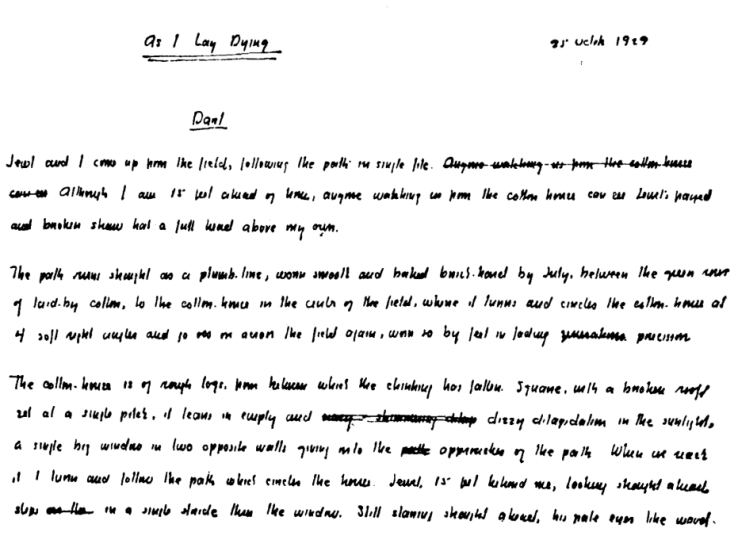
Manuscript Page of Faulkner’s As I Lay Dying

faulkner-w

“Ad Astra” — William Faulkner

“Ad Astra” by William Faulkner

I DON’T KNOW what we were. With the exception of Comyn, we had started out Americans, but after three years, in our British tunics and British wings and here and there a ribbon, I don’t suppose we had even bothered in three years to wonder what we were, to think or to remember.

And on that day, that evening, we were even less than that, or more than that: either beneath or beyond the knowledge that we had not even wondered in three years. The subadar, after a while he was there, in his turban and his trick major’s pips, said that we were like men trying to move in water. “But soon it will clear away,” he said. “The effluvium of hatred and of words. We are like men trying to move in water, with held breath watching our terrific and infinitesimal limbs, watching one another’s terrific stasis without touch, without contact, robbed of all save the impotence and the need.”

We were in the car then, going to Amiens, Sartoris driving and Comyn sitting half a head above him in the front seat like a tackling dummy, the subadar, Bland and I in back, each with a bottle or two in his pockets. Except the subadar, that is. He was squat, small and thick, yet his sobriety was colossal. In that maelstrom of alcohol where the rest of us had fled our inescapable selves he was like a rock, talking quietly in a grave bass four sizes too big for him: “In my country I was prince. But all men are brothers.”

But after twelve years I think of us as bugs in the surface of the water, isolant and aimless and unflagging. Not on the surface; in it, within that line of demarcation not air and not water, sometimes submerged, sometimes not. You have watched an unbreaking groundswell in a cove, the water shallow, the cove quiet, a little sinister with satiate familiarity, while beyond the darkling horizon the dying storm has raged on. That was the water, we the flotsam. Even after twelve years it is no clearer than that. It had no beginning and no ending. Out of nothing we howled, unwitting the storm which we had escaped and the foreign strand which we could not escape; that in the interval between two surges of the swell we died who had been too young to have ever lived.

We stopped in the middle of the road to drink again. The land was dark and empty. And quiet: that was what you noticed, remarked. You could hear the earth breathe, like coming out of ether, like it did not yet know, believe, that it was awake. “But now it is peace,” the subadar said. “All men are brothers.”

(Read the rest of “Ad Astra”).

Teaser Trailer for James Franco’s Film Adaptation of Cormac McCarthy’s Novel Child of God

So James Franco has taken a stab at Faulkner and one of Faulkner’s literary descendants, Cormac McCarthy—in the same year no less. Franco has adapted McCarthy’s 1973 novel Child of God; the film will play this weekend at the Toronto Film Festival.

Here is my review of McCarthy’s novel Child of God.

Suttree, Cormac McCarthy’s Grand Synthesis of American Literature

In his 1992 interview with The New York Times, Cormac McCarthy said, “The ugly fact is books are made out of books. The novel depends for its life on the novels that have been written.” McCarthy’s fourth novel, 1979’s Suttree is such a book, a masterful synthesis of the great literature — particularly American literature — that came before it. And like any masterful synthesis, Suttree points to something new, even as it borrows, lifts, and outright steals from the past. But before we plumb its allusions and tropes and patterns, perhaps we should overview the plot, no?

The novel rambles over several years in the life of Cornelius Suttree. It is the early 1950s in Knoxville, Tennessee, and Suttree ekes out a mean existence on the Tennessee River as a fisherman, living in a ramshackle houseboat on the edge of a shantytown. This indigent life is in fact a choice: Suttree is the college-educated son of an established, wealthy family. His choice is a choice for freedom and self-reliance, those virtues we like to think of, in our prejudicial manner, as wholly and intrinsically American. Suttree then is both Emersonian and Huck Finnian, a reflective and insightful man who finds his soul via a claim to agency over his own individuality, an individuality poised in quiet, defiant rebellion against the conforming forces of civilization. These forces manifest most pointedly in the Knoxville police, a brutal, racist organization, but we also see social constraint in the form of familial duty. One thinks of the final lines of Huckleberry Finn: “I reckon I got to light out for the Territory ahead of the rest, because Aunt Sally she’s going to adopt me and sivilize me and I can’t stand it. I been there before.”

Like Huck, Suttree aims to resist all forces that would “sivilize” him. His time on the river and in the low haunts of Tennessee (particularly the vice-ridden borough of McAnally) brings him into close contact with plenty of other outcasts, but also his conscience, which routinely mulls over its place in the world. Suttree is punctuated by–perhaps even organized by–several scenes of hallucination. Some of these psychotrips result from drunkeness, one comes from accidentally ingesting the wrong kind of mushrooms (or, the right kind, if that’s your thing), and the final one, late in the novel, sets in as Suttree suffers from a terrible illness. In his fever dream, a small nun–surely a manifestation of the guilt that would civilize us–accuses him–

Mr. Suttree it is our understanding that at curfew rightly decreed by law in that hour wherein night draws to its proper close and the new day commences and contrary to conduct befitting a person of your station you betook yourself to various low places within the shire of McAnally and there did squander several ensuing years in the company of thieves, derelicts, miscreants, pariahs, poltroons, spalpeens, curmudgeons, clotpolls, murderers, gamblers, bawds, whores, trulls, brigands, topers, tosspots, sots and archsots, lobcocks, smellsmocks, runagates, rakes, and other assorted and felonious debauchees.

The passage is a marvelous example of McCarthy’s stream-of-consciousness technique in Suttree, moving through the various voices that would ventriloquize Suttree, into the edges of madness, strangeness, and the sublimity of language. The tone moves from somber and portentous into bizarre imagery that blends humor and pathos. This is the tone of Suttree, a language that gives voice to transients and miscreants, affirming the dignity of their humanity even as it details the squalor of their circumstance.

It is among these criminals and whores, transvestites and gamblers that Suttree affirms his own freedom and humanity, a process aided by his comic foil, Gene Harrogate. Suttree meets Harrogate on a work farm; the young hillbilly is sent there for screwing watermelons. After his release, Harrogate moves to a shantytown in Knoxville. He’s the country mouse determined to become the city rat, the would-be Tom Sawyer to Suttree’s older and wiser Huck Finn. Through Harrogate’s endless get-rich-quick schemes, McCarthy parodies that most-American of tales, the Horatio Alger story. Simply put, the boy is doomed, on his  “way up to the penitentiary” as Suttree constantly admonishes. In one episode, Harrogate tries to buy arsenic from “a grayhaired and avuncular apothecary” to poison bats he hopes to sell to a hospital (don’t ask)–

May I help you? said the scientist, his hands holding each other.

I need me some strychnine, said Harrogate.

You need some what?

Strychnine. You know what it is dont ye?

Yes, said the chemist.

I need me about a good cupful I reckon.

Are you going to drink it here or take it with you?

Shit fire I aint goin to drink it. It’s poisoner’n hell.

It’s for your grandmother.

No, said Harrogate, craning his neck suspectly. She’s done dead

Suttree, unwilling father-figure, eventually buys the arsenic for the boy against his better judgment. The scene plays out as a wonderful comic inversion of William Faulkner’s “A Rose for Emily,” from which it is so transparently lifted. McCarthy borrows liberally from Faulkner here, of course, most notably in the language and style of the novel, but also in scenes like this one, or a later episode that plays off Faulkner’s comic-romantic story of a man and a woman navigating the aftermath of a flood, “Old Man.” Unpacking the allusions in Suttree surpasses my literary knowledge or skill, but McCarthy is generous, if oblique, with his breadcrumb trail. Take, for example, the following sentence: “Suttree with his miles to go kept his eyes to the ground, maudlin and muttersome in the bitter chill, under the lonely lamplight.” The forced phrase “miles to go” does not immediately present itself as a reference to Robert Frost’s famous poem, yet the direction of the sentence retreats into the history of American poetry; with its dense alliteration and haunted vowels, it leads us into Edgar Allan Poe territory. Only a few dozen pages later, McCarthy boldly begins a chapter with theft: “In just spring the goatman came over the bridge . . .” The reference to e.e. cummings explicitly signifies McCarthy’s intentions to play with literature. Later in the book, while tripping on mushrooms in the mountains, Suttree is haunted by “elves,” the would-be culprits in Frost’s poem “Mending Wall.” The callback is purposeful, but tellingly, McCarthy’s allusions are not nearly as fanciful as their surface rhetoric might suggest: the goatman does not belong in Knoxville–he’s an archaic relic, forced out of town by the police; the elves are not playful spirits but dark manifestations of a tortured psyche.

Once one spots the line-lifting in Suttree it’s hard to not see it. What’s marvelous is McCarthy’s power to convert these lines, these riffs, these stories, into his own tragicomic beast. An early brawl at a roadhouse recalls the “Golden Day” episode of Ralph Ellison’s Invisible Man; a rape victim’s plight echoes Hubert Selby’s “Tralala”; we find the comic hobos of John Steinbeck’s Cannery Row–we even get the road-crossing turtle from The Grapes of Wrath. A later roadhouse chapter replays the “Circe/Nighttown” nightmare in James Joyce’s Ulysses. Ulysses is an easy point of comparison for Suttree, which does for Knoxville what Joyce did for Dublin. Suttree echoes Ulysses’s language, both in its musicality and appropriation of varied voices, as well as its ambulatory structure, its stream-of-consciousness technique, its rude earthiness, and its size (nearly 600 pages). But, as I argued earlier, there’s something uniquely American about Suttree, and its literary appropriations tend to reflect that. Hence, we find Mark Twain, Herman Melville, Ernest Hemingway, Walt Whitman, Emerson and Thoreau, Emily Dickinson, and William Carlos Williams, to name just a few writers whose blood courses through this novel (even elegant F. Scott Fitzgerald is here, in an unexpected Gatsbyish episode late in the novel).

Making a laundry list of writers is weak criticism though, and these sources–all guilty of their own proud plagiarisms–are mentioned only as a means to an end, to an argument that what McCarthy does in Suttree is to synthesize the American literary tradition with grace and humor, while never glossing over its inherent dangers and violence. So, while it appropriates and plays with the tropes of the past, Suttree is still pure McCarthy. Consider the following passage, which arrives at the end of a drunken, awful spree, Suttree locked up for the night–

He closed his eyes. The gray water that dripped from him was rank with caustic. By the side of a dark dream road he’d seen a hawk nailed to a barn door. But what loomed was a flayed man with his brisket tacked open like a cooling beef and his skull peeled, blue and bulbous and palely luminescent, black grots his eyeholes and bloody mouth gaped tonguless. The traveler had seized his fingers in his jaws, but it was not alone this horror that he cried. Beyond the flayed man dimly adumbrate another figure paled, for his surgeons move about the world even as you and I.

Suttree’s dark vision points directly toward the language of McCarthy’s next novel, 1985’s Blood Meridian, roundly considered his masterpiece. Critics who disagree tend to point to Suttree as the pinnacle of McCarthy’s writing. I have no interest at this time in weighing the books against each other, nor do I think that doing so would be especially enlightening. For all of their sameness, they are very different animals: Suttree provides us intense access to its hero’s consciousness, where Blood Meridian always keeps the reader on the outside of its principals’ souls (if those grotesques could be said to have souls). And while Blood Meridian does display some humor, it is the blackest and driest humor I’ve ever read. Suttree is broader and more compassionate; it even has a fart joke. Blood Meridian, at least in my estimation (and many critics will contend this notion) has no flawed episodes; much of this results from the book’s own internal program–it resists love, compassion, and even human dignity. In contrast, Suttree is punctuated by two deaths the audience is meant to read as tragic, yet I found it impossible to do so. The first is the death of Suttree’s child, whom he has abandoned, along with its mother. As such, he is not permitted to take part in the funeral, observing the process rather from its edges. The second tragedy is the death of Suttree’s young lover in a landslide. The book begs us to empathize with Suttree, just as he often empathizes with the marginal figures in the novel, but ultimately these tragedies are a failed ploy. They underwrite a sublime encounter with death for Suttree, an encounter that deepens and enriches his character while paradoxically freeing him from the burdens of social duty and familial order. McCarthy is hardly alone in such a move; indeed, it seems like the signature trope of American masculine literature to me. It’s the move that Huck Finn wishes to make when he promises to light out for the Territory to escape the civilizing body of Aunt Sally; it’s the ending that Hemingway was compelled to give to Frederic Henry at the end of A Farewell to Arms; it’s all of Faulkner, with his mortification of fatherhood and the dramatic responsibility fatherhood entails. It is a cost analysis that neglects any potential benefits.

But these are small criticisms of a large, beautiful, benevolent novel, a book that begs to be reread, a rambling picaresque of comic and tragic proportions. “I learned that there is one Suttree and one Suttree only,” our hero realizes, but this epiphany is set against a larger claim. Near the end of the novel, Suttree goes to check on an old ragman who he keeps a watchful eye on. He finds the man dead, his shack robbed, his body looted. Despairing over the spectacle’s abject lack of humanity, Suttree cries, “You have no right to represent people this way,” for “A man is all men. You have no right to your wretchedness.” Here, Suttree’s painful epiphany is real and true, an Emersonian insight coded in the darkest of Whitman’s language. If there is one Suttree and one Suttree only, he is still beholden to all men; to be anti-social or an outcast is not to be anti-human. Self-hood is ultimately conditional on others and otherness. To experience the other’s wretchedness is harrowing; to understand the other’s wretchedness and thus convert it to dignity is life-affirming and glorious. Suttree is a brilliant, bold, marvelous book. Very highly recommended.

[Ed. note—Biblioklept originally published a version of this review on November 27, 2010].


Bloomsday

Portrait of James Joyce by Djuna Barnes

How to read Ulysses

Ulysses art by Roman Muradov

Selections from one-star Amazon reviews of Ulysses

joyce_ulysses-p2
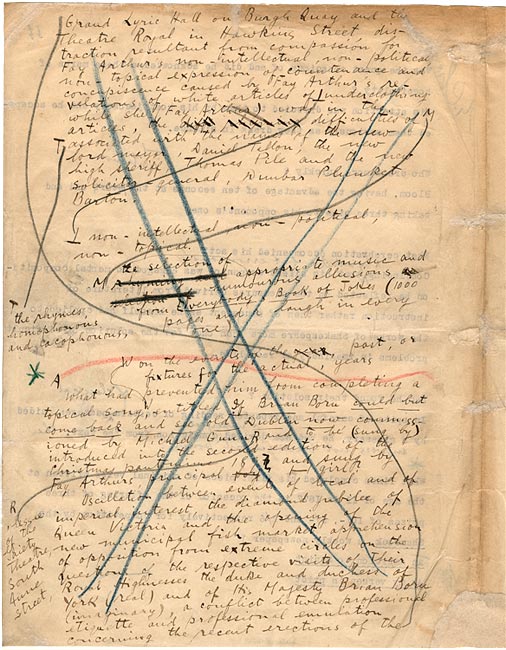
Ulysses manuscript page

A list of Irish heroes (from “The Cyclops” episode of Ulysses)

“Words,” a page from one of Joyce’s notebooks for Ulysses

Another page of Joyce’s notes, plus links to more

James Joyce talks dirty

Filming Finnegans

James Joyce’s eye glasses prescription

William Faulkner’s Joyce anxiety

Ezra Pound on James Joyce

Marilyn Monroe reads Molly 

Biblioklept’s lousy review (the review is lousy, not the book) of Dubliners

Joyce’s entry on the 1901 Irish Census

Joyce’s caricature of Leopold Bloom

Biblioklept’s review (not so lousy, the review) of a superior full-cast audio recording of Ulysses

James Joyce explains why Odysseus is the most “complete man’ in literature

James Joyce’s passport

Leopold’s Bloom’s recipe for burnt kidney breakfast

“What in water did Bloom, waterlover, drawer of water, watercarrier, returning to the range, admire?”

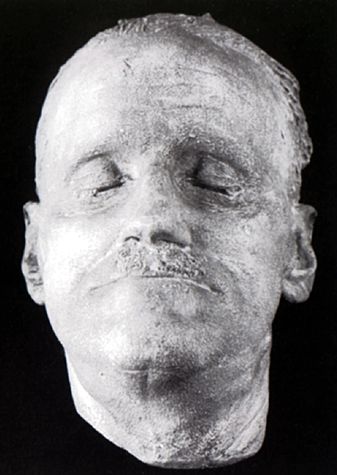
James Joyce’s death mask


“Was” by William Faulkner

“Was” by William Faulkner

Isaac McCaslin, ‘Uncle Ike’, past seventy and nearer eighty than he ever corroborated any more, a widower now and uncle to half a county and father to no one

this was not something participated in or even seen by himself, but by his elder cousin, McCaslin Edmonds, grandson of Isaac’s father’s sister and so descended by the distaff, yet notwithstanding the inheritor, and in his time the bequestor, of that which some had thought then and some still thought should have been Isaac’s, since his was the name in which the title to the land had first been granted from the Indian patent and which some of the descendants of his father’s slaves still bore in the land. But Isaac was not one of these:-a widower these twenty years, who in all his life had owned but one object more than he could wear and carry in his pockets and his hands at one time, and this was the narrow iron cot and the stained lean mattress which he used camping in the woods for deer and bear or for fishing or simply because he loved the woods; who owned no property and never desired te since the earth was no man’s but all men’s, as light and air and weather were; who lived still in the cheap frame bungalow in Jefferson which his wife’s father gave them on their marriage and which his wife had willed to him at her death and which he had pretended to accept, acquiesce to, to humor her, ease her going but which was not his, will or not, chancery dying wishes mortmain possession or whatever, himself merely holding it for his wife’s sister and her children who had lived in it with him since his wife’s death, holding himself welcome to live in one room of it as he had during his wife’s time or she during her time or the sister-in-law and her children during the rest of his and after not something he had participated in or even remembered except from the hearing, the listening, come to him through and from his cousin McCaslin born in 1850 and sixteen years his senior and hence, his own father being near seventy when Isaac, an only child, was born. rather his brother than cousin and rather his father than either, out of the old time, the old days.

When he and Uncle Buck ran back to the house from discovering that Tomey’s Turl had run again, they heard Uncle Buddy cursing and bellowing in the kitchen, then the fox and the dogs came out of the kitchen and crossed the hall into the dogs’ room and they heard them run through the dogs’ room into his and Uncle Buck’s room then they saw them cross the hall again into Uncle Buddy’s room and heard them run through Uncle Buddy’s room into the kitchen. Where Uncle Buddy was picking the breakfast up out of the ashes and wiping it off with his apron. “What in damn’s hell do you mean,” he said “turning that damn fox out with the dogs all loose in the house?”

“Damn the fox” Uncle Buck said. “Tomey’s Turl has broke out again. Give me and Cass some breakfast quick we might just barely catch him before he gets there.” Continue reading ““Was” by William Faulkner”

William Faulkner Pouring Some Coffee

tumblr_lrix0cDh9r1r2nz2so1_r1_400

(Via).

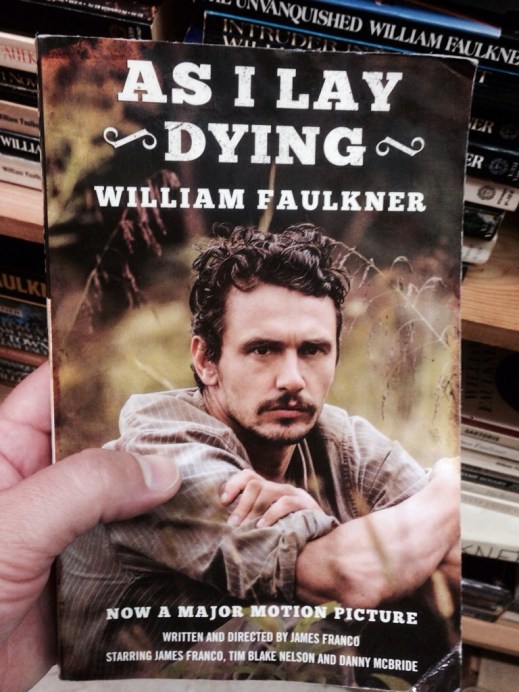
The Trailer for James Franco’s Film Adaptation of As I Lay Dying Is Pretty Unremarkable

All of this seems so terribly ill-advised. The book is great—not Faulkner’s greatest, but it has a linear trajectory that I do think is filmable—but this trailer seems to portray a pale imitation of someone else’s vision of what a Faulkner film might look like (no, I don’t know what that sentence means exactly, other than this film looks like a bad riff on Faulkner).

Faulkner Pronouncing Yoknapatawpha

Film Footage of William Faulkner (1952)

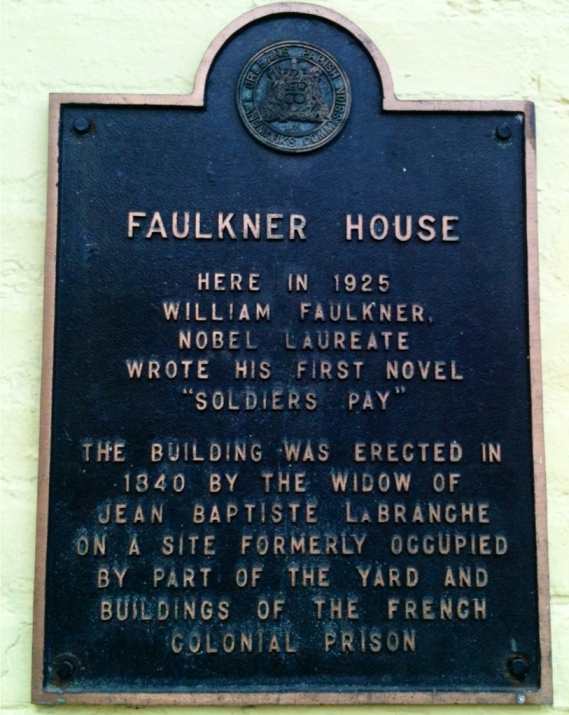
Faulkner House/Crescent City Books (Books Acquired Some Time Last Week)

Had a wonderful if sweaty trip to New Orleans last week.

Great food, great music, and great bookstores.

First up, Faulkner House:

20120808-163344.jpg

Faulkner House is a tiny little shop just off Jackson Square. Its two rooms (really, a main room and a hallway) are lined from bottom to top with literature, poetry, and philosophy. I can’t overstate the excellence of the collection in here—all kinds of rare and beautiful tomes, signed stuff, local and localish stuff, etc (local gal Anne Rice was the closest thing I saw to genre fiction). It’s great to walk into a bookshop and see a near-complete collection of new NYRB volumes stacked prominently upfront along with new novels by Richard Ford and Teju Cole.

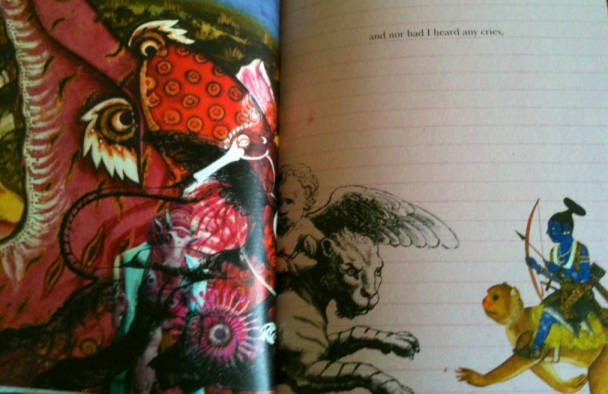
I picked up this handsome illustrated edition of Thomas Bernhard’s Victor Halfwit, the handsomeness and bigness and luxuriousness of which simply doesn’t come across in this lousy iPhone pic:

20120808-163414.jpg

Random framed shot:

20120808-163426.jpg

And a random two-page shot with glare:

20120808-163432.jpg

My wife picked out three lovely editions from Everyman’s Library Pocket series, poems from Christina Rosetti, Emily Dickinson, and Emily Brontë:

20120808-163439.jpg

The owner and the manager were very kind, knowledgeable, and tolerant of my questions about what kind of stock they moved (biggest seller, unsurprisingly, is Soldier’s Pay).

Info for Faulkner House, via bookmark (the manager put one in each book I bought):

20120808-163445.jpg

A few days later after a three-Bloody-Mary-breakfast I stumbled into Crescent City Books:

20120808-163523.jpg

This is a great shop that, like Faulkner House, doesn’t waste precious shelf space on glitter vampires or self-help books or novelty cookbooks. Lots of art volumes (many rare and in German, French, Italian, etc.), a large poetry section, philosophy, history, etc. Lots of great old prints too. And an old cat, who was basically boss of the place.

They also carry physical copies of Rain Taxi, which I haven’t seen in years.

I picked up Masquerade and Other Stories after a Biblioklept commenter recommended Walser (by way of Kafka). I read about half of this over the next few days (full review to come):

20120808-163504.jpg

Blah Blah Bloomsday

How to read Ulysses

A list of Irish heroes (from “The Cyclops” episode of Ulysses)

“Words,” a page from one of Joyce’s notebooks for Ulysses:

Another page of Joyce’s notes, plus links to more

James Joyce talks dirty

Filming Finnegans

James Joyce’s eye glasses prescription:

William Faulkner’s Joyce anxiety

Marilyn Monroe reads Molly 

Biblioklept’s lousy review (the review is lousy, not the book) of Dubliners

Joyce’s entry on the 1901 Irish Census

Joyce’s caricature of Leopold Bloom:

Biblioklept’s review (not so lousy, the review) of a superior full-cast audio recording of Ulysses

James Joyce explains why Odysseus is the most “complete man’ in literature

James Joyce’s passport:

Leopold’s Bloom’s recipe for burnt kidney breakfast

James Joyce’s death mask:


Book Shelves #22, 5.27.2012

20120527-111623.jpg

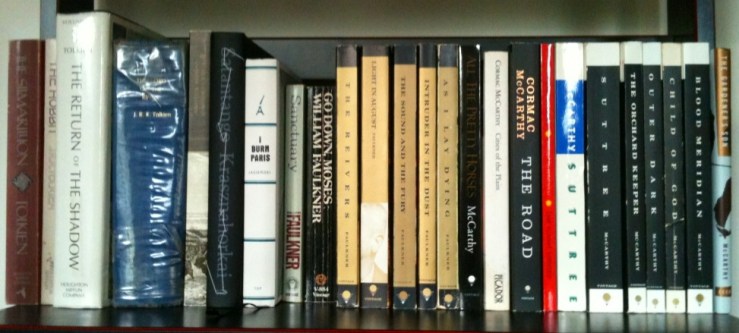
Book shelves series #22, twenty-second Sunday of 2012: Tolkien, Faulkner, McCarthy

As always, sorry for the glare. Shooting this case head on is almost impossible because of the windows on the other side of the room. Anyway.

I’ve read everything by Cormac McCarthy with the exception of his screenplay for The Gardener’s Son, which I found a week or two and picked it up. I don’t own a copy of No Country for Old Men because I haven’t found one that isn’t a movie tie-in.

20120527-111632.jpg

This copy of The Lord of the Rings—my first—was a kind gift from some friends we were staying with in Melbourne (the one in Australia, not Florida).

20120527-111642.jpg

I’ve read it at least four times; I have other copies of LoTR and have read them too. It’s probably the book I’ve read the most, although I haven’t read it since 2002. This copy is kindly inscribed:

20120527-111650.jpg

There’s a slim space on the shelf that currently holds a few books that I’ve been meaning to read:

20120527-111659.jpg

“He Squatted Among the Soft Womansmelling Garments” — A Strange Sex Scene from Faulkner

A strange, gross sex scene from William Faulkner’s  novel Light in August. As a child, the book’s anti-hero,Joe Christmas, an orphan of unclear parentage, sneaks off to suck sweet toothpaste from a tube. There, he surreptitiously witnesses a clandestine meeting between the orphanage’s dietitian and another worker:

In the quiet and empty corridor, during the quiet hour of early afternoon, he was like a shadow, small even for five years, sober and quiet as a shadow. Another in the corridor could not have said just when and where he vanished, into what door, what room. But there was no one else in the corridor at this hour. He knew that. He had been doing this for almost a year, ever since the day when he discovered by accident the toothpaste which the dietitian used.

Once in the room, he went directly on his bare and silent feet to the washstand and found the tube. He was watching the pink worm coil smooth and cool and slow onto his parchmentcolored finger when he heard footsteps in the corridor and then voices just beyond the door. Perhaps he recognised the dietitian’s voice. Anyway, he did not wait to see if they were going to pass the door or not. With the tube in his hand and still silent as a shadow on his bare feet he crossed the room and slipped beneath a cloth curtain which screened off one corner of the room. Here he squatted, among delicate shoes and suspended soft womangarments. Crouching, he heard the dietitian and her companion enter the room.

The dietitian was nothing to him yet, save a mechanical adjunct to eating, food, the diningroom, the ceremony of eating at the wooden forms, coming now and then into his vision without impacting at all except as something of pleasing association and pleasing in herself to look at—young, a little fullbodied, smooth, pink-and-white, making his mind think of the diningroom, making his mouth think of something sweet and sticky to eat, and also pink-colored and surreptitious. On that first day when he discovered the toothpaste in her room he had gone directly there, who had never heard of toothpaste either; as if he already knew that she would possess something of that nature and he would find it. He knew the voice of her companion also: It was that of a young interne from the county hospital who was assistant to the parochial doctor, he too a familiar figure about the house and also not yet an enemy.

He was safe now, behind the curtain. When they went away, he would replace the toothpaste and also leave. So he squatted behind the curtain, hearing without listening to it the woman’s tense whispering voice: “No! No! Not here. Not now. They’ll catch us. Somebody will—No, Charley! Please!” The man’s words he could not understand at all. The voice was lowered too. It had a ruthless sound, as the voices of all men did to him yet, since he was too young yet to escape from the world of women for that brief respite before he escaped back into it to remain until the hour of his death. He heard other sounds which he did know: a scuffing as of feet, the turn, of the key in the door. “No, Charley! Charley, please! Please, Charley!” the woman’s whisper said. He heard other sounds, rustlings, whisperings, not voices. He was not listening; he was just waiting, thinking without particular interest or attention that it was a strange hour to be going to bed. Again the woman’s fainting whisper came through the thin curtain: “I’m scared! Hurry! Hurry!”

He squatted among the soft womansmelling garments and the shoes. He saw by feel alone now the ruined, once cylindrical tube. By taste and not seeing he contemplated the cool invisible worm as it coiled onto his finger and smeared sharp, automatonlike and sweet, into his mouth. By ordinary he would have taken a single mouthful and then replaced the tube and left the room. Even at five, he knew that he must not take more than that. Perhaps it was the animal warning him that more would make him sick; perhaps the human being warning him that if he took more than that, she would miss it. This was the first time he had taken more. By now, hiding and waiting, he had taken a good deal more. By feel he could see the diminishing tube. He began to sweat. Then he found that he had been sweating for some time, that for some time now he had been doing nothing else but sweating. He was not hearing anything at all now. Very likely he would not have heard a gunshot beyond the curtain. He seemed to be turned in upon himself, watching himself sweating, watching himself smear another worm of paste into his mouth which his stomach did not want. Sure enough, it refused to go down. Motionless now, utterly contemplative, he seemed to stoop above himself like a chemist in his laboratory, waiting. He didn’t have to wait long. At once the paste which he had already swallowed lifted inside him, trying to get back out, into the air where it was cool. It was no longer sweet. In the rife, pinkwomansmelling, obscurity behind the curtain he squatted, pinkfoamed, listening to his insides, waiting with astonished fatalism for what was about to happen to him. Then it happened. He said to himself with complete and passive surrender: ‘Well, here I am.’

When the curtain fled back he did not look up. When hands dragged him violently out of his vomit he did not resist. He hung from the hands, limp, looking with slackjawed and glassy idiocy into a face no longer smooth pink-and-white, surrounded now by wild and dishevelled hair whose smooth bands once made him think of candy. “You little rat!” the thin, furious voice hissed; “you little rat! Spying on me! You little nigger bastard!”