Books To Look Forward To In 2010

A couple of months ago, this cryptic postcard arrived in the mail:

A second novel from Ralph Ellison? Wasn’t that Juneteenth, the posthumous work pieced together from thousands of pages and notes by Ellison’s literary executor, John Callahan? The one that was kinda sorta panned as a mess (or at least an incomplete vision)? A few weeks later, another postcard:
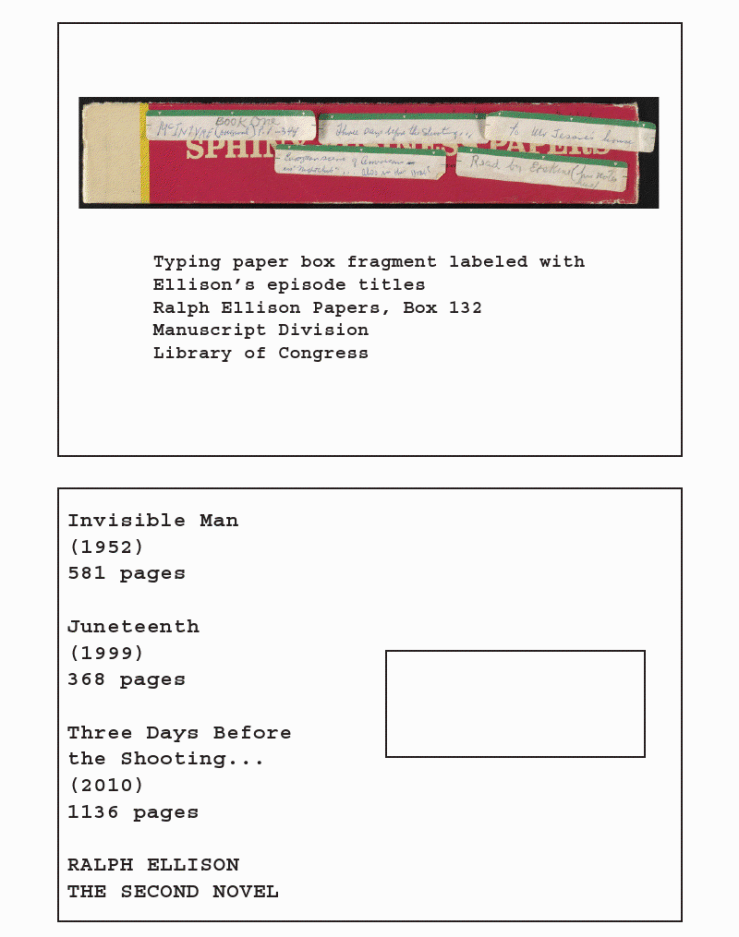
So we were still a little confused. Was Three Days Before the Shooting… a more complete version of Juneteenth, or a wholly separate novel? A week or two later, a third postcard showed up with some answers: Ralph Ellison’s Three Days Before the Shooting… is a re-edit of the material originally presented as Juneteenth back in 1999, expanded from 368 pages to 1136 pages. Hopefully, Ellison’s vision will be restored here. Modern Library plans to release Three Days Before the Shooting… in late January of 2010.

Don DeLillo‘s newest novel Point Omega (sounds like some G.I. Joe shit) will drop in early February of 2010. It’s a slim 128 pages, a novella really, which might be a nice change of pace. Here’s the cover:

Wells Towers had something of a hit this year with his collection of short stories, Everything Ravaged, Everything Burned, but maybe you didn’t read it because it was in oh-so cumbersome hardback. Thankfully, Picador will release Everything Ravaged in trade paperback in February of 2010. In the meantime, check out Chris Roth’s short adaptation of the title story:

There’s no release date yet for Jonathan Franzen‘s forthcoming novel Freedom, but it should come out next year. The novel is Franzen’s follow-up to his breakout hit, The Corrections. Can’t wait an indeterminate measure? The New Yorker published an excerpt called Good Neighborsearlier this year.

We began with a posthumous novel and will end with one: David Foster Wallace’s The Pale King may or may not come out in 2010 (some websites are citing 2011 now). We will not parse through the problems of unfinished, post-death work here but simply say we want to read it. We were intrigued by–and enjoyed–the portions of the novel that have been published thus far, and we love Wallace, and we’re greedy, and we want more.
(An Incomplete List of) Writers Who Died in 2009

John Updike

Blair Lent

Hortense Calisher

John Mortimer

Philip José Farmer

James Purdy

Billy C. Clark

Horton Foote

Santha Rama Rau

J.G. Ballard

Eve Kosofsky Sedgwick

Bob Hamm

Tim Guest

Gordon Burn

Frank McCourt

Stanley Middleton

E. Lynn Harris

Jim Carroll

Keith Waterhouse

William Safire

William Hoffman

Lionel Davis

Norma Fox Mazer

Claude Lévi-Strauss

Raymond Federman

Christopher Anvil

Robert Holdstock

D0nald Harington

Stephen Toulmin

Milorad Pavić

The Best Books We Abandoned in 2009

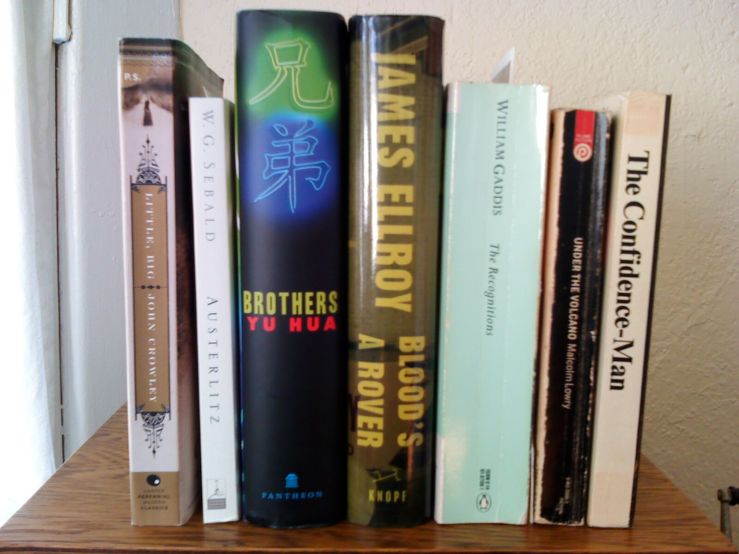
It’s an old story. Or maybe it’s just a common story. Anyway, Biblioklept World Headquarters, as one might reasonably expect, is larded with books, bursting at metaphorical seams, etc. Bibliophilia, that terrible disease, drives us to buy new (and old books) with a ridiculous frequency, a frequency that could never match a realistic able-to-be-read-in-the-allotted-time-we-have-to-read matrix. The Biblioklept Mission to review new books ironically compounds this problem. Advance review copies and galleys arrive, solicited or no, with publication dates stamped boldly on publicity sheets, publication dates that remind the reviewer that timeliness matters, that a Serious Editor would get out reviews in a Timely Manner. So. What happens? You know what happens, dear reader: books begun with the best intentions are brushed aside for just a week so that forthcoming novels might be appraised; but rhythm is lost; narrative drops away. We lose the thread. And before you know it, another set of new books crowds the doorstep. The following books were all great, in so far as we got into them, and we will do our best to finish them sometime in the near future.

The Recognitions — William Gaddis

We had the foresight to review the first book of this massive, massive novel. The first chapter is probably the best thing we read all year, but the book seemed to lose some of that initial energy, instead settling into a frustrating and ungenerous rhythm. But there we go, blaming the book, when its difficulty was also very rewarding. It’s embarrassing really. We read 342 of the book’s 956 pages and then turned our attention, for just a second, to a few new paperbacks, and poof! — we lost it.

The Confidence Man — Herman Melville

We got about 50 pages into the Norton annotated edition we found for a dollar at the Friends of the Library sale. And that was that. Will try again in 2010.

Under the Volcano — Malcolm Cowley

We’d been wanting to read this for awhile now, after reading David Foster Wallace cite it as a special kind of book, or a book that needed to be read (or maybe he said it was a book that people needed to be made to read . . . Hang on, was it even Wallace who told us to read it?) Abandoned about 30 pages in.

Little, Big — John Crowley

Little, Big is the one on this list that we’ll take for granted is as good as everyone says it is. We tried to read it with the AV Club’s book club, Wrapped Up In Books, but no. Harold Bloom says it’s one of his favorites, too. We got about 60 pages in, but it wasn’t exactly compelling, and Crowley’s rhetorical style was kinda infuriating in its contrived simplicity. The only book on this list we willingly put down.

Brothers — Yu Hua

We got over 100 pages into this ribald satire, but again, put it down to read a book about the moral panic comic books inspired. Probably the best unsolicited review copy we got this year. We should really go pick it up again . . .

Blood’s A Rover — James Ellroy

We read a 100 pages of Blood’s A Rover and then challenged traditional ethical notions of book reviewery and posted a review. We continued to read and then–viola!–the audiobook version came out. So, depending on how you view these things, we either technically did or did not abandon this fine crime procedural.

Austerlitz — W.G. Sebald

Oh the shame of it all. Stuck 158 pages into Sebald’s 298 page chronicle of the displaced orphan Austerlitz. The bookmark’s still there and everything. We read most of those 158 pages in two afternoon sittings. Then some book or other arrived (two, actually: Lethem’s Chronic City and Fallada’s Every Man Dies Alone). Sebald’s The Rings of Saturn is easily one of our favorite books, but it was divided into, y’know, paragraphs, sections, and chapters. Austerlitz is not–not even paragraphs. There are Sebald’s trademark black and white photos to occasionally break up the text, but otherwise, no, just long, long, chunks of texts that diverge and move through space, time, and voices. And while the book is very good, it also requires sustained concentration. It doesn’t want you cheating on it with another book. It’s quite selfish. But there are still a few days left in the year, and perhaps we’ll finish it one afternoon–although a quick glance over page 158 reveals that we are stuck in the text’s inertia.

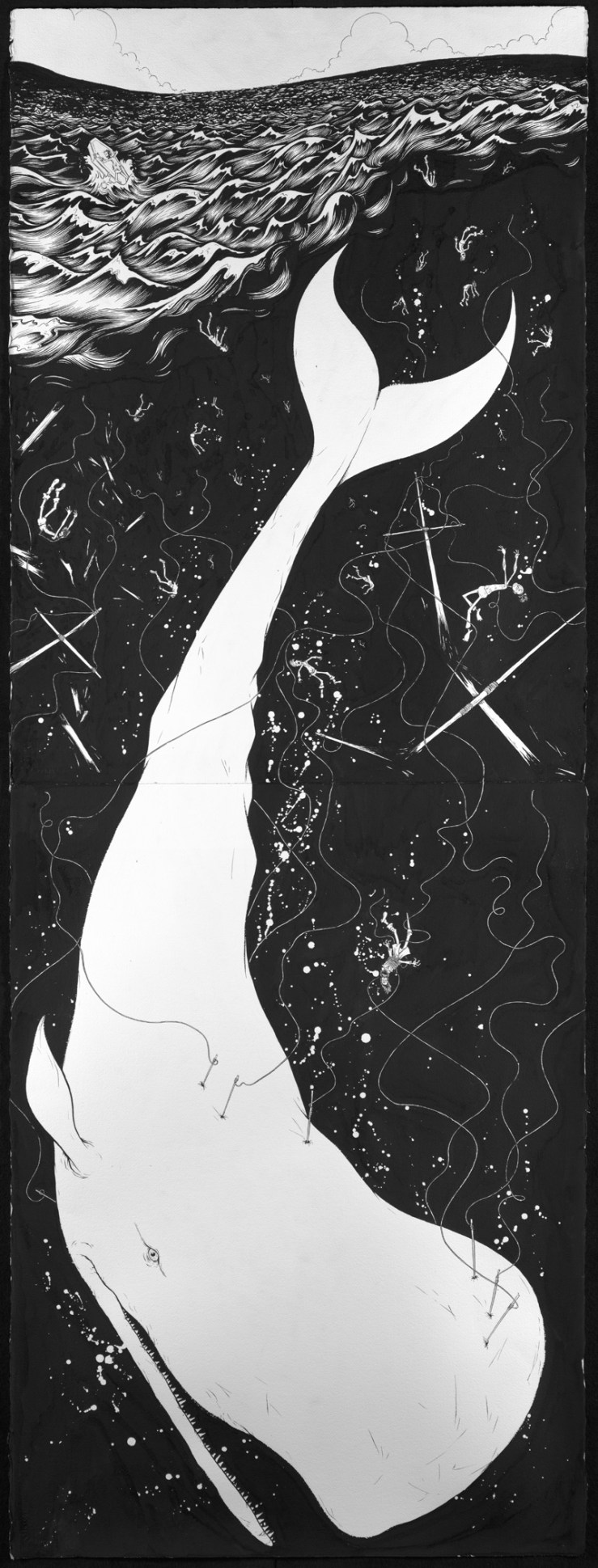
And I Only Am Escaped Alone to Tell Thee

Illustration of Moby Dick by Tom Neely

“little tree” — e.e. cummings

little tree
little silent Christmas tree
you are so little
you are more like a flower
who found you in the green forest
and were you very sorry to come away?
see          i will comfort you
because you smell so sweetly
i will kiss your cool bark
and hug you safe and tight
just as your mother would,
only don’t be afraid
look          the spangles
that sleep all the year in a dark box
dreaming of being taken out and allowed to shine,
the balls the chains red and gold the fluffy threads,
put up your little arms
and i’ll give them all to you to hold
every finger shall have its ring
and there won’t be a single place dark or unhappy
then when you’re quite dressed
you’ll stand in the window for everyone to see
and how they’ll stare!
oh but you’ll be very proud
and my little sister and i will take hands
and looking up at our beautiful tree
we’ll dance and sing
“Noel Noel”

Matt Kish Illustrates Moby-Dick, One Page at a Time

So, I’m on my fourth trip through Herman Melville’s masterpiece, Moby-Dick, courtesy of an excellent unabridged audio version read with aplomb, gusto, humor, and great pathos by the late character-actor William Hootkins. I’ll’ go out on a limb and suggest that Hootkins’s reading is so nuanced and attuned to Ishmael’s voice and Melville’s purpose that it would make a great starting point for anyone (unnecessarily) daunted by Melville’s big book.

I’ve been enjoying the book more than ever this time, in part because, knowing its themes, plot, and tone, I can relax a bit more and enjoy its nuance and humor, its weird little nooks and crannies. I’m also really digging Matt Kish’s mixed-media illustrations for the book. Kish is illustrating each page of his 552 page Signet Classics Edition–the same edition I used for a graduate seminar years ago. Kish’s art is fresh, fun, and invigorating; it’s also quite thoughtful in its interpretation of Melville’s text, and never fussy. You can check out an easy-to-use visual index here, or visit his blog here.

Page 046 : "...and from the shuddering cold and blackness of the sea, the whale came breeching up

“All That” — Another Excerpt from DFW’s The Pale King

The New Yorker recently published another excerpt from David Foster Wallace’s forthcoming posthumous novel, The Pale King. Their editors (?) are calling it “All That.” Here’s the first two paragraphs, although, if you’re a DFW fan you’ve probably already gone to the full excerpt:

Once when I was a little boy I received as a gift a toy cement mixer. It was made of wood except for its wheels—axles—which, as I remember, were thin metal rods. I’m ninety per cent sure it was a Christmas gift. I liked it the same way a boy that age likes toy dump trucks, ambulances, tractor-trailers, and whatnot. There are little boys who like trains and little boys who like vehicles—I liked the latter.

It was (“it” meaning the cement mixer) the same overlarge miniature as many other toy vehicles—about the size of a breadbox. It weighed three or four pounds. It was a simple toy—no batteries. It had a colored rope, with a yellow handle, and you held the handle and walked pulling the cement mixer behind you—rather like a wagon, although it was nowhere near the size of a wagon. For Christmas, I’m positive it was. It was when I was the age where you can, as they say, “hear voices” without worrying that something is wrong with you. I “heard voices” all the time as a small child. I was either five or six, I believe. (I’m not very good with numbers.)

The New Yorker published another excerpt from The Pale King they called “Wiggle Room” back in March, and a piece called “Good People” back in 2007. Harper’s ran another excerpt called “The Compliance Branch” last year, but you have to subscribe to read it.

Let’s Not Be Pretentious

Mónica Maristain interviewing Roberto Bolaño, collected in Roberto Bolaño: The Last Interview:

MM: John Lennon, Lady Di, or Elvis Presley?

RB: The Pogues. Or Suicide. Or Bob Dylan. Well, but let’s not be pretentious: Elvis forever. Elvis and his golden voice, with a sheriff’s badge, driving a Mustang and stuffing himself with pills.

“The Son Never Asked to Be Born” — Roberto Bolaño’s Parenting Advice

Roberto Bolaño, from an interview with Eliseo Álvarez, republished this month in Melville House’s Roberto Bolaño: The Last Interview:

I suppose that within his brutality and his courage–he is a very courageous man–my father loved me as I love my son. In the end, one could talk for hours about the relationship between a father and a son. The only clear thing is that a father has to be willing to be spat upon by his son as many times as the son wishes to do it. Even still the father will not have paid a tenth of what he owes because the son never asked to be born. If you brought him into this world, the least you can do is put up with whatever insult he wants to offer.

Okay, so sons didn’t ask to be born, but what about daughters? How did Bolaño feel about his daughter?

I won’t say anymore. I’ll start to cry. The only explanation I could give would be to cry. It’s beyond the beyond.

Reading these quotes, I thought about two of my favorite depictions of fathers and children in Bolaño’s work. First, there’s Bolaño as the son, “B,” in the title track from the collection Last Evenings on Earth. The story is a strange mix of sinister and funny, with the (perhaps overly literary) son fearing for his dad, a boxer who, at least in the son-narrator’s view, doesn’t seem to be paying attention to just how bad things seem to be turning on the pair’s vacation to Acapulco. Then there’s (possibly) Bolaño as parent, this time in the form of Oscar Amalfitano in 2666. If Bolaño would cry for his daughter’s safety, for anxiety and wariness of a cruel world, then Amalfitano becomes a literary center for those fears. And, if you’ve read that book, you know his paranoia is justified. In any case, it’s clear that Bolaño loved his children deeply. In another of the the book’s interviews–literally, “The Last Interview,” Bolaño, the exile who lived everywhere said, “my only country is my two children.” He even asked that his masterpiece 2666 be divvied up into five parts in the hopes that it would provide steady income for his son and daughter.

For more about Bolaño, check out Tom McCartan’s fantastic limited-run series, “What Bolaño Read.” We’ll do our best to get a full review out before McCartan (who annotated The Last Interview, by the way) addresses everything in the book.

Art Is The Proper Task of Life

Portrait of Nietzsche by Damon Soule

Literature Is Not Made From Words Alone

Roberto Bolaño, in a 2002 interview, tells us that

. . . literature is not made from words alone. Borges says that there are untranslatable writers. I think he uses Quevedo as an example. We could add García Lorca and others. Notwithstanding that, a work like Don Quijote can resist even the worst translator. As a matter of fact, it can resist mutilation, the loss of numerous pages and even a shit storm. Thus, with everything against it–bad translation, incomplete and ruined–any version of Quijote would still have very much to say to a Chinese or an African reader. And that is literature.

The interview, conducted by Carmen Boullosa, was originally published in Bomb. It’s now collected along with three other interviews, all meticulously annotated (there’s also a fabulous introductory essay by Marcela Valdes) in a collection called Roberto Bolaño: The Last Interview, new from Melville House. While you’re browsing Melville House, I highly, highly recommend Tom McCartan’s column “What Bolaño Read,which will be ongoing through next week. Great stuff. Biblioklept will run a proper review of The Last Interview later this week (no big surprise for regular ‘klept readers: I love it. Get it. Read it. Give it to the Bolaño fanatic in your life), but in the meantime, back to the quote.

I’ve written so much about Bolaño over the past year yet I’ve never really reflected on his English translators, Chris Andrews (the shorter works) and Natasha Wimmer (the long books), probably because I wouldn’t know how to begin. Reading interviews with Andrews and Wimmer (links above) is enlightening. Andrews attests that he tries to avoid “a translation that is unduly distracting,” and remarks on Bolaño’s epic syntax. Wimmer says she simply tried “to follow Bolaño’s lead,” but admits to her reviewer that she might have missed some puns (“Missing things like that is the translator’s great dread, but it’s probably inevitable occasionally, especially with Bolaño”). In both of the interviews, Bolaño’s translators come off as critical readers whose love of their source material is clearly at the forefront of their project. I have to believe–and have to is the operative term here–that their translations are faithful to Bolaño’s text (and spirit), that they are not, to use the man’s term, a “shit storm” on his oeuvre. But, given Bolaño’s own definition of “literature,” I’d also aver that his masterpiece 2666 could weather any shit storm (hell, the thing was, I suppose, technically incomplete at his death). In any case, I find Bolaño point reassuring, not just in light of his own work, but also within the context of a greater canon of world literature. His suggestion that real literature speaks beyond “words alone,” that storytelling is more than mere verbal tricks and schemes, should be an affirmation to anyone who’s ever been unsure that he’s properly “got” Kafka or Haruki Murakami or Dostoevsky or whomever. And I like that idea quite a bit.

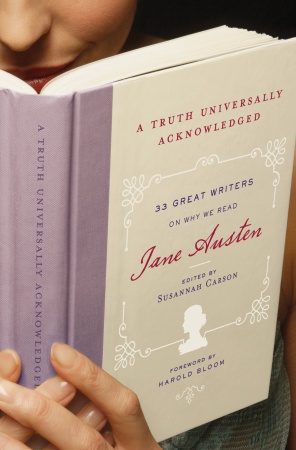
A Truth Universally Acknowledged — 33 Great Writers on Why We Read Jane Austen

In A Truth Universally Acknowledged, editor Susannah Carson collects thirty-three short essays on Jane Austen. In her introduction, Carson notes that each “of these essayists has taken a shot at defining and explaining Austen’s place both in the literary canon and in the cultural imagination.” And while there’s no mention of Austen’s recent tangles with zombies and sea monsters, the collection does cover quite a route of the cultural imagination that Carson promises. How could it not? There are short (and longish) essays from E.M. Forster, W. Somerset Maugham, Martin Amis, and C.S. Lewis, all proffering different reasons why Austen rules. Contemporary writer Susanna Clarke scolds those of us who might mistake film and TV adaptations as authentic representations of the lady’s work: “Austen wasn’t a visual writer,” Clarke writes, ” Her landscapes are emotional and moral–what we would call psychological.” Harold Bloom goes as far as to suggest that, “Like Shakespeare, Austen invented us.” Bloom’s usual Oedipal anxiety manifests itself in a more palatable line: “Because we are Austen’s children, we behold and confront our own anguish and our own fantasies in her novels.” (Never fear, Bloom gets some axe-grinding in as well: “Those who read Austen ‘politically’ now are not reading her at all.” Thank you again, oh great master critic, for telling us how to read our books). Benjamin Nugent gets pragmatic, seeing Pride and Prejudice as something of a self-help book: “Young nerds should read Austen because she’ll force them to hear dissonant notes in their own speech they might otherwise miss, and open their eyes to defeats and victories they otherwise wouldn’t even have noticed.” One of our favorite writers, Eudora Welty, writes a loving appreciation of the marvel of just how Austen constructed the complex ironies of her works: “Each novel is a formidable engine of strategy.” Rebecca Mead’s “Six Reasons to Read Jane Austen” is both funny and convincing. Reason four: “Because we are made to in school.” Mead’s little essay would be a worthy primer for any high school senior dreading wading into Pride and Prejudice. The great American critic Lionel Trilling points out, as those high schoolers know, that Pride and Prejudice “is the one novel in the canon that ‘everybody’ reads.” He wants you to know that of “Jane Austen’s six great novels, Emma is surely the one that is most fully representative of its author.” He makes a good case for this argument as well, comparing it to the “difficult” books of Proust, Joyce, and Kafka–company that we don’t always associate with Austen. Indeed, many of the essays here focus on Austen’s lesser-read volumes–Mansfield Park, Northanger Abbey, Emma–and to a positive end: these essayists will make you want to read these books. And isn’t that what real literary criticism should aim to do anyway–make the reader read the book herself, think critically about it herself? While Austen is hardly in need of a revival, A Truth Universally Acknowledged does a lovely job of balancing academic criticism with a popular appeal. Like Austen’s own work, it tempers social critique with sharp humor. A Truth will, of course, appeal mostly to Austen fans (many of whom will surely find it indispensable), but it’s also the sort of volume that will find a place in the hearts of those who simply love to read great writers writing about great writers. Recommended.

A Truth Universally Acknowledged is new in hardback this month from Random House.

Bibliokitchen: Mulatto Rice

At the beginning of Zora Neale Hurston’s novel Their Eyes Were Watching God, Janie returns from the Everglades to Eatonville in ragged overalls to a gossipy and unwelcoming town. The one exception is her best friend Phoeby, who brings Janie a “heaping plate of mulatto rice.” Janie gobbles up the simple, delicious meal, even as Phoeby notes that it “ain’t so good dis time. Not enough bacon grease.” She does however concede that “it’ll kill hongry.” No doubt.

We’ve always been intrigued by mulatto rice. What could it be? Is the dish still around today, but under a new name? Although the term “mulatto” has fallen into disuse, and perhaps distaste (just ask Larry David if you don’t believe us), organizations like mulatto.org have also taken a certain ownership of it. For Hurston, mulatto rice is a positive thing. Hurston could have had Phoeby bring any number of dishes to her friend Janie, so it’s telling that she chooses “mulatto rice” as a homecoming meal. The dish represents a communion, an admixture that reflects Janie’s multiracial identity as well as her resistance to gender-typing. “Mulatto” is also probably etymologically akin to the word “mule,” and if you’ve read Eyes, you know that mules are a major motif in the story. But enough literazin’.

Down to the nitty-gritty–we made up a mess of mulatto rice tonight thanks to a recipe from The Savannah Cook Book by Harriet Ross Colquitt. Not that we found this 1933 cookbook ourselves. No, the real merit here goes to the very cool website Take One Cookbook, which explores the history and culture and sociology behind old, weird cookbooks–all while making the recipes. Colquitt’s recipe, via Wendy at Take One Cookbook (see Wendy’s version here):

Mulatto Rice

This is the very chic name given to rice with a touch of the tarbrush.

Fry squares of breakfast bacon and remove from the pan. Then brown some minced onion (one small one) in this grease, and add one pint can of tomatoes. When thoroughly hot, add a pint of rice to this mixture, and cook very slowly until the rice is done. Or, if you are in a hurry, cold rice may be substituted, and all warmed thoroughly together.

The rice is very easy to make and very, very tasty. We substituted green onions for a small onion, and used a hickory-smoked bacon that infused the rice with a lovely sweetness (we also included a tablespoon of brown sugar right after the tomatoes). We served the dish, pictured above, with ham steaks and fried green tomatoes with a spicy yogurt sauce. Hearty and rich and satisfying–just the sort of thing one wants to eat after a soul-searching quest (or maybe just a long day). Recommended.

Plazoleta Julio Cortázar

Big thanks go out to Biblioklept correspondent Nicky Longlunch for this inspiring photo of Plazoleta Julio Cortázar. On special assignment in Buenos Aires, Longlunch visited the plaza, supposedly the bohemian heart of a hip neighborhood. Will Longlunch manage to photograph the school and library that also bear the name of this famous Argentine writer? We wait to see. This also reminds us that we should give Hopscotch another tangle.

Best of the Aughties

So, this is Biblioklept’s 500th post [pauses for applause].

Thank you, thank you. To mark the special occasion, we’ve artfully and scientifically compiled a list of the best stuff of the aughties (or 2000s, or whatever you want to call this decade that’s ending so soon). We know the year’s not over yet, and we readily admit that our list is incomplete: we didn’t read every book published in the decade, listen to every record, watch every film, etc. So, feel free to drop a line and let us know who we forgot (or, perhaps, snubbed).

Here, in no particular order, is the best of the past decade:

Picture 1

Roberto Bolaño’s 2666, Children of Men, The Fiery Furnaces, The Wire, Kill Bill, Sen to Chihiro no Kamikushi (Spirited Away), The Believer, Peter Jackson’s The Lord of the Rings trilogy, Beyoncé’s “Single Ladies” (and its marvelous video), David Foster Wallaces’s essays in Consider the Lobster, Denis Johnson’s Tree of Smoke, Animal Collective, Barack Obama, Terrence Malick’s The New World, Mad Men, Deadwood, Dave Chappelle, Curb Your Enthusiasm, Mitch Hedberg, R. Kelly, YouTube, Drag City Records, Cormac McCarthy’s The Road, Nathan Rabin’s “My Year of Flops,”

Picture 2

Chris Adrian’s The Children’s Hospital, Extras, Harry Potter on Extras, Dave Eggers’s A Heartbreaking Work of Staggering Genius, Missy Elliott’s “Get Ur Freak On,” Wong Kar-wai’s In the Mood for Love, Pixar movies–especially the latest three: WALL-E, Up, and Ratatouille, McSweeney’s #13 (the Chris Ware Issue), Jimmy Corrigan, the Smartest Kid on Earth, that time the Shins were on Gilmore Girls, the first six episodes of The OC, Arrested Development, Nintendo Wii, Andre 3000’s “Hey Ya!,” The Office, Will Ferrell, Bob Dylan’s Theme Time Radio Hour, Picador Books, Donnie Darko,

Picture 3

Veronica Mars, The Venture Brothers, Home Movies, the third Harry Potter movie, Wikipedia, Bob Dylan’s Chronicles, Jonathan Lethem’s The Fortress of Solitude, DFW’s Oblivion, especially “The Suffering Channel,” Wallace’s 2005 Kenyon commencement address, Wonder Showzen, Toni Morrison’s A Mercy, the totally goofy but totally fun troubadour sequence from Gilmore Girls with Yo La Tengo, Thurston, Kim, and daughter Coco Haley, and Sparks jamming, OutKast’s Stankonia, Pan’s Labyrinth, The Devil’s Backbone, The Orphanage, Cat Power’s “Willie Deadwilder,”Flight of the Conchords, Girl Talk’s Night Ripper, The Daily Show with John Stewart, The Colbert Report,

Picture 4

Andy Samberg’s Digital Shorts, Autotune the News, Tim Tebow, Panda Bear’s Person Pitch, Nels Cline’s guitar solo in “Impossible Germany,” Judd Apatow, Be Kind Rewind, Eternal Sunshine of the Spotless Mind, Thrill Jockey Records, I Heart Huckabees, Chris Bachelder’s U.S.!, David Lynch’s INLAND EMPIRE, Fennesz’s Endless Summer, Gmail, the Coens’ No Country for Old Men, MF Doom (all iterations), Broken Social Scene’s You Forgot It in People, Satrapi’s Persepolis, UGK’s “International Player’s Anthem,” Bob Dylan’s “Things Have Changed,” Bonnie “Prince” Billy,

Picture 5

The Silver Jews’ Tanglewood Numbers, lolcatz, Once, Lynch’s Mulholland Drive, the Coens’ O Brother, Where Art Thou?, web two point oh, 30 Rock, Belle & Sebastian’s “Stay Loose,” It’s Always Sunny in Philadelphia, Philip Pullman’s The Amber Spyglass, Werner Herzog’s Grizzly Man, WordPress, Jim O’Rourke’s Insignificance, the first season of Battlestar Galactica, Superbad, half a dozen or so short stories by Wells Tower, David Cross’s Shut Up, You Fucking Baby!, Drunk History, the action sequence at the end of Tarantino’s Death Proof (and especially the joyous, headcrushing final shot), Slavoj Žižek’s Violence, The Royal Tennenbaums, the first 20 minutes of Gangs of New York,

Picture 7

Firefox, the increasing and continuing availability of English translations of authors like Roberto Bolaño and W.G. Sebald, Bill Murray, Margot at the Wedding, Rachel Getting Married, Top Chef, The Dirty Projector’s Bitte Orca, Battles’ “Atlas,” Revenge of the Sith, Sarah Vowell, Art Spiegelman’s In the Shadow of No Towers, Christoph Waltz’s bravura performance in Inglourious Basterds, the surreal animations of Carson Mell, Margaret Atwood’s Oryx and Crake, Tina Fey’s impression of Sarah Palin, David Mazzucchelli’s Asterios Polyp, Neko Case’s “Star Witness,” Jason Statham, The Pirate Bay,  HDTV, Charles Burns’s Black Hole, &c . . .

New Cormac McCarthy Interview

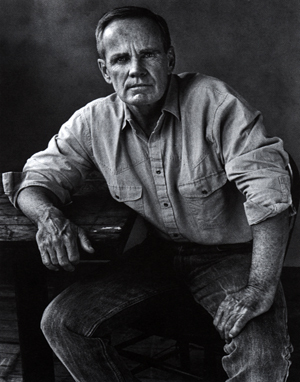
cormac-mccarthy-in-new-york11

There’s a very cool new interview with Cormac McCarthy, published yesterday at The Wall Street Journal, of all places. McCarthy speaks frankly about the movie adaptations of his work, including John Hillcoat’s upcoming (and long-delayed) adaptation of The Road. He also proffers this nugget, explaining why he prefers novels to short fiction: “Anything that doesn’t take years of your life and drive you to suicide hardly seems worth doing.” Sure. McCarthy also talks about the book he’s writing now: “It’s mostly set in New Orleans around 1980. It has to do with a brother and sister. When the book opens she’s already committed suicide, and it’s about how he deals with it. She’s an interesting girl.” But why are you still here? Go read the interview.

On Cult Books

I finished Lore Segal’s lovely and perplexing 1976 novella Lucinella today. It’s a witty and rewarding little book that deserves its own review, of course, and I’ll post one later this week. Lucinella is new in print again for the first time in a few decades courtesy of the good folks at Melville House Publishing. The jacket and the press release Melville House sent me both trumpet the book as a “cult classic.” I’ve been reading a number of so-called “cult books” lately–William Gaddis’s The Recognitions, Malcolm Lowry’s Under the Volcano, and John Crowley’s Little, Big. But I’m not really sure what a “cult book” might be. It got me to thinking, of course, and before I went to that ersatz oracle of our time (i.e., a Google search), I thought I’d try to define “cult book” in my own terms:

First, to be clear, a cult book is not (necessarily) a book about cults. It’s a book that has a cultish following (i.e., a group of devoted (perhaps obsessive) fans who work to push the work on anyone who will listen to them).

Second, cult books tend to address or include subject matters and issues outside of mainstream tastes (whatever that means). Of course, what’s open to public discourse changes over time, so what was once a cult book, over time, can soon move into mainstream or even canonical tastes. Hence, a large number of books and authors that once might have been cult are no longer cult.

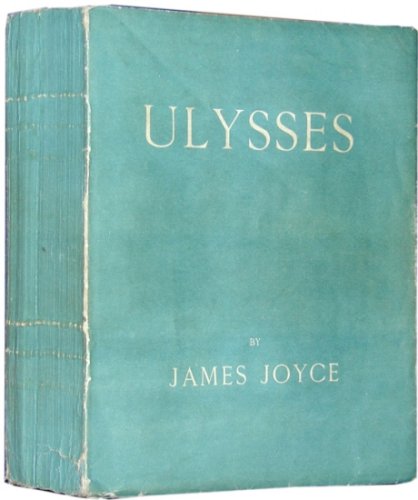
ulysses unrestored copy
First edition of Ulysses

But this doesn’t seem satisfactory: James Joyce’s Ulysses had to be initially smuggled into America; it’s now a canonical standard. William Burroughs’s Naked Lunch faced similar obscenity charges; decades later, Burroughs starred in a Nike ad. Yet, it seems that despite their eventual “mainstreaming” both books have something of a cult status–yet they don’t seem to need a cult the way that Gaddis or Lowry might. But what about Laurence Sterne’s Tristram Shandy? It clearly needs a cult to push it on people in the hopes of it actually being read, despite its canonical status. Which brings us to defining point three:

Third, the cult in question can not be purely academic. Faulkner would probably be a cult author if it weren’t for English professors and teachers with their syllabi and whatnot.

So, what is a cult novel? I have to think that, based on my definitions, cult status is always malleable. Thanks to the internet, readers have greater access to other readers, not to mention an exponentially expanded market of books to access. So I have to think back to high school and college, to those books that friends thrust on me, saying simply, “Read this, you have to,” books that I thrust on others, books that were secreted from hand to hand, clandestinely, until their covers had to be fixed with Duck tape. I think about Hunter S. Thompson’s Fear and Loathing in Las Vegas; anything by Kurt Vonnegut; Sylvia Plath’s The Bell Jar; anything by Charles Bukowski; Tropic of Cancer (or was it Tropic of Capricorn?). Antony Scaduto’s Bob Dylan biography made the rounds in my circle of friends, as did the Led Zep bio, Hammer of the Gods.

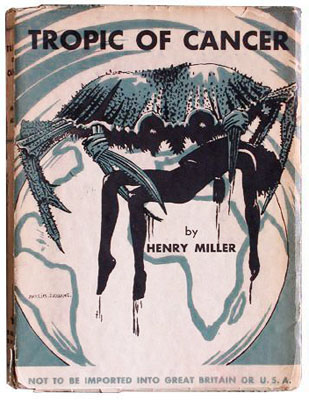
tropic-of-cancer
Note the warning that the book is verboten in the US and UK

There was also a pirate copy of The Anarchist Cookbook that someone had downloaded off of something called the internet (this was 1994 or 1995) and printed on a dot matrix printer. William Burroughs, of course. William Gibson. Anthony Burgess. Philip K. Dick. Cerebus. Aldous Huxley (especially Ape and Essence). Lolita. On the Road. Camus. Kafka. In college: John Barth’s Lost in the Funhouse. J.G. Ballard. Douglas Coupland. David Foster Wallace’s Girl with Curious Hair, a book literally pressed on me my freshman year by a friend who simply could not believe I had never read Wallace. To some embarrassment, I suppose, Irvine Welsh. Thomas Pynchon. Hofstadter’s Gödel, Escher, Bach. After college, a refinement I suppose (grad school ironing out some kinks of course): Blood Meridian. W.G. Sebald. Roberto Bolaño. Jorge Luis Borges. The list goes on; I’m sure I’m forgetting hundreds. (Normally, I’d hyperlink most of these authors and books to Biblioklept posts, but there’s just too many. Interested parties, if they exist, may use the search feature).

My list is pretty expansive I suppose (and it’s truncated to be sure), and I concede that the term “expansive” seems at odds with the term “cult.” It seems that all literature that lasts must first build a cult, and I guess that’s a good thing. Anyway–I eventually did google “cult novels” and here’s a few lists. Plenty of overlap with some of the above citations, and some stuff I didn’t think of as well. Also, stuff that I think is too canonical, but, again, make up your own mind:

The Telegraph‘s 50 Best Cult Books

The Cult’s List (chuckpalahniuk.net)

We like this one from Books and Writers

And of course, we’d love to hear from you, dear reader.