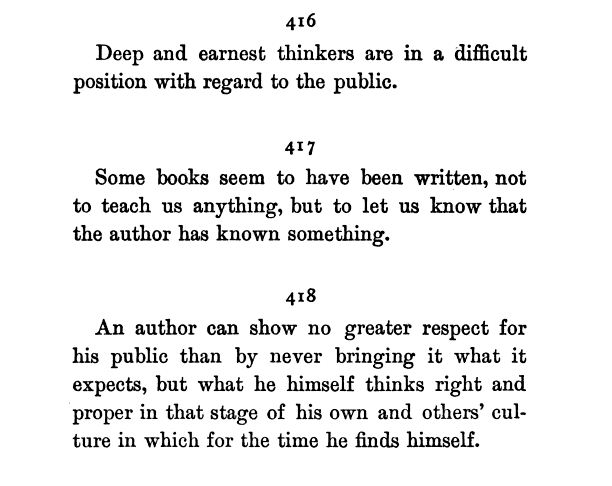
Three Aphorisms on Writing (Goethe)

George Washington’s Rules of Civility

(Non-manuscript, more legible version).

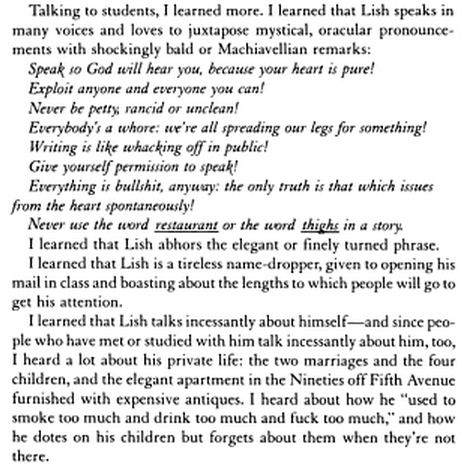
“What I Know About Gordon Lish” (1986 Spy Magazine Feature)

From a 1986 Spy magazine feature on editor/writer/hero Gordon Lish:

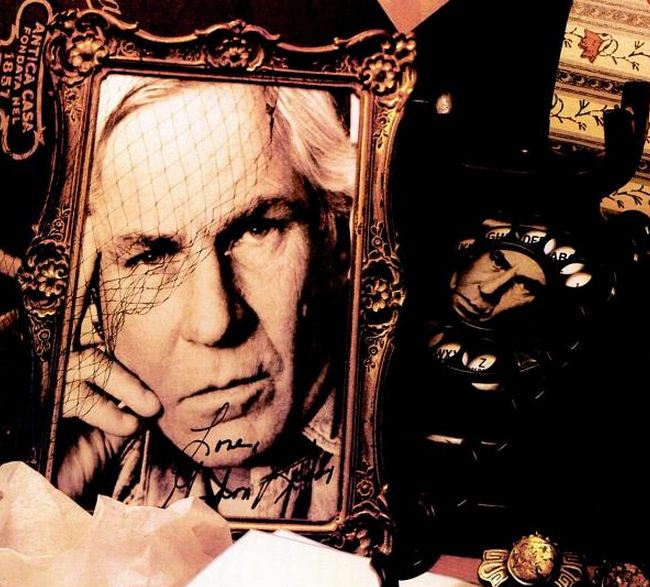
Henry Miller Riffs on Nietzsche and Dostoevsky (Film)

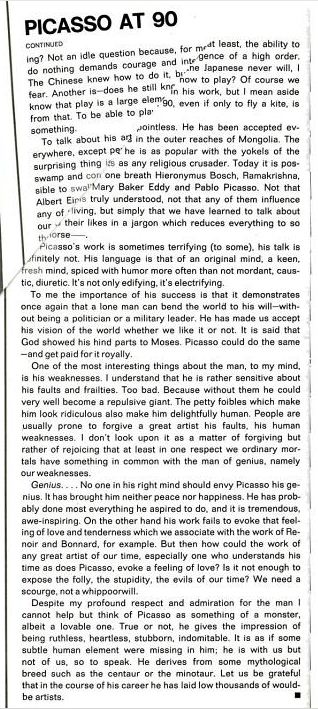
“Picasso at 90” — Henry Miller (1971 LIFE Magazine Profile)

“Picasso at 90” is an October, 1971 profile on the artist by Henry Miller, presented here via Google Books. In a felicitous cubist twist, the second page of the article (featuring the full portrait of Picasso and, on its back, the column of text) seems to have been cut (or ripped) and then repaired.

Does Bret Easton Ellis Consider Himself a Serious Novelist?

INTERVIEWER

Do you not consider yourself a serious novelist?

ELLIS

I recently got into one of those weird, terrible fights writers can find themselves in with a friend who has for a long time been writing novels he can’t get published. For twenty-five years I’ve been trying to help him. He can’t rise to the occasion. He can’t write a novel because he doesn’t have the passion to write a novel. He’s writing a novel to make the money, get the film rights, become famous, whatever—all the wrong reasons. When he asked me to read the latest one, I told him, “Look, if this novel is superpassionate, and it really is about shit you’re going through, and pain, and it means the fucking world to you, by all means send it to me.” He said, “Yeah, it’s totally all those things,” and he sent it to me, and it was absolutely like all the others. I flipped out. I went ballistic on him. I said, “You never took this seriously! From the time you were twenty-three, it was always some kind of sterile exercise, like an imitation of a novel. And you never talk passionately about writers. I never hear you talk about books you’re reading. You just saw that a young writer in the eighties could make some cash from a literary novel. It was moneymaking to you.” And my friend was shocked, or pretended to be. “You know, it’s really amazing to hear you say that, Bret, because looking at your career and reading your books, I never thought you actually took it seriously. I saw your books as trendy knockoffs. I saw you as kind of a hack. I never thought you were really serious.” I mean, he’s not representative of the kind of person anyone should take seriously in literary matters, but when my friend said that, I’ll admit it gave me pause. I thought, What does it mean to be a “serious” novelist? Regardless of how my books have turned out, or how some people might have read them, I clearly don’t think I write trendy knockoffs. My books have all been very deeply felt. You don’t spend eight years of your life working on a trendy knockoff. In that sense I’ve been serious. But I don’t do lots of things that other serious ­writers do. I don’t write book reviews. I don’t sit on panels about the state of the novel. I don’t go to writer conferences. I don’t teach writing seminars. I don’t hang out at Yaddo or MacDowell. I’m not concerned with my reputation as a writer or where I stand relative to other writers. I’m not competitive or professionally ambitious. I don’t think about my work and my career in an overarching or systematic way. I don’t think about myself, as I think most writers do, as progressing toward some ideal of greatness. There’s no grand plan. All I know is that I write the books I want to write. All that other stuff is meaningless to me.

From Ellis’s Paris Review interview.

“The modern novel should be largely a work of reference” (Flann O’Brien)


In reply to an inquiry, it was explained that a satisfactory novel should be a self-evident sham to which the reader could regulate at will the degree of his credulity. It was undemocratic to compel characters to be uniformly good or bad or poor or rich. Each should be allowed a private life, self-determination and a decent standard of living. This would make for self-respect, contentment and better service. It would be incorrect to say that it would lead to chaos. Characters should be interchangeable as between one book and another. The entire corpus of existing literature should be regarded as a limbo from which discerning authors could draw their characters as required, creating only when they failed to find a suitable existing puppet. The modern novel should be largely a work of reference. Most authors spend their time saying what has been said before – usually said much better. A wealth of references to existing works would acquaint the reader instantaneously with the nature of each character, would obviate tiresome explanations and would effectively preclude mountebanks, upstarts, thimble-riggers and persons of inferior education from an understanding of contemporary literature. Conclusion of explanation.

—From Flann O’Brien’s novel At Swim-Two-Birds (1939).


Master Class with Charlie Kaufman (Göteborg International Film Festival 2011)

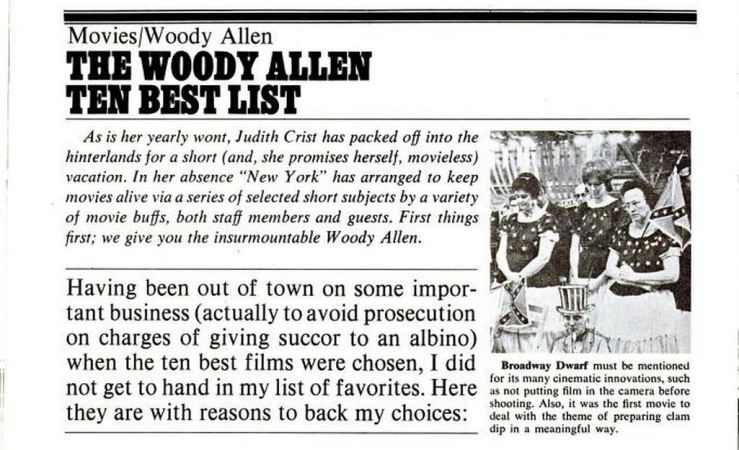
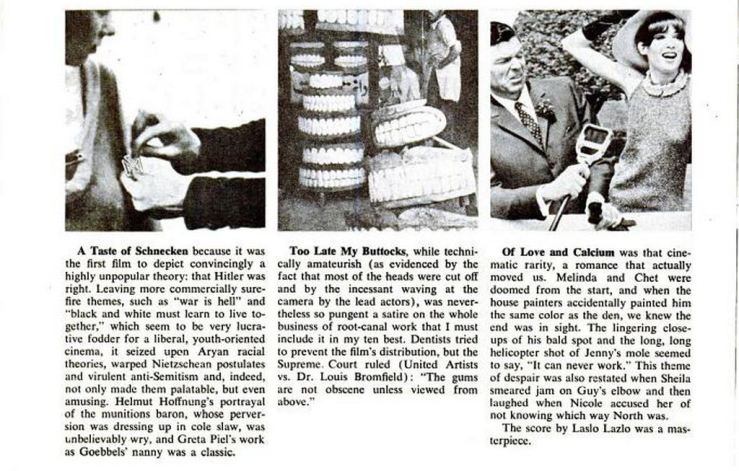
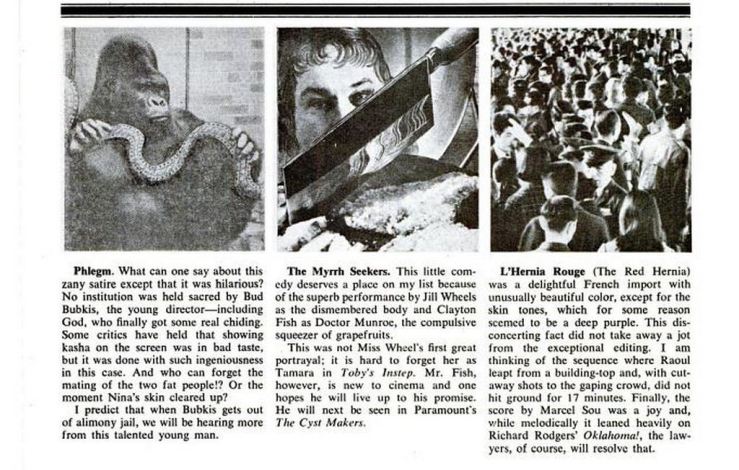
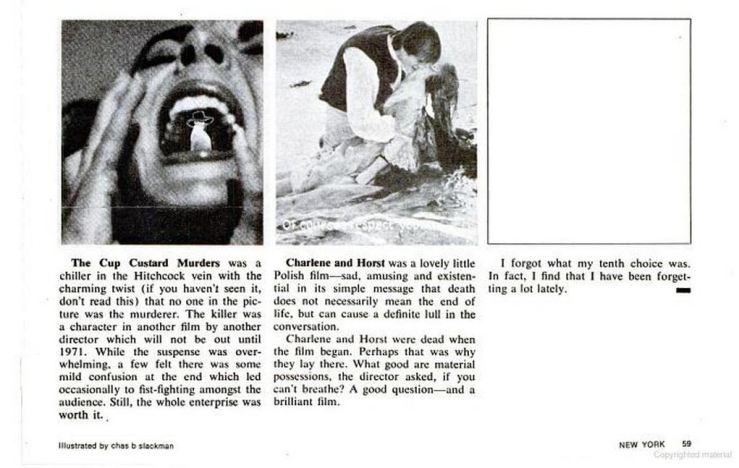
The Woody Allen Ten Best List

From New York Magazine, August 3, 1970. Via Matt Singer’s Twitter

Minor Works & Masterpieces — An Excerpt from Bolaño’s Novel 2666

Another stand-alone segment from Roberto Bolaño’s novel 2666—from “The Part About Archimboldi”:

Our hero Reiter (writer!)—who at this moment (or just before it, unbeknownst to the reader) adopts the ridiculous nom de thing Archimboldi (!!!)—secures a rented typewriter from a failed writer, an old man who takes the time to lecture on writing and camouflage and masterpieces and Jesus &c.—and writing as channeling (or maybe a type of divine madness), as a ventriloquist act (which I touched on here). (Perhaps I’m pushing the limits of copyright law here. Look, I think you should all buy and read this book and give copies to loved ones and enemies alike).

“I was a writer,” said the old man.

“But I gave it up. This typewriter was a gift from my father. An affectionate and cultured man who lived to the age of ninety-three. An essentially good man. A man who believed in progress, it goes without saying. My poor father. He believed in progress and of course he believed in the intrinsic goodness of human beings. I too believe in the intrinsic goodness of human beings, but it means nothing. In their hearts, killers are good, as we Germans have reason to know. So what? I might spend a night drinking with a killer, and as the two of us watch the sun come up, perhaps we’ll burst into song or hum some Beethoven. So what? The killer might weep on my shoulder. Naturally. Being a killer isn’t easy, as you and I well know. It isn’t easy at all. It requires purity and will, will and purity. Crystalline purity and steel-hard will. And I myself might even weep on the killer’s shoulder and whisper sweet words to him, words like ‘brother,’ ‘friend,’ ‘comrade in misfortune.’ At this moment the killer is good, because he’s intrinsically good, and I’m an idiot, because I’m intrinsically an idiot, and we’re both sentimental, because our culture tends inexorably toward sentimentality. But when the performance is over and I’m alone, the killer will open the window of my room and come tiptoeing in like a nurse and slit my throat, bleed me dry.

“My poor father. I was a writer, I was a writer, but my indolent, voracious brain gnawed at my own entrails. Vulture of my Prometheus self or Prometheus of my vulture self, one day I understood that I might go so far as to publish excellent articles in magazines and newspapers, and even books that weren’t unworthy of the paper on which they were printed. But I also understood that I would never manage to create anything like a masterpiece. You may say that literature doesn’t consist solely of masterpieces, but rather is populated by so-called minor works. I believed that, too. Literature is a vast forest and the masterpieces are the lakes, the towering trees or strange trees, the lovely, eloquent flowers, the hidden caves, but a forest is also made up of ordinary trees, patches of grass, puddles, clinging vines, mushrooms, and little wild-flowers. I was wrong. There’s actually no such thing as a minor work. I mean: the author of the minor work isn’t Mr. X or Mr. Y. Mr. X and Mr. Y do exist, there’s no question about that, and they struggle and toil and publish in newspapers and magazines and sometimes they even come out with a book that isn’t unworthy of the paper it’s printed on, but those books or articles, if you pay close attention, are not written by them.

“Every minor work has a secret author and every secret author is, by definition, a writer of masterpieces. Who writes the minor work? A minor writer, or so it appears. The poor man’s wife can testify to that, she’s seen him sitting at the table, bent over the blank pages, restless in his chair, his pen racing over the paper. The evidence would seem to be incontrovertible. But what she’s seen is only the outside. The shell of literature. A semblance,” said the old man to Archimboldi and Archimboldi thought of Ansky. “The person who really writes the minor work is a secret writer who accepts only the dictates of a masterpiece. Continue reading “Minor Works & Masterpieces — An Excerpt from Bolaño’s Novel 2666”

John Steinbeck on Work Habits

Mark Twain used to write in bed—so did our greatest poet. But I wonder how often they wrote in bed—or whether they did it twice and the story took hold. Such things happen. Also I would like to know what things they wrote in bed and what things they wrote sitting up. All of this has to do with comfort in writing and what its value is. I should think that a comfortable body would let the mind go freely to its gathering.

You know I always smoke a pipe when I work—at least I used to and now I have taken it up again. It is strange—as soon as a pipe begins to taste good, cigarettes become tasteless. I find I smoke fewer and fewer cigarettes. Maybe I can cut them out entirely for a while. This would be a very good thing. Even with this little change, my deep-seated and perennial cigarette cough is going away. A few months without that would be a real relief.

I have dawdled away a good part of my free time now carving vaguely on a scrap of mahogany, but I guess I have been thinking too. Who knows. I sit here in a kind of a stupor and call it thought.

Now I have taken the black off my desk again, clear down to the wood, and have put a green blotter down. I am never satisfied with my writing surface.

My choice of pencils lies between the black Calculator stolen from Fox Films and this Mongol 2 3/8 F which is quite black and holds its point well—much better in fact than the Fox pencils. I will get six more or maybe four more dozen of them for my pencil tray.

I have found a new kind of pencil—the best I have ever had. Of course it costs three times as much too but it is black and soft but doesn’t break off. I think I will always use these. They are called Blackwings and they really glide over the paper.

In the very early dawn, I felt a fiendish desire to take my electric pencil sharpener apart. It has not been working very well and besides I have always wanted to look at the inside of it. So I did and found that certain misadjustments had been made at the factory. I corrected them, cleaned the machine, oiled it and now it works perfectly for the first time since I have it. There is one reward for not sleeping.

Today is a dawdly day. They seem to alternate. I do a whole of a day’s work and then the next day, flushed with triumph, I dawdle. That’s today. The crazy thing is that I get about the same number of words down either way. This morning I am clutching the pencil very tight and this is not a good thing. It means I am not relaxed. And in this book I want to be just as relaxed as possible. Maybe that is another reason I am dawdling. I want that calmness to settle on me that feels so good—almost like a robe of cashmere it feels.

It has been a good day of work with no harm in it. I have sat long over the desk and the pencil has felt good in my hand. Outside the sun is very bright and warm and the buds are swelling to a popping size. I guess it is a good thing I became a writer. Perhaps I am too lazy for anything else.

On the third finger of my right hand I have a great callus just from using a pencil for so many hours every day. It has become a big lump by now and it doesn’t ever go away. Sometimes it is very rough and other times, as today, it is as shiny as glass. It is peculiar how touchy one can become about little things. Pencils must be round. A hexagonal pencil cuts my fingers after a long day. You see I hold a pencil for about six hours every day. This may seem strange but it is true. I am really a conditioned animal with a conditioned hand.

I am really dawdling today when what I want to write is in my head. It is said that many writers talk their books out and so do not write them. I think I am guilty of this to a large extent. I really talk too much about my work and to anyone who will listen. If I would limit my talk to inventions and keep my big mouth shut about work, there would probably be a good deal more work done.

The callus on my writing finger is very sore today. I may have to sandpaper it down. It is getting too big.

The silly truth is that I can take almost any amount of work but I have little tolerance for confusion.

From John Steinbeck’s 1969 interview in The Paris Review.

“This Is What All Good Writers Are Doing” — Tom McCarthy on Library as Source Code

A passage from Tom McCarthy’s essay “Transmission and the Individual Remix”:

This is what all good writers are doing, and always have been. Here I’d part company even with Robbe-Grillet: there is nothing “new” about this. Shakespeare was remixing Ovid, Plutarch, Holinshed, not to mention the authors of the King Leirs and Hamlets already in circulation when he penned his versions. Cervantes was remixing Montalvo, Ariosto, Apuleius, and any number of picaresque authors—and doing this with such delirious selfconcsiousness that at one point he even makes the characters of Don Quixote pause to take stock of the library, the engine room behind their mad associate’s reenactments, perusing it as though it were some kind of source code—which it is. Pound was remixing Villon, Daniel, and Sordello; De Mailla, Marco Polo, and Malatesta; Jefferson, Adams, and Jackson, merging all these feed together as he wound them through his typewriter, splicing them in with fragments of newsprint, shards of radio transmissions—merging them yet in a manner that made no attempt to mask their fragmentary, collated character, to “naturalise” them. With the Cantos, he kept up this furious enterprise for five whole decades, ramping its intensity up and up until the overload destroyed him, blew his mind to pieces, leaving him to murmur, right toward the end: “I cannot make it cohere.”

Josh Henkin Talks to Biblioklept About His New Novel, The World Without You

Joshua Henkin’s new novel, The World Without You, tells the story of the Frankels, a large Jewish American family who gather over the Fourth of July weekend to mourn the death of their son Leo, a journalist who was kidnapped and then murdered in Iraq. The World Without You is Henkin’s third novel after Matrimony and Swimming Across the Hudson. Henkin directs the MFA program in Fiction Writing at Brooklyn College. The World Without You is new in hardback from Pantheon. You can learn more about Henkin at his website. He was gracious enough to talk to me over a series of emails about writing, teaching, verb tense, sympathy, and his new novel.

Biblioklept: There’s a lot going on in The World Without You, but it seems to be essentially a novel about a family—what it means to be a family, what it means to be in a family, what it means to be in conflict with a family—where did the Frankels come from?

Josh Henkin: The most simple answer is, My imagination.  The Frankels aren’t based on anyone I know, and like all characters in fiction (at least the kind of fiction I write), they developed slowly over time; I discovered them in the writing process over the course of quite a number of years.  What I would say is that I think that in the same way that people speak of “rebound relationships,” I think of my novels as “rebound novels.”  Matrimony took place over twenty years and focuses on a small cast of characters, and I wanted to write something different this time.  So, whether consciously or not, I set out to write a book that was more compressed, on one hand (it takes place over 72 hours instead of over 20 years), and more spacious, on the other hand (there are many more characters, and we go into many points of view).  If you’re asking where the inspiration for the book came from, I’d say it came mostly from the following.  I had a first cousin who died of Hodgkin’s disease when he was in his late twenties. I was only a toddler at the time, but his death hung over my extended family for years. At a family reunion nearly thirty years later, my aunt, updating everyone on what was happening in her life, began by saying, “I have two sons….” Well, she’d once had two sons, but her older son had been dead for thirty years at that point. It was clear to everyone in that room that the pain was still raw for her and that it would continue to be raw for her for the rest of her life. By contrast, my cousin’s widow eventually remarried and had a family. This got me thinking how when someone loses a spouse, as awful as that is, the surviving spouse eventually moves on; but when a parent loses a child they almost never move on. That idea was the seed from which The World Without You grew. Although there are many tensions in the novel (between siblings, between couples, between parents and children), the original tension was between mother-in-law and daughter-in law, caused by the gulf between their two losses, by the different ways they grieve.

Biblioklept: You mention the compression of The World Without You, which here strikes me as form of realism. The book takes place over the July 4th holiday—why did you choose this setting? Was the Independence Day setting always part of your design?

JH: I knew I wanted a compressed period of time–mostly because Matrimony took place over twenty years and I think of books like relationships:  one book is a rebound from the previous one.  I also knew that I wanted the book to be told in many points of view; this, too, makes it different from Matrimony, which was told only in Julian and Mia’s points of view.  In terms of Independence Day, I think that was a little more unconscious, though probably intentional as well.  Part of the issue was a practical one:  how do you get a large, disperse family together in one place?  You need an occasion for the telling, and a holiday like July 4th provides one.  Though of course the real occasion for the telling is Leo’s memorial.  But I think even there Independence Day is relevant because although the book is obviously about the specific characters (I think all fiction worth its salt is always first and foremost about the particular, not the general), I do think this novel in its own indirect way is a novel about America more broadly, and certainly about a certain segment of America, of which I consider myself a part.  The Frankels are a political family, with strong opinions about Bush and about the Iraq War, but they’re also privileged.  They’ve really known no one who has fought in the war, have been insulated from it in their day-to-day lives–and then, with Leo’s death, it comes and touches them in the most horrific and personal way.  And I wondered what that’s like–to be mourning while the rest of the country is celebrating, to be commemorating the independence of a country that has sent its young men and women to war, a country that’s responsible for their son and brother’s death.

Biblioklept: You mention the Frankels’s privileged background. They are, for the most part, liberal, secular, refined. Leo dies in Iraq, but, significantly, he’s a journalist, not a soldier. Do you worry that not all readers will connect to these characters? How do you make your characters sympathetic—or does sympathy even matter in fiction?

JH: My feeling is that people are people, and they merit as little or as much sympathy as they merit whether they’re rich or poor, healthy or sick, beautiful or ugly.  There’s a strand of anti-elitism in American culture  (one can see it every day, tirelessly, in our politics), and one sees it, too, in certain attitudes toward literature–the idea being that only the humble, the uneducated are worthy of our fiction.  But I find the idea pretentious; it smacks of a kind of reverse snobbery.  And tell it, in any case, to Fitzgerald, or Cheever, or Yates.  One of the things good literature does is it humanizes people we might not otherwise be drawn to.  And (this is at least as important) it allows us to enjoy the company of people on the page whose company we might not enjoy off the page.  Which is another way of saying that sympathy doesn’t matter in fiction, at least not sympathy narrowly construed.  In fiction, as in life, some people are likable and some people aren’t likable, and the world would be boring if everyone were likable.  The fiction writer’s job is to make his characters complex, interesting, fully human, not (or at least not necessarily) likable.

Biblioklept: The World Without You is conveyed in the present tense. I’m curious what led you to compose in the present tense, or if you drafted parts of the novel in the past tense—what advantages can the present tense offer the writer and reader? What are its limitations?

JH: I think about tense a lot, probably because I teach fiction writing and, more specifically, because I direct Brooklyn College’s Fiction MFA program, and so I end up reading 500 application manuscripts a year, a good number of which are written in the present tense.  It’s said that present tense makes the story feel more immediate, yet year after year I notice among our graduate applications that the present-tense stories are usually the least immediate, most inert stories in the bunch.  Why is that?  I think it’s because some writers use present tense as a substitute for narrative, as a way of hiding that nothing is happening in their stories.  They think that if they write in present tense their stories will feel immediate.

I also think that present tense is deceptive because it’s easy in present tense to slip out of scene and into general/habitual time.  In the past tense, you would write “She went to the store on Tuesday” to suggest that the character is going to the store at a specific time.  If, on the other hand, you wanted to indicate repeated or habitual action, you would write, “She would go to the store on Tuesday.”  But in the present tense there generally isn’t such a distinction between the specific and the habitual.  “She goes to the store on Tuesday” can mean either that she’s going to the store right now on Tuesday or that she’s a habitual store-goer on Tuesdays.  I think what happens in present tense is that a lot of writers end up slipping into the habitual, and so what seems immediate is actually not at all immediate.

The other thing I’d say is that it’s very hard to write a present-tense novel that takes place over ten years because it’s likely to feel artificial for all that time to be in present tense.  Present tense works best, then, in novels and stories told in compressed time.

The World Without You simply came to me in present tense.  That was the tense that felt right for the book.  This may be true, in part, because I’d been influenced by Richard Ford’s Independence Day, another novel told over a single July 4th holiday that’s told in present tense.  But I think it’s more than that.  The World Without You takes place over 72 hours, so it’s ideally suited for present tense, and it’s also told in confined space; most of the book is situated in the Frankel family home and the streets that surround it in Lenox, Mass.  One thing I was trying to do was balance the sprawling quality of the book (there are many characters and lots of different points of view) with the more focused time and space that I just mentioned, and I think present tense allowed me to do that.  But all this is post-facto, a case of me looking back at what I did.  I proceeded intuitively, which is what I always do, and present tense simply felt right (it was the right sound, the right voice) for this book.

Biblioklept: You bring up your position as Brooklyn College’s MFA fiction program director—I’m curious if reading so many manuscripts affects your own writing.

JH: I love teaching, and that’s in large part because I get to teach some of the most talented young writers out there.  In the last few months alone, five of our recent MFA graduates have gotten book contracts.  There are writers who wouldn’t know how to teach; for them, writing is an intuitive process and they aren’t fully conscious of what they’re doing.  For me, it was the opposite.  I could read someone else’s short story and figure out what wasn’t working long before I could make things work in my own stories.  I needed to learn how to become a more intuitive writer, and critiquing other people’s stories helped me do that; it still helps me.  I’ve been at this process longer than my students have, but we’re all struggling with the same thing—how to write convincing stories; how to make our characters comes so deeply to life they feel as real as, even realer than, the actual people in our own lives; how to use language in a way that’s precise and beautiful and utterly true.  That never changes.  So in a way, even though I’m the instructor, we’re all students in the room.  Also, I’m a fairly social person, and writing is incredibly solitary, so teaching gives me the chance to be with other people and to talk about the work I love.

Biblioklept: Are there manuscripts that come in where you just kind of slap your forehead and go, “Not another story about ______ again!”

JH: Absolutely.  Many of my graduate students are in their mid-twenties, and so they write about the concerns of people in their mid-twenties.  How to find love in the big city, that kind of thing.  That’s okay.  If it’s done well, just about any subject matter can make for compelling fiction, and in any case, my students won’t be in their mid-twenties forever.  That’s one of the nice things about being a writer.  You mature; you get better over time.  Writing is different from figure skating.  It’s even different from playing the violin.  You can be in your late forties and still be a young writer.  At least that’s what I like to tell myself!

Often it’s less a similarity of subject matter that I see than a similarity of voice or sensibility.  For a time I saw a lot of Lorrie Moore imitators.  Then I saw a lot of George Saunders imitators.  If you’re going to imitate someone, those are two pretty good choices, though in a lot of ways Moore and Saunders are inimitable.  But that’s fine.  Imitation is part of the maturing process.  It’s how a writer achieves her own voice.

Biblioklept: Do you have any upcoming writing projects? What are you working on next?

JH: My most immediate project is a trip to Hawaii! Writing a novel takes a lot out of you. Right now, I’m trying to figure out what comes next. I promised myself I would go back to writing short stories. It’s weird, I’ve spent the last nearly twenty years writing novels, when in so many ways I think of myself as a short-story writer. It was certainly my first love, and because I teach MFA students, I spend a lot of time reading and thinking about short stories. So last fall, when I finished the final draft of The World Without You, I immediately sat down to write a short story, and what happened? The draft I wrote was 113 pages along! And then the second short story I wrote was over 200 pages long! I still think I’m capable of writing a regular old twenty-to-thirty-page short story, but we’ll have to see. In the meantime, I’m tossing around some ideas for a new novel, but it’s still in the very early, incubating stages, so I’m not saying anything more than that.

Biblioklept: Have you ever stolen a book?

JH: Alas, I have not.  But I’m working on it.
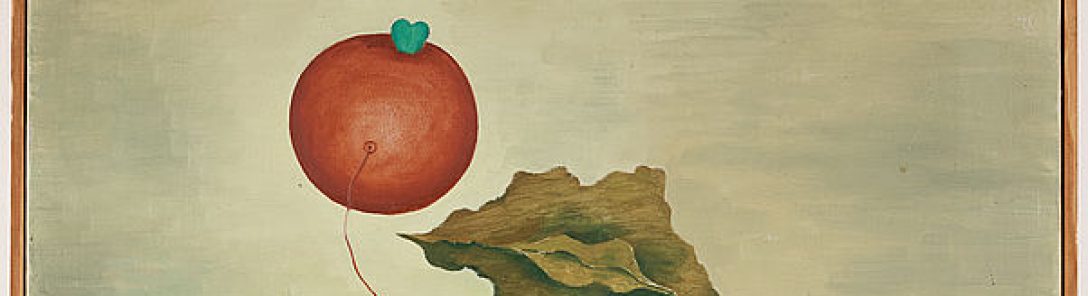
“Words” — A Page from James Joyce’s Notebooks

This page is from the same notebook where Joyce headed a page he titled “Rhetoric”; the notes in the books seem to suggest the notebook is part of the preparatory material for Ulysses. From the National Library of Ireland, which probably doesn’t want me posting their material like this.

RIP Ray Bradbury

RIP Ray Bradbury, 1920-2012.

Thanks for helping teach me how to read.

Here’s Bradbury sharing some writing advice:

“I Wouldn’t Recommend It” — J.G. Ballard on Writing Novels

Writing a novel is one of those modern rites of passage, I think, that lead us from an innocent world of contentment, drunkenness, and good humor, to a state of chronic edginess and the perpetual scanning of bank statements. By the eighteenth book, one has a sense of having bricked oneself into a niche, a roosting place for other people’s pigeons. I wouldn’t recommend it.

From J.G. Ballard”s Paris Review interview.

“And God Help You If You Use Voiceover in Your Work, My Friends!” (Screenwriting Seminar Scene, Adaptation)