Books Acquired, 1.13.2012 (Ezra Pound, Thomas Bernhard, Louis Zukofsky)

20120115-163012.jpg

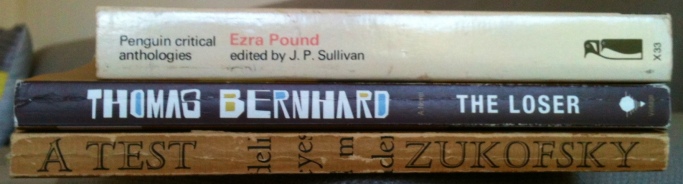
Picked up these three last Friday.

20120115-163023.jpg

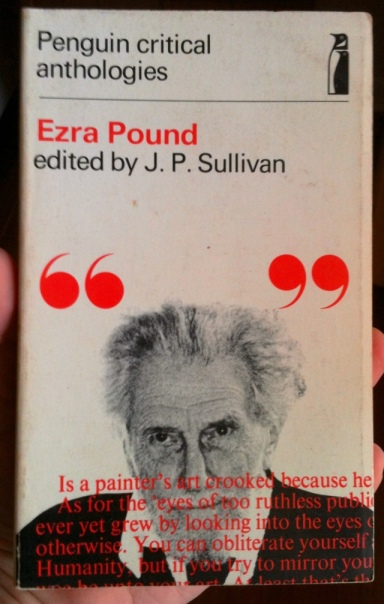
This is a collection of letters to and from Ezra Pound, as well as criticism, introductions, etc. I like the cover, which is a bit too busy.

20120115-163044.jpg

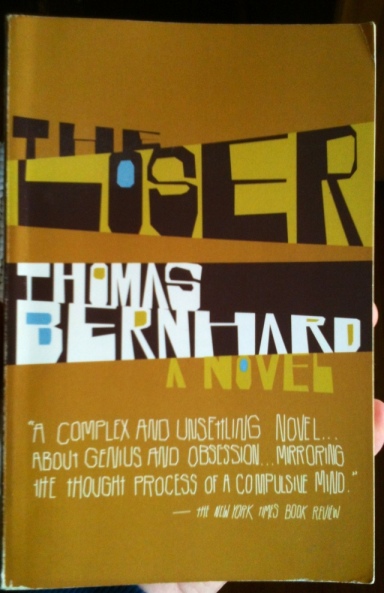
I picked up Thomas Bernhard’s Correction last year on reader recommendation (recommendation: read Bernhard). Saw The Loser in the shop used, so I picked it up. Any recommendation on which one to start with?

20120115-163114.jpg

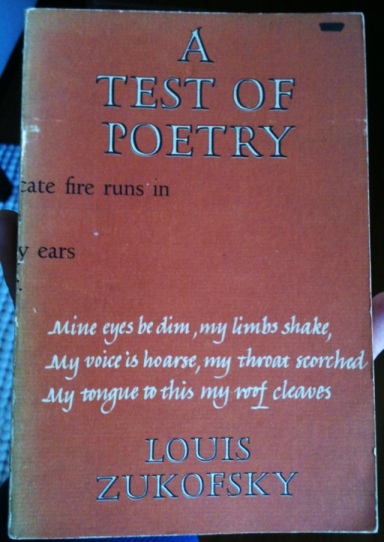
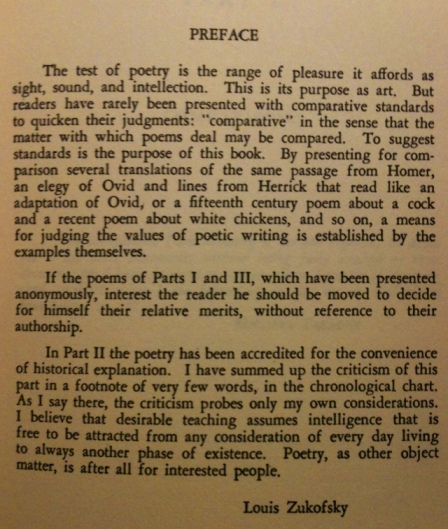
A midcentury paperback of Louis Zukofsky’s A Test of Poetry. This is a strange book. I’d better let Zukofsky explain it:

20120116-175731.jpg

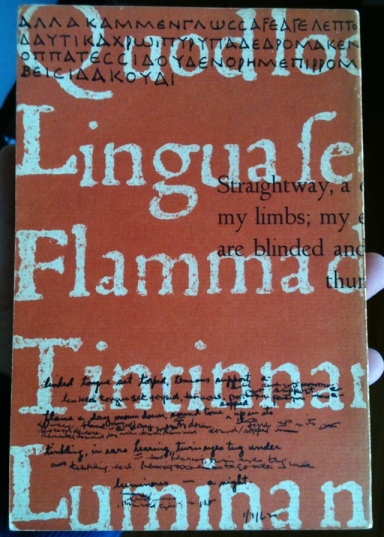
The back cover is lovely as well:

20120115-163132.jpg

Check Out Movie Critic Armond White’s 2011 Better-Than-List

Critic/contrarian Armond White’s 2011 Better-Than-List uses one movie to beat up on another. It’s grand reading—read it in full! A few choice snips:

Revisiting A Wrinkle in Time

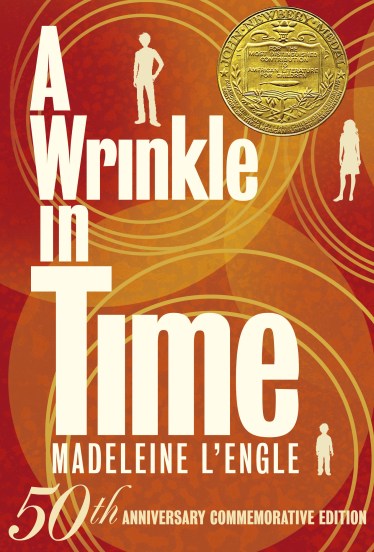
Madeleine L’Engle’s seminal fantasy novel A Wrinkle in Time turns 50 this year, and publisher Macmillan is celebrating by releasing a new anniversary edition with oodles of extras, including photos, manuscript pages, and new editorial content. They’ve also initiated a “50 Years, 50 Days,   50 Blogs Celebration Campaign” to promote the new book, and they asked Biblioklept to participate in the first week.

Here is the new cover:

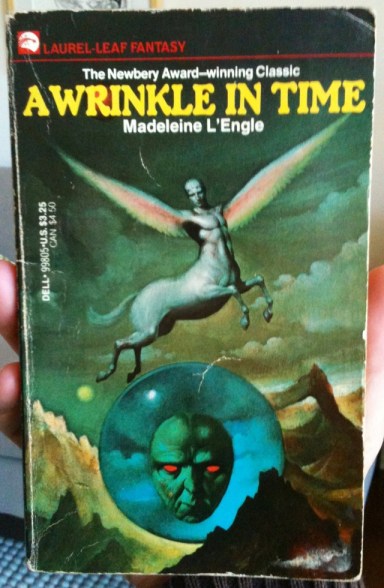
And here is the cover to my beloved, ragged edition:

20120115-162927.jpg

A Wrinkle in Time explores the strange intersections of space and time against a backdrop of adolescent angst. Our intrepid heroine Meg, her child genius brother Charles Wallace, and her would-be beau Calvin O’Keefe, go on a trans-dimensional quest to find her missing physicist father. They are aided (and initiated into) this quest by a trio of immortal women (shades of the Norns); their intergalactic mission finds them encountering angelic centaurs, motherly tentacled beasts, a red-eyed automaton, a disembodied brain, and more more more. Dr. Dad has disappeared while working on a mysterious project involving a tesseract.

Here’s a nifty visualization of the tesseract:

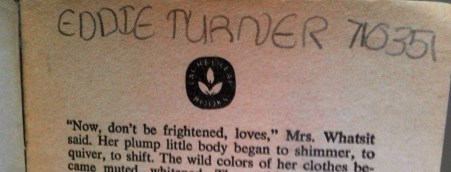
Like a lot of young people, as a child I was deeply fascinated by the concept of “tessering” away to a strange, marvelous, dangerous place, and it was surely this idea that most enthralled me as an early reader of the novel. I was probably ten when I first read the book, which I’m pretty sure was a gift from my aunt who brought it to me while our family was living in New Zealand. I actually wrote my name and our six-digit phone number into the book, which suggests that I loaned it out quite a bit.

20120115-162941.jpg

A Wrinkle in Time gelled with all of the stuff I was reading then: lots of Tolkien, C.S.Lewis, and Douglas Adams, but also plenty of crappy Dr. Who novels and lots of execrable fantasy novels. L’Engle’s novels (of course I read all of them after reading Wrinkle; to this day, Many Waters is probably the one that stands out the most, weird and sexy as it was) were of a piece with Tolkien and Lewis (especially Lewis’s oft-overlooked space trilogy)—but there was something distinctly American about L’Engle’s characters—her writing even—that intrigued me. I had spent my entire childhood expatriated and was constantly looking for avenues of American expression, ways “to be American” (yes, I realize how silly that sounds now).

In retrospect, it’s not the tesseract and its fantastical properties that I so recall from A Wrinkle in Time so much as it is L’Engle’s characters, especially mercurial Meg and her future-husband Calvin. While much of literature emphasizes the clash between individual desires and societal conventions, L’Engle’s particular tone and characterization is keenly sensitive to the difficulties adolescents face navigating this conflict. In a sense, L’Engle is working out the early blueprint for what would become the conventions of Young Adult literature. L’Engle wrote a specific brand of sci-fi/fantasy that, on the surface, sets her apart from S.E. Hinton and Robert Cormier—but what these writers share in common, what makes their work so enduring even as society changes, is the essential emotional reality their characters share with readers.

Wrinkle endures also because of its handling of complex themes of conformity, idealism, faith, and science. It’s a book that challenges a youngish audience to read in new ways. It’s also a frequently challenged book—always the sign of something good—suggesting that it’s not going anywhere soon. In this sense, Wrinkle’s literary legacy externally recapitulates its internal themes of nonconformity.

Of course, characterization and strong themes probably wouldn’t get too far with young readers if Wrinkle didn’t deliver the goods that YA readers demand: a good yarn. Wrinkle is spry and engaging at fifty, and while it’s not as bloody as new kid on the block The Hunger Games (the protagonist of which owes some small debt to Meg Murray) it nevertheless negotiates the dangers of existence (both physical and metaphysical) with greater emotional intensity.

But I’ve veered off course here, invoking a newer, more violent YA star at the end of my riff, when what I really want to do is encourage young people who haven’t read Wrinkle yet to pick it up (okay, especially young people who think that Collins’s trilogy is the bee’s knees). It’s a wise, endearing, and enduring classic, one that deserves attention on its golden anniversary.

Duchamp Is Our Misfortune — Art Spiegelman


20120116-110047.jpg

Book Shelves #3, 1.15.2012

Book shelves series #3, third Sunday of 2012: In which we revisit the master bedroom corner piece bookshelf in the southwest corner; two tiers + top shelf.

So, in last week’s engrossing installment our hero photographed and discussed some of the books in this bookshelf:

20120115-103251.jpg

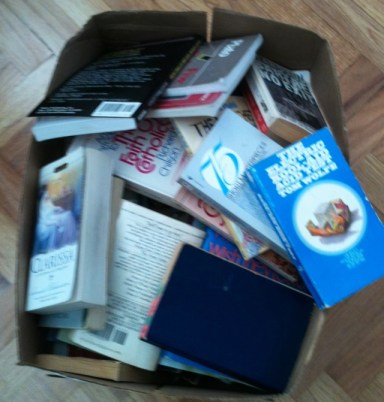
The post optimistically concluded: “So we’ve made it out of my bedroom” — but not so, dear reader, as post-Christmas/New Year cleaning up type activities led to a box of books, still in a storage room in the back of my house, needing to finally be shelved or ejected from the house. Said box:

20120115-103300.jpg

Most of the volumes herein are aesthetically-challenged/of a certain sentimental value: lots of books from my youth and the youth of my wife; lots of books that taught me how to read, books that weirded me out, books that I hope my kids will want to read in a few years. The corner piece bookshelf had the most (only, really) free space for shelving; it’s also tucked away from public view where an eyesore like my crumbling copy of Vonnegut’s Cat’s Cradle won’t sore eyes:

20120115-103312.jpg

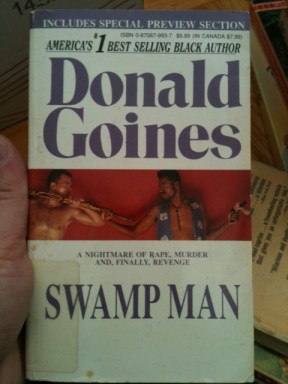
I actually read Goines’s Swamp Man. It’s not the Deliverance knock off you might expect, although it is singularly horrific.

20120115-103322.jpg

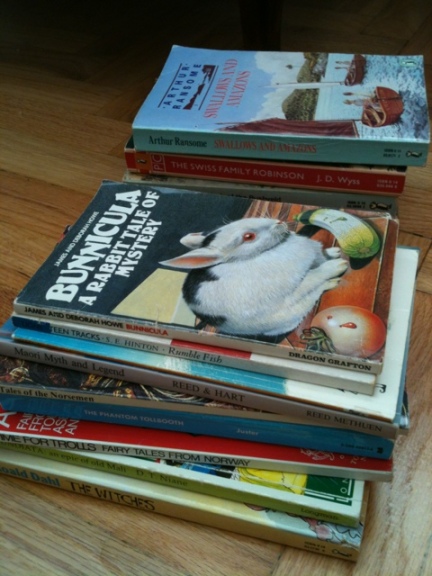
Some beloved childhood classics. Arthur Ransome, S.E. Hinton, various myths and legends, Roald Dahl, etc.:

20120115-103331.jpg

Two books I hated. Hated. I keep them as badges of a strange honor, a sort of “I did it, okay?”:

20120115-103343.jpg

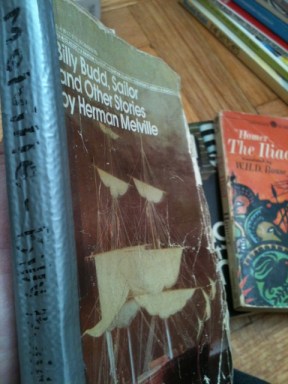
Melville stories held together with duct tape. This was the copy my 11th grade teacher assigned; I stole it of course. I used it in numerous subsequent courses and the annotations I made are somehow (unduly) precious to me. I can’t part with it even though I have at least two other volumes of Melville stories;

20120115-103358.jpg

Never sure where to shelve this RAW volume:

20120115-103428.jpg

Not sure if you can make out the title of this one, but it’s Alcoholic Anonymous’s Big Book. I found it on the beach one night when I was maybe 17 or 18. It’s full of highlighted passages and annotations and I’ve always been intrigued at what led the former owner to cast it away into cattailed dunes, as if the person couldn’t wait to be rid of it but couldn’t bear to bury it in a garbage can. Anyway, I picked it up because I pick up any discarded book, but I’ve kept it because I don’t know why I’ve kept it. Maybe it helped inform my reading of Infinite Jest, I don’t know:

20120115-103503.jpg

And here’s the “after” shot. I’ll try not to fret over re-shooting shelves again. But moving the box of books yesterday, knowing I was going to do the book shelf post today, I couldn’t help but photograph some of these as I went.

20120115-103518.jpg

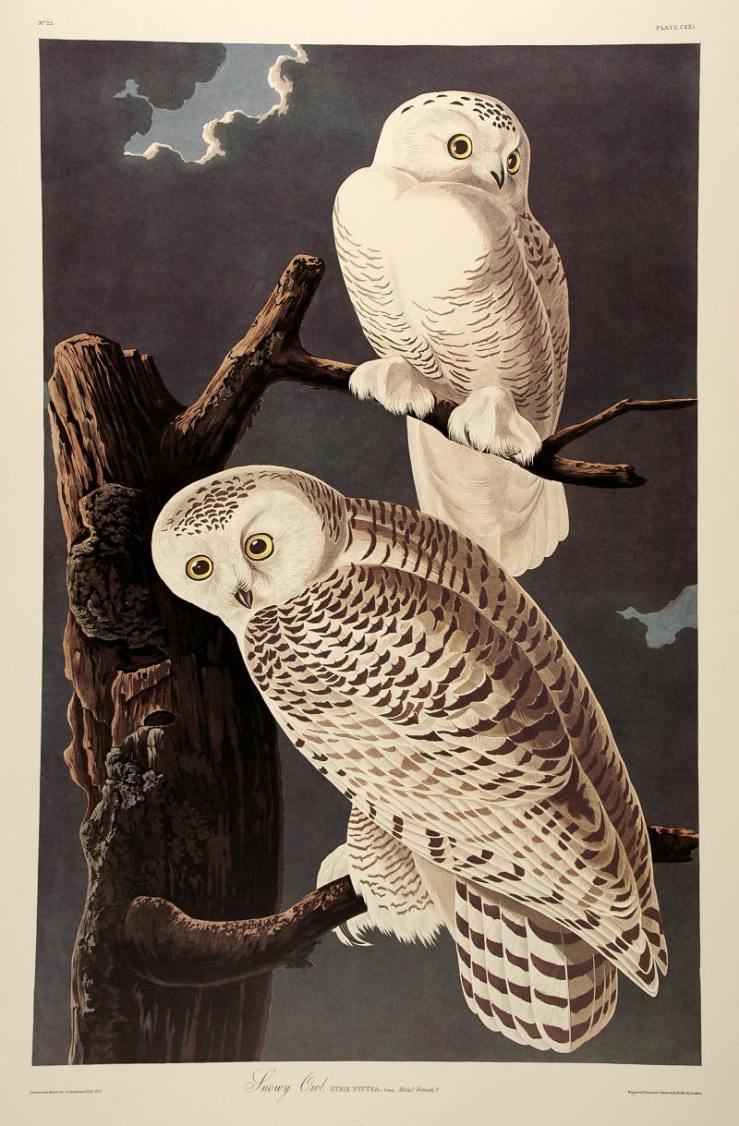
Snowy Owl — John James Audubon

Book Acquired, 1.12.2012


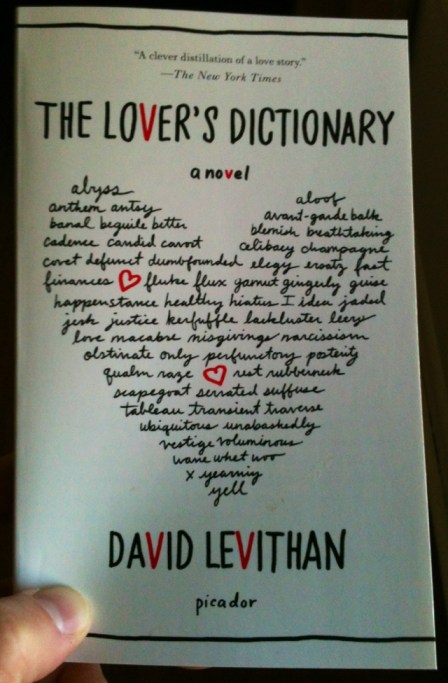
20120114-110434.jpg

In the post from the kind people at Picador, The Lover’s Dictionary by David Levithan (I want to type “Leviathan,” of course). Publisher’s description:

How does one talk about love? Is it even possible to describe something at once utterly mundane and wholly transcendent, that has the power to consume our lives completely, while making us feel part of something infinitely larger than ourselves? Taking a unique approach to this age-old problem, the nameless narrator of David Levithan’sThe Lover’s Dictionary constructs the story of a relationship as a dictionary. Through these sharp entries, he provides an intimate window into the great events and quotidian trifles of coupledom, giving us an indelible and deeply moving portrait of love in our time.

Joseph Campbell on Circumcision

Read an Excerpt from Stuart Kendall’s New Translation of Gilgamesh

Contra Mundum Press is publishing a new translation of the epic of Gilgamesh by renowned translator and scholar Stuart Kendall, who has translated works by Bataille, Blanchot, and Debord, among others. You can read (and download if you like) a good chunk of this text now. It’s good stuff.

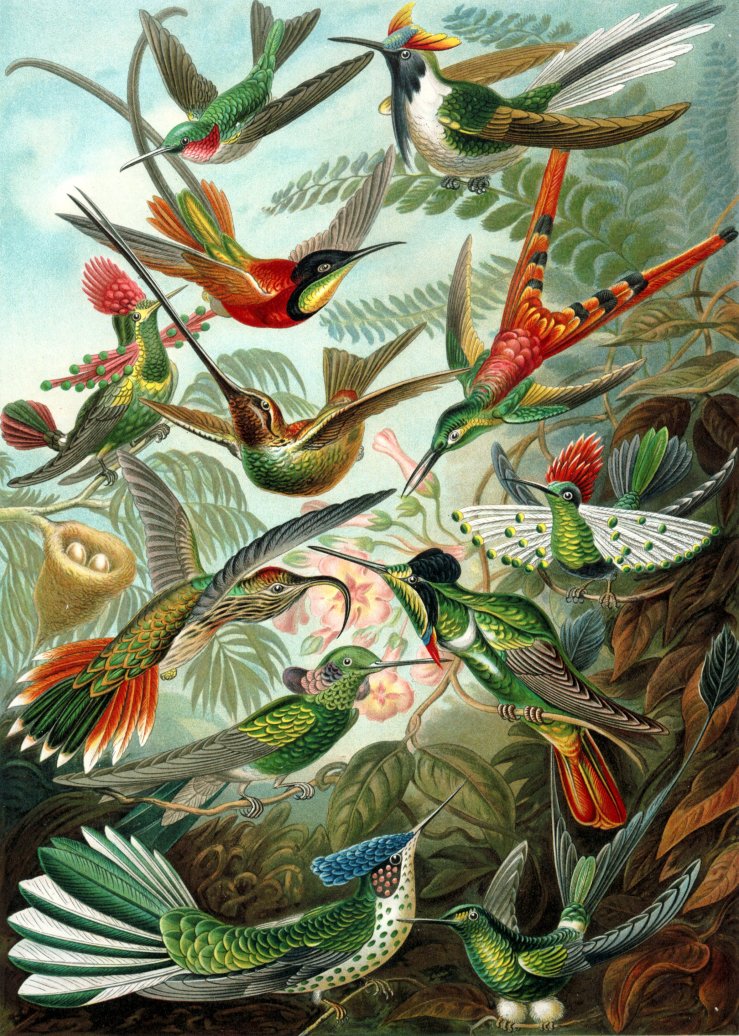
Trochilidae — Ernst Haeckel

I (Sort of) Review the the Trailer for Wes Anderson’s New Film, Moonrise Kingdom

If you hate Wes Anderson—and hating Wes Anderson seems like a special kind of sport in 2012 (or at least it did after his last two films, The Darjeeling Limited and Fantastic Mr. Fox)—the trailer for his new film Moonrise Kingdom will surely give you fuel for that fire or arrows for your quiver or whatever you need for your particular metaphor.

I like Wes Anderson’s films: I like the strange blend of earnestness and irony, the precociousness and preciousness, the calculated soundtracks, the fussy set and costume design and faux-’70s color schemes; I like the crumbling families, the failed and failing geniuses, the narcissists and the hacks; I like the fantasy of it all. I like the sentimentality of it all. I like the tents and special societies and secret compartments and fake books. I like the depression behind the charm.

I especially like Rushmore and The Royal Tenenbaums, which I think are the films that best navigate that special space between fantasy and reality (and theatricality) that is Andersonville. My least favorite film of his is his first, Bottle Rocket—too realistic (what a strange claim!), too naturalistic, not mannered or fussy enough.

I more or less understand why so many people hate Anderson’s fantasies, although I think it’s weak criticism to dismiss them as empty exercises in style without substance; still, watching the new trailer, I can see why anyone with a quarrel with Wes Anderson will positively hate this Wes Anderson movie before it’s even come out.

Here is that trailer:

So:

We’ve got a charismatic young man in the Max Fischer mold.

We’ve got a never-was early 1960s (?) sleep-away-camp (?)

We’ve got Edward Norton in a scouting uniform (in shorts!) saying: “Jiminy Cricket, he flew the coop!” (this is like +100 flaming arrows in the quivers of Anderson-haters, I imagine; it made me cringe my own self).

We have a portable turntable on a Northeastern beach.

We have the kind of tracking close up shots that went out of fashion, what, thirty years ago now?

Also:

A 1960s French pop song.

A play.

A house in a tree.

Some sailing shots that somehow remind me of Arthur Ransome’s Swallows and Amazons.

Old Bruce Willis.

Frances McDormand.

And:

Well, did you watch the end? Did you see those final moments, the shirtless Bill Murray with the ax propped over one shoulder, bottle of red in the other? Well, that’s why I tend to like these films.

McNulty’s Fake English Accent (The Wire)

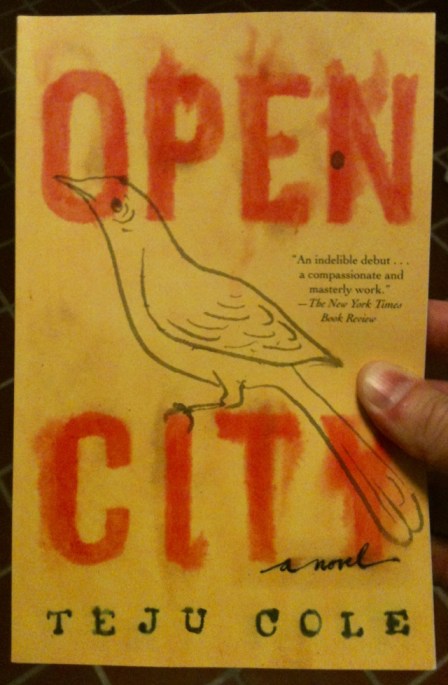
Book Acquired, 1.11.2012 (Teju Cole Edition)

20120111-194217.jpg

Teju Cole’s Open City was a big favorite for many lit folks last year, including Anthony at Times Flow Stemmed, a blog I admire. The book seems similar to Sebald’s strange opus The Rings of Saturn. In short, very excited for this one.  From the write-up at Times Flow Stemmed:

Open City is narrated by Julius, a part Nigerian, part German psychiatry student. Beginning with a strong Sebaldian influence as Julius aimlessly wanders around the streets and parks of New York, the story develops into a modern inquiry into the foundation of personality, memory, nationhood and dislocation.

Although written in the first person the narrator remains at a distance, a lonely, bookish character, more comfortable discussing literary or musical influences (Mahler, Coetzee, Barthes) than developing a relationship with a childhood friend or dying professor. This distance allows Cole, as James Wood explains . . .  to make his novel ‘as close to a diary as a novel can get, with room for reflection, autobiography, stasis, and repetition.’

The Last Supper — An Excerpt from Peter Greenaway’s Installation

Bohemian Grove Toy Set

(Via).

David Markson Reads from The Last Novel at the 92nd Street Y, 2007

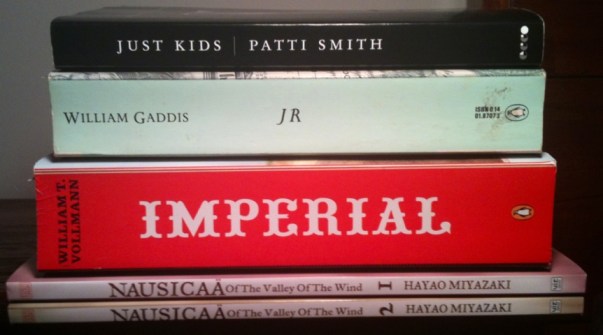
Riff on Recent Reading, 1.09.2012 (Gaddis, Vollmann, Dragons, Nausicaä, Patti Smith)

20120110-181813.jpg

1. Just Kids, Patti Smith

Really slowed down on this one, mostly because the spring semester hath begun, wreaking all sorts of destabilizing tasks on me. Momentum and reading habits will inevitably return. Anyway, Smith’s book is more or less a litany of famous meetings and infamous moments with lots and lots of descriptions of talismanic objects. The scene where she meets Allen Ginsberg is pretty cool. Smith presents herself as earnest, passionate, but also somehow at odds (or at least outs) with the whole Chelsea Hotel scene.

2. Nausicaä of the Valley of the Wind, Vol 1, Hayao Miyazaki

Completed the first volume of Miyazaki’s groundbreaking manga and started the second. The art is well crafted and distinct, but often extremely busy and even frenetic. It sometimes feels squashed in the panels, like it needs room to breathe. I can’t help but compare it to the film that followed, which is visually richer and more expansive. The film, in a sense, helps me to fill out the scope signaled in Miyazki’s inky illustrations.

The story in the manga so far differs subtly but significantly from the film; without adding spoilers (I think fans of the film will enjoy the book), the political dimension of the plot is heightened and gender roles are explored with greater concern. Nausicaä’s initial rashness is also presented with greater intensity (read: violent consequences). More to come.

3. Imperial, William T. Vollmann

Chapter 3 of Imperial, “The Water of Life,” is some of the best gonzo journalism I’ve ever read. Vollmann (along with an improbably game ex-Marine/hotel clerk) takes a raft—a cheap rubber dinghy, really—down the infamous New River, purportedly one of the most polluted waterways in North America. This river is filled with dead birds, dead fish, probably dead humans, lots and lots of garbage, industrial runoff, and lots and lots of human shit.

Of course, Vollmann can find beauty and strangeness and ugliness all at once:

The chapter does everything one wants from the book, and if you’re at all intrigued, there’s a version in the excellent Vollmann reader Expelled from Eden, which is a good starting point for his work.

The next chapter, “Sublineations: Lovescapes,” is this awful emo exploration of a bad breakup and the following heartbreak Volls feels after. It was torturous to get through, the sort of thing that screams for an editor. It also underscores how deeply deeply deeply personal the book is to him, though. More to come.

4. A Dance with Dragons, George R. R. Martin (audiobook read by Roy Dotrice)

Well goddam if I didn’t finally finish it. As I’ve lamented elsewhere in these e-pages, Martin’s fourth and fifth books in the A Song of Ice and Fire series (I hate that name, by the way: Game of Thrones (without the indefinite article) is way cooler sounding) are bloated, sagging, overfilled beasts sorely in need of an enema. Still, Dragons picks up in its final third, and ends with some shockers that, if I remember them 12 years from now when he finally finishes the next one, I may want to read it. Roy Dotrice = a very gifted reader. A great audiobook (still, I can’t believe this one topped so many year end lists).

5. JR, William Gaddis  (tandem reading with audiobook read by Nick Sullivan)

Big thanks to Dwight at A Common Reader for suggesting the audiobook of JR read by Sullivan. I’m a few hours in; I’ve also been rereading bits immediately when I get home (I listen mostly in the car or on walks), retracing the lines that I’ve mentally underlined. Sullivan is a gifted voice actor who brings the many, many voices of JR to vivid life (that line seems hackneyed but it is in no way insincere. If I weren’t riffing I’d revise. If I weren’t riffing I’d edit parenthetical excuses. I’m gonna drink more red zin now). I’m reminded in some ways of RTE’s full-cast unabridged recording—performance really—of Joyce’s Ulysses. I’d read Ulysses twice before, but I feel like the full-cast production was an equally definitive version to the one in my head. Like Ulysses—especially the Sirens episode—JR is extremely aural; it’s mostly dialogue.

I’ve laughed out loud several times so far—had no idea the book would be this funny. Also, reading/hearing it, I can’t help but see how profoundly David Foster Wallace was influenced by Gaddis here: the bizarre corporate-speak, the disjunctive rhythms, the absurd humor, the satire on modernity, the ironic-earnest axis—even the passages of naturalistic description.

On deck: The Orphan Master’s Son by Adam Johnson, Open City by Teju Cole, Smut by Alan Bennett and more more more.