St. Jerome Reading — Giovanni Bellini

I Audit Hilary Mantel’s Bring Up the Bodies (Part 1)

The good people at Macmillan Audio were kind enough to send me a copy of the unabridged audiobook of Hilary Mantel’s Bring Up the Bodies, the highly anticipated sequel to her 2009 Booker prize winner, Wolf Hall. (I loved Wolf Hall, by the way). I’ll be writing about Bring Up the Bodies in brief installments as I audit the book, instead of waiting to complete the whole thing before reviewing (as I usually do) because a) it’s hard to dogear passages from an mp3 and b) the book is pretty damn long (about 24hrs) and c) I’ve yet to read a review of the book that might color my own perceptions.

Bring Up the Bodies—now seems as good a time as any to point out that, hey, that’s just a great title—Bring Up the Bodies picks up right where Wolf Hall left off. Just as that first book throws its audience into the deep end, with one of the more bewildering openings in recent memory, so too does Bring Up the Bodies begin abruptly in media res. Please forgive me if I begin in the middle of things as well—to be clear, it’s not a good idea to jump into Bodies until you’ve read Wolf Hall. And Wolf Hall is worth your time.

It’s 1535 and our protagonist Thomas Cromwell is 50 and starting to feel his age (he laments at one point that he no longer remembers any of the snippets of Welsh he once knew; he can no longer play tennis). His prince, King Henry VIII, is also quickly aging, his body turning to the fat lump that we tend to picture him as these days. An expanding tummy is the least of Henry’s worries, however—and Henry’s worries are Cromwell’s worries. The major plot arc will likely be Henry’s plans to oust his newish bride Anne Boleyn, a repetition of sorts from Wolf Hall, where Henry and Cromwell (mostly Cromwell) worked to annul Henry’s marriage to Queen Katherine. Obviously though, we can’t accuse Mantel of a lack of imagination in crafting her plots. She’s working from history of course, and what’s most amazing about both Wolf Hall and Bring Up the Bodies is how Mantel invigorates that history. Who knew the hoary Tudor saga needed a retelling?

It works here of course because Cromwell is such a fascinating character. Mantel anchors her impeccable free indirect style in Cromwell’s mind, and she channels his intense intellect with sharp grace.  Here’s a remarkable passage that somehow summarizes (broadly, of course) much of Wolf Hall and showcases Mantel’s ability to move her prose seamlessly from exterior to interior,  from how others might see Cromwell to how he might understand himself:

Thomas Cromwell is now about fifty years old. He has a labourer’s body, stocky, useful, running to fat. He has black hair, greying now, and because of his pale impermeable skin, which seems designed to resist rain as well as sun, people sneer that his father was an Irishman, though really he was a brewer and a blacksmith at Putney, a shearsman too, a man with a finger in every pie, a scrapper and brawler, a drunk and a bully, a man often hauled before the justices for punching someone, for cheating someone. How the son of such a man has achieved his present eminence is a question all Europe asks. Some say he came up with the Boleyns, the queen’s family. Some say it was wholly through the late Cardinal Wolsey, his patron; Cromwell was in his confidence and made money for him and knew his secrets. Others say he haunts the company of sorcerers. He was out of the realm from boyhood, a hired soldier, a wool trader, a banker. No one knows where he has been and who he has met, and he is in no hurry to tell them. He never spares himself in the king’s service, he knows his worth and merits and makes sure of his reward: offices, perquisites and title deeds, manor houses and farms. He has a way of getting his way, he has a method; he will charm a man or bribe him, coax him or threaten him, he will explain to a man where his true interests lie, and he will introduce that same man to aspects of himself he didn’t know existed. Every day Master Secretary deals with grandees who, if they could, would destroy him with one vindictive swipe, as if he were a fly. Knowing this, he is distinguished by his courtesy, his calmness and his indefatigable attention to England’s business. He is not in the habit of explaining himself. He is not in the habit of discussing his successes. But whenever good fortune has called on him, he has been there, planted on the threshold, ready to fling open the door to her timid scratch on the wood.

Of course, good fortune is not without its headaches, and Bring Up the Bodies quickly establishes the daily grind of being the king’s chief minister. Cromwell has to worry about the uncertain finances of the kingdom; the plots of the Catholic Church; the ever-present threat of Katherine’s nephew, Charles V, Holy Roman Emperor; Cromwell also has to worry about scheming at court and gossip in the towns. And yet he keeps a level head, even as he appeals to his memories of the late Cardinal Wolsey, who hangs like an ironic ghost over the early chapters of Bring Up the Bodies. (I’m hoping Wolsey’s ghost will continue to haunt the book). It’s when Cromwell turns his sharp mind to a critique of the cleric class (he’d turn out all the abbeys and seize their coffers), or to a flat rebuttal of the concept of confession (“God doesn’t require an intermediary”), or even when he sniffs at Machiavelli as too conservative that we see in Cromwell the advent of modernity.

A quick word on the audio production—it’s great stuff. Reader Simon Vance delivers the tale in a dry, clear cadence that perfectly suits Mantel’s prose. Vance knows when to lean into the ironic inflections that sometimes color Cromwell’s dialogue (both interior dialogue and speech with others), and he employs a range that easily differentiates the other voices that pop up in the narrative without losing a consistent tone. As I’ve stated on this blog many times, a good reader makes all the difference, and Vance is a good reader. More to come.

Shark Fishing — Winslow Homer

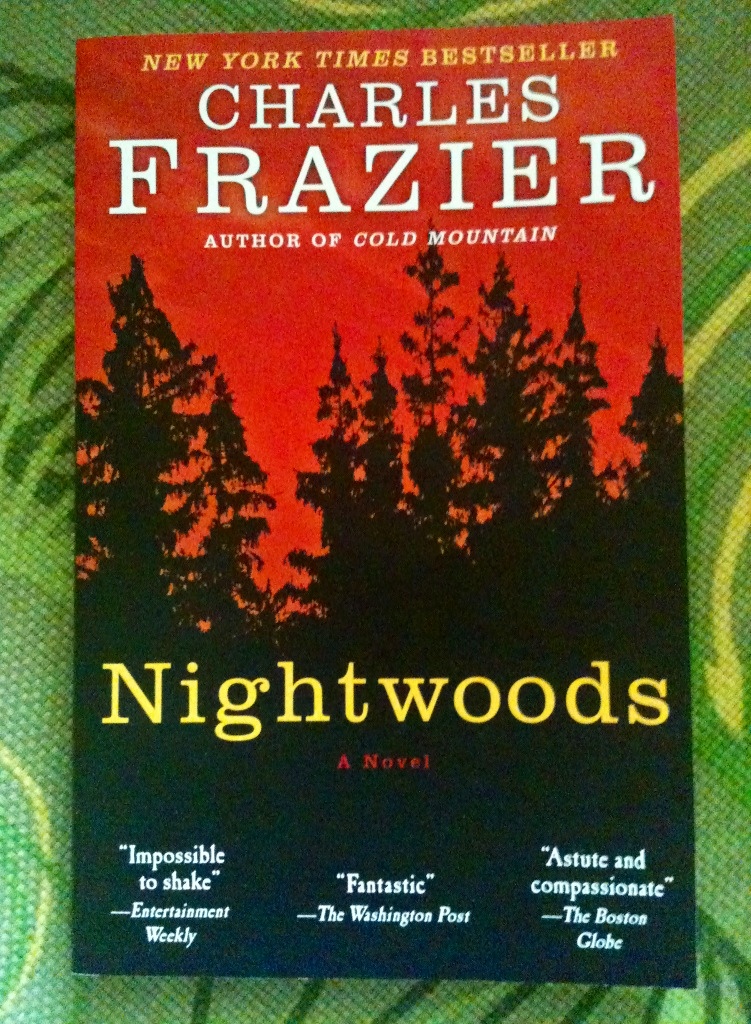
Charles Frazier’s Nightwoods (Book Acquired, 6.14.2012)

20120622-100218.jpg

Charles Frazier’s Nightwoods, new in trade paperback. From Randy Boyagoda’s NY Times review:

“Nightwoods,” Frazier’s new novel, is a departure from its predecessors in some respects. It’s set in the early 1960s rather than the 19th century, and it involves no literary or historical elements of comparable grandeur and gravity. Indeed, based on its premise, the new book feels remarkably stripped down: a young woman named Luce, the caretaker of an old lodge in small-town North Carolina, becomes the guardian of the twin children of her murdered sister. In turn, she must defend them from Bud, their former stepfather, who killed their mother while they watched, and who believes the traumatized children know the location of some stolen money. As a setup, this promises suspense and mystery, to which Frazier adds family tension (when Luce’s lawman-cum-drug-addict father buddies up with Bud) and romance (after the shy, handsome grandson of the lodge’s deceased owner visits his inheritance and falls for Luce).

Tom McCarthy on William Burroughs’s Verbal Remix Software

A passage from Tom McCarthy’s essay “Transmission and the Individual Remix:”

It might be inferred, from what I’ve said, that any old remix will do. Not so: there are good and bad ones. Tristan Tzara cutting Shakespeare sonnets up and pulling their words from hats is an exercise in randomizing. William Burroughs and Brion Gysin mixing poems in with sliced-up pages of The New York Times is quite another matter: it is assiduous composition—composition understood in all its secondary nature: as reading, tracing, reconfiguring. Using the same technique, Gysin comes up with a few clumsy permutations along the lines of “Rub the Word Right Out . . . Word Right Rub the Out” and so on—whereas Burroughs generates such gorgeous sequences as:

Visit of memories. Only your dance and your voice house. On the suburban air improbable desertions . . . all harmonic pine for strife.

or

The great skies are open. Supreme bugle burning flesh children to mist.

Why does Burroughs conjure so much more richness from the same source material? Because (unlike the painter Gysin, whose skill lies primarily in the domain of images), he has uploaded the right verbal remix software. He has read and memorized his Dante, his Shakespeare, his Eliot—to such an extent that his activity as a composer consists of giving himself over to their cadences and echoes, their pulses, codas, loops, the better that these may work their way, through him, The New York Times and any other body thrown into the mix, into an audibility that, booming and echoing in the here-and-now, transforms all the mix’s elements, and time itself.

This is what all good writers are doing, and always have been.

St. Jerome Reading — Rembrandt

Heads of Torture Victims (Study for The Raft of the Medusa) — Theodore Gericault

Slavoj Žižek: “More Than Ever, We Need Philosophy Today” (On Philosophy vs. Science)

Denis Johnson’s Train Dreams Is a Perfect Audiobook

Going West (Express Train) — Thomas Hart Benton

A few weeks ago on this blog, I declared Denis Johnson’s Train Dreams a perfect novella, a claim that I feel even more certain about after listening to Macmillan audio’s new production of the book, read by Will Patton.

Precise, funny, and moving, Train Dreams tells the story of Robert Grainier, a laborer (and eventual hermit of sorts) who makes a life in (and against) the strange wilderness of the Idaho panhandle. The book somehow measures the first half of the twentieth century in the US without overreaching; instead, through Grainier’s human (but anti-social) presence, Johnson traces the end of Manifest Destiny, the last strands of the wild frontier. Train Dreams, poised tautly on a line that divides the mythic and metaphysical from the concrete and real, shows us a world where we might catch a glimpse of wolf-children and angels—the real thing, not just the sham show, not just a pale suggestion.

Moving through the book again via Patton’s expert narration, I was struck by how constructed yet seamless Johnson’s narrative is. Johnson gets so much credit for the precision of his syntax, but a rereading of Train Dreams reveals how tight and layered, yet never obvious, his plot is—how he lays out his themes repeatedly without brazenly calling attention to them. (One of the joys of reading is rereading; one of the joys of a novella is that its brevity allows us to easily reread). The book is a gem.

Will Patton’s reading perfectly matches the tone, pacing, and depth of Train Dreams. He understands the restraint of Johnson’s prose, never tripping over into bombast or ghastly over-emoting. Patton’s wry, not-quite-dusty, not-quite-dulcet tone brings Johnson’s small cast to vivid life. In particular, he breathes energy into the humorous dialogues. I found myself laughing aloud over a discourse between Grainier and a man who’s been shot by his own dog. Patton understands the material and brings the same sensitivity, pathos, and wit to it that he brought to his reading of Johnson’s 2007 opus, Tree of Smoke.

A good reader makes all the difference of course. In the wrong hands—excuse me, wrong voice—a book we thought we knew can come across stifled, squashed; the reader can actually hurt the book, impose the wrong tone: misread. A reader like Patton (and I should credit his director and production team too, of course) can enlarge a book for its audience, shining light on the subtle nuances we might overlook, or even clouding phrases we thought we fully understood, empowering the language with a new ambiguity that enriches the overall reading experience. Highly recommended.

Here’s Patton reading the first part of Train Dreams:

The Magdelene Reading — Rogier van der Weyden

RIP Andrew Sarris

RIP film critic Andrew Sarris, 1928-2012.

Sarris wrote film criticism—meaningful, real writing, not just film “reviews”—for half a century, publishing several books, and writing regularly for first The Village Voice and then The New York Observer. Sarris was one of the earliest proponents in the US of the auteur theory of film (he’s credited with coining the word in his essay “Notes on the Auteur Theory in 1962“), first put forward by Truffaut and other persons active in the French New Wave. In 1971, Sarris got into a good ole fashioned fight with fellow film critic Pauline Kael over the auteur issue when he responded to her Citizen Kane essay “Raising Kane,” contending that, yes, the film was guided by the unique vision of Orson Welles (even if others helped). His response essay is still worth reading.

In his 1968 book The American Cinema: Directors and Directions 1929-1968, Sarris famously named a “pantheon” of 14 top-tier directors: here’s that list:

Charlie Chaplin

Robert Flaherty

John Ford

D.W. Griffith

Howard Hawks

Alfred Hitchcock

Buster Keaton

Fritz Lang

Ernst Lubitsch

F.W. Murnau

Max Ophuls

Jean Renoir

Joseph Von Sternberg

Orson Welles

Sarris later added Billy Wilder to this pantheon.

If you like lists, check out this archive of Sarris’s favorite films by year—from 1958 to 2006.

Like any great critic, whether or not one ultimately agreed with Sarris was beside the point—his scholarship and criticism was insightful and enlightening the kind of writing that frankly makes for better film audiences.

For a more detailed obit, check out Scott Tobias’s piece at AV Club.

Brian Wilson Goes on The Rock & Roll Chef; Discusses Surfer Chicken, His Deafness, and His Love of Thai Food; Raps a Little (1990 Interview)

Summer Interior — Edward Hopper

List of Fictional Suicides (From David Markson’s Reader’s Block)

Emma Bovary.

Anna Karenina.

Othello.

Jocasta.

Brunnhilde.

Hedda Gabler.

Romeo and Juliet.

Werther.

Dido.

Cio-Cio-San.

Antigone and Haemon.

Miss Julie.

Axel Heyst.

Quentin Compson.

Aida.

Inspector Javert.

Mynheer Peeperkorn. Leo Naphta.

Smerdyakov.

Rudolf Virag.

Edna Pontellier.

Hero.

Manrico’s Leonora.

Cheri.

Goneril.

Richard Cory.

McWatt.

Tosca.

Stravrogin. Kirillov.

Martin Eden.

Hurstwood.

Pyramus and Thisbe.

Roithamer.

Pierre Glendinning.

Winnie Verloc.

George Wilson.

Hedvig Ekdal.

Christine Mannon. Orin Mannon.

Willy Loman.

Senta.

Maggie Johnson.

Peter Grimes.

Bess, the landlord’s black-eyed daughter.

Svidrigailov.

James O. Incandenza.

Konstantin Treplev.

Bartleby.

Septimus Smith.

Deirdre.

Seymour Glass.

Ophelia.

Samson.

Eustacia Vye.

Phaedra.

Alcetis.

Launcelot.

From David Markson’s Reader’s Block.  By my count, Markson references throughout the book 149 suicides (or near-suicides, or presumed suicides) of real, actual persons (i.e., not including the list above). This count does not include Markson’s reference to “Nine hundred and sixty Jews” who “committed suicide at Masada, in 73 A.D., rather than surrender to the Roman legions that had lately sacked Jersusalem.” It’s entirely possible I miscounted.

Geisha Reading — Katsushika Hokusai

Bret Easton Ellis Comments on “Stanley Kubrick’s Gayness”

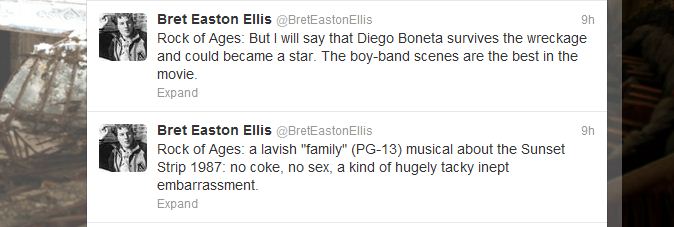
Late last night, Bret Easton Ellis took to Twitter to review the film Rock of Ages:

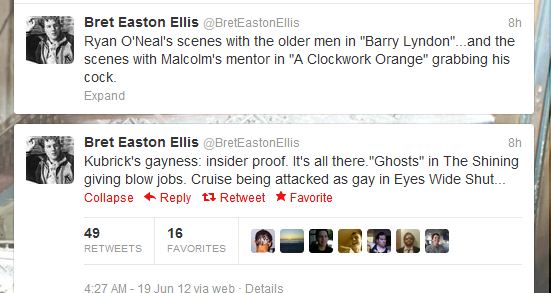
He then offered this bizarre nugget:

And here’s his evidence:


Pegasus — Jean-Michel Basquiat