Demons Armed with Sticks (Detail from the Isenheim Altarpiece) — Matthias Grünewald

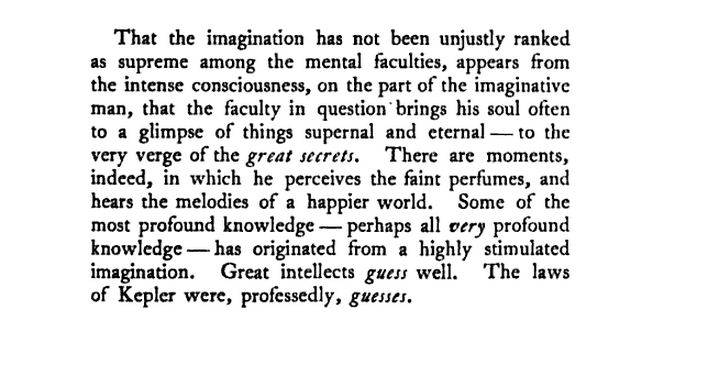
Edgar Allan Poe on Imaginative Capacity

(From “A Chapter of Suggestions”).

Poetry Reading — Milton Avery

Danse Macabre Scene / Jean Renoir’s The Rules of the Game

Dracula — Andy Warhol

Goya’s Witch/Clergy Axis (Robert Hughes)

In a disguised way, Goya in the Caprichos drew a parallel between witchcraft and the activities of the clergy. He stressed the resemblance between witches and friars in their obedience to the hierarchy of their calling, the younger deferring to the older. In plate 47, Obsequio al maestro (“Homage to the master”), an apparently senior witch looks down with stony disdain at another, who ois offering her (or him) the gift of a dead baby; the supplicant’s gesture reminds one of a groveling postulant kissing the cardinal’s ring. “Es muy justo,” runs the Prado text: “This is quite fair, they would be ungrateful disciples who failed to visit their professor, to whom they owe everything they know about their diabolical faculties.”

Plate 46, Correccion (“Correction”), shows a group of brujos, male witches, as seminarians, consulting “the great witch who runs the Barahona seminary” — whatever that institution may have been. Of course, Goya could not be too explicit about this: on the other side of any public criticism of clerical practices lay the ever-watchful eye of the Inquisition, which Goya had to be at pains to avoid.

—From Robert Hughes’s biography Goya.

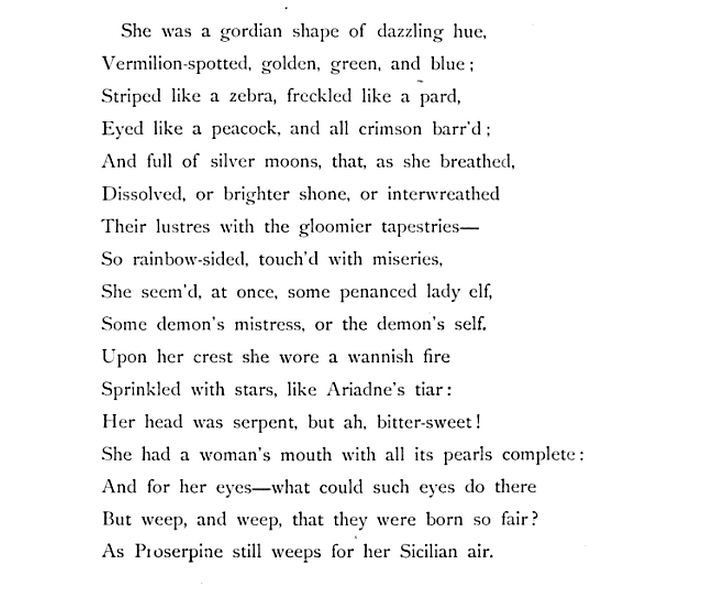
“A Gordian Shape of Dazzling Hue” (Keats’s Lamia)

(Read the entirety of John Keats’s supernatural long poem Lamia as a free illustrated ebook).

Portrait of Madame Ginoux (L’Arlesienne) — Vincent van Gogh

Eraserhead — David Lynch

Witches in the Air — Francisco Goya

Reading Chris Ware’s Building Stories / I just met

Continuing kinda sorta where we left off

Not sure of the name of this episode, but I’ll refer to it as I just met, a phrase that repeats twice in a huge headlinish font that seems to suggest, y’know, title:

20121021-201130.jpg

I just met uses a few pages to tell the story of a deteriorating relationship—what happens when two twenty-somethings turn into two mid-to-late-thirtysomethings?

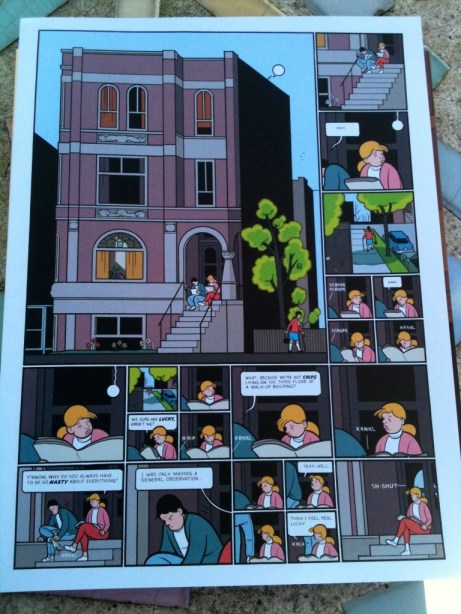
The comic opens with an establishing shot of what I take to be the building in Building Stories; we also get a glimpse of what I assume will be another character, the beehive, and a few other details that surely will attach themselves to these panels in future readings. We also get the general bitter tone of the couple’s relationship:
20121021-201139.jpg

He was one of those dudes who was once in a band; she was one of those chicks who thought guys in bands were cool.

The romance of their initial hookup is summed up neatly in the pic below; knowing Ware’s spare, precise style, the trash on the floor seems to scream symbolic detail!

20121021-201147.jpg

The hurt and disappointment in I just met unfolds over just a few painful pages—painful mostly in their concrete reality.

We know who these people are, even if we’re lucky enough not to be them.

Just as in  Branford, the Best Bee in the World , which I read earlier (although, to be clear again, there are no reading directions or prescriptions for Building Stories), there’s a theme of eternal recurrence, of mistakes playing out again and again in a painful, recursive loop.

Just when Ware threatens to overstate the mundane repetitions his principals suffer, he pulls off a daring and effective move, transposing his characters into the psychic collective memory of a future that’s in many ways already familiar. The effect is simultaneously jarring and oddly reassuring—the promise that our capacity for human connection and deep empathy will never buckle under the threat of drastic technological change, but also suggesting that the cost of maintaining this emotional constant is deep, ugly pain.

20121021-201154.jpg

“Manifest Destiny” — Kate Beaton Does Robinson Crusoe

(More/via).

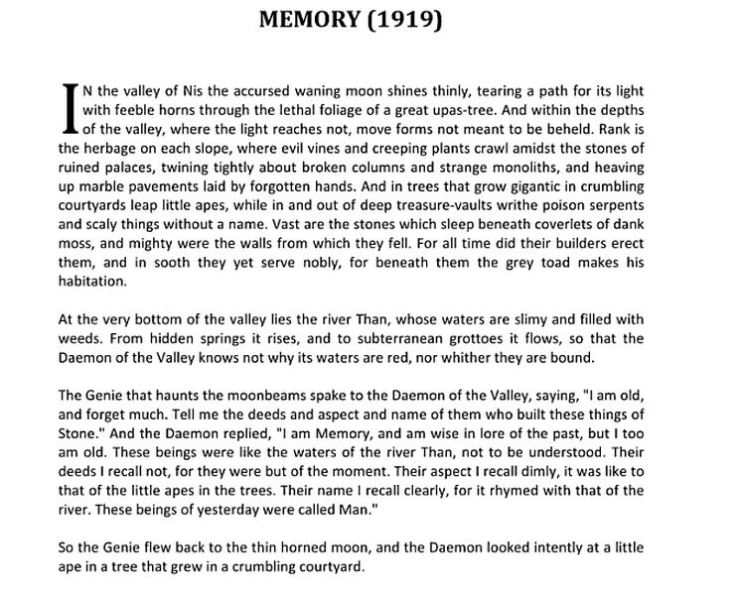
“Memory” — H.P. Lovecraft

A Young Girl Reading — Jean-Honore Fragonard

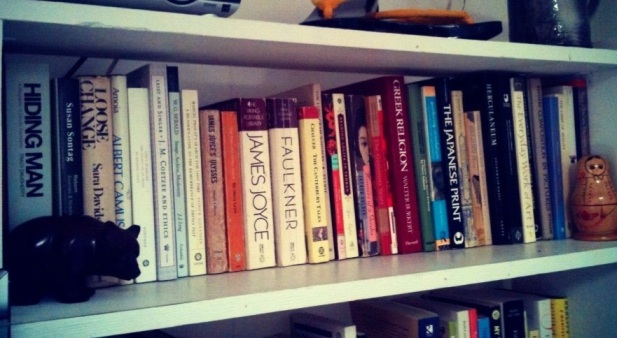
Book Shelves #43, 10.21.2012

20121021-104711.jpg

Book shelves series #43, forty-third Sunday of 2012

Kind of a hodgepodge shelf—some literary biography, a few now-redundant collections, some literary criticism, art books, etc.

Tracy Daugherty’s Donald Barthelme biography Hiding Man is on the far left; I reviewed it a few years ago, taking note of my favorite part, the so-called postmodernists’ dinner.

Next to it is Susan Sontag’s Reborn, a collection of early journals that I also reviewed.

Next to these two is Sara Davidson’s Loose Change. My aunt gave me a box of books years ago (lots of Asimov and Octavia Butler) and this was in here.

I knew about it because of a long essay in a 2007 issue of The Believer.

20121021-104718.jpg

I picked up Penguin’s The Essential James Joyce in Jimbocho, an area in Tokyo known for used bookstores.

I recall paying maybe ¥100 for it. It comprises a few selections from Ulysses and Finnegans Wake, some of  Joyce’s (totally unessential) poetry, and the entirety of Dubliners, Exiles, and Portrait. I’ve kept it because of sentiment (and  I like the cover).

20121021-104725.jpg

The Laughing Demon — Katsushika Hokusai

Totoro Jack O’ Lantern Stencil

Do you still need an idea for a jack o’ lantern? Are you a fan of Hayao Miyazaki films? Even the really sweet and gentle ones, like Ponyo and My Neighbor Totoro? And, are you, like, totally skilled at carving pumpkins? If so, have at it with this cool stencil by Flickr user PlayWithFire:

You can see variations on Totoro jack o’ lanterns–and other cool Miyazaki-inspired pumpkins here. From that set, here’s Flickr user C. Lambert’s Totoro pumpkin–