Rashomon — Akira Kurosawa (Full Film)

Reading Chris Ware’s Building Stories / Untitled Wordless Loop

20121109-140907.jpg

Continuing this project:

I’ve thus far titled the pieces I’ve been reading of Chris Ware’s Building Stories in a rather ad hoc fashion, but this entry is a wordless affair.

It continues the story of the “lonely girl,” the “cripple” who is the primary narrator of September 23rd, 2000.

Here, we see her raising her daughter in a series of wordless, precise panels that span roughly a decade.

Building Stories’s brilliance derives in large part from its precision and economy—Ware tells a story on every page, a chapter in every small panel:

20121109-140920.jpg

I’m a parent (my daughter is five, my son is two), and so much of this untitled piece struck me as utterly real and authentic—so true in the details.

There’s a moment when our mother looks up to see her daughter reading—silently, to herself—that is bittersweet, a kind of gentle heartbreak:

20121109-140926.jpg

There’s a fine line between the precise evocation of emotion and sentimental schlock, but Ware never comes close to treading it here—he’s always firmly on the side of the real.

And yet this doesn’t come at the expense of evocations of wonder, as we can see in the panels below:

20121109-140934.jpg

As I’ve suggested a few times already, Building Stories is a sort of  Möbius strip; this particular comic nearly literalizes this metaphor.

It begins with our mother drifting from sleep to waking memory, and ends thusly, a strange loop documenting how fast and how slow life changes.

“The Great Bridge Between Modernism and Post-modernism” — David Foster Wallace on Jorge Luis Borges

. . . Borges is arguably the great bridge between modernism and post-modernism in world literature. He is modernist in that his fiction shows a first-rate human mind stripped of all foundations in religious or ideological certainty — a mind turned thus wholly in on itself. His stories are inbent and hermetic, with the oblique terror of a game whose rules are unknown and its stakes everything.

And the mind of those stories is nearly always a mind that lives in and through books. This is because Borges the writer is, fundamentally, a reader. The dense, obscure allusiveness of his fiction is not a tic, or even really a style; and it is no accident that his best stories are often fake essays, or reviews of fictitious books, or have texts at their plots’ centers, or have as protagonists Homer or Dante or Averroes. Whether for seminal artistic reasons or neurotic personal ones or both, Borges collapses reader and writer into a new kind of aesthetic agent, one who makes stories out of stories, one for whom reading is essentially — consciously — a creative act. This is not, however, because Borges is a metafictionist or a cleverly disguised critic. It is because he knows that there’s finally no difference — that murderer and victim, detective and fugitive, performer and audience are the same. Obviously, this has postmodern implications (hence the pontine claim above), but Borges’s is really a mystical insight, and a profound one. It’s also frightening, since the line between monism and solipsism is thin and porous, more to do with spirit than with mind per se. And, as an artistic program, this kind of collapse/transcendence of individual identity is also paradoxical, requiring a grotesque self-obsession combined with an almost total effacement of self and personality. Tics and obsessions aside, what makes a Borges story Borgesian is the odd, ineluctable sense you get that no one and everyone did it.

—From “Borges on the Couch,” a 2004 NYT piece republished this month in the David Foster Wallace collection Both Flesh and Not.


Ticket of Admission to a Lecture by Walt Whitman on Abraham Lincoln

Ticket of admission to a lecture by Walt Whitman on Abraham Lincoln,"  initialed by Whitman at lower right. Lecture "to be delivered on Thursday, April 14th [1887], at 4 o'clock P. M., in the Madison Square Theatre, New-York."

(Via/about).

The Connoisseur — Norman Rockwell

Read “A Tree, A Rock, A Cloud,” a Short Story by Carson McCullers

“A Tree, A Rock, A Cloud” by Carson McCullers

It was raining that morning, and still very dark. When the boy reached the streetcar café he had almost finished his route and he went in for a cup of coffee. The place was an all-night café owned by a bitter and stingy man called Leo. After the raw, empty street, the café seemed friendly and bright: along the counter there were a couple of soldiers, three spinners from the cotton mill, and in a corner a man who sat hunched over with his nose and half his face down in a beer mug. The boy wore a helmet such as aviators wear. When he went into the café he unbuckled the chin strap and raised the right flap up over his pink little ear; often as he drank his coffee someone would speak to him in a friendly way. But this morning Leo did not look into his face and none of the men were talking. He paid and was leaving the café when a voice called out to him:

“Son! Hey Son!”

He turned back and the man in the corner was crooking his finger and nodding to him. He had brought his face out of the beer mug and he seemed suddenly very happy. The man was long and pale, with a big nose and faded orange hair.

“Hey Son!”

The boy went toward him. He was an undersized boy of about twelve, with one shoulder drawn higher than the other because of the weight of the paper sack. His face was shallow, freckled, and his eyes were round child eyes.

“Yeah Mister?”

The man laid one hand on the paper boy’s shoulders, then grasped the boy’s chin and turned his face slowly from one side to the other. The boy shrank back uneasily.

“Say! What’s the big idea?”

The boy’s voice was shrill; inside the café it was suddenly very quiet.

The man said slowly. “I love you.”

All along the counter the men laughed. The boy, who had scowled and sidled away, did not know what to do. He looked over the counter at Leo, and Leo watched him with a weary, brittle jeer. The boy tried to laugh also. But the man was serious and sad.

“I did not mean to tease you, Son,” he said. “Sit down and have a beer with me. There is something I have to explain.”

Cautiously, out of the corner of his eye, the paper boy questioned the men along the counter to see what he should do. But they had gone back to their beer or their breakfast and did not notice him. Leo put a cup of coffee on the counter and a little jug of cream.

“He is a minor,” Leo said. Continue reading “Read “A Tree, A Rock, A Cloud,” a Short Story by Carson McCullers”

“Lipostudio . . . And So On” — Matmos

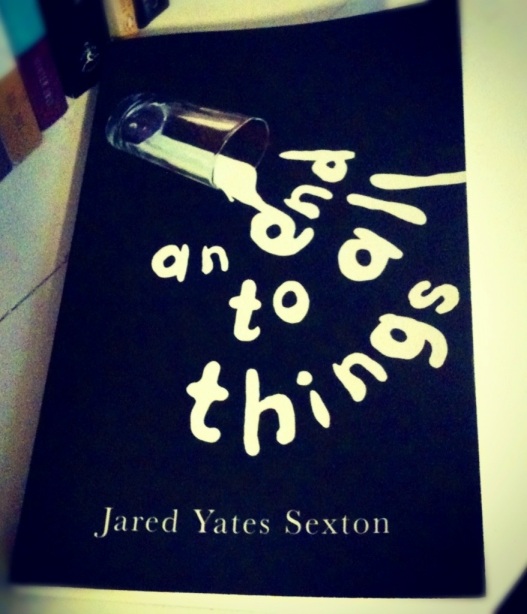
Jared Yates Sexton’s An End to All Things (Book Acquired Sometime Last Month)

20121018-174605.jpg

Jared Yates Sexton’s An End to All Things immediately appealed to me when it arrived last month. This collection is stocked with short, precise, unpretentious stories. Great sentences—shades of Hannah, Carver, Pancake. I’ve read about half a dozen so far, parceling them out over spare afternoon minutes and it’s good stuff—feels real without the strains of literary realism. You can read a story at publisher Atticus Books’ site, “You Never Ask Me About My Dreams” (great title). The first few paragraphs:

At that point things had been rough for a couple of months and I would’ve done anything to ease the tension. I set an alarm for half an hour earlier than usual. I thought if I had some breakfast going when Cathy got up she’d have to see that I cared.

After all, cooking wasn’t the easiest thing to do in our house. Both of us hated dishes so the kitchen was always a mess. There were pots and pans stacked on the counters and plates in the sink. Some still had clumps of food stuck to them. I even had to rinse out a bowl to use. Somehow there were a couple of clean forks and knives in the drawer. I got some eggs from the fridge and went to work scrambling the yolks.

A Girl Reading — Pierre-Auguste Renoir