Read an Excerpt from Stuart Kendall’s New Translation of Gilgamesh

Contra Mundum Press is publishing a new translation of the epic of Gilgamesh by renowned translator and scholar Stuart Kendall, who has translated works by Bataille, Blanchot, and Debord, among others. You can read (and download if you like) a good chunk of this text now. It’s good stuff.

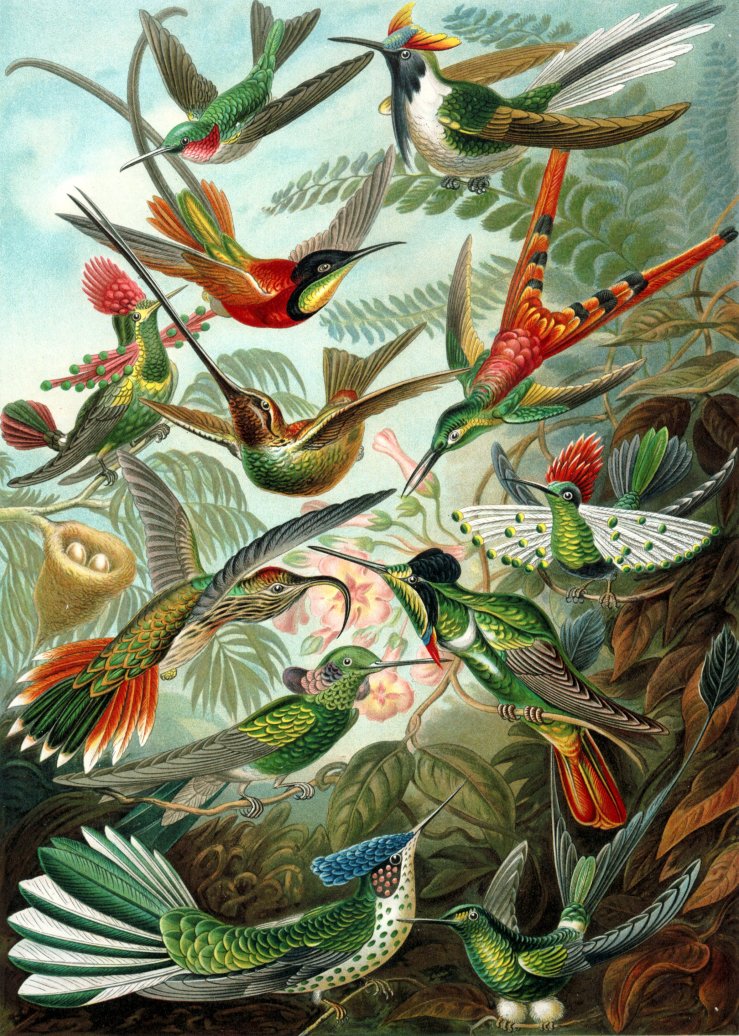
Trochilidae — Ernst Haeckel

I (Sort of) Review the the Trailer for Wes Anderson’s New Film, Moonrise Kingdom

If you hate Wes Anderson—and hating Wes Anderson seems like a special kind of sport in 2012 (or at least it did after his last two films, The Darjeeling Limited and Fantastic Mr. Fox)—the trailer for his new film Moonrise Kingdom will surely give you fuel for that fire or arrows for your quiver or whatever you need for your particular metaphor.

I like Wes Anderson’s films: I like the strange blend of earnestness and irony, the precociousness and preciousness, the calculated soundtracks, the fussy set and costume design and faux-’70s color schemes; I like the crumbling families, the failed and failing geniuses, the narcissists and the hacks; I like the fantasy of it all. I like the sentimentality of it all. I like the tents and special societies and secret compartments and fake books. I like the depression behind the charm.

I especially like Rushmore and The Royal Tenenbaums, which I think are the films that best navigate that special space between fantasy and reality (and theatricality) that is Andersonville. My least favorite film of his is his first, Bottle Rocket—too realistic (what a strange claim!), too naturalistic, not mannered or fussy enough.

I more or less understand why so many people hate Anderson’s fantasies, although I think it’s weak criticism to dismiss them as empty exercises in style without substance; still, watching the new trailer, I can see why anyone with a quarrel with Wes Anderson will positively hate this Wes Anderson movie before it’s even come out.

Here is that trailer:

So:

We’ve got a charismatic young man in the Max Fischer mold.

We’ve got a never-was early 1960s (?) sleep-away-camp (?)

We’ve got Edward Norton in a scouting uniform (in shorts!) saying: “Jiminy Cricket, he flew the coop!” (this is like +100 flaming arrows in the quivers of Anderson-haters, I imagine; it made me cringe my own self).

We have a portable turntable on a Northeastern beach.

We have the kind of tracking close up shots that went out of fashion, what, thirty years ago now?

Also:

A 1960s French pop song.

A play.

A house in a tree.

Some sailing shots that somehow remind me of Arthur Ransome’s Swallows and Amazons.

Old Bruce Willis.

Frances McDormand.

And:

Well, did you watch the end? Did you see those final moments, the shirtless Bill Murray with the ax propped over one shoulder, bottle of red in the other? Well, that’s why I tend to like these films.

McNulty’s Fake English Accent (The Wire)

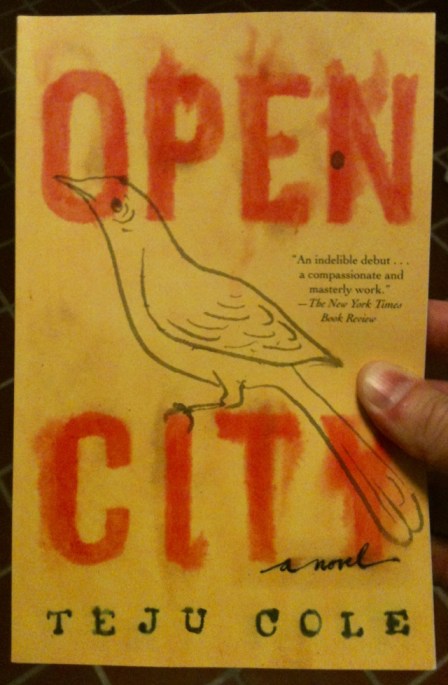
Book Acquired, 1.11.2012 (Teju Cole Edition)

20120111-194217.jpg

Teju Cole’s Open City was a big favorite for many lit folks last year, including Anthony at Times Flow Stemmed, a blog I admire. The book seems similar to Sebald’s strange opus The Rings of Saturn. In short, very excited for this one.  From the write-up at Times Flow Stemmed:

Open City is narrated by Julius, a part Nigerian, part German psychiatry student. Beginning with a strong Sebaldian influence as Julius aimlessly wanders around the streets and parks of New York, the story develops into a modern inquiry into the foundation of personality, memory, nationhood and dislocation.

Although written in the first person the narrator remains at a distance, a lonely, bookish character, more comfortable discussing literary or musical influences (Mahler, Coetzee, Barthes) than developing a relationship with a childhood friend or dying professor. This distance allows Cole, as James Wood explains . . .  to make his novel ‘as close to a diary as a novel can get, with room for reflection, autobiography, stasis, and repetition.’

The Last Supper — An Excerpt from Peter Greenaway’s Installation

Bohemian Grove Toy Set

(Via).

David Markson Reads from The Last Novel at the 92nd Street Y, 2007

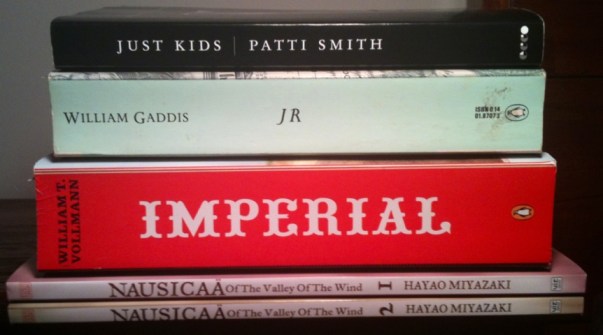
Riff on Recent Reading, 1.09.2012 (Gaddis, Vollmann, Dragons, Nausicaä, Patti Smith)

20120110-181813.jpg

1. Just Kids, Patti Smith

Really slowed down on this one, mostly because the spring semester hath begun, wreaking all sorts of destabilizing tasks on me. Momentum and reading habits will inevitably return. Anyway, Smith’s book is more or less a litany of famous meetings and infamous moments with lots and lots of descriptions of talismanic objects. The scene where she meets Allen Ginsberg is pretty cool. Smith presents herself as earnest, passionate, but also somehow at odds (or at least outs) with the whole Chelsea Hotel scene.

2. Nausicaä of the Valley of the Wind, Vol 1, Hayao Miyazaki

Completed the first volume of Miyazaki’s groundbreaking manga and started the second. The art is well crafted and distinct, but often extremely busy and even frenetic. It sometimes feels squashed in the panels, like it needs room to breathe. I can’t help but compare it to the film that followed, which is visually richer and more expansive. The film, in a sense, helps me to fill out the scope signaled in Miyazki’s inky illustrations.

The story in the manga so far differs subtly but significantly from the film; without adding spoilers (I think fans of the film will enjoy the book), the political dimension of the plot is heightened and gender roles are explored with greater concern. Nausicaä’s initial rashness is also presented with greater intensity (read: violent consequences). More to come.

3. Imperial, William T. Vollmann

Chapter 3 of Imperial, “The Water of Life,” is some of the best gonzo journalism I’ve ever read. Vollmann (along with an improbably game ex-Marine/hotel clerk) takes a raft—a cheap rubber dinghy, really—down the infamous New River, purportedly one of the most polluted waterways in North America. This river is filled with dead birds, dead fish, probably dead humans, lots and lots of garbage, industrial runoff, and lots and lots of human shit.

Of course, Vollmann can find beauty and strangeness and ugliness all at once:

The chapter does everything one wants from the book, and if you’re at all intrigued, there’s a version in the excellent Vollmann reader Expelled from Eden, which is a good starting point for his work.

The next chapter, “Sublineations: Lovescapes,” is this awful emo exploration of a bad breakup and the following heartbreak Volls feels after. It was torturous to get through, the sort of thing that screams for an editor. It also underscores how deeply deeply deeply personal the book is to him, though. More to come.

4. A Dance with Dragons, George R. R. Martin (audiobook read by Roy Dotrice)

Well goddam if I didn’t finally finish it. As I’ve lamented elsewhere in these e-pages, Martin’s fourth and fifth books in the A Song of Ice and Fire series (I hate that name, by the way: Game of Thrones (without the indefinite article) is way cooler sounding) are bloated, sagging, overfilled beasts sorely in need of an enema. Still, Dragons picks up in its final third, and ends with some shockers that, if I remember them 12 years from now when he finally finishes the next one, I may want to read it. Roy Dotrice = a very gifted reader. A great audiobook (still, I can’t believe this one topped so many year end lists).

5. JR, William Gaddis  (tandem reading with audiobook read by Nick Sullivan)

Big thanks to Dwight at A Common Reader for suggesting the audiobook of JR read by Sullivan. I’m a few hours in; I’ve also been rereading bits immediately when I get home (I listen mostly in the car or on walks), retracing the lines that I’ve mentally underlined. Sullivan is a gifted voice actor who brings the many, many voices of JR to vivid life (that line seems hackneyed but it is in no way insincere. If I weren’t riffing I’d revise. If I weren’t riffing I’d edit parenthetical excuses. I’m gonna drink more red zin now). I’m reminded in some ways of RTE’s full-cast unabridged recording—performance really—of Joyce’s Ulysses. I’d read Ulysses twice before, but I feel like the full-cast production was an equally definitive version to the one in my head. Like Ulysses—especially the Sirens episode—JR is extremely aural; it’s mostly dialogue.

I’ve laughed out loud several times so far—had no idea the book would be this funny. Also, reading/hearing it, I can’t help but see how profoundly David Foster Wallace was influenced by Gaddis here: the bizarre corporate-speak, the disjunctive rhythms, the absurd humor, the satire on modernity, the ironic-earnest axis—even the passages of naturalistic description.

On deck: The Orphan Master’s Son by Adam Johnson, Open City by Teju Cole, Smut by Alan Bennett and more more more.

Lucifer Son of the Morning, I’m Gonna Chase You Out of Earth — Van Arno

Check out more of Van Arno’s amazing series of oil paintings, The Minstrel Cycle. Artist’s statement about Lucifer Son of the Morning, I’m Gonna Chase You Out of Earth: 

Jay-Z’s ‘Lucifer’ sampled the Max Romeo song ‘Chase The Devil,’  but didn’t include the full chorus, ‘I gonna put on an iron shirt, and chase Satan out of earth… I gonna send him to outer space, to find another race.’ The armor, and futility of the mission brings to mind Don Quixote, who mistakes a windmill for a giant, much as our heroine mistakes the evil in her own nature for a space traveling monster.

Margaret Atwood Talks About Twitter (Video)

David Markson: “Originally I Was Calling It Wittgenstein’s Niece”

More from David Markson’s interview at the Dalkey Archive:

DM: Originally I was calling it “Wittgenstein’s Niece.” Never knowing, of course, that Thomas Bernhard would eventually publish something called “Wittgenstein’s Nephew.” But even before I submitted it I knew I’d have enough trouble finding a publisher as was—hardly the amount I did have, but some—and so not wanting to compound the difficulty I changed it to “Keeper of the Ghosts.” Which is something I swiped from Lowry, by the way, from a character named Ghostkeeper. But once the manuscript wound up in the hands of a small press that wasn’t going to be worried about recognition value in Downers Grove, Illinois, or among the knuckleheads at a sales conference, I went back to Wittgenstein. “Mistress” had been on the same scratch sheet with “Niece,” and I decided I liked it better by then.

JT: And meaning basically that your heroine is mistress to Wittgenstein’s thought?

DM: Well, along with several other people’s yes. But as I started to say a few minutes ago, the Wittgenstein is frequently most obvious in the very way she questions so many of her own “propositions,” as it were.

The Last Supper — Joe Simon

“I Suppose You Become Addicted to a Certain Kind of Writing” — David Markson on Lowry, Joyce, and Gaddis

David Markson talked with Joseph Tabbi about (among many other things) his friendship with Malcolm Lowry, his love for William Gaddis’s The Recognitions, and how James Joyce teaches us to read. Read the entire interview at the Dalkey Archive:

JT: You mention your critical study of “Volcano.” But you did a master’s thesis on it at Columbia much earlier?

DM: While we were in touch, but before I’d actually met him, yes. In 1951.

JT: Which means it was only four years after the novel had been published. Isn’t that rare, an academic paper on an entirely “new” writer with no body of criticism to verify his status?

DM: As a matter of fact I had to wander around the English department knocking on doors looking for someone to approve the project. I remember Lionel Trilling’s dismissal in particular: “What is all this drunkenness all about?” My whole object was to explain just that, obviously, but I decided to find less of a current to buck. Finally William York Tindall gave me a go-ahead.

JT: That brings up a question of a different sort, however. “Volcano” is scarcely your everyday traditional novel. What sort of training or background did you have that let you feel able to confront the challenge of interpreting something that difficult?

DM: To tell the truth, I’m not sure if I had any real idea what I was getting into, or if any of us do, the first time we’re seduced by a book of that sort. Though Joyce certainly teaches us, for starters. By which I mean that we all learn quickly with “Ulysses” that we cannot simply read the novel itself but have to lean on some of the critical crutches.

JT: But you had no crutches at all?

DM: Oh, well, but there are always clues in the text itself—this reference to that which leads to patterns you begin to trace out. On one level I impressed the hell out of myself, surprised at what I did know. And evidently I impressed a few other creatures as well, since I kept hearing that the thesis was being stolen from by students all over the place. The again when I sat down years later to turn that early stuff into a full length book I was almost embarrassed at how little I’d seen after all.

JT: Not long after that original Lowry thesis you were proselytizing fairly extensively for “The Recognitions” too?

DM: I suppose you become addicted to a certain kind of writing. There’s little enough of it extant, God knows. I’m not sure how much actual “proselytizing” I did for Gaddis, however. Except of course for practically button-holing friends on street corners.

JT: But I understand you were very directly responsible for the first reissue of the book, also?

DM: Evidently I was. It’s a funny story, actually. I was living in Mexico, and someone—well, old Aiken, in fact—gave my address to Aaron Asher, who was the editor of Meridian Books at the time. I picked him and his wife Linda up at their hotel and brought them out to where Elaine and I were living—outside Mexico City—for dinner and then spent approximately three solid hours talking nonstop about Gaddis. Finally Aaron threw up his hands in despair, telling me, “Please, please, I promise I’ll read the darned thing as soon as I get home! But now tell us something about where to go and what to see in Mexico, for heaven’s sake!”

JT: And then he did publish it. Did Gaddis himself know about the impetus?

DM: That’s fairly funny too, as it happens. “The Recognitions” came out in 1955. I’d read it twice when it did, and then wrote Gaddis a letter. It’s perhaps the only other letter I’ve written to an author I didn’t know, but it was completely different from the one I wrote to Lowry. In this case I’d just been infuriated by the rotten reviews and simply wanted to tell the man the hell with them all, that there were some few of us out there who did see what he’s accomplished. I didn’t get an answer, though I eventually heard secondhand that Gaddis had been too depressed at the time to send one. Or that he’d ultimately decided it was too late. But then sometime in 1961, not long after the Asher incident, I did hear. Six years after the fact, this was, a long letter beginning with something like, “Dear David Markson, if I can presume to answer yours of June whatever, 1955!” Which went on to say that Asher was in fact about to do a first reprint.

John Cage’s Variations VII (1966)

Chiroptera — Ernst Haeckel

“Strawberry Soda” (The Wire)