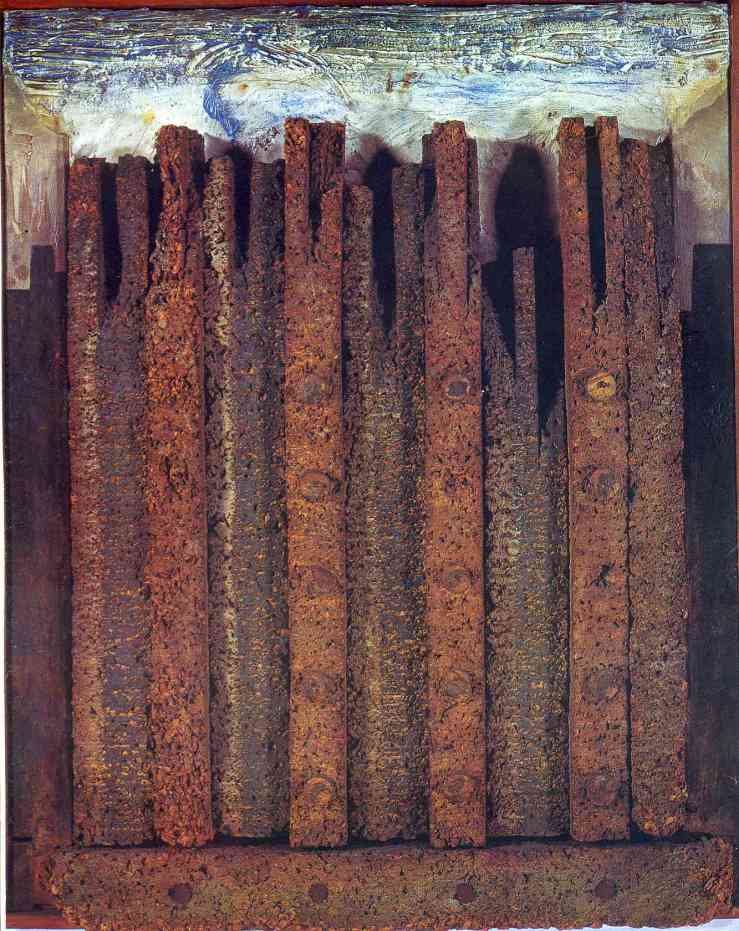
Dadaville — Max Ernst

dadaville-1924

“…his body was a sentry-box and this soliloquizer on guard there…” (Moby-Dick)

Yet, as previously hinted, this omnitooled, open-and-shut carpenter, was, after all, no mere machine of an automaton. If he did not have a common soul in him, he had a subtle something that somehow anomalously did its duty. What that was, whether essence of quicksilver, or a few drops of hartshorn, there is no telling. But there it was; and there it had abided for now some sixty years or more. And this it was, this same unaccountable, cunning life-principle in him; this it was, that kept him a great part of the time soliloquizing; but only like an unreasoning wheel, which also hummingly soliloquizes; or rather, his body was a sentry-box and this soliloquizer on guard there, and talking all the time to keep himself awake.

From “The Carpenter,” Chapter 107 of Melville’s Moby-Dick.

“Blizzard” — William Carlos Williams

“Blizzard” by William Carlos Williams–

Snow falls:
years of anger following
hours that float idly down —
the blizzard
drifts its weight
deeper and deeper for three days
or sixty years, eh? Then
the sun! a clutter of
yellow and blue flakes —
Hairy looking trees stand out
in long alleys
over a wild solitude.
The man turns and there —
his solitary track stretched out
upon the world.

“Headache” — Frank Black

A New York Blizzard — Childe Hassam

“On the Fear of Death” — William Hazlitt

“On the Fear of Death” by William Hazlitt

And our little life is rounded with a sleep.

Perhaps the best cure for the fear of death is to reflect that life has a beginning as well as an end. There was a time when we were not: this gives us no concern—why, then, should it trouble us that a time will come when we shall cease to be? I have no wish to have been alive a hundred years ago, or in the reign of Queen Anne: why should I regret and lay it so much to heart that I shall not be alive a hundred years hence, in the reign of I cannot tell whom?

When Bickerstaff wrote his Essays I knew nothing of the subjects of them; nay, much later, and but the other day, as it were, in the beginning of the reign of George III., when Goldsmith, Johnson, Burke, used to meet at the Globe, when Garrick was in his glory, and Reynolds was over head and ears with his portraits, and Sterne brought out the volumes of Tristram Shandyyear by year, it was without consulting me: I had not the slightest intimation of what was going on: the debates in the House of Commons on the American War, or the firing at Bunker’s Hill, disturbed not me: yet I thought this no evil—I neither ate, drank, nor was merry, yet I did not complain: I had not then looked out into this breathing world, yet I was well; and the world did quite as well without me as I did without it! Why, then, should I make all this outcry about parting with it, and being no worse off than I was before? There is nothing in the recollection that at a certain time we were not come into the world that ‘the gorge rises at’—why should we revolt at the idea that we must one day go out of it? To die is only to be as we were before we were born; yet no one feels any remorse, or regret, or repugnance, in contemplating this last idea. It is rather a relief and disburthening of the mind: it seems to have been holiday-time with us then: we were not called to appear upon the stage of life, to wear robes or tatters, to laugh or cry, be hooted or applauded; we had lain perdus all this while, snug, out of harm’s way; and had slept out our thousands of centuries without wanting to be waked up; at peace and free from care, in a long nonage, in a sleep deeper and calmer than that of infancy, wrapped in the softest and finest dust. And the worst that we dread is, after a short, fretful, feverish being, after vain hopes and idle fears, to sink to final repose again, and forget the troubled dream of life!… Ye armed men, knights templars, that sleep in the stone aisles of that old Temple church, where all is silent above, and where a deeper silence reigns below (not broken by the pealing organ), are ye not contented where ye lie? Or would you come out of your long homes to go to the Holy War? Or do ye complain that pain no longer visits you, that sickness has done its worst, that you have paid the last debt to nature, that you hear no more of the thickening phalanx of the foe, or your lady’s waning love; and that while this ball of earth rolls its eternal round, no sound shall ever pierce through to disturb your lasting repose, fixed as the marble over your tombs, breathless as the grave that holds you! And thou, oh! thou, to whom my heart turns, and will turn while it has feeling left, who didst love in vain, and whose first was thy last sigh, wilt not thou too rest in peace (or wilt thou cry to me complaining from thy clay-cold bed) when that sad heart is no longer sad, and that sorrow is dead which thou wert only called into the world to feel! Continue reading ““On the Fear of Death” — William Hazlitt”

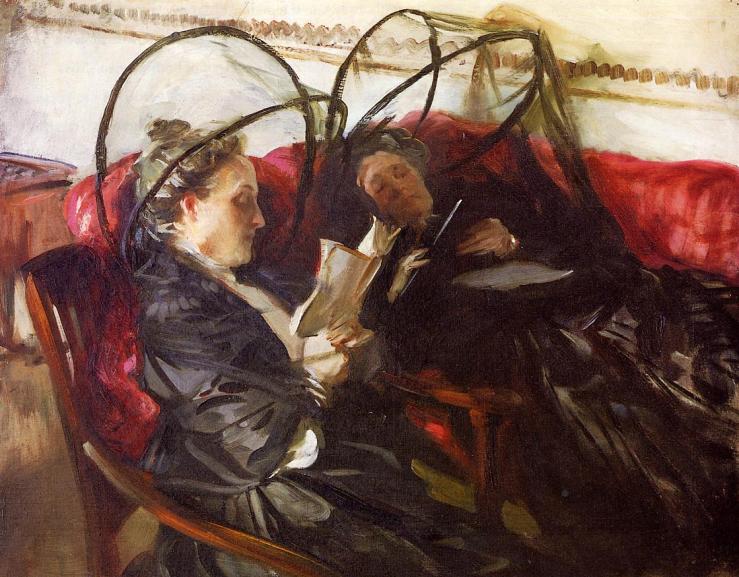
Mosquito Nets — John Singer Sargent

mosquito-nets-1908

Alfred Hitchcock’s The Lady Vanishes (Full Film)

Beastie Variation, Phlegmatic — Thomas Woodruff

beastie variation woodruff

(More).

Skeeno H.C. Rules — Sonic Youth

“How to Write a Novel” — Gordon Lish

“How to Write a Novel” by Gordon Lish

First make sure you have enough time. It is crucial that you have enough time to make things up. Myself, I do not have time enough for anything like that.

But I’ll tell you what’s what. It will not be hard for you to follow me doing it.

Just listen.

Just watch.

I’m composing these instructions on an I.B.M. Selectric. I got it back in 1961. I did not buy it. I finessed it or I finagled it or I stole it.

The person who is the unexpressed direct object of one or the other of these verbs was rich. He said you can borrow this thing, use it for a while. Then he stuck his other thing in my wife’s thing. They still have their things and I have this thing and I’m not giving it up.

It’s given tip-top service. I really loved it when I first saw it, and I still love it just as much.

I never cover it over with anything. I don’t cover it over with anything like a cover or anything—because I like to look at it—the shape.  I.B.M. is good at giving a thing a nice shape. I always look at the shape of things before I snap of the light in a room.

I think 1961 was the Selectric’s first year.

I talk to engineers whenever I get a chance. I don’t mean the kind that build bridges. I mean the fellows that service things. Those are the engineers I talk to.

You know what one of those fellows once told me once? Buy the first of whatever it is! He said buy the first one of whatever it is because the maker of it is never going to knock himself out like that again—making, you know, all of the others after that. That’s why this one’s still going fine after so many wonderful, wonderful years.

The same goes for the Polaroid camera I’ve got. I’ve got the oldest one there is. You know how old that is? Here’s how old it is. It’s called, they call it, the Polaroid Land Camera.

That’s how goddamn old it is!

No shit, it was a first one—it was the very first Polaroid the Polaroid people made!

You want to see pictures? Look at these pictures! Tell me when in your life you ever saw in your life pictures as sharp as these pictures!

Because they’e this big when I start out with them. You see how big? Next to nothing, right? But then what? But then I go get them all blown up as big as life! See them? Look at them all over the walls if you don’t know what I mean!

That’s resolution for you , isn’t it?

Well, that’s my second wife, okay?

They’re framed all over the place.

People come in here and then they look at them and then they smack their heads.

My God, they say, such pictures!

I say, original issue, a maker knows his game.
Little Nemo Strip — Winsor McCay

“A Winter Walk” — Henry David Thoreau

“A Winter Walk” by Henry David Thoreau

The wind has gently murmured through the blinds, or puffed with feathery softness against the windows, and occasionally sighed like a summer zephyr lifting the leaves along, the livelong night. The meadow-mouse has slept in his snug gallery in the sod, the owl has sat in a hollow tree in the depth of the swamp, the rabbit, the squirrel, and the fox have all been housed. The watch-dog has lain quiet on the hearth, and the cattle have stood silent in their stalls. The earth itself has slept, as it were its first, not its last sleep, save when some street-sign or wood-house door has faintly creaked upon its hinge, cheering forlorn nature at her midnight work,—the only sound awake twixt Venus and Mars,—advertising us of a remote inward warmth, a divine cheer and fellowship, where gods are met together, but where it is very bleak for men to stand. But while the earth has slumbered, all the air has been alive with feathery flakes descending, as if some northern Ceres reigned, showering her silvery grain over all the fields.

We sleep, and at length awake to the still reality of a winter morning. The snow lies warm as cotton or down upon the window-sill; the broadened sash and frosted panes admit a dim and private light, which enhances the snug cheer within. The stillness of the morning is impressive. The floor creaks under our feet as we move toward the window to look abroad through some clear space over the fields. We see the roofs stand under their snow burden. From the eaves and fences hang stalactites of snow, and in the yard stand stalagmites covering some concealed core. The trees and shrubs rear white arms to the sky on every side; and where were walls and fences, we see fantastic forms stretching in frolic gambols across the dusky landscape, as if nature had strewn her fresh designs over the fields by night as models for man’s art.

Silently we unlatch the door, letting the drift fall in, and step abroad to face the cutting air. Already the stars have lost some of their sparkle, and a dull, leaden mist skirts the horizon. A lurid brazen light in the east proclaims the approach of day, while the western landscape is dim and spectral still, and clothed in a sombre Tartarian light, like the shadowy realms. They are Infernal sounds only that you hear,—the crowing of cocks, the barking of dogs, the chopping of wood, the lowing of kine, all seem to come from Pluto’s barn-yard and beyond the Styx;—not for any melancholy they suggest, but their twilight bustle is too solemn and mysterious for earth. The recent tracks of the fox or otter, in the yard, remind us that each hour of the night is crowded with events, and the primeval nature is still working and making tracks in the snow. Opening the gate, we tread briskly along the lone country road, crunching the dry and crisped snow under our feet, or aroused by the sharp clear creak of the wood-sled, just starting for the distant market, from the early farmer’s door, where it has lain the summer long, dreaming amid the chips and stubble; while far through the drifts and powdered windows we see the farmer’s early candle, like a paled star, emitting a lonely beam, as if some severe virtue were at its matins there. And one by one the smokes begin to ascend from the chimneys amidst the trees and snows. Continue reading ““A Winter Walk” — Henry David Thoreau”

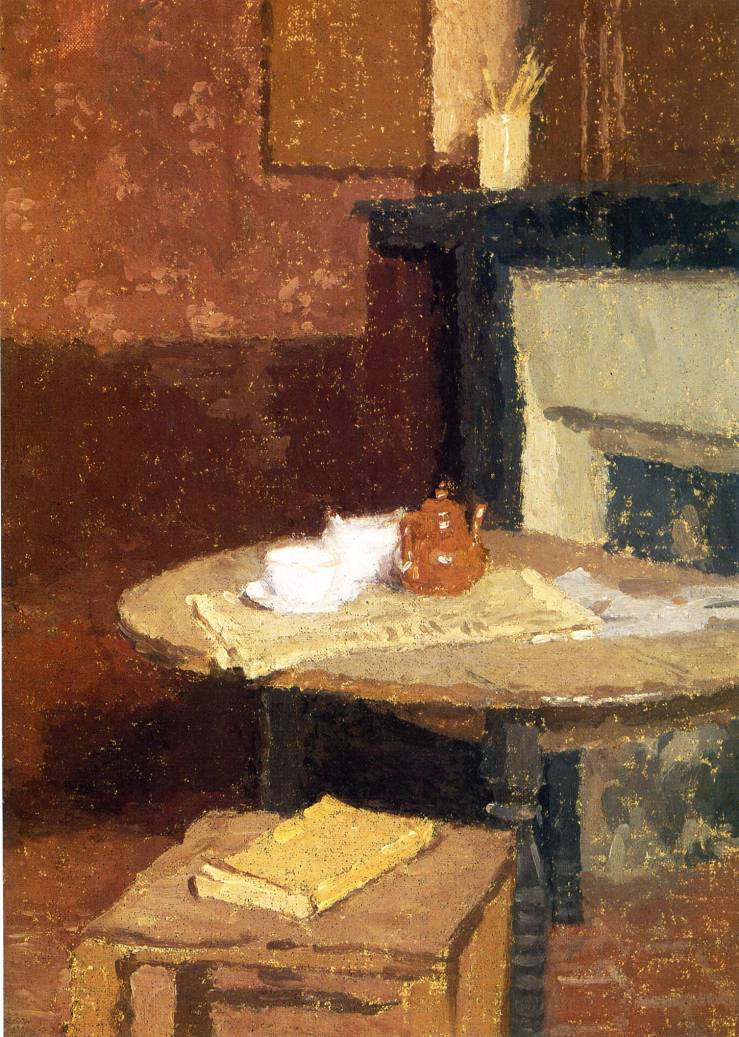
The Brown Pot — Gwen John

the-brown-tea-pot

See Robert Altman’s Adaptation of Harold Pinter’s Play, The Room

Batgirl — James Jean

batgirl6920125

“When you shoot an elephant, it stays on its feet for ten days before it falls over” (Werner Herzog)

Iquitos, 29 June 1979

When you shoot an elephant, it stays on its feet for ten days before it falls over. When I got back on the ice after two minutes in the penalty box, a puck struck hard from a short distance away smashed into my head. There was a pulsing flash of light before my eyes, and I became weightless. On the boat to Belén: roast alligator was served. Women delousing children, children carrying much too heavy burdens held by forehead straps.

Boats passing, everything in slow motion. A large pile of empty tortoise shells. Chickens tied by the legs, swinging in an empty-looking radius. At night the cooking fires glow. Enormous fish at the market, fruit juices surrounded by swarms of flies, filth. Children playing marbles between the houses’ stilts. Vultures that spread their wings like Christ on the Cross and remain in that statuelike position, presumably to cool off or to drive away itching mites. In early times it was interpreted as the posture for prayer, and because of the mites the eagle became the favorite heraldic bird for coats of arms. Cattle heads, skinned and bloody, on a hand cart. The women crouch in the brownish water, doing their laundry. In a bar a man was lying on the floor unconscious, dead drunk. By fifteen most of the girls already have one or two children. This city seems to be inhabited exclusively by children. Today is a holiday. In the evening up the Río Momón by boat.

An entry from Werner Herzog’s journal Conquest of the Useless, which records the difficulties he faced while making Fitzcarraldo.