Mutual Appreciation Society (David Markson)

Capture

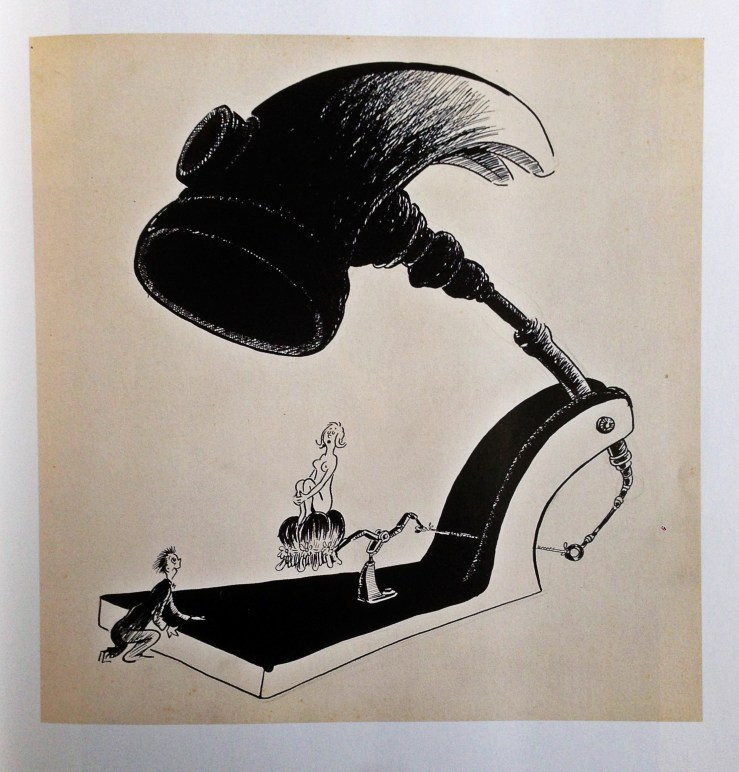
Untitled — Dr. Seuss

IMG_5181

“Reflections for Gentlemen-jockeys” — Franz Kafka

“Reflections for Gentlemen-jockeys” by Franz Kafka

When you think it over, winning a race is nothing to sigh for. The fame of being hailed as the best rider in the country is too intoxicating a pleasure when the applause strikes up not to bring a reaction the morning after.

The envy of your opponents, cunning and fairly influential men, must trouble you in the narrow enclosure you now traverse after the flat racecourse, which soon lay empty before you save for some laggards of the previous round, small figures charging the horizon.

Many of your friends are rushing to gather their winnings and only cry ‘Hurrah!’ to you over their shoulders from distant pay boxes; your best friends laid no bet on your horse, since they feared that they would have to be angry with you if you lost, and now that your horse has come in first and they have won nothing, they turn away as you pass and prefer to look along the stands.

Your rivals behind you, firmly in the saddle, are trying to ignore the bad luck that has befallen them and the injustice they have somehow suffered; they are putting a brave new face on things, as if a different race were due to start, and this time a serious one after such child’s play.

For many ladies the victor cuts a ridiculous figure because he is swelling with importance and yet cannot cope with the never-ending handshaking, saluting, bowing, and waving, while the defeated keep their mouths shut and casually pat the necks of their whinnying horses.

And finally from the now overcast sky rain actually begins to fall.

Still Life with Skull, Candle and Book — Paul Cezanne

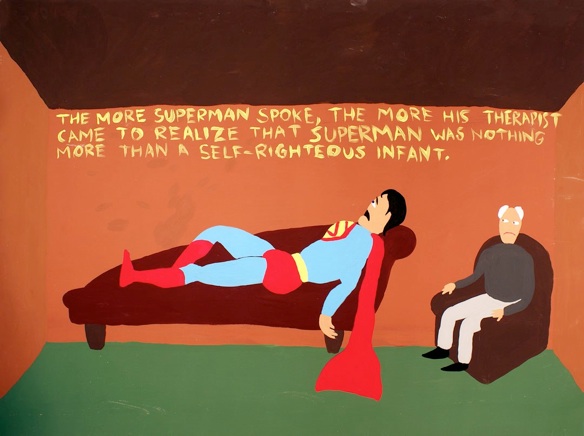
The More Superman Spoke — Jayson Musson

07.-supermanstherapist

(Via/more).

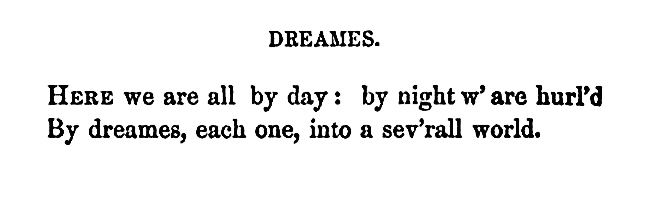
“Dreames” — Robert Herrick

Capture

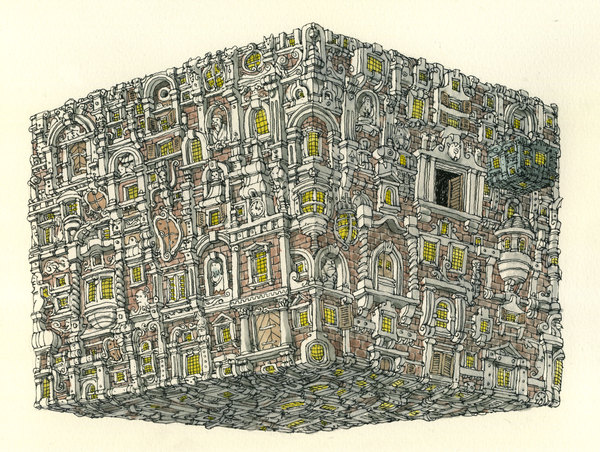
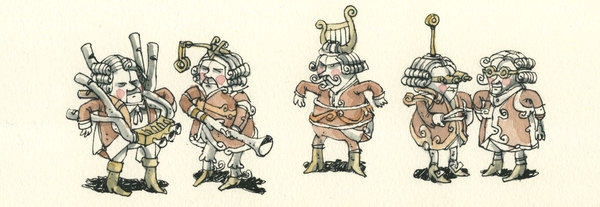
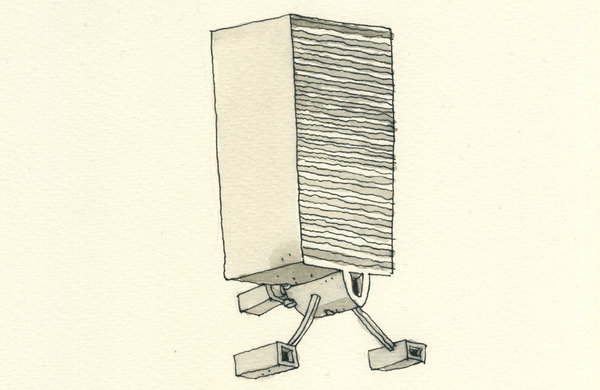
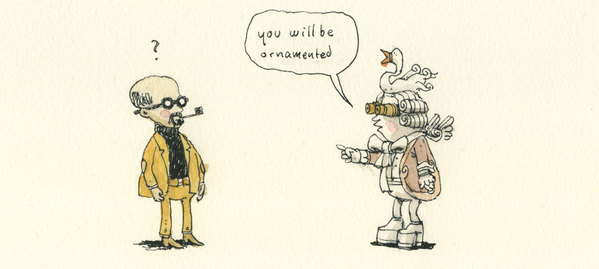
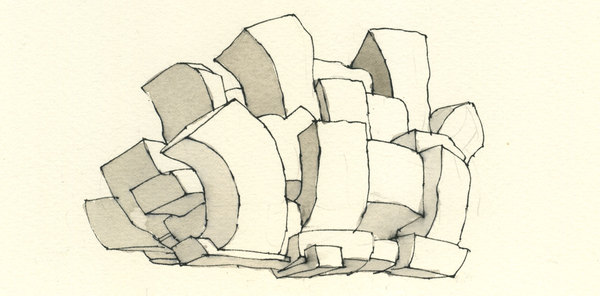
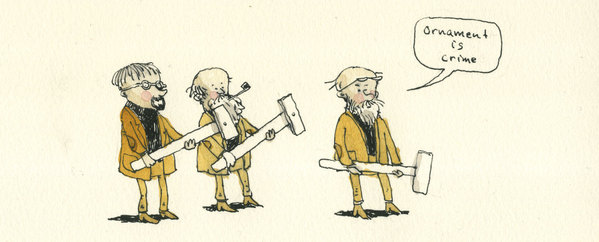
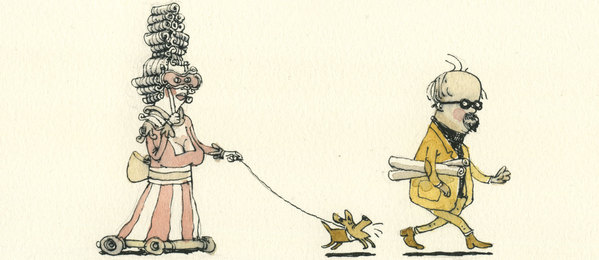
Rococo Borg vs The Association of Modernist Architects — Mattias Adolfsson

40217880c836c870cb687c970a768e25 ee3d359221e41d11679a7b9d33aed9b5 a2cd72731b785e607097b4c8b735f4d6 7688231f53421d922bac64efd0c2f60f 3784ff3670c6b426c1a9b917d7fe90b5 0d3eafe6b0376dba4bee0ba7106ea61d 2804392f9ac746cd0c020391846ae23b

(More/via).

Tim O’Brien Tells a War Story (And Explains Why He Writes)

I’m just an animal looking for a home

“Out, Out—” — Robert Frost

“Out, Out—” by Robert Frost

The buzz-saw snarled and rattled in the yard
And made dust and dropped stove-length sticks of wood,
Sweet-scented stuff when the breeze drew across it.
And from there those that lifted eyes could count
Five mountain ranges one behind the other
Under the sunset far into Vermont.
And the saw snarled and rattled, snarled and rattled,
As it ran light, or had to bear a load.
And nothing happened: day was all but done.
Call it a day, I wish they might have said
To please the boy by giving him the half hour
That a boy counts so much when saved from work.
His sister stood beside them in her apron
To tell them “Supper.” At the word, the saw,
As if to prove saws knew what supper meant,
Leaped out at the boy’s hand, or seemed to leap—
He must have given the hand. However it was,
Neither refused the meeting. But the hand!
The boy’s first outcry was a rueful laugh,
As he swung toward them holding up the hand
Half in appeal, but half as if to keep
The life from spilling. Then the boy saw all—
Since he was old enough to know, big boy
Doing a man’s work, though a child at heart—
He saw all spoiled. “Don’t let him cut my hand off—
The doctor, when he comes. Don’t let him, sister!”
So. But the hand was gone already.
The doctor put him in the dark of ether.
He lay and puffed his lips out with his breath.
And then—the watcher at his pulse took fright.
No one believed. They listened at his heart.
Little—less—nothing!—and that ended it.
No more to build on there. And they, since they
Were not the one dead, turned to their affairs

“The Mustache” — Guy de Maupaussant

“The Mustache” by Guy de Maupassant

CHATEAU DE SOLLES, July 30, 1883.

My Dear Lucy:

I have no news. We live in the drawing-room, looking out at the rain. We cannot go out in this frightful weather, so we have theatricals. How stupid they are, my dear, these drawing entertainments in the repertory of real life! All is forced, coarse, heavy. The jokes are like cannon balls, smashing everything in their passage. No wit, nothing natural, no sprightliness, no elegance. These literary men, in truth, know nothing of society. They are perfectly ignorant of how people think and talk in our set. I do not mind if they despise our customs, our conventionalities, but I do not forgive them for not knowing them. When they want to be humorous they make puns that would do for a barrack; when they try to be jolly, they give us jokes that they must have picked up on the outer boulevard in those beer houses artists are supposed to frequent, where one has heard the same students’ jokes for fifty years.

So we have taken to Theatricals. As we are only two women, my husband takes the part of a soubrette, and, in order to do that, he has shaved off his mustache. You cannot imagine, my dear Lucy, how it changes him! I no longer recognize him-by day or at night. If he did not let it grow again I think I should no longer love him; he looks so horrid like this.

In fact, a man without a mustache is no longer a man. I do not care much for a beard; it almost always makes a man look untidy. But a mustache, oh, a mustache is indispensable to a manly face. No, you would never believe how these little hair bristles on the upper lip are a relief to the eye and good in other ways. I have thought over the matter a great deal but hardly dare to write my thoughts. Words look so different on paper and the subject is so difficult, so delicate, so dangerous that it requires infinite skill to tackle it.

Well, when my husband appeared, shaven, I understood at once that I never could fall in love with a strolling actor nor a preacher, even if it were Father Didon, the most charming of all! Later when I was alone with him (my husband) it was worse still. Oh, my dear Lucy, never let yourself be kissed by a man without a mustache; their kisses have no flavor, none whatever! They no longer have the charm, the mellowness and the snap —yes, the snap—of a real kiss. The mustache is the spice.

Imagine placing to your lips a piece of dry—or moist—parchment. That is the kiss of the man without a mustache. It is not worth while.

Whence comes this charm of the mustache, will you tell me? Do I know myself? It tickles your face, you feel it approaching your mouth and it sends a little shiver through you down to the tips of your toes.

And on your neck! Have you ever felt a mustache on your neck? It intoxicates you, makes you feel creepy, goes to the tips of your fingers. You wriggle, shake your shoulders, toss back your head. You wish to get away and at the same time to remain there; it is delightful, but irritating. But how good it is!

A lip without a mustache is like a body without clothing; and one must wear clothes, very few, if you like, but still some clothing.

I recall a sentence (uttered by a politician) which has been running in my mind for three months. My husband, who keeps up with the newspapers, read me one evening a very singular speech by our Minister of Agriculture, who was called M. Meline. He may have been superseded by this time. I do not know.

I was paying no attention, but the name Meline struck me. It recalled, I do not exactly know why, the ‘Scenes de la vie de boheme’. I thought it was about some grisette. That shows how scraps of the speech entered my mind. This M. Meline was making this statement to the people of Amiens, I believe, and I have ever since been trying to understand what he meant: “There is no patriotism without agriculture!” Well, I have just discovered his meaning, and I affirm in my turn that there is no love without a mustache. When you say it that way it sounds comical, does it not?

There is no love without a mustache!

“There is no patriotism without agriculture,” said M. Meline, and he was right, that minister; I now understand why.

From a very different point of view the mustache is essential. It gives character to the face. It makes a man look gentle, tender, violent, a monster, a rake, enterprising! The hairy man, who does not shave off his whiskers, never has a refined look, for his features are concealed; and the shape of the jaw and the chin betrays a great deal to those who understand.

The man with a mustache retains his own peculiar expression and his refinement at the same time.

And how many different varieties of mustaches there are! Sometimes they are twisted, curled, coquettish. Those seem to be chiefly devoted to women.

Sometimes they are pointed, sharp as needles, and threatening. That kind prefers wine, horses and war.

Sometimes they are enormous, overhanging, frightful. These big ones generally conceal a fine disposition, a kindliness that borders on weakness and a gentleness that savors of timidity.

But what I adore above all in the mustache is that it is French, altogether French. It came from our ancestors, the Gauls, and has remained the insignia of our national character.

It is boastful, gallant and brave. It sips wine gracefully and knows how to laugh with refinement, while the broad-bearded jaws are clumsy in everything they do.

I recall something that made me weep all my tears and also—I see it now—made me love a mustache on a man’s face.

It was during the war, when I was living with my father. I was a young girl then. One day there was a skirmish near the chateau. I had heard the firing of the cannon and of the artillery all the morning, and that evening a German colonel came and took up his abode in our house. He left the following day.

My father was informed that there were a number of dead bodies in the fields. He had them brought to our place so that they might be buried together. They were laid all along the great avenue of pines as fast as they brought them in, on both sides of the avenue, and as they began to smell unpleasant, their bodies were covered with earth until the deep trench could be dug. Thus one saw only their heads which seemed to protrude from the clayey earth and were almost as yellow, with their closed eyes.

I wanted to see them. But when I saw those two rows of frightful faces, I thought I should faint. However, I began to look at them, one by one, trying to guess what kind of men these had been.

The uniforms were concealed beneath the earth, and yet immediately, yes, immediately, my dear, I recognized the Frenchmen by their mustache!

Some of them had shaved on the very day of the battle, as though they wished to be elegant up to the last; others seemed to have a week’s growth, but all wore the French mustache, very plain, the proud mustache that seems to say: “Do not take me for my bearded friend, little one; I am a brother.”

And I cried, oh, I cried a great deal more than I should if I had not recognized them, the poor dead fellows.

It was wrong of me to tell you this. Now I am sad and cannot chatter any longer. Well, good-by, dear Lucy. I send you a hearty kiss. Long live the mustache! JEANNE.
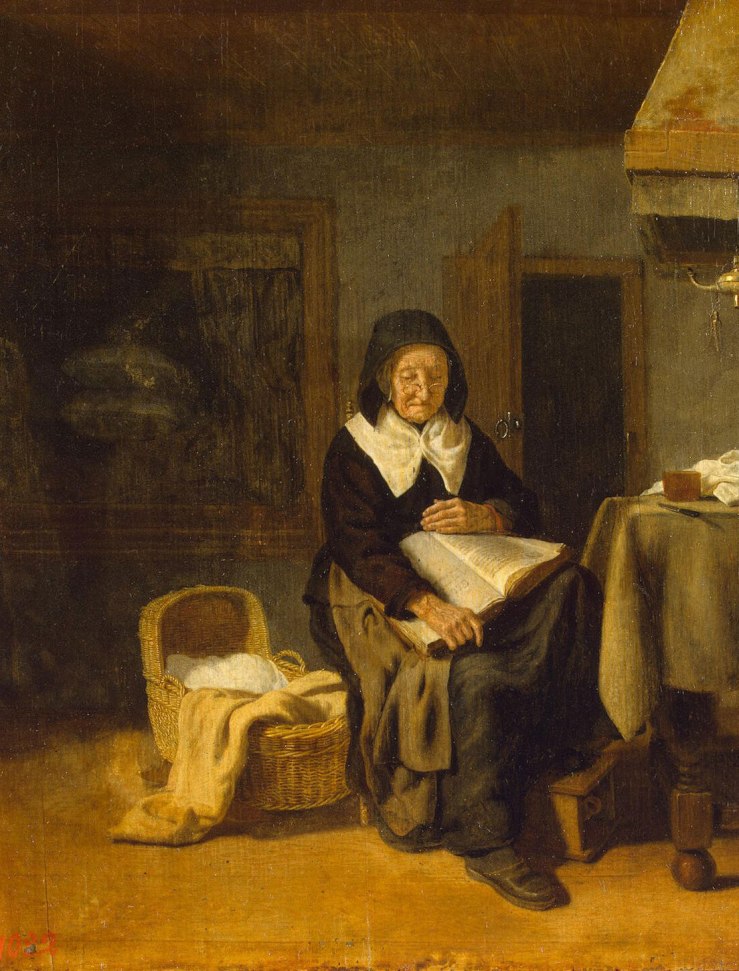
Old Woman Reading — Pieter van den Bos

Bos_Pieter_van_den-ZZZ-Old_Woman_Reading_a_Book

Boudou Saved from Drowning — Jean Renoir (Full Film)

The Sensational News — René Magritte

Storm Kings (Book Acquired Some Time Last Month)

20130414-153718.jpg

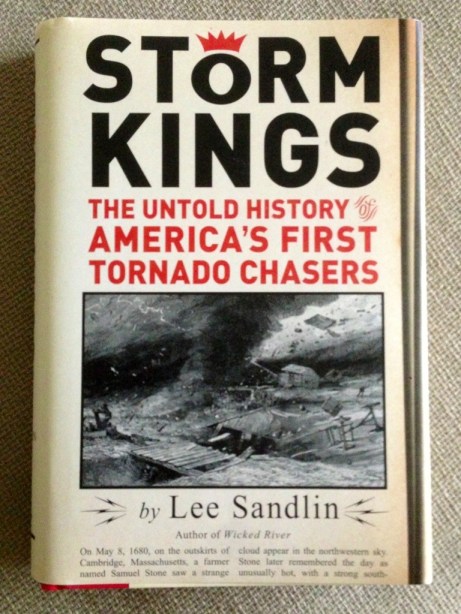
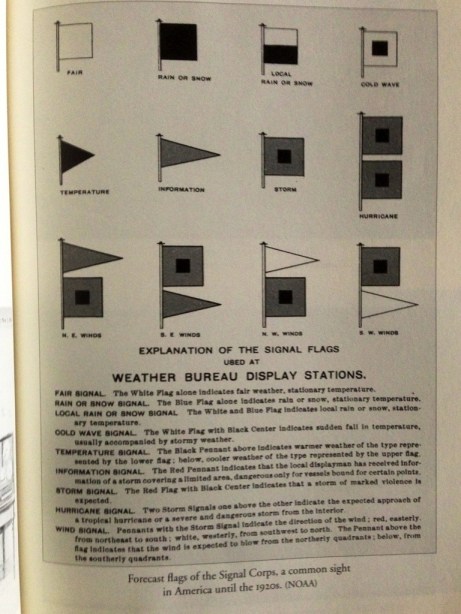
I liked Lee Sandlin’s last book Wicked River, so I took interest when a reader copy of his  new book Storm Kings: The Untold History of America’s First Tornado Chasers showed up at Biblioklept World Headquarters a few months ago. I have no special interest in tornadoes or meteorology, but so far Storm Kings has intrigued me into reading more.

20130414-153724.jpg

Publisher Random House’s blurb:

From the acclaimed author of Wicked River comes Storm Kings, a riveting tale of supercell tornadoes and the quirky, pioneering, weather-obsessed scientists whose discoveries created the science of modern meteorology.

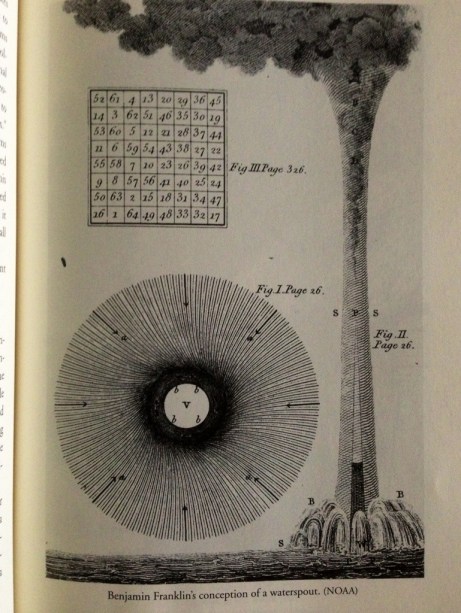
While tornadoes have occasionally been spotted elsewhere, only the central plains of North America have the perfect conditions for their creation. For the early settlers the sight of a funnel cloud was an unearthly event. They called it the “Storm King,” and their descriptions bordered on the supernatural: it glowed green or red, it whistled or moaned or sang. In Storm Kings, Lee Sandlin explores America’s fascination with and unique relationship to tornadoes. From Ben Franklin’s early experiments to the “great storm war” of the nineteenth century to heartland life in the early twentieth century, Sandlin re-creates with vivid descriptions some of the most devastating storms in America’s history, including the Tri-state Tornado of 1925 and the Peshtigo “fire tornado,” whose deadly path of destruction was left encased in glass.

Drawing on memoirs, letters, eyewitness testimonies, and archives, Sandlin brings to life the forgotten characters and scientists who changed a nation—including James Espy, America’s first meteorologist, and Colonel John Park Finley, who helped place a network of weather “spotters” across the country. Along the way, Sandlin details the little-known but fascinating history of the National Weather Service, paints a vivid picture of the early Midwest, and shows how successive generations came to understand, and finally coexist with, the spiraling menace that could erase lives and whole towns in an instant.

20130414-153731.jpg

Twenty Ideas from Nathaniel Hawthorne’s Note-Books

1. A hint of a story,–some incident which should bring on a general war; and the chief actor in the incident to have something corresponding to the mischief he had caused.

2. A sketch to be given of a modern reformer,–a type of the extreme doctrines on the subject of slaves, cold water, and other such topics. He goes about the streets haranguing most eloquently, and is on the point of making many converts, when his labors are suddenly interrupted by the appearance of the keeper of a mad-house, whence he has escaped. Much may be made of this idea.

3. A change from a gay young girl to an old woman; the melancholy events, the effects of which have clustered around her character, and gradually imbued it with their influence, till she becomes a lover of sick-chambers, taking pleasure in receiving dying breaths and in laying out the dead; also having her mind full of funeral reminiscences, and possessing more acquaintances beneath the burial turf than above it.

4. A well-concerted train of events to be thrown into confusion by some misplaced circumstance, unsuspected till the catastrophe, yet exerting its influence from beginning to end.

5. On the common, at dusk, after a salute from two field-pieces, the smoke lay long and heavily on the ground, without much spreading beyond the original space over which it had gushed from the guns. It was about the height of a man. The evening clear, but with an autumnal chill.

6. The world is so sad and solemn, that things meant in jest are liable, by an overpowering influence, to become dreadful earnest,–gayly dressed fantasies turning to ghostly and black-clad images of themselves.

7. A story, the hero of which is to be represented as naturally capable of deep and strong passion, and looking forward to the time when he shall feel passionate love, which is to be the great event of his existence. But it so chances that he never falls in love, and although he gives up the expectation of so doing, and marries calmly, yet it is somewhat sadly, with sentiments merely of esteem for his bride. The lady might be one who had loved him early in life, but whom then, in his expectation of passionate love, he had scorned.

8. The scene of a story or sketch to be laid within the light of a street-lantern; the time, when the lamp is near going out; and the catastrophe to be simultaneous with the last flickering gleam.

9. The peculiar weariness and depression of spirits which is felt after a day wasted in turning over a magazine or other light miscellany, different from the state of the mind after severe study; because there has been no excitement, no difficulties to be overcome, but the spirits have evaporated insensibly.

10. To represent the process by which sober truth gradually strips off all the beautiful draperies with which imagination has enveloped a beloved object, till from an angel she turns out to be a merely ordinary woman. This to be done without caricature, perhaps with a quiet humor interfused, but the prevailing impression to be a sad one. The story might consist of the various alterations in the feelings of the absent lover, caused by successive events that display the true character of his mistress; and the catastrophe should take place at their meeting, when he finds himself equally disappointed in her person; or the whole spirit of the thing may here be reproduced.

11. Two persons might be bitter enemies through life, and mutually cause the ruin of one another, and of all that were dear to them. Finally, meeting at the funeral of a grandchild, the offspring of a son and daughter married without their consent,–and who, as well as the child, had been the victims of their hatred,–they might discover that the supposed ground of the quarrel was altogether a mistake, and then be wofully reconciled.

12. Two persons, by mutual agreement, to make their wills in each other’s favor, then to wait impatiently for one another’s death, and both to be informed of the desired event at the same time. Both, in most joyous sorrow, hasten to be present at the funeral, meet, and find themselves both hoaxed.

13. The story of a man, cold and hard-hearted, and acknowledging no brotherhood with mankind. At his death they might try to dig him a grave, but, at a little space beneath the ground, strike upon a rock, as if the earth refused to receive the unnatural son into her bosom. Then they would put him into an old sepulchre, where the coffins and corpses were all turned to dust, and so he would be alone. Then the body would petrify; and he having died in some characteristic act and expression, he would seem, through endless ages of death, to repel society as in life, and no one would be buried in that tomb forever.

14. Canon transformed to church-bells.

15. A person, even before middle age, may become musty and faded among the people with whom he has grown up from childhood; but, by migrating to a new place, he appears fresh with the effect of youth, which may be communicated from the impressions of others to his own feelings.

16. In an old house, a mysterious knocking might be heard on the wall, where had formerly been a door-way, now bricked up.

17. It might be stated, as the closing circumstance of a tale, that the body of one of the characters had been petrified, and still existed in that state.

18. A young man to win the love of a girl, without any serious intentions, and to find that in that love, which might have been the greatest blessing of his life, he had conjured up a spirit of mischief which pursued him throughout his whole career,–and this without any revengeful purposes on the part of the deserted girl.

19. Two lovers, or other persons, on the most private business, to appoint a meeting in what they supposed to be a place of the utmost solitude, and to find it thronged with people.

20. Some treasure or other thing to be buried, and a tree planted directly over the spot, so as to embrace it with its roots.

From Nathaniel Hawthorne’s American Note-Books.