Fantastic Planet (Full Film)

Fairy Tails — Konstantin Makovsky

Robert Wilson and Arthur Miller Don’t Get It (Nathan Gelgud Animation)


William Gibson’s Review of Pacific Rim

William Gibson posted this review of Guillermo del Toro’s film Pacific Rim today:

A ravishing display of intelligent, often wonderfully witty visual design, every frame alive with coherent language, in the service of what is at heart a children’s story. A children’s story for a very dark time, our own, about a very dark time as children understand such things: monsters, from beneath the bed — our own or the ocean’s! It restores heroism to the realm of the humanistic, an extraordinary accomplishment given so much of the film culture of our day. The protagonists know, and demonstrate that they know, that it isn’t about them. A sweetly simple fable, for all the titanic grandeur of its cosplay (which I took to be the message of the slowly pumping wooden bellows in the kaiju-drifting machine, which became for me the sly sweet heart of it all). A demonstration of the degree of heart *and* physicality that even very big-ticket FX can convey when there’s an honest will to avoid the opposite; mega-scale FX that don’t drain either away. A baroque that doesn’t curdle, that never fetishizes itself.

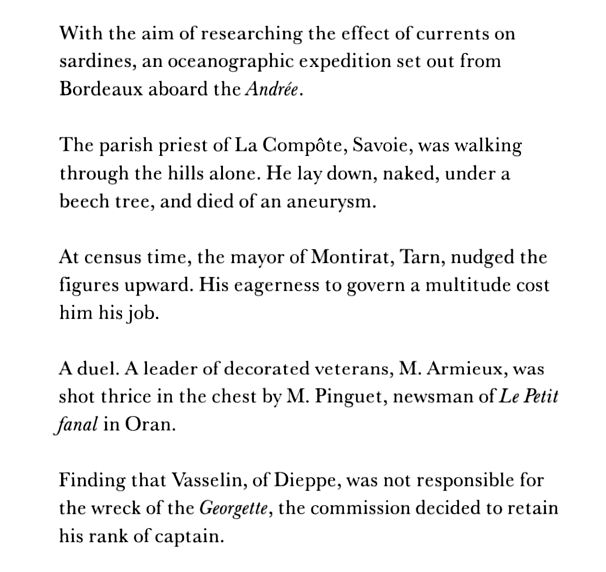
Five from Félix Fénéon

ff

Félix Fénéon at the Revue Blanche — Felix Vallotton

New Issue of Asymptote Features David Mitchell, László Krasznahorkai, Fady Joudah and More

The July issue of Asymptote, a journal devoted to literary translation, is chock-full of goodies, including a long interview with David Mitchell, a shorty from László Krasznahorkai translation, and an essay by Fady Joudah with the marvelous title  “Dear God, Your Message Was Received in Error.” Here’s the beginning of that essay:

In Borges’ story, “Averroës’ Search,” Averroës interrupts his long day of contemplating the problem that confronts him in Aristotle’s Poetics (how to translate ‘tragedy’ and ‘comedy’ into Arabic) and joins friends for dinner. The Andalusian philosopher seems to be listening (against hope or “without conviction” as Borges put it) for a solution to his problem in something that any of his guests might say. Maybe the answer is “near at hand” or, as in Lydia Davis’ “The Walk,” right “across the street.”

As the conversation meanders through various subjects about writing, God, and art, one of Averroës’ guests brings up the account of the seven sleepers:

“Let us imagine that someone shows a story instead of telling it—the story of the seven sleepers of Ephesus, say.* We see them retire into the cavern, we see them pray and sleep, we see them sleep with their eyes open, we see them grow while they are asleep, we see them awaken after three hundred nine years, we see them hand the merchant an ancient coin, we see them awaken with the dog.”

Borges’ mention of the seven sleepers comforts me, perhaps because I know the story from the Koran. Or perhaps because it serves as yet another cornerstone of what translation work can perform: transforming telling into seeing. Telling a story through seeing is also a gesture at what Averroës could not grasp when he encountered Aristotle’s ‘tragedy’ and ‘comedy’: theatre.

Lots of great stuff–check it out.


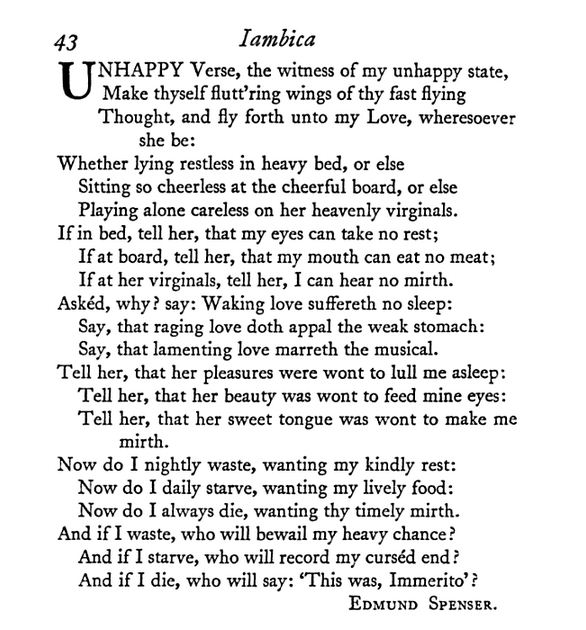
“Iambica” — Edmund Spenser

imabica

Coco Reading — Pierre-Auguste Renoir

“—boys to your bellybone and chuck a chum a chance!” — Pynchon Riff + Joyce + Moebius + Chloral Hydrate Party

75883c2d61c7b1ea157f39a036480922

1. Here is a rambling riff if ever I rambled and riffed:

2, First, look, that lovely image—it’s by Jean Giraud, aka Moebius. I came across it a week or two ago and digitally nabbed it.

I love Moebius’s work in general and something about the image reminds me of Thomas Pynchon’s Against the Day, although maybe I’m too immersed in the thick novel to not have much of what I see recall it in some ways.

Something about the airship and the horseman recalls an early passage where Reef Traverse, in the American West, dream-reads the airship adventures of The Chums of Chance into existence. (There are parts of Against the Day that recall to me Cormac McCarthy’s westerns (sometimes—often—called anti-westerns, but come, let’s be adults)…where was I going here? It’s Friday and I’ve consumed the better part (aka “all”) of a bottle of rosé and now I’m circling round some odd notes here—yes—the western/Western thing: Manifest Destiny, etc. — I see it in the Moebius illustration, but of course I bring it with me like a sickness. I move on).

3. ” . . . boys to your bellybone and chuck a chum a chance!” — This is from James Joyce’s Finnegans Wake (85.8). Pointed out to me by Roman Tsivkin, this seems like a most reasonable/splendid source for the namesake of our aeronaut adventurers (who seem rather, uh, absent of late in the final moments of the Bilocations book I’m in right now).

4. Data, perhaps imperfect (again, digitally nabbed)—

In Against the Day:

—Some form of the word invisible appears 173 times—

—The word inconvenience or inconvenient — 84 times—

—The phrase the day — 213 times (usually in a cadence suggestive of the book’s title—some kind of rhythm to it, anyway)—

—The phrase against the day — once (unless you count the chapter (book, really) called “Against the Day,” or the colophon, or what-have-you)—

5. I’m a few sections past this, but a nice passage to end on of a Friday night:

Among students of mathematics here, chloral hydrate was the preferred drug. Sooner or later, whatever the problem being struggled with, having obsessed themselves into nightly insomnia, they would start taking knockout drops to get to sleep—Geheimrat Klein himself was a great advocate of the stuff—and next thing they knew, they were habitués, recognizing one another by the side-effects, notably eruptions of red pimples, known as “the dueling scars of chloralomania.” On Saturday nights in Göttingen, there was always sure to be at least one chloral party, or Mickifest.

It was a peculiar gathering, only intermittently, as you’d say, brisk. People were either talking wildly, often to themselves and without seeming to pause for breath, or lounging draped in pleasurable paralysis across the furniture or, as the evening went along, flat on the floor in deep narcosis.

Untitled — Zdzisław Beksińsk

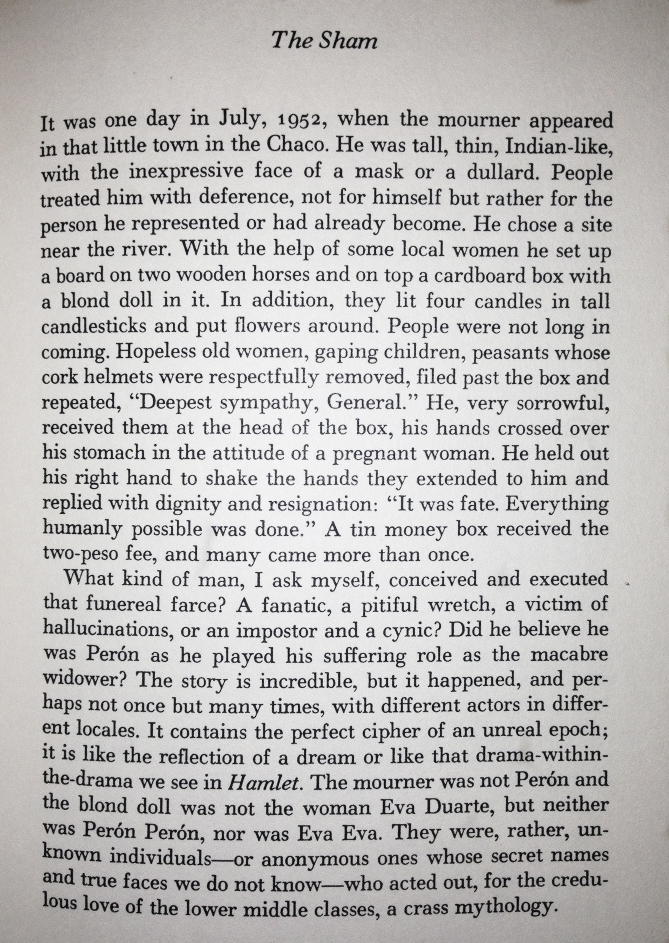
“The Sham” — Jorge Luis Borges

jlb

First Dance, Mulholland Dr.

Okahumkee (Some other Peoples Blues) — Peter Doig

W.H. Auden Comic (Tom Gauld)

3364580035_c3b19ce349_o

“On a Notebook” — Hilaire Belloc

“On a Notebook” by Hilaire Belloc

A dear friend of mine (John Abdullah Capricorn, to give him his full name) was commandeered by a publisher last year to write a book for £10. The work was far advanced when an editor offered him £15 and his expenses to visit the more desperate parts of the Sahara Desert, to which spots he at once proceeded upon a roving commission. Whether he will return or no is now doubtful, though in March we had the best hopes. With the month of May life becomes hard for Europeans south of the Atlas, and when my poor dear friend was last heard of he was chancing his popularity with a tribe of Touaregs about two hundred miles south of Touggourt.

Under these circumstances I was asked to look through his notebook and see what could be done; and I confess to a pleased surprise…. It would have been a very entertaining book had it been published. It will be a very entertaining book if it is published.

Capricorn seems to have prepared a hotchpotch of information of human follies, of contrasts, and of blunt stupidities of which he intended to make a very entertaining series of pages. I have not his talent for bringing such things together, but it may amuse the reader if I merely put in their order one or two of the notes which most struck me.

I find first, cut out of a newspaper and pasted into the book (many of his notes are in this form), the following really jovial paragraph:

“Archdeacon Blunderbuss (Blunderbuss is not the real name; I suppress that lest Capricorn’s widow should lose her two or three pounds, in case the poor fellow has really been eaten). Archdeacon Blunderbuss was more distinguished as a scholar than as a Divine. He was a very poor preacher and never managed to identify himself with any party. Nevertheless, in 1895 the Prime Minister appointed him to a stall in Shoreham Cathedral as a recognition of his great learning and good work at Durham. Two years later the rectory of St. Vacuums becoming vacant and it being within the gift of Archdeacon Blunderbuss, he excited general amazement and much scandal by presenting himself to the living.”

There the paragraph ends. It came in an ordinary society paper. It bore no marks of ill-will. It came in the midst of a column of the usual silly adulation of everybody and everything; how it got there is of no importance. There it stood and the keen eye of Capricorn noted it and treasured it for years.

I will make no comment upon this paragraph. It may be read slowly or quickly, according to the taste of the reader; it is equally delicious either way.

The next excerpt I find in the notebook is as follows:

“More than 15,000,000 visits are paid annually to London pawnbrokers.

“Jupiter is 1387 times as big as the earth, but only 300 times as heavy.

“The world’s coal mines yield 400,000,000 tons of coal a year.

“The value of the pictures in the National Gallery is about £1,250,000.” Continue reading ““On a Notebook” — Hilaire Belloc”

A Woman Reading — Claude Monet